Seven Stages of Wisdom and the Nature of Self-Awareness
05.09.2026
0 мин. чтения
0
Share
copy
search
add
share
Commentary on the text “Yoga Vasishtha,” Chapter 3. The Story of Lavana.
Vasishtha tells Rama the story of King Lavana, using this example to illustrate the philosophy of pratibimba-vada. He says that Lavana performed a religious ritual that enabled him to attain a high position, just as King Harishchandra had once done. Since he performed the ritual mentally, that is, as manasika puja, for an entire year, the result was not long in coming. However, this ritual was complicated by the fact that whoever performed it laid claim to a very exalted position. Indra always tested such beings. Those who performed the ritual on the material plane were tested by him on the material plane. Since Lavana performed the ritual as manasika puja, Indra tested him on the level of the mind. The fakir whom he sent to him was in fact a divine messenger.
The Seven Stages of Folly and Wisdom
Rama asked, “O holy one, what are these seven stages of which you speak?”
Vasishtha replied, “O Rama, there are seven descending stages in folly and seven ascending stages in wisdom. I shall now describe them to you. To abide constantly in Self-awareness is liberation: when Self-awareness is intermittent, egoism and bondage arise.”
“To abide constantly in Self-awareness is liberation.” The essence of this phrase expresses the fundamental principle of the teachings of Laya Yoga. When awareness becomes intermittent, egoism, suffering, and illusion arise. It follows that everything depends on properly entering Self-awareness. Then, without becoming distracted, one must attain not intermittent but continuous Self-awareness.
What distinguishes a saint from a neophyte? A neophyte’s Self-awareness is intermittent. Even if they experience flashes of clarity, insight, or expanded consciousness, all of this is short-lived, unreliable, and lost under the influence of destabilizing factors.
A saint’s Self-awareness shines powerfully, like the light of a lamp in a room where no wind blows. It is uninterrupted. It operates continuously, and even strong disruptive factors cannot shake it.
Principles of Self-Awareness
“The state of Self-awareness is one in which there is no mental agitation, no distraction or dullness of mind, no egoism, and no perception of multiplicity.”
Thus, Vasishtha defines here the principle of presence, Self-awareness, contemplation, and the natural state—all of these are synonyms.
The first principle states: there is no mental agitation. As soon as you embark on the path of contemplation and the principle of self-liberation is explained to you, all mental agitation should, in theory, leave you, because the secret of the arising and dissolution of thoughts is clear to you. Then you no longer experience mental agitation. If mental agitation remains, it means that the secret of self-liberation has not yet been realized, and in that case one must realize the secret of self-liberation without delay.
A yogi who has mastered the secret of self-liberation attains at least shanti—the tranquility of mind. The yogi discovers the secret of self-liberation by understanding that thoughts in themselves have no inherent essence, and that their basis is a subtler intuitive consciousness resembling space. The most important thing in practice is to shift the focus of attention to intuitive awareness, which is like space, rather than following thoughts—or, worse still, emotions. Those who do not understand this may believe that suppressing emotions, blocking thoughts, and abiding in mental emptiness constitute the path. However, these things in themselves are not the path. The following example is given. An insensible block of wood has no emotions. Can it be called a perfect sannyasin, one endowed with vairagya? Crystals have no thoughts. Can they be called liberated?
Neither the suppression of emotions in itself nor the blocking of thoughts and abiding in emptiness is yet a factor of liberation. The true factor of liberation is the recognition of subtle, illuminating emptiness—the infinite, space-like consciousness that arises as a result of flawless contemplation.
“No perception of multiplicity” means that, when looking at multiplicity and differences, you are nevertheless not enchanted by these differences, but perceive them as manifestations of the one infinite consciousness. Multiplicity is secondary and inessential. The one infinite consciousness is essential and paramount. Fools become entangled in multiplicity, while sages discern unity in diversity. At the same time, we do not deny multiplicity. It is not bad. Multiplicity is a flowering, a factor of variability, the diversity of universal energies. Nevertheless, all of this is unreal and devoid of essence, like flowers in the sky or horns on a hare. It is no more real than a reflection in a mirror. This multiplicity is like an adornment; it is the patterns on the mirror of the natural state.
A sage does not reject multiplicity. But he sees that multiplicity itself is unreal, just as the snake mistaken for a rope is unreal. Therefore, while contemplating multiplicity, the sage discerns the pure mirror of the one mind. A fool, however, is utterly devoid of any understanding of unity and attaches great importance to multiplicity. Because multiplicity bewitches him, his mind is divided and fragmented; he himself is divided. And then he becomes involved in the various kinds of games of multiplicity in this universe.
One who has mastered self-liberation, however, flawlessly discerns unity, regarding multiplicity as the play of energies, as the creative manifestation of the Absolute, as a pattern, embellishment, or ornament—that is, as a beautiful addition to infinite consciousness, indistinguishable from consciousness itself.
“Free from egoism” means that one who abides in self-awareness is no longer enchanted by the illusion of one’s own “I.” Egoistic fears, envy, doubts, attachments, likes, dislikes, and other such things are alien to him—all of these are functions of ahamkara (the false ego). But how can they exist if the ego itself is known to be unreal, merely a ripple on the mirror of self-awareness? They may be understood in several ways. First, as entirely illusory and unreal, as something that can be cast aside, discarded, parted with without regret, cut off together with hope and fear as something obstructive, as heavy ballast. Second, they may be recognized as the play of the mirror of the natural state, as its creative lila, as its adornment.
The first approach is suitable for a novice practitioner. The second is for an experienced yoga master or siddha. In that case, even egoistic motivations, impulses, and manifestations have lost their power. They are as harmless as a snake whose fangs have been pulled out. Whatever manifests is perceived simply as play; there is no substance behind it and no attachment to it. The yogin has lost the ego, and therefore whatever he experiences is likewise free from egoism.
Dullness of mind, darkness of consciousness, tamas, arises when we abide not in the subtle self-awareness of buddhi but in the coarse manas, and when manas is not turned toward itself but is strongly directed toward the sense organs and objects.
When we contemplate, however, something else occurs: manas turns away from external objects and begins to recognize its source, itself, its own “I am” awareness. In the depths of “I am” awareness, it discovers a subtle, barely perceptible presence that is its intuition, its sacred foundation. This is buddhi. When it continuously meditates on buddhi, its consciousness is never dull or obscured. Its consciousness is always illuminated by the light of intuitive wisdom.
The Seven States of Delusion
“The delusion that obscures this self-awareness has seven aspects: the embryonic waking state, waking, full waking, waking dream, dreaming, dreamlike waking, and deep sleep.
In pure consciousness, when the mind and limited consciousness exist only as names, this is the embryonic waking state.
When the concepts of ‘I’ and ‘this’ arise within it, this is called waking.
When these concepts are reinforced by memories of past incarnations, this is full waking.
When the mind has fully opened itself to its fantasies and is filled with them, this is a waking dream.
Mistaken notions about sensations during sleep that seem real are dreams.
In the state of dreamlike waking, a person recalls past sensations as if they were real now.
When this is abandoned in favor of complete unconscious stupor, this is deep sleep.
These seven states have their own infinite subdivisions.”
There is a gradation of states of consciousness. Usually, four states are mentioned. Here, however, a gradation of seven states is presented.
As a rule, they speak of wakefulness, dreaming sleep, dreamless sleep, and the fourth state that transcends them—turya. All modifications of the mind are ultimately manifestations of the same infinite consciousness. It is like an ocean that sometimes has ripples, sometimes waves, sometimes is completely calm, and sometimes has silt rising from the bottom, making it opaque so that nothing can be seen. Nevertheless, it is essentially one and the same ocean.
The practitioner's task, having discovered infinite consciousness within, is to gradually transcend all seven levels, or all seven states. That is, to bring the principle of self-awareness into dreamless sleep, dreaming sleep, daydreams, and ordinary waking experience.
Waking experience or sleep may seem incompatible with the principle of infinite consciousness, but this is not so. As soon as we try to trace the source of dreaming sleep or dreamless sleep, or to discover where thoughts and experiences are generated, we inevitably come up against the same principle of boundless consciousness. Ultimately, we arrive at the same thing.
The mathematics of the Advaita siddhas is roughly as follows: one plus one equals one, one plus two equals one, one minus one still equals one, one minus two equals one, one minus infinity equals one, infinity minus one still equals one. No matter from which angle you approach self-inquiry, you return to the source of infinite consciousness.
Vasishtha continued: “Rama, I will now describe to you the seven states or dimensions of wisdom. By knowing them, you will not be led by misunderstanding. Pure desire or intention is the first state. Knowledge is the second. The third is when the intellect becomes subtle.”
The First State: Boundless Intention
The first state leading to liberation is intention, pure desire, sankalpa-shakti. When we practice, we must hone our intention so sharply that nothing can hinder it.
In ancient times, teachers helped students hone their intention by subjecting them to severe trials. Those were the times. It was believed that if the power of your intention was weak, there was no point even discussing the path of the teaching with you. If your sankalpa-shakti is weak, you must cultivate it, because in that case philosophy and everything else are pointless. You must develop sankalpa-shakti so that your intention becomes boundless. This is not commonly practiced in our liberal age. But in ancient times, the siddhas' approach was very radical.
When we have boundless sankalpa-shakti, or boundless intention, it helps us overcome all limitations and obstacles. When you take responsibility for your spiritual choice, neither maras, nor gods of passion, nor demons, nor temptations, nor desires, nor obstacles on the spiritual path can shake your intention. But when intention is weak, a person can waver very easily. Some experience arises, or they encounter a minor obstacle, and they immediately begin to waver.
To develop boundless intention (sankalpa-shakti), it is very useful to contemplate the law of karma, suffering, precious human birth, old age, illness, death, impermanence, and your own limitations. It is important to contemplate the impermanence of time, which devours everything, in order to become fully convinced of how limited you are, how you must not waste time, and how you must not remain unconscious, simply squandering your precious life force. Such an approach gives rise to a powerful intention for liberation that nothing can withstand.
People often pay attention to external things. And depending on how those external things are arranged, their intention to practice may be strong or weak. But in reality, none of this matters. Whether the monastery is beautiful and wealthy or not, whether tasty prasad is served or not, whether senior monks treat you kindly, whether they indulge some of your whims or disregard them altogether, whether the weather is good or not—none of this matters at all. In fact, if you pay attention to all these things and allow them to unsettle you, you will never attain liberation. A true yogin focuses on the essence, on the root: “I am mortal, I am limited. There are liberated sages. There is a path. Everything else is not so important.” This is true sankalpa-shakti.
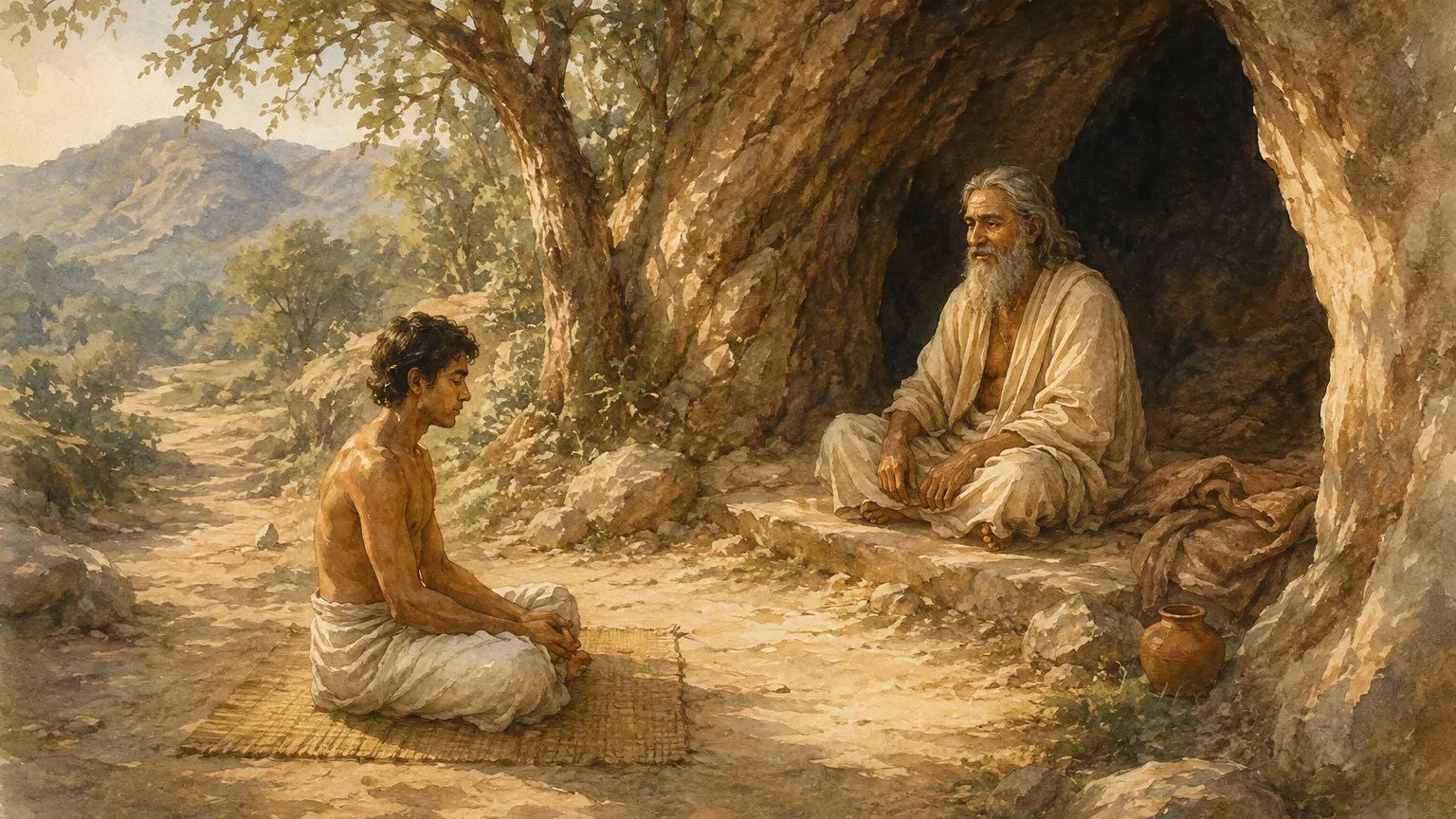
In ancient times in India, spiritual teachers sometimes accepted disciples while sitting under a tree or in a cave. But the disciples were devoted to dharma and practiced. Once I heard the following conversation between a monk and a lay practitioner. The monk said, “Come and practice with us at Divya Loka,” and the layman replied, “But it is dirty there.” Yet from the standpoint of sankalpa-shakti, it is sometimes even more beneficial to practice under harsh conditions, thus refining one’s choice, than in overly luxurious ones, especially for beginners. Sometimes Spartan conditions are better suited to attaining impeccable sankalpa-shakti.
The Second and Third States: Knowledge and Refinement of the Mind
“Knowledge is the second. The third is when the mind becomes subtle.”
The second principle signifies knowledge. Besides intellectual knowledge, it means knowledge of methods of practice and knowledge of the essential principle of awareness. When such knowledge arises in a yogi, their mind becomes subtle. This means that they gain insight into the intuitive foundation of thoughts, feelings, emotions, and everything else. As a rule, someone whose mind is subtle possesses well-developed intuition, clarity, flexibility, and the ability to understand sacred texts. In other words, they understand quite well what is discussed in lectures. Subtlety of mind bestows supernormal abilities and creative powers. Those who lack subtlety of mind have no inspiration, creative powers, or refinement in their understanding of situations, in their own practice of the teachings, philosophy, and so forth. This means that they need to pay attention to it.
The Fourth, Fifth, Sixth, and Seventh States
“The fourth is becoming the truth. Complete freedom from attachments and dependencies is the fifth. The sixth is the cessation of objectivity. The seventh is beyond all of these.”
As consciousness becomes more subtle, it becomes established in its own truth. When it becomes established in its own truth, in its source, genuine freedom arises, and preferences and attachments disappear. Everything that once seemed important ceases to be important. The yogi attains the initial level of the single “taste.” The perception of the universe as objective, as something real and independent of consciousness, also disappears.
The beginning of the single “taste” means that everything starts to become equal for you. It does not matter whether you are suffering physically or, conversely, experiencing bliss. It does not matter whether you are being honored or, conversely, humiliated. It does not matter whether you are in refined, luxurious surroundings or, conversely, in less than comfortable conditions. It does not matter whether you see auspicious signs in dreams and meditations or inauspicious ones. It does not matter whether you have mystical experiences or not. It does not matter whether your energy level is high or low, or whether the nadis are clogged. It does not matter whether you eat high-quality food conducive to a healthy diet or subsist on scraps. It does not matter whether your status is high or low. All of this becomes approximately equal, and your consciousness becomes very stable.
At first, it becomes stable at the level of the subtle foundation, but at the level of energy it may still fluctuate greatly. You feel that your inner equilibrium no longer changes: neither highs nor lows, neither joy nor sorrow can affect you. Nevertheless, you feel that your energetic state still fluctuates greatly. Later, you feel that neither your mind nor your energetic state fluctuates, and everything becomes favorable. Such a yogi is like a mighty elephant or rhinoceros.
It is said: “When an elephant goes to a watering hole, all the tiny insects scatter.” In the same way, all kleshas, obscurations, obstacles, curses, malevolent spirits, and the yogi’s past karmas scatter and dissipate when, like an elephant, he advances in the practice of awareness. Such a yogi does not care whether he is reviled or praised; he regards everything as a play. It does not matter whether his plans come true or, on the contrary, fail. It does not matter whether he looks good in the eyes of others or not. It does not matter whether his senses are gratified or not. He is always in a highly favorable state. It does not matter whether he performs prestigious service or some menial task. Whatever his relationships with other people may be, if he maintains harmony, it is he who maintains harmony for others. It does not matter whether he has friends or not; he is self-sufficient. It does not matter whether he stays in touch with those close to him or is alone, like a bird in its own universe. All of this ceases to be important to the yogi. It is not that any of it is cast aside or denied; rather, it all sinks and dissolves into one great state.
A Practical Description of the Seven States of Wisdom
“Why do I continue to be a fool? I must seek the company of holy people and study the scriptures, cultivating dispassion”—such is the aspiration in the first state. Therefore, a person begins to engage in various practices of cognition (direct observation)—the second state. At the same time, non-attachment grows, and the mind becomes subtle and transparent—the third state. When these three states are practiced, a natural aversion to sensual pleasures and a natural abiding in truth arise in the seeker—this is the fourth state.
When all this has been fully lived through, complete non-attachment arises, together with conviction in the essence of truth—this is the fifth state.
When a person delights in their own supreme Self, the perception of duality and multiplicity within and outside oneself ceases, and the efforts made to inspire others bear fruit in the form of direct spiritual experience. After this, there is no other foundation, no division, no multiplicity, and self-awareness is spontaneous, natural, and therefore continuous—this is the seventh transcendental state. This is the state of one who has been liberated in this life. Beyond it lies the state of one who has transcended the boundaries of the body.
Vasishtha describes here the seven grounds of wisdom—the seven stages of awakening, which are also described in the teachings of Laya Yoga in the book “The Radiance of the Precious Secrets of Laya Yoga.” When you wish to analyze your spiritual path and determine the stage you are at, you can always turn to the teaching of the seven grounds of wisdom, the seven jnana bhumis. These seven grounds of wisdom encompass all the diverse states that a yogi experiences on the spiritual path.
Vasishtha says:
Rama, all those great ones who have ascended these seven steps of wisdom are saints. They are free and do not sink into the mire of happiness and unhappiness. They may work or refrain from working. They delight in supreme consciousness and do not need others for their happiness.
The supreme state of consciousness can be attained by anyone, even animals and people from wild tribes, those who have a body and even those who do not, because all that is needed for this is the growth of wisdom.
Self-realization
Self-liberation
Vasishtha
Yoga Vasistha
Rama
Sankalpa-shakti
Jnana-bhumi
7 grounds of wisdom
Egoism
Author Гуру
Read 14 times
Articles
Vidya AI
Search
Lectures
November 3, 2026
Mantra of the day
ОМ САДРЩАЙА НАМАХ ОМ Видящему равно – поклонение!
Auspicious Times(Rome)
Brahma Muhurta:
04:54 - 05:49
Abhijit Muhurta:
11:33 - 12:14
Sayam Sandhya:
16:43 - 17:24
Mokshada Ekadashi (6 November)
Ekadashi of liberation. Helps to achieve spiritual enlightenment.