The Sixteen Stages of Kala: Challenges of Contemplation
11.08.2026
0 мин. чтения
0
Share
copy
search
add
share
As you know, the essence of the teaching lies in following three main principles: shravana, manana, and nididhyasana. Once direct experience has been attained, followed by clarification of the nature of the Mind and final conviction in it, the task of practice is nididhyasana—the making of the “great decision” and its constant maintenance, or “gestation.” According to the teaching of the sixteen kalas, at this time the yogin is at the stages of “transmission,” “conception,” or “gestation.” I think each of you knows approximately which stage you are at.
In the process of maintaining this state, in the work of contemplation, “gestation” takes up a very long period of time. It is not all that difficult to progress from the worldly level to the level of “conception”; of course, a great deal of work must be done, but in principle it is achievable. Yet reaching the level of “birth” is extremely difficult. This period between the stage of “conception” and the stage of “birth” is called “gestation.” It takes up most of our lives. Sometimes we make breakthroughs in gestation, and sometimes we slide backward.
Naturally, in order to gestate, you must truly clarify this state; you should have no doubts. If there are doubts or uncertainty, if you do not know what to gestate, then this cannot yet be called gestation; you need to work on clarifying it. If a child has already been conceived, then everything is clear: from then on, everything happens naturally and only time is needed. But if the child has not been conceived, then no matter how much you gestate, nothing will be born. It is the same here. This period of clarification (manana) is very important, but if this state has been clarified, there are no longer any doubts in it; there is profound self-sufficiency, and all that is needed is the skillful maintenance of this state and work with sankalpa. For a long period, you simply need not to depart from it or abandon it, but to make it flexible and learn to integrate it with different activities.
The stage a person is at can often be determined by how they act, how they speak, how they cope with tasks, how lightly they approach certain situations, how they self-liberate, and how flexible and harmonious they are. Just as a good fortune-teller, after glancing at the lines on a person’s palm, their eyes, overall appearance, and subtle body, can say a great deal about them, so too can a good practitioner, after looking at key points, say approximately what stage a person is at.
Causes of Losing the State of Contemplation
When we have reached gestation, or are desperately trying to clarify and contemplate in order to reach at least the level of conception, or to maintain the state of transmission while working with sankalpa, various disruptive situations may arise. The greatest difficulty both at the “conception” stage and at the “gestation” stage is distraction, the loss of these states, the inability to return to them, or the prolonged process of returning.
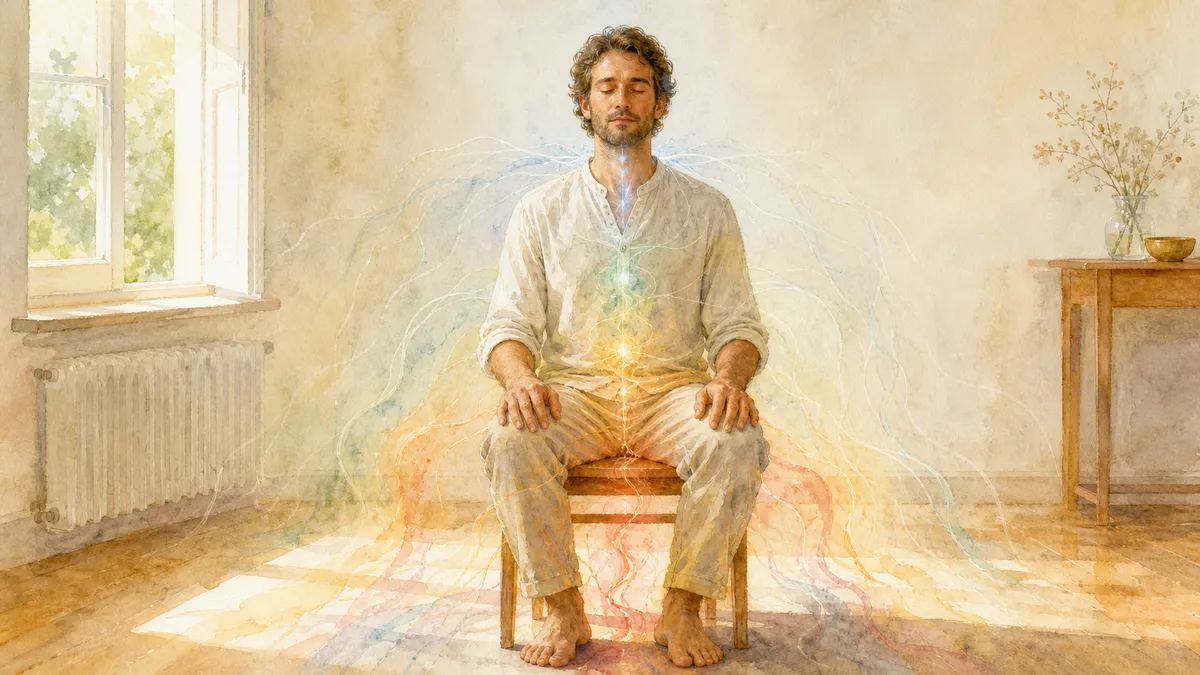
Sometimes a person has a certain state or mood, and then it goes away, and they do not know where it went or why it disappeared. This is related to the fact that we have an energy system and channels. When desires intensify, when a person eats, and so on, all of this causes the nadis (channels) and pranas in the chakras to function more actively, which affects the mind. For example, the mind was in an even state, but then the chakras began to function more actively, causing a disruption; this evenness is lost, and one has to return to it again.
The Teaching of Swara Yoga and the Influence of the Elements
Another reason why this state disappears is the functioning of the channels. According to the Swara Shastra teaching on swara yoga, each hour we breathe actively through one nostril. Approximately every hour, this breathing alternates: ida—pingala (moon—sun). And the sixty minutes during which the breathing changes can be further divided into five smaller flows. These flows correspond to the five elements.
During the first ten minutes of the hour, the flow of ether (the space element) is active. If, during the first ten minutes, you begin to act while an active swara has just started, those first ten minutes are unfavorable for any actions or undertakings; at the level of the space element, nothing works out. Only practicing yoga is auspicious, while physical actions of any kind cannot be performed effectively.
For the next fourteen minutes, the earth element becomes active—this is an auspicious time for long-term undertakings, when everything begins to work out. During the following twelve minutes, the water element is active—this period is also favorable for various immediate tasks. Thus, during an active swara, the first ten minutes are unfavorable, while the period from the tenth to the thirty-sixth minute—that is, a span of twenty-six minutes within the hour—is the most auspicious time. If you know which swara is active and determine precisely when it began to operate, then whatever you begin during this time will bring great results.
Finally, after the water element, the air element is active for another twelve minutes; it is favorable for some activities but not so favorable for others. During the final twelve minutes, the fire element is active. In general, air and fire are not very auspicious elements.
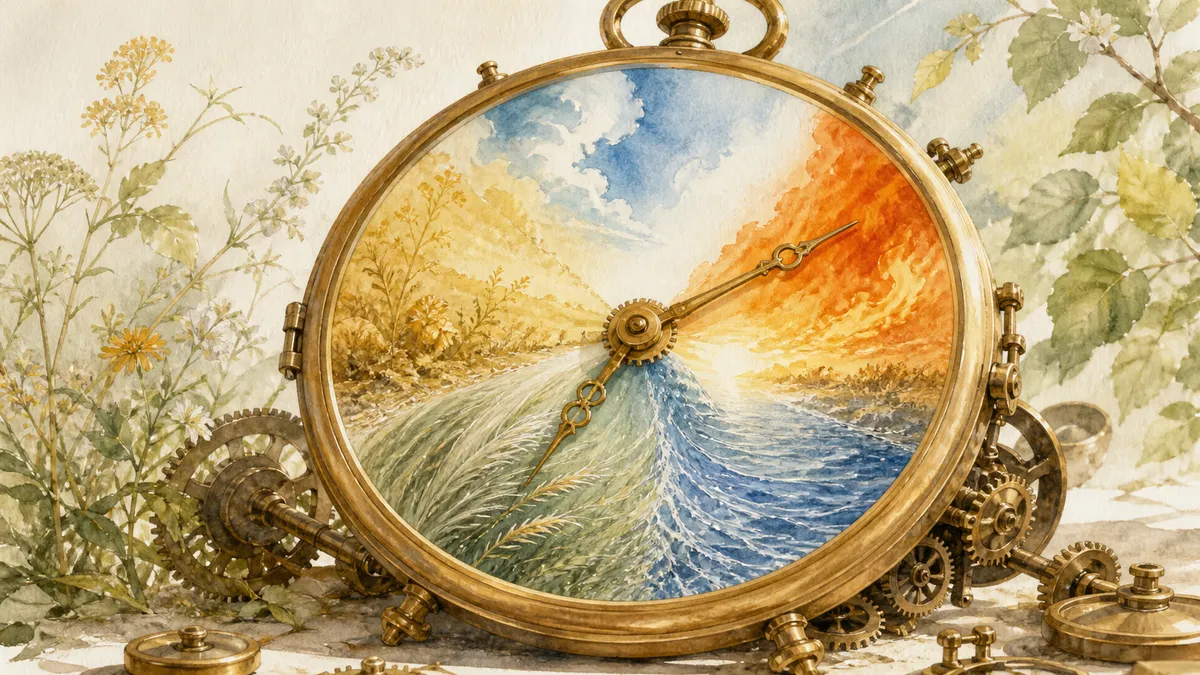
Thus, over the course of an hour, the elements operate in this sequence: space, earth, water, air, and fire. As you can see, even within a single hour our state changes five times. Accordingly, our contemplation also changes five times over the course of an hour. Depending on which kleshas are present in the different elements, which wisdom has been realized in the different elements, which integration skills have been developed, and how pure a particular channel is, your contemplation undergoes five different changes during an active swara, that is, within a single channel. If it was the solar channel, these changes occur within the solar channel; then the channel changes again and the lunar swara becomes active, with the same alternation of elements taking place once more. Depending on which chakras are pure and which wisdoms have been realized, you will again experience five different states, and they will alternate. This is precisely why our mind is not even and constant; rather, it is a moving, fluctuating state.
Being Rooted in the View as the Basis of Stability
The way to attain true stability in contemplation, overcoming the influence of the elements, is to be rooted in the view. If one has developed the habit of being rooted in the view, this means that our contemplation does not depend on the elements, tattvas, pranas, or external objects.
The view consists of several principles:
the five-part formula (including the principle of “reducing everything to mind”);
understanding the illusory nature of the world;
the principle of pure vision;
the principle of divine pride;
the principle of the single “taste”;
the principle of contemplative self-liberation.
If you uphold these principles together with the view, and your view is founded upon them, you will remain unaffected by either external influences or the alternation of the elements.
There are stories about great beings who realized such a state.
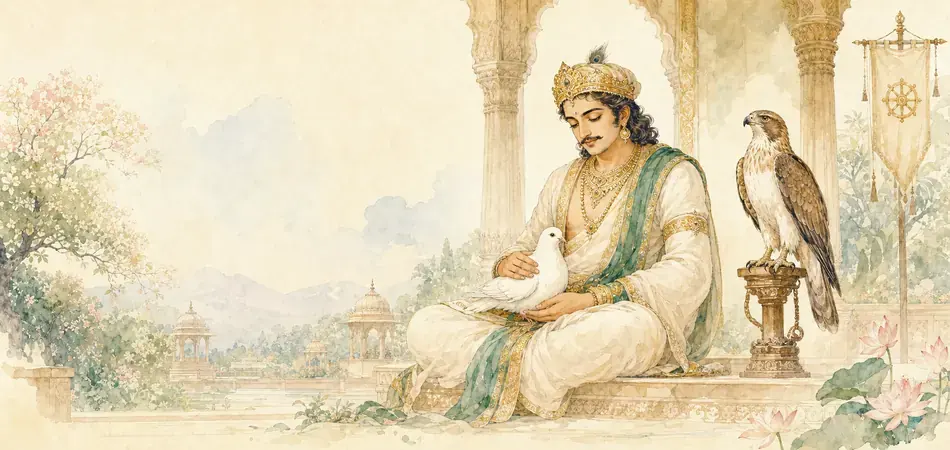
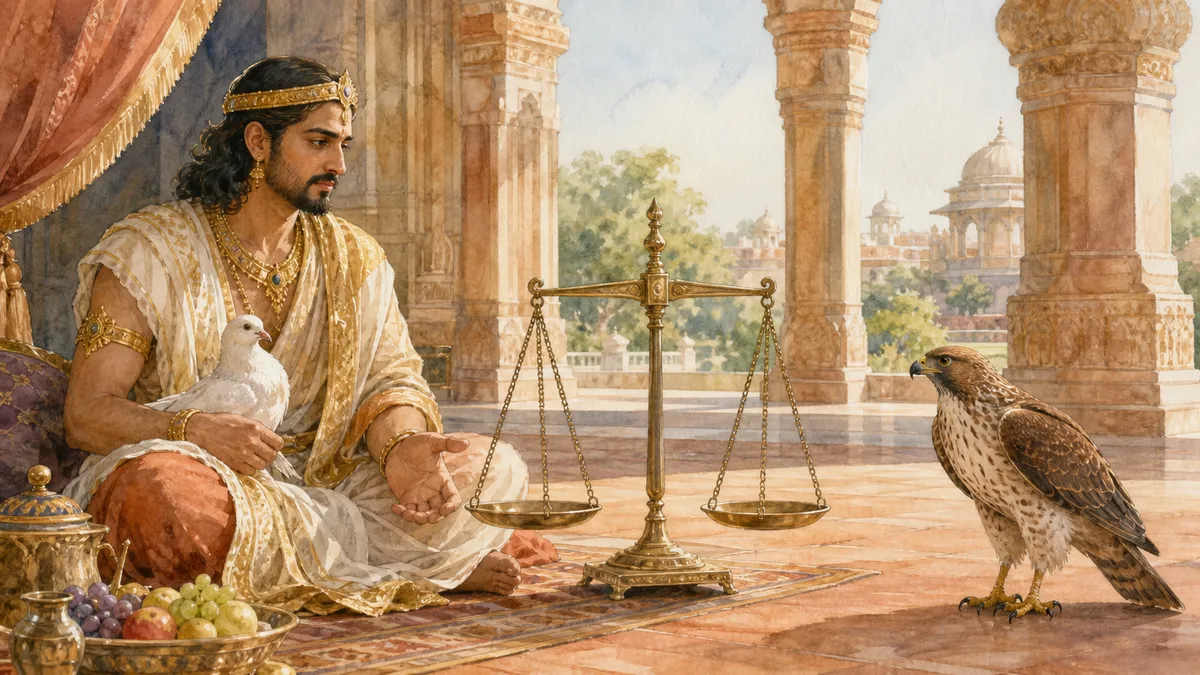
Once Indra and Agni, the highest of the gods, set out to visit the sacrificial arena of King Shibi of Ushinara. To test the king and bestow their blessings upon him, Indra assumed the form of a hawk and Agni that of a dove. The hawk began pursuing the terrified dove, which, seeking protection, alighted on the king’s thigh.
The hawk then addressed the king:
“All the monarchs of the world claim that you are a righteous king. Why, then, have you given refuge to this dove, thereby violating the injunctions of the scriptures? I am terribly tormented by hunger, so do not, under the pretext of piety, deprive me of the food that God has destined for me. By acting in this way, you are in fact behaving immorally.”
“But this dove is afraid of you,” the king replied. “Seeking to escape your talons, it alighted on my thigh and appealed to me for help. Do you not understand that the highest morality lies in preventing you from tearing this dove apart?”
“The highest?”
“Yes. Look, he is trembling with fear, he is distraught, and he is asking me for protection. To refuse him would be a sin for me. One who kills a brahmana or a cow, as well as one who rejects someone seeking protection—all these people are equally sinful.”
However, the hawk objected:
“All living beings sustain their lives with certain kinds of food. A person may continue living after abandoning those who were dear to him, but he cannot live long if he deprives himself of food. If you deprive me of food, I will undoubtedly die, and my wife and children will die with me, all because you protected this pigeon. Thus,” the hawk continued, “a virtue that infringes upon someone’s interests is not virtue but sin. Virtue deserves to be called such only if it does not harm others; therefore, you must weigh everything carefully and make the right decision.”
The king replied:
“Your words are undoubtedly of great value, and so I suspect that you are Garuda, the king of birds. I have no doubt that you are well versed in all matters of practical morality. But I cannot understand how refusing to help someone who asks for it can be considered moral. Since you need food, you can satisfy your hunger with some other, equally appealing fare. I am ready to bring you any food you wish, be it a buffalo, boar, deer, or ox.”
“I want neither the flesh of a boar nor that of an ox or any other animal, since such food is unnatural for me. But the pigeon is precisely what fate has destined for me, so please give it to me.”
“You may eat whatever you wish except this pigeon. What must I do to satisfy you while saving this bird at the same time?”
“Cut off a piece of your own flesh, place it on one pan of the scales, and put the pigeon on the other. When the pans are balanced, give me the piece of your flesh, and that will satisfy me.”
“Very well, I shall do so.”
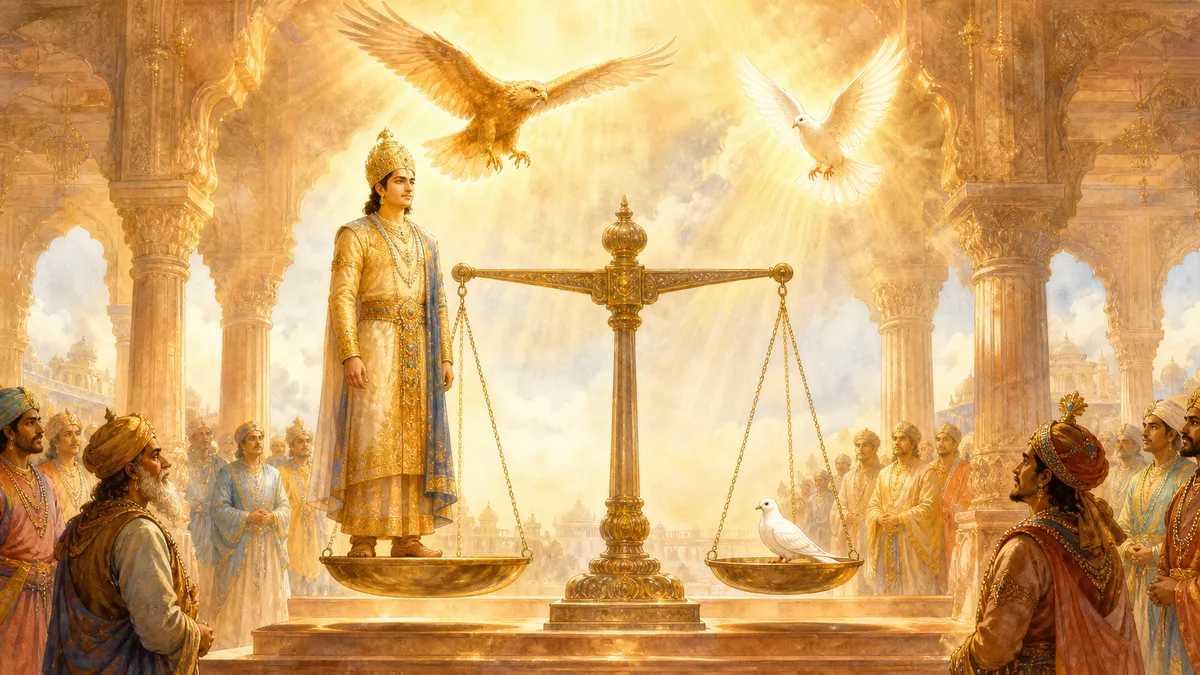
The king placed the pigeon on one pan of the scales and, after cutting off a piece of his own flesh, placed it on the other. But the pigeon proved heavier. Then he cut off another piece, then another, and another. This continued until there was no flesh left on his body. At last, he himself stepped onto the scales. Astonished by this, the hawk and the pigeon decided to reveal their true identities to him.
The hawk said:
“I am the god Indra, and the pigeon is Agni. We came here to test your spiritual strength. And because you sacrificed your flesh to save the pigeon’s life, you will be renowned forever for this deed. At the end of your life, you will go to the highest abode.”
Then Indra and Agni returned to heaven, while the righteous King Shibi of Ushinara, having filled the earth and sky with the glory of his righteous deeds, ascended to the heavens in a radiant body.