

All our lives, we transform everything into seva—service to God, carrying out the divine will. When we say to God, “Dattatreya, here are my hands, here are my feet, here is my body; I entrust them to you on an indefinite lease—act through me for the benefit of all living beings,” liberation will come to us.
The spiritual path is very long and very vast. The human condition in which we find ourselves is only the very beginning. From human being to sadhu, from sadhu to jnani, the enlightened one, from jnani to siddha, from siddha to deity, devata, from deity to mahadevata, the great deity—a vast evolutionary ladder. And during our human life, we cover only a small segment so that we may consciously continue further in the next life, so that our subsequent lives may be in a divine state of play and no longer in a karmic body, a worldly body, so that they may no longer be in samsara, the state of ignorance. To achieve this, we must make our entire life service to the divine.
All higher beings have long served the divine. They have made service to the divine will the meaning of their lives. They have no ego. Their ego is merely an instrument, merely a function. But in other worlds—in the human and asuric worlds—the ego takes everything for itself; it blocks the possibility of service, sets its own plans and goals, and then suffers and deludes itself.
Knowing divine wisdom, carrying out the divine will, and performing divine deeds—these are three tasks, three shaktis: jnana-shakti, iccha-shakti, and kriya-shakti. These are the three goddesses—Saraswati, Lakshmi, and Parvati. With the help of these three goddesses, we free ourselves from samsara.
The Importance of Spiritual Culture
In order to practice well, one needs culture, a good environment, and good company. When we walk the spiritual path, we see that the culture around us does not correspond to our culture. The goals are completely opposite, the tasks are different—it is like going against the current, constantly overcoming obstacles. Therefore, we strive to create our own culture.

When there is culture, practicing becomes easy. Then the very atmosphere breathes the spirit of the divine. Then you look around—your husband has attained enlightenment, your neighbor has attained samadhi, your boss at work is a saint, your father-in-law is a yogi, a rishi, and has attained samadhi—and you think, “Am I any worse?” It is easy for you to practice; you too become inspired. The entire culture around you is like this. And it is possible.
In ancient times, there was a city called Vishala, described in the “Tripura Rahasya.” When Hemachuda attained enlightenment under the guidance of Hemalekha, he told his ministers; they attained enlightenment, the ministers told their relatives, and they attained enlightenment; the relatives told their friends, and in this way the entire city became enlightened—even the parrots sang mantras. We were in India and recently stopped by this city. The city still exists—Vishala, the city of sages. True, those sages are no longer there, but the name remains.
Sanatana Dharma as a Sattvic Culture
It is very important to preserve and support this culture. Sanatana Dharma—the Vedic dharma—is a sattvic culture: a refined culture, a culture of enlightenment and sadhana, a culture of deities and divine beings. It is not a human culture; it does not pursue human goals. It is a culture that channels divine energies. When we follow such a culture, we draw closer to divine energies and find our own happiness.
Sanatana Dharma is the eternal divine law. If we follow it, we are in harmony with the universe, with ourselves, and with other living beings. If we forget it, this harmony disappears. We come into conflict with many energies, and suffering then arises. Samsara is such a world—a world where there is no divine harmony, where there is very little of it, where sattvic energies are scarce, but rajas and tamas abound. Especially in Kali Yuga, the balance of energies is not in favor of sattva. In Satya Yuga, there was more sattva. In higher worlds, there is also more sattva. The more sattva there is, the more there is the spirit of samadhi and meditation; divine beings appear to people more often, and there is more culture and spiritual life.
Serving Sanatana Dharma in a sattvic culture is very important; then this sattva begins to surround you and becomes part of your life, and you become a conduit for this culture. There are very few sattvic cultures in the world, because samsara itself is a world dominated by coarse tattvas: rajas and tamas. Sattvic cultures survive with difficulty and are easily derailed, because samsara is for tamasic, rajasic, immature souls. In a sense, samsara is a refuge for foolish souls or for those who came here consciously to perform service. All decent people have long since become deities or siddhas, gods already, but immature souls fall into samsara as into a trap, in order to continue cleansing their rajasic and tamasic karmas and seek the path to liberation.

We ended up here because we lacked drive and wanted some kind of extreme experience—the experience of the body, the experience of coarse energies, the experience of rajas and tamas—but at birth we did not calculate that the power of our inner light would not be enough to cope with these energies, that we lacked the realization needed to pacify this tamas and rajas. We became heavily dependent on samsara.
The Principle of the Sadhu’s Self-Sufficiency
Material energy, samsara, is such an energy that if you get caught on its hook, it holds you for a long time. You ask it for one ruble, and it will ask you to repay a billion—not in just one lifetime, but over the next ten lifetimes, until you free yourself. It is like borrowing from bandits: yes, we will lend you the money, but then we will come to you, and you will never get off our hook. It is the same thing. Therefore, a sadhu has the principle of being self-sufficient, depending less on samsara, being whole, and relying on the inner energy of the soul, on the inner energy of Atma-shakti, the energy of God. The less dependent you are on samsara, the freer you are.
We can use material things; we do not deny the external world, but we must not be dependent on them—we must use them only for service. We do not deny the material world, but we place it at the service of Dharma; this is the proper way. If there is money, we build temples. We do not say, “Money is evil”; we say that money is unrealized murtis of Dattatreya: temples, monasteries, retreat centers. It is shakti, and this shakti can be used for its intended purpose. Our body is also shakti. This shakti can be used in service. Everything is shakti; if you approach this shakti properly, in the spirit of service, it has no power over you, it has no jurisdiction over you—it serves God itself. And as soon as you have ego, attachment, the desire to possess, the desire to appropriate, it immediately gains power over you. It says, “You are using me, so you will serve me.”
Liberation from Karmic Debts
And when we take Refuge and practice seva and karma yoga, karma gradually loses its power over us; we leave its jurisdiction, and the karmic deities, spirits, and lords of karma—the ones to whom, according to their duties, we must repay our karmic debts—begin to worry. They think, “Oh, he owes us this much.” They look at our records, the chronicles of chitta, the Akashic records: “He committed such-and-such sins in past lives, had such-and-such intentions in past lives; he owes us a great deal, and through the planetary deities, through the grahas in his horoscope, he will give us everything—we will collect it from him.” But then he suddenly enters the spiritual path, and they begin to worry: “Oh, he will leave, he will leave us and will not repay any of his debts. We must present them to him quickly.” Therefore, when someone begins to practice, many karmic bills are presented to them; in a short time, everyone wants to collect their debts from them, fearing that they might escape.
But if the practitioner has faith and strength of spirit, when the planetary grahas, creditor spirits, and his own states of mind come, he says, “I am not under your authority, excuse me; I am under the jurisdiction of Dattatreya and the saints. I write off and forgive all my debts to you; you need not come to me.” And they leave very dissatisfied and disappointed. They say, “Then we will return later. We will wait until the planets in his horoscope align negatively, until his faith wavers, until his spirit falters and becomes clouded. We will come, and he will forget that he is under the jurisdiction of Dattatreya, and we will present everything to him; he will pay us everything in full, according to karma.”
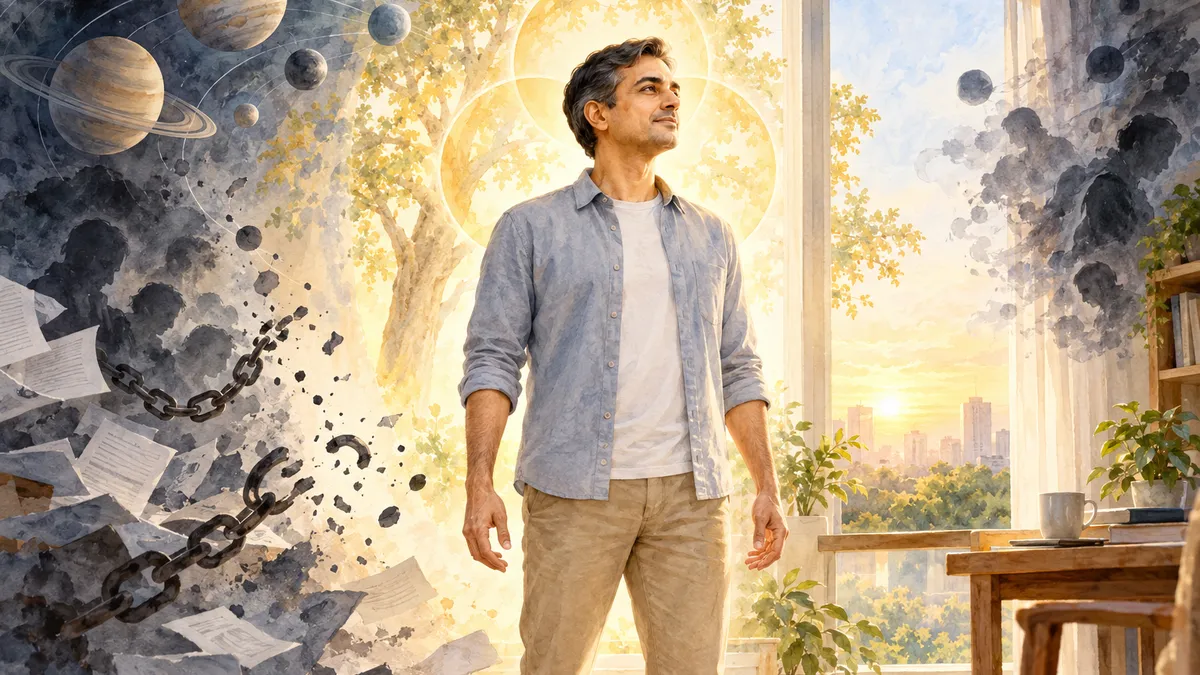
And they wait, they wait; they have plenty of time, they are immortal, they have nothing else to do, this is all they watch over, this is their seva, their service: they watch over every person and their future. And as soon as a person loses connection with the spirit, loses connection with the Refuge, with the Root Guru, with the Ishta-devata, with the saints, with the Dharma, with the divine Source, as soon as their mind becomes clouded, as soon as the planets align unfavorably, they come again. If a person does not have enough strength of spirit to tell them, “I am under Dattatreya’s jurisdiction, I trust him completely, I am under the power of the divine; you have no power over me,” then they will falter and begin to get entangled again, to unravel these karmas again. But if they are ready to let everything go, they see that they cannot reach them in any way, and they say, “That’s it, let’s leave; there is no use here, they will not give us anything anymore. They have already come out from under our power, they are no longer in our Universe; let’s go look for others.” And in this way, the sadhu becomes free from karma.
Developing Faith — Shraddha
These karmas will test and test you many more times. Faith (shraddha) is important here, and at first all of us have little faith; we are people of little faith. And we must acknowledge this fact and not be afraid: yes, we have little faith. The spiritual path begins with this acknowledgment, because if you realize that you have little faith, you understand that you need to develop faith, strengthen it, invoke it, deepen it, so that it becomes vajra-like, indestructible. Gradually, faith is strengthened through sadhana, meditation, association, and the study of sacred texts. Faith becomes strong and deep; then this faith becomes miraculous, when, by joining sankalpas with it, we can change reality, time, and space and free ourselves from karma; and then, precisely from this faith, we create a new reality, a new consciousness, a mandala of pure vision, of a pure dimension. It must be a faith that has dissolved all our ego, a faith in which we rely only on God.
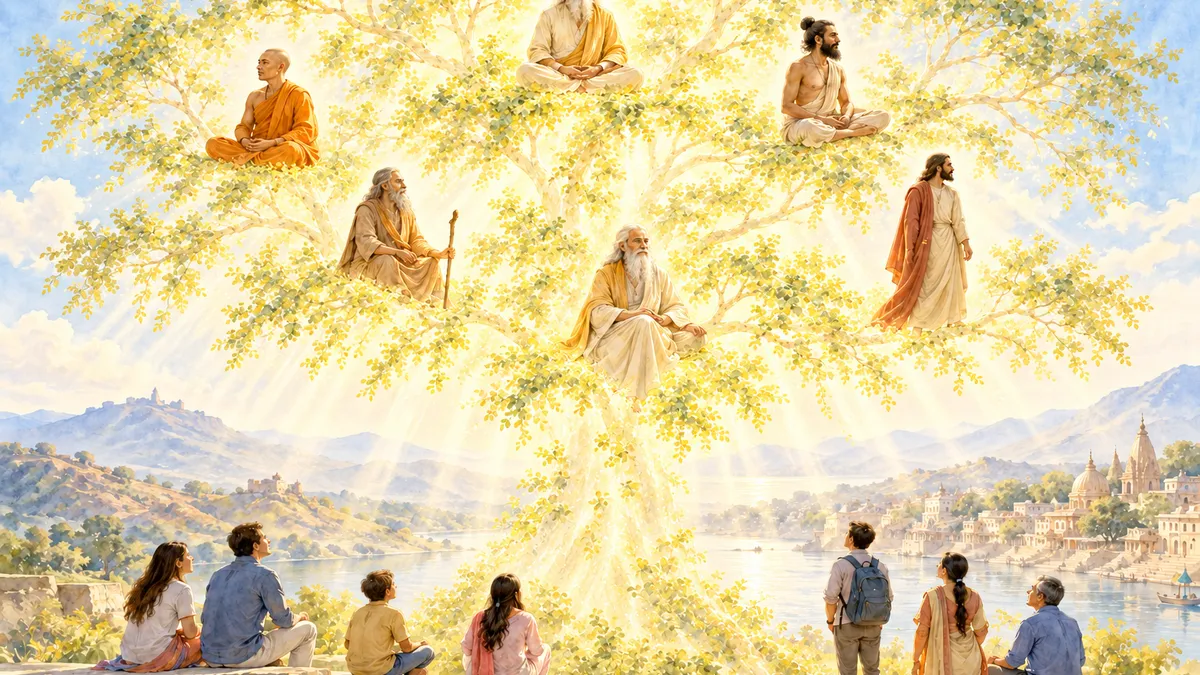
Faith, shraddha; sharanam, the Refuge; and shila, aspiration — these three “Sh”s are very important. Shraddha means faith, while sharanam means connection with the objects of faith. For example, what is very important for us is the Root Guru; the paramguru, Guru Brahmananda Shiva Prabhakara Siddha-yogi; the Guru-acharya, Shri Adi Shankaracharya, who gave Advaita Vedanta; Dattatreya as the Satguru — all of this is one principle of the guru; the rishis; the saints of the Tree of Refuge; the gods, such as Brahma, Vishnu, and Shiva — all of this is one great Tree of Refuge in the Vedic Universe.
Connection with the Refuge — Sharanam
When we have a connection with the saints and the Tree of Refuge, we glorify it, praise it, invoke it, make offerings to it, visualize it, and serve it. We have a constant connection with the divine Source; then the Refuge begins to protect and bless you. Then we and the Refuge are one; we, as it were, integrate ourselves into the Tree of Refuge and become part of it. Then the Refuge is always with you.
A nun was conducting a class, and a certain person came who could see spirits, a psychic who enjoyed astral visions, although I tell him to practice detachment, but he remains curious anyway. During the class, he saw that asuras in a subtle body were attacking the subtle bodies of some laywoman. But the nun who was sitting there conducting the class was under a dome, and they could do nothing to her — the power of the Refuge. When you have a connection with divine energies, you are protected. The nun told him not to cling to visions, not to cling to the subtle world or astral visions, but to establish himself in the deities of the Refuge and in the spirit of nonduality, in the nature of mind. This is the best way to solve all problems and the best way to receive protection.
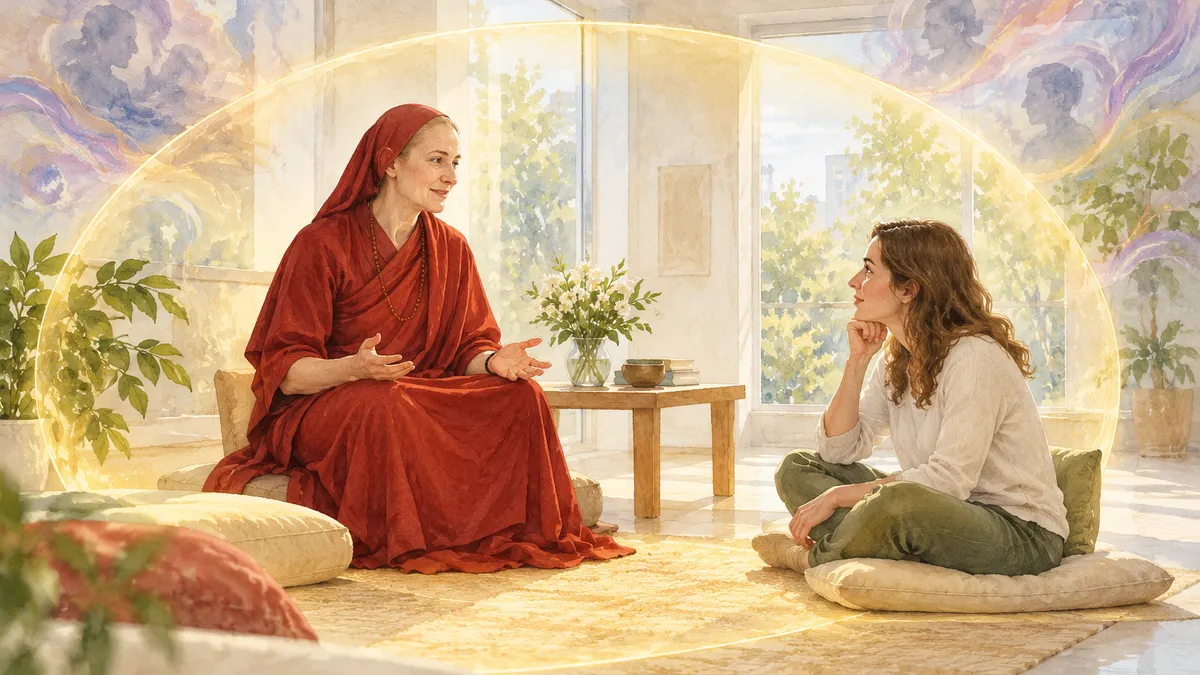
Thus, sharanam, the Refuge, means that you are in constant connection with divine energies, that you constantly remain in the spirit of samaya. Connection with the Refuge ensures the spirit of samaya. If your spirit of samaya is pure, then your wireless connection with divine beings, with the saints, and with the Supreme Source is flawless. Then you can constantly receive blessings, impulses of Anugraha.
Aspiration — Shila
And the third “Sh” is shila (aspiration). Aspiration means spiritual zeal, faith that blazes and becomes action. If there is shila, it is easy for you to practice, easy to perform seva, easy to overcome selfishness; everything is easy for you, nothing is impossible. If there is no shila, if there is no shraddha, you say, “Oh, this is difficult, this is impossible,” you impose limitations on yourself, and then these limitations prevent you from continuing along the path of further development.
Shraddha and shila remove all boundaries. You understand: I can live anywhere, I can eat any food, I can wear any clothing, I can live in any body, I can live in any loka in the Universe if I serve the Divine. With the blessings of the Divine, I can achieve anything, because my soul is immortal, omnipresent, omniscient, and all-pervading. And if it lacks anything, the saints will bless it, and everything will be provided. Then you worry about nothing; you become children of God who play, through whom the divine play (lila) unfolds; you no longer belong to your body, you do not belong to your ego.
The saints in the divine worlds live precisely this way. They have no karma; through them, lila (the divine play) unfolds; they are all in samadhi, and not a single one of them remains in an ordinary state. If you look at the Tree of Refuge—you will see Guru Brahmananda, Shankara, Dattatreya, the seven rishis, the four Kumaras, Brahma, Vishnu, Shiva and their consorts, and many other divine beings. They are all in samadhi; this is infinity itself, manifesting and manifesting in accordance with our karmas.
The Life of a Sadhu in Divine Wisdom
A sadhu is one who constantly thinks: “What is divine wisdom, what is Brahman, what is the Absolute, how can I abide in God, what is the divine will, how can I become its instrument?” These are the only two thoughts that occupy a sadhu. If he sees that something does not correspond to the divine will, he does not get involved in it, he does not touch it. He says: “This is not my karma, this is not my task.” If he feels that he is not in divine wisdom, he stops and says: “First I need to immerse myself in the state of divine wisdom, and only then act, then speak, then think.” He knows that it is not so important what you think, what you do, or what you say; what matters is whether you are in a state of divine wisdom, in unity with God, whether you stand before God.
And an experienced sadhu checks himself every second: am I in God or in maya, is my mind in samsara or in God? Every second—there is not a single second in which he does not check himself. If he does not check himself, then he is still a young and foolish sadhu. One second in God, two hours in maya, three minutes in God, five hours in maya—in this way, over the course of a week, he accumulates two and a half minutes in God and one hundred and seventy hours in maya.
But a wise sadhu does not act this way. A wise sadhu compares every step and every word with God; he is in God every second. Without abiding in God, he will not even move a finger or utter a word, because he cherishes it; he knows that this is the essence of the universe, the spirit of the siddhas, the spirit of the Gods, the spirit of divine beings. The entire life of a sadhu consists of an uninterrupted song of worship to God; he casts his ego at the feet of God and does not spare it, he feels no pity for it. He thinks: the ego is not me; what is the point of fussing over the ego? I am not the ego, I am the Absolute itself, I am divinity, while the ego is merely an instrument, a function. If necessary, I will make the ego this way or that way, as long as it is a good instrument of the Divine, as long as it serves the Divine. But when we forget and think that we are the body, that we are the ego, that we are the mind, the ego seems very important to us. The moment we give it our power, we lose our true, spiritual, divine power. Therefore, an experienced sadhu is not afraid when his ego is not satisfied.
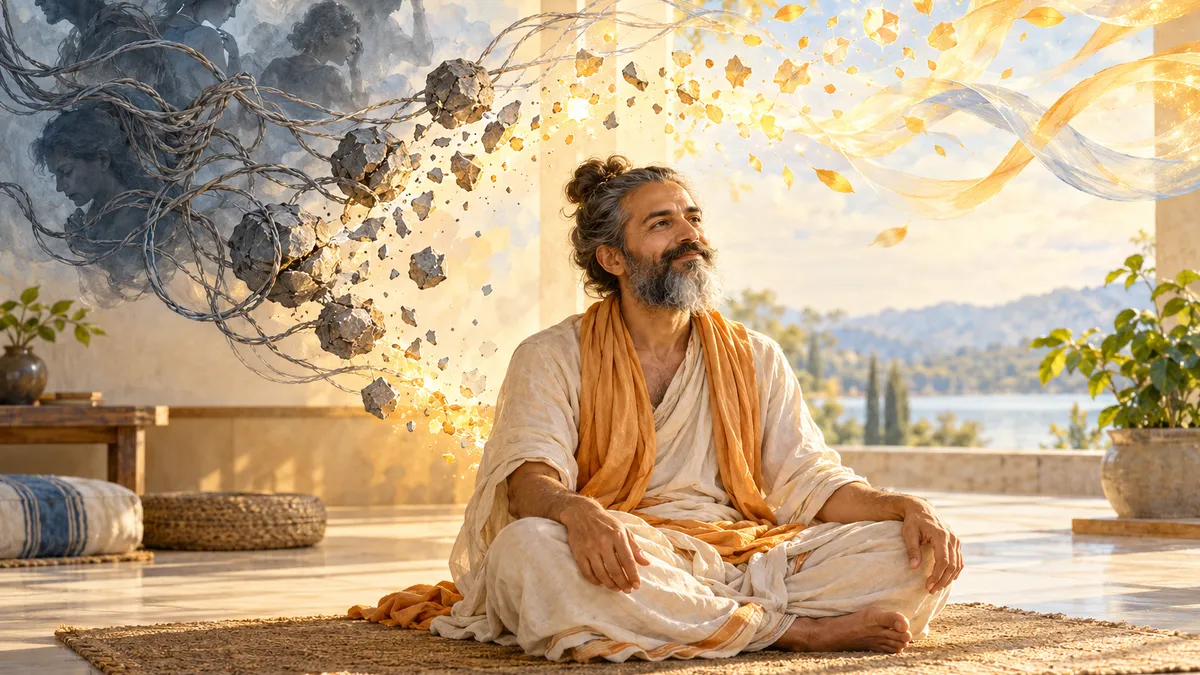
At a satsang, Pilot Baba once told his disciples: when you suffer, it is not bad, because your karma is being purified. But when a person suffers, he thinks it is bad and is afraid of suffering. When a sadhu suffers, however, he thinks: excellent, this too is karma that can be worked with; it means I must free myself and cleanse all my attachments, all my hopes and fears, in order to attain enlightenment. Then suffering disappears; it becomes a play.
The Nature of Suffering and Divine Wisdom
In fact, there is no suffering as such; it arises because of identification. When you serve the divine and abide in divine wisdom, suffering is entirely impossible, because nothing prevents you from abiding in divine wisdom, and nothing prevents you from being an instrument of the divine will.
It depends only on you: suffering may exist in the material world, in samsara, but when you abide in divine wisdom and are an instrument of the divine will, suffering cannot touch you. Even if the body suffers, you do not suffer.
