

Commentary on the text “Yoga Vasistha,” the Story of Kundadanta
Vasistha tells of an island called Kusadvipa. There was a city there named Ilavati, ruled by King Prajnapati. One day this king met Vasistha and, after greeting him, asked him questions. He asked:
“When this entire visible universe dissolved, what were the causes for the creation of a new universe? What is this universe? Part of it is constantly in darkness; somewhere within it worms dwell. But how did all these elements that make up the world arise, and how were mind and intellect created? Who is the creator of all this, and who experiences it? Who is the foundation of everything?
Undoubtedly, there is no final destruction of the universe. Whatever each living being is conscious of, that is what it experiences. What, then, is real and indestructible? When a person dies and the body is cremated, who creates a body for him in hell so that he may undergo the necessary experiences there? Surely it is neither grace nor sins, because they themselves are subtle and formless. To say that the ‘other world’ does not exist seems just as mistaken, because it contradicts the statements of the scriptures.
It is absurd even to suppose that something formless can undergo the experiences of punishment. Tell me also how substances undergo change. What is the purpose of scriptures describing prohibitions and permissions? What does the statement of the holy text mean, that at first only the unreal existed, and then it became real? If the creator Brahma arises from emptiness, why does this emptiness not create many creators everywhere? How did grasses and everything else acquire their characteristic essences? In one holy place two people live at the same time, someone’s friend and someone’s enemy. The friend prays and asks for long life for that someone, while the enemy prays and asks for his death—whose request will be fulfilled? If thousands of people desire, ‘May I be the moon in the sky,’ why will there not be thousands of moons shining at the same time? If thousands of people meditate and pray that they may receive a certain woman as their wife, while at the same time she meditates and prays to remain a maiden, what will be the result?
How are the results of funerals and the corresponding rituals experienced by the dead in the absence of a body?”

Many of these questions are such that entire philosophical debates could be held over them and winners determined. And Vasistha replies:
“Listen, O king. I will answer your questions in such a way that all your doubts will be dispelled.
All objects in this world are always unreal, but they are also real, because consciousness is real—their only reality and their content. Whatever this consciousness decides to be ‘this and that,’ it becomes that, whether real or unreal. Such is the nature of consciousness.”
Consciousness as the Creator of Reality
One person asked us the following question in a letter: “I wanted Indian teachers to visit Russia and give teachings. But at that time it was impossible, because Russia was behind the ‘Iron Curtain,’ closed off from other countries, and had a communist regime. But I wanted it very much and meditated, and a year later the USSR collapsed. Tell me, are these siddhis manifesting in me? I see that my consciousness achieves what I want. I wanted to study philosophy at some educational institution and modeled an academy where there would be a philosophy department, where I could communicate with a professor of philosophy. A year later I found such an academy and enrolled in it.” And he described many similar situations and wrote that they could not have been coincidences. This is one example of how consciousness can work. If a person’s ajna chakra is developed, then the future happens as he models it.
One could answer him as follows: “Of course, it was not you who brought down the USSR, but by the power of your consciousness you entered a tunnel of reality in which the USSR collapsed. Perhaps, if you had not generated such a sankalpa, the USSR would have continued to exist in your universe.” Because consciousness seems to glide through a space of meanings that are transmitted continuously. And in this space, consciousness can extract certain meanings. The stronger its potential, the deeper the meanings it can extract.
Question: During the practice of contemplating the samsaric mandala, there was a rally of communists taking place there, that is, music was playing, a communist march, and elderly grandmothers and grandfathers were making offerings of flowers to the murti of Lenin. In their tunnel of reality, did the USSR not collapse, or did it collapse after all?
On the physical level, of course, it collapsed. But if they create a fairly powerful shakti and this shakti is transmitted to many people, then they may even change history and enter such a tunnel of reality where it has always existed and will exist. All this depends precisely on the power of consciousness.
That is, they can shift themselves into such variants of space where there is an alternative history in which, even if the USSR collapsed, it was restored or successfully flourished instead of falling apart. Another question is that shifting oneself into such alternative variants of karmic vision is extraordinarily difficult. Karmic vision exerts the strongest pressure on living beings. It continuously generates certain meanings that enslave these beings. And in order to move within the space of karmic vision, between variable universes, it is necessary, firstly, always to be self-liberated from the meanings transmitted by samsara, and secondly, to have enough wisdom and clarity to generate meanings oneself.
Transmission of Meanings and Karmic Vision
Meanings are constantly being transmitted, and we live in a continuous transmission of meanings. Living beings are subject to these meanings, that is, they are not self-liberated from them. They perceive these meanings as the natural environment of their existence, not understanding that the reality surrounding them is only the transmission of certain meanings. For example, our universe is a global transmission of the meaning of Brahma’s sankalpa, but for us it is a natural environment that we perceive as a given.
There is a saying: “Geniuses invent devices. Enterprising people promote them. And fools use them without even thinking about where they came from, taking them for granted, as some kind of environment.”
Roughly the same thing happens on a more global level, on the scale of the Universe. But when we consider who the source of these meanings is, we discover that the sources are divine beings possessing extraordinarily developed awareness and capable of generating continuous clarity.
Question: “It is said that through the work of your consciousness you create a certain tunnel of reality. But does it not happen the other way around, that a certain tunnel of reality forces you to generate certain thoughts or attracts you to itself? One can even take as an example the situation with this prabhu who wrote you a letter. That is, a certain reality had to be created, certain vibrations began to be generated, and the person began to think about this topic. That is why it is said that the crowd effect arises, when you were not thinking about anything, but a certain energy is created, you fall under these vibrations and begin to think exactly the same way as those around you. Question: Are these phenomena not interdependent? You attract the tunnel of reality, and the tunnel of reality attracts you.
They are definitely interdependent. But I was speaking from the position of identification with “I am Brahman,” when your consciousness is deeper than the consciousness of the crowd. That is, everything depends on the level of identification, on the level of your consciousness.
All of this is a game; these are secondary and primary causes. Secondary causes can initiate a certain vision. And, conversely, a certain vision can initiate certain secondary causes. What determines who will have priority? It depends on whose consciousness is deeper. If the consciousness of the crowd and of social processes is deeper, then they will act as a catalyst for a person’s thoughts, and then the person will fall under their influence, enter a certain tunnel of reality.
But if a person, for example, is charismatic, a passionate individual possessing colossal spiritual power by birth or as a result of practice, then he generates colossal bhava and clarity, which invisibly flood everything around and change the tunnel of reality, and then one can say that he initiates a new karmic vision. These processes are interconnected. Everything depends on the depth of contemplative presence. Since such meanings are continuously being transmitted, an emanation (drishti-spanda), living beings are rigidly enslaved by them.
Of course, it seems to us as though the universe consists of gross objects, but all this is not so much gross, or even energetic, objects as it is meanings that are continuously transmitted from fundamental awareness. Meanings create karmic vision; karmic vision creates certain subtle pranas; then the subtle pranas become subtle tattvas, and afterward they become gross tattvas. But in the beginning, everything is decided at the level of meanings. And one can say that the world is a continuous play and transmission of various meanings.
For example, there are harmful spirits that come to a person at night in a dream and transmit the energy of obstacles or illnesses. If a person’s clarity is insufficient, if he is unaware, then he is seized by this energy of obstacles and illnesses, and therefore in the morning he wakes up exhausted and spends another week in that state. But if he was in a more flexible, quick, and subtle consciousness, then he managed not only to avoid being subjected to the harmful energy of the spirits, but he himself transmitted to the spirits the energy of pure vision, divine pride, and pacification, as a result of which the spirits abandoned their evil intentions and even found refuge in the Dharma, becoming his helpers. This means that the person, having transmitted his meaning, acted as a mandaleshvara and included them in his vision as auspicious deities in pure vision. And such a transmission of meanings between different living beings occurs continuously.

Suppose you had debates. The debates took place on the relative level, but on a deeper level you were practicing the ability to transmit your meanings and self-liberate others’ meanings. And depending on how aware you were, how deeply you abided in contemplative presence and were able to unite it with your own clarity and energy, you either fell under the meanings of others or self-liberated them and transmitted your own meanings. That is, it was an exchange of various karmic visions. The subtler and deeper a person’s awareness was, the better he could do this.
Vasishtha’s Teaching on the Nature of Consciousness
Thus, Vasishtha then says:
“This consciousness conceives the body and is aware of the body. This self-awareness is aware of the body, and not the other way around. At the very beginning of creation there was nothing; there was only consciousness, and therefore the appearance of the world arose in this consciousness like a dream. In whatever way consciousness conceives the world, that alone it becomes.”
Ultimately, our spiritual practice consists in conceiving ourselves and our world in a certain way and becoming what we have conceived ourselves to be. If we have conceived ourselves as the principle of divine pride and pure vision, then we must adhere to this principle, cultivate it, and in the end become it. If we have conceived ourselves as the principle of natural awareness, emptiness on the deepest level, and bhava, then ultimately we must become this.
Each of you is learning. Learning what? How to become a mandaleshvara. And in the end, someday he will become one. And having become a mandaleshvara, he will create an entire universe, a mandala, by the power of his mind. And depending on how successfully he practices and attains wisdom, he will be able to create it either sooner or later, or will not be able to at all. In other words, by purifying your consciousness, you create, by the power of clarity, certain meanings that constitute the mandala, the pure dimension where everything consists only of your mind.
Vasishtha says:
“In whatever way consciousness conceives the world, that alone it becomes.”
In order for you to be able to create a mandala, to become mandaleshvaras by transmitting the necessary meanings, your consciousness must be one-pointed; it must not deviate from the set goal. It must strike one point for years. That is, if a person engages in contemplation, self-liberation, and maintains the bhava of divine pride, pure vision, the single “taste,” and integration, then all of this must grow in him without interruption. Even a small interruption will be a step backward.

The Nature of Brahman and Cosmic Creation
Vasishtha says:
“However, like frogs in a well, foolish and ignorant people base their understanding on the sensations of the moment and, because of their distorted understanding, are deluded and think that only the body is the source of sensation and awareness. But we have nothing in common with them. No matter how intelligent a person may be, if he is unable to put an end to someone’s doubts, such a person is ignorant. If self-awareness is one of the characteristics of the physical body, then why does a corpse feel nothing?
The truth is the opposite. It is the consciousness of Brahman, infinite consciousness, that manifests as this universe—as an object in a dream appears in your consciousness. Brahman is infinite consciousness; it imagines this dream-city, which is the cosmic person. This cosmic person is the creator Brahma and also consists of pure consciousness, although it is known as this universe.
What was conceived in the dreamlike creation of the creator Brahma is exactly what is experienced here in just that way. Thus this body has two states—living and dead. Likewise, this creation appears and disappears. It has no other cause besides Brahman, and therefore it is nothing other than Brahman. Whether the body exists or does not exist, this consciousness experiences whatever it is aware of, wherever and however it wishes, before and after “death.” Consciousness alone invents “other worlds” and experiences them as such.
Such erroneous experience does not cease until a person comes to the correct means of liberation and attains awakening, when mental conditioning ceases and consciousness becomes unconditioned.”
Vasistha said:
“Whatever this infinite consciousness conceives, that it experiences. Likewise, curses and blessings receive their power from infinite consciousness. Because of the corresponding concept that has arisen in consciousness, permissions and prohibitions receive their powers and authority.
Since an embodied being in this world cannot understand what existed before the beginning of this creation, it is said that before it there was only nonexistence.”

Liberation from the Meanings of Samsara
Worldly scholars describe the world as material. Samkhya describes it as consisting of gunas and tattvas (the five elements and so on). But if we consider it from an even higher point of view, then the world, including our own, is a certain meaning, a karmic vision, a point of view. The elements, physical laws—these are secondary manifestations of this point of view. This means that in order to be liberated from the world of samsara, it is necessary to become completely free from its meanings, from this point of view. Liberation from its meanings and from this point of view occurs only when we penetrate into a completely nondual, nonconceptual state.
But merely penetrating into it is not enough. Many penetrate into it at the moment of brief insights. The point is that, having penetrated into it, one must constantly establish oneself in it, never losing it, so that while interacting with relative meanings, one nevertheless constantly remains beyond them; so that, while opening to relative meanings, one not only does not lose nonconceptual consciousness, but enriches it through the method of integration (this is what is called “the mother feeds the son”), and so on.
Often the behavior of practitioners is incomprehensible to others, and their level may also be invisible. One person may act on the relative dimension while being completely un-self-liberated, while another may outwardly do exactly the same thing, but with entirely different aims and plans, being completely self-liberated. The first is a soul absorbed in samsara, while the second is a liberated player who freely operates with various energies without being colored by them.
There was such a situation. At first, one person was criticized a great deal. Some people did not like him, others did not like him, and so on; nevertheless, there were situations in which he showed himself to be very self-liberated. Then, when these same people found themselves in similar situations, they saw that they could not react as self-liberatedly as he did. Later they repented and said: “Yes, I have changed my opinion of this person. It turns out that I did not understand at what level he acts and abides. I had many wrong thoughts about him; his level is significantly higher than mine.” Levels of awareness and clarity are difficult to recognize on the external plane.
There is such a story. A student and a teacher were traveling from one place to another. The teacher looked like a completely ordinary person, while the student looked like a very exalted person. And it often happened that laypeople thought the student was, of course, the teacher, that he was a very exalted being, since he bowed so restrainedly, took a cup so attentively, walked so smoothly, and looked so insightfully. The teacher, however, looked like a completely ordinary person, trivial. And people thought he was surely the student. But when people got to know them more deeply, everything turned out to be the opposite, and so they were shocked. They asked the student:
“Why do you look so exalted, while the teacher looks so ordinary?”
The student replied:
“My teacher is so holy that he can look like an ordinary person, concealing his holiness. I, however, do not yet know how to conceal my holiness; I have something to learn from him.”
This means that the teacher has become completely empty; he is a perfect actor, a player. The student, on the other hand, is one who is still striving to attain the necessary holiness; he does not yet have the required emptiness.

Further, Vasishtha says:
“Existence and non-existence, creation and destruction are like the opening and closing of the eyes of infinite consciousness. Such is the nature of infinite consciousness that creation arises and disappears constantly, just as when you dream, you build and destroy your mental images in the blink of an eye. Yet all of this is only images arising in infinite consciousness. It itself does nothing.
Since infinite consciousness exists everywhere and always, there are no obstacles for it; it can create any image anywhere and at any time. Permissions and prohibitions exist only to preserve the social structure of society. But since they are all established in consciousness, they are capable of producing their results even when a person leaves this world.”
The Cyclical Nature of Spiritual Dialogue
When the “Yoga Vasishtha” was completed, Vasishtha said this interesting phrase to Rama:
“O Rama, you also questioned me about the truth in the previous kalpa, the epoch. You were also my disciple, and I was your teacher. And you also questioned me. I remember this dialogue clearly, and I have repeated it for you.”
It is very astonishing that after a kalpa this situation repeats itself: that not only in this kalpa did Vasishtha exist, but there were many Vasishthas; that there was not just one Rama, but many Ramas; that this dialogue took place between them many times.
The Teaching on the Self-Perfection of the Three Bodies
There is a teaching called the self-perfection of the three bodies. If we continue this statement of Vasishtha and recall this teaching, then according to it we already have self-perfected, fully awakened bodies in pure dimensions. That is, we already have jnana-deha — the boundless body of wisdom, like space. We already have the divine illusory body, maya-deha — a body like a deity in the higher dimensions of Svarga. We already have siddha-deha, or shuddha-deha. And there is not just one of these bodies, but an infinite multitude.
In other words, from the point of view of self-recognition, right now you have a countless number of illusory bodies of your doubles: physical, subtle-material, united by a single spatial foundation. These illusory double-bodies exist in variable spaces; you simply do not yet encompass them with your consciousness. And when the wholeness and power of your consciousness are sufficient to awaken an instantaneous impulse, spanda, in all these illusory bodies, something like a tremendous flash, an ignition, will occur, when all these bodies will be recognized by you as your own “I.”
The Principle of the Variability of Consciousness
For example, imagine that an infinite number of variations exist in consciousness, that at this moment there are five billion of your bodies listening to a similar lecture, and there are also others listening to lectures on a slightly different topic. This is not even to mention that there are variations of you in other bodies as well. And this goes on to infinity. This is the principle of the variability of consciousness. At the moment when your consciousness expands, these bodies of yours recognize themselves as naturally inherent in you, as your own, and are instantly emanated, manifested.
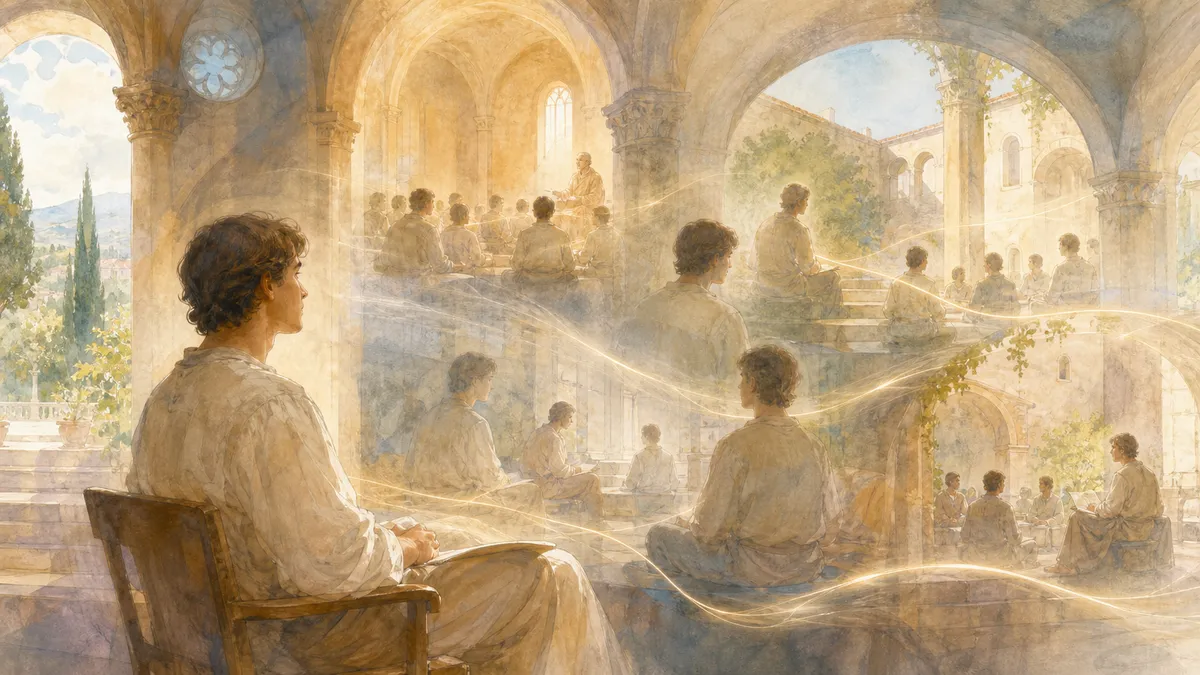
Sometimes cases are described in which people encounter their doubles. But these doubles are slightly different. This is an example of how, when different tunnels of realities intersect, one encounters one's illusory bodies. The sutras describe the ability of a saint to emanate countless illusory bodies. The deeper and stronger the consciousness, the stronger this radiating power. All of this is a manifestation of the creative power of consciousness—spanda-shakti. This creative power of consciousness depends on how deep the presence and immersion in bhava are.
