

Commentary on the text “Tirumantiram,” Tantra 3, Shloka 668
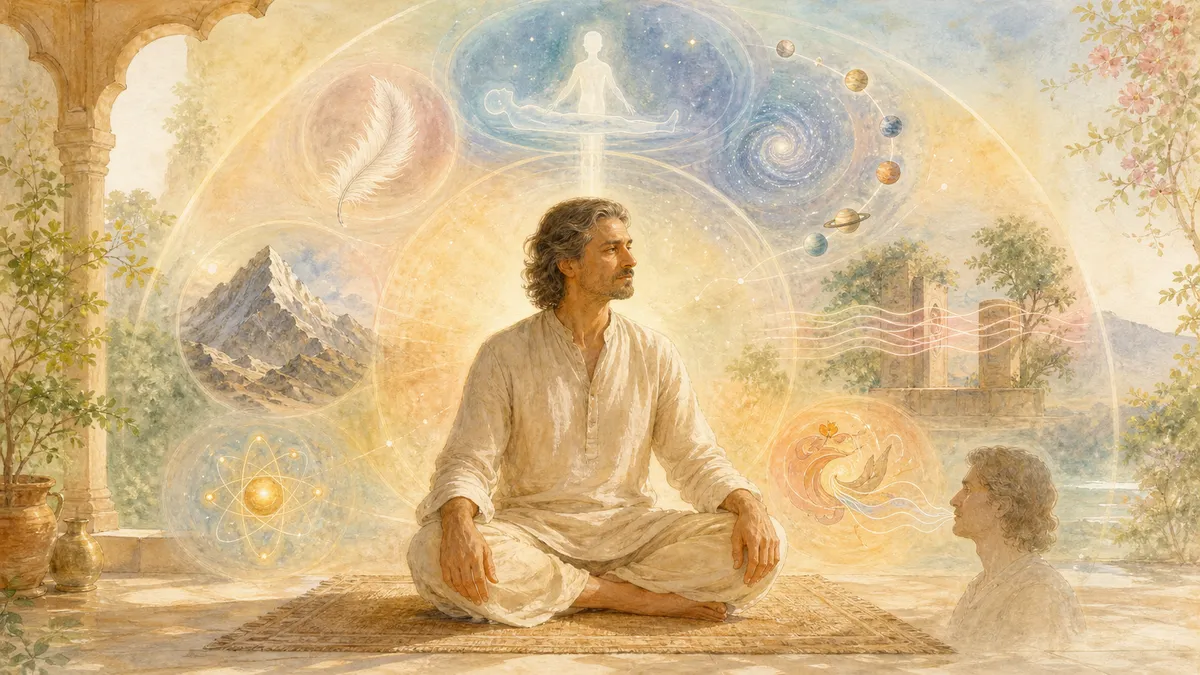
List of siddhis:
1. The ability to become tiny, like an atom — anima.
2. The ability to become immovable and great in size, expanding infinitely — mahima.
3. The ability to become heavy, like a mountain — garima.
4. The ability to become weightless and light, like steam — laghima.
5. The ability to leave the body and enter other bodies — parakaya-pravesha.
6. Complete knowledge of the past, present, and future; the ability to penetrate anywhere, even to other planets and stars — prapti.
7. The ability to be present in all things while controlling events; the ability to fulfill all one’s desires, perfect acuity of mind and senses — prakamya.
8. The ability to become the creator of all that exists and to have complete power over both living and nonliving objects of the universe — ishitva.
9. The ability to be omnipresent and to be at any point, the ability to control everything by thought and word — vashitva.
Here there turn out to be nine siddhis, but in other sources parakaya-pravesha is classified among the lesser siddhis.
Rishi Tirumular goes on to say:
“When the eight siddhis have been attained, he is now a master who has accomplished the practice and obtained the eight siddhis. Now he is the god of universes and worlds, and his radiance is adorned with a garland of victory. His breath is turned toward the incomparable light.”
In the seventh year of practice, the yogi becomes light as the wind. His feet may no longer touch the ground, and he can soar in the sky. He can read and anticipate the thoughts of other beings. In the eighth year of practice, he attains a youthful body that is forever free of gray hair, sagging muscles, and wrinkles. In the ninth year of practice, he can assume any form and enter the bodies of various beings.
Shakti grants both siddhis and mukti. One who performs yoga will be able to realize siddhis, but they should not be the primary goal, since freedom, liberation (mukti), is immeasurably higher than they are. In the process of practice they will reveal themselves on their own, because the primordial power grants them to all who turn to it.
Siddhis at the stages of the tenth, eleventh, and twelfth years: in the tenth year of practice, the yogi can expand to infinity and live at any point in the cosmos. In the eleventh year, the yogi can assume the form upon which he meditates. In the twelfth year of practice, the yogi realizes all eight siddhis, gaining the ability to wander through all worlds. His body radiates fiery light; it no longer ages and is not subject to the laws of time. He can assume any form, becoming a creator and creating worlds. Shining like a thousand suns, he burns away the sins of those fortunate enough to see him.
Tirumular says that these siddhis are not an end in themselves, but come spontaneously as a result of practice, and he calls them initial ones. He calls the true supreme siddhi liberation in nonduality.
He says:
“A yogi, possessing siddhis, can take the size of an atom or enter the bodies of different beings, and then return to his natural form. Having realized the stage of siddhis, the yogi advances further, working with the processes of nada yoga and the mantra Om. Thus he realizes the highest liberation — mukti.”
The Principle of the Creation of Reality by Consciousness
The world in which we live is nothing other than a modification of consciousness. In other words, the world becomes what we conceive it to be in our thoughts. As we project ourselves into the future, so that future manifests. If your will is impeccable, if your iccha-shakti is activated, if it is based on jnana-shakti (the power of knowledge), you can model your future, direct the events of your future as you wish. If you know the principle of contemplation, unite it with iccha-shakti (will), and your iccha-shakti fertilizes your kriya-shakti (the power of action), then the abilities of creation, preservation, destruction of obstacles, concealment, and manifestation of the divine spontaneously blossom within you.
Our thoughts create the surrounding reality. The world in which we live is our frozen imagination. It is not rebuilt immediately, since it consists of inert tattvas (elements); nevertheless, this is precisely how it happens. If we change our imagination, then the world around us also changes.
Consequently, a yogin, practicing prakamya-siddhi and trying to operate with his iccha-shakti, strives to constantly concentrate his imagination on the necessary thoughts—on thoughts that lead him to liberation and siddhi. He strives to constantly remove his mind from undesirable thoughts that do not lead him to this.
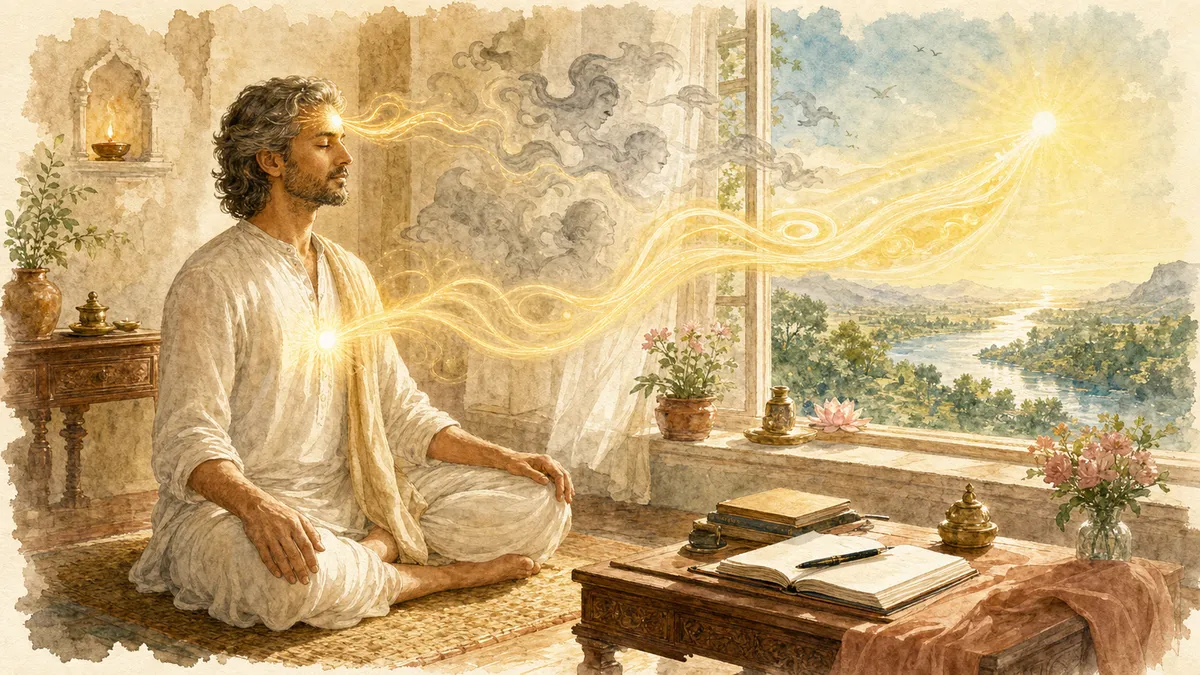
What we constantly think about grows in our soul. If we constantly think about something day after day, it begins to sprout in our consciousness like a seed and bear fruit. If we do this day and night, morning and evening, concentrating all our spiritual power, it begins to sprout, and over time we ourselves become what we thought about. This is similar to how a caterpillar, thinking about how to become a butterfly, turns into a butterfly.
When we concentrate thoughts in the desired direction, we thereby change ourselves from within. These thoughts, being transmitted into space, change our bhava, our worldview, our karmic vision. For example, even if a person had the factor of a preta (lower spirits) or was an ordinary person, but directs his thoughts toward becoming a deity and constantly thinks about it, then after some time he becomes a bearer of the bhava, worldview, and karmic vision of a deity. The new worldview begins to resonate with universal forces (shakti) and attract them into his destiny. These universal forces change the environment around him, the energy, and even his own body. Thus, the reality around him gradually changes.
The Interconnection of the Three Shaktis and the Acceptance of Responsibility
If we understand the principle of the relationship between jnana-shakti, iccha-shakti, and kriya-shakti, that is, the power of wisdom, the power of will, and the five powers inherent in action, we obtain in our hands the levers for controlling our destiny, evolution, and spiritual life. We now begin to understand that everything depends on us. It is we ourselves who create reality through the power of our consciousness. When we understand that everything depends on us, it means that for the first time we become aware of our responsibility. Having accepted responsibility, we understand: wherever we direct our thoughts, so it will be.
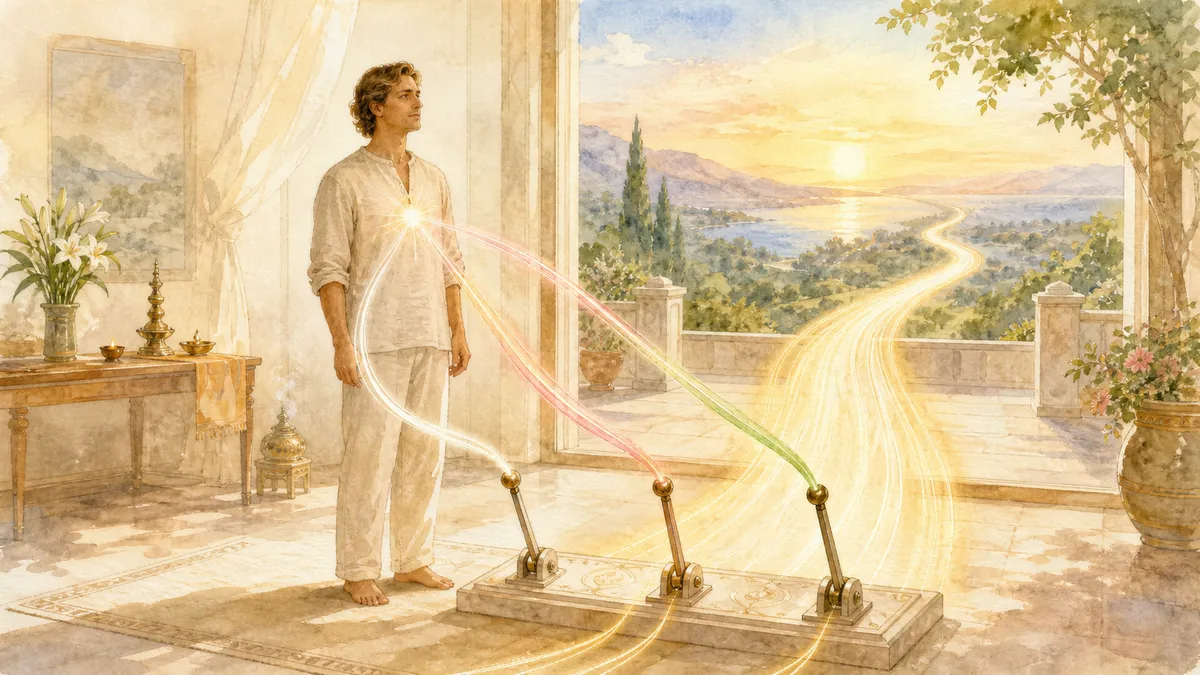
Precisely because humanity does not know the mechanism of managing reality, it cannot accept responsibility. Various difficulties, cataclysms, wars, and misunderstandings occur in the world because each individual person does not feel himself to be a powerful-willed operator; at best, he feels himself to be a statistical unit, a will-less being incapable of influencing anything global in this world. But when we discover the secret of jnana-shakti and iccha-shakti, we feel that very much depends precisely on our consciousness. At the very least, we can actively influence our own destiny by applying our spiritual knowledge. In essence, yoga is nothing other than the transformation of one’s own destiny, one’s own pranas, the body, the modeling of one’s future, and the purification of one’s past.
The question is to what extent our limitations allow us to purify the past, model the future, and to what extent they allow us at all to think in this way. If we set limitations for ourselves and say, “I cannot, this is impossible,” then, of course, it becomes impossible. If we allow ourselves to do this, remove limitations, and believe in our own potential, our own jnana-shakti and iccha-shakti, if we have the fearlessness to accept responsibility for the reality in which we live, then this potential begins to blossom and bear fruit. Every siddha and every deity realizes themselves in precisely this way.
The Fullness of the Realization of the Three Shaktis
The realization of emptiness is only the first step. The realization of the empty state of the nonduality of Brahman means the activation of one’s own jnana-shakti. But jnana-shakti alone does not exhaust everything. At the next stage, our activated jnana-shakti awakens our iccha-shakti, that is, our volitional functions. Iccha-shakti, inherent in every person, is a divine universal power given to him by birth; he rightfully possesses it. And when we fertilize our will with the power of jnana-shakti, the will begins to blossom as the five powers of action.
- The power of creation means that creative abilities appear in you.
- The power of maintenance means that your will can harmonize the world around you.
- The power of removing obstacles means that your will, fertilized by wisdom, can go into the future and purify approaching negative samskaras, avoiding the blows of fate. It can go into the past and purify negative experiences. It can envelop you in the future with a protective shell.
- The power of concealment means that your will, fertilized by wisdom, can hide your secret traits from negative influences.
- Finally, the power of self-recognition and revelation of the divine means that your will, fertilized by wisdom, can manifest outwardly, be transmitted to other people, blossom in works of art, in books, in actions—in anything, simply be shaktipat.
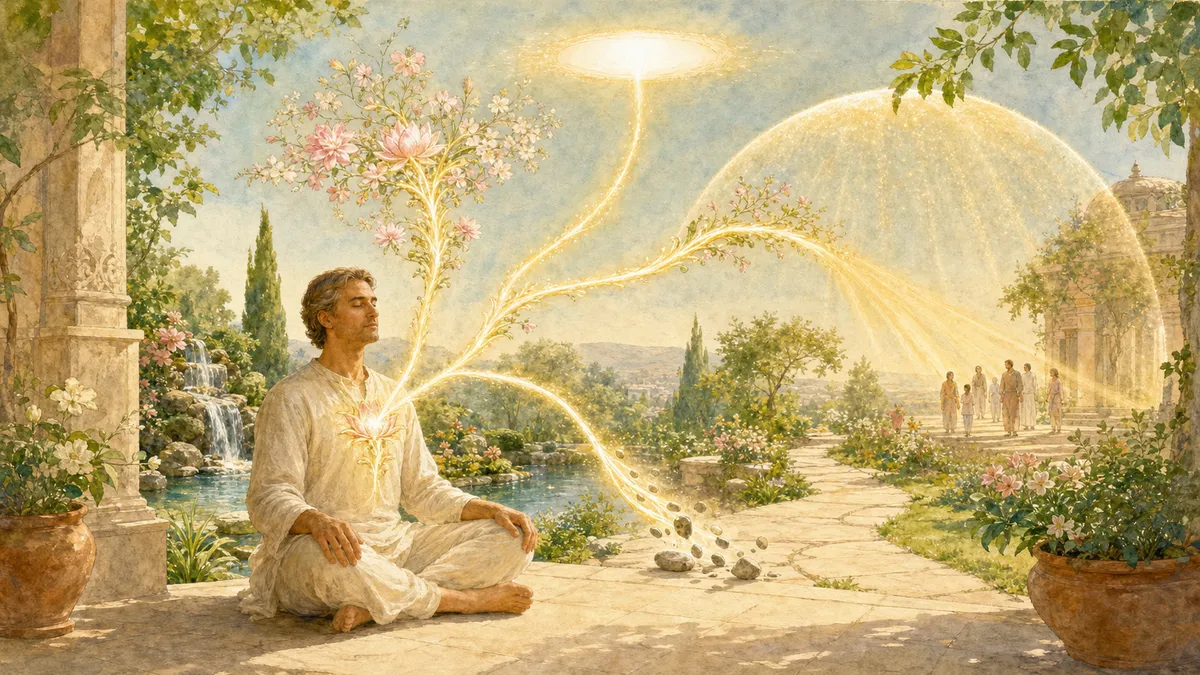
Thus, the will fertilizes the five powers inherent in every yogin. Deities, siddhas, are those who have revealed not only jnana-shakti, but also their own iccha-shakti and kriya-shakti. That is precisely why they became renowned.
In fact, there are very many saints, but they are not so well known because they realized only the aspect of jnana-shakti—empty consciousness. But when we speak of Dattatreya, Saraha, Matsyendranath, we always mean that they also realized iccha-shakti, that is, their volitional aspects. Moreover, their iccha-shakti blossomed in a diversity of enlightened actions.
It is precisely such realization that is purna, that is, the fullness of the realization of all spiritual powers in a person’s life. One who is unable to understand the interconnection of jnana-shakti with iccha-shakti and how it manifests in action (kriya-shakti) cannot grasp such fullness of realization.
The Vision of Humanity’s Future and the Realization of Pranava-deham
I think that if we create an intention and express such a sankalpa, it will inevitably begin to materialize, since the power of collective intention can be very strong and capable of changing space. For example, according to my calculations and intention, in ten years humanity, including you, will be able to attain immortality, and in fifteen years humanity will be able to travel through the Solar System in a quantum body, like gods.
Gods, unlike humans, do not have the element of earth or the element of water in their bodies. The gods of passion have only the element of fire. The gods of the upper world of forms do not even have the element of fire in their bodies; they have only bodies made of the element of wind. The task of yoga has always been to create such a body. Of course, in a physical body, in which there is the element of earth, it is hardly possible to travel through the Solar System. But a body that has been spiritualized and cultivated as a result of spiritual practice and skillful means, in which there is no element of earth or water, which consists only of fire, wind, space, and consciousness (mahatattva), or which consists only of wind, space, and mahatattva, can quite well be immortal and travel through the Solar System. It can remove the barrier between the physical and subtle worlds, abolish compulsory death and reincarnation.
What I am saying is not science fiction. It is recorded in the authoritative texts of our tradition. And such realization is called the realization of pranava-deham—an immortal body made of energy. In fact, this is the goal of our spiritual practice. The realization of emptiness must precede the realization of this body. If you create a true intention, such realization will certainly begin to materialize. Accordingly, in twenty years it will be possible to remove the barrier between the physical and subtle worlds, to abolish compulsory death and reincarnation. In fifty years humanity may essentially complete its global history and begin a new history—the history of deities, connected not with race, lineage, or nation, but with each individual person who becomes a deity at the center of the mandala.
The question is to what extent we have limitations in consciousness, or to what extent we free ourselves from them in order to realize such a scenario of events in the universe. In my karmic vision, such a scenario of development exists. Does it exist in your karmic vision? Everything depends on you.
When such a scenario comes to encompass billions of people, humanity’s collective tunnel of reality will begin to change, and then, in accordance with the laws of parasatarka logic, reality will begin to change. New tunnels of karmic vision will begin to open, where such things are something normal.
The Authentic Spiritual Practice of the Siddhas
This is precisely how the ancient siddhas, gods, and saints practiced. Spiritual practice is always mysticism, a great mystery surpassing the most incredible science fiction. Spiritual practice, religion, is by no means orthodox dogmas or grandmothers in headscarves. The true spiritual practice of the siddhas is always something transcendently fantastic. It is something that completely removes your limitations, opens up entirely new horizons for you, and gives you the opportunity to completely change your understanding of the world and of yourself. It is precisely this approach to spiritual practice that is authentic and effective. This is exactly how the great mahasiddhas practiced, those who had no limitations whatsoever. They set great global goals and were fearless enough to accomplish them. They had no limitations in consciousness that would prevent them from allowing themselves to accomplish them. This is precisely the kind of consciousness the gods possess. Gods do not have the limitations in consciousness that people have. That is why they can freely operate with time, space, and causality, model the future, and change the past. They allow themselves to do this because they believe in their higher “Self,” in their jnana-shakti.
Unfortunately, people, possessing a shrunken mind, do not allow themselves this. Moreover, they cannot even imagine it or believe in it. Nevertheless, all the sacred texts of our tradition constantly speak about this. The question is how much we can believe in our own potential and allow ourselves to do this, and how free our mind is from our limitations.
