

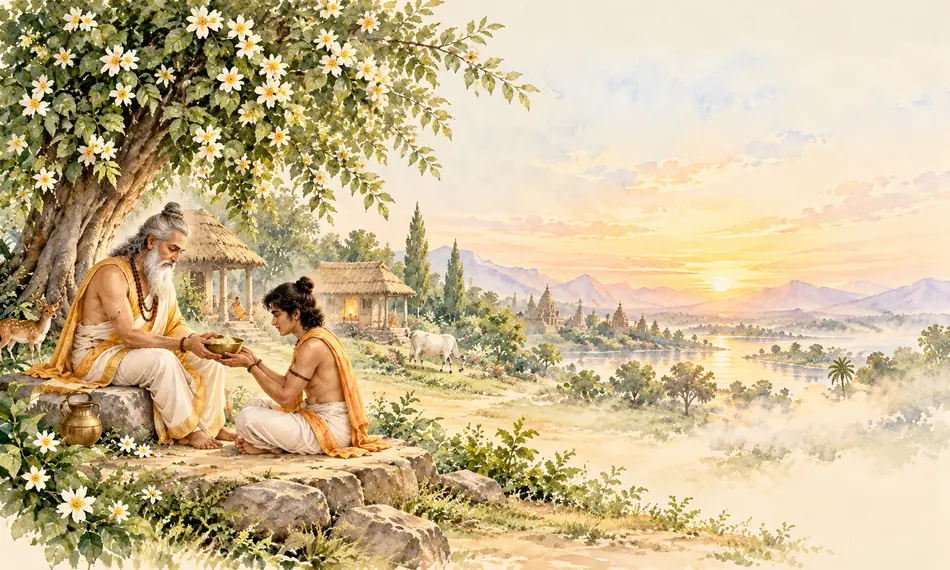
We all follow the path of Sanatana Dharma. Sanatana Dharma is the eternal, divine law of the Universe. It is like the law of nature; no one invented it. Sanatana Dharma has always existed. There is no particular prophet or founding date; it is not a religion, but the law of nature, the law of the divine Universes. All religions, to one degree or another, are parts, branches of the great tree of Sanatana Dharma. To follow the path of Sanatana Dharma means to follow the path of knowing the Divine.
From the perspective of Sanatana Dharma, the meaning of life is the attainment of divine wisdom. It is precisely the attainment of divine wisdom that is the meaning of Sanatana Dharma, because without divine wisdom, the life of any being loses its meaning. When we embark on the path of Sanatana Dharma, we make a promise to the Divine and to ourselves that we will attain this divine wisdom, sparing neither effort nor time.
At first, we want to attain divine wisdom out of our own curiosity or for the sake of our own happiness; we lack many things in life: knowledge, experience, energy, money, and perhaps strength. And we want to make up for this dissatisfaction so that we may become happier, more harmonious, and stronger. This is normal; such motivation is natural at first. But then, in the process of attaining it, we see that this motivation is childish and immature, and we begin to wonder what truly constitutes the truth and the right motivation.
Then we ask the holy sages, study the sacred scriptures, and find the answer: in reality, the true motivation is the principle of serving the divine will—the motivation to live not for oneself, but for the Divine; the motivation to serve and to carry out the divine will. And when we look at the saints and the deities, they are all servants and instruments of the divine will, if they are enlightened, of course. And they all see the meaning of life precisely in serving the Divine and carrying out the divine will. They are great precisely to the extent that they serve the divine will and carry it out.
Asuras and Gods: The Difference in Service
For example, the asuras are beings who are older than the gods. Brahma created them first; the asuras emerged from the dynasty of Kashyapa, from the great rishi Kashyapa and his union with his wife Danu. The descendants of Diti are the sons of light, the gods, while the descendants of Danu are the asuras—but they have one husband, Kashyapa, the rishi Kashyapa. If you look at the Great Bear in the evening and see seven stars, these are the seven rishis, our entire Parampara. The whole tree of our Refuge is always present in the sky: Vasistha, Vishvamitra, Atri, Bharadvaja, Jamadagni, Gautama. The seven rishis have their bodies in the form of the seven stars of the Great Bear.

And the asuras appeared before the gods through the power of Kashyapa. Kashyapa is not a human being. His human incarnation is merely his illusory body, an emanation, while the rishis are powerful forces of the Universe that stand at the origins and foundation of creation. And when the asuras appeared as a result of the merging of the energies of Kashyapa and Danu, they refused to be instruments of the divine will. They possessed enormous powers, immense abilities and siddhis, and decided to move forward on their own.
It was precisely from that moment that their problems and conflicts with the gods began; from that moment onward, they have been continuously at war with the gods. The gods are not at war with them; the gods have no problems—the asuras are the ones who have problems with the gods. Since then, they have remained envious and hateful toward the gods; they personify the forces of darkness, the dark side of God. In other words, the dark side of God consists of the asuras and the various demons subordinate to them: bhutas, pishachas, and rakshasas. And this entire dark side is always dissatisfied, always filled with hatred and envy, and constantly challenges the gods. All of this is because they have not found their path; they have not found the path of carrying out the divine will. They serve the ego, their own ego, but the ego is constantly unstable, continually bringing them suffering and tormenting them.
When Hiranyakashipu waved his fist at the sky and shouted, “Vishnu, I will get to you, I challenge you to a fight!” Vishnu stood there smiling. Lakshmi asked him, “Vishnu, why don’t you destroy this foolish asura? You can wipe him out with a single finger.” Vishnu, smiling, said, “Why? Time has already destroyed him. He is so foolish that he does not even realize the passage of time—that there is kala-shakti, the energy of time—and he has already been destroyed by it. I do not even need to do anything.”
In other words, asuric consciousness is a coarse, foolish consciousness that is unaware of reality; it is unaware of the divinity of the reality in which it lives. It is a narrow, self-centered consciousness that separates itself from others, remains caught in highly dualistic concepts, and invents problems for itself, then tries to fight them heroically—but does not even overcome them, suffering defeat all the time.
The Principle of the Victory of the Divine over the Coarse
The gods always defeat the asuras. At first, everything unfolds in such a way that the asuras attack and vanquish the gods because they have greater weapons and power, and because the gods never prepare for war. But then the power of divine energies overthrows the asuric energies. The same thing happens in our soul and in the material world: at first, it seems as though the coarse forces, the coarse energies, so serious and so important, are winning—as though our kleshas, our desires, our inner egoism are so serious and so important that they keep winning all the time. But this is only temporary.
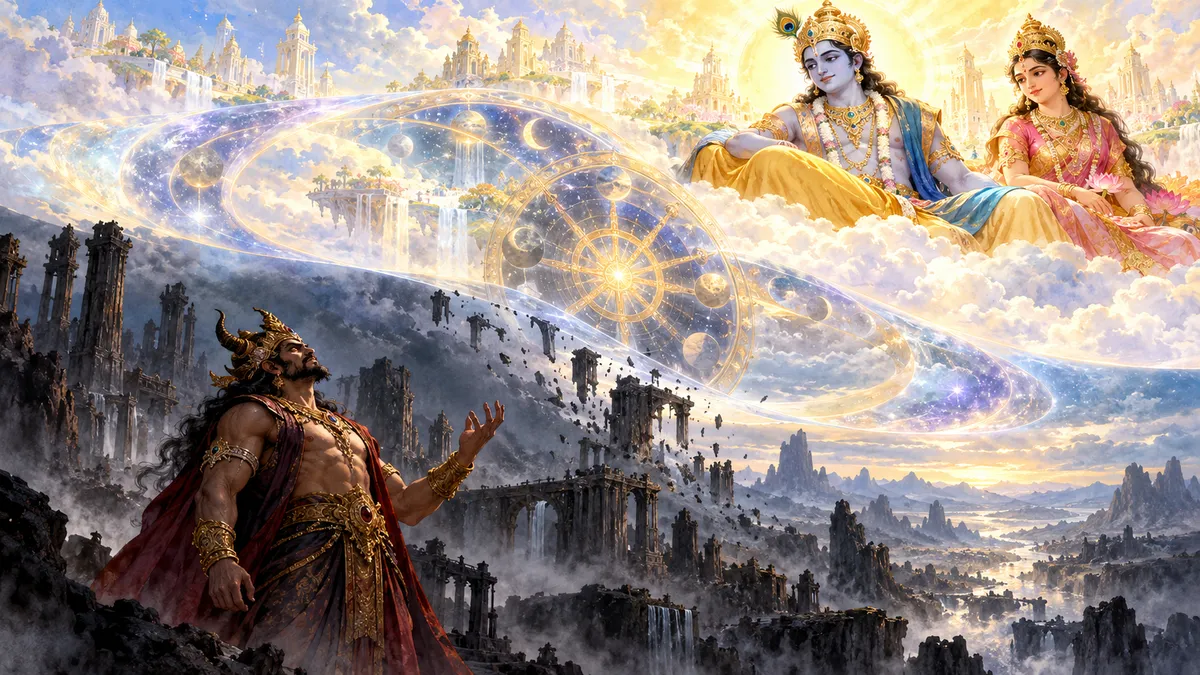
As soon as we gather our strength and come into awareness, we see that all these kleshas, these energies, all this importance dissipates. In the same way, in the world, as soon as the sages gather, all the material energies that seemed so important and serious become nothing and no one. This is a universal principle of creation. Everything coarse is governed by the subtle; everything external is governed by the divine. And when we open ourselves to our divine nature, we suddenly see that it becomes easy, joyful, and free for us to live, and that coarse things submit to the subtle and divine within us. The more we become conduits of the divine, the easier it is for us to manage life’s challenges, and the more freedom we have.
Divine Beings in Samadhi
Divine beings live in such a way as to be impeccable conduits of the divine will. They are always in samadhi. When we look at Dattatreya, the seven rishis, Guru Brahmananda, and Shankaracharya, these are beings who never leave samadhi. And samadhi is an indefinable state; it cannot be defined by the mind, and one cannot even speak about it. Although we speak about it, all of this is merely conventional. Samadhi is a state of infinity, of divine, holy infinity. And all these beings have long been abiding in samadhi; they have no duality. They are all aware: “I am Brahman,” “Aham Brahmasmi.”
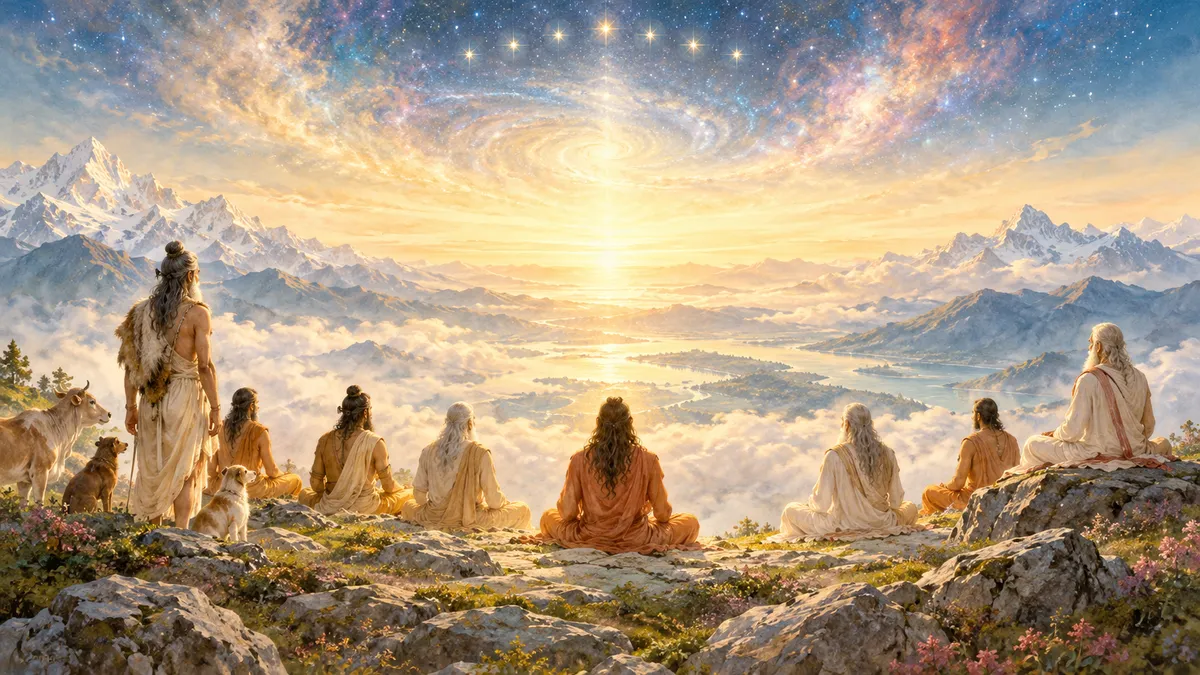
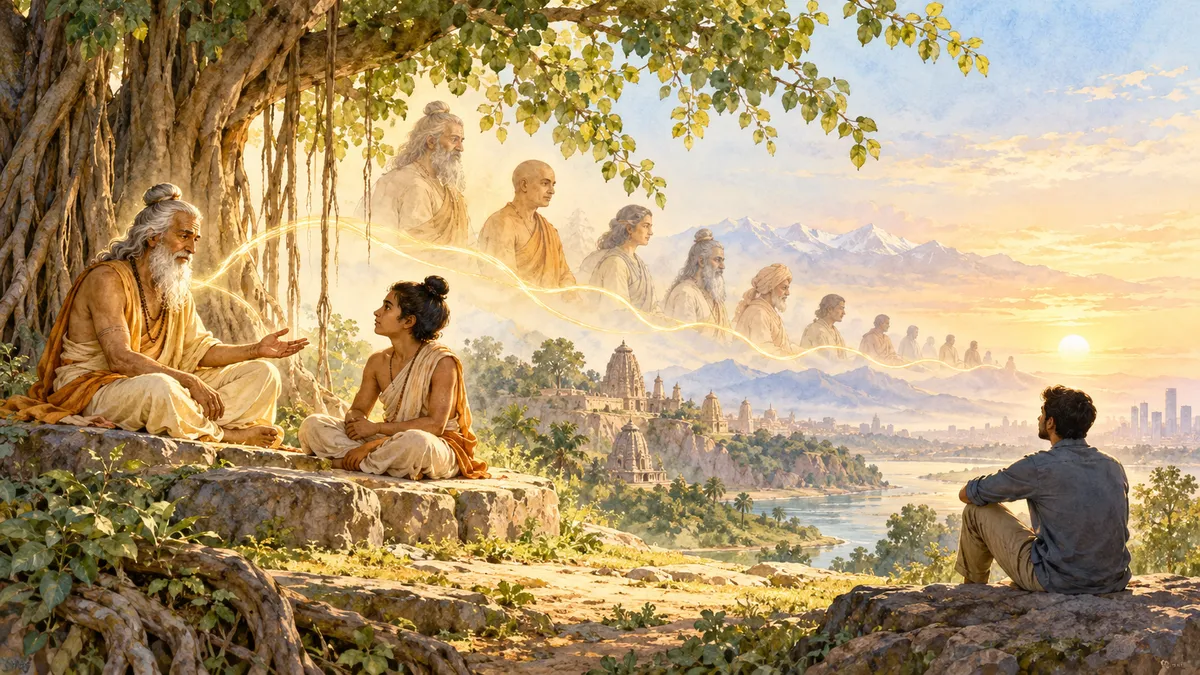
Therefore, it is very important for us to rely on divine beings, invoke their blessings, merge our consciousness with theirs, and discover their perspective on reality and the Universe. And this entire Tree of Refuge is like a universal tree, a hierarchy; it shows us our future evolution and where we should move next. It shows us our place in the Universe, and we must find this place in the Universe. That is, we must also place ourselves somewhere near the bottom of this tree and enter this lineage of succession.
The System of Divine Coordinates
Sanatana Dharma gives everyone the opportunity to determine their place in the Universe. It provides a system of divine coordinates. And it is very important to understand our place in the Universe, within this system of divine coordinates, in order to continue growing and evolving spiritually. Many problems arise for humanity because it lacks a culture that would provide it with such a system of coordinates.
Someone gets an idea, starts developing it, starts believing in it, someone else gets another idea... But all of this is not real—it is the unrealized nature of profound experience. For example, the communists created an ideology; Lenin wrote one hundred volumes—the complete collected works—and communist ideology emerged. In 1905, everyone sang, “God Save the Tsar!” and in 1917 everyone began shouting, “All power to the Soviets! Down with autocracy! Now we have our own gurus—Lenin, the Party, and the Komsomol.” Everything changed completely. In 1991, they started shouting again: “...” — this is bad; down with Lenin, the Party, and the Komsomol! Glasnost, perestroika, democracy—this is how we will live now.” Everyone was delighted: “At last, we have found it.” In 2010, they again began saying: “Now we no longer need perestroika, glasnost, or democracy. Autocracy, Orthodoxy, and nationality!”
In other words, in the space of just one hundred years, the course was radically changed four times. Why does this happen? Because there is no serious culture, no serious system of coordinates indicating where a person and humanity as a whole should move. It is impossible to develop under such conditions, when yesterday people bowed to the tsar, and tomorrow they overthrew him and began building communism and a bright future. They did not finish building it, abandoned it, and now we are moving toward democracy and perestroika. Ten years later, we became disillusioned, waved it aside, and now we will build something else. What is this? It is the absence of a serious culture, the absence of a culture that is beyond the control of time, the absence of a system of coordinates. There is no clear map, no goal, no development program.
But Sanatana Dharma is different. It is a culture beyond the control of time. Five thousand years ago, Vasistha taught Rama Advaita, and it is still relevant today. Ten thousand years ago, the “Tripura Rahasya” of Dattatreya was spoken, and we study it now and know that it is our path. A thousand years ago, Shankara wrote “Viveka Chudamani,” “Atma Bodha,” and “Tattva Bodha,” and we know that they are absolutely relevant today, that they are entirely about us. And for another thousand years, they will remain about us and absolutely relevant.
The Path of Spiritual Evolution
Sanatana Dharma establishes a system of coordinates showing that our future is to move from human being to God-human, to the divine. From the God-human, we move on to become a sadhu, jnani, or siddha; then further to the deity—the devata—and from the deity to the great deity—the mahadevata. Sanatana Dharma says: you were not born merely to eat and consume; all of this is only a part of life. It is necessary, but it is not the main thing. It is only an insignificant part of life; you were born to follow the divine path, to realize divine wisdom, to realize the divine will, and to perform divine deeds.

But unfortunately, among the seven billion people of humanity, hardly one percent or three percent can be found who fully realize this. Of the seven billion people of humanity, six billion 970 million are still in a childlike state, because they are like a child who does not even have the simplest toys. Many people are still simply not fed; many people simply have no housing; many people are simply struggling to survive; many people are simply ill; and many people simply lack the karma, merit, or education to understand the meaning of life.
For example, in India, 500 million people live below the poverty line. On our second-to-last trip, when we were in Delhi, about fifteen people approached the car. I said to Trailokyadevi, “Give them ten rupees...” What are ten rupees? She merely held out her hand, and it was like this! And another ten rupees... Can you feed everyone and make their fate happy? And this is only India, although India is not a poor country; it is a wealthy country, more powerful than Russia. But then there is Africa, the countries of South America...
Humanity is still in its childhood, when its main needs have not yet been fulfilled. It still seems too early for it to think about the divine, about transitioning to the divine, because only a mature mind can think about these things—a mind that no longer has passionate desires and has already solved all material problems. And those who have cultivated a mature mind, those who have fulfilled all their basic material needs, begin to understand that the matter is not material needs, but comprehending the divine. They no longer have greed, attachment, or avarice. They have an aspiration toward the divine. And this aspiration, once it arises, if cultivated properly, deepens, deepens, deepens, and becomes shraddha—faith, shila—single-minded purpose, sharanam—refuge.
Ignorance as the Source of All Problems
The problem underlying humanity’s troubles is ignorance. Crises arise because of ignorance, wars break out because of ignorance, the economy declines because of ignorance, and political corruption scandals emerge. All of these are different forms of ignorance. Because of ignorance, people have to work hard to provide for themselves; they cannot even earn a living. But when we eliminate ignorance, all our problems begin to be resolved. Eliminating ignorance and comprehending divine wisdom lead to the blossoming of consciousness, the blossoming of energy, and the flourishing of every nation, every people, every culture, every state, and the entire human race.
Sometimes I say: “Let us suppose that we can come to any country; we know how to make you prosperous, we know how to make you spiritually, materially, politically, and economically happy, but we will come and no one will listen to us.” This is because the modern world is such that people do not want to listen to sages. People do not believe in the wisdom of sages. People believe in money, power, fame, politics, and material shakti. This is the state of ignorance. They hope that these things will make them happy. But that is not so.
But when we create a culture that respects saints, sacred sages, sacred scriptures, respects Sanatana Dharma, all religions, and all cultures—a culture consisting of spiritual, meditating people—this culture is always blessed. And we need to take care that such a culture flourishes, is supported, and spreads. This is a sattvic divine culture. And although there are very few such people, they always make a great impression on others. My blessings to everyone, so that your spiritual path may be successful, that you may always be surrounded by such a culture, and that it may flourish and develop.
Feeding Sadhus as a Spiritual Practice
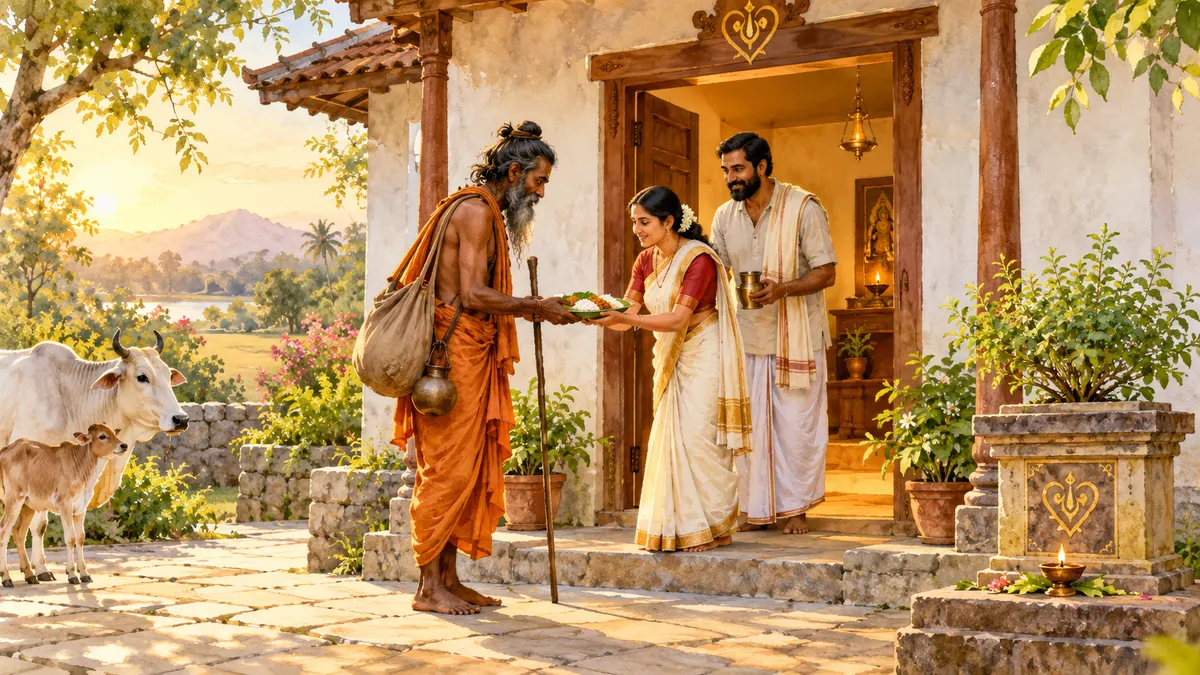
Practitioner: The simplest form of offering is feeding sadhus. Dronacharya and Mahavidya are feeding sadhus today. We have a project called “The Sadhu House.” We invited all the students in different cities, so that when a sadhu travels (a sadhu is not only a monk, but also a lay disciple who adopts a spiritual way of life and devotes himself more fully to spiritual practice), they can create such houses in different cities where sadhus could come and stay, so that they could be accommodated and fed. Odesa is participating.
If you are ready to receive sadhus in your home, hang a golden sign of Vishnu—the shrivatsa—above the door. This will be a sign for any sadhu who enters: this is a place where they can come in, and they will be sheltered and fed.
The Principle of Growing Energies Through Respect
The energies that you respect and make offerings to grow. If you want a particular energy to grow in your life, treat it with immense respect, and then it will flourish, grow, and develop. Any energy, if you respect it and make offerings to it, will develop. If you feed sadhus, there will be more and more of them around you. They will come and appear because you are supporting this energy.
For example, in India, in one place they decided to feed the poor. They began feeding them, but with each year there were more and more of them, and eventually the entire area became poor, with poor people all around. I said: “Why are you feeding the poor? It would be better to feed the rich. Then there will be more and more rich people, the poor will become rich, and your entire area will begin to prosper. The poor will move into the wealthy class; they will disappear altogether. You are feeding the wrong people.” Of course, the poor do need to be fed, but this does not solve the problem. One should not feed the poor, thereby encouraging poverty; one should feed the rich, thereby encouraging prosperity, and then the poor will move into the class of the prosperous. The energy you feed is the energy that grows. It increases. The energy to which you show respect blesses you.
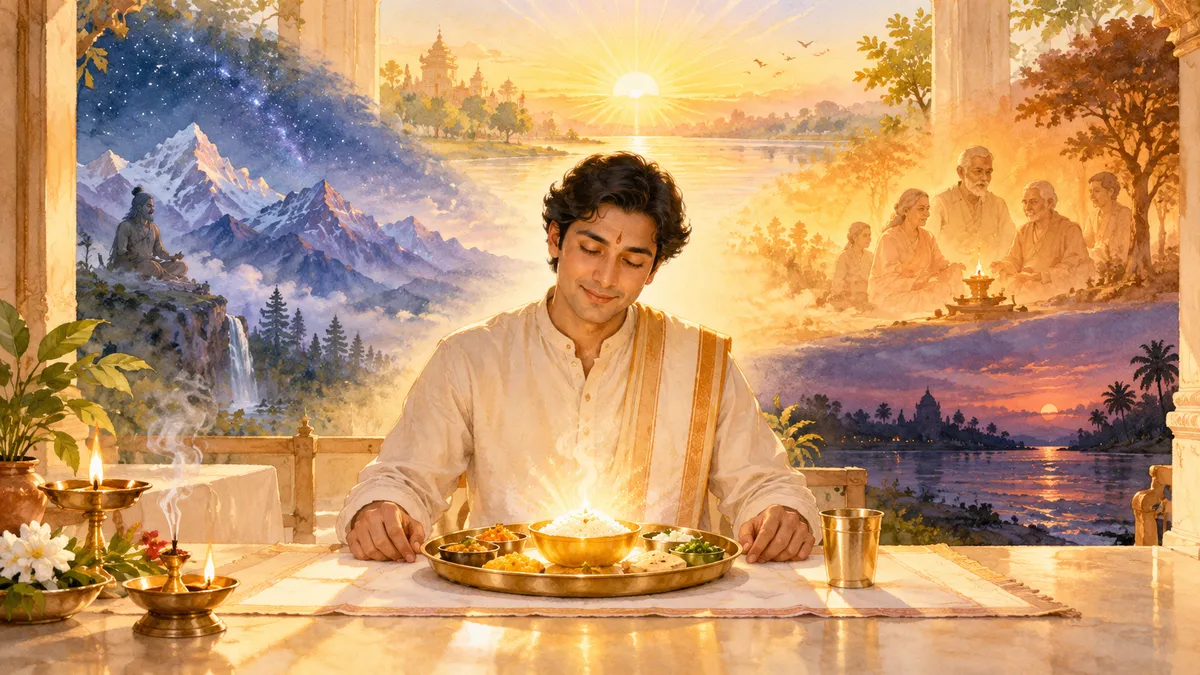
For example, if you eat food with tremendous respect, seeing it as divine nectar, this food will bless you. It will become healing. It will harmonize your prana, cleanse subtle obstacles, and contribute to an increase in vitality. It is worth eating attentively, with respect, offering it to the Refuge, sanctifying it, and visualizing it as nectar. But it is also important, of course, which direction you face. If you wish to invoke the blessings of the gods, you should eat and receive prasad facing east. If you wish to attract the blessings of the rishis and righteousness, then turn toward the north; if you seek material prosperity, face west, and if you seek fame, face south. This is because the east belongs to the gods, the north to the rishis, the south to the pitris, the spirits of the ancestors, and the west to the asuras.
Therefore, if you meet a sadhu somewhere in the street, grab him and take him to be fed, and then all the sadhus will know that sadhus are fed there, and they will come to you. You will communicate only with sadhus, your destiny will change, and you yourself will quickly become a sadhu; then others will feed you. This is an ancient tradition. In India it is also disappearing, but it still remains.
The Story of Durvasa Muni and the Pandavas
Once, Durvasa Muni decided to visit the Pandavas, the Pandava brothers, among whom were Arjuna, Bhishma, and others, together with his disciples. When they arrived, the Pandavas were observing a fast, and this fast had to be completed at a specific time—they had to break it. Then Durvasa Muni arrived with his thousand, or perhaps ten thousand, disciples. When they arrived, they said: “We will bathe now, and then we will come back, and you may offer us food if you wish.”
The Pandavas were very happy and wanted to feed the sadhus, but they had to end their fast. They faced a dilemma: either break the fast and eat before Durvasa Muni, before the holy man, or refrain from eating before the holy man, in which case the fast would not be properly broken and their tapasya would be useless. So they decided to break the fast ahead of time and eat after all, and they ate.
When Durvasa Muni came and saw that the Pandavas had eaten before him—that is, they had not held a bhandara but were already eating themselves—it was considered disrespectful according to those traditions. The Pandavas expected him to become angry, and they were already waiting for Durvasa Muni to come and curse them. Durvasa Muni was a very irascible person, an incarnation of Shiva; he could easily bestow blessings, but he could also curse just as readily, although that curse would ultimately become a blessing. And they were afraid that if he found out that they had eaten before him and violated the tradition, it would be all over.
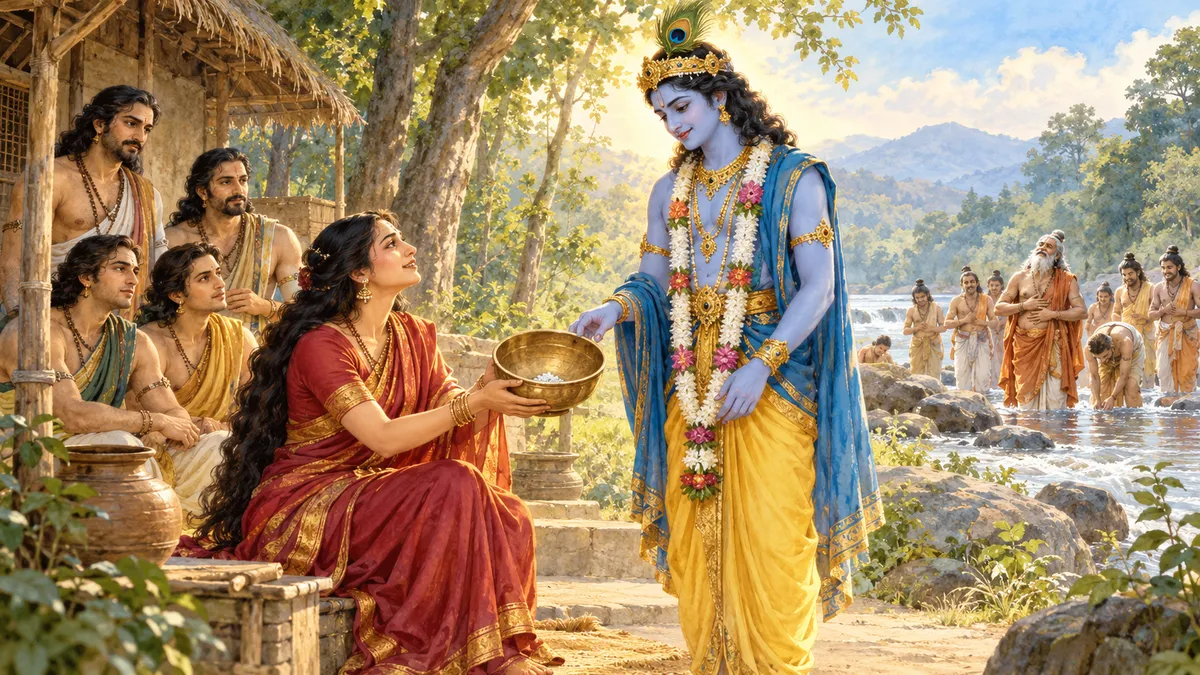
Then Draupadi began to pray to Krishna and said: “Only You can save us in this difficult situation.” Krishna said: “Bring me the vessel from which you ate.” How were they going to feed Durvasa Muni? They had a vessel that materialized food, the akshaya-patra. They had already eaten; they had no food left, and they could not prepare any more.
Krishna said: “Bring me the vessel.” He saw that only one grain remained at the bottom of the vessel. He multiplied this grain many times over, and made Durvasa Muni feel as though he had eaten, while all his disciples also felt as though they had eaten. They thought: “We have all already eaten. This must be the power of the Pandavas—they are such powerful people that they fed us with a single sankalpa. And if we go there, they will offer us food, and it will be very awkward for us to refuse.” They were all frightened. “The Pandavas are so powerful that they can feed people through the power of sankalpa.” So they came and said: “For some reason, we do not feel like eating today,” and in fact they did not come at all. Thus the Pandavas were saved.
But we do not have such traditions; you can eat earlier or later—what difference does it make? No one like Durvasa is going to curse you, so you do not need to be afraid.
Questions and Answers
Question: Gurujī, we should honor and worship our root Guru, right? Isn’t that an extreme, since there is another side to the coin as well? If we find ourselves in this situation, might the other side also manifest in order to harmonize the spirit?
The other side?
Question: Well, the negative, undesirable one, if we are captivated by the good one, and this is the good one.
There is no question of being captivated; we practice dharma not in order to be captivated. It is important to understand what the Guru is. The Guru is not a person; the Guru is a principle. The Guru is at once the root Guru who gives you initiation into dīkṣā and the guru-mantra; it is also the Paramguru—the Guru-grandfather who stands behind him; it is Guru Brahmānanda, Śrī Ādi Śaṅkarācārya, the guru ācārya who guides through the sacred scriptures and gives the philosophy of Advaita; Bhagavān Dattātreya, who is the Ādiguru in the heart of every person. And the point is that through our root Guru we must enter into a connection with this principle of the Guru, which manifests as the entire Universe, as everything divine. Ultimately, we must come to the Satguru in our heart. And do you want to deny the Satguru in your heart?
Apart from reverence, no other relationship is possible. Reverence for the divine—upāsanā, the spirit of worship—is one of the principles of yama-niyama, and this spirit must be cultivated within oneself. You must honor not only the Guru; you must honor yourself as the divine, the Satguru within you. You must honor your Iṣṭa-devatā as your Satguru. You must honor your sisters and brothers in the dharma within the saṅgha; ultimately, you must learn to honor every living being, every leaf on a tree, every brick and every atom in the Universe—only then will you be able to attain Enlightenment.
There can be no denial here; there can be transcendence of form and name in order to penetrate the true essence of the divine. But denial is characteristic of asuric beings, because the asuras are afraid to honor the divine: in the process of such reverence, they lose their identity, and their ego loses itself. Therefore, the path of Sanātana dharma is the cultivation of the spirit of worship (upāsanā), the worship of the divine everywhere and in everything.
If you think that you should honor only the Guru, and conceive of the Guru as a person, this is a dangerous delusion. You must honor not only the Guru but everything; secondly, you must not look at the Guru as a person. That is all.
Question: Such reverence is the level of a Master.
This is not the level of a Master; it is the accepted view in Sanātana dharma in general, in the tradition of Sanātana dharma. When honoring the Master, you honor neither his body nor his personality; when honoring the deity, we do not honor his form; when expressing respect to a sādhu, we do not look at his personality. When we make the gesture “Namaste,” the Añjali-mudrā, what does this gesture mean? It means: I honor the divine in you. We all greet one another in this way. In the process of this reverence, we must go beyond the name, beyond the form, beyond the body, beyond the personality and the mind, and see the divine spirit in everything. This is the principle of yama-niyama, upāsanā, Īśvara-praṇidhāna. And this spirit must be cultivated within us; it does not appear immediately. It must be cultivated and cultivated gradually. And if it does not work, we must pray to Dattātreya and to the saints of the Refuge Tree: “Please give me the blessing to honor the divine in everything.”
You should not engage in yoga, meditation, prāṇāyāma until you have cultivated such a spirit within yourself, because it is precisely this spirit that blesses and protects you on the path. If you practice mantra, japa, meditation and prāṇāyāma without cultivating such a spirit within yourself, your clarity will increase, your power will increase, your ego will increase, and you may follow an asuric path; asuric tendencies may prevail. This must be guarded against; it is dangerous. But when you have the spirit of worship, it comes to you naturally. We also call this pure vision.
And at first, of course, we do not have pure vision. Let us suppose your neighbor is sitting next to you, and it is difficult for you to believe that this person is a deity, that there is something divine in them, and that you should offer them namaste. But you have no other choice. You must cultivate yourself in this way, first through the mind, then through bhāva, and then it will reveal itself. If we do not have such vision, at least on the level of the mind we must somehow cultivate and attune ourselves so that, even if I do not understand it, the saints and the sacred scriptures say that this is divine, that this is how it manifests, and I must respect it.
Question: Guruji, please tell me, I understand that by the end of one’s fifth decade, it seems that half of life has already passed, and life is such a fleeting thing—it can end at any moment. And suddenly you feel that all this time you have, so to speak, not even begun to live yet. How can one accept oneself as one is and find the divine within oneself?
Live long, create the sankalpa to live long, because there is still a great deal of work to do.
In order to accept yourself, you must first accept something that surpasses you. You do not begin with self-acceptance; you end with it, because accepting yourself is already self-recognition—pratyabhijna. Self-acceptance is possible after serious mystical experiences (samadhi), or after profound insights in jnana yoga, in contemplation. Begin by accepting divine objects, but at the same time do not separate yourself from the divine objects.
For example, you have accepted Dattatreya as your Refuge, you have accepted the Tree of Refuge, allowing it into your heart as sacred divine energies. Then think: “They are not different from me; they are part of me; this is I myself, this is my ideal self.” From this moment, self-acceptance begins. When you look at Dattatreya on the altar but do not separate yourself from Dattatreya, when you see that Dattatreya is my divine Self, that we are one with him, and that by worshipping Dattatreya, I worship myself, by bowing to the Guru, I bow to myself. And when you accept sacred objects, divine objects, as part of yourself, of your consciousness, in the spirit of Advaita, then gradually divya-bhava, or brahma-ahambhava, the experience “I am divinity,” will begin to arise within you.
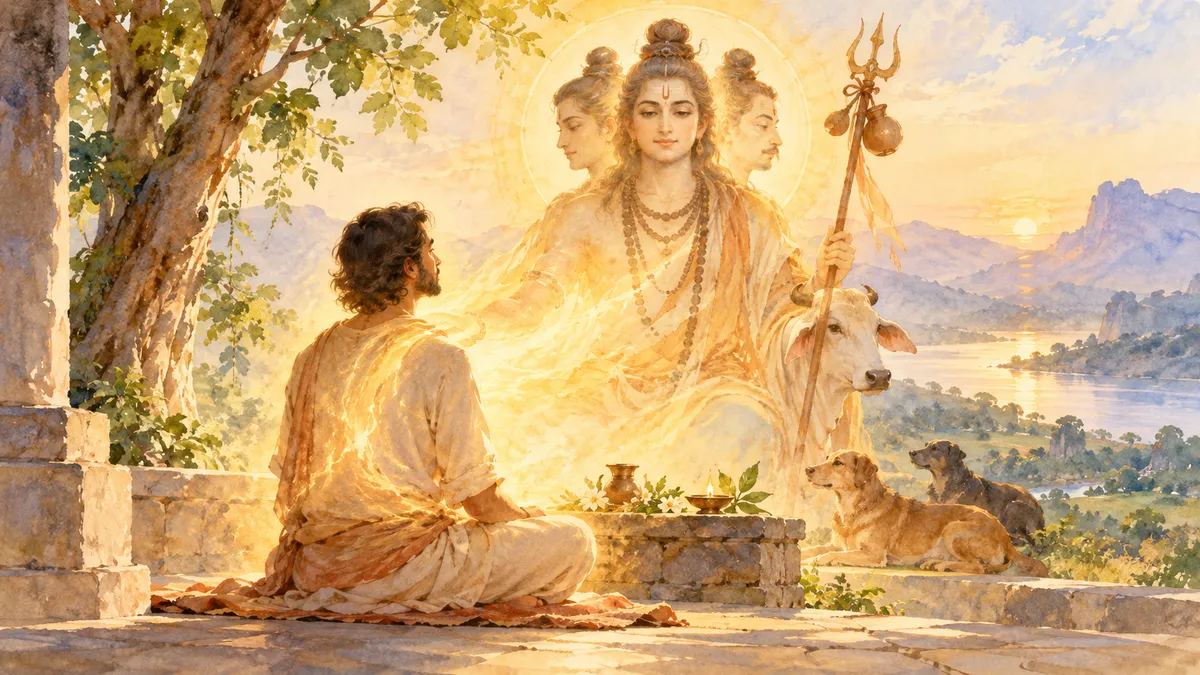
And this experience may arise as inner ecstasy, inner joy, inner greatness, purity, great devotion to the divine as pure divine bhava. And it will begin to flood your entire being, touch the ego and various areas of consciousness, purify and dissolve them; it will touch the very lowest boundaries of your Self, your deepest phobias, fears, complexes, and past karmas, and it will purify all of this, purify it completely. And when all of this has been purified, you will see that there is nothing in me except the divine, I am divinity itself embodied; it is simply that my mind did not understand this before, but in my depths, at my very foundation, the supreme divinity has never left me—I have always been that—and why, then, should I not accept myself?
Beginning with the acceptance of higher objects, we must then necessarily recognize the higher objects as ourselves, as something indivisible. If we do not recognize them, our ego may want to fight them, because the ego has its own ambitions and plans. And subconsciously, the ego may begin to enter into conflict; this means flaws in one’s view. That is, if you have no flaws in your view, then in the spirit of Advaita you honor the Guru, and you never have any conflicts with the Guru; you never have any conflicts with your Ishta-devata, with any deity, ever. You understand: “But all of this is part of me; I am one total consciousness. Perhaps I do not fully understand this yet, but in terms of the view, everything is so—there is no duality.” There are never any conflicts with anything at all in this world, in this universe; you are in a state of total acceptance, that is, everything is the Self, everything is part of my energies. And if everything is me, then how could I fight with myself? I can purify myself, I can nurture certain positive energies within myself, and work in some way with the negative ones, but I will no longer fight them, because who fights with themselves? Only someone insane.
When we are in a state of total acceptance, any relationship is a lesson for us, any situation is a blessing, and pure vision arises by itself. Any manifestation is darshan. When we are in duality, relationships confuse us, situations attract and bind us, and events sometimes bring joy, while at other times they lead us into delusion and confusion. But always and everywhere we strive to remain in non-duality, in the non-dual view. And when we have received the darshan of the non-dual view, it is important to remember it, remember it, and assimilate it well, forever. Or, until you have assimilated it, keep coming to the Guru until you are completely convinced of it. All uncertainty and doubt must be cut away; this is the principle of shravana and manana. Then simply maintain it always and everywhere—this is nididhyasana, the third principle. If you follow these three principles—shravana, manana, nididhyasana—then you know the entire essence of Sanatana Dharma. Whoever knows these three principles knows everything.
And accepting oneself means recognizing one’s divinity. We do not know our divinity; we do not believe in our divinity. We are unaware of that space of pure light hidden in our heart. We know our mind, our body, our energy. We are always dealing with them, but first we must at least accept on faith what the holy sages, the sacred scriptures, and the lineage Guru say—simply accept it as a fact and become accustomed to this fact. Then we must gain a personal experience, the soul’s direct experience of this divinity, and having received it, even for a while, even for a few seconds, we need to remember it and try to remain in it, continuing and continuing, and learn to look at the world through the eyes of this divinity, to act from this divinity, without jumping back to our old perception, to our old karmic vision. Slowly, this will be purified.
And when we begin to look at the world through the eyes of divinity, a single taste will naturally arise within us; pure vision will come naturally, as will the experience of divine grandeur. The feeling of doing, the sense of being the doer, attachment to the fruits of one’s labor, and the limitations of karma—all of this will naturally disappear. We will begin to act spontaneously, intuitively, playfully; we will become empty, void-like, because divinity is not overcrowded with names and forms; there is no overpopulation there. Divinity is infinity beyond name and form, infinity beyond subject and object. And we will begin to play—or rather, it will not be we who begin to play: we will dissolve, and the infinity of the divine will begin to play through our bodies, speech, and minds.

Therefore, all wise sadhus are very light; they are all empty, they do everything effortlessly, and it is as though they act without acting and speak without speaking; they are always in harmony. They are in harmony with themselves, in harmony with the universe and with other beings, because there is no ego within them, no center to which one could cling; there is no clinging within them, no ambitions, no pride.
Accepting oneself means acknowledging this divine space, this divine light, which is the source of our thoughts, body, speech, and mind. This is called pratyabhijna—self-recognition. But such self-recognition is possible when we surrender our ego to the divine source within us, neither later nor earlier. When we surrender our ego and say, “Not my will, but Yours be done”; when we say, “Ego, we are no longer ‘We’; I am alone, I am no longer your slave. I am your Master, and you are my function, my helper, my servant”; when we say to the mind, “Mind, I am no longer your slave; you are my function, my faithful servant, but you are not my master; I will no longer listen to you”—then it becomes possible. When we say, “I have already done everything; I do not need to do anything; the doer is gone, doing is gone.” When we say, “I do not need anything more, no fruits in the external world; I remain here and now, without doing, without a doer; I have done everything, everything that needed to be done; there are no actions; I am free from actions; I abide in my own nature; I deepen my understanding of it, as though I had been enthroned at the summit of Kailash.”
Actions may be carried out by the body, but it is all a play. It is simply a play arising from our natural state, but there is no doer, no clinging, hopes, or fears. Then self-recognition will arise, and self-acceptance comes from self-recognition. There are other psychological methods of accepting oneself, in which people say: love yourself, embrace the child within you—various such clever tricks of the mind. Psychologists help many people through these methods, and that is also good. In New Age culture, there are many coaches who engage in similar practices and help others. People become a little more harmonious, a little more relaxed. But this will not truly help you, because the ego will still remain.
True self-acceptance arises from self-surrender, from self-recognition. Self-recognition means understanding “Aham Brahmasmi.” You understand this formula truly, with your spirit. It is a very great formula, a mahavakya. It may take you perhaps decades even to attain it to any degree, but merely realizing this formula is like nuclear weaponry, like atomic energy. In atomic energy, even 200 grams can generate immense shakti. Even a little realization of the formula “Aham Brahmasmi” will give you a completely new turn in your vision of life and your vision of yourself; therefore, our entire life is meditation on the formula “Aham Brahmasmi.” It is the recognition of this formula; you must meditate on this formula correctly.
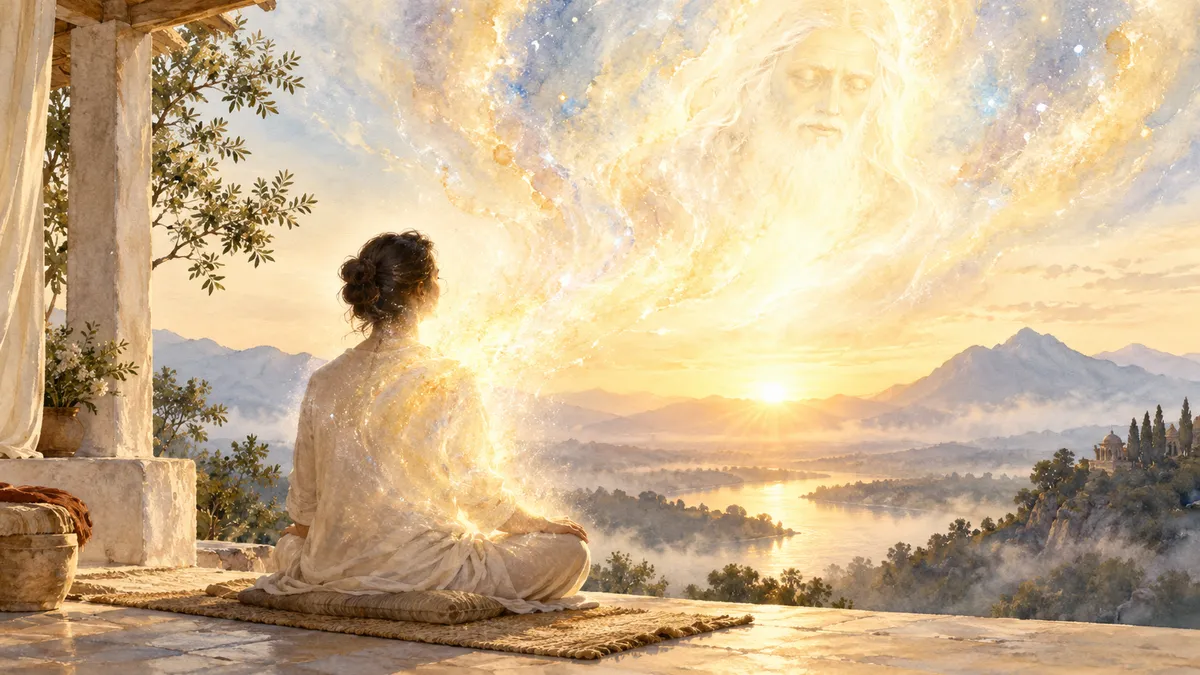
This mahavakya was first uttered by the sage-rishis long ago. And it appears in the Upanishads: the four principal mahavakyas are “Prajnanam Brahman,” “Aham Brahmasmi,” “Tat Tvam Asi,” and “Ayam Atma Brahman,” the four great mahavakyas of the Vedic tradition.
The Four Great Mahavakyas
Prajnanam Brahman means that pure primordial consciousness is the Lord, God, the Absolute.
Aham Brahmasmi means that in my essence I am the Absolute; that is, I am not a finite individual, not the body—I am infinity, I am divine infinity.
Tat Tvam Asi means “You are That”: you are the soul, and That is the Absolute. Tat means “That,” and Tvam Asi means “you are That.” You are not the body, you are not the mind, you are not an individual—you are That, you are Brahman.
Ayam Atma Brahman means that this Atman, this consciousness, is the Absolute.
All four mahavakyas are the mahavakyas of Advaita Vedanta. These were the very words that Acharya Swami Deshananda whispered to me during my initiation as a Mahamandaleshwar at the Kumbh Mela. I thought: “Oh, a familiar phrase—we sing it every Saturday.”
