

When the soul seeks God, it seeks a path to Him. At first, of course, the soul does not seek God—it seeks happiness. At first, the soul is far from seeking God; it simply wants to arrange its life a little better in this universe. It simply wants not to suffer, but to be happy and normal, and it seeks happiness. And when it becomes disappointed that material happiness does not bring it satisfaction, it begins to seek another kind of happiness.
This is called disillusionment with samsara, and sooner or later everyone, if they possess at least a little wisdom, becomes disillusioned with samsara. In other words, samsara is not a place where happiness can be found. Samsara resembles a useless candy in beautiful packaging, sometimes even a poisonous candy. A very good advertising campaign has been created for it; excellent PR managers have worked on it. It is advertised and promoted very well everywhere, the marketing is excellent, but the candy itself is useless, and sometimes even poisonous. Beautiful packaging—that is what samsara is, and the soul that understands this becomes disillusioned with samsara. It can no longer be won over by beautiful packaging, labels, and advertising.
Everyone understands that the products being advertised look foolish, so that people will immediately rush to buy them, because people want to make money—that is all. In the same way, samsara is built on certain energies, and when it presents itself so beautifully and powerfully, it is simply material energy (Prakriti) at work. This has nothing to do with happiness, and disillusionment with samsara is an indication of the soul’s maturity.
Disillusionment does not mean that we need to deny it, condemn it in some way, or fight against it—this is pointless. Disillusionment with samsara means that we reconsider the scale of our values, meanings, and beliefs, which have been built on the material and on samsaric values. We rethink our life strategy—and this is very important.
We have meanings—this is how we see the world in general, how we define the meaning of life. And there are values that arise from these meanings—a scale of values and priorities has already been established. Based on this scale of values, the mind sets goals, specific goals for realization, and when the goals are clear and formulated, the command is given to put them into practice.
A sadhu is someone who has fully understood the meaning of life, formed a good scale of values, and defined the right goals in order to realize these values, and then acts in accordance with those goals. But many people are not like this.
The state of a person preoccupied with samsara, the so-called ajnani—ajnani is a model through which we demonstrate the soul’s delusion. This does not mean any particular person, but rather an ideal model in general, which is useful for showing all the delusions of the human soul. The state of an ajnani often arises when the meaning is unclear—there is no answer to what the meaning of life is; there is no answer to what the meaning of the material universe is; there is no answer to what the meaning of birth in this material world is.

The most mysterious questions have somehow been forgotten, even though our soul asked these questions when it was incarnating, and in childhood we asked them of adults. But then, somehow, so many other, secondary questions appeared that we stopped seeking answers to these questions; we were more or less satisfied with evasive replies. But a sadhu is someone who is not satisfied with evasive replies; they keep searching and searching, as they say, digging deeper.
Sometimes meanings are unclear and values are also blurred, making it difficult to define goals—this is a major problem of modern humanity, because true values are being replaced by the values of consumer culture, the values of political culture, and ideologies. What are ideologies? Ideologies are certain mental patterns that are offered in place of true values. There is great misunderstanding and great ignorance, and therefore action is also mistaken—action under the influence of the analytical mind, under the influence of the intellect, instincts, and egoism. Such actions, of course, will bring problems and suffering, as we see in the modern world.
The modern world is far from ideal; there is suffering in it. Suffering is a consequence of egoism, egoism is a consequence of misunderstanding, and misunderstanding is a consequence of ignorance. A sadhu is a person to whom the merits of karma have nevertheless allowed a certain degree of understanding—to make sense of things, to establish a proper scale of values, to set the right goals, and then to follow the path toward achieving them.
Studying Philosophical Texts
I recommend that students study and explore the philosophical texts of the Advaita Vedanta teachings very deeply. Ideally, each of you should be able to approach and study them at least at the level of a PhD candidate. We need to understand the teachings logically, because if we do not understand them logically, how will we understand them intuitively, contemplatively, beyond the mind—after all, logical understanding is the simplest. It is impossible to practice something you do not understand intellectually. First, it must be understood by the mind—that is the minimum; it must be understood well by the mind, and one must receive the blessings of Saraswati.
Without intellectual understanding, practice is difficult and sometimes even unsafe, because attempts to break through the conceptual mind using various lock picks, methods, and skillful means do, of course, succeed, but we must be able to explain the experiences that follow. We must establish priorities and be able to analyze them from the standpoint of the saints and the sacred scriptures—then there will be a result, and the practice will be correct. Spiritual experience is not only a blessing but also something very profound; it can be confusing, and we need viveka (discerning wisdom).
Perhaps I am exaggerating with the PhD candidate comparison, but one must know the texts, which is why I always tell students to study the “Yoga Vasistha,” the “Tripura Rahasya,” the “Viveka Chudamani,” the foundational texts, the ten principal Upanishads, and the eleven canons of the mukhya Upanishads selected by Shankara, in order to understand the philosophy of Advaita and study the basic Vedic culture as such. We must thoroughly understand at the intellectual level what the sacred texts and the saints say about the meaning of life, about values, how to act, and how to conduct ourselves—then the practice will also proceed successfully.

If you want to understand any aspect of the teachings of Advaita Vedanta, Tantra, or Sanatana Dharma, you can do the following: simply write a short treatise—one page or three pages—on the topic that interests you. Find everything available from the sacred scriptures, take quotations from the saints, and offer it to Saraswati after reciting a prayer for blessings, so that Saraswati may grant you the wisdom to understand what you want to understand.
The Sadhu as Researcher and Observer
There is a great deal that needs to be understood in spiritual life, because a sadhu, a spiritual person walking the path of Dharma, is by nature a researcher, an observer, and an investigator. This observing consciousness is called sakshi (witnessing), while investigation is called vichara. To investigate divine reality is the destiny of a sadhu, and to observe what is not divine reality without becoming involved is also the destiny of a sadhu. Therefore, our destiny as sadhus and practitioners is to become researchers and observers.
Many people think that their destiny is to become doers, and Dharma practice is also perceived as yet another thing to do. We are accustomed to being doers. The language of actions makes sense to us; we know that if something is needed, it must be done—we have been taught that we must always be doing something. And then, when we hear about God and liberation, we think, “Oh, so we just have to do this.” “Make it,” “do it”—that is what they say in America; and when we try to make liberation and make God in the American way, it does not work—it is impossible. It cannot be bought, it cannot be made, and here the issue is not doing at all; the issue is investigation, understanding, clarification, awakening the subtle aspects of the soul, faith, devotion, and self-surrender.
At the beginning, of course, through logical understanding and analysis—in other words, fundamentally, in the process of spiritual life—our tendency to be doers of something in the material world shifts toward the tendency to observe, investigate, open ourselves, and awaken. Of course, we can do certain things; there is no need to renounce actions where they are appropriate—for example, we can perform asanas, carry out ritual practices, study, even take examinations for levels within the teachings, and perform service. All of this is good. But doing itself is only a supplement; spiritual life does not unfold on the plane of action, and it presupposes that the doer must gradually withdraw over time, making way for non-doing. It is in the dimension of non-doing that an understanding of Dharma arises.
The Three Jewels
Thus, disillusionment with samsara makes it possible to rebuild meanings and values and to determine one’s actions. The meaning of every sadhu’s life is the knowledge of God and attaining freedom (moksha); there is no other meaning. If he has another purpose, then he is not a sadhu, but simply another person belonging to a different category. But if we are speaking of a sadhu, then the entire meaning of a sadhu’s life consists in this: he revolves, as it were, around God and only around God, around the Absolute.
God comes to the forefront in a sadhu’s life. If at some point his own interests, his own desires, or perhaps the external material world were in the foreground, then when a person becomes a sadhu, God comes to the forefront for him, one way or another. Why? Because a sadhu who has become disillusioned with samsara, with happiness in the material world, begins to understand very clearly and well that happiness is found in God.
Then he begins to seek God, and the investigation of divine reality becomes his destiny—vichara, brahma-vichara, observing the material world, and the state of conscious witnessing.
Disillusionment with samsara must first take place within; there is no need to rush to demonstrate it to others, and there is no need to rush into making any drastic changes on the external material level. Sometimes one’s decisions need to be tested by time. When we decide something, we should wait a little—if it is a genuine decision, it will not change. For example, you have decided to become a monk or decided to withdraw into seclusion. If it is an impulsive decision, do not rush; simply wait. If it is a genuine decision and it does not disappear after a year, it will, on the contrary, only grow stronger. But if it suddenly disappears, then it was a false, fabricated decision, and you are not yet responsible for it—it arose under the influence of the planets, under the influence of mental tendencies, or perhaps under the influence of someone else’s example. But that which does not disappear with time is authentic; it is real.
How can one recognize an experienced sadhu, a saint, in general? He never changes; he never changes the direction of his intention, his thoughts, or his actions. He moves forward like an icebreaker, as the years go by. Dharma does not change either. Everything that is true and eternal does not change; it is eternal. That is why our path is called Sanatana Dharma (the eternal divine principle), the eternal divine law.
Where are the kingdoms described in the “Tripura Rahasya” and the “Yoga Vasistha”? Five thousand years have passed, perhaps ten thousand years—we do not even know—and yet the subject remains the same, without change; Dharma remains the same, without change. Political regimes may collapse, and various events may take place, but a sadhu does not change his direction—that is a sign of his authenticity.
In July of the previous year, two thousand fifteen, it had been twenty years since I began teaching Dharma—nothing has changed; everything remains the same because Dharma is eternal. Atma-vichara has remained the same, everything remains the same, because you cannot change along with the world if you are a person of Dharma. Because if you are a person of Dharma, if you are a sadhu, you discover within yourself that timeless eternity which never changes again. God is that which is beyond time, that which never changes, that which does not act, that which lies beyond the mind’s judgments, that which lies beyond perception.
Disillusionment with samsara has, as its reverse side, the search for that which is beyond action, beyond time, that which is eternal and never changes.
The Four Maras on the Spiritual Path
On the spiritual path, a sadhu encounters various traps and various difficulties—this is true, and knowledge of the texts, knowledge of philosophy, and viveka (discerning, discriminating wisdom) are very important in order to avoid all these traps.
There are four maras. For example, there is the mara-skandha, the so-called mara of the sheaths, that is, when our sheaths are taken to be the true “I” and we cling to them. There is the sheath of energy, the sheath of the physical body, the sheath of the astral body, the sheath of the mental body—they all have their own experiences. In each sheath we have a certain degree of awareness, but what is the mara of these sheaths, the mara of the five koshas, which in Buddhism is called the mara-skandha? It is when we cling to the experiences of the sheaths. The very fact of clinging is the mara; that is, mara is, conventionally speaking, like a demon. This does not mean that there is some kind of demon there; it simply means that this is the tendency of the mind. Through viveka (discriminating wisdom), we can easily bypass the influence of these maras.
There is another mara, called the mara of the kleshas, meaning that the obstacle comes from the kleshas. Kleshas are afflictions of the mind arising as a result of worldly desires: egotism, arrogance, greed, malice, hatred, uncontrollable lust, avarice—all of these are kleshas, afflicted states, while the mara is when our mind clings to them. In the same way, we must understand what the culture of a sadhu is, how a sadhu subdues the mind, how they purify the kleshas, and how they discipline the mind in order to bypass these maras.
There is also another mara, called the mara of the son of a celestial being; this refers to ego, arrogance, pride. In other words, it is not ordinary worldly conceit, but spiritual self-importance, something that constitutes an obstacle. The mara of the son of a celestial being tempts the yogin later, not immediately; that is, at every stage of the yogin’s journey, certain forces lie in wait to test them.
The mara of the kleshas tempts one at the very beginning, while the mara of the sheaths (clinging to the skandhas) tempts one later, when mystical experiences begin. Until you have subdued the mara of the kleshas, you will not attain mystical experience, because the kleshas take everything for themselves; all the energy goes toward the kleshas—so how could one attain mystical experience?
But as soon as the yogin has subdued the kleshas, purified the channels, and freed themselves from attachments, the body becomes light, and they can sit in meditation for a long time without moving. They think: “Excellent, now I’ll start floating just like all the saints.” But here another mara awaits them—the mara of the sheaths (the mara-skandha). They will discover that the mind has a tendency to cling to absolutely everything: experiences, images, thoughts, any kind of experience. All these experiences are limited by the sheaths, and it is very difficult to subdue this mind so that it does not cling—great discernment and great wisdom are required here.
Finally, when they have overcome these attachments, a feeling arises within them once again: “I have done it; I am free from this.” But here the mara of the son of a celestial being lies in wait. It says: “Well done, you are very powerful, you are undoubtedly a great sadhu, you are a siddha; others should respect you. Heaven forbid that anyone should fail to respect you.” Thus pride is born—the pride characteristic of a celestial being.
All celestial beings, the gods who dwell in places such as Indra’s heavens, possess this sense of self-worth, power, splendor, and greatness. These are bhavas, certain views, and in the heavenly worlds they manifest as siddhis, supernatural abilities, patronage, and what is called aishvarya-shakti—it is far greater than among human beings.
But from the perspective of liberation, this is yet another trap, because a sadhu does not seek the joys of heaven or the joys of worldly gods, since no one can rise above the worldly heavens while still possessing self-importance. Self-importance and pride arise from the ego, while the ego itself is ignorance—root ignorance, so to speak, the very essence of ignorance.
The titans, the asuric beings, are also beings who have developed immense self-importance. This self-importance prevents them from coming to God, which is why asuric beings are always waging battles in the subtle worlds, fighting wars with divine beings. Asuric beings dwell in rajas, while divine beings dwell in sattva-guna.
Vairagya—the Nectar of Renunciation
Thus, when a sadhu overcomes these maras with the help of discriminating wisdom (viveka) and vichara, vairagya arises within them. Vairagya must be understood very deeply. It is not simply renunciation of the world or renunciation of desires—vairagya is the ability not to be reborn in gross, material worlds. It is the ability not to be seized by material energy (Prakriti) even to the slightest degree, the ability to live on divine light, and the ability to nourish oneself with antaranga-shakti.
Avadhuta Dattatreya says the following in the “Avadhuta Gita”:
“The avadhuta drinks the nectar of renunciation; the saints drink the nectar of renunciation.”
How can renunciation be nectar? After all, renunciation is usually something negative, when we lose something—so what kind of nectar are we talking about? In fact, for saints, renunciation truly is nectar, because they drink the nectar of God, they drink the nectar of divine light, they are nourished by the subtlest energy called antaranga-shakti, and they do not depend on material energy (bahiranga-shakti). Even if they use it, they use it for others, not for themselves; or they have no clinging, no attachments; or they use it in the spirit of the teachings of tantra, which allows one to operate with material force without attachment or dependence.
Vairagya means that we act without a doer; we act from non-doing. This means that the question of action has been resolved. When we embark on the spiritual path, sit in satsang, it is very important to tell ourselves: “I have already done everything.” Until we tell ourselves, “I have already done everything,” until we have unfinished tasks and unresolved matters, we will not be able to enter the presence of awareness, the natural state, non-doing.
Overcoming the Concept of the Doer
Sometimes we can notice that our mind is even afraid of such pressure, because everything in this world seems to be built around doing. We immediately begin to think: “How can that be? I have to do this and that. If I do nothing, the apartment bill will arrive—who will pay it?” That is not the point—the things that need to be done can continue to be done as usual. The point is that the mind that wants to do, the worrying mind, must disappear. And this mind is not so easy to calm; the concept of the doer, of the mind, must leave.
Therefore, when a disciple sits in satsang, they should tell themselves: “I have already done everything. I do not need to do anything,” because the issue is not doing, but being. When we do not need to do anything, when we have done everything, for the first time we can abide in the state of the observer. What else is there for us to do if nothing needs to be done? Because when we are bound to action, attached to action, observation is impossible—the doer interrupts the observer. Conversely, when we have done everything, the observer awakens, and atma-vichara and shambhavi mudra awaken naturally, by themselves.
This is reminiscent of something. Why is satsang important? Because while you are sitting in satsang, you are genuinely doing nothing. You simply enter the field of the Guru, the field of the Dharma. What else is there for you to do here? During this time, you are genuinely in non-doing. Satsang is the embodiment of this non-doing, the embodiment of the awakened state, so sometimes one simply needs to remain in satsang in order to become imbued with its taste.

This is reminiscent of a theater or cinema: you have reached the cinema or theater and taken your seat, but after that you can no longer do anything. You cannot walk around during the performance, say something, do something, start anything; you cannot correct anything—you simply have to be an observer. You are a witness, and that is all; from then on, the process is no longer in your hands. When we change the mind’s concept to non-doing, observation, contemplation, and awareness awaken naturally. Our destiny as sadhus is to remain in observation, not to be doers, but to be in observation first. One can act, but later, from the state of the observer.
The State of the Observer and the Birth of Inquiry
If there is no observer, then all doing is useless. It may help in worldly life, but in spiritual life it is of little use. The state of the observer, sakshi (witnessing consciousness), is the first sign of the development of jnana (wisdom).
Inquiry (vichara) arises from the observer. When we can observe the surrounding world without becoming involved, while remaining in non-doing, sooner or later another question will arise: “But who is the observer itself? I observe, but there is also an observer. What about understanding the observer?” Our observation begins to turn inward, to turn toward ourselves; then atma-vichara naturally begins.
We begin to understand that within “I,” within us as observers, there is depth. And when we study the texts and listen to the Guru’s teachings, they say: “This is the path to God; God is within you, but you must seek Him, you must understand what is not God and what is. It is not such a simple matter to separate one from the other; viveka (discriminating wisdom) is needed.” In all the years that follow, the disciple does nothing but separate God within themselves from non-God.
A thought arises — this is not God. Images arise — this is not God. An experience arises, great experiences, but this too is not God. As long as there is someone experiencing, this is not God. Wherever there is a duality between the experiencer and that which is experienced, this is a continuation of the mind’s illusion. Through the method of viveka, the yogin cuts away and separates the layers, like the skins of an onion, one from another; he experiences various coverings.
Paradoxes of Spiritual Life
At last, a moment arrives when vichara (inquiry) leads to such an experience. This does not mean that experiences are unnecessary — they are useful; they represent a certain stage. The issue is not the experience, but one’s attitude toward it. Many people think that the issue lies in the experience — not at all.
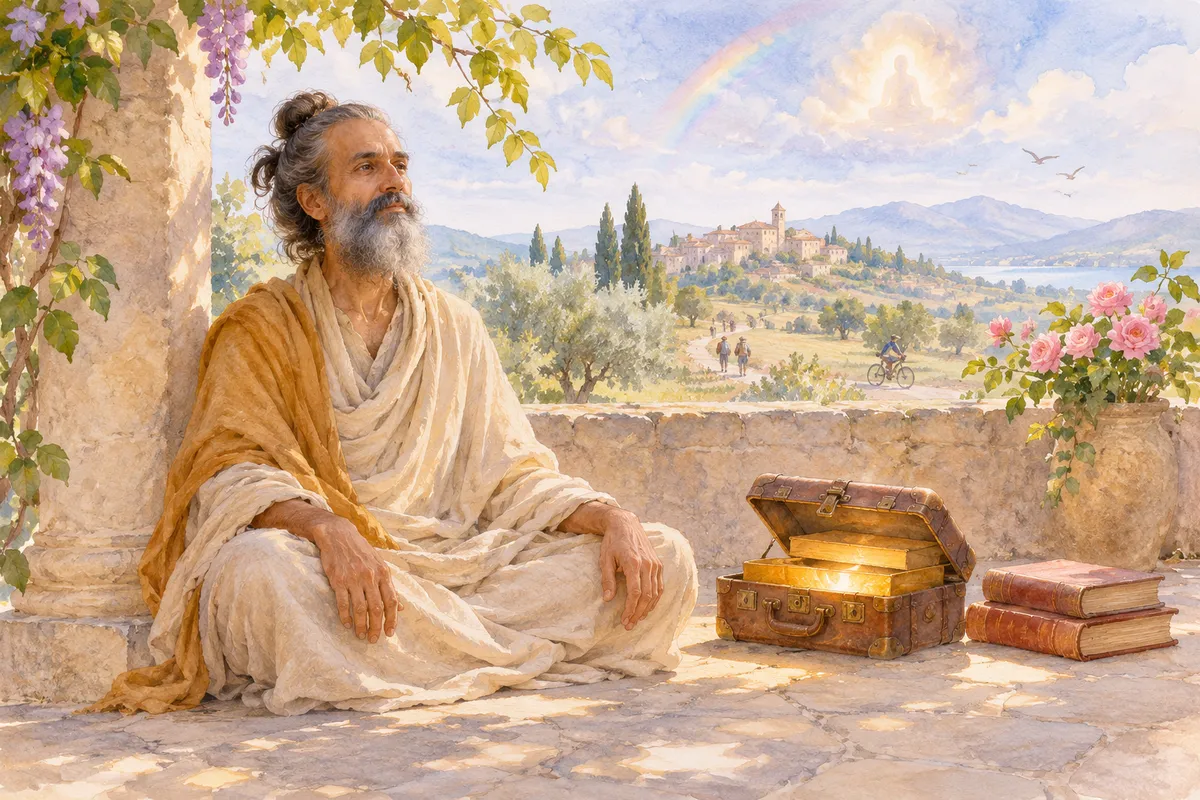
You see, spiritual life is paradoxical: we think the question is about doing something, whereas the question is about non-doing. We think that we need to gain experiences, whereas the question is not about experience. It is like a suitcase with a double bottom. Without the sacred scriptures, without the guidance of saints, it is difficult to understand this, because the soul in samsara is simple and guileless, and is easily inclined to deceive itself. But divine reality is structured in a very mysterious way, unimaginably mysterious. We cannot even imagine how mysterious it is.
If you think that the saints have understood it, or that the gods know it like the back of their hand — no, it always remains a mystery both for sages and for gods. In principle, it is inexhaustible as a mystery; it is impossible to understand it. One can abide in it, become free through it, remain in awe of it, worship it, and surrender oneself to it, but it is never possible to know it completely.
Thus, the issue is not the experience, but one’s attitude toward the experience. A sadhu learns to relate to the experience by observing it as well, without becoming involved and without attributing significance to it. As long as there is someone experiencing experiences, this too is a form of duality. But when the experiencer is overcome, this can be called the true experience of awakening, when the experiencer, the very experiencer, disappears. But in the process of spiritual life, the experiencer is in no hurry to disappear — there are very many stages of this disappearance. Traditionally, sixteen stages of the dissolution of the experiencer are described.
Sri Ramakrishna described the following example: a salt doll entered the ocean and began to dissolve; it remained there until it dissolved completely. When it dissolved, it did not return, because there was no one to tell the story, for the salt doll itself had disappeared.
A salt doll dissolving in the ocean is an example of realization on the path of Shankara’s Advaita Mayavada. The divine ocean dissolves the salt doll of the ego; the salt doll dissolves because from the very beginning it was not real, from the very beginning it was illusory. And if something dissolves, it is the illusion of the ego that dissolves — this is kaivalya-mukti.
The ideal of tantra is somewhat different: the salt doll dissolves in the ocean, becomes the ocean, and then begins to send magical emanations from the ocean, resembling salt dolls, but composed of light. The soul passes through both of these stages on the path to realization.
Humility — Preparation for Self-Surrender
So, I would like to read aloud Chapter Twelve from the book Spiritual Alchemy. The Path of Inner Asceticism — “Humility — Preparation for Self-Surrender and the Descent of Divine Grace.”
“Even if you have already achieved small victories in inner alchemy, somewhat subdued the mind and coarse desires, learned to contemplate without distractions, and somewhat submitted your will to the divine will, do not be deluded or proud. You are only at the very beginning of the path, for the ladder to God is endless, and above you are all the great sadhus, saints, siddhas, rishis, and gods.”
When we walk the spiritual path, it is very important always to keep the Tree of Refuge in mind, and not merely to keep it in mind, but to do so with faith, love, and devotion. We must always believe, know, and be certain that behind us and above us there is a vast tree of saints, and that we always have somewhere to turn. We are not alone on the spiritual path.
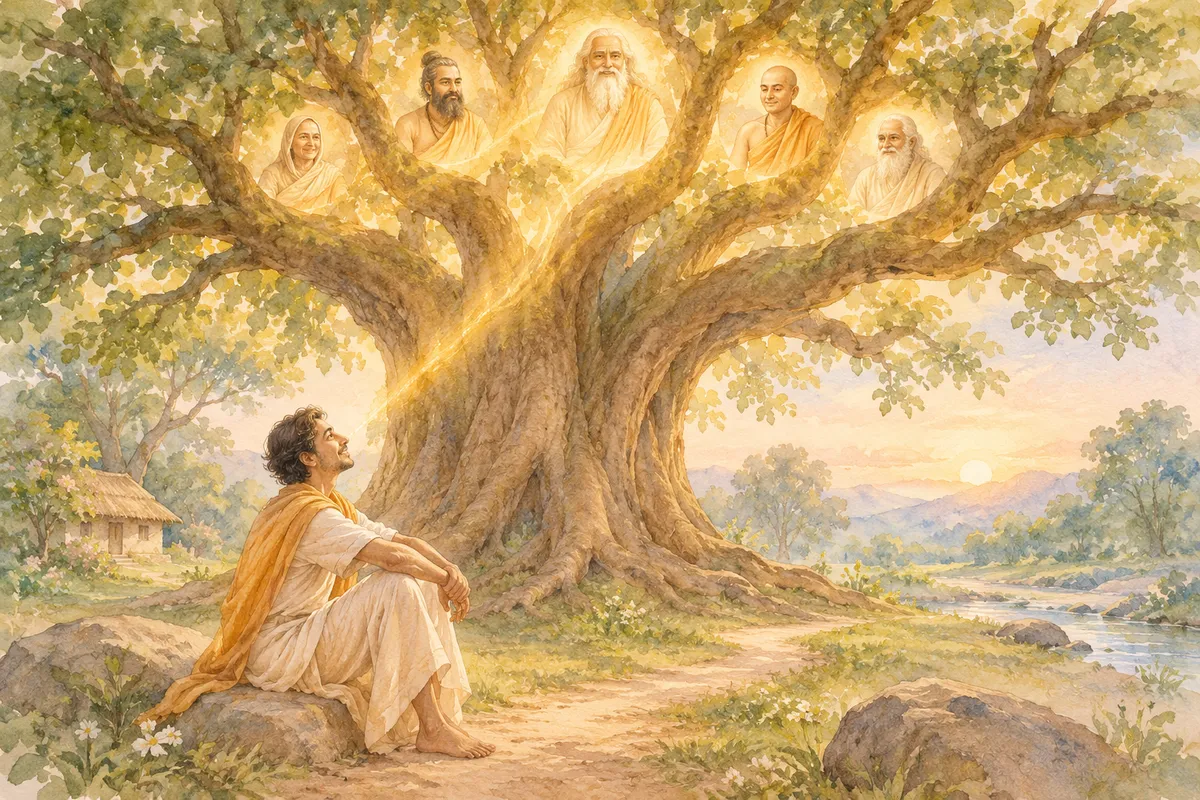
Sharanam (Refuge) means that we can rely on the blessings of the saints, and for this reason the saints establish a connection with other beings. They are filled with joy, happiness, freedom, love, and compassion; it is precisely their compassion that makes it possible to establish a connection with the saints. When we turn to the Guru, the Paramguru, the Guru-Acharya, and the Adiguru, we repeatedly renew this sacred, holy connection.
Over the years on the spiritual path, this sacred, holy connection should deepen; it is also called the spirit of samaya. Samaya means the principle of faith and devotion to that which connects us with the Dharma and with the spiritual path. It is also the principle of a pure, spiritual connection in relationships with our spiritual brothers and sisters. This is not given easily, but one must work on it, and it will come.
“Be vigilant, lest you lose the little you have earned through such great effort. Guard samaya as the apple of your eye. Do not attribute any merits or virtues to yourself. Attribute everything good that is in you to the blessing of God, your master, the saints, and the help of your brothers and sisters in the Dharma, while attributing everything foolish to your ego and your ignorance. Always remember the kindness and compassion of the saints of the Refuge, the lineage of masters, those who revealed to you the great mysteries of their souls and shared their priceless gifts. Beware of falling into conceit; do not consider yourself seasoned and experienced—for before God there are no seasoned ones; there are those who have surrendered to His will and attained wisdom, receiving gifts, and those who have not. Do not boast of your inner asceticism—the fool who boasts of this is foolish before the saints and God. Remember: however good you may be, there are those who are much better. However wise you may be, there are those who are much wiser. Indeed, human wisdom before God is the same as foolishness. Recall the words of the saints: ‘Who is not a fool before the Lord?’ However holy you may be, there are those who are much holier. However high you may rise in spiritual life, there are those who soar so high that you could not ascend there even after a thousand years of effort.”
Overcoming Pride Through Awareness
When we were in America, we met a mataji who is the secretary of the league’s parliament and, in addition, a witch and shaman in some city. She saw the Kumbh Mela, the parade, the Guru, the chariot, and the monks, and said: “You are shown such honors here; have you not become proud? I would have, if I were shown such honors.”
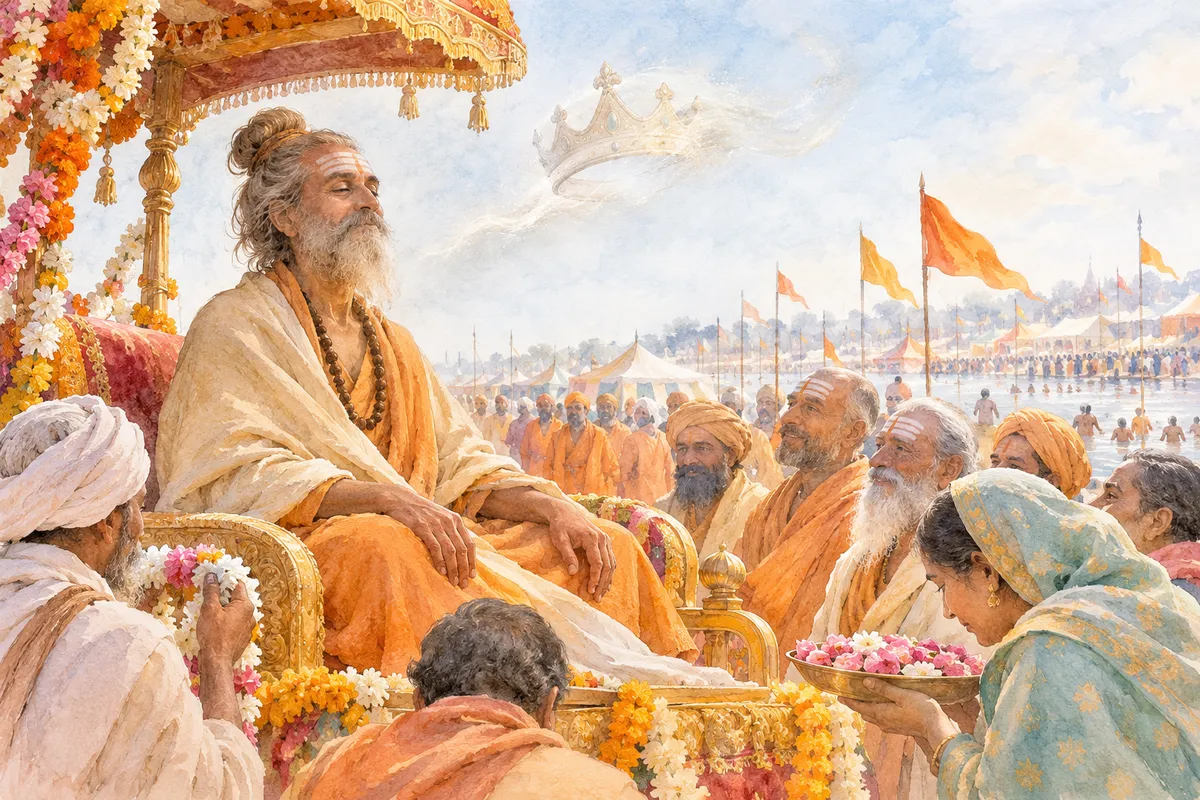
I replied: “I simply do not think about it. It is happening, but it does not prevent me from remaining in a state of awareness—that is the whole point. If I am in contemplation and in an aware state, I do not give it a chance, whatever it may be. This applies not only to pride, but to anything at all. As a sadhu, you can easily overcome various maras if you do not give them a chance, if you do not give them a chance while remaining in a state of awareness. But if awareness fades, you always give them that chance. Rest assured, they will take advantage of it.”
But that is how the maras are constituted: if they see, “Yes, this sadhu is aware; there is no way to approach him,” they say: “Well, we will wait. Soon the malefic planets (grahas) will align in his horoscope, and his awareness will fall by half; then there will be a difficult karmic knot on his path, and there his vigilance will fall by another third. That is when we will come in all our glory.”
But a wise sadhu does not leave them a chance. He says: “Grahas are grahas, karmic knots are karmic knots, but there is also awareness; there is also my faith and devotion (what is called buddhi-karma); there are also the blessings of the saints (bhagavata-karma). We shall see who overcomes whom,” and he leaves them no chance. Then all these maras—the mara of the afflictions, the mara of the skandhas, the mara, son of the celestial being—they become so disappointed: “It is useless; there is nothing to do here. We will come back in twenty years; perhaps something else will change, but for now there is no point. Let us go look for someone else.”
There are always the forces of maya, material energy (Prakriti), which are always glad to test a sadhu—that is simply their nature, just as it is a dog’s nature to bark in the yard. But the awareness of a sadhu leaves them no chance.
What are the signs that a sadhu has somewhat calmed the mind through mindfulness? Any food — he is happy; any clothing — he is happy; wherever he stays — he is happy; whatever status, position, or situation he is in — he is happy. This means that the mind has been somewhat calmed.
