

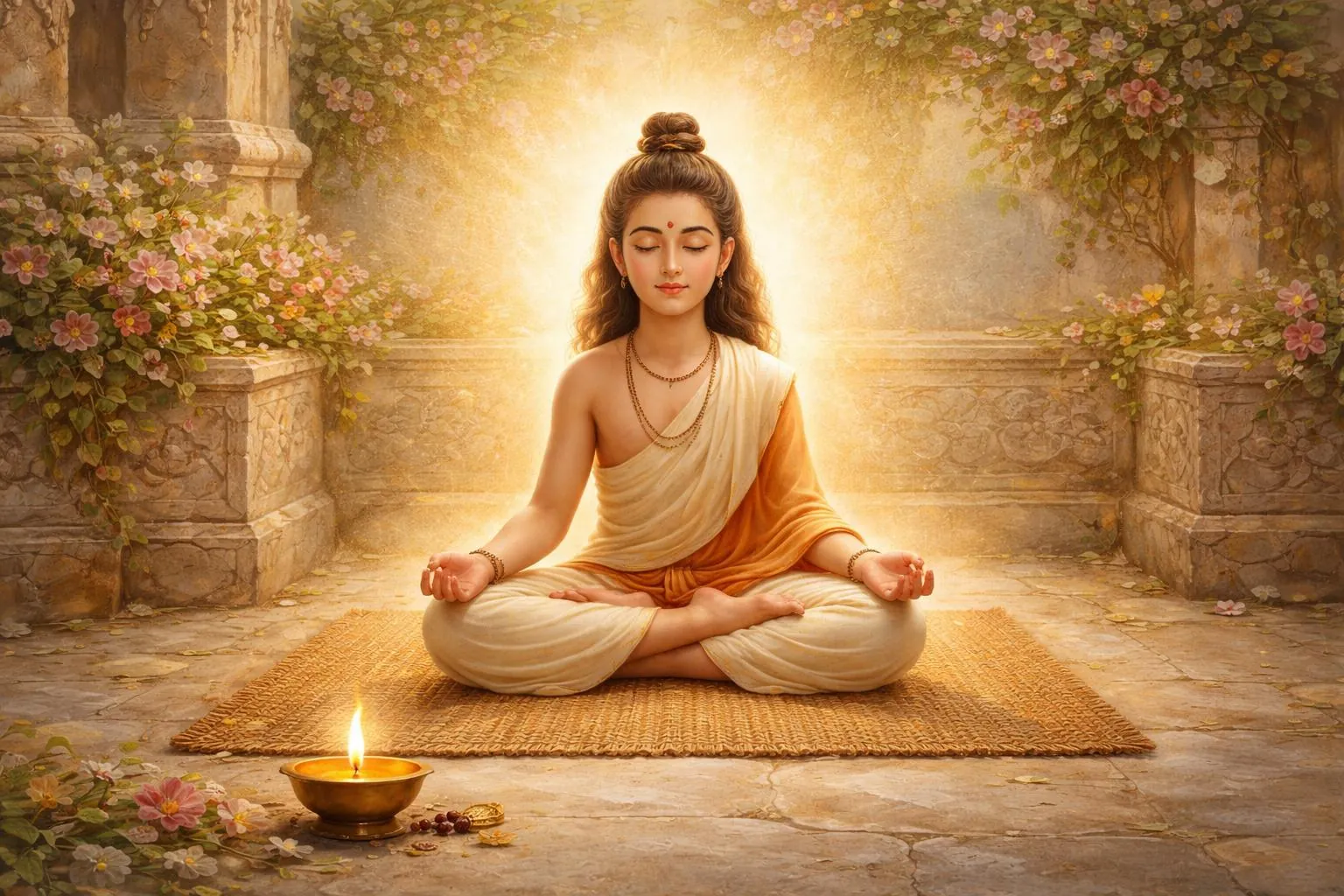
Uniting Presence with Energy in the Chakras
It should be borne in mind that although all these types of bliss arise as a result of the secret tigle under the influence of the fire of tummo, they are not the great bliss that arises when the pranas enter the central channel and dissolve in it; this we will discuss in detail below.
Since retaining the tigle during the experience of ecstasy is of paramount importance, some commentary should be given. Generally speaking, most practitioners are usually able to retain the tigle if they can clearly and distinctly visualize the three nadis and four chakras with the help of certain exercises, such as the six movements of Naropa, etc. But there are practitioners whose tigles are very unstable and difficult to control, so that when they perform exercises to intensify bliss, it is difficult for them to hold the flow of the tigle.
Here we are speaking of the awakening of energy and the experience of it in the chakras. When energy awakens, we have various experiences in the chakras and nadis. When energy enters the chakras, the essential elements that make up the chakra begin to melt, which is why they are called bindu or tigle. When they melt, our karmic knots are untied.
Deepening Nonduality through Kundalini Yoga
In order, while practicing Kundalini Yoga, to intensify the experience of nonduality, the yogin must observe with great attention the nature of the bliss produced by the inner fire, as well as the nature of the Mind and its manifestations. When we simply contemplate, we have a certain experience of nonduality; however, in order to deepen it, we practice purification and circulation of prana, concentration on the energy centers.
When such inner fire, heat (shuddhi-ushanam), begins to melt the elements in the centers, bliss arises, which is the basis of all other minor forms of bliss, for example worldly experiences of bliss from sensory pleasures: meeting someone close or a relative gives an experience of joy in the anahata chakra, a state of excitement — bliss in the vishuddha chakra, and so on.
These various types of bliss are secondary.
Primary bliss is the bliss that resides in the essence of the elements and is not directly connected with objects or worldly desires. Therefore, when we purify ourselves, we can experience such bliss. The yogin no longer needs to feel craving for objects; he can experience the same bliss, but it occurs in him thanks to the circulation of his prana.
When can such bliss be experienced without relying on external objects? When the prana flowing from the chakra is completely purified and can circulate freely in the purified nadis, spreading throughout the body. If, however, the nadis in the chakras are clogged, then the wind, rising through the nadi, cannot pass further; therefore, what is experienced in the chakra is not bliss, but unpleasant pressure, and in order to remove this pressure, a person has to satisfy a worldly desire.

When bliss is experienced in the chakras, one must see with great attentiveness the empty nature of all things and remain in the primordial state for as long as possible.
In the tantras there is a description of the types of bliss that arise as a result of the melting of the elements in the chakras and entry into the central channel. With the experience of each type of bliss, a special kind of presence is experienced, distinct from the others.
Uniting Bliss with Emptiness
It is said: “When practicing Kundalini Yoga, the yogin must try to unite bliss with emptiness (shunyata).”
In the canonical text “Yoga-Kundalini Upanishad” it is said:
“The yogin must constantly place manas in shakti, and shakti in manas.”
Manas can be translated as ordinary mind; however, this translation is not suitable in this case. Here, manas means contemplative presence, empty awareness, while shakti is the bliss that arises in the body.

If you understand this principle, then in practice, when various experiences arise, you integrate the experience of bliss and your own clarity. Then suddenly you begin to understand what it means to contemplate with the body, what the five empty spaces in the body mean.
It can be said that this practice belongs to the realm of mastery. For novices, it may not be entirely relevant, but it is enough to understand the basic principle in order to understand the particular features of working with energetic experiences in the body.
I usually recommend that students engage in such practice in retreat, when there is an opportunity to perform shat-chakra-dharana for many months, concentrating on the chakras and devoting several months to each center. When various experiences arise in the body, one can then unite empty awareness with these experiences. This is the general principle of the practice of nonduality. For those who have already realized emptiness and the essence of the mind, these few words will be quite sufficient.
For those who have not yet attained this, the following should be added. In order to realize nonduality more deeply, a yogi should devote from one half to two thirds of the time of each meditation to this. If the yogi has already achieved some stability in samadhi, he should apply this attainment to the perfection of emptiness. If not, then first he should achieve stability in samadhi through the practice of pranayamas, control of the wind, and other methods, because if his samadhi is unstable, he is unable to achieve successful contemplation and attain nonduality.
The Basis of Practice Is Samadhi
The basis should be samadhi realized through the practice of the sutra, that is, mahashanti meditation. If you can stop the mind for a long time and remain in thoughtlessness, then a moment comes when you break through, sequentially experiencing the dhyanas, or, even if you have not mastered the dhyanas, you have constant awareness, a contemplative presence, in the waking state.
When such a basis is realized, you can train in uniting this basis with the energy of the body, and this can be practiced not only in retreat but also in everyday life. Suppose you eat prasad, and a feeling of bliss arises from the taste. In this case, if your nadis are purified, you can separate the prasad itself, the taste of the prasad, and the bliss: the prasad is on the plate, the taste is on the tongue, and the bliss is in the manipura chakra. Then you need to notice precisely the bliss of the manipura chakra and unite your awareness with it, that is, find the source of this bliss and discover empty awareness.
When you penetrate into the essence of bliss while receiving prasad, suddenly you see that the source of bliss is not the bananas themselves, for example, or dates, and not the tongue; rather, the source of this bliss is your own primordial Clarity, the nature of Mind. Suddenly you begin to feel the astonishing, delightful, divine taste of prasad, your central channel begins to fill, and you are thrown into a deep state of awareness. It can be said that at that point initiation has been received.

Enlightening Emptiness and Liberation from Doubts
Then the yogi attains the awareness that the inconceivable essence of the mind is enlightening emptiness, and that all manifestations and constantly changing thoughts are themselves empty. And in this way he is forever freed from all doubts and fears.
It is necessary to observe how all thought processes arise, remain for some time, and disappear. In addition, the practice of identifying emptiness with sound, with manifested forms, and with clarity will be extremely useful.
Here it is speaking about how to unite emptiness with the sounds of nada, with external phenomena, and with inner clarity.
The third part of each meditation period should be devoted to the practice of pranayama, restraining the breath. After meditation, the yogi must try to maintain awareness and identify all his experiences with the path of contemplation.

We will not now examine in detail the different types of samadhi connected with kundalini yoga and other things. One should understand the basic principle, and if you understand it, you intuitively begin to discover a new vision for yourself.
Every experience can be felt in two ways: either it simply arises as a kind of ripple on the surface of the mind, or you always discover its emptiness. For example, if you practice the Four Immeasurables, a certain wave of emotion arises in you, and then it even arises as a state of energy. If you constantly attune yourself to this wave, recognizing its emptiness, this means that you are not merely practicing the Four Immeasurables, but are uniting the energy of the Four Immeasurables with presence, recognizing its empty source, and then this becomes a continuous practice of contemplation.
