

Moksha as the Highest Goal of Life
Vasishtha continued: “That which is called liberation or moksha is the state in which delusion comes to an end through the investigation (inquiry) into the nature of one’s own ‘I,’ when individual consciousness suddenly ceases to be individual consciousness and the mind becomes no-mind.
The most important thing in life is to set the right goal. The right goal for the soul is liberation in God (moksha). There are four goals of Vedic society: dharma (righteousness, following principles), artha (prosperity), kama (living in harmony with the universe so that the senses enjoy themselves and others), moksha (liberation). Moksha is the highest goal.
It is believed that in order to set the highest goal in life, one must possess eight freedoms, such as being born without defects—for example, not being ill, autistic, disabled, deaf, or blind, that is, when it is possible to study dharma. To be born in a country where one can listen to dharma, to meet a spiritual Teacher, to possess the ability to listen to dharma, and others. All this is called the eight freedoms.
It is believed that if these eight freedoms are sufficient, then the soul must set the goal of moksha—this is its dharma. If these qualities are insufficient, it cannot set moksha as its goal. Even if it sets it, it will not be able to follow it, and it must lower the bar and set the goal of dharma. Dharma means righteousness, which ensures the next good rebirth, life in paradise, protection from hellish dimensions, from the lower worlds, rebirth in one of the heavenly dimensions, entry into the host of devas and angels, the heavenly worlds in the next life.
If the soul adheres neither to moksha nor to dharma, then it must try to adhere to the principle of artha in order to develop its qualities and more or less avoid accumulating sins, and in the next life be born as a human being.
The principles of artha and kama are principles that allow one simply to be a good person and to be born in the next life under normal conditions, not to fall into the lower worlds, not to sin, to satisfy the senses in a controlled way, to develop one’s ego, to act in accordance with one’s inner inclinations, with one’s svadharma. When a person follows his inclinations, but follows them correctly, in a controlled way, in accordance with the instructions of the scriptures, satisfies the senses in moderation, makes offerings to saints and temples, follows the commandments, performs small religious practices—he may be born as a human being in the next life. To be born human in a good family, endowed with good abilities, is also a great merit, since a human body is not so easy to obtain, because many after death, driven by their inclinations, receive not a human body, but the body of a spirit, a preta, a ghost, the body of a hellish being, or the body of an animal.
The Plasticity of the Soul and the Formation of Posthumous Destiny
The soul is very plastic; the mind is very plastic. It only seems that everything is so unshakable; it is simply that the physical body is inert. But when the soul leaves the physical body, it is very plastic; it can undergo serious transformation. Even during life we can observe how people’s characters sometimes change. Good people sometimes degrade, degrade irreparably, become drunkards, drug addicts, robbers. Sometimes the opposite happens—sinners reform, hardened sinners repent and enter the path of dharma. This means that the mind can change even in the body; how much more plastic the mind becomes without the body.
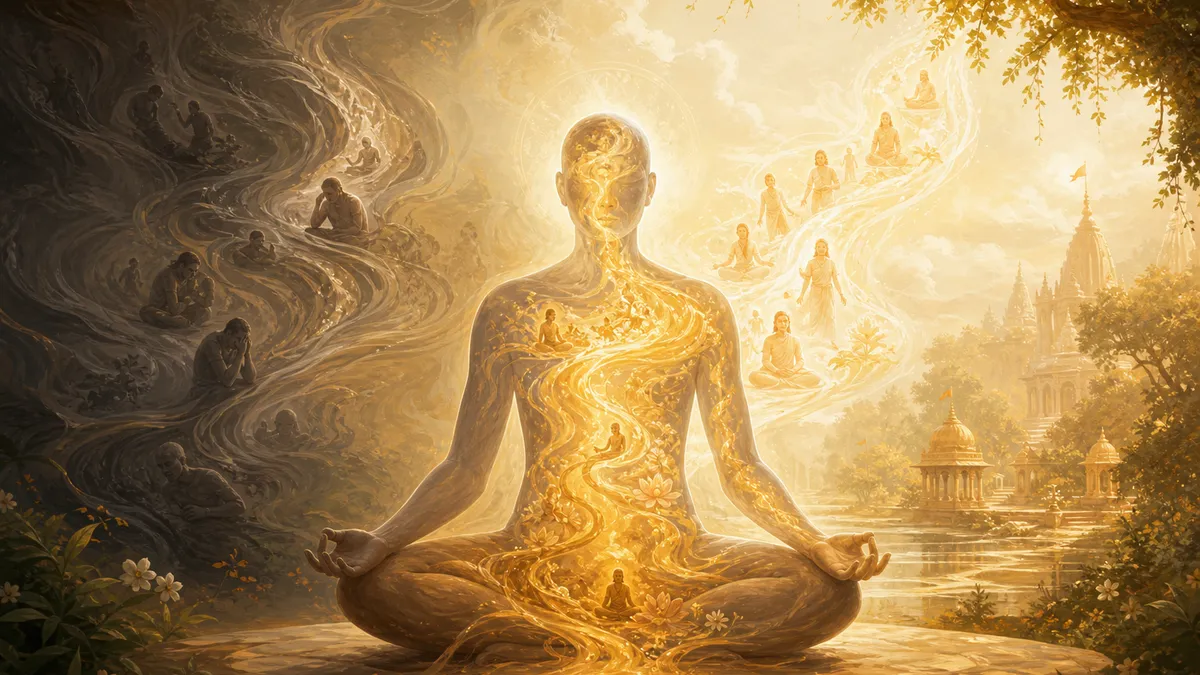
The soul, falling under the influence of certain energies, reveals hidden tendencies. Each soul in the subtle world represents what is its dominant will, its dominant love, and love may be directed both toward sins and negative inclinations, and toward holy objects.
But there it is impossible to oppose one’s own will and one’s dominant love; no one can resist. If the soul has created a certain dominant inclination, a dominant love during life, then this is precisely what manifests after death in the subtle world, and no one can resist it except those who have purified their karma. The dominant will and dominant love of the soul for something, its inclination, draws it precisely to that place, precisely to that realm of devas, angels or spirits, or demonic beings, or hellish beings, to which its inclination corresponds.
The actions that the soul performs here are recorded, copied by its subconscious mind. Our subconscious, the sphere of the unconscious, is a vast realm, an enormous area that for many is unperceived and uncontrolled. It is there that records and copies of our actions are stored, as well as our attitude toward these actions. In accordance with the law of correspondence, all our deeds and actions have their reflection in the subtle world.
Different Worlds According to Karmic Tendencies
For example, callous, heartless souls after death end up in such dark, gloomy places, and they do not love the light of divine truth, they do not like listening about divine love, about awareness. Just as in life, when you speak with such people, they turn away or object; it is unpleasant for them to listen to this. In the same way, in the subtle world they do not like hearing about God, they do not like communicating with saints; they seek to hide somewhere, they find shelter in crevices, in caves, in hollows, in various dark places, because this corresponds to the dominant tendency of will and love that they kept in life.
When they hide in such places, they fear the light of truth, the light of God, the light of the devas (gods), the light of angelic beings, since their energies do not correspond to it. When they hide in crevices, caves, trees, in groves and forests, after some time their minds begin to function in accordance with where they live, and thus their minds are transformed. They may spend quite a long time in trees, like spirits; their memory gradually becomes dimmed, they begin to forget their earthly life, to forget what they were called, a new character forms in them, and gradually they turn into animal spirits living in forests, caves, or crevices.
Gradually they acquire a subtle body like that of an animal, because, being unable to communicate with greater beings or with spirits of high moral development, they begin to interweave their subtle body with the subtle body of the animal species. Gradually their subtle body changes, begins to resemble animals, because in these places they see animals; they do not see angels and gods.
Gradually animal tendencies, animal habits, and imitation of behavior appear in them, and the subtle body of an animal is formed; and when the subtle body of an animal is formed, the memory of human life is displaced, and animal consciousness arises. Then, when animal consciousness arises, desires inherent to an animal arise, instinctive desires. Then there appears a desire to obtain a body, because without a body it is impossible to satisfy these desires, and the law of karma, the preciousness of human birth, and dharma are forgotten. It was already too long ago, there have been too many impressions, the memory of the subtle body is erased. Then birth in the body of an animal occurs — so this is how it can be.
On the contrary, people whose dominant love and inclination during life was to discuss dharma, to discuss God, to discuss truth, are drawn to those who are also inclined to discuss dharma, to discuss truth. Some hard-hearted people with a gloomy state of consciousness are also reborn in gloomy dimensions, and they cannot rise into the heavenly, divine dimensions. Even if they do rise there, their state of mind does not correspond to the heavenly dimensions; they cannot even perceive it. They feel bad there, they suffocate, and they quickly strive to leave such a dimension.
Thus, different souls with different inclinations of the subconscious form their own special groups and take root in their own particular worlds, and they cannot change their nature, since everyone, in a certain sense, except for saints and the awakened, is a slave to their unconscious nature. For a very long time, one receives rebirth in accordance with one’s unconscious karmas stored in the subtle body. Except for those who have truly purified themselves and developed awareness.
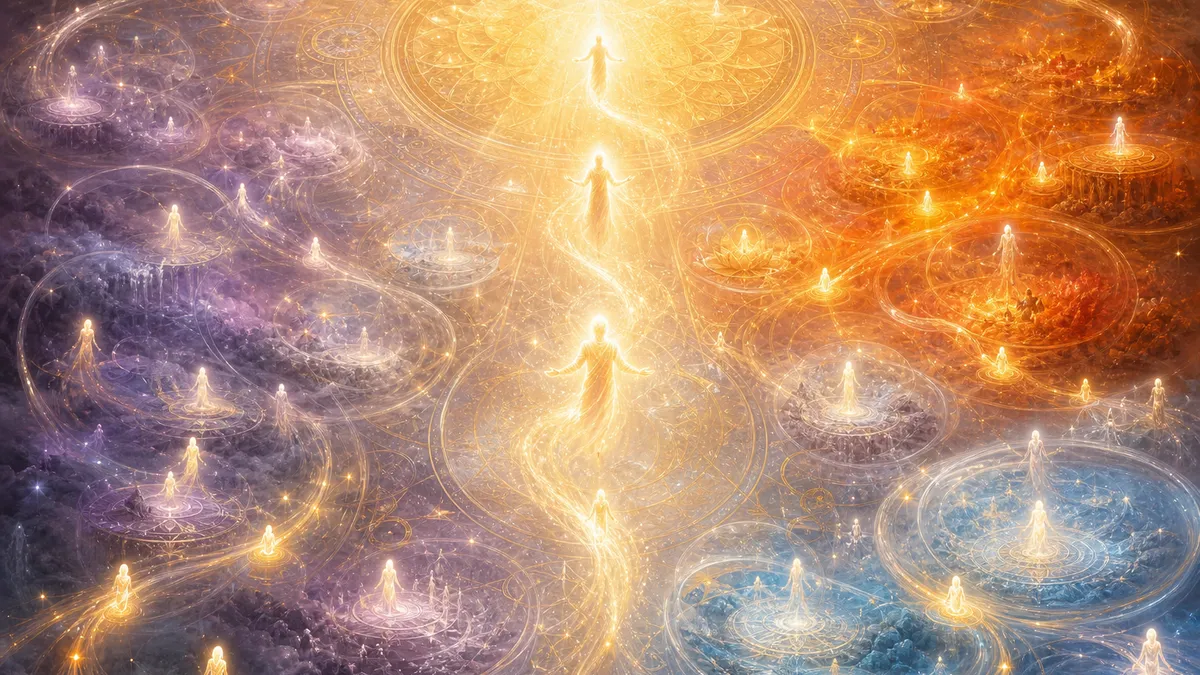
Souls accustomed to being in the light of truth, divine love, divine wisdom, and contemplation live in such places where everyone sees purely, among gardens, luxurious places, murmuring streams, beautiful mountains, magnificent sunlit views. Their consciousness sees the world in this way; that is, the subtle world for souls after death looks subjective, it is not like the physical one. The physics of the world is different — everyone sees the world and lives in accordance with their own karmic vision, with what they have in the subtle body.
Souls that have cultivated within themselves an inclination toward divine love, devotion to God, acquire the ability to live in pure dimensions with souls like themselves—with angelic, pure, holy souls filled with divine love. Dark souls, condemning others, using foul language, blaspheming, are born in a dimension where they have to suffer, where they are constantly attacked by other spirits, where they constantly battle with others. Spirits that have committed any kinds of offenses are born in worlds where they have to eat excrement and consume something impure, since this corresponds to their tendencies; and when other spirits invite them into pure dimensions, they cannot get there, because the pure dimensions make them feel as if nauseated, shaken, and pained by it.
Everyone who has created the corresponding inclination is reborn in such a world. One who has created an inclination to think purely, to abide in pure vision, meets the spirits of the pure lands, and they invite him to become an inhabitant of the pure lands.
One who observed tantric samayas becomes a spirit of angels in the pure lands who practice tantric samaya. One who was devoted to contemplation of his ishta-devata unites with those who are likewise devoted to contemplation of the ishta-devata. According to inner inclinations, various souls, angelic beings, devatas, and pitris are grouped with the type of practice, with their ishta-devata, which they performed during life. Those who are the most advanced are, as it were, the center of the mandala, the central deities. Those who are less advanced are the deities of the periphery. Such divine communities or communities of spirits form diverse groups—small or large—that are united by one and the same mindset. For example, just as in earthly communities people endowed with one and the same mindset, for instance one faith, one samaya, together create one common field, a common atmosphere.
The Story of the Vampire and Questions About the Nature of Reality
Since the sense of self-importance and other concepts are unreal, like water in a mirage, they cease when the light of inquiry is directed upon them. Regarding this, O Rama, listen to the inspiring and enlightening questions the vampire asked.
In the forests of Vidya there lived a vampire. One day he wished to satisfy his hunger, but he could not kill anyone even when he was hungry if the victim did not deserve it. Not finding such a person in the forest, he went to the city and met the king.
The vampire said to the king: “O king, I will not kill and eat you if you do not deserve it. You are a ruler and fulfill the wishes of those in need. I beg you, fulfill my wish. I will ask you several questions. Give me the correct answer.
What is the sun of which these universes are particles of rays?
In what great wind does this vast space manifest?
We pass endlessly from one dream into another, without losing our own nature, yet easily leaving behind the realities of the dream. What is this nature?
From the trunk of a banana tree one can peel away layer after layer until reaching the center. What is that most subtle center reached by inquiring into the nature of this world?
In what atom are all the universes themselves even smaller particles?
In what such formless ‘stone’ are all three worlds hidden, like uncarved figures?
Answer these questions. If you do not answer, then you are worthy of my eating you.”
The king replied: “O vampire. This universe was once covered with many layers, as a fruit is covered with a peel. There was also a branch on which thousands of such fruits hung. There was also a tree with thousands of such branches, a forest with thousands of trees, a hill with thousands of forests, a country with thousands of hills, a continent with thousands of countries, a planet with thousands of continents, an ocean with thousands of planets, a being with thousands of such oceans within itself, and a supreme being who wears thousands of such beings in his necklace. There is a sun in whose rays are thousands of supreme beings, and this sun illuminates everything. It is the sun of awareness, O vampire. In the light of this sun, the universes are merely the tiniest specks of dust. Because of the light of this sun, all these things listed appear real.”
The Sun of Divine Consciousness
Thus, what the vampire was asking about is the Sun of God, the sun of consciousness. In the divine worlds, the Sun of God, as the principle of awareness and divine love, is obvious, manifest, visible, and nourishing for gods and spirits. Just as, for example, the sun is manifest to us and nourishes us with its warmth. The divine sun of consciousness in the heavenly dimensions is revealed and manifest. The sun about which the prince answered the vampire-spirit is Shiva, the Brahman of the Vedas. It is the primordial sun that nourishes all living beings with the power of its brahma-shakti. It is also the divine being by whose power of creative will the universe is created — Ishvara.
This sun of awareness is called turya (the fourth state), that which is beyond the previous three — waking, dreaming sleep, and dreamless sleep. Those who do not know this sun live in the darkness of ignorance, and their life passes in vain, so it is considered, because spiritual evolution is possible only when we establish a connection with this sun.
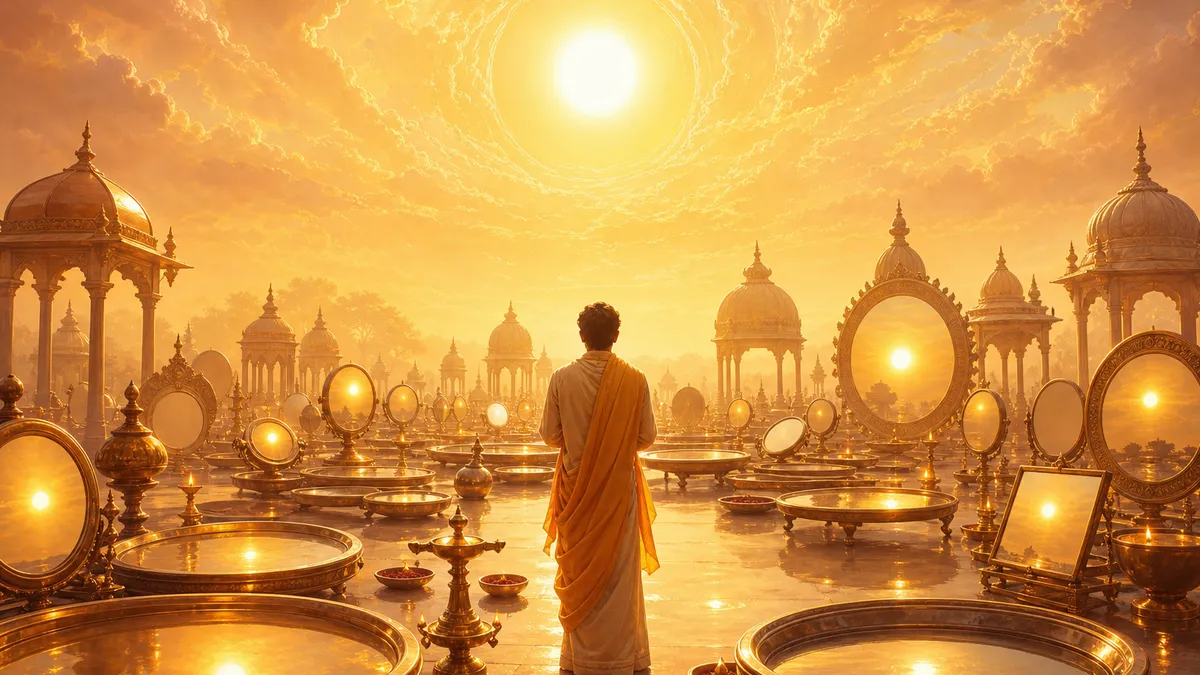
Connection with the Refuge, the Symbol of Faith, the acceptance of samaya, the ishta-devata — these are the reflection, the refraction of this sun in our earthly material reality. The less developed a person’s mind is, the more he sees the refractions and the less he sees the sun itself. When he sees different reflections and refractions of this one Sun of God, he considers them to be different things. For example, the image of one God and the image of another God, one sadhu and another sadhu, one scripture and another scripture — for him all these are very differentiated things, one method and another method. He has no vision of unity.
The Development of All-Encompassing Wisdom
The more a sadhu develops and the more his all-encompassing wisdom develops, the more the experience of the unity of awareness and divine love increases. Or jnana yoga is one thing for him, bhakti yoga is another, raja yoga is a third, kundalini yoga is a fourth. Different methods of different traditions differ greatly. The further a sadhu advances on the path of spiritual practice, the more prajna and upaya (method and wisdom) unite for him, the more the single truth of different scriptures, different deities, and different methods becomes more and more united for him. He begins to see that one sun which stands behind all teachings, objects, methods, and living beings. This means that the yogin’s all-encompassing wisdom of space is increasing.
All-encompassing wisdom means the ability to see holistically, to unite, to synthesize beyond duality into a single vision.
When all-encompassing wisdom increases, it is said that the yogin’s wisdom of equality also increases — the wisdom that is capable of detaching from samsara and seeing everything equally. It is said that he attains a single “taste,” and he is ready for the teaching of anuttara tantra, for the teaching of laya yoga.
The teaching of laya yoga means completing all diverse relative methods in the single method of nondual presence, completing all diverse actions in playful non-action, completing all diverse cognitive activities in self-liberation — this is called jnana-nishpatti. To complete all diverse emotional states in a single divya-bhava or brahma-aham-bhava — this is called bhava-nishpatti. When these three completions occur — the completion of action in non-action, the completion of all emotional states in divya-bhava, the completion of all cognitive activity in nondual wisdom, that is, when kriya-nishpatti, bhava-nishpatti, and jnana-nishpatti take place — the three exhaustions — then it is said that such a yogin has confidently entered the path of liberation. He has discovered the nature of Mind, discovered the great Sun of God.
The Unchanging Nature of Consciousness
The king said: “In the light of supreme consciousness, concepts or the relative reality of time, space, and movement sparkle like particles of diamond, while being consciousness and the purest intelligence. Although it seems that the true nature or consciousness passes from one dream world into another, in reality, it never leaves its natural nature and never loses awareness of itself.”
Thus, the spirit asked: “What is this nature that does not change through the various experiences of waking or sleep?” This nature is always one; it is called Atman, the nature of Mind, when Atman is realized. This nature is realized by us when the state of turya is realized.
Yesterday we spoke about the three gunas and prabhasvara (the primordial pure light). Understanding the principle of the three gunas and the pure light (prabhasvara) is extremely important for understanding turiya. It is very difficult to realize the nondual nature; it is not such a simple matter, since one must transcend the subtle body, the mental body, and the causal body. One must pierce the five sheaths with meditative concentration, that is, separate oneself from the physical body, the energetic, astral, mental, and causal bodies.
In the process of such separation, the yogin undergoes experiences, and this is the experience of moonlight. This means that sattva-guna is experienced, the mind of special emptiness associated with sattva-guna; that is, various kinds of emptiness are experienced. For example, you sit in the meditation of great peace (mahashanti) or in the meditation of atma-vichara, a one-pointed state beyond the mind arises in you, and in the area of the ajna chakra you begin to feel light, as if the moon is breaking through the clouds. This light grows and grows, and then it is as though you find yourself beneath an enormous dome flooded with soft moonlight. Your breathing stops, you do not feel the body, and you immerse yourself in this space of the emptiness of moonlight. This means you are coming into contact with the first light—the light of opening, or the light of radiance, as it is called—this is how sattva-guna is experienced.
The Experience of the Three Lights and the Transcendence of the Gunas
Then, as you continue your practice, you come into contact with the second light, especially if your practice is connected with kundalini yoga. The second light personifies rajas-guna. If the first light personifies the father’s white drop in the head, then rajas-guna is connected with the red drop received from the mother, which rises from below through the muladhara chakra, through the central channel. Then red floods, red intensifications are experienced, when the yogin immerses himself in a space of red emptiness like the sun at sunrise or sunset, a space of sky colored by the rays of such a setting or rising sun.
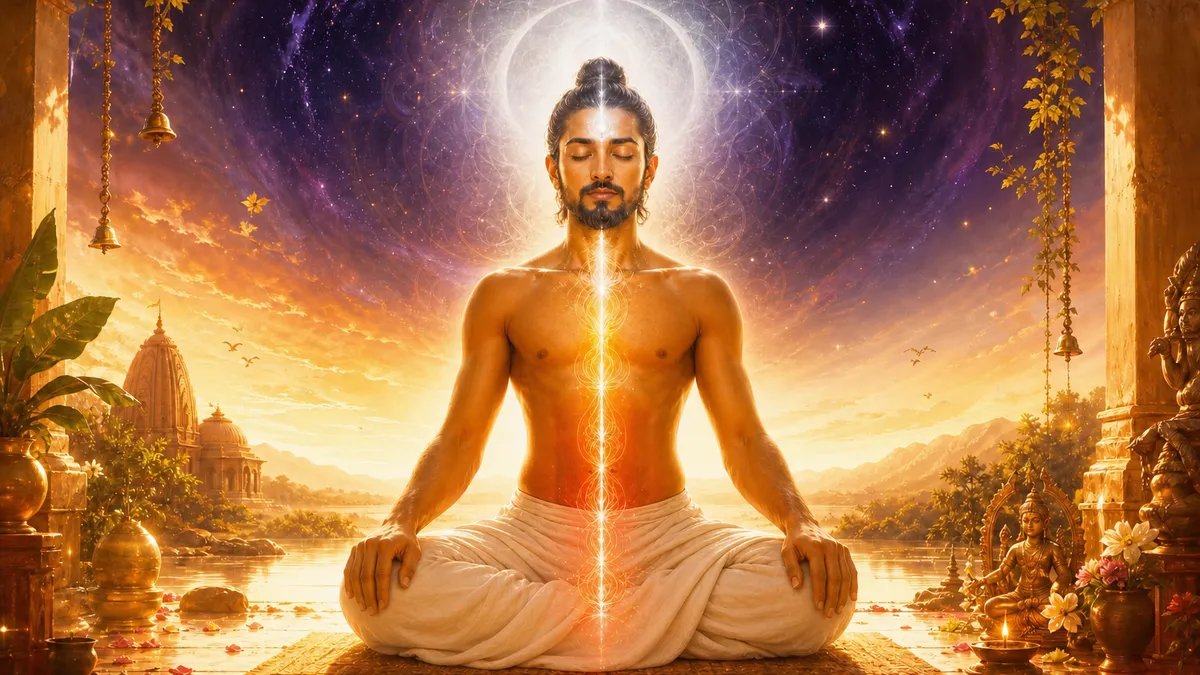
Finally, the yogin’s breathing stops completely, and he enters the period called shunya-jyoti (the light of emptiness) or the light of blackness, the light of near-attainment—into a dark space in which there is no moon, no light, no gleam, no stars—nothing, in which it is very difficult to become aware of oneself. This means he comes into contact with tamas-guna. The processes experienced in kundalini yoga, raja yoga, dream yoga, the yoga of the illusory body, the experiences of these three colors—all of them indicate that the yogin is transcending the three gunas.
Attainment of the Pure Clear Light and Purusha-tattva
Finally comes the experience of the pure clear light (prabhasvara), a transparent light like an autumn sky without any admixture of clouds, haze, or anything else. The experience of this boundlessly transparent pure light indicates that true emptiness has been attained, that the initial stage of realization has been acquired. This is also called the attainment of the samadhi of raja yoga, when Prakriti-tattva has been transcended and Purusha-tattva has opened.
What does this indicate? It indicates Prakriti, that is, the experience of the gunas—all of this is Prakriti-tattva. In Prakriti-tattva, the gunas are in equilibrium in the form of such colors, and when the yogin experiences this, pierces Prakriti-tattva, he enters Purusha-tattva. Purusha-tattva means the experience of the pure Clear Light. From Purusha-tattva one can contemplate God, one can contemplate Brahman, when the primordial eternal light of the Absolute is seen directly and immediately.
From Purusha-tattva one can rise further. We have already left Prakriti behind; next come the kanchukas—this means that from this state, if one does not fall out of it—and this state is beyond even dreamless sleep, the state of turiya—one can gradually tear apart the kanchukas: kala-kanchuka, kala-kanchuka, niyati-kanchuka, raga-kanchuka, vidya-kanchuka; that is, dualistic limitations from this state go away by themselves, if one simply remains in it. Purusha-tattva is connected with the experience of the Clear Light. Quite simply, if the yogin contemplates the Clear Light, the limitations of time, space, causality and cognition, the pull of desires, the sense of being the doer, anava-mala, maya-mala, karma-mala—all of them go away. Simply abide in it; therefore the goal of raja yogins is to gain the experience of Purusha-tattva, having transcended Prakriti-tattva, and to remain in nirvikalpa samadhi for as long as possible.
The Necessity of Nirvikalpa Samadhi and the Transcendence of the Kanchukas
To penetrate the pure light, nirvikalpa samadhi is necessary; savikalpa samadhi will not allow one to penetrate it, because the slightest ripple of the mind means that you fall out of the pure light. But in nirvikalpa samadhi the yogin abides in Purusha-tattva for a very long time, and he perceives the inner Shiva; he directly perceives God. Although his inner Shiva is connected with the body, the kanchukas, and limitations, inwardly he is already correct. One simply needs to remain there as long as possible—there are yogis who can remain in nirvikalpa samadhi for hundreds, thousands of years.
When the kanchukas are transcended, the experience of maya-tattva arises: absolutely pure consciousness, the absolutely unmanifest being of God.
Here there is a dangerous point: if the yogin does not have sufficient intensity of contemplation, intense activity of vichara-spanda (investigative vibration), he may loosen his grip and be satisfied with the experience of the formless, unmanifest emptiness of nirguna-brahman and remain there. Those, however, who continue to penetrate this state of nonduality intensely, generating investigative activity (vichara-spanda), go further. The former become pralayakalas, while the latter, those who generate vichara-spanda, intense investigative activity, become vidyakalās. From the state of vidyakalā they overcome the sixth tattva, and then rise to the fifth tattva (Sadashiva-tattva) and to higher ones, and receive proper realization, proper liberation. They become vidyeshvaras, mantra-maheshvaras, shaktas, shambhavas, akalas. They become beings called Pati (lords of Prakriti); Prakriti no longer has power over them, and they become like Shiva, attaining one of the forms of sayujya-mukti or sarshiti-mukti.
Question: Om, Guruji, why is it necessary to abide in nirvikalpa samadhi for such a long time? What happens there during this period, and what does it depend on?
In order to dissolve the kanchukas; dissolution takes place, establishment in the power of the purity of the primordial light takes place, and the dissolution of very subtle, the subtlest dualistic states takes place.
Question: And why can’t this be done immediately, in a single moment?
The power of illusion is great. But if the yogin follows the high methods of anuttara tantra, he can do it faster. Often they remain there because there are no higher teachings. Suppose a person knows the teaching of raja yoga, but does not know the teaching of anuttara tantra, the illusory body, and others, and through the power of raja yoga he has attained this experience, and he only remains in it, unable to act in any other way; therefore it is said that to attain it by the methods of lower teachings requires dozens of lifetimes. If there are higher teachings, one can make a breakthrough to the fifth tattva, to the sixth tattva, to the state of vidyakalā, vidyeshvara, mantra-maheshvara more quickly—this is the value of anuttara tantra.
Question: Guruji, please tell us, why is it that pralayakalas—after all, they are in a state higher than nirvikalpa samadhi—why, when they are in emptiness, does everything not dissolve for them, all these kanchukas? In theory everything should dissolve for them while they are sitting there.
The kanchukas do dissolve, yes, and thanks to this their karma-mala and maya-mala dissolve, but the last one remains—anava-mala; and they too are in one of the nirvikalpa samadhis, in one of the high nirvikalpa samadhis. But anava-mala does not dissolve, and therefore, while they are in the unmanifest state, they are liberated. But as soon as the universe begins to move, when Lord Shrikantha begins to churn the universe and the gunas begin to come out of equilibrium, jnana, iccha, kriya and other energies, srishti, sthiti—that is, creation, maintenance, destruction—the energies begin to move, the force of these energies will bring them out of balance. Then their undissolved anava, the subtlest “I,” will begin to fall downward again, to acquire bodies, to become overgrown with ignorance and so on. The power of their consciousness was not sufficient to break through to the fifth tattva, because at some point they stopped and immersed themselves in the unmanifest. They were satisfied with this unmanifest.
It happens that a person successfully practices self-inquiry (atma-vichara), dualistic notions dissolve, he renounces various identities, enters a state of bliss, a state of clarity and emptiness. He is satisfied with this; there is no more suffering, one can always live in a subtle state, and since the churning of universes does not occur, he is satisfied for his entire life; he already lives in this status. But when shakti applies some influence, some activity to him sufficiently, it can bring him out of this state if he does not continue his intense inquiry. Then he will lose his status of witnessing consciousness, of observation, slip down, and identify.
The Magical Nature of the World and the Role of Consciousness
Just as the trunk of a banana tree is peeled layer by layer, and each layer conceals another one just like it, so the external world is nothing other than awareness, if one looks carefully and reflects. This consciousness is called by various names — truth, Brahman, God, awareness — and, since it is beyond any description, it is also designated through negation: emptiness, indescribability, and so on.
Often, when people hear “emptiness,” they give it a nihilistic connotation, as if nothing exists — a great mistake. When we say that the world is consciousness, a product of consciousness, this should be understood not as a metaphor, but as a fact, and this fact must be seriously examined. One of the fundamental principles is that the world possesses a magical nature. “Magical nature” means that it is directly connected with our consciousness, and it is generated by the subtle layers of our consciousness.
When we follow Sanatana Dharma, there are several principles; for example, one of the principles is that the entire world, the entire universe, is the body of God. The body of one superintelligent living being; we live inside this superintelligent living being. The second is that the world possesses a magical nature, that is, it is not dense, not material, as it seems to us. It is generated by the subtle layers of collective and individual consciousness.
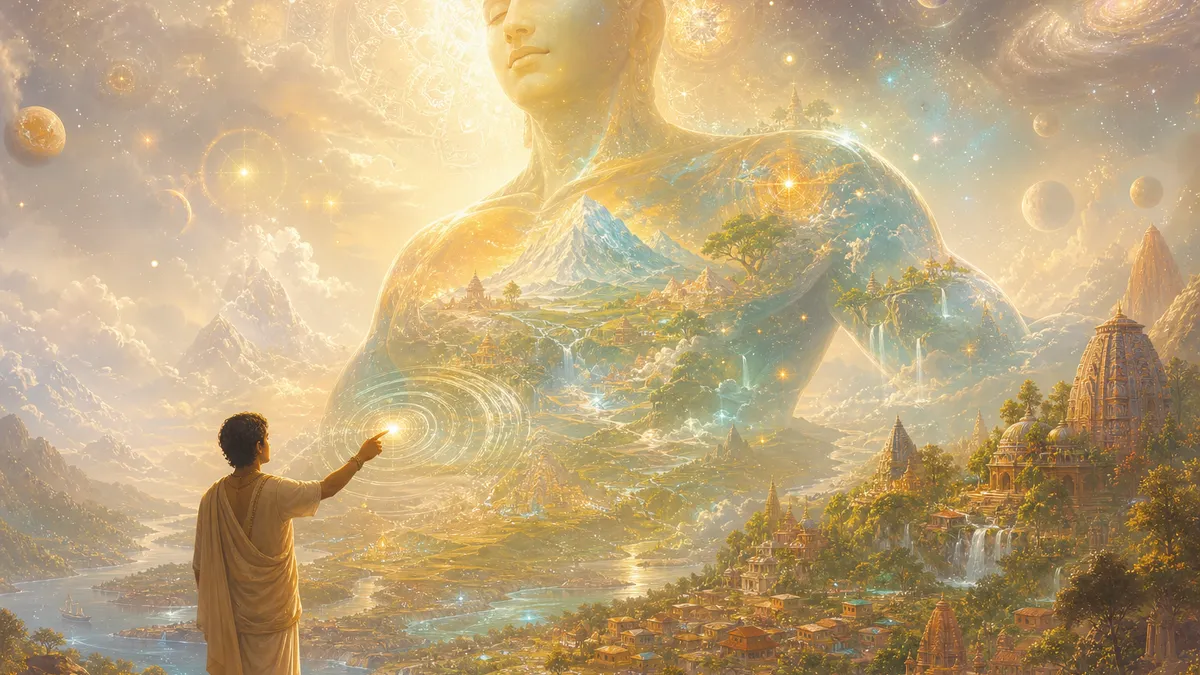
Since it is generated by the subtle layers of our own consciousness, we must change our attitude toward the world as real, as dense. We must look at it in just this way — it is a magical world; in a certain sense it is illusory; behind it is the emptiness of nondual consciousness, blazing with light, while all names and forms merely conceal the emptiness of nondual consciousness, full of light. If this world possesses a magical nature, then we recall the laws that follow from this, for example, the law: what you think about, you become; or another law: wherever and whatever consciousness conceives, there it manifests. This means that we, as observers in this quantum world, which has a magical nature, can to some extent influence it — this world and our destiny within it — by using the power of consciousness.
Conscious Spiritual Practice and Responsibility
When we understand this, and we know that consciousness is the point of application and that our will is the point of influence upon this world and upon our destiny, we consciously begin spiritual practice. We understand that we practice precisely in order to influence this world, in order to take the key to managing our destiny into our own hands, the levers of control over our evolution within us, and that we are responsible for our destiny. If the world is a manifestation of our consciousness — a collective visualization in which we also take an active part — and there is nothing unambiguously dense that manifests, but everything consists of consciousness, then we can begin to manage this process; we are responsible for this process. Everything that happens in our life is a consequence of our visualizations — it is a consequence of our intentions. Then we consciously perform practices in order to increase our ability to manage our destiny and our own world. Then our practice and evolution become the only thing we should be engaged in.
Whatever is perceived as real becomes real. Although the perception of a particular form is determined by previous experience, it is nothing other than pure consciousness — just as a banana trunk is a banana trunk, and each of its layers resembles all the others.
When we understand the magical nature of the world and the two principles of law that follow from it — you become what you think about, and wherever, whatever consciousness conceives, that is what manifests — we discover the key to materialization. Materialization means that we can materialize an intention by the power of our will, the power of visualization, the power of consciousness. Then we ask ourselves: “What do we want to materialize?” Suppose we have understood that this world possesses a magical nature, and that by pressing the right buttons in consciousness, we can materialize certain things in it, provided, of course, that we apply sufficient tapas. Then what do we want to materialize? God. Let us say that we can materialize ourselves in a godlike form, for example — this is precisely the practice of the illusory body.
The practice of the illusory body means that we materialize ourselves, deify ourselves, endowed with the divine traits of Shiva or Dattatreya. We can materialize a heavenly world, manifest it. We can manifest the necessary qualities within ourselves, the qualities that imply liberation. Ultimately, we strive to manifest within ourselves the qualities of Ishvara — this is the sixteenth stage of kala; that is, we materialize strictly in accordance with the teaching. We move through the tattvas, and the materialization of one achievement or another means that our consciousness must transition to a higher tattva. For example, in order to materialize an entire universe, one must transition in consciousness to the fourth tattva — from there the materialization of an entire universe is possible, as with Ishvara. From lower tattvas, this is impossible. To manifest a level where there is no time and space, where they are under control, one must realize the tattva of kala-kanchuka, niyati-kanchuka; one must raise one’s consciousness to the corresponding tattva.
Gradually we understand the magical nature of reality, understand which button to press in order to achieve our goal — this is what the teaching of tantra consists of: mantra, visualization, invocation of the Refuge Tree, invocation of divine beings. However, all our materialization must not be selfish in nature. There are many magicians and sorcerers who also successfully engage in magical operations on a small level for selfish purposes, but what we seek to realize or manifest is the execution of divine will. We do not seek to realize our own will outside the will of God. Our task is to serve God and to materialize precisely what the divine will commands. On the contrary, the materialization of one’s own selfish intentions is a mistake and a departure from the spiritual path, a departure into magical operation — the path of the magician. This is not the path of liberation.
Question: From which tattva do these magicians act? They also change reality.
Ahamkara-tattva, at most buddhi-tattva. Our task, however, is completely different tattvas, which is why Patanjali’s “Yoga Sutra” warns: “Fascination with siddhis can become a serious obstacle.” When siddhis manifest naturally, this is called the siddhi of the natural state — it is simply the natural course of things. But when they manifest from ahamkara-tattva, this is a problem, because the yogi already seeks to carry out not the divine will, but the will of ahamkara-tattva. Those who practice for the sake of siddhis, and not for the sake of carrying out the divine will, are considered to be on a false path.
There was an example when the Buddha invited a man into the monastic community, and he said:
— What do you love most of all?
— I love women most of all.
— Look at earthly women: they quickly wear out, their beauty fades, and there are flaws as well — an earthly body, and relationships too, binding oneself with obligations, — then he manifested a vision for a while and showed him heavenly women (apsaras), and said:
— Look how beautiful the heavenly women are; their bodies are divine, they do not age, they live for a hundred thousand years, they require no obligations, and they will delight you for tens of thousands of years.
— I agree, that’s it, no questions, I’m becoming a monk.
The Buddha said:
— I will give you a method, a dharana; practice the dharana, read the text, engage in visualization, and you will attain the paradise of the heavenly women.
But when he was tonsured and began this practice, the other monks refused to sit near him and receive prasad with him; they set him apart and said: “Your place is to sit over there.” He was not accepted into the monastic community; in essence, he was ignored, and he took offense at this. “But why?” he asked. They said: “This is natural; you are following a false path, you are not following the true teaching of the awakened ones — this is a false teaching.” But this was the Buddha’s skillful means. Subsequently, this monk realized his delusions and entered the path of attaining nirvana.
The true essence is considered to have an atomic nature because it is exceedingly subtle and imperceptible, but at the same time, since it alone exists, it is infinite and stands at the beginning of all existence. It is formless, although it manifests in diverse forms.
