Mutual Absorption: The Path to the All-Encompassing “I” in Shaivism
02.09.2026
0 мин. чтения
0
Share
copy
search
add
share
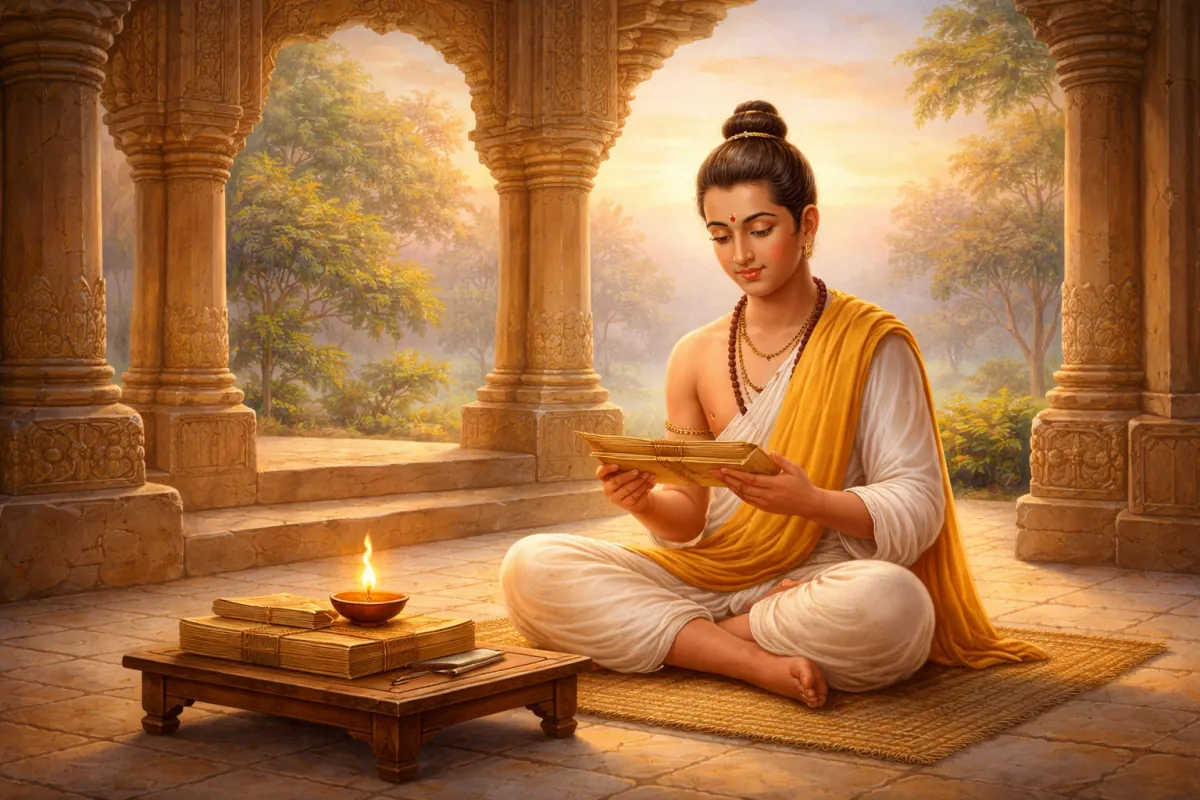
We will examine such concepts as saha-bhojana (joint absorption), purna-ahanta (the all-encompassing conception of the “I”), the three types of linga: kriya-linga, bhava-linga, and jnana-linga, as well as sva-linga and svayam-linga. These are important concepts in the philosophy of Shaivism for clarifying the ground.
The ground is translated as adhara; the ground of everything is God. When we clarify the ground and the ground (God)—that upon which everything rests—has been clarified, our contemplation and our view are unerring. People often have a mistaken view of the universe, God, and creation because the ground has not been clarified and there is no view either. If there is no view, contemplation is also impossible. What is there to contemplate if there is no view? The view is a particular ideal state that we have understood.
The ground, the view, and contemplation are always interconnected. The deeper we penetrate the ground, the more powerful our view becomes. The more confident we are in the view, the more stable, one-pointed, unwavering, and profound our contemplation becomes. And the deeper our contemplation, the deeper our viveka, vairagya, and other excellent qualities become, ultimately leading to liberation.
Purna-ahanta: the All-Encompassing “I”
The Sthala of “Unity.”
The world is a manifestation of Shiva—this is what the saint always feels; he is called one who perceives everything in the One, because he has dissolved everything in the One, in Shiva.
The world is a manifestation of Shiva, vishvam-shivam-mayam—this is how the yogi feels. The yogi has dissolved everything in the One; that is, he has realized everything as a manifestation of Shiva. To realize everything as a manifestation of Shiva, to realize the unity of one’s “I,” the Guru, the world, and Shiva—this is what is called saha-bhojana (joint absorption). When everything is absorbed into a single consciousness, all together, this is a very important element in Shaiva philosophy and the philosophy of Anuttara Tantra: to unite everything in the One, to integrate everything in the One.
On the relative level, there are many different things: the Guru is the Guru, the disciple is the disciple, the deity is the deity, Vishnu is Vishnu, Shiva is Shiva, and Vishnu is not Shiva. But from the standpoint of the view, such notions are erroneous and dualistic. Such notions may be valid in a relative sense from the standpoint of conduct. For example, from the standpoint of conduct, it is clear that there is a distinction between the Guru and the disciple and that there is an appropriate code of ethics; or we understand that Vishnu embodies certain qualities and Shiva embodies certain qualities, but this is only from the standpoint of relative conduct. In the view, a yogi should not hold such notions. In the view, he should unite everything, and this process is called joint absorption.
Through the vision of the unity of all that exists—oneself, the world, and Shiva—the yogi gains conviction in the unity of prasada.
The vision of everything as one—oneself, the world, and Shiva. Such a vision leads to what is called purna-ahanta—the all-encompassing conception of one’s own “I.” Among the twelve sankalpas, there is one called “the world is one with the mind” or “everything is one with the mind.” Everything being one with the mind is purna-ahanta.
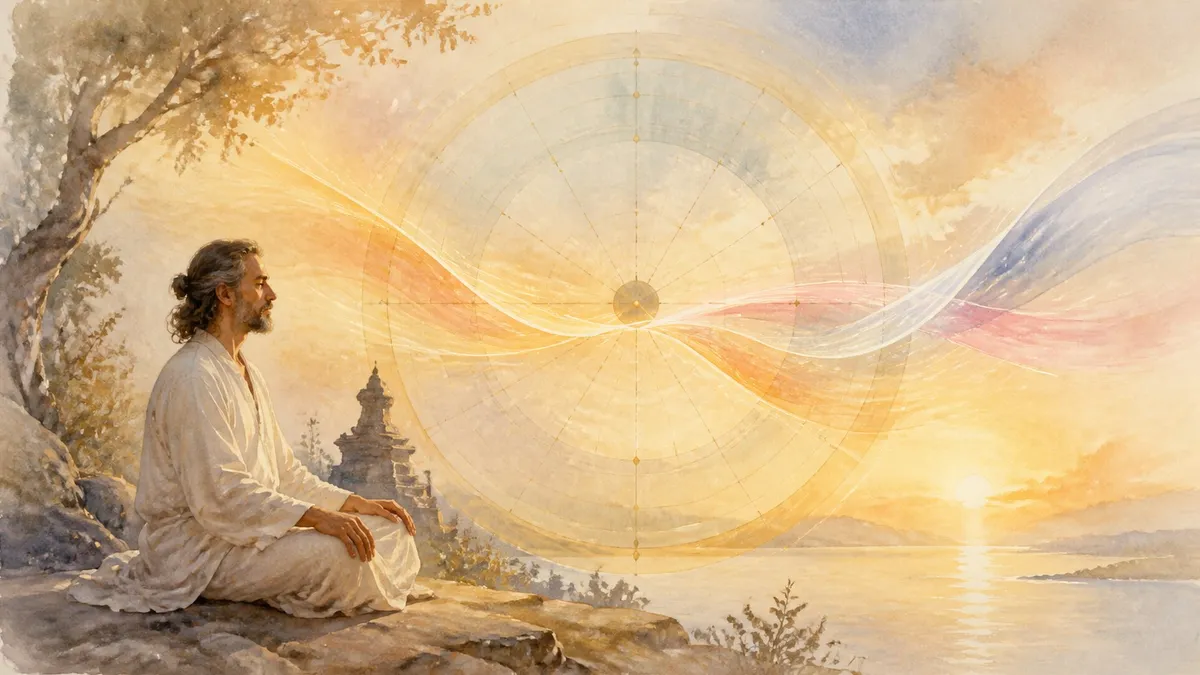
When we change our conception of our “I” into an all-encompassing one... Usually, we have a narrow, limited conception of our “I”; for example, we think, “I am a man, I am a woman, I am a human being belonging to the human race.” It does not occur to us to feel all-encompassing—this is very difficult, and few people other than sadhus have such thoughts.
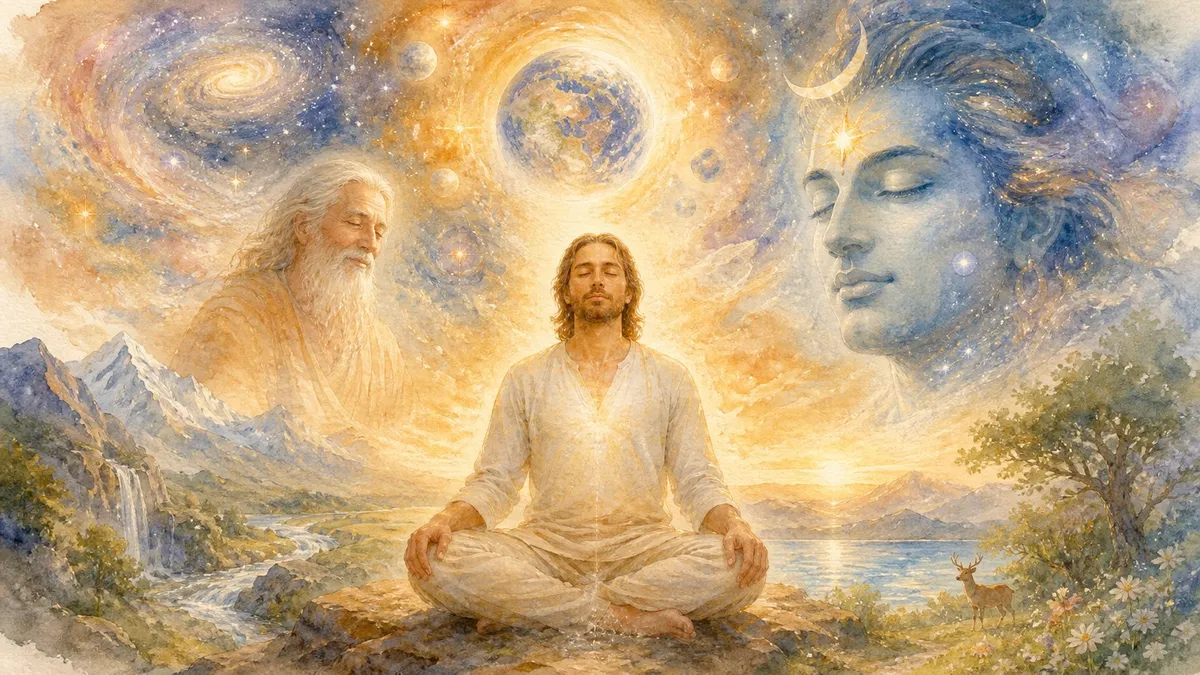
For example, it does not occur to us to feel: “I am a galaxy, I am all galaxies, I am the sun, I am the moon, I am all the stars, I am all the planets, I am the outer world, I am the gods, I am the inner world, I am the hells, I am the heavens, I am human beings, I am the rishis. Oh, how vast I am, how majestic I am! Indeed, I am everything; there is nothing apart from me. I remove and absorb all of this.”
What then? With whom will you have conflicts? What do you want to prove to anyone, whom will you get around, whom will you surpass or outstrip, with whom will you compete? To whom will you become attached, and with whom do you want to build a relationship at all? To whom will you be senior or junior, whom will you serve or from whom will you accept service, to whom will you preach? It is all to yourself.
Becoming accustomed to experiencing this is precisely the sankalpa “everything is one with the mind”; it is not so simple. This is one of the most profound and serious sankalpas, and therefore it should be practiced at the very end, after mastering all ten preceding ones. This is purna-ahanta (the all-encompassing notion of “I”); it is the notion of an enlightened jnani.
Abiding in the View means gradually displacing notions of one’s old, small, limited self with this all-encompassing notion of “I.” In order for those notions to be displaced, we must learn to hold this notion through training in contemplation, become accustomed to it, and then continuously sustain the natural state of awareness. This is one of its facets—this is what it means to have an all-encompassing notion of “I.”
The mind must be wide open; it must be let go, liberated, relaxed, artless, natural, and beyond correction—these are certain facets. But if this all-encompassing notion of “I” is absent from natural awareness, then it cannot yet be said to be the natural state of awareness.
The natural state of awareness is precisely purna-ahanta, a truly great state. A yogi should become accustomed to it by establishing himself in the View that unites everything and absorbs everything into the one—into a single vision.
The Balance Between Unity and Discernment
What does it mean to absorb everything into a single vision? It means not attaching importance to differences at the level of the contemplative View, but placing greater emphasis on unity. Usually, when we focus on differences and emphasize them, it means that we are overusing viveka (discriminating wisdom), that we are taking viveka too far. Viveka pulls our mind out of the state of unity, and we become fixated on something separate, particular, local, disconnected, and fragmentary. Through excessive clarity, viveka can often lead us away from the spiritual path and away from the natural state. It may be mental clarity or some other kind.
Collective absorption means that, on the contrary, we focus on wholeness, unity, and universality. We reduce our inclination toward differences and increase our inclination toward unity, our sense of unity, our experience of unity and of a single “taste”—that all of this is one.
There is a subtle point here: nothing should be taken too far. If we overdo viveka (discernment), we will distinguish everything with extreme subtlety—the details of prasad, the details of concepts, the details of ethical nuances. We will distinguish them so clearly that we become captivated by this discernment, and attachment to some things and aversion to others will arise. When this happens, it is the result of overusing clarity and viveka. It means that maya-mala has been activated and has begun to dominate, and the sense of difference has begun to increase.
We have begun to distinguish everything to such an extent that we have lost our sense of unity. This happens when a monk thinks: “Monks and laypeople are completely different people, entirely different universes. It is actually frightening even to speak with a layperson—you will become so defiled and your channels will become blocked.” He is afraid even to interact with laypeople. This means that he is overusing viveka.
Going even further, he begins to think: “A monk before twelve o’clock and after twelve o’clock are completely different things. You have to maintain your level and not even sit beside one another.” “An initiated disciple with diksha and one without diksha are completely different. Prasad prepared by someone with diksha and by someone without diksha are completely different, and such a difference can be felt in everything. It affects you so much that afterward life becomes very difficult. Meditation and service are such different things—they are as different as heaven and earth. Aversion to service even arises, because meditation is the soaring flight of samadhi, while service is a waste of time; that is, they are completely different things.”
“Matajis and prabhus are so different that a mere glance, even a passing shadow, can defile a brahmachari’s monastic vows; that is, hatred and even aversion arise—I cannot even bear to see them.” This is an example of a distorted mind that has become captivated by excessive discernment. Or when someone thinks: “Sanatana Dharma is the highest Dharma, while those other Dharmas are simply mistaken, understand nothing, and are like some sort of kindergarten”—there is contempt and no love or compassion. All of this is excessive clarity.
This can happen, as in: “A brahmachari undergoing monastic training is different from some layperson,” or: “Someone who has merely taken the Creed and a karma sannyasi are simply worlds apart.” These are all examples of being caught up in excessive clarity. But in reality, in Brahman we observe the absence of distinctions and the unity of all concepts; believing otherwise is a great delusion—this is excessive viveka.
There must be viveka, but it should not assume such a distorted character. Here, the yogi should concentrate on the sense of wholeness, on the sense of unity, while not losing viveka. A sense of wholeness, commonality, and unity means that in our view we see all of this as one, yet we do not lose viveka. If we lose viveka, it will be said that we have lost action in the view, that we have instead become biased toward the view: “Vegetarian prasada, non-vegetarian—it is all the same; one can eat meat. Yes, laypeople, monks—what is the difference?”
The subtle union of view and discrimination is precisely the principle whereby we skillfully absorb everything, reducing it all to one, yet without losing viveka-vidya (discriminating wisdom).
Shiva as the Foundation of the World
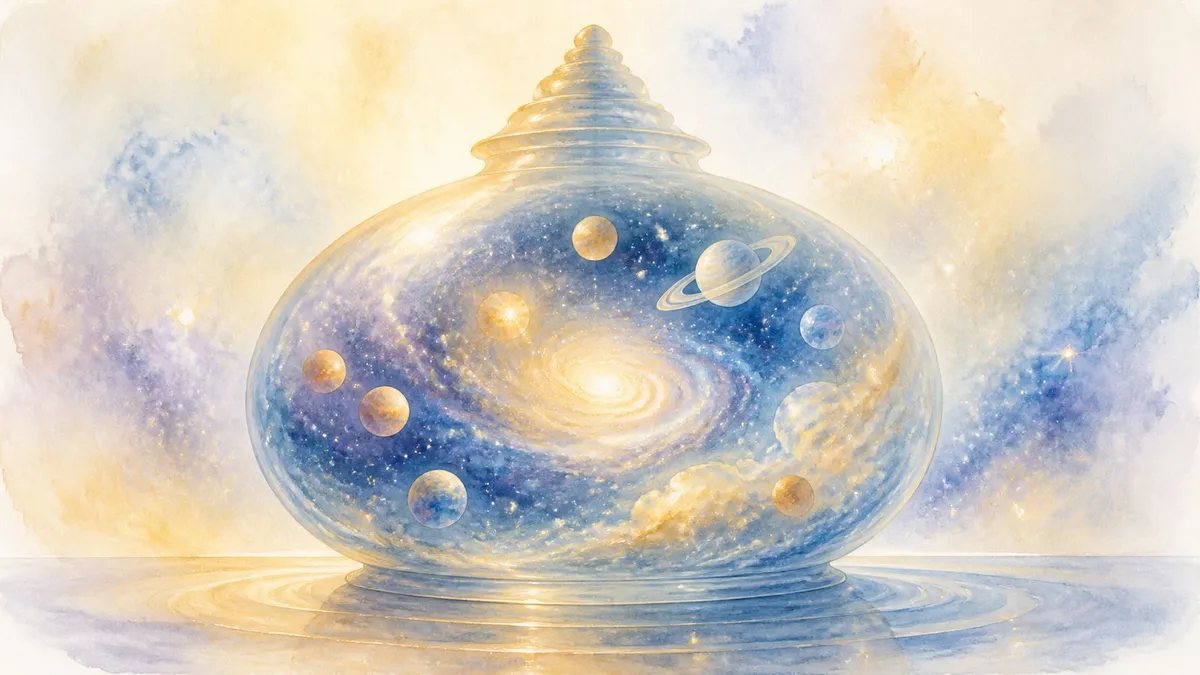
This entire world abides in Shiva; only Shiva is seen everywhere. Shiva and the world are related as the support and that which rests upon it, or as the container and its contents.
Shiva is the support, the container, the foundation, while the world is the content, that which rests upon it. This entire world rests upon Shiva. Shiva is the container of this entire world. How can this be realized? For example, analytically, through reasoning, one can arrive at the state of the Big Bang and what preceded it, or at the state of emptiness of all phenomena. Through direct contemplation, one can attain a vision beyond judgments, where all distinctions and all objects of the world dissolve in primordial consciousness.
For one whose mind is absorbed in the One, whose thoughts contain only Shiva and nothing more, what use is the material world, whose root is illusion (maya)? Supreme consciousness illumines the world; without it, the object (the material world) does not exist. What use are the creations of illusion (maya) to those whose minds are focused on supreme consciousness?
The material world, the material illusion, captivates us only because we pay attention to it. The dense, gross material world only appears dense and grossly material because we have invested enough energy and attention in it. Our attention has singled out precisely such a world. When we begin to pay attention to Brahman, to Ishvara, we begin to realize Brahman, Ishvara, while the dense material world ceases to exert such an influence on us.
Whatever we pay attention to manifests more fully in our lives. When we pay attention to distinctions, distinction increases, and they become maya-mala. When we pay attention to unity, the sense of unity increases. Whichever way we turn our mind, so it will be. The process of liberation means learning to turn our mind until we establish it in the dimension of turiya, in the transcendent state. Those who are adept at turning their minds find this dimension and abide in grace. Those who are unable to turn their minds skillfully are tormented in their search for this grace, but have not yet found it.
The Mystery of “Aham”
The yogi always abides in his heart, immutable, unperturbed, and completely dissolved in Shiva; such a person has attained liberation—there is no doubt about it.
The letter “A” signifies Shiva—it is the first letter of the Sanskrit alphabet, the heart of being, the primordial nature of reality. The letter “Ham” is the last letter of the alphabet; it signifies Shakti. These two letters, the first and the last, form “Aham.” “Aham” means “I am.” “Aham” means that Shiva and Shakti are always united. “Aham” is what we say about ourselves: “I am,” “I exist.” “Aham” means that deep within I am Shiva, while my five sheaths (koshas) are Shakti—this is what a human being is. Whoever can recognize the mystery of “Aham” realizes the principle of liberation.
Saha-bhojana: the absorption of all distinctions into the one consciousness
The Sthala of “Joint Absorption”
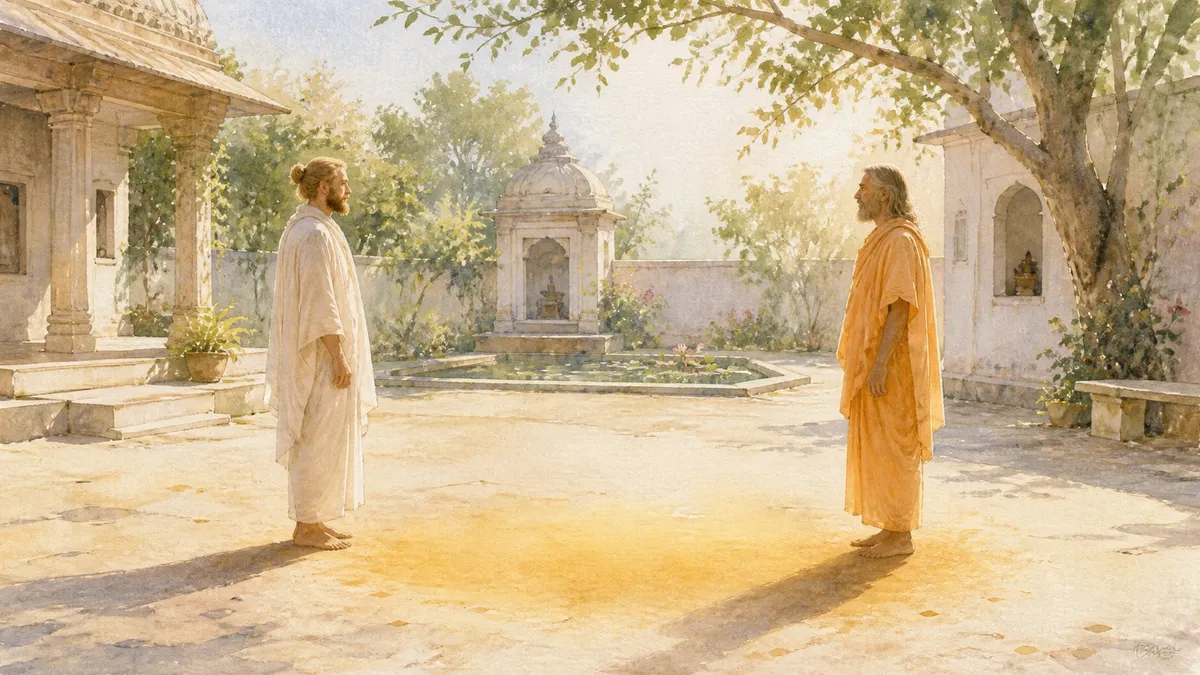
The understanding that the teacher, Shiva, and the disciple are all forms of the person himself is called “joint absorption” (saha-bhojana).
Saha-bhojana (“joint absorption”) begins when we start to regard the world as a manifestation of our own self, the Guru as one with our mind, the Guru as one with our self, the ishta-devata on the altar as one with our mind, the ishta-devata in different bodies as one with the self, and Shiva as Ishvara as one with the self.
When we begin to accustom ourselves to such a view, a very profound, mysterious mystical process begins, and the yogi’s life changes because his identity changes. Imagine a person who experiences himself, you, God, the Guru, and the deities on the altar all as himself. When such a person walks, thinks, acts from this vision, sleeps, and eats, will he be limited by habitual tendencies, kleshas, and karmas; will the eight pashas (bonds of consciousness) hold power over him? Such a person naturally abides in profound awareness of Brahman. Even if this is not the case at first, sooner or later he attains such awareness.
It is called “joint absorption” because its nature is to absorb everything.
What does “joint absorption” mean? “Joint absorption” means that your view, your understanding of the ground, begins to absorb all distinctions; your sense of wholeness, of unity in the ground and unity in God, begins to absorb all those differences that were previously important to you.
For example, there is a distinction between day and night, but if you contemplate both day and night, does it really matter where and when you contemplate? There is a distinction between “like” and “dislike,” but if behind everything you see Shiva as darshan, as a blessing, does it really matter whether you like it or not? There are distinctions between one method and another, but if the mind is in its natural state, does it really matter which method you use? When you are in the natural state, the method is applied as play. There are distinctions between one form of service and another, but if you abide in the view of the Absolute (in God), does it really matter which form of service it is? Is it essential in which form of service you contemplate or worship God? There is a distinction between service and meditation, but if in both you are in God and in profound sahaja samadhi, does it really matter whether you are in sahaja samadhi while sitting or in sahaja samadhi during service? It does not, although this is difficult to attain.
Ultimately, the yogi absorbs all these internal and external distinctions; this is very important. We feel that the inner is interesting, while the outer is not so much, if we are yogis. But if a yogi contemplates God equally within and without, does it really matter where he contemplates Him? Contemplation and distraction—if the yogi abides in God like a finger stuck in glue, is there any difference between contemplation and distraction?
Ultimately, the yogi must attain a state in which life and death as a distinction, as well as having or not having a body, also lose their meaning and importance, when the yogi feels: is there any difference between having a body and not having one? Dreaming sleep and dreamless sleep, wakefulness—the three states of vishva, taijasa, and prajna—if the yogi has realized turiya, then is the difference between turiya-jagrat, turiya-svapna, and turiya-sushupti essential? If all is the one turiya, it is not so essential.
Absorption means erasing distinctions more and more and arriving at a single “taste.” When a yogi arrives at a single “taste,” he naturally releases the perception of Shiva from every act of perception, from every taste, every scent, every sound, every touch, every smell, and every action. When he releases Shiva and Shiva comes to the fore, everything is naturally purified, reveals its empty, playful nature, and reveals its pure nature.
One should constantly unite Shiva, the world, and the Guru within one’s Atman (within oneself, within one’s “I”). When they are one in consciousness, this is “joint absorption.”
When Shiva, the external world, the Guru in Guru Yoga, and I myself are united, all of this is called “joint absorption.” We rely on the Refuge in order to absorb the distinctions of this world and become established in unity.
“This is Shiva, and this is the Guru. This is the animate and inanimate world, and this is I.” A person who has no such dualistic ideas “absorbs the entire world without distinctions.”
Instead of such dualistic ideas, we adopt a single nondual idea—it is much more convenient. What is this idea? “I am Shiva, and all this is one. The Guru is Shiva, the Guru is I, I am Shiva, Shiva is the Guru, I am the world, the world is I, the world is Shiva.” All of this is one, but it is not a mixture; it is a transcendence of concepts. We do not repeat this; we realize it directly. We do not need to philosophize at length about it; we need to see it directly by breaking through concepts. When we break through concepts, that is joint absorption.
Then we feel that many dualistic states of some kind still remain, perhaps within, perhaps without. For example, time—we feel: “I have not yet taken in or absorbed time. I need to absorb time. There is still past time, future time, and the present, and I also need somehow to bring them all to a common denominator and unite them within myself.” First, the past, future, and present must be joined together, and then they must be merged with one’s “I.” “I am time; I am the one who is beyond time—kalatita.”
There is raga, desires—I also need to absorb them. There are desires that cause problems and desires that do not cause problems. There is attachment and there is aversion based on desire. There is I and there are desires—I need to reunite this once again, to reunite with the energy of all desires without falling under their influence, to transcend them, rise above them, take all the energy of desire, and see it as Shiva. Many such dualistic notions must be united with this primordial consciousness of wholeness—this is “joint absorption.” We must absorb all of this.
“There are some unpleasant sensations, and they are separate from me, which means that I must expand the boundaries of my perception and absorb these unpleasant sensations, making them ornaments of my natural state, as Shiva did.” Thus the yogi gradually expands the boundaries of his perception of nonduality, absorbing various tattvas, categories, and kanchukas until this process becomes like a forest fire—that is, until it expands his consciousness to infinity. There is wakefulness, there is dreaming, and there is dreamless sleep—I must absorb and transcend these as well, rising to turiya.
Question: Guruji, please tell us, what happens when absorbing time?
You become Mahakala. He alone can absorb time.
Question: Can one say that the past and future become part of the present, or is this a transcendence that cannot be described so simply?
They become part of the present, but not the present identified with the mind; rather, the present that transcends all distinctions.
Question: So is it perceived as the overall picture or as part of the present?
One could put it that way. Time is Kalashakti (energy), a very subtle force. In absorption, this subtle force is perceived as one with consciousness, as part of one’s own consciousness. This is the only present there is.
“I am the servant, Shiva is the master. I am the disciple, and he is the teacher.” One who has no such thoughts is established in the state of nonduality. The embodied Atman (the embodied “I”) that has merged with Paramatman (the supreme “I”) is a flame illuminating the universe.
Changing One’s View and Attaining Adhara-Agni
Gradually, we change our human view into the view of a Shivayogi. For now, everything remains the same in terms of behavior, because behavior is governed by the laws of energy, and in the realm of energies, differences are of great importance. Therefore, we do not hurry to change our behavior until we have changed our view. We change our view until it merges with our own “I.” When our view merges with our own “I,” we gain access or the right to what is called the foundation, or adhara-agni.
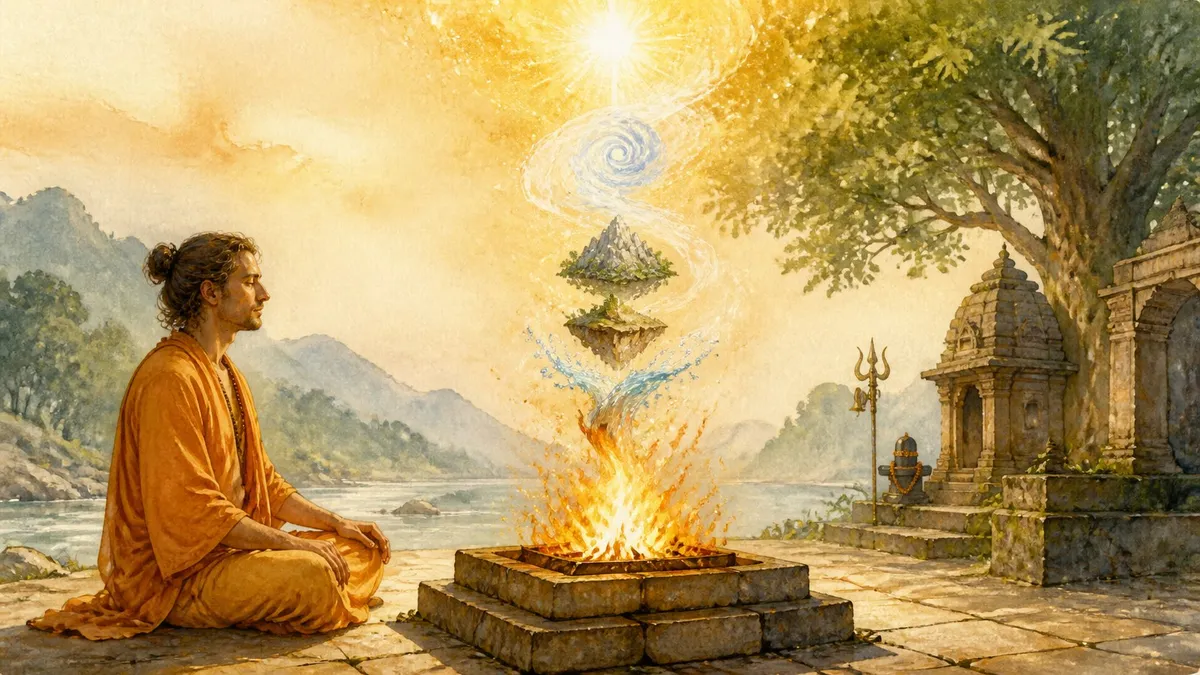
Adhara-agni can be translated as “the fire of Shiva that melts everything,” as the universal flame of faith and love for God in which everything burns up in nonduality. “Adhara” means foundation, and “agni” means fire. It is adhara-agni that melts down all these dualistic notions and karmas present in our subtle body; adhara-agni burns all of this. We gain access to it when we master such a view.
The view turns into contemplation when we hold it continuously, when we abide in it. When we abide in a state of self-surrender, we have the flame of divine love, the flame of divine faith and divine wisdom that burns everything—this is adhara-agni. There must be the fire of great faith and the flame of universal love within you so that you can burn the kleshas, burn identifications, burn perception—this is self-liberation and self-surrender.
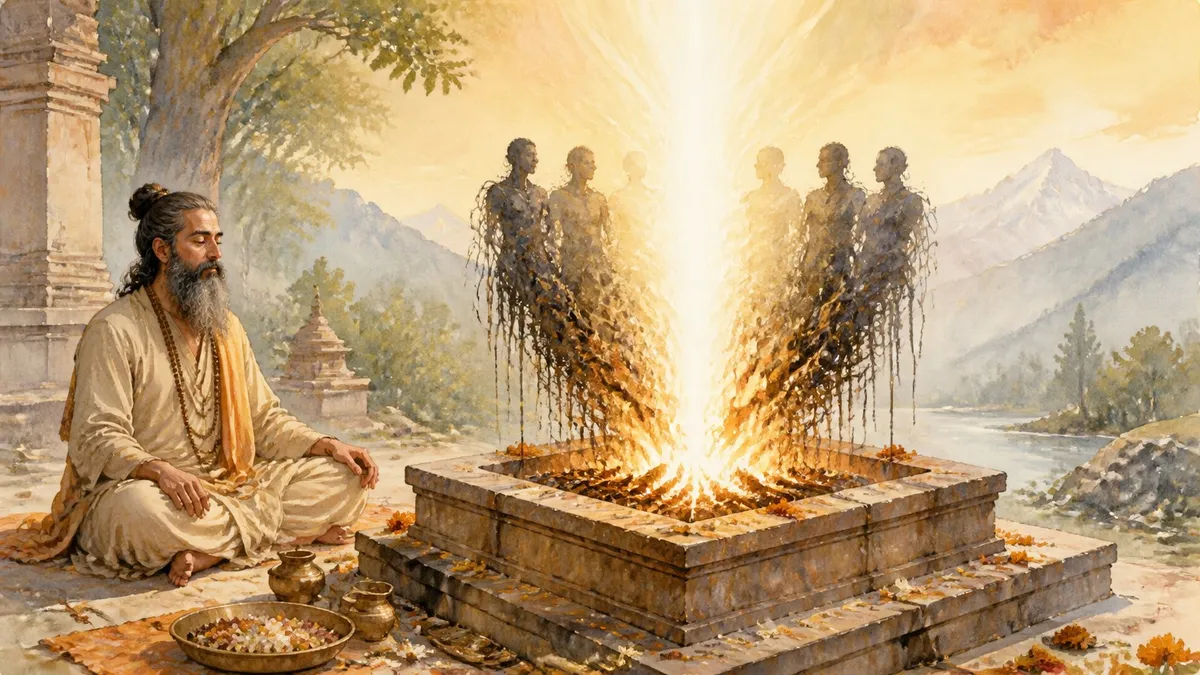
Then the great sacrifice (maha-yajna) naturally takes place: whatever you drink or eat, whatever you see or hear, whatever you do—you offer it, just as during a havan we throw offerings into the kunda and say, “Namaha.” You offer everything that is experienced into the kunda of adhara-agni (the flame of Shiva), which burns everything.
One who sacrifices to the flame of his Atman everything represented by the notion of “this” (this world) “sacrifices everything.”
At first, we must be very careful, and just as not everything can be thrown into the kunda at once, because if too much is thrown in, smoke will rise and the flame will not burn, so dirty objects and anything extraneous are not thrown into the kunda; only samagri is offered. Large sticks should not be thrown into the kunda, so that the fire may keep burning—in other words, our fire must always burn. Therefore, we must not clog our fire with worldly desires, behavior that is unbecoming of a sadhu, or perceptions. In our view, we must sacrifice everything, but on the relative level we must understand what can be thrown into this fire and what cannot yet be thrown in, so that the fire does not go out. But as it grows, we can throw more and more into it until it becomes the flame of universal faith and love, in which the entire universe burns within our perception.
The All-Encompassing Notion of “I”
“I am Shiva. I am the Guru. I am the world, both living and nonliving.” Full awareness of this is called “the all-encompassing notion of ‘I’” (purna ahanta).
When the yogi burns all his dualistic notions in this flame of adhara-agni, he gains a new “I,” a new notion of “I”: “I am no longer the little person I thought I was; I am completely different now; I am a new person.” This is not merely a human being—it is the deity within, human in body but Shiva in consciousness. This is the consciousness of a jnani, and such consciousness is purna-ahanta, the all-encompassing, integral notion of “I.”
We replace our small, limited, egoistic human “I,” with its fears, attachments, hopes, and illusions, with a total sense of being in God, a total sense of divine greatness, divine purity, beauty, wisdom, love, and openness. Living naturally in such a beautiful “I” is far happier; such an “I” has the right to happiness—the happiness of twenty-four hours a day, which never ends. When you attain purna-ahanta, grace descends in a broad stream. In a state of grace, the yogi is always happy.
This small, limited human personality may be unhappy, experience distress, suffer, and have problems, whereas a yogi with such divine majesty of “I” as Shiva cannot, in principle, experience anything other than happiness, because this is his natural state. Shiva is bliss, grace, satyam, shivam, sundaram, shubham — eternal purity, eternal beauty, and eternal happiness. Experiencing such beauty, love, and eternal happiness is a sign that purna-ahanta has been attained, an all-encompassing, integral experience of “I.”
Question: Gurudji, as I understand it, can we arrive at such a state when we have passed through lila, that is, understood lila? Everything passes through the scenario that manifests in this world, and if we do not become part of this scenario, then we will not be able to attain this state?
You probably meant that we have learned to liberate our actions and perceive them as a game, as well as other types of activity, the actions of others, and everything that happens to us—for example, karma and destiny, right? Yes, that is correct—that is how it is. We will talk about this a little later; it is called kriya-linga.
Question: Gurudji, the states that were described—“universal absorption,” divine pride, pure vision, and so on—are these aspects of the natural state?
Of course, if by the natural state we mean unity with Shiva, rather than a type of attention or something conceptual.
Question: Let us say, jnana?
Of course.
Question: If a person attains jnana, whether through jnana yoga, bhakti yoga, or kundalini yoga, does he automatically acquire, so to speak, all these states?
If it is a true attainment, then not automatically, but naturally.
Question: But does the very fact of attainment imply that a person acquires all these qualities?
Not all at once, but gradually, yes, exactly so.
The Sacrifice of Knowledge and the Great Yajna
A person who has attained unity with Shiva performs the sacrifice of knowledge, offering the world consisting of differences as an offering into the “flame of the foundation” (adhara-agni), which is consciousness. Such a person “absorbs the world as a sacrifice.”
The perception of the world and actions change their qualitative characteristics. The world is regarded as something that is offered—no one had thought that one could relate to the world in this way. The world is a large package of samagri containing a mixture for havan, or a large set of sticks and flowers for puja—that is what the five perceptions are. This is the meaning: puja prepares us, it accustoms us to the fact that such a process exists, but now, if we have learned to perform pancha-upachara-puja with flowers, incense, fragrances, and a lamp, then our upacharas are now all five elements.
The ritual implements simply expand a little: the sun, the moon, the earth, the universe, the entire element of air, all the waters of the world, and so on. To whom do we offer them, where is our deity, where is our altar? It is adhara-agni, the radiance of Shiva’s fire, the fire of awareness within us—but not only within us, also beyond us and in every living being, beyond the body and within it, inside and outside. We perform the sacrifice through every act of perception—every act of hearing, every act of seeing, every act of eating, touching, smelling, and so on. Puja never ends—it is an eternal havan, the great yajna. How does this yajna take place on the fire—the adhara-agni of the great radiance of the foundation? Through simply abiding in natural awareness, through simply connecting perception with the fire of awareness.
When a person’s thoughts have dissolved into the sun of supreme bliss, into consciousness, into the supreme space, what significance does the order of the universe have for him?
Indeed, if everything is a great offering, what difference does it make how the ingredients for the offering are arranged—you pour them into the kunda anyway.
The Dissolution of the Ego in the Supreme Space
One should feel how one’s own Atman (self, “I”) dissolves when it merges with the flawless supreme space of consciousness, free from the suffering of the world (samsara).
When we open up to the principle that “everything is one with the mind,” attain purna ahanta (the all-encompassing conception of “I”), and gain the right to adhara-agni, to the great light of the radiance of Shiva’s fire, it becomes clear that our ego remains; it has not disappeared anywhere, and we must dissolve this ego. That is, the first thing that must be sacrificed to this great fire of Shiva, to this great state of the all-encompassing conception of “I,” is our own ego — this is self-surrender, along with its hopes, fears, ambitions, attachments, fixed stereotypical ideas, habits, and everything else. We must feel this small ego dissolving into the great all-encompassing state.
This is the highest knowledge, revealing the nature of being-consciousness-bliss. Enlightened sages call this knowledge, which dispels the illusion of the world, liberation.
The great illusion of the world is this: all living beings live in a great illusion. One should not think that they know something, one should not think that they are right, one should not think that they are so important. All of this is untrue. The entire world is a great illusion; samsara deceives all living beings, regardless of what they do, how wealthy they are, or what they possess. Only siddhas, only sadhus, only the awakened know the truth and are not deceived by the world.
It is like being in a hospital: it does not matter how powerful or wealthy a person is in the hospital — he is still a patient at that moment. It does not matter whether he possesses artistic flair or is a great writer — in a hospital, everyone is a patient first and foremost. So it is in samsara — in samsara, everyone is deceived first and foremost. When everyone is drowning in the sea, it does not matter who is a great superior, who is a king, who is a great wealthy man, or who is an intellectual — while they are drowning in the sea, the status of “drowning in the sea” is their main characteristic.
In the same way, in samsara all living souls are subject to the great illusion, absolutely all of them, but the sadhu emerges from this great illusion by dissolving his ego in the light of Shiva. When his ego dissolves, there are signs, there are indications: his pride decreases, humility increases, love and compassion increase, his patience, humility, and compassion increase, as do his pure vision, inner peace, and inner happiness; fears, attachments, kleshas, clinging, and apprehensions, on the contrary, diminish. This is a clear sign that the ego is being sacrificed. Conversely, in one who does not make the sacrifice, these qualities do not diminish, because he does not sacrifice his ego to his higher “I.”
Through practices pertaining to the stages (sthalas) described above — bhakta and so on — one attains the most wondrous state of unity with Shiva, the supreme heaven of consciousness. Then a person truly becomes a vessel for the wealth of liberation.
Thus ends the sthala “Joint Absorption.”
Nonduality
Contemplation
Liberation
Viveka
Shiva
View
Shri Siddhanta Shikhamani
Saha-bhojana
Purna-ahanta
Adhara-agni
Author Гуру
Read 15 times
Articles
Vidya AI
Search
Lectures
November 2, 2026
Mantra of the day
ОМ САХАДЖАЙА НАМАХ ОМ Естественному – поклонение!
Auspicious Times(Rome)
Brahma Muhurta:
04:53 - 05:48
Abhijit Muhurta:
11:33 - 12:14
Sayam Sandhya:
16:44 - 17:25
Mokshada Ekadashi (6 November)
Ekadashi of liberation. Helps to achieve spiritual enlightenment.