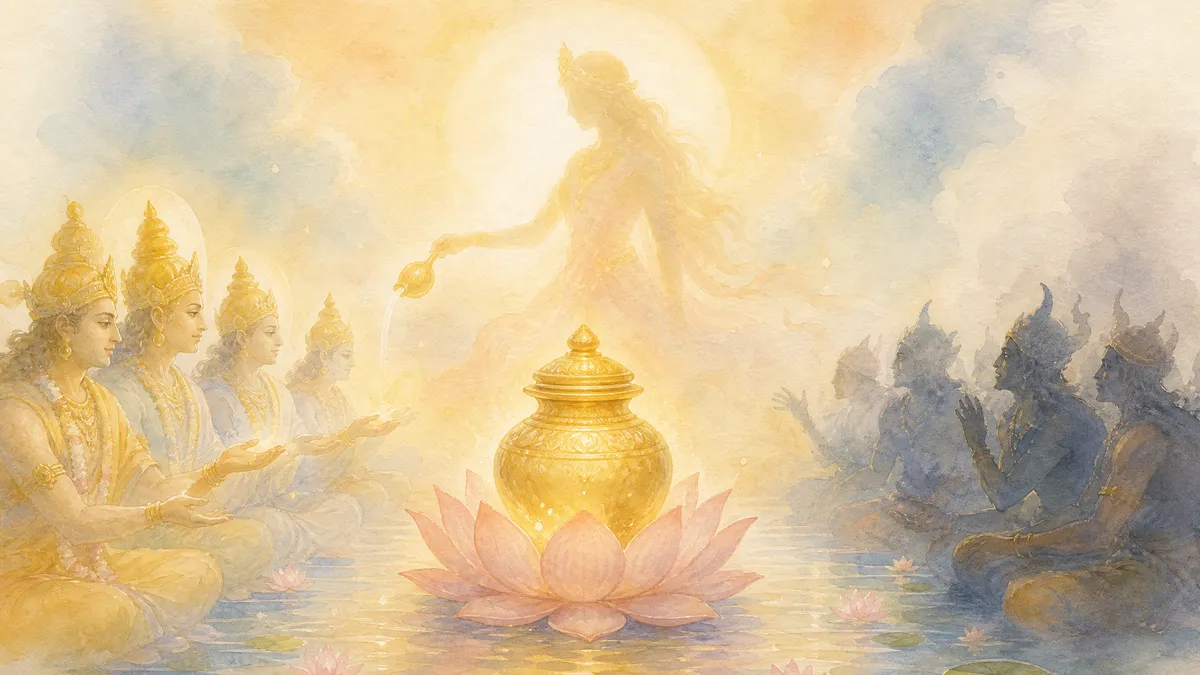
The Principle of Vishnu and Lakshmi
In Vishnu temples there should always be butter and ghee, while Shiva is content with raw milk, for Vishnu is the god who enjoys the very best that the material world can offer, whereas Shiva is the God indifferent to material reality. Lakshmi is the best that the material world can offer, and Vishnu enjoys her. When butter appears in the process of churning milk, the ocean of milk begins to yield its treasures.
The principle of Vishnu, like Lakshmi, is the principle of happiness, the happiness that arises as a result of the samadhi of awareness in contact with material nature, when material nature does not bring suffering, does not bring problems. Usually, for the beings of samsara, material nature appears as avidya, and it is precisely that part of material energy (Prakriti) which is connected with avidya (ignorance) that we call samsara. This is the tamasic part and the dense rajasic part. When tamas and rajas dominate, and this tamas and rajas touches souls, it has an indelible effect on them; it plunges them into ignorance as if hypnotizing them — this is avidya. The realm where souls fall into deep ignorance under the influence of Prakriti is called samsara.
The principle of Vishnu, Lakshmi, is an entirely different principle; it is the principle of contact with material energy that does not lead into delusion. On the contrary, it allows one to abide in happiness, in joy, and in enjoyment. In what case is this possible? In the case where we have enough energy of consciousness and enough strength of the soul, the power of samadhi, to see the subtle, empty, enlightening, luminous force within Prakriti. Then happiness arises when we come into contact with Prakriti, material energy; then Prakriti appears in the form of sattva, the pure light that governs everything visible in the universe.
Happiness comes from understanding the principle of Vishnu; therefore it is said that Vishnu and Lakshmi are connected, that Lakshmi loves Vishnu alone. Vishnu is the principle of non-duality, the principle of consciousness that supports everything, all this material energy, and where there is recognition of the infinite space associated with Vishnu, there is also happiness in interaction with Prakriti (material energy); that is why Lakshmi loves Vishnu.
If Lakshmi is the principle of manifested material success and the happiness connected with Prakriti, then Vishnu is the principle of infinite consciousness; one cannot exist without the other, and therefore Lakshmi is always devoted to her spouse. Where her spouse is forgotten, she departs; that is, where infinite consciousness is forgotten, happiness departs, because the balance of energy with Prakriti is disturbed. We must also analyze our own consciousness, to what extent we ourselves abide in the dimension of happiness. If we maintain a balance between material energy, the mind, interaction with the external world, and our own awareness, then ananda comes and we are naturally happy. If this balance is disturbed, we become disorganized, disoriented, and dissatisfied. Maintaining this subtle balance keeps us in the mandala of Lakshmi and Vishnu, in Prakriti in the mandala of the pure dimension, when Prakriti (material energy) ceases to be samsara and becomes the heavens, the mandala of pure vision.
The Churning of the Ocean and the Manifestation of Divine Forces
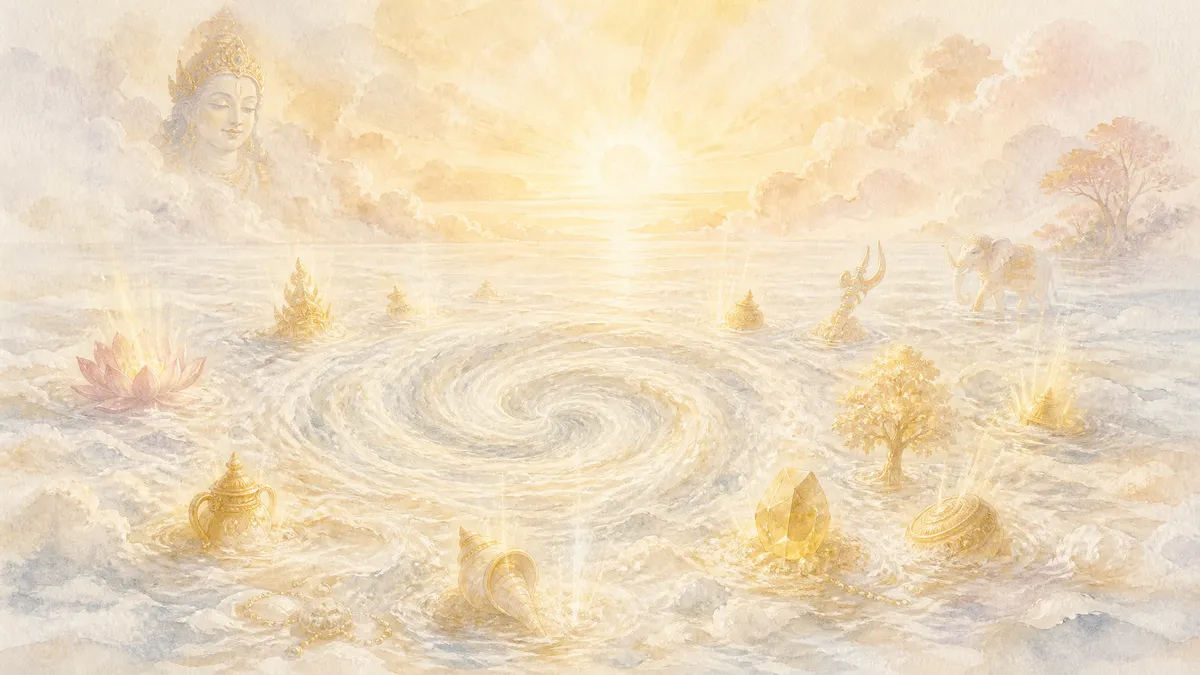
Here are the flying horse Uchchaihshravas and the white elephant with seven trunks, Airavata. Here are the Parijata tree (another name for Kalpataru), and Kamadhenu, and Chintamani (also known as Kaustubha). Here are the nymph Rambha and the wine Varuni. All these treasures once adorned Indra’s Svarga. Among them, Rambha and Varuni are noteworthy. Indra’s fascination with women and wine cost him his fortune; however, the scriptures acknowledge that these pleasures are part of earthly life. Ancient myths do not express anxiety about sensual pleasures. They recognize their significance, but warn of the dangers associated with excessive indulgence in them.
The churning of the ocean by the asuras and devas led to the appearance of various divine beings. This ocean is the primary primordial matter; one might say that the gods and the technogenic civilization united in order to influence the primordial matter underlying the universe, with the blessing of Vishnu. In what way they influenced it, and precisely which energies, is difficult to say, but as a result of the influence on primordial matter — that is, it was psychophysics, the quantum physics of the age of Dvapara or Satya Yuga, an influence on the tattvas, on the first elements of the universe by the combined forces of various civilizations under the guidance of the higher gods — this was done in order to change the balance of the tattvas, the balance of energies in the universe, and to obtain certain benefits.
From this primordial matter, various treasures began to emerge: Indra’s horse Uchchaihshravas, the elephant Airavata — all these are mystical divine powers that embody Indra’s powers as the lord of the universe. At the level of the microcosm, these powers also awaken within us when we act upon the first elements, upon our five elements. But the most important elixir; there also emerged the Kaustubha gem (Chintamani is another name), the Kalpa-vriksha tree (Parijata is another name), and many other things. But all these things were secondary; that for the sake of which the action upon primordial matter was undertaken was immortality, the attainment of the nectar of immortality for the gods, and the asuras also longed to obtain it.
This giant alchemical experiment was undertaken in the era of Satya Yuga, perhaps ten thousand years ago, under the guidance of the gods, and perhaps the consequences of this experiment are still being felt. For example, we go to the Kumbh Mela because, when the nectar of the gods was obtained, it was spilled; it is believed that drops of it fell in those places, that is, in certain locations there occurred a leakage of the primary substance of the pure Absolute. As a result of this churning, the primordial, pure Absolute in the form of the purest Prakriti was to be produced.
As a discharge occurred due to staff oversight, some leakage happened because of a lack of understanding between the different civilizations of the gods and the asuras, and most likely it was arranged as a form of lila; these leakages on earth turned into four pithas, sacred places where people now gather during an astrologically appropriate situation and perform ablutions. People even felt the results of this churning — this is what the Kumbh Mela is. One might say that the gods and devas, Indra, and many asuric technogenic civilizations under the guidance of the higher gods were working with primordial matter, and this is what came of it. There were evidently certain ethical complications there, because the ethics of the asuras and the devas do not coincide; only Vishnu can encompass the ethics of both, because he does not support either side, his task being to preserve this universe in balance while maintaining neutrality, although in extreme cases he does of course come to the aid of the gods.
Thus, Indra’s Svarga is a place where women dance and wine flows, and it was because of these pleasures that Indra lost his sensitivity. The horse and the elephant personify dharma (righteous conduct). The tree, the cow, and the precious gem symbolize artha (wealth). The nymph and wine symbolize kama (pleasure). Thus, righteous conduct, wealth, and pleasure emerged from the ocean.
So, the attributes of the three — dharma, kama, and artha — appeared from the ocean, but what the gods and devas longed for was the fourth (moksha) and liberation, and as an aspect of liberation — nityatva (immortality); they longed for the nectar of immortality, they longed for the fourth aspect that was to appear.
The Gifts of the Ocean of Consciousness
These are the gifts of the ocean. These are the gifts that foretold the appearance of Lakshmi, the goddess of wealth.
Gifts of which ocean? Of course, these are not gifts of the Pacific Ocean, the Indian Ocean, the Arctic Ocean, or the Atlantic Ocean — these are gifts of the ocean of sahaja, the ocean of the nondual state, the ocean of God. It is Brahman that is often compared to an ocean, as an ocean of pure awareness, and this ocean of pure awareness is not simply emptiness; it is different levels of light, different levels of primordial matter. Prakriti has various gradations, different kinds of wisdom connected with each element, and at some level this ocean is connected with primordial matter, and it is capable of bestowing various wondrous powers, magical energies — that is what its gifts are. If, as a result of tapasya, one acts upon this ocean, then from its depths after the churning — any tapasya is a churning — these wondrous magical gifts rise to the surface.
Moreover, this occurs both at the level of the microcosm and at the level of the macrocosm. We humans reproduce these processes within our own body; we perform this alchemy. If we churn the ocean of our consciousness and the ocean connected with the Prakriti of the first elements through kundalini yoga, mantra, the illusory body, contemplative practices, and sahaja-kriya, these gifts gradually emerge. Various powers, various forms of wisdom and understanding awaken within us, of which we could not even have guessed that they existed inside us. The gods and asuras possess such power that they can do the same at the level of the macrocosm, on the scale of a vast universe, since their capabilities are far greater.
Pure and Impure Tattvas
As soon as Lakshmi appears, everyone becomes excited. She is dressed in a red sari, adorned with jewels, and seated on a lotus. In her hand is the Akshaya Patra, a vessel that is always filled to the brim with grain and gold. The devas and asuras sing praises to this beautiful and enchanting goddess. White elephants, standing at the cardinal and intermediate points of the compass, rush toward her; they raise their trunks and sprinkle her with fragrant water.
All these deities, attributes, and magical powers are manifestations of the pure tattvas (shuddha tattvas). It is the pure tattvas that are the embodiment of divine forces and energies. Our material world (samsara) consists of impure tattvas, of polluted ones, and when they are called impure, this is not a value judgment, not some moral category; it refers to the qualities of the tattva. There are pure tattvas and there are impure ones, and how do they differ? In essence, both have come from the Supreme Source, and for Brahma or for the Absolute Parabrahman, both pure and impure tattvas are equal; for him there is no difference, which is why it is said that the highest gods and saints abide in a single “taste.” But for gods of a lower rank and for various other beings, the purity or impurity of the tattvas is of fundamental importance, and how do they differ?
Pure tattvas contain luminous power, the power of emptiness, and the manifest power of luminosity; impure tattvas contain it too, but to a much lesser degree. They consist more of rajas and tamas, and emptiness is hidden in them, nonduality is hidden, therefore through contact with impure tattvas one can become obscured, and conversely, through contact with pure tattvas one can become enlightened, simply by being near them, even simply by touching them, if you are fortunate enough to hold them in your hands or come into contact with them in some way. Pure tattvas are not an attribute of the material world; they are very rare precious things, if they appear at all. When they appear, they always produce miracles; they violate the physics of our world, because they are not subject to the laws of physics of the material world. They operate according to the laws of physics of higher worlds.
Many sacred objects, objects miraculously materialized, are all manifestations of pure tattvas; this is matter, but of another plane. When we perform the invocation of divine beings and engage in contemplation, pure tattvas can also manifest within our body and mind. They at least increase, even if only on the subtle, astral level; for example, you see pure signs in dreams or see deities—this means that pure tattvas have penetrated the subtle body. If you meditate and flowers or vibhuti materialize around you, this means that pure tattvas are manifesting on the physical level.
It is believed that if the body of a saint becomes so filled with pure tattvas, if the fluids become filled with pure tattvas, they transmute at the atomic, molecular level. Then he can urinate on a piece of iron, and the iron will turn into gold; alchemy will take place, that is, within him there is no longer urine, but some kind of alchemical liquid that has changed its structure at the molecular level. Some siddhas, by rubbing stones with their feces, turn them into jewels, into diamonds, or turn metals into gold, because their body is an alchemical cauldron (crucible) in which alchemical transmutations occur.
All alchemists dream of producing alchemical gold and seek various methods; famous alchemists in Prague, Nicolas Flamel, for example, devoted their whole lives to the materialization of gold. All kings dreamed of having such alchemists at their courts; some even succeeded. Nicolas Flamel learned to produce alchemical gold and then built many temples with it. But here alchemical gold is produced by the siddha’s own body, because he has managed to awaken pure tattvas in his consciousness, in his pranas.
Lakshmi’s Choice
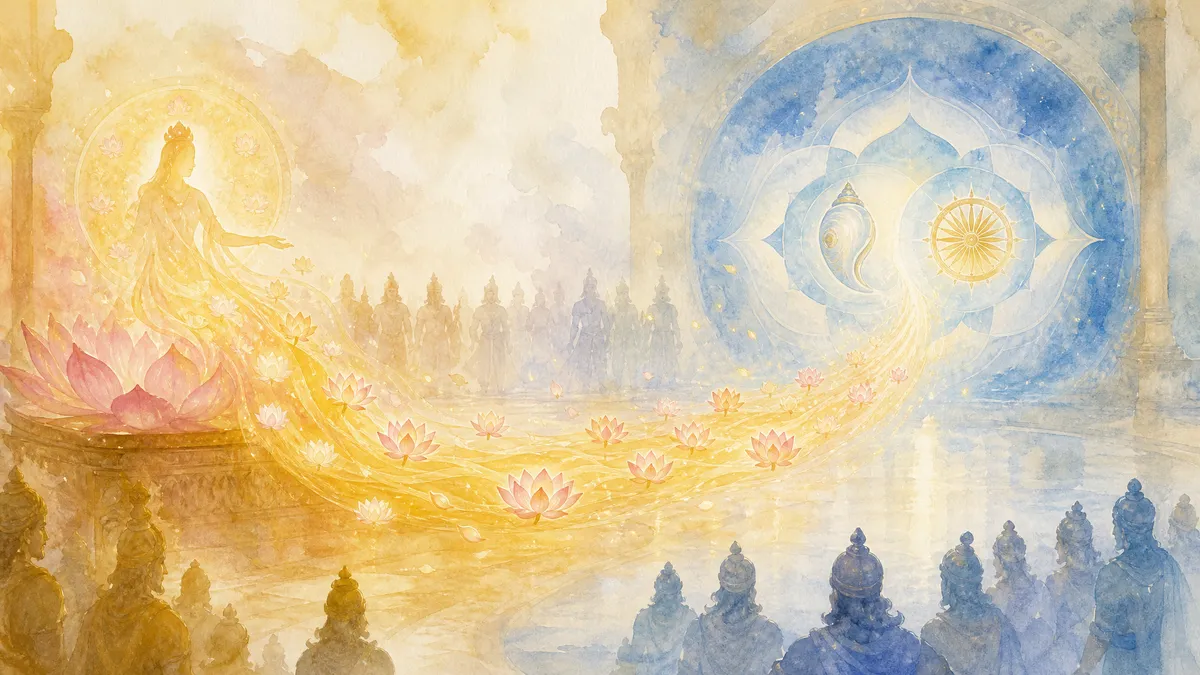
Everyone waits with bated breath to see where Lakshmi will go. Will she become the wife of the devas or the daughter of the asuras? But, to everyone’s surprise, she goes to Vishnu and embraces him, thereby declaring him her husband.
In the film this is shown very beautifully: Lakshmi looks everyone over, then sees Vishnu, her gaze lights up, and she runs into his arms. But what does this mean? It is a metaphor: Lakshmi is power, divine power directed by will, and power flows through certain channels in a certain direction. On a universal scale, this power found a swift source, and it flowed into the realm of Vishnu, into the realm of pure, nondual consciousness, because it itself is very pure and very high. It flows into those realms that correspond to its purity.
At the micro level, it is the same. In order to be happy outwardly, in the material world, one must have a sense of happiness within; billions of people dream of being happy. But subconsciously they curse themselves, with their own minds; of course, they do not say, “I curse myself,” but their state of mind is such as if that is exactly what they are doing, that is, they dwell in anger, they dwell in despondency, they dwell in self-pity, they dwell in greed and envy.
No matter how much the gods may want to bless them, the energy of happiness simply cannot even approach them. They say: “Well, at least tune yourself a little so that the energy of blessing can enter you even a little; you do not even give it a chance, there is not even a gap.” There is constantly a certain wave: now anger, now envy, now malice, now hatred, now regret, now complaints, now suffering—such continuous activity. There is not even a way to slip in for a second in order to bless you. Therefore, in order to be happy, one must cultivate the state of happiness within oneself; then the energy of happiness from the external world will resonate and come. In order to be loved, one must cultivate the state of love within oneself; then the energy of universal love will also touch one, because like energies are attracted to like.
Many people pray: “God, give me this,” but within them there is no such state, and therefore they cannot receive blessings; that is why it is said: “There are not enough merits.” Not enough merits means that the mind is not truly attuned to these energies, but when the mind itself is attuned to these energies, it begins to attract universal blessings, and the energy of love or the energy of happiness, the energy of compassion, enters it. The question is how to generate such a state oneself. All people hope that energy will come from outside, but the secret lies in changing the state of the mind. How can one generate a happy state within? One must find infinite consciousness like Vishnu; it is toward that that the power of Lakshmi aspires.
Why does Lakshmi choose Vishnu? Because Vishnu is enterprising—he conceives the churning and makes enemies work together. She chooses him also because he is detached from the entire undertaking. He helps the Devas, but he does not seek the treasures of the ocean.
Lakshmi chooses the self-sufficient, those who desire nothing from her, those who themselves have purnatva (divine wholeness) within. Vishnu does not belong to the category of seekers; he belongs to the category of those who found long ago, who found from the moment of the creation of the universe. He does not belong to the category of those who ask; he belongs to the category of those who give, and Lakshmi is the same in bhava (divine majesty), and therefore she seeks a worthy partner for herself. She sees that the asuras, with their avarice, greed, and envy, are not at all worthy of her company. She also sees that the gods, despite all their purity and exaltedness, are also weak—samsaric gods; we are not speaking of the gods who are on our altar. The gods of Svarga-loka are lower gods; they still have an ego that remains, though not human but higher. They have a refined attraction to pleasures, refined and elevated weaknesses. She sees that the gods too are weak, and that only Vishnu can be the one whose wife she is worthy to become and before whom she is worthy to bow her head and take Refuge in him; therefore she goes toward him.
Vishnu knows that he is spiritual reality, Brahman, infinite and immortal, and therefore he also knows that Lakshmi is material reality. He derives no meaning from her, but he knows that she allows him to understand himself, and therefore he does not try to control her. Instead, he enjoys her capricious nature. His knowledge of Lakshmi brings a smile to his face. In the Ramayana, Rama does not lose his composure when he is asked to leave the palace in order to live in the forest. He is equally peaceful both in the palace and in the forest. He does not derive his identity from material reality. This quality of Vishnu attracts Lakshmi, and therefore Vishnu is called Shri-Nivasa and Shri-Vatsa, which means “Abode of Lakshmi.” He is Lakshmi-Vallabha and Lakshmi-Kanta, which means “Beloved of Lakshmi.”
Shiva as the Principle of Renunciation and Balance
He is ShriNatha and Tiru-Pati, which means “Master of Lakshmi.” He does not seek her, but she always follows him. Vishnu is depicted sleeping on the coils of the serpent Adi-Ananta-Shesha, floating on the surface of the ocean of milk. Lakshmi sits at his feet, massaging his legs, modest and tamed. This is quite unlike her nature. Lakshmi is a radiant goddess who goes wherever she wishes. Neither the devas nor the asuras, who compete for her, can control her. But there is something in Vishnu that makes her voluntarily renounce her independence. He does not seek her, and precisely for this reason she wants to follow him and serve him; therefore Vishnu is Shri-Vatsa, the “Abode of Lakshmi”: where he is, there she is as well.
Why does Vishnu not seek Lakshmi? Because his goal is not Lakshmi; his goal is Parabrahman, and he abides in sahaja samadhi, in the eternal, infinite, deepest sahaja samadhi of Parabrahman. Lakshmi, simply by being with him, also feels the bhava of sahaja samadhi, and because this bhava is very great and precious, it is what attracts her. That is, Vishnu allows Lakshmi to be near him; he is not carried away by her, does not strive to possess her, because he is already enchanted by another reality. He is enchanted by his source—Parabrahman; he knows who he is, he knows that he is not Vishnu, that he himself is the Absolute, and this transcendental knowledge attracts Lakshmi. Neither the asuras nor the worldly gods possess this transcendental knowledge. All they see is the external Lakshmi, and they passionately desire to possess her, to control material reality, to have power, to have magical qualities, to have various energies. But what they do not have, Vishnu already has, and this is what attracts Lakshmi.
Alakshmi—the Shadow Side of Material Success
Lakshmi has a sister named Alakshmi. She is the goddess of discord. When wealth comes into a house, Lakshmi’s sister comes with it, causing quarrels. Alakshmi is the husk of the grain that is Lakshmi. Alakshmi is the impurities accompanying the metal that is Lakshmi. Alakshmi is the inedible peel and pits of the juicy fruit that is Lakshmi. They always come together; therefore, when Lakshmi emerges from the ocean of milk, Alakshmi also appears with her in the form of the terrible poison Halahala.
Alakshmi is the reverse side of material reality, the reverse side in the form of problems, failures, and troubles that accompany great success in the material world. It happens that when a person begins to earn a great deal, if he is inattentive and unaware, wealth will go to his head. He may begin to entertain himself thoughtlessly, excessively, and then problems begin; or he develops great ambitions, and together with material success, for example, some bandits may appear, or others’ envy may come, obstacles may arise. This means that the material energies are strong for the soul, and they have affected it in such a way that they have brought his prana out of control.
Black sticky foam fills the air with a disgusting stench. The light disappears; the devas and asuras suffocate from the terrible fumes enveloping everything around them. “Save us,” they implore Vishnu. Vishnu immediately summons Shiva, the God whose indifference allows him to accept everything that others reject.
So, when Alakshmi comes, the shadow side of material success arises—various problems. For example, a person has accumulated merit, acquired strength, power, status, material shakti, or magical powers, but somewhere he has overestimated himself and become proud, and a disturbance of balance has occurred in him, and his egoism has summoned not only good energies from the universe but also negative energies. He feels that these negative energies have begun to seize him, and he needs equilibrium. And it is said that in this case Vishnu, as the inner sense of awareness, summons Shiva; only Shiva can absorb them.
Shiva is detachment, vairagya, dispassion, cutting off, which can absorb the terrible poison Halahala produced as a result of the churning of the world ocean. This is empty, nondual consciousness, which can restore the balance of energies that have gone out of control into a single “taste.” During the churning of the world’s primordial matter, the energies went out of control, and various cosmic impurities began to poison the breath of the gods and devas with toxic fumes. Then Shiva was summoned, who, by the power of the single “taste,” brought the energies into balance. In the same way, we can bring our out-of-control energies into balance through the power of nondual awareness, through the power of the single “taste,” through precisely this energy of renunciation.
Shiva’s Nondual Perception
Everyone accepts Lakshmi and longs for the amazing gifts that accompany her, but no one accepts Halahala. Yet someone must accept Halahala as well, otherwise it will destroy the world. For this purpose Shiva was summoned, who swallows the poison in one gulp. In some folk traditions, Alakshmi emerges from Halahala and demands that she be given a husband. If Vishnu accepted Lakshmi, then someone must accept Alakshmi as well; since neither the devas nor the asuras want her, she is given to the only one who has neither preferences nor prejudices—Shiva! Some researchers of myths believe that Alakshmi symbolizes the wild and untamed Kali. Others are convinced that Alakshmi and Lakshmi together personify Prakriti. Lakshmi is the desirable aspect of nature, and Alakshmi the undesirable one.
The point is that Shiva looks at the world differently, in another way. For him, Lakshmi and Alakshmi are one single whole; they are Prakriti, and he can perceive her in any aspect, since he does not pass evaluations or judgments, perceiving reality in a single “taste” and being completely non-dual.
Lakshmi is the desired aspect of nature, and Alakshmi is the undesired aspect. If Lakshmi is love, then Alakshmi is conflict. If Lakshmi is tempting food, then Alakshmi is a poisonous admixture. One cannot exist without the other. The distinction between them is created by Maya. Vishnu does not see the distinction. He accepts Lakshmi in all her fullness, together with Alakshmi. He knows what the place of Lakshmi is and what the place of Alakshmi is. He knows that Alakshmi cannot be ignored or rejected. Vishnu differs from Shiva in that he is a very discriminating form of God. Shiva does not take anyone’s side; he neither loves nor hates the devas or the asuras. By swallowing Halahala, he did a service to both the devas and the asuras. Vishnu, on the contrary, takes the side of the devas, and this is especially clearly expressed in the story of Amrita.
Amrita and the Appearance of Dhanvantari
Amrita is the nectar of immortality. It is the last treasure to emerge from the ocean of milk after Lakshmi and Halahala. It appears from the sea in the hands of a deity named Dhanvantari, the god of health and healing. He is the patron of Ayurveda, traditional Indian medicine. Dhanvantari is a form of Vishnu; like Vishnu, he holds a conch shell and a discus, but unlike Vishnu, he also holds a pot of nectar in one hand and a leech in the other. Practitioners of Ayurveda use leeches to draw pus out of infected wounds. Sometimes, instead of the vessel with Amrita, he holds herbs or a pestle and mortar, with which pastes and ointments are prepared.”
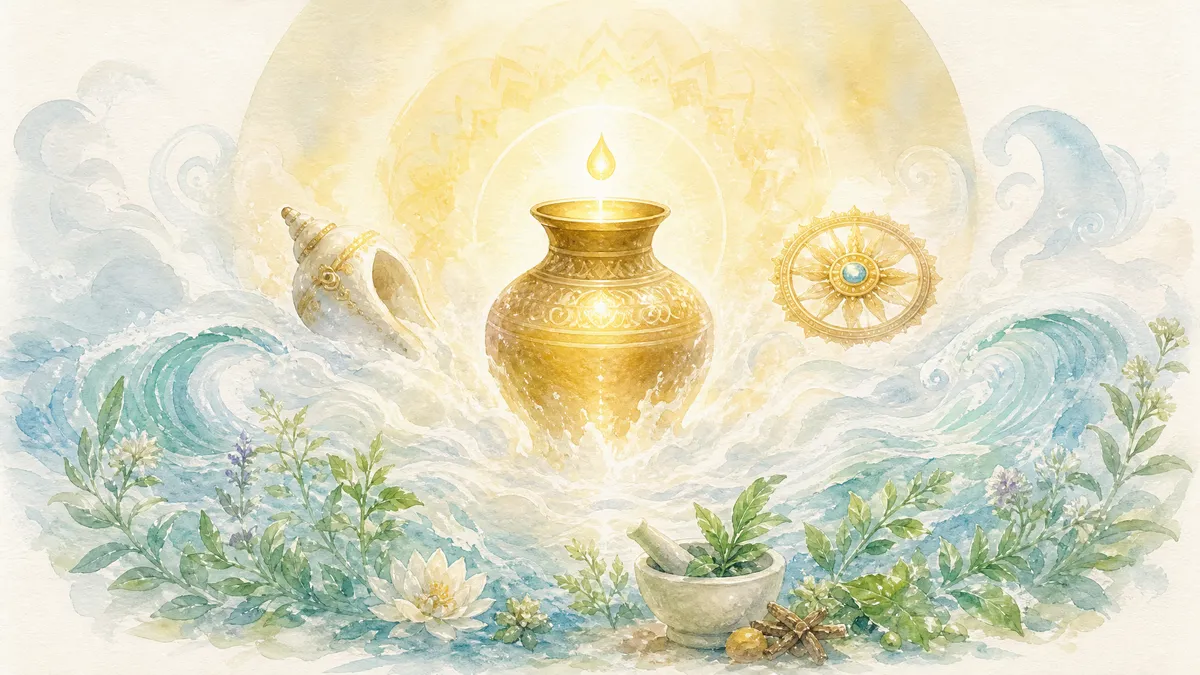
“Everyone wants Amrita, the nectar of immortality. All the children of Brahma, whether they are “gods” or “demons,” fear death. Everyone wants to live forever, and so both the devas and the asuras hurry to seize the pot of nectar. The partnership that made the churning possible collapses. A battle begins, in which each side lays claim to the nectar. Everyone agrees that all who churned the ocean have a right to the nectar, but who should drink first? The devas and the asuras do not trust each other.
Mohini and the Birth of Hari-Hara-Suta
Then Vishnu takes the form of Mohini and appears before the devas and the asuras. She is so beautiful that everyone is overwhelmed with desire. Shiva, having swallowed Halahala, was about to return to his mountain abode, but then he too saw Mohini. He was enchanted by her beauty, and he embraced her. From this union of Shiva and Mohini, Hari-Hara-Suta was born, the son of Vishnu and Shiva, possessing Shiva’s ascetic qualities and therefore refusing to marry, but also possessing Vishnu’s warrior qualities and therefore always ready to protect society. In Tamil Nadu, this warrior-ascetic is known as Ayyanar. In Kerala, he is Manikanta, Shasta, or Ayyappa, whose shrine is built on Sabarimala hill.
God Ayyappa is important to us because he belongs to the southern lineage of transmission, and Brahmananda, in one of his incarnations, was the secretary of God Ayyappa, as it is believed. He embodies the united power of Shiva and Vishnu. There is an expression in the tantras: “Shivasyam Hridayam Vishnoh, Vishnocha Hridayam Shivah” (Shiva is in the heart of Vishnu, Vishnu is in the heart of Shiva, and he who does not know this will not attain liberation). This is an instruction on the unification of the single “taste,” on the transcendence of different energies in the non-dual Absolute. Hari-Hara-Suta, or Ayyappa, embodies such a vision of the single “taste.” He is considered to have arisen precisely from such a union during the churning of the cosmic ocean.
Women are not allowed into this shrine built on Sabarimala hill, and men, in order to enter it, must fast and abstain from sex for several weeks.
Why are women not allowed in? For the same reason that women do not worship Skanda Karttikeya, so that their family life does not fall apart; otherwise the husband may go off to war, and so on. That is, the masculine principle—if a woman comes, and by “woman” is meant not a sannyasi, but a respectable grihastha, a family, children. If she begins to worship, to invoke such a god, what blessing will he give her—brahmacharya at best, sannyasa, or that her husband should go to war, or that her husband should strengthen his masculine principle, so that the masculine principle of her life predominates. Then harmony, the destabilization of the balance of her family life, will be disrupted; the husband may become a soldier, the husband may become a sannyasi, the energy of Mars will intensify, one might say, and therefore they are not allowed in for their own safety.
Mohini’s Deception and the Victory of the Devas
Mohini is so enchanting that for a moment everyone forgets about the nectar. She says in a melodious voice, “Allow me to divide the nectar.” No one can object to such a lovely being. The temptress takes the pot of nectar, and all the devas and asuras sit down, awaiting their turn. Mohini maneuvers among them, smiling coquettishly, winking, and pouring Amrita into their throats. Suddenly the asuras notice that Mohini is pouring Amrita only into the throats of the devas. The asuras receive nothing. They realize that they have been tricked. The maiden has outwitted them! They take up their weapons and rush toward Mohini to seize the pot of nectar again. But now all the devas have tasted Amrita; they are immortal. They hurry to Mohini’s aid, and a great battle begins. Weapons are powerless against the devas, and the devas easily defeat the asuras.