

We continue discussing the practice of contemplation from the Prajna Yantra section.
When we engage in contemplation, a transformation of consciousness takes place. To move toward enlightenment means to constantly transform oneself into something greater, to develop new qualities within oneself that one did not possess before.
The path to liberation consists precisely in developing these qualities. More precisely, not in developing them, but in recognizing them as qualities that have always been inherent in us. At first, of course, it seems that we are developing new qualities within ourselves. We were attached, and then we became detached, and it seems to us that we have developed detachment within ourselves. Our mind was constrained by fixed judgments, and then we freed our mind, gained flexibility and openness to everything. Then we think: “Yes, I trained and attained this.” But over time, when we discover our primordial nature, we see that these qualities have always been inherent in us. They have always been present within us, but in a concealed state. All the higher qualities are present in our consciousness at this very moment. Therefore, we can say that we do not develop these qualities, but recognize them as qualities that have always been inherent in us.
Transformation consists in recognizing what is inherent in us from the very beginning. The Absolute is inherently endowed with various qualities, if one may put it that way: inconceivability (achintya), infinity (ananta), spontaneous perfection (arya), all-pervasiveness (sarvabhava), primordial purity and stainlessness (niranjana). These qualities are singled out simply because different schools traditionally meditate on them. Different traditions place particular emphasis on certain qualities, although one could speak about the qualities of the Absolute endlessly.
Since these qualities are inherent in absolute Consciousness, the Supreme Source, they are also inherent in us. Why? Because in the tradition of laya yoga, we do not speak of some Absolute that is separate from us. We speak of the Absolute in the context of the nature of our Mind, because the Absolute is our fundamental Mind in its true suchness. And since these qualities are inherent in the Absolute, they are also spontaneously inherent in us.
When we hear that the Supreme Source, fundamental Consciousness, possesses certain universal qualities, we naturally do not feel that these qualities are inherent in us. It seems to us that we must develop them through spiritual training. However, the process of developing and attaining them does not mean introducing something new; it means removing everything that prevents them from manifesting. In other words, it is self-recognition, when we discover within ourselves that which is and has always been. In other words, in the process of spiritual practice, we must recognize ourselves as the Absolute, as a deity endowed with perfect qualities.
Stages of Spiritual Transformation

What is the logic of transformation when we engage in practice? At first, of course, we are ordinary deluded people. Then, when we are faced with the need to resolve for ourselves questions concerning the meaning and value of existence, we embark on the spiritual path and become practitioners, that is, sadhus. When we clarify the path for ourselves and turn our practice into an art and a skill, we rise another step and become masters of contemplation, bearers of a living lineage of saints. When our mastery reaches its peak, we attain signs of realization and become yogis who have attained genuine holiness—that is, those immersed in the Source who do not lose it under any circumstances. Usually, it takes a person an entire lifetime to reach these stages. However, from the standpoint of the siddhas, this is only the beginning.
The next stage is that of the mahasiddha, the possessor of an illusory divine body. At this stage, the yogin begins to transform not only their consciousness, but also their elements, including the physical body. When this transformation is complete and the elements dissolve, the yogin fully enters pure vision, free from karma. This realization is called the “great transition” in the tradition of the masters, or the attainment of the divine rainbow body (kaya-vyuha), when all the impure components of the yogin’s body, consisting of flesh and blood, are transformed into light. This is not metaphysics; it is reality. The yogin truly disappears from this world, leaving behind hair, twenty fingernails and toenails, and clothing.
There is such a story. An old nun, while traveling through Tibet, passed by a village. She went to visit lay believers who often made offerings to her and asked to stay in their cowshed for several days, saying that she needed to undertake a certain practice in retreat. They gave her permission. After several days had passed, they suddenly realized that no one was bringing her any food. So they decided to see how she was living there. When they entered the cowshed, they saw that instead of the nun’s whole body, there were simply body parts lying in different corners. Rainbow light streamed from these body parts, emitting subtle rays of light. The laypeople were deeply perplexed. They thought it was something nonhuman, so they decided not to interfere. When they came to the cowshed seven days later, they saw that her body had completely disappeared, and only her hair, fingernails, and clothing remained. They had thought this nun was merely an illiterate old woman who followed the teachings, but she turned out to be a practitioner of the highest realization who had attained saruba-samadhi.
There was another similar case. One yogi earned his living by carving sacred symbols on stones in exchange for offerings. While still young, he had received instructions from his Master, but everyone considered him merely an eccentric old man. He drew symbols on stones, and people gave him a little food and clothing in return; the rest of the time he sat in the mountains and sang various songs whose meaning no one understood. But toward the end of his life, he asked that after he left his body, no one touch it for seven days. Before his departure, his son came to him and said, “You must remember all the instructions you received.” But the old man simply laughed and replied, “I no longer need those instructions; I have already forgotten everything I knew. I am not worried about it.” His son thought that the old man had simply lost his memory. But when they opened the body seven days later, they saw that only twenty fingernails, a tuft of hair, and his clothing remained. Then all the other yogis realized that this old man had been a practitioner of the highest caliber. They thought, “How ignorant we were not to recognize such a high-level practitioner and receive his instructions. We considered him an ordinary person, but he was a supreme saint.”
This is the stage of the pure rainbow body. The holy man Ramalinga Swamigal attained a similar level not at the end of his life, but during it. While still alive, his body cast no shadow, so he was forced to wrap himself in a bedsheet. And at the age of more than fifty, he simply disappeared in a violet flash of flame. This is the culmination of the transformation into a pure rainbow body.
At the next stage, the yogi becomes the possessor of thousands of bodies and infinite magical emanations. He becomes a creator deity.
Finally, at the next stage, the yogi—or whatever one may call him—transforms himself into a great deity who creates entire worlds and universes. That is, this is a deity possessing divine bodies in the form of universes. From the perspective of human consciousness, this seems fantastical; nevertheless, it is so.
And when we list all these levels, this is a description of our “spiritual career”—the spiritual path we are to walk if we practice diligently. One might say that whoever demonstrates great zeal in service will ascend the steps of this “career.”
Such are the stages of transformation.
The Nature of Genuine Realization
Many people believe that spiritual development involves various experiences and visions. All of this is certainly interesting, but true spiritual transformation entails discovering new qualities within oneself and being able to manifest them. How does this happen? It happens because the yogi discovers the nature of his Mind, which is the source of all magical qualities. Without discovering the nature of the Mind, it is impossible to attain genuine awakening. And even if a yogi acquires certain supernatural powers through magical means, mantras, or the use of various substances, this cannot be called genuine realization.
There are two kinds of mystical powers: kalpita-siddhis and akalpita-siddhis. Kalpita-siddhis are supernatural powers attained through something artificial, for example, reciting mantras, invoking certain beings and bringing them under one’s control, performing rituals, or contacting some beings. But all of this is considered something artificial.
Akalpita-siddhis are natural siddhis that arise as a flowering as a result of a yogin opening to the nature of his “Self.” The yogin does not concern himself with siddhis; he is concerned with opening his original nature. And this original nature, manifesting itself, manifests as the flowering of his perfect supernatural abilities (siddhis), depending on his destiny and karma.
Commentary on the Text “Laya Amrita Upadesha Chintamani”
We begin the text “Laya Amrita Upadesha Chintamani” (“The Liberating Nectar of Precious Instructions”). This is a root text on the practice of contemplation.
The yogin said:
For one who directly comprehends the nature of the “Self,” there is nothing more to comprehend.
When the unborn and inconceivable is known, there is nothing more to know.
For one who has become boundless, infinite Consciousness, above, below, and everywhere—there is nothing more to become.
If we reduce the root of all teachings, the essence of all mantras and tantras, the essence of all religions, and condense them into a single instruction, that instruction would be as follows: “Comprehend the nature of your Mind. Open the primordial face before birth. Enter your natural state.” Everything else is simply commentary on how to reveal this very nature.
Those who have not revealed the radiant nature of the primordial “Self” wander as if in darkness, becoming hungry ghosts because of attachment and falling into hells because of hatred.
During rebirth, living beings are carried away by various karmic currents projected from their consciousness.
The teaching of antarabhava-vidya (the teaching of the bardo) says that after death, fifty-two peaceful and forty-eight wrathful deities appear before a person. These peaceful and wrathful deities are projected from the yogin’s stream of consciousness. And if the yogin does not recognize their empty nature and regards them as something separate from himself, they make a shocking impression on him.
The Process of Rebirth and Liberation
Rebirth occurs because the consciousness of a person or being is carried away by karmic currents and begins to follow toward the place of a new birth, toward a new mother, following some vision or light. At the moment of rebirth, a yogin trained in contemplation can attain liberation even if he did not attain it during life. This is because the binding network of the channel winds and the physical body are absent, and his mind is highly malleable, meaning that it can be given any form.
At this moment, a yogin who has successfully practiced contemplation can reach the culmination of his realization if he fixes his mind one-pointedly on contemplation and the nature of the “Self,” on the Clear Light, instead of following visions in the intermediate state. Then, at that moment, his death will become the culmination and the path to authentic, complete enlightenment, and therefore he will no longer return to samsara. By contrast, an ordinary living being who is unfamiliar with the nature of Mind and untrained in contemplation will be confused by the various peaceful and wrathful visions that appear. His consciousness will be shifted, so he will have to follow one vision or another and then reincarnate in one of the worlds.
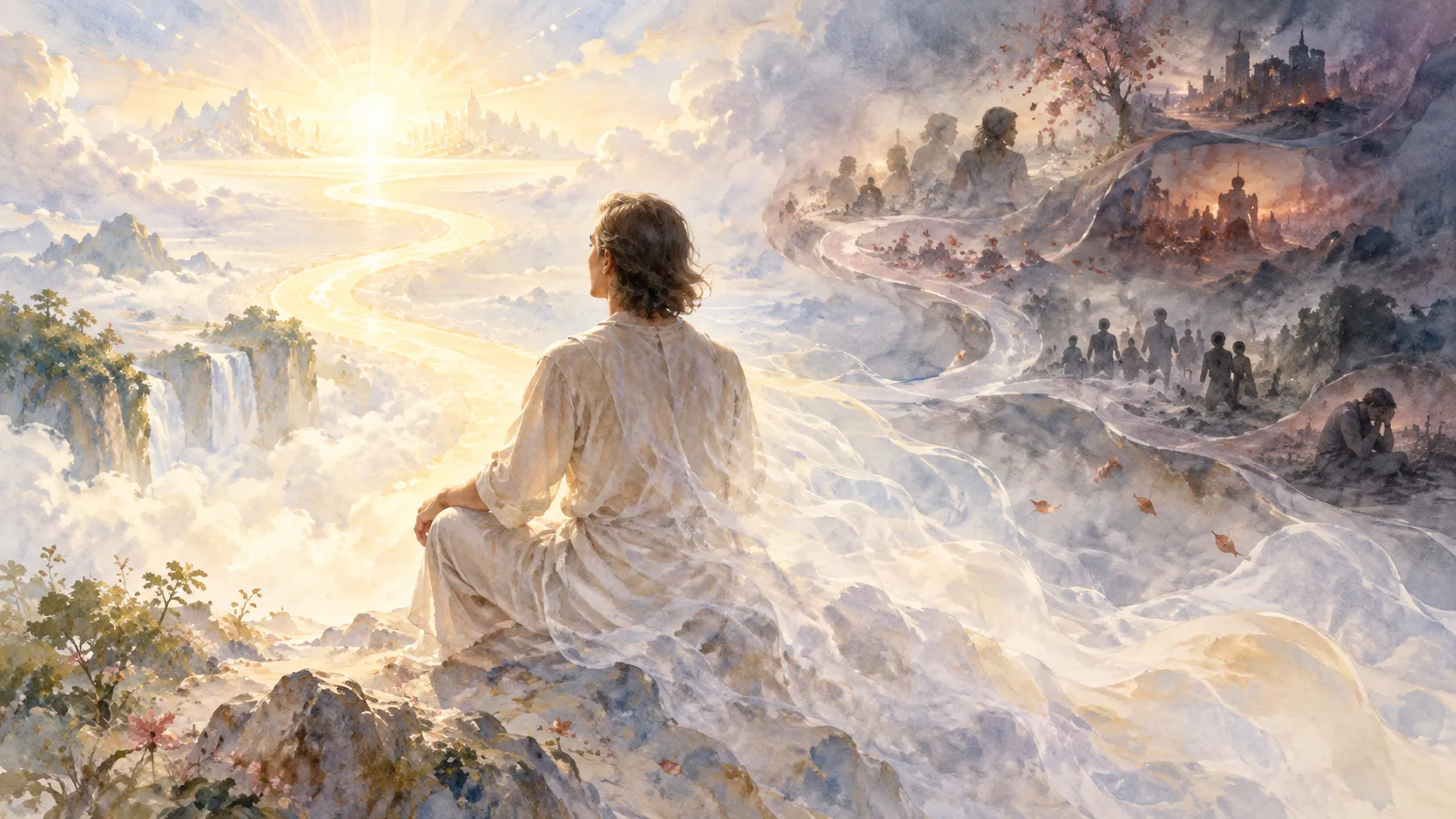
At the moment of death, the fate of a living being is decided: one can once again embark upon the path of samsara, or one can embark upon the path of nirvana. The path of nirvana begins when we recognize all visions as illusions, as indistinguishable from the nature of the “Self,” when we enter contemplation one-pointedly and self-liberate visions instead of becoming fascinated by these visions and the experiences that arise. The path of samsara begins when a person fails to recognize the visions, begins to regard them as something external to himself, and falls under their influence. It is precisely this fact—the very subtle act of recognition or, conversely, distraction—that determines a person’s next life: whether he will continue to be reborn, enter pure lands, or attain complete liberation by uniting with the Supreme Source.
A yogin who is stable in contemplation will be able to be reborn in pure lands, continue his practice there, and attain complete enlightenment within five hundred years, for example, in the pure lands of the mahasiddhas, in the heavens of Maitreya, in the heavens of Dattatreya, on Shiva-loka, or in the heavens of Matsyendranath and Gorakshanath. However, such a yogin must become well acquainted with the nature of his Mind and attain a certain stability in contemplation so as not to lose awareness.
If, in a dream with dreams, a person becomes aware of themselves and can continue contemplation, meditating on the Supreme Source, this is a guarantee that they can attain liberation at the final stage of the intermediate state. If a yogin becomes aware of themselves in a dream without dreams, this is a guarantee that they will attain liberation in the first moments of the intermediate state, immediately after death. Finally, if a yogin has fully uninterrupted consciousness and has revealed the primordial Clear Light, they are liberated already during life.
The Practice of the Natural State
To realize the natural state, let the body and mind remain relaxed. Remain naturally free, without exerting yourself even in relaxation. Then equilibrium arises in the mind, peace in the heart, the body moves smoothly and resiliently, and futile thoughts and restlessness subside.
When you practice contemplation, concentrating on the feeling of “I,” a subtle awareness, an inner observer, arises within you. Noticing it and beginning to establish yourself in this inner observer is the beginning of the practice of contemplation. Gradually, most of your consciousness should move into this inner observer, and then a new dimension of reality arises within you, one that begins to give you inner integrity and balance. Gradually, this inner integrity becomes your nature, and therefore the elements of your body begin to harmonize and come into balance.
Contemplating everything you encounter, unite it with an understanding of boundless emptiness, the Pure “I,” inconceivable and infinite.
Practicing atma-vichara, concentration on the feeling of “I,” does not mean turning consciousness inward and shutting yourself off from the world and external objects. It means contemplating and sustaining the inner observer, uniting the feeling of “I” with external objects, blending it with them. Then the entire external world and our inner consciousness become a homogeneous, unified mass of consciousness.
When we have discovered the inner observer, that is only part of the work. The other part is learning to sustain it continuously. But even when we continuously sustain the state of the inner observer, the third part of spiritual practice consists in developing flexibility and blending.
What does blending mean? For example, a particular object can be viewed in different ways. You can simply see it as an object, and then you have an arrow of consciousness directed with its tip at the object, so you forget yourself when looking at it. But when you practice self-remembrance, this arrow of consciousness has two tips. That is, one gaze is directed at the object, while the other is directed at yourself, at the feeling of “I.” Then you are in contemplation, perceiving the object, but this object is still separate from you. At least, you remember yourself while seeing this object, so you no longer become lost in objects, emotions, or thoughts, and you do not identify yourself with them.
At an even deeper level, you contemplate the “I” and look at the object without making judgments, evaluating it, introducing past knowledge and past experience, or projecting any expectations. You could say that you see it through the eyes of a newborn.
In the tantras, there is an expression: “Do not think, do not evaluate, do not analyze, do not reflect, do not create mental projections—remain in the natural state.”
When we contemplate an object in this way, we have no fixed point from which we see it. And then the barriers between subject and object begin to dissolve. At that moment, the object is part of us, and we are part of the object. Then this object becomes part of your mind. This is approximately what can be called blending in contemplation.
Mistakes in Contemplation
Do not freeze consciousness, making it unresponsive or dull, nor be hypersensitive and overly delicate.
While contemplating, let presence gain strength and clarity; become rooted in situations and in walking, and do not hang suspended in Emptiness.
When we begin practicing contemplation, for example, concentration on the feeling of “I,” if we are good at it, there is a danger of freezing consciousness, making it unresponsive by trying to shield it from reality and concentrating rigidly within. However, this is a mistake indicating a deviation in contemplation. Another danger is making consciousness too vulnerable and hypersensitive. But the yogin avoids extremes, trying to become so firmly rooted in his contemplation that he is simultaneously open to the world and protected from it. That is why it says here: “Do not be suspended in emptiness.”
There is also a third error, when the yogin tries to direct his mind toward the unmanifest, but clings to it too tightly, completely denying thoughts, feelings, and external objects. Certainly, when we contemplate, the mind should settle in the unmanifest, in a thought-free state beyond concepts. But this does not mean stopping thinking. Thoughts and feelings may arise, yet consciousness remains at a point beyond thoughts and feelings, and thanks to this they self-liberate as soon as they appear. What does “self-liberate” mean? They disappear at the very moment they touch that point of consciousness where we are during correct contemplation.

Understand: being relaxed does not mean indulging in inactivity or idleness.
When many people hear about the practice of natural contemplation, relaxation, and non-action, they may think: “Oh, this suits me. I am lazy, so non-action suits me very well.”
However, the non-action in question does not imply inertness of consciousness. Non-action means that we establish our mind at a point where it is impossible to perform any actions, where action and the subject making an effort cannot exist. Actions may be performed, but they are performed precisely from this point. In other words, countless practices must be carried out, and various activities may take place, but this activity always proceeds from the point where there is no action whatsoever. Then the yogin abides in non-action even while doing something. He has no attachment to results; he acts spontaneously, without selfish motivation. There is no discrimination, no reliance on formed experience. It is as if he does without doing, speaks without speaking, thinks without thinking, because he acts not from the coarse layers of the conceptual mind (manas), but from subtle intuitive consciousness (buddhi).
To enter the path of non-action does not mean abandoning actions or practice. Being in naturalness does not mean remaining in laziness and dullness.
Being spontaneous does not mean behaving like a clown or a madman. Let every action be performed attentively, and let the practice be maintained.
When we enter the spiritual path of anuttara-tantra teachings, there are many actions that we need to perform. Without performing them, we will not be able to purify our channels or eliminate the obscurations of the mind. It is said that our original nature truly does not need to be corrected and that no adjustments need to be made to it, because it is already perfect. But if we do not correct the conditioned mind, success on the spiritual path will be impossible. Therefore, we perform various spiritual practices whenever something in us needs to be corrected. If the channels need to be purified, we purify the channels; if we need to practice concentration, we practice it. Nevertheless, our basic consciousness is always beyond action, that is, at the point where there is no action. If we understand this principle and follow it, it is said that we are in correct contemplation.

Discovering the Primordial Nature
While abiding in contemplation, let the yogin discover his primordial nature as extending in all directions without obstruction, like space; as inner space without edges or center; as a sphere resembling a sky without clouds.
Clear, radiant like a campfire flame, unshakable like an elephant, omnipotent like the god who is lord of thousands of universes, majestic like thousands of gods, vast like the infinite universe.
Abiding in such contemplation, let the yogin remain undistracted and unwaveringly attentive; let him avoid distractions, pleasures, entertainments, and worldly bustle, meditate while sitting and standing, live simply, and nurture his strength day after day, year after year.
When a disciple receives an initiation, he is usually given instructions such as these: “Now you must work with this method, sustaining it from second to second, minute to minute, day to day, week to week, month to month, and year to year, until you attain complete realization.”
The holy Neem Karoli Baba said: “A saint is one who continuously directs his mind toward the Supreme. As soon as he becomes distracted, it is as though his sainthood had never existed.”
This is so because true holiness arises from directing consciousness toward the primordial Foundation, toward the Supreme Source.
Spontaneous Practice and the Unity of Emptiness and Bliss
Once contemplation has gained strength and can move the wind, let such a yogin accept everything he encounters on the path as practice and allow everything to liberate itself in empty presence, placing shakti in manas and manas in shakti. There is no secret higher than this contemplation!
Once the yogin has become established and continuously abides in connection with the Supreme Source, he can act more spontaneously. His contemplation continues uninterruptedly, and it is said of him that he can turn any situation into a path of practice.
This means that any situation is suitable for spiritual practice. Whether you are preparing food in the kitchen, talking, shopping, walking, or riding in a vehicle—this very place is where you can carry out your full practice, because the primordial Mind is unrestricted by anything and can be blended with all everyday situations.
A master is one who can blend his primordial consciousness with everyday situations. But mastering control of consciousness is only the beginning. After that, the yogin gradually begins to take control of his energy. To do this, he learns to place his awareness in various centers within his subtle body. As a result, the subtle essential drops are activated, and the elements in his body begin to melt and dissolve, while the winds begin to enter the central channel. At this point, bliss is experienced, and each point of the body has its own particular form of bliss; this depends on which winds enter the central channel. The yogin then works with the unity of emptiness and this bliss, which arises as a result of the melting of the essential drops. Blending empty contemplative presence with bliss is one of the secrets, the highest art, of masters. Such blending makes it possible to bring the pranas into the central channel, dissolve all karmas in a short time, and open the subtlest levels of Clear Light within the stream of consciousness. For this, there are practices from the section of shakti-yantra, some of which you receive as an initiation, as well as the highest-level sadhanas—nada-yoga and jyoti-yoga.

The lecture may have seemed a little difficult, but this is the approach: if you push a student into the water right away, they will learn to swim on their own.
