

Commentary on the text “Yoga Vasistha. Chapter 5. On Dissolution”
Indeed, all this is the supreme consciousness. However, just as waves rise in the ocean, so the diversity called the universe is perceived in the mind. Here and there, the essence manifests as active, while elsewhere it remains in a passive state. Substances such as stone are motionless, whereas people are active. Omnipotent existence sustains the notion of ignorance in everything and therefore remains seemingly ignorant.
O holy one, how did concepts and categories become so universally accepted? I beseech you, explain this to me!
Rama asks: what is the cause of this conditioning, this illusion? The philosophies of yoga and Samkhya consider two fundamental principles: prakriti and purusha. Purusha is pure consciousness, while prakriti is the force of nature, inert matter. The philosophy of Advaita goes further and says that this division is unimportant: everything is the Absolute, everything is Brahman (both prakriti and purusha). One cannot say that one philosophy is correct while the other is mistaken—each describes reality in its own way, and each is right in its own way.
The philosophy of Samkhya, upon which yoga is based, is encompassed within the philosophy of Advaita. Advaita describes the view of reality in its purest essence, as it is, whereas purusha and prakriti are a description inherent in Samkhya, which explains how reality manifests in the relative realm.
The Origin of the Tattvas and the Manifestation of the World
Ignorance has the same nature as awakening—they share the same root. Ignorance itself is the primordial energy; this entire samsara consists of ignorance—it is the great mahamaya (the great illusion). From the space of nondual emptiness arose the primordial vibration (spanda), also called shakti chit-rupini. This vibration generated waves in consciousness—adya-shakti, anadya-shakti (the subtlest waves in the space of emptiness). After this, coarser waves began to appear, and the division into prakriti and purusha began.
Purusha is always silent, inactive, empty, still; it has no concepts, is connected to nothing, and is identified with nothing.
Prakriti is the primordial force that began to vibrate and generate the tattvas. At first, it manifested as pure consciousness, but then, as it continued to vibrate, it produced the element of space. A certain understanding arose that consciousness occupies volume—this is how akasha-tattva appeared. Then oscillation and movement began within akasha-tattva, leading to an uneven distribution of particles. Thus arose vayu—the energy of wind, the air element. As the air element continued to move, in some places its particles began moving with particular intensity and generating heat; these regions began to separate and condense—thus arose agni (agni-tattva, the fire element). When the subtle particles of fire began to slow their movement and enter a denser state, condensing, they ceased to be fire and became the water element (apas-tattva, jala). Finally, when certain particles in the realm of water became dense and inert, the earth element was formed.
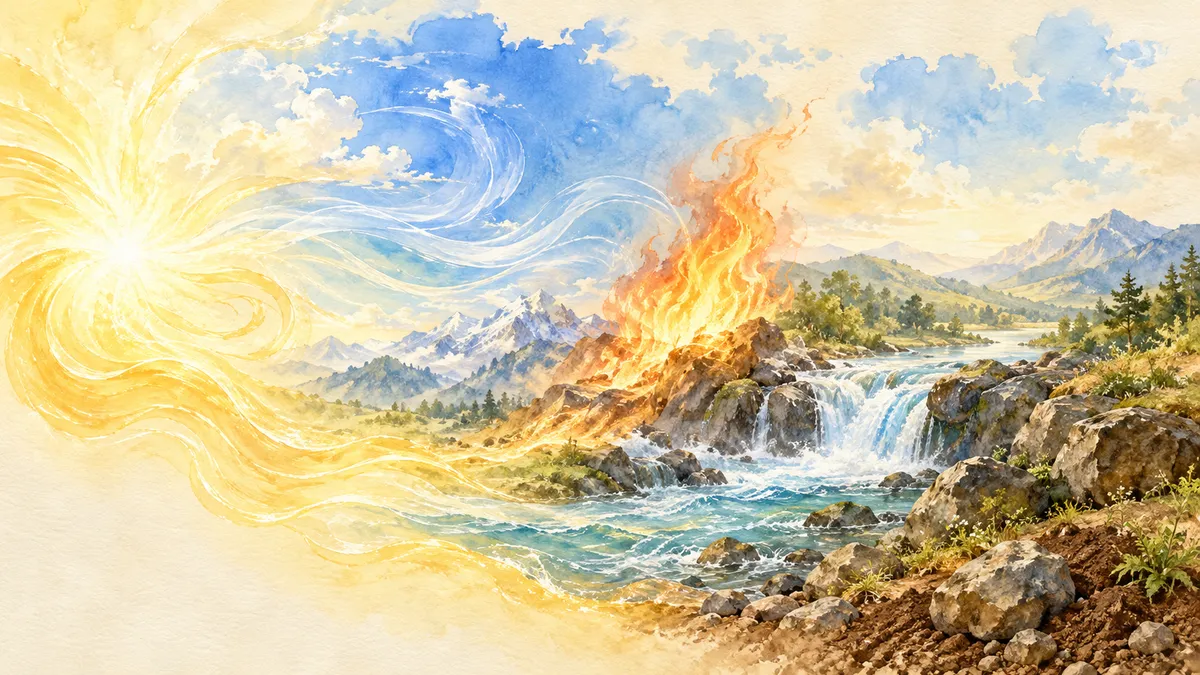
All the great elements (mahabhutas) were formed from the tamasic aspect of prakriti.
From the rajasic aspect of prakriti arose the five pranas present in our body, as well as the organs of action (karma-indriyas).
From the sattvic aspect of prakriti arose the antahkarana—our inner instrument (chitta, manas, buddhi, ahamkara)—the subtlest components.
Thus, this world consists of various forms of prakriti (material energy): its sattvic, rajasic, and tamasic aspects manifest as this world. Purusha—the primordial consciousness—is free from all this and takes no part in any of it. This world, composed of prakriti, consists of different forms of ignorance.
The Three Gunas and the Realms of Existence
Sattva predominates in the heavenly realms. These are worlds of thought, magical and mental worlds; gods and siddhas dwell in them. Their reality is governed by will because there are no gross elements there: bodies are made of light, and the worlds themselves consist of light and subtle prana. Rajas and tamas are present there only in small proportions. Many people—Muslims and Christians—wish to be born in the heavenly realms after this life ends. These are precisely the worlds in question: pure sattva, no gross energies, no tamas, no rajas, no gross pranas; bodies consist of the wind element, and sometimes of the fire element and consciousness.
There is plenty of rajas and tamas in our world, while sattva is suppressed, so the world is not governed by the power of thought—it is not a magical world but a material one. The tattvas here are difficult to control through the power of the mind. The world of the gross body creates a corresponding culture.
There are also even denser worlds where tamas predominates, where there is not even this degree of mental activity and movement—very viscous, dense, inert worlds.
The Path of Purification and Sadhana
Our task in this life is to purify ourselves of tamas and rajas as much as possible, increase sattva, refine our consciousness, and free it from all attachments, all kleshas, and all dense forces and fetters that bind us like chains. Then, using sattva as a springboard or launchpad, we must make a leap into the purest infinite consciousness. This is the traditional path of Vedic sadhana and Vedic culture: to purify oneself, become sufficiently sattvic, like the celestial beings, and then break through from sattva into the transcendent.
There are certain extreme schools that believe it is not necessary to purify oneself and cultivate sattva, and that rajas and tamas can also be used as a launchpad for a leap into the transcendent. But all wise sadhus regard this with great skepticism, because rajas and tamas are energies that are difficult to control. If you are under the sway of these energies, how can you use them to make the leap? They are the ones using you. Only a very strong, wise, enlightened person can use them. An unawakened person has no chance, because using the tattvas presupposes complete control over them in a state of fluidity and harmony. This is called samyama (equilibrium).
For example, you have a car and need to get to Moscow. But besides the car, you also have a wild bull and a lazy cat. Which one will get you there faster? The answer is obvious. The bull is wild and difficult to control—instead of reaching Moscow, you may simply be thrown off. The cat is lazy, does not want to go anywhere, and certainly does not want to carry you. The cat is tamas, the bull is rajas, and the car, or horse, is like sattva.
To purify does not mean not to use. All energies are present in the body, and they have a right to exist. The real issue is that they must be completely purified and made luminous and awakened, relying on the most sattvic part: tamas must be kept under control, while rajas must not interfere and should act only when appropriate—for example, when prana needs to move. And by using sattva, one must create a divine body and make the leap into transcendent consciousness. That is what this life is meant for: a human being is destined to become divine, and this divinity lies within.

Karma and Karmic Vision
When we follow the divine path, it is like going against the current, because our karma rebels against it, resists, and wants to continue in the old way. That is why it is called tapasya, ascetic practice—it is much easier to heed the call of karma and follow it. When a person follows the call of karma, they feel joy and pleasure, but this is joy of a lower order. Their lower chakras are happy, while the higher ones remain closed. They feel that everything seems fine, yet something is wrong: the body is satisfied, but the soul is not.
When people love the body in one another, love the personality in one another, and love material things, they use the lower chakras; their pranas move, and they rejoice. Prakriti acts within them; nature impels them to have children, marry, fall in love, go shopping, and pursue a career. They are driven by prakriti conditioned by karma, but their essence is not awakened, and their soul is not satisfied. Although their energy is moving, they are not truly happy about it, because this is not a state of wholeness, not a state of divine ananda, not a state of refined openness and divine majesty.
Then, upon entering the path of a sadhu, a person renounces indulgence in prakriti, does not follow the call of karma, and seeks the purusha—the divine spirit—within, embarking on the path of self-discipline, tapasya, and control of desires.
According to karma, everyone has their own desires conditioned by past births:
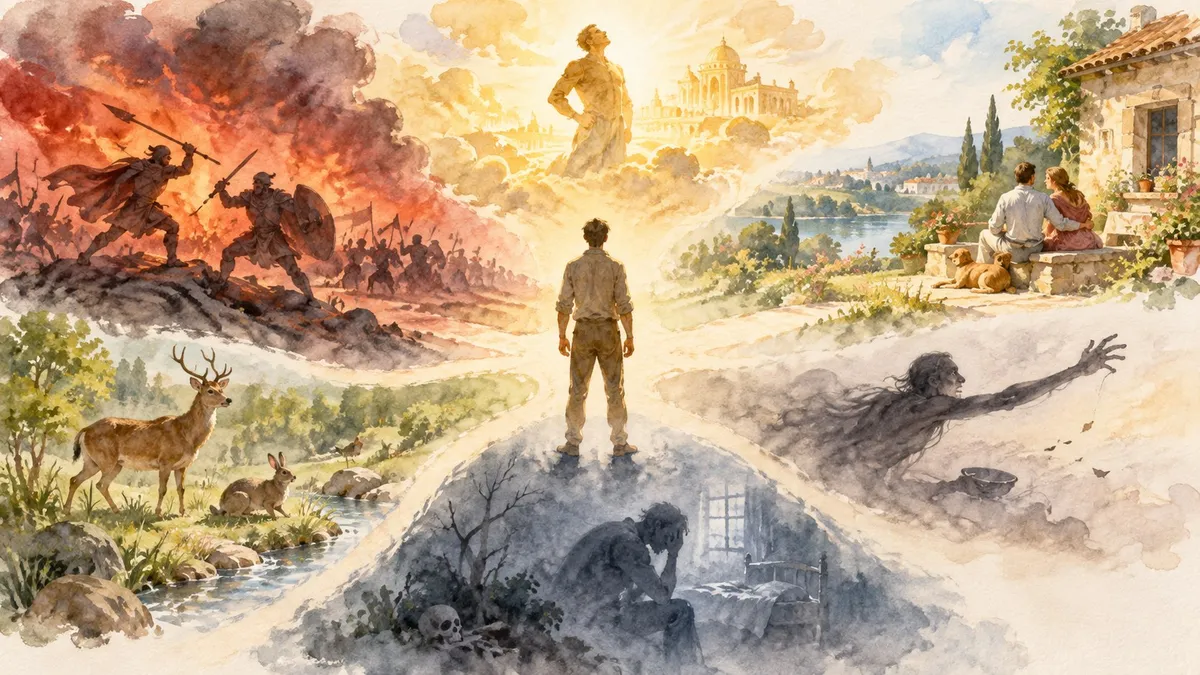
One who lived in the asuric worlds in a past life strives for rivalry and challenge: “Either I challenge others, or I am challenged.” This is the consciousness of the asuras.
One who was human in past lives revolves around human concerns: attachment, love, separation, sentimentality, and human happiness—this is the world of humans.
One who lived in Svarga-loka (who was a deity in the heavenly realms) carries the qualities of pride, arrogance, pseudo-contentment with oneself, and narcissism: “How good I am; I feel so good, but I need nothing.”
One who has the karma of pretas is always dissatisfied, always lives with an outstretched hand; they never have enough love, energy, money, or living space—they never have enough of anything. Even if they are given something, they will find a way to spoil it and remain dissatisfied.
Souls that have come from the animal world are very happy to receive this body. For them, it is an inexhaustible source of pleasure. They live through the muladhara chakra and svadhisthana chakra. The goal of their life is to obtain as much pleasure as possible, keep themselves safe, and survive. This is the most primitive life.
A person who has come with the karma of the hellish realms will have many fears, illnesses, and problems because their subtle body remembers all of this.
But precious human birth means that we can bring all of this under control and purify it through self-discipline. We can change the proportion of the tattvas: strengthen sattva, purify tamas, and subdue rajas. In our bhava and purity of mind, we can become like the consciousness of celestial beings, and then open up nondual transcendental consciousness.
Individual Consciousness and the Trap of Personality
“Thus the infinite clothes itself in the garments of ignorance; this is called individual consciousness, like an elephant lured into the trap of the apparent world.”
Individual consciousness—our ego, which makes us feel like individuals in this incarnation, our personality—is like a trap into which an elephant, a mighty animal, has fallen. The infinite becomes finite, the Absolute becomes a personality and is reduced to the body.
Psychologists already say that a person is not necessarily a single personality—under certain circumstances, alter egos may emerge. There is even such a diagnosis: multiple personality disorder.
For example, there is a woman. In one persona, she is a hardworking homemaker and the mother of her children; in another, she is a resident of Africa who knows how to hunt; and in a third persona, she feels like a man, drinks beer, and swears like a man. This personality emerges only occasionally, under certain circumstances. This is classified as an illness, and doctors are perplexed: “Where do these personalities come from?” They are alter egos that emerge from the subconscious. She identifies more strongly with one personality, but the other alter egos have also gained strength, and somehow she dives into the subconscious and then resurfaces as a different personality.
Every person’s consciousness is structured in a similar way. Those who do not control this and are not attached to a single stable personality are considered ill. But in reality, no personality is important, and no personality is self-existent.
Within us there is an original, profound consciousness free from all personalities. Yogis do not seek the path of a strong, integrated personality—they seek the path of freedom from any personality. They seek the freedom to form any personality (if necessary) and dissolve it, to be independent of any personality, because a personality is a set of particular qualities; it is a limitation if we identify ourselves with it. It is far better to be able to control the settings of this personality ourselves and define the parameters of any quality.
Antahkarana: The Inner Instrument and Its Dissolution
“It is called the soul because it is alive. Because of the egoistic notion, it is called the ego. Since it discriminates and determines, it is called buddhi (intellect), or the faculty of discrimination. Because of its ability to create concepts and perceptions, it is called the mind. Since it is natural, it is called nature.”
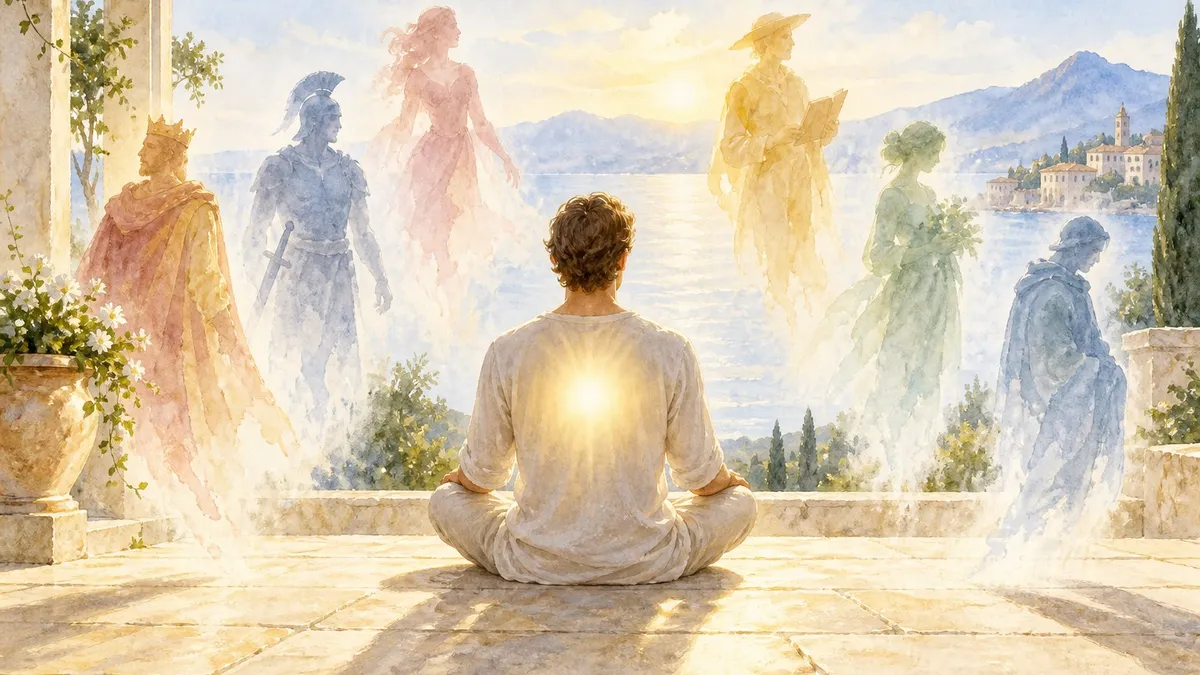
The mind creates concepts and perceptions. The ego gives rise to the sense of personality, ahamkara. Buddhi compares and determines on a subtle level. All of this, together with memory, constitutes our inner instrument—the antahkarana. We must gain a deep understanding of this inner instrument. It is our software, and we must understand how it all works and where the controls for all of it are located.
The key to freedom from this instrument lies beyond the mind, beyond memory, beyond the ego, and even beyond buddhi. It is the pure consciousness from which all of this arises. We need to discover this pure consciousness in order to rise above the inner instrument and dissolve it. In Laya Yoga, this process is called antahkarana laya chintana—the dissolution of the inner instrument, the antahkarana.
We must discover the immortal divine consciousness within ourselves and dissolve our memory (chitta)—take all the internal recordings, the files of our memory, and cast them into the fire, dissolving them so that they no longer bind us, leaving them only as subtle traces that cause no attachment. We must take our ego and immerse it in the light of pure consciousness, dissolving it so that the idea of being confined within our small personality and its attachments no longer binds us. We must take the conceptual mind, the operating system, and likewise immerse it in the light of this space and dissolve it, so that it may later emerge again, but we use it only in a state of complete freedom.
When we dissolve these instruments—as though dipping them into a solution of pure, immortal consciousness—they undergo an alchemical transmutation:
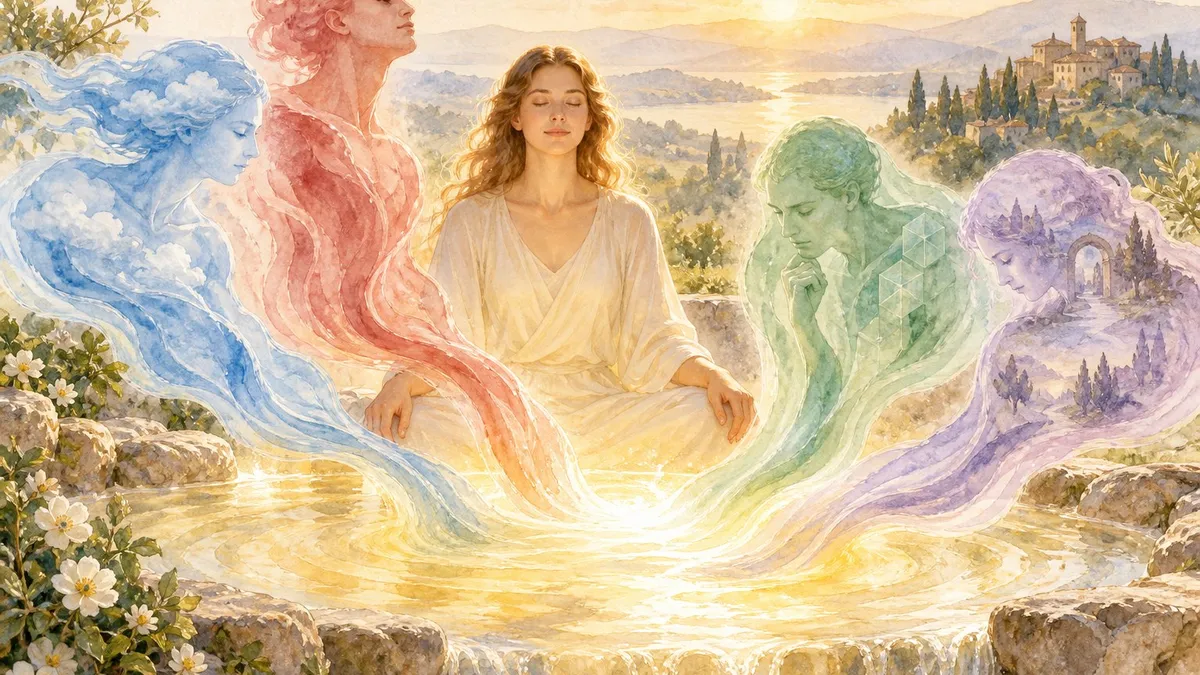
The mind (manas) ceases to be rigid; its judgments and concepts no longer bind us.
The ego ceases to be a personality with which we identify and becomes an instrument.
Buddhi becomes the purest conduit of the divine will.
Memory becomes traces, information with which we do not identify.
All of this fuses into a single whole and becomes our instrument, our function—what is called shuddha sattva svarupa (the purest form of the original Self).
This shuddha sattva svarupa is directly connected with the divinity of the Atman, with the presence of pure space, and can manifest as an illusory body of light, as an illusory physical body, as emanations of magical bodies in the gross and subtle worlds, as space—in any form whatsoever. There is no longer any tamas, rajas, or gross tattvas in it. This is transmutation on the path of the Laya Yoga Teaching.
What melts these tattvas and this inner instrument is divine consciousness and the grace of the anugraha shakti of divine consciousness. We ourselves, as a personality, cannot dissolve and melt all of this. The processes of antahkarana laya chintana are carried out neither by our purified ego nor by our purified, concentrated mind—they are carried out by the divine power to which we open ourselves in the process of contemplation and self-surrender.
Models of Reality and Their Limitations
“It itself is known as the body because it changes. It is called consciousness because its essence is consciousness. Supreme consciousness—the only truth—is situated directly between the inert and the conscious. It alone creates diversity and is known by various names. But all divisions and categories were invented by people with distorted minds for the enjoyment of arguing and to confuse ignorant people.”
Models, classifications, concepts, and categories are merely mental models of reality. But a model is not reality; it is simply a model. The map is not the territory; it is merely a map. We must understand that models have their own limited scope of application. We can work with a model, but we should never believe that the model is reality itself.

For example, there are the fourteen worlds of the Vedic universe—this is a model, not the universe itself; the universe is far more complex and cannot be described by the logical mind. There is a model in which Brahman is Sat-Chit-Ananda, but this is a model of thought, a description produced by the mind when it contemplates the Absolute—it is not the Absolute itself.
Perception as a Model of Reality
To comprehend the Absolute itself, we must freely go beyond the mental model and apprehend it directly, immediately, beyond the mind. Even the universe we see is no more than a model of reality perceived through the sense organs. It is not the true universe itself, because everything we see in the universe is merely data from the five senses; it is a signal processed by the brain.
We do not see this hall itself; rather, we perceive an image formed in the neural networks of our brain through our eyes, ears, skin perception, and all five senses. The five sense organs (jnana-indriyas) provide an impulse, a certain signal; the neural networks process this signal and present an image. From the brain it is sent to the subtle body, which receives the signal: “Yes, there is something here resembling a hall.” But if we had a snake’s organs of perception—its jnana-indriyas—the image would be different. A snake, for example, sees in infrared light, its hearing is structured differently, and it perceives the world in a different range. A snake would not see this hall as a hall at all. It would see the world in its own way.
It can be said that, in a sense, the jnana-indriyas create the universe of each being in their own way. A snake’s jnana-indriyas create the universe in one way, a human being’s jnana-indriyas in another, an animal’s jnana-indriyas in another, and a deity’s jnana-indriyas in yet another. But what is the universe really like? Everyone will see this hall in their own way. And Vasishtha will say: “In reality, there is no universe separate from you. You are the one who creates it—as soon as you turn away, it disappears.”
The Observer and Quantum Physics
Even scientists conducting research in quantum physics have reached such paradoxical conclusions. One scientist wrote an article titled “Does the Moon Disappear When We Are Not Looking at It?” He is developing a theory in quantum psychology, which mentions Pribram, Bell, David Deutsch, Amigo Swami, and Robert Wilson. All this began back in the 1920s, but no one knew about it. Physicists arrived at this conclusion, but they were so shocked that for a long time they could not even get used to it. It began with Einstein’s theory, when Einstein said: “Yes, if we accept the theory that the observer changes the universe, then a mouse can destroy the universe simply by looking at it.” Then he thought: “But how can that be? The universe is not being destroyed; we must keep searching.”
The universe exists precisely because we exist and perceive it through the five senses. When we do not perceive it, it dissolves into emptiness—it does not exist outside our perception.
Where does this hall go when we leave? Someone may say, “Where could it go? It will remain standing here, just as it is.” In fact, when this hall disappears from the field of our jnana-indriyas, it returns to the unmanifest, to emptiness; it does not truly exist. Someone may say, “How can it not exist? If I come back, it will still be standing there—all the stones, all the pillars, and the roof will be in place.” To this one should reply, “No, you came—and your indriyas created it. It did not exist while no one was there. Even if just one person comes, that person will create this hall. For the hall to exist, your indriyas are required. As long as you are not present as the subject and your indriyas are absent, the hall is absent as well. Have you never thought about this?” Then a clever person may object, “But if no one is there and we install a video camera, the camera will record that the hall is still there, and we can watch the footage.” The answer is that this merely makes the problem slightly more complicated. To watch the camera footage, a person—a subject, an observer—is needed, and once again the indriyas are required. We are simply creating another transmission mechanism, but the indriyas must still create the video camera. Without you as the subject, without the indriyas, there will be no video camera either, because the video camera also dissolves into the unmanifest as soon as the last person leaves the hall.
We are convinced that reality exists independently of us—and this is a very strong and deep-rooted belief known as eternalism. But both Vasishtha’s philosophy and modern scientists conclude that an observer is indispensable as a participant in perception, and that it is precisely the perceptual apparatus that creates the world we see. In other words, for a world to be created at all, an observer, a subject, is required. And for a specific world to be created, a specific apparatus is needed—that is, the specific jnana-indriyas of a specific being.
The Diversity of Worlds and the Apparatus of Perception
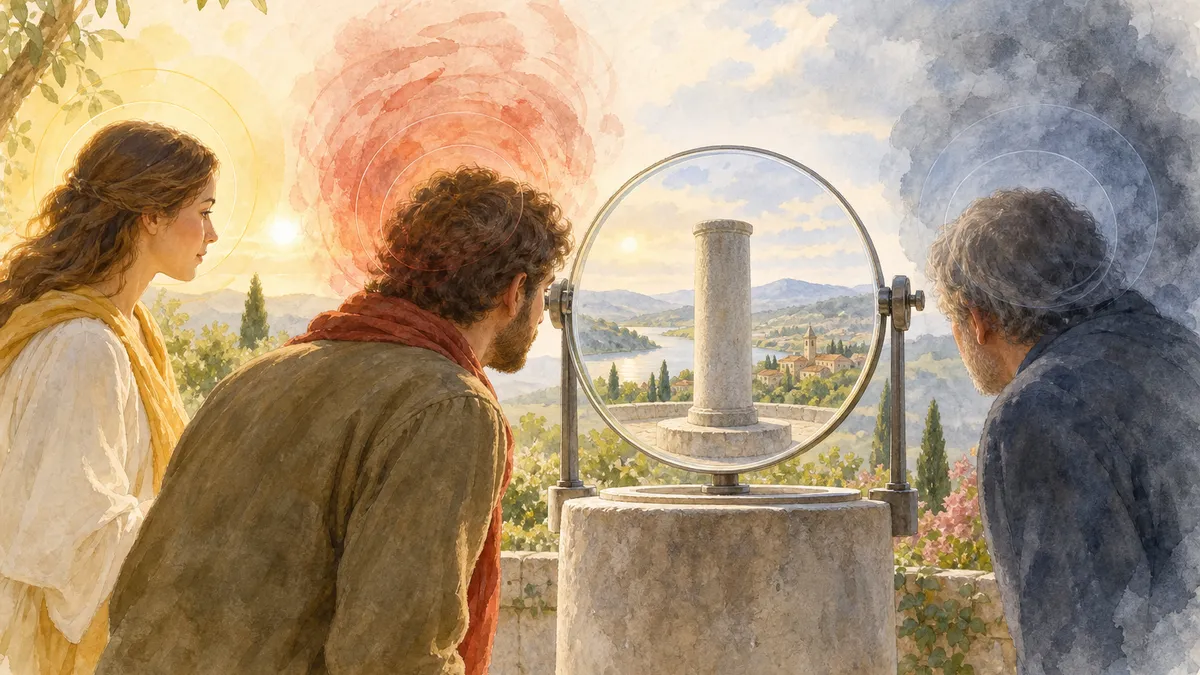
The apparatus of a human, a snake, an asura, a deity, a rakshasa, or a hungry spirit differs: their indriyas differ, and their memory differs. This is precisely why the saints say:
“The gods see a river as nectar, the asuras as a weapon, humans as water, fish as a habitat, hungry spirits as streams of pus and excrement, and the beings of hell as fiery lava.”
This is because their apparatuses differ, and they create different worlds while perceiving the same universe.
The apparatus of all humans is approximately the same. If it were not the same, we would see the world differently. But our descriptions of reality are similar: if I say that this is gray, you agree; if I say, “The column is round,” you roughly understand what I mean. The apparatus is the same, but there are certain differences—in the admixtures of sattva, tamas, and rajas, in their proportions, as well as in the antahkarana (chitta, manas, buddhi) and its functioning.
To enter the Master’s universe does not mean entering some personal universe of the Master. Rather, it means entering that purified vision which is not identified with the apparatus—with chitta, manas, buddhi, and ahamkara. It is connected with the purified apparatus of siddhas and saints. As we purify ourselves, we draw ever closer to a different karmic vision. When we have purified ourselves sufficiently, we can look at the world even through the eyes of Dattatreya, our Ishta-devata, and the universe will appear before us in an entirely different form.
Consciousness, Death, and Liberation
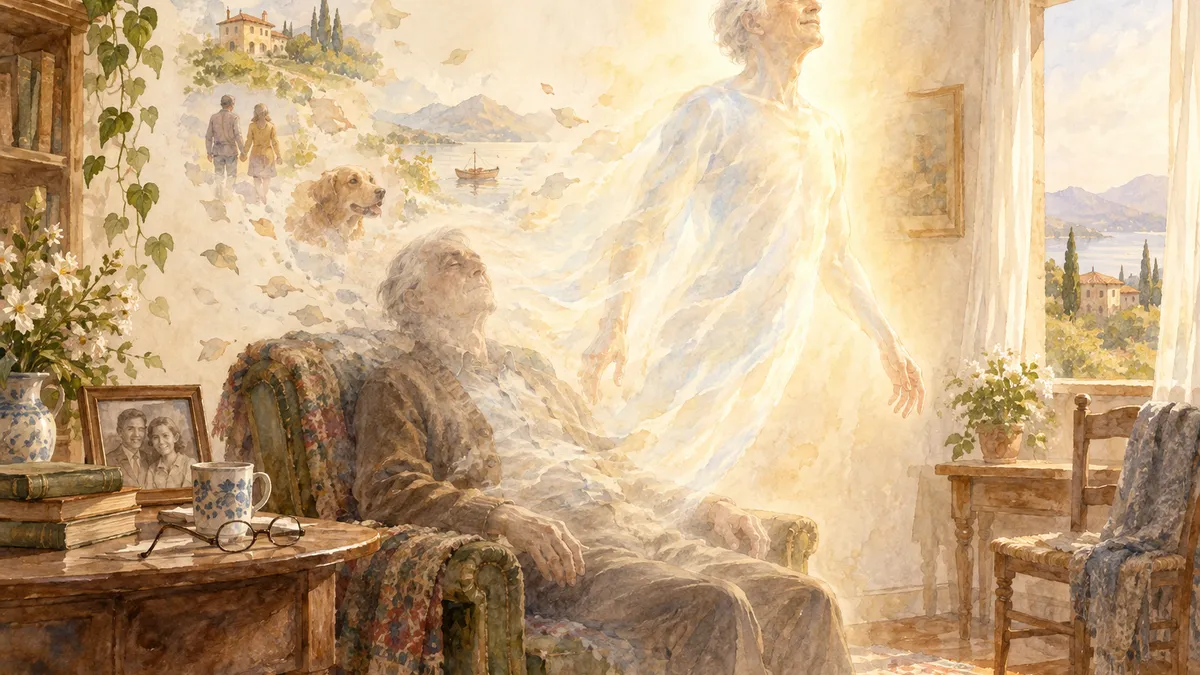
“Therefore, O Rama, individual consciousness alone is the cause of the apparent world. What can this deaf and ignorant body do? If the body dies, consciousness does not die, just as a tree does not die when a leaf falls from it. Only an ignorant person thinks otherwise.”
After the death of the physical body, the human soul remains. The mind of that soul draws a mental image of the body, and this mental image will roughly correspond to the body one had in this life. A person’s habits, sayings, way of thinking, mentality, and memory—all of this remains. This is because the soul remains the soul, the personality remains the personality, and all attachments remain for a long time afterward.
But sadhus strive to dissolve this inner instrument during their lifetime, to dissolve the soul in the divine, to surrender the soul to the divine, to subject the soul to the divine. Then they live in the body, but their soul is dissolved in the divine, and their mind no longer pictures any future for itself other than the divine. Their mind pictures no desires, no connections—it pictures only God. Indeed, it pictures nothing at all; it abides dissolved in God.
“On the other hand, if the mind dies, everything else also disappears, and final Liberation ensues. A person who suffers and thinks, ‘Alas, I am dying, I am disappearing,’ clings to false concepts out of ignorance. He will again experience the illusion of the world in some other place and at some other time.”
Even if a person dies, their mind creates a new reality and a new body—it may be subtle or dense, depending on their karma. And they will again have similar experiences, interact with similar people, and have similar karma and similar circumstances; they will continue doing what they did during their lifetime. But since they will be free of the physical body, their subtle body will perceive the world differently—they will enter illusory universes, illusory alternative worlds, lose themselves in them, and become confused. If they are an experienced sadhu, they will break free and will not become entangled in these illusory worlds. But if the sadhu is inexperienced, they will become confused, lose themselves in them, and eventually connect with a world that will lead them to a new rebirth. Or they will enter a heavenly realm, the heavens, and live there for some time—as long as their merit lasts. Or they will enter the world of the pitris (ancestral spirits) and meet relatives who remember them.
But a sadhu does not seek to enter any worlds without control; they do not seek a new birth. They strive to live a long time in this body in order to attain enlightenment and Liberation; they strive to dissolve their mind.
“Individual consciousness, limited by the mind, leaves one body and seeks another, just as a monkey in the forest leaps from tree to tree. Just as a nanny carries a child from place to place to distract it, so the limitation of the mind—a psychological habit or tendency—carries the soul to and fro. Thus, bound by the rope of mental limitation, individual consciousness passes through a variety of recurring births and sufferings.”
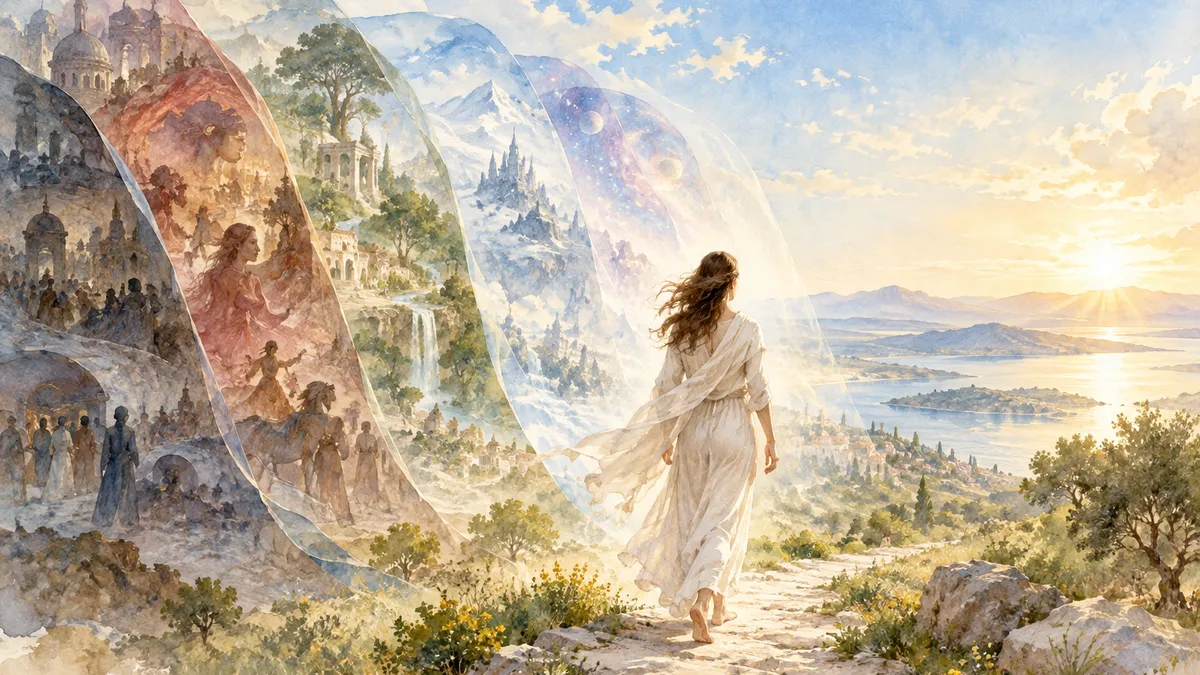
Liberation is the rejection of any interpretation. The world of pretas is an interpretation, a karmic vision; the world of asuras is an interpretation, a karmic vision. All worlds are karmic worlds. Liberation is freedom from any conditioned karmic vision.
Karma, Upbringing, and Pure Vision
Our karma and our upbringing prompt us to make different judgments, including impure ones. A child is not a blank slate. They have karma; they already have memory—only this memory has not yet been attuned, and it takes some time for it to establish a connection with the indriyas. Society teaches the child how to attune this memory. A child comes with karmic baggage. But the specific personality into which this karmic baggage is molded depends to a great extent on upbringing. Sometimes children were abducted by monkeys or other animals and raised in the jungle, where they learned to run like animals and understand their language. And when they were found several years later, it was very difficult to bring them back to normal human life. In other words, the instrument of the antahkarana—human socialization through society and upbringing—had not been formed. Possessing the karmic vision of a human being, they acquired some of the languages of the human world, but they still saw the world in their own way and could not make full use of it.

Our upbringing prompts us to pass various judgments, including impure ones: this person is such-and-such, that person is this or that. But we must retune ourselves toward pure vision. Pure vision is the vision of divine beings. As the saying goes, “On an island of gold, there is not even a drop of dirt.” Gods, divine beings, and saints live in heavenly worlds composed entirely of pure tattvas, or elements. Not even a speck of dirt, such as can be found on Earth, exists there. When we practice pure vision, we retune our faculty of perception toward this kind of vision. Another matter is that this cannot be done mechanically. True pure vision arises naturally as a result of maintaining presence. And working with the sankalpa “Pure Vision” is merely a preparation for it to later become natural pure vision.
