

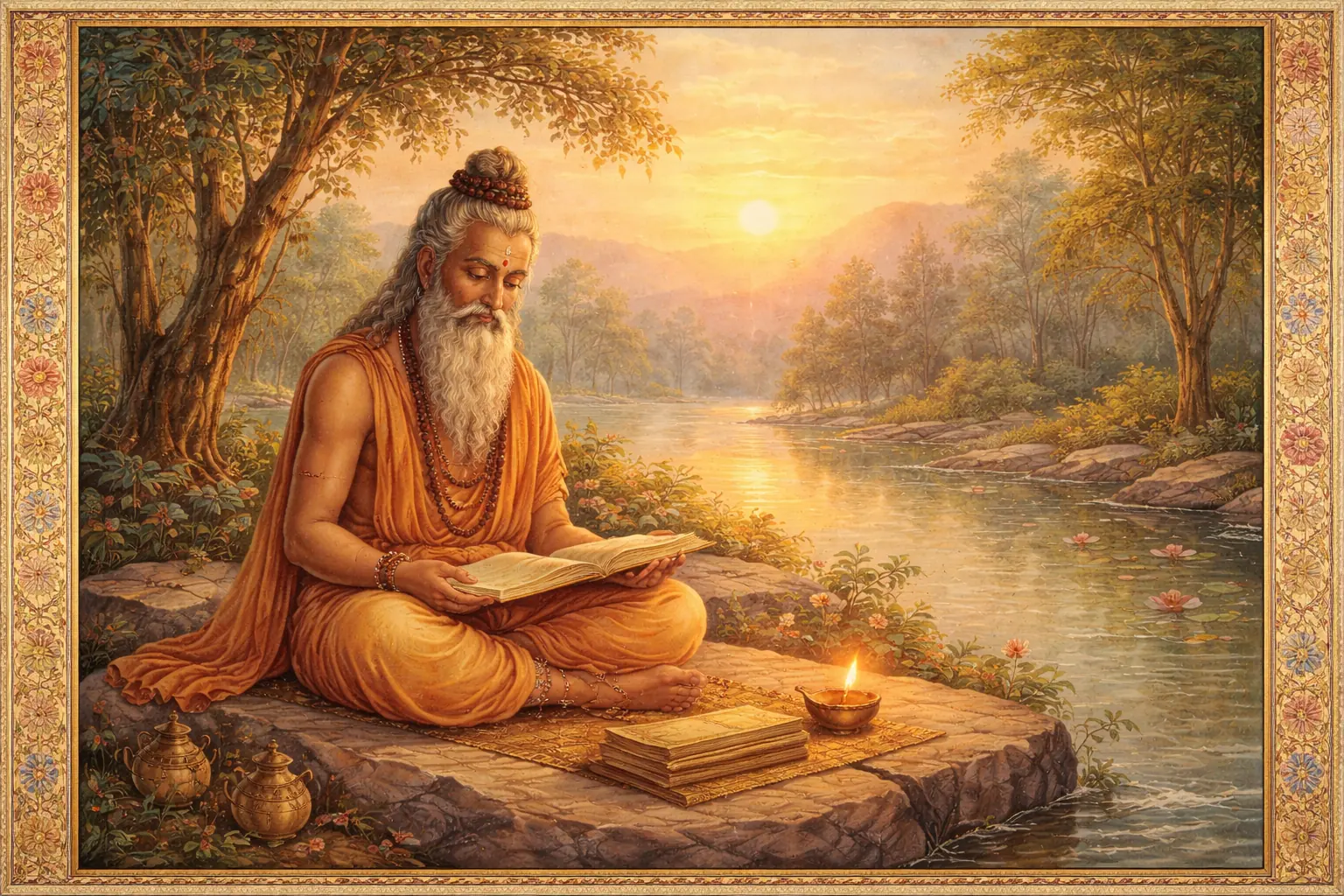
Commentary on the text “Yoga Vasistha.” The Story of the Hunter and the Deer
“Once, a sage came to visit me. I entertained him, and in the evening he told me a story. He described the infinite universe in detail and concluded his account by saying that all of it was infinite consciousness. My own mind awakened. I immediately remembered everything from the past, how I had entered another’s body, and so on. I thought that this other person was a cosmic person and tried to leave him. I entered that person’s breath. Becoming one with him, I came out. There I immediately saw my own body before me in the lotus posture, in a hermit’s dwelling, surrounded by disciples. According to them, only an hour had passed since I had entered samadhi. The person whose heart I had entered turned out to be another traveler who was asleep. I told no one about any of this, but quickly entered the traveler’s heart again. Cosmic destruction was completed in his heart. The village where I had lived with my relatives disappeared. Everything was burning in the flames of destruction. I became one with the wind and explored it.
Although I was surrounded on all sides by this terrible fire, I was not unhappy. If, in a dream, you know that you are asleep and dreaming, you are free even amid the fire.”
When the mind is strongly conditioned, it seems that reality has rigid cause-and-effect relationships and a strict linearity, meaning that the vector of time flows unidirectionally from the past into the future, that we are firmly grasped by reality and have no choice. When we begin to understand the illusory nature of the world and the nature of the Mind becomes somewhat clearer, we begin to understand that external reality is not as material as it seems and is an expression of many of our inner tendencies. If we know how to enter within and find the necessary tendencies while blocking the unnecessary ones, reality will also change. At this stage, when we can enter within, see these tendencies, and change or direct them to some extent, fate does not have as much power over us as it does over other beings. This is because fate is one dominant tendency chosen by us from among many possibilities, from an entire spectrum of different tendencies, and this tendency guides us.
When we penetrate into the depths of awareness, we see many such tendencies and can choose. Right now, there are hidden, unrealized versions of reality lying dormant in the subtle body. In some versions of reality, you may have been a monk since the age of twelve; in some versions of reality, you are a Swami monk; in some versions of reality, you are already free from samsara and possess pure realization; and in some, you may not have been fortunate enough to encounter the Dharma. These hidden versions of reality are also present in consciousness. And in these versions, you have your own individuality, different memories, a different fate, and different karma. But you are simply not reunited with these versions through your present consciousness; this can be done only at a deep stage of penetrating the nature of the Mind. There are also countless external realities, and in these versions of reality you live through other stories and under other external circumstances.
And one who is capable of penetrating deeply into the nature of the Mind can move through these different versions of reality, just as the siddha Narada does. The flow of time has no power over such a person, because he understands that by contracting consciousness, one can contract time, and by stopping consciousness, one can stop time. However, this is realized at an advanced stage of penetrating the nature of the Mind.
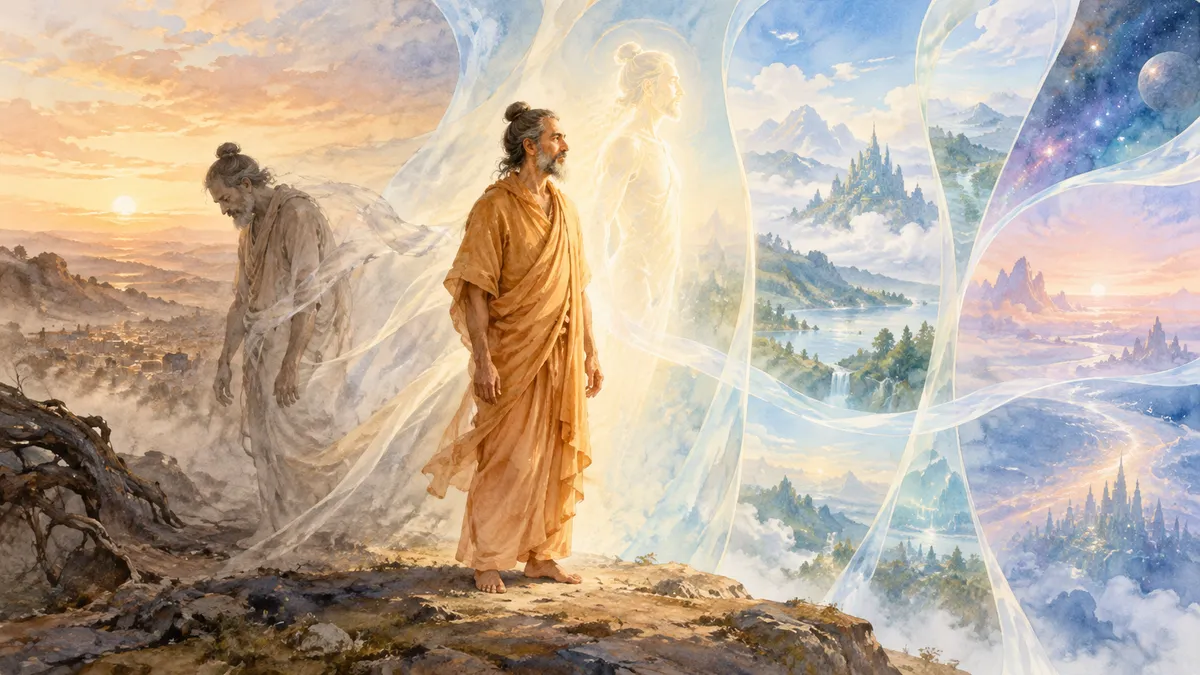
All the ideas we currently have about the human world, cause-and-effect relationships, goals, and being as such are merely one tiny version, just as illusory as our fantasies. However, samsara means that we are firmly grasped by this version, since we have a gross body here and it seems to us that we are the body. At the moment when we begin to free ourselves from the notion “I am this body” and penetrate into the subtle body, discovering awareness, freedom from being grasped by the current reality gradually arises.
The Nature of Creation and the Illusion of Causality
“While I was exploring the nature of fire without being scorched, because I knew that all of this was only a dream, a monstrous wave of heat arose. Everything began to spin and catch fire. It was as if it were a dance of destruction.
I thought: “After all, this is only a dream that I am seeing while inside someone else’s heart. Why should I not get out instead of watching this destruction?”
The Hunter asked:
“You entered that person’s heart to find out what a dream is. Why did you decide to get out? Did you discover the truth?”
The Sage replied:
“From the outset, this creation has no reason to arise. Therefore, neither the word ‘creation’ nor the object of ‘creation’ itself is real.”
It says here that this creation has no cause for its arising. But why does it have no cause? If there is creation, then there must always be some cause. The point is that there is no creation as such; it only appears to us as creation as long as we, as the subject, occupy a certain point of view. When we free ourselves from the illusion of the seer, the seen itself also appears as an illusion, as something that never existed. Accordingly, it has no cause either. What cause is there for a snake seen in a rope—what caused a snake to appear in the rope? If there is actually no snake, what cause could it have?
All those who speak of creation, taking the position of gradual creation, proceed from the assumption that the snake supposedly exists, and then, if there is a snake, there must also be creation. The true view of Advaita says from the very beginning that there is no snake (by “snake” here we mean the creation of samsara), and therefore, by definition, there can be no cause for it. The question is how to purify one’s mind sufficiently to see this.
“They do not exist. But the misunderstanding of this, or unreality, is merely concepts arising in consciousness or reality. I can tell you the truth only from the perspective of one in whom foolishness and misunderstanding no longer exist; what is true from the perspective of a fool—I do not know.”
Every person has their own idea of truth, and this idea of truth is conditioned by their karma, education, upbringing, and the peculiarities of their mentality. But Vasistha says: “What is truth for a fool, I do not know.” In reality, however, none of this is truth.

Some people tend to identify themselves with something, and then they consider whatever is true within the framework of their identification to be the truth. For example, if people identify themselves with the American nation, everything that is beneficial to the American nation is considered right; and if people identify themselves with something else—for example, the human race—then what is commonly accepted as right according to the notions of the human race is considered true. But in reality, none of this is so; it is merely a collectively maintained meaning, a point of view that is relative. For example, third-world countries see the world differently from America. Animals have their own ideas about ethics and morality, and they could present humanity with a bill for all the fur coats and jackets made from their skins.
From a relative perspective, there is no true, correct, or genuine point of view. All these points of view are only seemingly true, conditionally so. The true point of view is found only in awakened awareness. And awakened awareness is not connected with either a concept or the assertion of “this” or “that” at the level of the logical mind.
Pure Consciousness as the Foundation of All That Exists
“The truth is this: all of this is pure consciousness, which permeates everything.
Where is the body, where is the heart, what is a dream, where is the water and where is the flood, where is awakening and where is the end of awakening, where is birth and where is death? There is only pure consciousness. In the presence of this consciousness, even the tiniest particle of space appears to be the infinite cosmos. Spontaneously, this consciousness ‘thinks’ for a moment, and the concept of the world arises, although it is still the same pure space. As in a dream, consciousness assumes various forms, although in reality there are no cities and nothing at all: the dream world is consciousness alone.”
People who do not engage in spiritual practice live at the level of gross matter. Yogis who have achieved some success in sadhana live at the level of prana and subtle images. Siddhas and rishis live and operate at the level of meanings, without needing contact with gross matter, or even with prana and subtle images.
Meanings are the essence of the causal body (karana-sharira). Our physical world is, as it were, a reflection of the astral world, the world of subtle information. The astral world is a reflection of the causal world (the world without forms). The causal world is the repository of first principles and primordial meanings. One who is capable of establishing themselves in the causal world needs neither matter nor information; they simply generate new meanings. If their sankalpa is strong, these meanings become clothed in information and matter and manifest, materialize. One who does not understand this is forced to borrow meanings, information, and energy from outside and is therefore not self-sufficient.
For example, a person is forced to build a house out of bricks in order to protect their body from the five elements. The state of a siddha or rishi is such that, through the power of sankalpa and visualization, they create it within themselves. When they create it, this house becomes so dense that they can live in it; it is simply enough for them to generate such a meaning.
Liberation is precisely the transition to living at the level of meanings (drishti), vision, and perspective; liberation from the gross and subtle bodies, and then from the causal body as well; penetration into the very essence of meanings. Our universe is first and foremost vision, and only then matter. It is a kind of condensed meaning. One who penetrates into the primordial space of meanings becomes free from the laws of this universe.
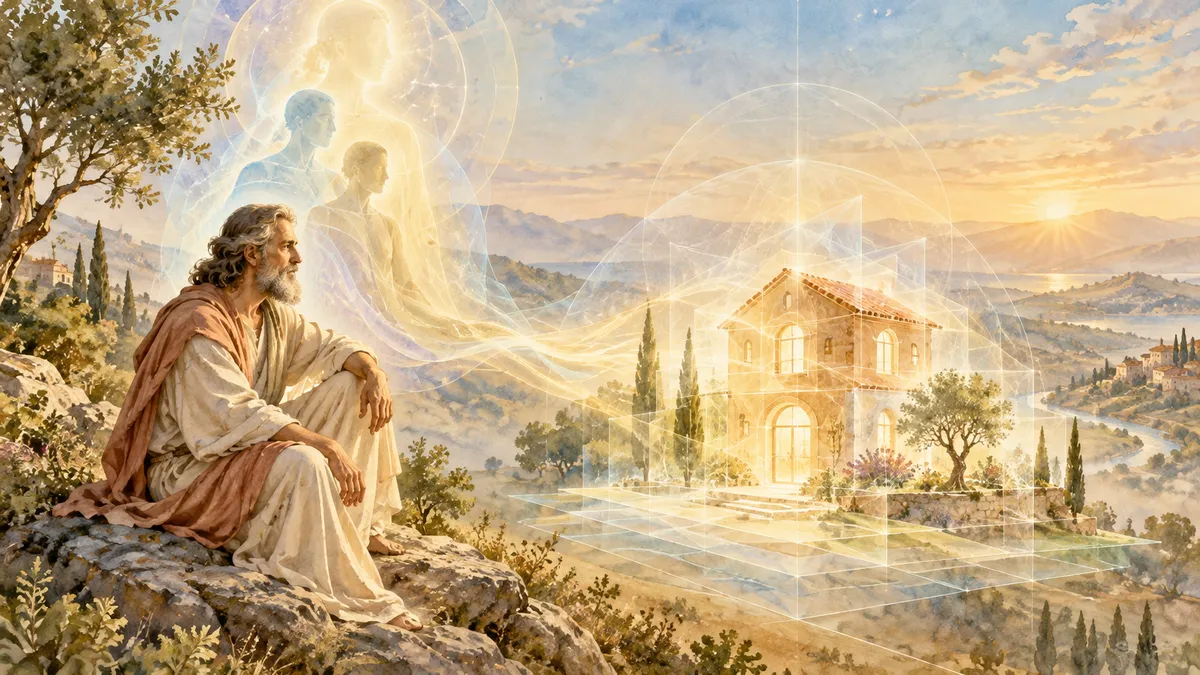
For example, there is a person who finds studying difficult and has certain limitations, so they think about themselves: “I have weak intellectual abilities.” There is another person who sees that they need to obtain some information or acquire certain abilities, and then within themselves they change the meaning of weak intellectual abilities into strong ones. They generate the following meaning: “I have incredibly profound intellectual abilities,” and these abilities awaken in them—this is how the blessing of the saints works. Or there is a person who works hard to earn a living, but still cannot make ends meet, let alone practice. And there is another person who generates the meaning of flourishing and abundance, or of having free time for practice. This meaning is simply transmitted outward and materializes.
In the process of contemplation, we move away from gross reality and from the subtle information of the astral body, learning to live through the subtlest meanings. Impurities in the channels, attachments, and the contamination of the astral body prevent us from penetrating into the space of meanings. As long as it remains inaccessible, this purification has not yet taken place. But when we penetrate into it, consciousness becomes capable of changing reality, moving into other kinds of reality, and changing its own line of destiny or that of others, simply by replacing meanings.
Nondual Consciousness and Freedom from Causality
“For us there are no external forms, nothing real or unreal, no space, but only the formless, beginningless, and endless—nondual infinite consciousness. A dream arises without any cause; it is only the pure consciousness of the perceiver (without an independent object). Here too there is no cause and therefore neither subject nor object: all that exists is pure consciousness, pure perception, nondual and beyond the bounds of description.”
It is similar to the following. When you dream, certain energies and certain meanings are transmitted into your consciousness. They are transmitted in such a way that you have to believe in them if your mind is not awakened. And even if your mind is somewhat awakened, you still experience the actual transmission of these energies and meanings. But if you have sufficient clarity and spiritual power in the dream, you may not be subject to these meanings at all. For example, if you do not like something, you can easily change it, understanding that everything is immaterial and that all of it can easily be changed by consciousness.
Freedom from samsara manifests in the same way on the physical level: when you do not like some physical dream, you simply free yourself from it, simply changing it by altering yourself slightly from within and giving rise to a new meaning within. There is an illness—you generate the meaning of absolute health, and then not even a shadow of the illness remains in the body. There is a disharmonious situation—you generate the meaning of harmony, and afterward everything suddenly dissolves. You lack certain abilities—you generate the meaning of these abilities within yourself, and they manifest. Certain intentions have not been realized—you generate these intentions within as already realized, and then physical reality begins to respond and manifest.
Why can a saint enter hell and liberate the souls suffering there, while not suffering himself? Because he does not submit to the meaning of hell; he does not believe in it. He believes in inner reality, is capable of resisting the disorienting energy of hell and transmitting his own meaning, which pacifies the hells.
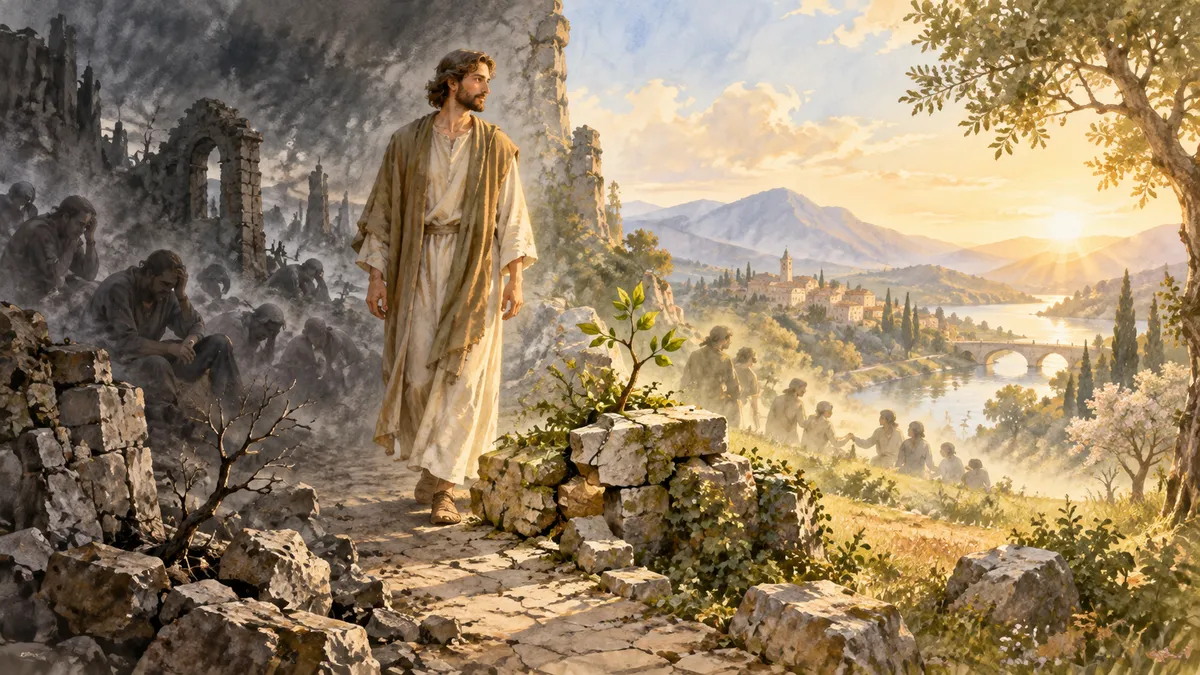
How does he do this? By drawing from within an immense source of meanings, atma-shakti. And why is he able to do this? Because his gaze always contemplates what is within, and he makes use of it.
Three Stages of Contemplation
Contemplation has three stages: the first is when we seek the nature of the Mind; the second is when we find it and relax; the third is when we make use of it. This is similar to a peasant who initially does not know that a piece of gold is sewn into the lining of his coat. Then he searches for it because someone has told him about it, but he has not yet found it. Then he finds it, holds it in his hands and marvels at it, congratulating himself. And finally, the last stage is when he makes use of it.
All three stages progress successively. And until we are capable of using our nature of Mind, all achievements remain questionable. Of course, for many, even searching for the nature of the Mind and embarking on this path is great happiness. Perhaps this path will end in future lives. For some, finding the nature of the Mind means a tremendous achievement, relaxation, the elimination of egotistical motivation, and so on. This is the stage of birth according to the teaching of the sixteen kalas. However, this is not where it all ends, as many claim.
For example, many say: “When you attain this state, you experience a state of egolessness, and then you need to relax and simply celebrate; there is nothing more to attain or do.” This is true. However, this is not where it all ends. If that were the end of it, it would be a very shallow state of attainment. It is like a peasant who has found gold and says: “Wow! This is amazing! Now I am rich; now a new life will begin for me.” But he has not yet sold the gold or bought anything worthwhile with the proceeds. He simply remains in a very elevated and joyful state. Of course, he no longer has bad moods, suffering, or fears about how to provide for his family. But the path of the siddhas always says that one must go further, that now this gold must be actively put to use.

Those who follow the path of avyakta and advaita say nothing about this. One gets the impression that they do not even suspect it. They say that from then on one should simply celebrate, simply stop and do nothing more, because this is non-action, and therefore nothing else can happen. And since nothing else can happen, they freeze themselves into a static state. There are no problems, no fear, no ego, no worries in it; it is unconditional, deep, and authentic. Nevertheless, this static state is not the final point, the point of realization; most likely, it is a launchpad for true realization.
Of course, after you realize “great non-action,” there is no longer any question of having to do something, of any goals, of an ego that would want to do something, of cause-and-effect relationships, aspirations, benefit, or hopes for the future. Of course, this is no longer an issue in principle; nevertheless, development itself continues nonetheless. This development contains within itself a point at which, essentially, there is no external development, but only deepening and transformation.
What does this transformation consist of? It consists in making use of our natural state. We no longer dream about it; we do not desperately cling to it, thinking, “How can I avoid losing it?” Instead, we simply take it and boldly make use of it. Who are “we” if the “I” has disappeared? This is also a question. We are merely a convention. Nevertheless, energy exists, it must somehow be designated, and we designate it as “I.”
Playful Consciousness and the Path of the Devas
There is a certain spiritual awareness, and this spiritual awareness has already established contact with the Source; it is no longer seeking it, but drinking its nectar. And when it drinks its nectar, it itself becomes saturated with it, and then natural blossoming begins. The use of this precious stone consists in the fact that all limitations, illusions, and fixations, even in the smallest things, gradually disappear, and all qualities and channels fully blossom. This state is called the path of the devas. The human stage of the spiritual path comes to an end, and the divine stage begins.
Brahman
Consciousness is absorbed in Brahman, identified with Brahman, and it is one and the same as Brahman; it itself becomes:
Aparicchinna – that which has no boundaries
Avāṅmanugocara – that which is beyond the reach of speech and mind
Avikāri – unchanging
Avināśi – indestructible
Avicchinna – continuous, indivisible
Avyākṛta – undifferentiated, indefinable
Avyāpadeśya – indescribable
Avyaya – inexhaustible, undiminishing
Agādha – immeasurable
Agrāhya – that which cannot be grasped
Aguṇa – without guṇas (qualities)
Advitīya – one without a second
Aja – unborn
To be absorbed in the Source means to remain constantly in continuous meditation and devotion.
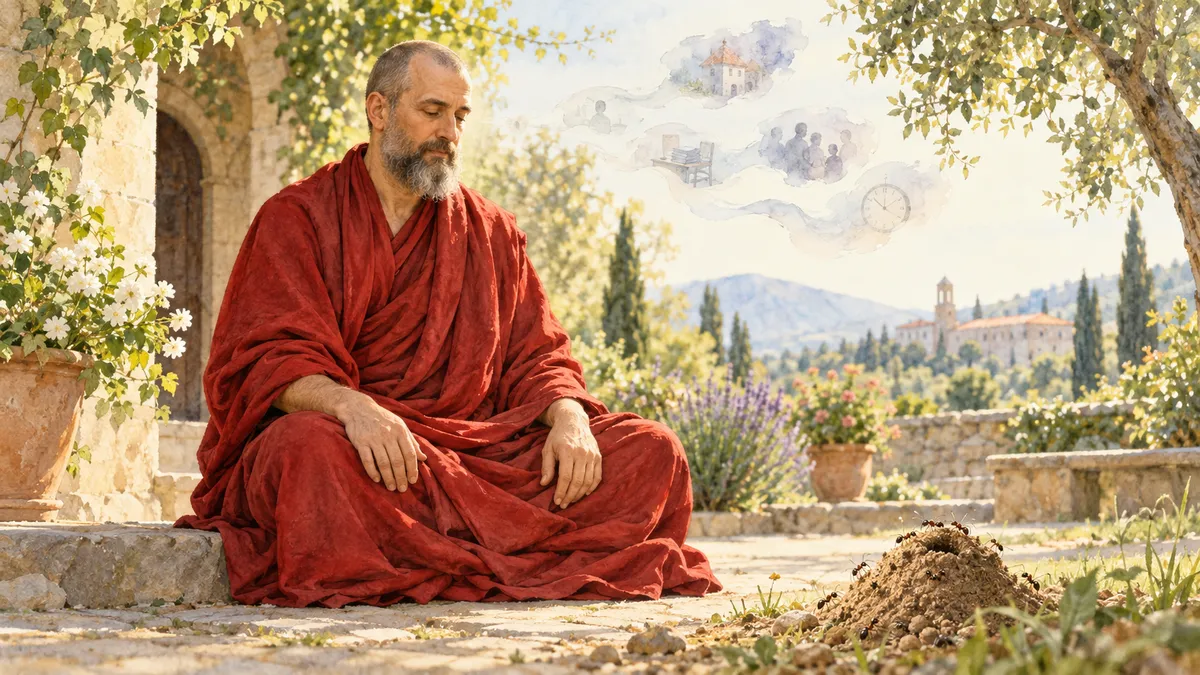
What does a monk think about? It may seem to you that a monk thinks: “Oh, if only prasāda would come soon,” “Oh, what did that monk say to me?” “Why is my saṅghāti like this, while his is like that?” “When will I attain the fifth stage?” No, a monk thinks of none of these things. That is, the most varied thoughts may flash through his stream of consciousness, but if he is a true contemplator, he abides in Brahman, and everything else has no significance for him. For example, there is a fairly large anthill next to our workshop. Do you often worry about it? In the same way, a true contemplator does not worry about these thoughts either, because he is absorbed in Brahman, which is:
Ādi-tattva – the primordial principle
Adṛṣṭa – that which is unseen
Ādhāra – the support, the foundation of everything
Adhiṣṭhāna – the foundation of everything, the receptacle of everything
Ādidevatā – the supreme deity
Akṣaya – endless, continuing forever
Akṣobha – undisturbed, free from agitation
Aliṅga – impersonal, yet manifesting through personality and individuality
Amāyā – that which is free from māyā
All these are principles of the nature of Mind. And this is called anavicchinna-caitanya, undivided consciousness.
Undivided Consciousness
Understanding that all his past suffering had arisen because his consciousness was divided, he now turns his attention to undivided consciousness. If he is an inexperienced ātma-jñānī, it is easy to drive him back into divided consciousness. A little more confusion, a little more disruptive prāṇa, a few more abstruse theories, a little more suffering, and he may leave this state again.
Many people experience rasa, a certain “taste,” certain experiences of nonduality, but who sustains it? This flash simply remains afterward as a memory. The task is not merely to sustain it, but to immerse oneself in it fully and deeply, so that transformation takes place in everything. And then the yogin, having placed the mind in chains of iron, abides at the point that is also known as:
Anādi – beginningless
Anādi-ananta – that which has neither beginning nor end, eternal and boundless
Anādikāla – eternity, beginningless time
Anādiprāvāhasatta – the beginningless stream of existence, eternal abiding
Anāmaya – a place without disease
Ānanda – bliss, joy
Ānanda-khana – a place of bliss or a mass of bliss
Ānanda-maya – complete bliss
Ānanda-pada – a blissful place
Ānanda-sāgara – the ocean of bliss
Ānanda-svarūpa – the nature or essence of bliss
Ananta – infinite, boundless
Ananta-āmanda – bliss that has no boundaries, that continues eternally
Ananta-jyoti – boundless light
Anirvācanīya – indescribable, inexpressible
Anirdeśya – indefinable
Antaryāman – governing from within
One who penetrates deeply within understands all these qualities well. He passes all these subtleties through himself and understands that this is like a pearl or a precious diamond with billions of facets. One cannot say that it is only infinite or that it is only like space. If a diamond is well cut, it may have a huge number of facets. If light is directed at them, it can refract and shimmer into a multitude of the most diverse flashes.
This is Antaryāmin – the inner ruler, the Supreme Essence present in every creation and governing all creations.
Immutability as a Sign of Realization
This is Aparināmin – immutability itself, the constancy of the mind. This is a factor indicating that a yogin has realized something. His mind is no longer seeking anything, moving anywhere, or twitching in any direction; it is even, like the water in the ocean, which is equally salty in one place as in another.
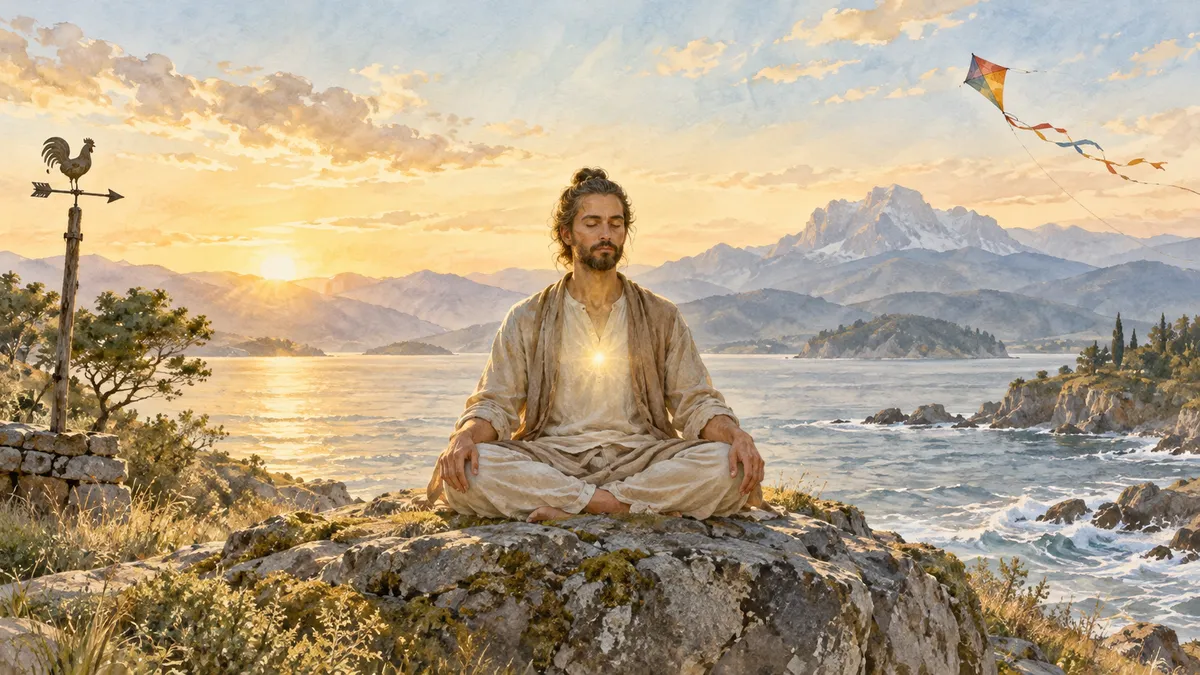
A person who changes their point of view, ideals, theories, concepts, or mood cannot be trusted. How can one trust them if they do not trust themselves? Today they hold one point of view, tomorrow another, and the day after tomorrow their mood changes completely. How can one trust them if they are like a weather vane or a kite being tossed back and forth by the wind? Such behavior means that they have realized nothing. They are simply being carried along by the will of the wind of karma. They have no center. Conversely, when a person is constant, when they have this profound foundation, Mount Meru would sooner shift than they would change anything within themselves. This concerns the essence; I am not speaking about the surface.
Such immutability is not “stubborn obstinacy.” There is stubbornness like that of a donkey, but here we are speaking of something entirely different. It is an immutability that is the fundamental background of awareness. Outwardly, such a person may change something, but in essence, in their soul, nothing changes, because they have penetrated to the point where no changes can reach them. They may change anything: their form, clothing, name, or nationality. They may even change their body. But this point has already been reached, and it is immutable; therefore, they are called Aparināma – immutability itself.
Sometimes I observe spiritual practitioners and see how their consciousness was one thing, then became another, and then a third. It is amusing to watch. At the same time, my consciousness does not undergo any changes in principle. I have met many practitioners who held a very high opinion of their own spiritual realization. However, years passed, and then they changed their view of themselves. At the same time, they tried to teach me and give me instructions. But time always shows flawlessly who is where, and there is no need to prove anything to anyone; one can simply say: “Time will tell.” Great Kāla will put everything in its proper place, and no one will escape him. It is impossible to fake true realization, because Kāla will nevertheless put everything in its proper place. True realization can be attained only when this immutability has been attained.
This Brahman is also called:
Apratarkya – incomprehensible, inconceivable
Atanu – bodiless
Atarkya – that which cannot be thought through to the end
Atyndriya – that which lies beyond the reach of the sense organs; it is also called atyndriya-sukha, happiness beyond the reach of the senses
Atisukshma – extraordinarily subtle
The Subtlety of the Laya Yoga Teachings
The teachings of laya yoga themselves are extraordinarily subtle. Perhaps you are not yet fully able to appreciate the depth and preciousness of these teachings. Many people come from India and say: “I spent six years in the Himalayas, was a sadhu, walked naked like Shiva, with tridents and animal skins, but I have not seen a school like the one you have here in Russia.” They come, live in India, associate with sadhus, and then come to Guru Swami Vishnu Dev for darshan and ask: “What should I practice next?” Exactly so—and this has happened more than once. Then I explain to them the nature of the Mind and sankalpa, speak about the subtleties of contemplation, and so on. Because the teachings are very subtle.

Sankalpa, the nine self-liberations, shambhavi mudra, divine pride—these are above rituals, above techniques and pranayamas, above bodily asceticism. This is where you work at the subtlest level.
If you work with this correctly, realization inevitably comes, although it requires incredible mastery. Here, it is not anything external that counts, but precisely this subtle mastery. If you can become your own master, then your realization steadily blossoms year after year, just as the sun rises.
This Brahman is also called:
Avyapadeshya – something that cannot be defined
Amanaska – a state beyond the Mind
Amanu-bhava – knowledge not based on mental experience
Anadya – having no beginning or end, without hope
Aprameya – that which cannot be described in words
Asansari – untouched by samsara
Sahajya-Spanda
When we penetrate this state even to the slightest degree, we can gradually make use of it. To make use of it means to manifest it in the form of purushartha, in the form of siddhi, in the form of controlling reality. When we have entered this state, it is simply called sahajya. And when we have entered the space of sahajya, generated a sankalpa, and begun to use it, this is called sahajya-spanda. Now we ourselves become like Brahma, who generates a certain sankalpa, a certain intention. From this moment on, samsara ceases to influence us, and we can already influence it.
What is sahajya-spanda? For example, while remaining in a state of presence and divine pride, you generate some intention or meaning, and if you hold it one-pointedly, it materializes. You have generated spanda from the natural state and woven certain events into the fabric of the future—for example, you eliminated suffering and created something good.
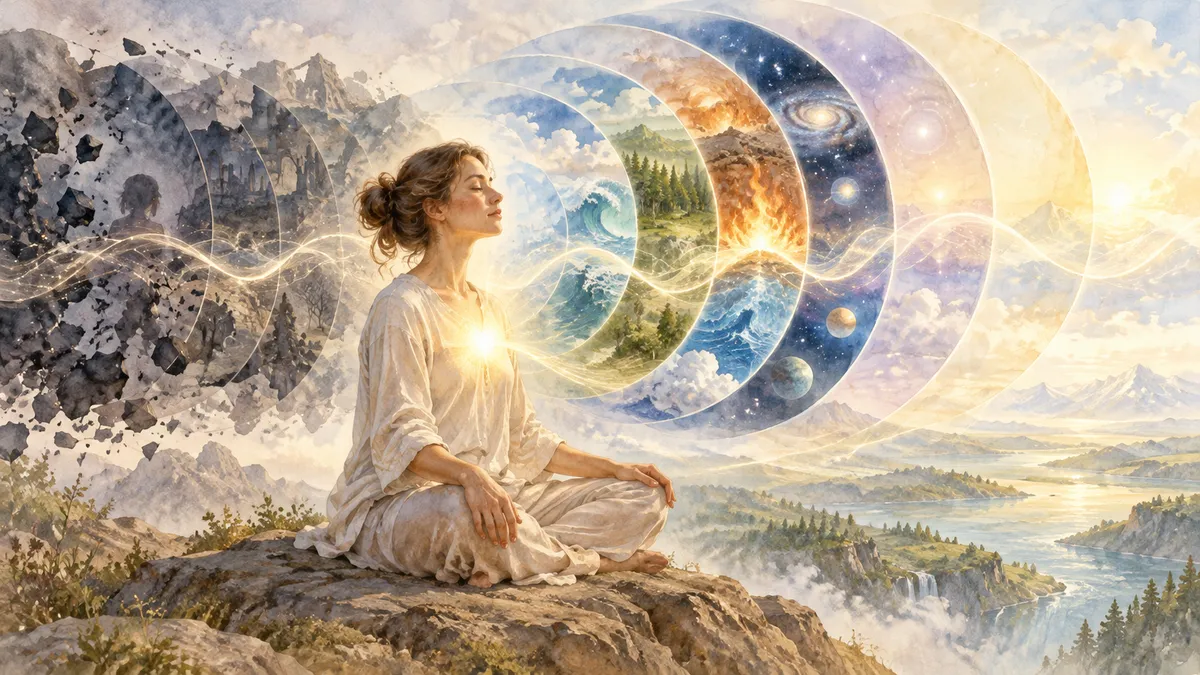
When you can generate sahajya-spanda in enormous quantities, when your clarity continuously, every second, broadcasts very deep, branching meanings, and you surround yourself with sahajya-spanda in the past, present, and future, within and without, at the level of all five elements, in the astral body, in the causal body, and in the physical world—when your sahajya-spanda penetrates various aspects, reality begins to transform and become pure space.
For example, if you feel sleepy or experience tamas, you generate sahajya-spanda, it penetrates sleep, and you experience a lucid dream. If there are problems with the physical body, you generate it at the level of the physical body, and as it penetrates the physical body, it changes the structure of the subtle and physical bodies.
