

Commentary on the text “Yoga Vasistha”
I will give some commentary on the sutras from the “Yoga Vasistha” concerning the siddhi called prakamya-siddhi, that is, the ability to embody intention. Our entire spiritual practice is the embodiment of a certain intention; that is, we express some intention and strive to realize it. For example, we express the intention to free ourselves from limitations or to free ourselves from suffering, death, and so on. We try to realize this intention. Realization comes or does not come depending on how strong or weak, correct or incorrect our intention is. Such practice of embodying intention is called abhyasa, or spiritual practice.
According to the philosophy of the rishi Vasistha, the world is a manifestation of thought. What seems to us to be an external, objective, real world is in fact a very great illusion.
Imagine that we are at the center. Usually we always believe that we are on the periphery, but this is not so. It is we (our Atman, our consciousness) who are always at the center, while various events occur around us. Life, birth, death are the flickering of various events, of what are called external objects. But in fact this is a change occurring above all in the stream of consciousness. There is no rebirth in the absolute sense; there is only a change of samskaras, a change of energies around this center. Likewise, there is no true subject-object life; there is the play of unfolding energies and samskaras around this center.
The attainment of liberation is above all the establishment in this center, so that the unfolding play of samskaras can no longer obscure this center. Vision arises when we lose sight of this center. The play of energies and samskaras becomes more important or more powerful than this central consciousness. Rishi Vasistha often says that this world is analogous to a dream, to the same state or the same reality that is created in a dream.
“That which is experienced as waking life is not at all different from the experience of sleep. It is all only the play of consciousness: the concepts arising in this consciousness seem to be covered with solid reality.”
The yogin penetrates this truth throughout his entire life, perhaps not just one life, but even many.
The Main Law of Creation: Thought Creates Reality
The main law that concerns any processes of creation in the universe states: “According to the rule, you see everything that you think about for a long time.” Our thought, by concentrating, generates a certain reality. And this reality manifests precisely in accordance with those samskaras, with that thought which we conceive within. The world becomes the way we have conceived it within. There is no objective law. Objective laws exist independently of consciousness as long as you agree with this, as long as you accept it. But when you begin to examine the principle of foundation or begin to consider the statements of saints, you see that there is no physical reality, physical universe, objective laws, processes, or constants separate from you in and of themselves. All of them are in fact only karmic vision; they are all psychological, that is, the world at its foundation is not physical, but magical.

Scientific laws, unlike magical laws, operate with so-called objective reality, objective external laws, processes, connections, constants, and relations. But magical laws always assume that the observer influences the observed, that consciousness always intervenes in the laws, that there is always the principle of the “operator” as the principle of human or any other consciousness. If consciousness intervenes, this means that it can cancel some laws and establish others, it can influence them, change connections and relations; that is, consciousness here is always the active principle. But in materialistic laws consciousness is not an active principle, but a passive principle; it performs the role of an observer, a bystander.
However, the latest achievements in quantum physics speak of what the rishis were speaking about five thousand years ago. At times it is astonishing how much time a human being needs to understand what has long been known. Now quantum physics also acknowledges that the observer influences the observed. The foundation for these assertions was laid by Everett’s theory, I believe, and by the English physicist Bohm. But in fact this reality has always been known in Vedic philosophy. It says that it is we who, through our consciousness, project reality; we are the creators of reality, and it is we who bear responsibility for the state, the world, in which we find ourselves. That is, it is not some objective external laws, but precisely our own consciousness. And since we bear responsibility for this, it means we can do it or not do it.
The World as a Dream: the Subjective Nature of Reality
Vasishta says: “Understand the entire universe, consisting of you, me, mountains, gods and demons, and so on, as you would understand what happens in a dream.”
What characterizes a dream? When we see a dream, that dream concerns only us. In a dream we dwell precisely in our own tunnel of reality, not in some objective one. If a person says, “In my dream you said this or that to me,” the other person will say, “Well, that’s your problem, actually; after all, it’s your dream.”
One disciple had a dream in which the teacher gave him initiation, but did not give him something in the process. The disciple came to the teacher and said:
— You gave me initiation, but there was one thing you did not give.
The teacher said:
— Actually, that is your dream. So what do I have to do with it?
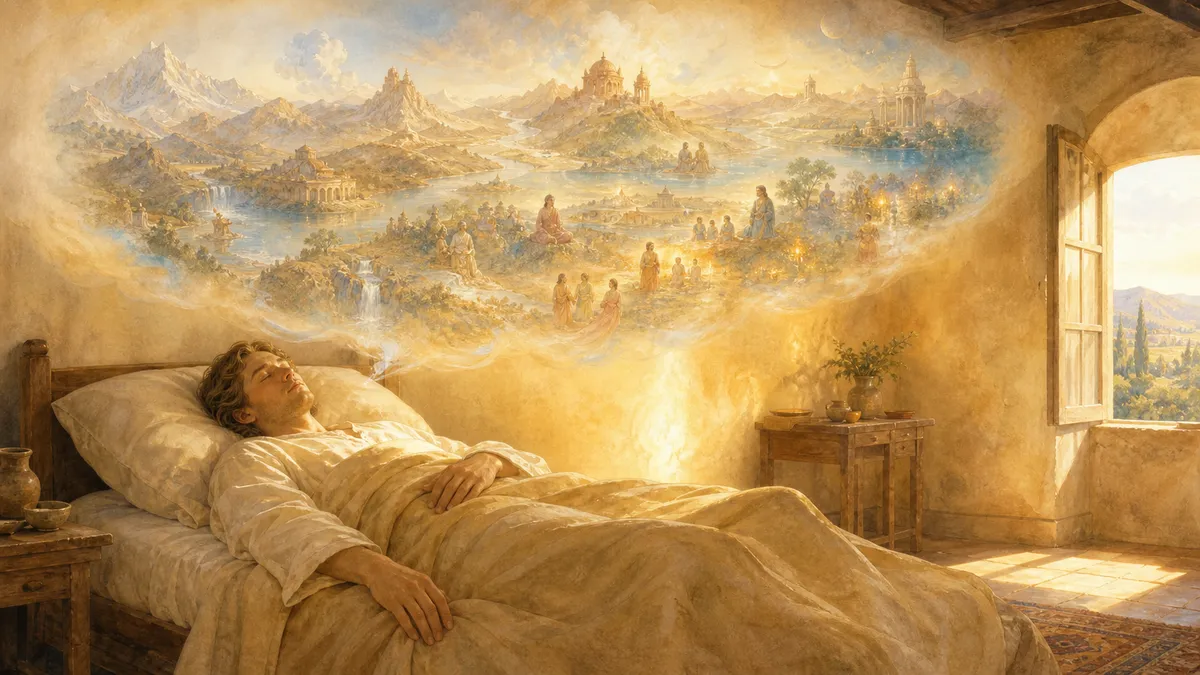
In one’s dream, each person abides precisely in their own psychic universe. A dream is characterized by the fact that each person abides in their own subjective psychic reality. But this dream is connected precisely with us, with our consciousness. Consciousness generates the dream, and during sleep we are at the center of this world. That is, a dream is a kind of large film set, and in it we are the chief director or actor. But the external world does not seem that way to us. Nevertheless, Vasishta says that the external world is the same thing. Each of us abides in such a subjective psychic tunnel of reality of our own, and then it creates the external real world.
Every living being lives in the world that corresponds to its vision. It is vision that creates the external habitat. It is called karmic vision. The different visions of many people come together, and as a result some resultant vector becomes fundamental and materializes.
Examples of Creating Reality Through the Power of Thought
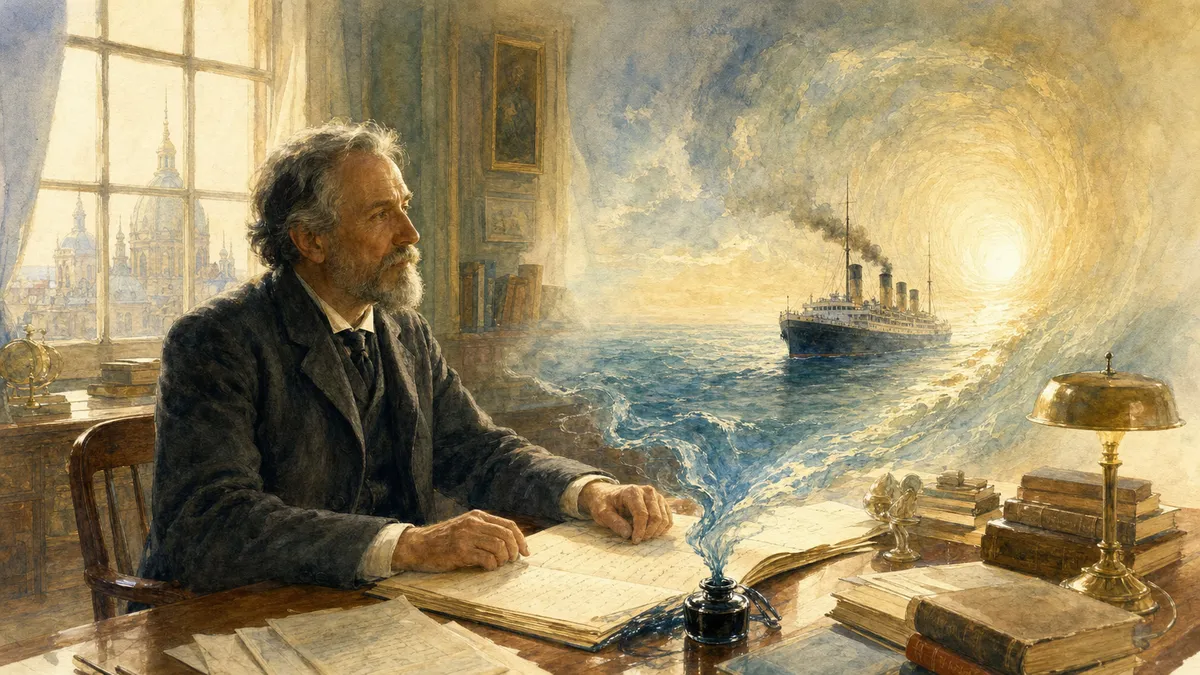
There is such a fact. In 1898, the writer Morgan Robertson wrote a book called Futility. He described a ship called the Titan. All the parameters of this ship, all the unfolding events, and even the name of the captain coincided with the Titanic, which sank in 1912, that is, 14 years later. The ship Titan described in the book struck a giant iceberg, and this is exactly what happened in reality to the Titanic. Many later called this writer a “servant of the devil.” This coincidence caused a great stir, since even the dimensions of the two ships, their displacement, the number of people, and the captain’s surname coincided. Others said that perhaps creative people read information from the subtle plane, from the collective unconscious, and then describe it, seeing the future. But from the perspective of spiritual practice, many later came to the conclusion that creative people create reality. Perhaps the sinking of the Titanic would not have happened if Morgan Robertson had not written this book in 1898. By writing it, he made a kind of magical offering; he opened a certain tunnel of reality. He materialized a certain universe, and it inevitably had to manifest.
There is an even funnier case. One man was engaged in collecting envelopes. He did it in an unusual way: he would send an envelope to some corner of the world, writing an incorrect address, after which the letter would travel halfway around the world and return with various seals, stamps, and postage marks. It was precisely such envelopes that he collected. Once, as a joke, he also wrote a letter at random to Australia. It contained approximately the following words: “I am your old friend so-and-so. How are you? How is your wife? Do you remember how much fun you and I had?” Two years later he received a reply with the following content: “Yes, hello. I remember how we met. My wife is fine. Your friend so-and-so.” The man nearly turned gray, because his letter was a complete fabrication, as was the address to which it had been sent. Nevertheless, this so captivated him that he could not calm down. A year later, he traveled from Europe to Australia to see this person. He saw that such a person really did live there, and that he really did have a wife. Moreover, they claimed that they had met him, that all the events he had described in the letter had actually happened. This was a colossal paradox. In other words, by writing such a letter, the man, through the power of intention, created a certain tunnel of reality; he invoked certain energies of the variational universe in which this tunnel of reality materialized.
Question: Guruji, Robertson, by writing the book, opened a tunnel of reality in which the “Titanic” sank. Does he bear karmic responsibility for this?
I think so. After all, in your consciousness there exists a connection with this tunnel of reality, with a karmic vision—and one that is impure, uncontrolled chaos. This means you can easily enter it, or in a future life you may often enter it. You yourself created it, after all, which means it is the reality of your consciousness.
Thus, the universe around us is a magical world that is constantly being created and destroyed precisely by the individual and collective consciousness of five or six billion people.
Vasistha goes on to say:
“Everyone has their own dream world, and this world is then projected outward, merging with the collective karmic vision of other people.”
There is another such example. In Russia there is a well-known writer, who was also called a Soviet writer, Mikhail Svetlov. In his time, he wrote a poem called “Grenada” (1926). In it, he describes a young man who is possessed by the idea of a world proletarian revolution and goes to Spain to carry out a communist revolution. In the 1930s, these verses were very popular. When Mikhail Svetlov wrote this poem, there was no revolution in Spain, but ten years later a civil war began there, and everything that had been written in the poem actually happened.
Many such examples can be given. Creative people, without knowing it themselves, create various variational worlds, variational universes, and local realities by the power of consciousness. This process is generated continuously. Such generation then unites into certain large currents, which eventually become a kind of resultant vector and materialize.
Creative Consciousness as a Generator of Reality
If thoughts possess sufficient power and one-pointedness, reality will inevitably materialize. It is creative consciousness that is the generator of such realities. And what is creative consciousness? It is a factor inherent in the gods; it is the energy of clarity that is emitted due to a person’s abiding in a certain level of presence. Creative consciousness is generated shakti. For example, the god Brahma possesses creative consciousness of a very high level. And it is precisely the gods who possess creative consciousness who are capable of changing reality. In what way? They create new variations, new mandalas.
One who is capable of generating new meanings, new realities, new mandalas can operate reality. He understands that reality is something derived from his consciousness; therefore, in order to change reality, one must generate another reality, and in order to generate it, one must give rise to a new meaning at a deep level. It is precisely the higher gods (creators of universes, guardians of worlds, gods of the five elements, guardians of the essential principles of time and space) who are generators of meaning, that is, those who operate not with material things, but with meanings, creating various levels of parallel realities. We, however, as humans, perceive different realities as natural, as a kind of physical given; we live in them simply because we have no choice. But as spiritual practice progresses and contemplative presence deepens, such a choice appears.
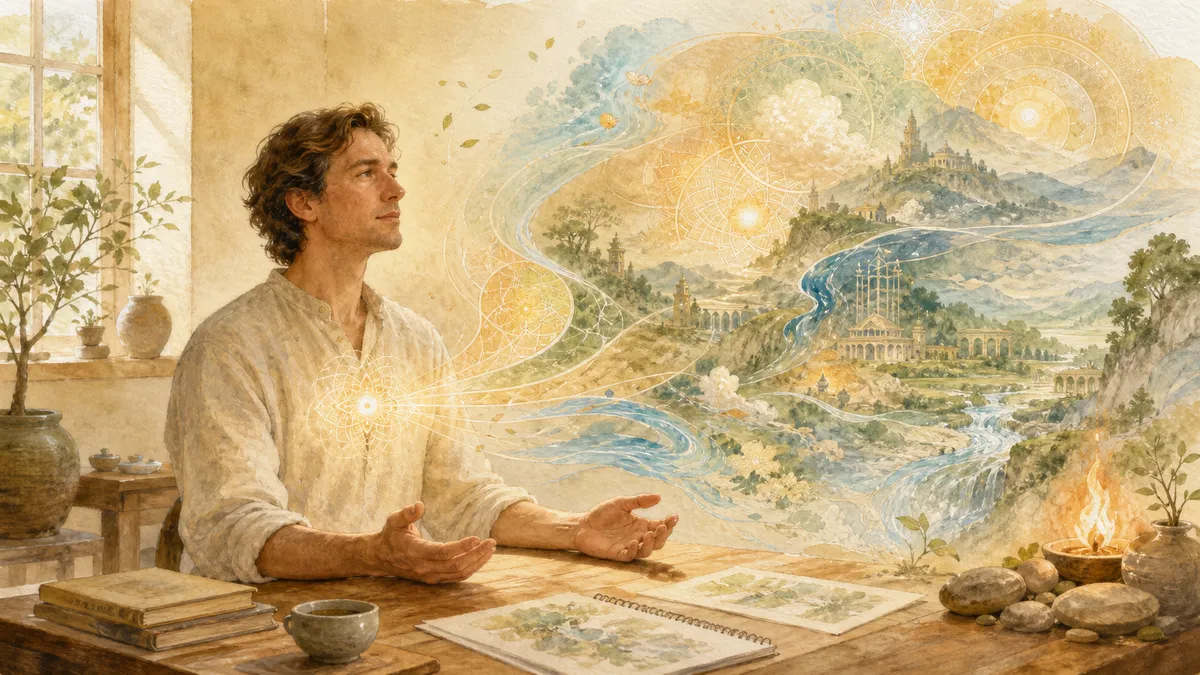
Variability is a consequence of creative consciousness. With the proper orientation of consciousness and the proper level of contemplative presence, reality becomes exactly as we conceive it, regardless of objective laws or anything else.
The Practice of Divine Pride and Pure Vision
Dattatreya says: “The world becomes exactly as we conceive it in our thoughts.” This is precisely why, throughout our entire spiritual practice, we conceive of ourselves as a liberated deity. The practice of divine pride is our destiny. We conceive of ourselves as a deity, not separate from the Absolute. We continuously cultivate and nurture this thought as something very precious. Of course, if someone does not cultivate it, then naturally he will not be able to achieve this. But if someone works with it deeply, according to the principles of the teaching, he will certainly obtain results: his clarity, creative consciousness, and meditative experience grow; karma is purified; karmic vision deepens, and so on. The reverse side of the practice of divine pride is pure vision. If you regard the world as pure vision, over time you begin to perceive it exactly that way, and you truly find yourself in pure vision. Thought, as it were, draws probabilities together and generates a new reality. It is precisely through thought that a yogin is able to completely change himself, change his destiny, and purify karma.
What does it mean to purify oneself, become a deity, attain liberation? It means, having entered contemplative presence, to give rise to a new meaning, a new clarity, and generate a new reality — the mandala of pure vision — and then to establish oneself in this mandala and begin to live in it.
Scenarios of the Future: The Choice Between Chaos and Divinity
At present, there are many different scenarios for the development of human civilization. Numerous forecasters and futurologists describe with great interest the scenarios according to which human civilization may develop. There are versions of an extremely bleak future — apocalyptic scenarios. That is, some say that major ecological catastrophes and the greenhouse effect may occur, and therefore humanity will have a very hard time around the period of 2012–2020, closer to 2030, and so on. Other apocalyptic scenarios speak of an uprising of robots, artificial intelligence, grey goo, and nanorobots that could “devour” all of humanity. There are also scenarios of a post-industrial society in the form of a dystopia. They say that there will be a golden billion of humanity, which will separate itself from everyone else through high technologies, the development of consciousness, and immortality, while all the rest will be third-world countries, subservient to them and working for them. That is, there will be some race of neo-nomads, united clans of higher political elites, connected neither by family, nor race, nor culture, nor nation. There are also scenarios according to which superhumans, a superhumanity, modified robot-cyborgs will dominate all the others who have not restructured themselves; there will be higher and lower beings because of the difference in their abilities. And finally, there are positive scenarios. A positive scenario is the scenario that we are building: pure vision, divine humanity, spiritual development, development based on spiritual practice. In fact, there are not very many positive scenarios, and our scenario is one of the few. Other scenarios are much worse.
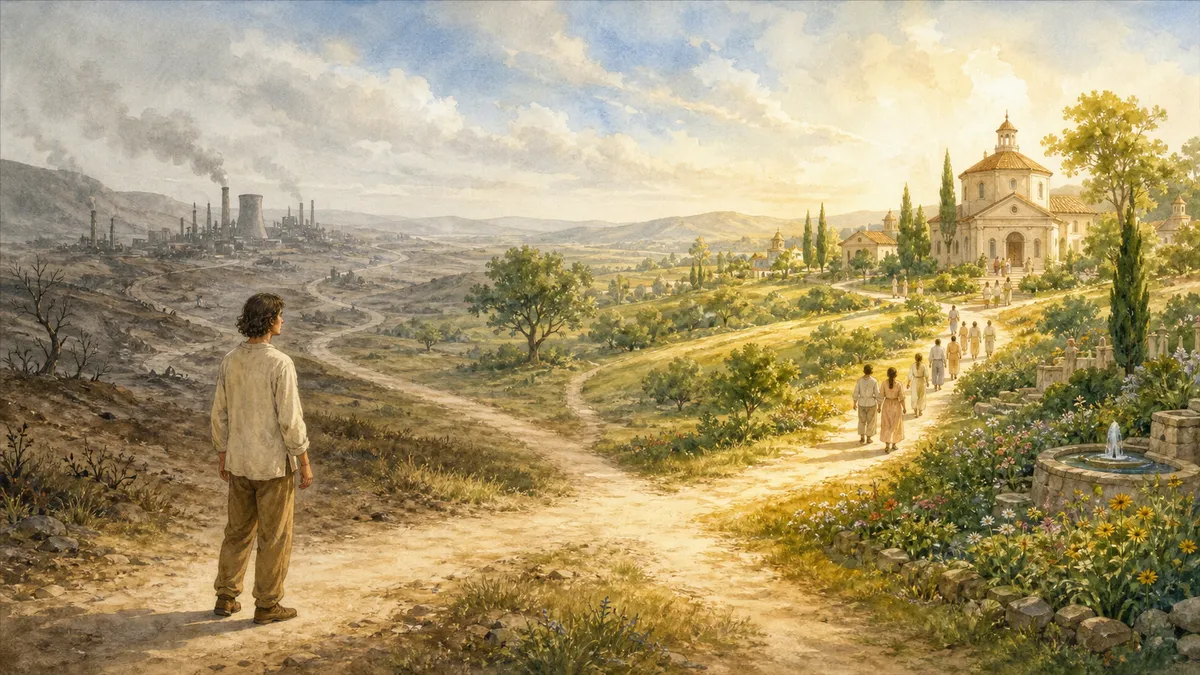
Why is it much easier to generate a bad scenario? Because a simple scenario of the future is always a simplification of reality; it is a transition toward chaos, toward the simple, toward disorganization, toward entropy. A complex scenario always requires an increased level of self-organization, increased clarity. A positive scenario is always complex. For example, it is easy to think about destruction or global catastrophes, but it is much more difficult to make all people happy, healthy, immortal, prosperous, godlike, because embodying such a level of complexity on a gigantic scale requires colossal clarity, superhuman genius, divine consciousness. It is much easier for people to generate chaotic, entropic scenarios because they do not require spiritual development. Any conditional scenarios (for example, the scenario of god-humanity, a pure land, universal happiness) require an entirely new level of consciousness, and one who does not practice is incapable of generating it.
Our scenario, which we establish as a sankalpa, is entirely positive. It is a scenario of a pure land, a scenario of god-humanity. It is based on the fact that one must master contemplative presence, reveal pure vision and divine pride, and then, drawing inspiration and creative potential from this, project the necessary reality. Whether we will be able to project it within the framework of our own vision, within the framework of the sangha, or within the framework of large masses is an entirely different matter. But the point is that we, like all practitioners, choose precisely this kind of sankalpa, knowing that our consciousness, which creates such a scenario, sooner or later becomes embodied in a specific karmic vision, in a specific material reality. That is why we establish ourselves in pure vision, in divine pride.
Mastery of Universal Energies
Practice consists not only in penetrating empty awareness. Penetration into empty awareness is only the very beginning. After we have penetrated empty awareness, there follows the stage of mastering shakti — universal energies. In the language of yoga, this is called “siddhi” and “riddhi.”
Empty awareness gives us a certain freedom: the freedom not to fall under the power of internal data or external reality, the freedom to make our own choice, to manifest our will (this is called iccha-shakti). On the basis of this will, we begin to possess the ability to operate with reality, to create the reality that we would like to create. This is precisely the meaning of further practice in mastering siddhis.
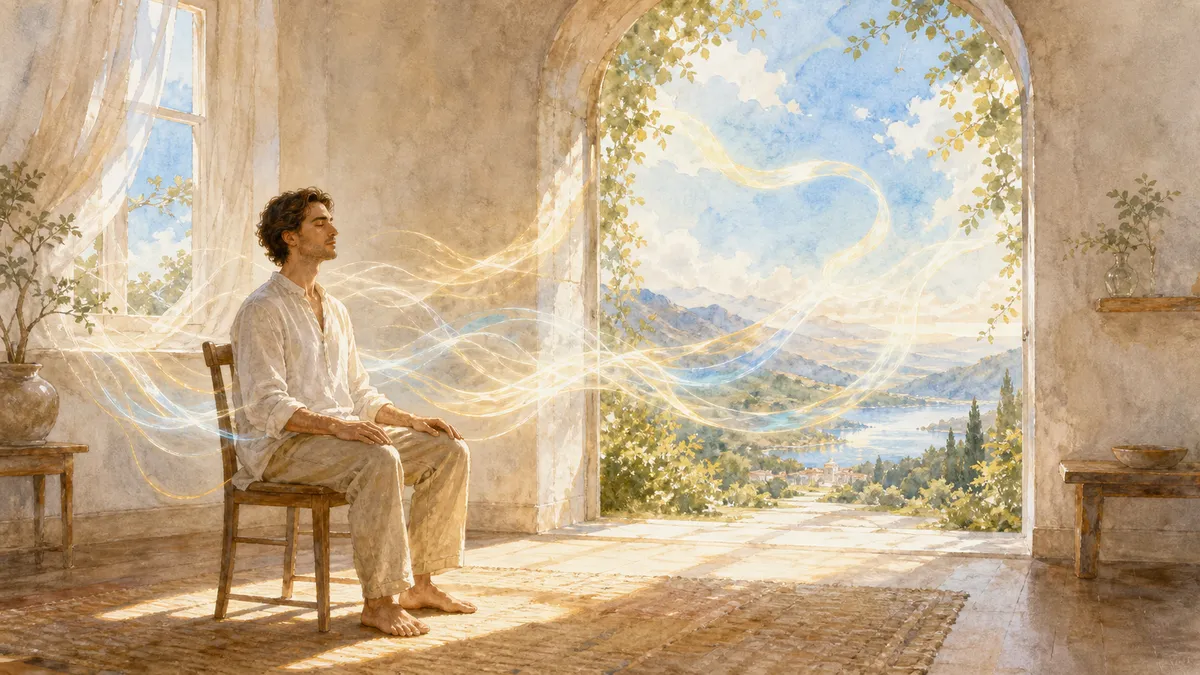
Based on the natural state, we attract various universal energies (of creation, maintenance, dissolution, concealment, enlightenment) in order then, with the help of these energies, to generate a new world around us, to generate the mandala of a pure dimension. This is called “turning the Wheel of Dharma.” The Wheel of Dharma is our contemplative presence. Its turning is the process of attracting various universal energies so that they bring benefit. To turn the Wheel of Dharma means, having opened fundamental consciousness, to enlighten all the energies in which your consciousness abides, to purify them completely, creating a mandala of pure vision.
Practical Manifestations of Clarity
What can this be like in practice? This is not philosophy, but concrete manifestations in life. In practice, it manifests through your awareness, when awareness continuously generates some kind of clarity, and this clarity allows you to improve and purify the world around you and within you.
For example, clarity regarding prana and the channels allows the body to become perfect, strong, healthy, resistant to obstacles, and endowed with great immunity. It is clear to you how the pranas, channels, and chakras work, therefore you are capable of eliminating any deviation; you are not subject to illness. Clarity regarding external reality allows you to harmonize relationships, life, and so on.
It is precisely the generation of such clarity, based on presence, that is the beginning of the transition into the mandala of a pure dimension. It is like building a large house: you lay the foundation in the form of presence, and then begin to build the roof and walls by generating various kinds of energies.
Using the Precious Pearl of Practice
Many believe that the practice of revealing the nature of the Mind consists in discovering unmanifest, empty contemplation, and that this is where everything ends. But in fact, this is a dead end. Having revealed the empty state, we must certainly learn to use it, connect it with various forces, and use this precious jewel to generate various pure energies.
Therefore, I often tell practitioners: “Your practice must bring you real benefit. You must know how to use it. It is like a precious jewel that appears in your possession. If you use it correctly, it will surely make you wiser, purer, more compassionate, more brilliant; it will make you more creative, joyful, stable, unshakable, energetically strong, wise, skillful, flexible, fearless, courageous, and so on. All your sins and shortcomings are purified; you become at least a superhuman, and in the long term, a deity.

One who is inflexible, cowardly, unenterprising, foolish, closed, constrained, possesses limited consciousness, and is not harmonious cannot become a deity. This is impossible in principle, because deities are those who gush forth with creative energy, creative power, and creative abilities. They do not merely manifest all this; they gush forth with it. That is, they radiate it with tremendous force. Why can they do this? Precisely because they are overflowing with divine blessing. Divine blessing fills them so completely that they themselves burst forth as a fountain of goodness, sattva, love, harmony, purity, beauty, grandeur, sacredness, joy, blessing, creativity, mystery, transcendence. Their inner paradoxicality, based on deep bhava, manifests as a profound fountain of blessing; this is precisely why gods bless people, and not people bless gods.”
Signs of True Practice
In the same way, when a practitioner practices little by little, he begins to discover and accumulate inner potential. This inner potential reveals various new abilities and qualities within him, giving him the opportunity to master what he did not master before.
Therefore, it is often said: “The signs of your practice are the growth of pure vision, an increase in devotion and self-surrender, the strengthening of compassion, an increase in harmony, the clarification of your mind, the growth of your abilities; that is, your practice manifests in the form of concrete changes within you. True practice, based on deep presence, is always a creative dawn.
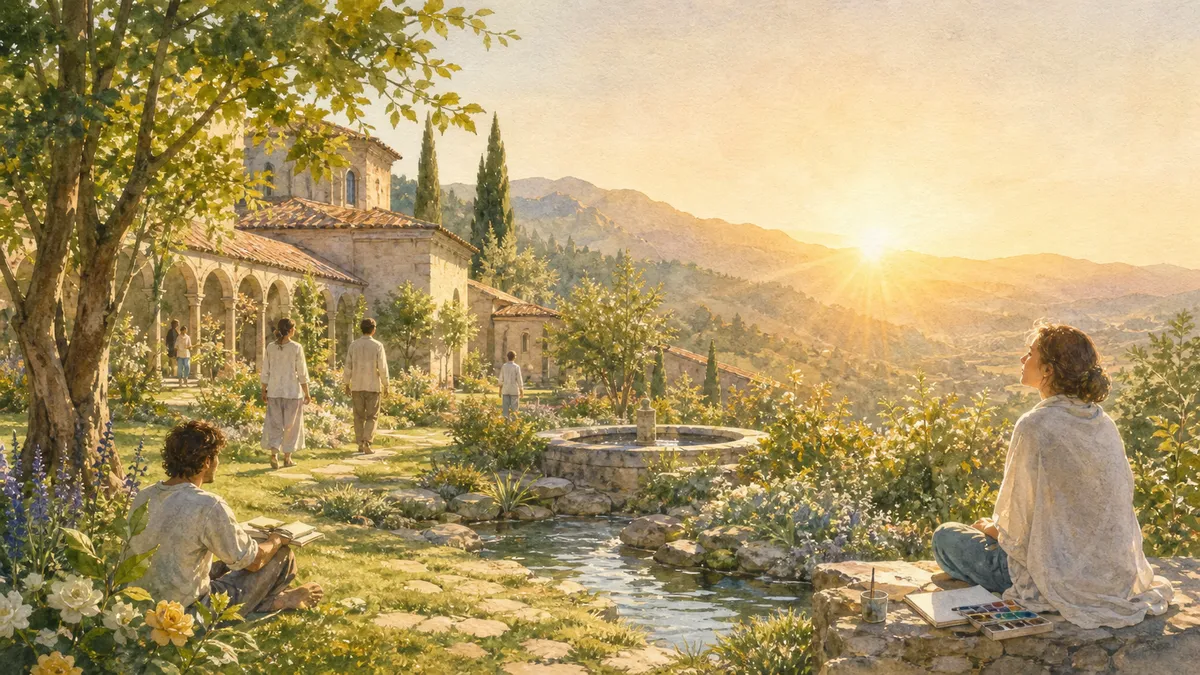
It should not be the case that years pass and the practitioner becomes ever gloomier, more withdrawn, closed, torn apart inside by demons and contradictions, and harmony with others is disrupted. If this happens, it means that his practice is degenerating, becoming demonic. In this case, it is necessary to correct the practice and reconsider some of one’s positions and approaches in practice.”
