

Commentary on the text “Yoga Vasistha,” Chapter 3. The Story of Karkati
The king’s answers to the questions of the demoness Karkati.
“In the blink of an eye, this infinite consciousness experiences within itself an entire epoch, just as in a brief dream one can experience youth, old age, and even death. All these events and objects appearing in consciousness are in fact indistinguishable from consciousness itself, just as a sculpture carved from stone is only stone. As an entire tree with all its future changes is contained in a seed, the whole universe of past, present, and future is contained in the atom of infinite consciousness.”
In the teaching of anava yoga, there is a method in which we visualize everything as consisting of rainbow light, and then dissolve it all. Although this exercise is done artificially, it itself points to something much greater. In fact, in this exercise we are doing what exists in reality. The world around us is as real as virtual reality can be real.
For example, if a person has a virtual reality helmet put on his head, gloves with tactile sensors (this already exists now; it is not science fiction), he can see and touch virtual reality, and even smells are simulated. He can remain in the full sensation that this reality is genuine. He can touch it, see it, hear it, and interact with it in real time.
Modern virtual reality technologies are such that they can model illusion with great precision. Nevertheless, it does not occur to a person immersed in it to think that this world is real. He knows that it exists in his consciousness as a sensation, but in fact none of it exists. It is simply a skillfully modeled computer program projected onto the monitor of his helmet or through implants, which he perceives through tactile sensations.
This is a wonderful example that shows how we should perceive this surrounding world as well. In fact, this surrounding world is the same kind of virtual reality. It differs only in the higher quality of its elaboration and greater complexity, in its higher resolution. Very outstanding, brilliant “programmers” worked on it: the gods of the five elements, deities connected with individual elements of nature, with the structure of the human body, the deities of the sense organs, and many others. But in fact it is a bodiless, virtual, intangible reality existing in the mind, projected through the sense organs and seeming real to us.

The Non-Agency of the Higher “Self”
“Although infinite consciousness, the higher ‘Self,’ is not the doer who performs actions, and is not the one who experiences sensations, it performs all actions and experiences all sensations. There is nothing apart from it.”
When a person is immersed in computer virtual reality, he himself is sitting in a special chair, with a helmet on his head, sensor gloves and sensors or cochlear implants—that is, implants that transmit sound. In virtual reality he can run; it will seem to him as though he is fighting or communicating. But in fact, if one looks at his real body, he is not doing anything of the kind; he is sitting motionless in the chair. All this is happening only in his consciousness, while he himself is doing nothing.
This is another example that can illustrate the inactive state of our deep “Self.” Although each of us does many things, in truth, at the deepest foundation, we are all “just sitting”; our primordial “Self” abides in non-action. All of this unfolds only at the level of consciousness.
The Nature of the World and the Doctrine of Maya
“Within the tiniest particle of infinite consciousness, the doer and the experiencer are its inseparable components. The world, however, was never actually created, and it never disappears. It can be regarded as unreality only from the relative point of view; from the absolute point of view, it is not different from infinite consciousness.”
And just as a programmer can approach a person who has become entangled in virtual reality and begun to identify himself with the events in it, pat him on the shoulder, and say: “This world was never truly created; it is something illusory, existing as a program in a computer or as images in your subconscious,” in the same way Vasistha says to Rama: “This world was never created; it exists only as a manifestation of consciousness.” This is from the relative point of view.

A variety of Advaita philosophy that interprets this world as nonexistent, completely illusory, is the doctrine of maya, the so-called Mayavada. Initially, Shankara is considered one of the representatives of the Mayavada doctrine, although his view is much deeper.
The Mayavada doctrine says precisely that the world only seems to be as it is, while in reality it is maya — an inexplicable illusion, an inexplicable ignorance that creeps into the lila of the Absolute when it divides itself into living beings.
However, many consider the Mayavada doctrine flawed, in the sense that it cannot explain where this inexplicable illusion, maya, comes from. It seems to separate the Absolute and maya. It is believed that a higher point of view is the tantric point of view of Anuttara Tantra, which says that, in reality, maya too is the Absolute, Brahman.
In fact, the doctrine of Mayavada as such does not exist in reality, because saints who speak about maya always emphasize the second aspect: it is only a relative view. But both Shankara, and Sri Ramana Maharshi, and Vasishtha say: “Maya in the absolute sense, as such, is also Brahman, also the Absolute.” That is, maya does not exist. Everything that manifests is the play of one single consciousness. One can say that maya is a special form of Shakti, a special form of the play of the Absolute which, by leading living beings into illusion, contributes to their spiritual growth in the process of disentangling themselves from this illusion.
Thus, the absolute doctrine of Advaita states that even energy is Brahman, the Absolute; even the energies of maya are perfect. It is said: “Maya is Krishna’s maidservant,” that is, she plays with living beings, entangling them so that, in the process of suffering, delusion, and disentanglement, they nevertheless find the right way out and thereby cultivate their wisdom.
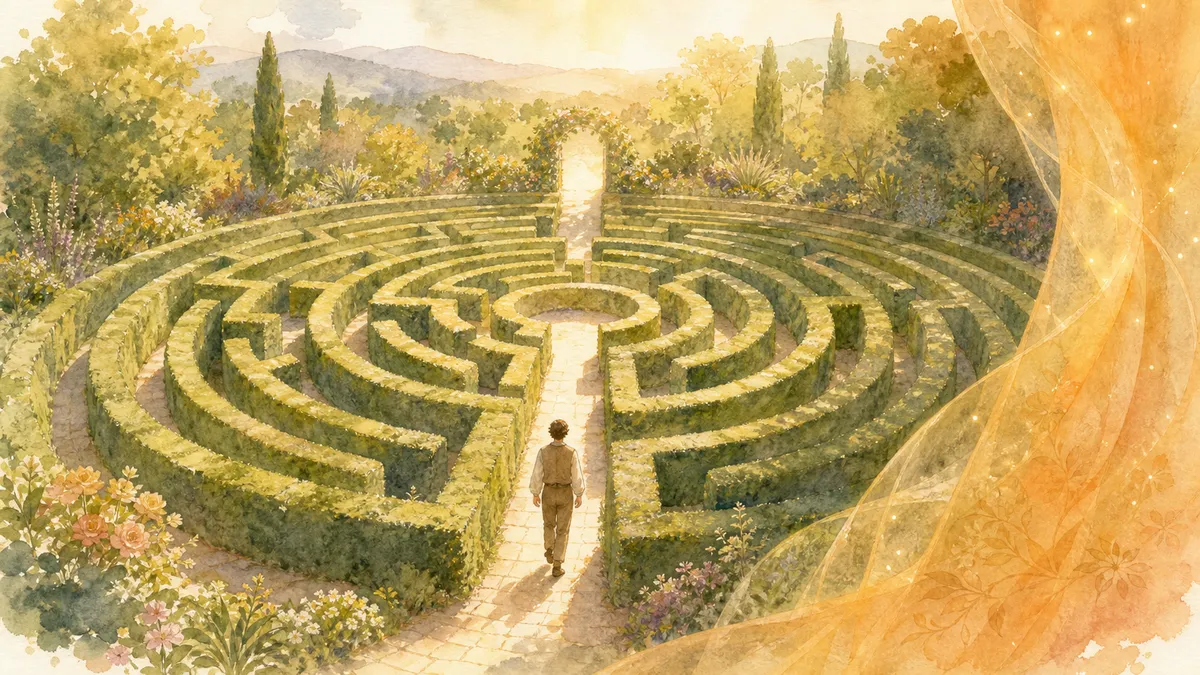
This is roughly similar to the way scientists place white mice in a maze, and in order to get food they need to pass through many passages. By finding the correct way out each time, they develop their intelligence. But if the mice had no maze and food were given to them just like that, they would not develop. Maya plays the same role in training living beings.
The Teaching on the Observer (Sakshi)
The king continued:
“The sages only speak of the inner and the outer, but these are merely words, not supported by anything material — they are used only to instruct those who do not understand. The observer, while remaining invisible himself, sees himself, and the observer never becomes an object of awareness. The observer is only observation, and when the latent psychic imprinted impressions cease, the observer attains his pure existence.”
The teaching on sakshi (the observer), antaryamin (the inner ruler), is a kind of refined Vedic psychology of the rishis, to which modern scientific psychology still has a long way to go. It says that the observer, for most living beings, always remains invisible, since the mind is turned toward external objects. But when the observer tries to observe himself, that is, tries to reflect himself as an inner object instead of external objects, when he tries to make himself an object, in reality he cannot become an object of consciousness, because in the perception of himself the observer (sakshi) is only observation; it is not an object, but a process.
Hidden psychic impressions or sensations cease when the observer begins to turn toward himself. And then he begins to discover that he himself is a stream of consciousness. At first, many hidden samskaras, subconscious psychic impressions, imprints, childhood memories and associations manifest in this stream of consciousness, imprinted like film frames on a reel, some fragments of subconscious experiences. And when we enter into them, they give bhavana — an emotional coloring, a worldview. On the subtle level, we consist of these imprints and subconscious impressions; they form our character, our subconscious reactions, and behavior.
But when we try to direct attention to the observer, we see that he is deeper than these samskaras, imprints; that if we continuously seek the essence of the observer himself at his foundation, he is discovered as an undifferentiated, unstained stream of pure consciousness, like space. And the samskaras, imprints, memories, and impressions are like growths stuck to it, just as shells, mollusks, and seaweed cling to a large ship standing in dock.
Often, when a ship has been at sea for a long time, mollusks, shells, and a great deal of seaweed cling to it, and its speed slows because of this. For example, if it was moving at a speed of thirty-six knots, then, when during such a long voyage it has accumulated a great many of these shells and mollusks, it may barely maintain a cruising speed of twenty knots. Then such a ship must be put into dock and its hull cleaned so that it can again sail at high speed.

The process of spiritual purification is something similar. On the space of our consciousness, which manifests as the observer, various growths accumulate in the form of impressions, samskaras, and vasanas, which give rise to different shifts in the sense of the world. Because of this, the mind abides in false self-identifications and seems to shrivel up. Its self-identification becomes narrower and narrower; it depends very strongly on these imprints.
The very process of observation, self-liberation, and attentive self-awareness is like such a process of cleansing them. Then the observer attains his pure, unstained existence.
The Interdependence of Subject and Object
“When an external object is imagined, the one who sees it is also created. If there is no subject, then there is no object either — after all, it is the existence of a son that makes a person a ‘father.’ And again, the subject becomes the object: there is no object (the process of seeing), and there is no subject (the one who sees), for without a father there is no son.”
There is a saying: “Things exist because of the mind, and the mind is such because of things.” All of this is mutually conditioned, interconnected. If we see a deity, then the cause of this deity is our own mind. If it were not there, there would not be even the shadow of a deity. Our mind is the cause of the deity. If we see a demon, then again the cause of that is our mind, in the stream of which there is a corresponding perception for demonic realms.

Outside our mind, no deities or demons exist. If we establish a relationship with anything, the cause of this is not something external but our own mind. If there were no karmic vision in the stream of our consciousness, then there would be no such objects either.
When the mind disappears, external objects also cease to exert influence and then disappear. When the mind changes, the external environment is also rearranged. This is like the relationship between son and father. If a father has no son, then he himself cannot be a father. In the same way, when there is no conditioning by objects, then the observer as such also does not exist. The separate existence of the ego also does not exist when there is no identification with objects.
The ego always exists in identification with a collection of objects. For example, if a person as an ego is divided into sectors, he represents an ego that projects itself in different positions: as a son, brother, husband, father, boss, and as someone else besides. All of this makes up the aggregate of what is called the ego. If all these identifications are removed, the ego will disappear too.
The saints, however, say that in reality both object and subject, and the ego, and the relationships into which it enters — all of this is like your speaking with the “son of a barren woman.” If a woman is barren, what kind of son can she have? Only an imaginary one. Consequently, a conversation with the son of a barren woman can be just as illusory as he himself is.
In one of the stories, Rishi Vasishtha says: “Once I met the son of a barren woman, who was walking along the bank of a river that had neither a bed nor water.” This world is like such a son of a barren woman, like such a conversation.
Gold and the Bracelet: Unity and Manifestation
“Because the subject (the observer, the one who sees) is pure awareness, it is capable of creating an object. The reverse is not true—the object does not create the subject; therefore, only the observer is real, while the observed is only a hallucination: only gold is real, and the bracelet is merely a name and a form. As long as the concept of the ‘bracelet’ persists, pure gold goes unnoticed; as long as the concept of the ‘object’ exists, the division between the observer and the observed also exists.”
What is gold? Gold is the space of pure awareness. What is the bracelet? It is what is suspended in this space: material forms, connections, relationships, names, and so on. From the perspective of the tantric teaching, gold is very important, but the bracelet is not denied either. To fall into negation and think that only gold is important, while the bracelet has no significance at all, is an extreme view called nihilism. To fall into the other extreme—that is, to think that only the ornaments themselves (bracelets, etc.) are important, while the gold from which they are made is not—is another extreme view called eternalism.

The correct vision of the siddhas is the principle of “two in one,” that is, the ability to see inseparable unity with the priority of gold. The natural state manifests itself, playfully manifesting ornaments, decorations, and patterns in the form of names and forms. They are all completely unreal, being simply its creative manifestation; nevertheless, they always appear. Both are one single substance.
There is a great temptation to enter into negation. We are so caught by names and forms that it seems to us they obscure our primordial state. Sometimes we want to throw all this out of ourselves, to free ourselves from all of it. However, negation and such throwing away are also a certain illusion. There is another tendency—eternalism, that is, the complete acceptance of the play of names and forms as something real and a strong grasping at them. Neither one nor the other is welcomed by the saints.
The true play, however, consists in discovering the gold of primordial awareness and abiding in it, uniting the play of names and forms without denying them, but with complete all-acceptance, while at the same time without the slightest shadow of attachment.
When we do not fall into either of the extreme views, we gain true wholeness; we move through the world like a cloud or a dry leaf. We are like a lotus leaf that lives in water and grows out of mud, yet is neither soiled nor soaked. Like a mirror, we reflect myriads of things, but nothing is reflected in us.
It can often be seen that a practitioner, having heard something, perceives it very painfully. For example, he painfully perceives criticism or some event. He considers himself very refined and is strongly affected by even small things. But in reality, all of this is like images flickering in a mirror.
The Non-Duality of Awareness
“But just as, because of consciousness in the bracelet, gold feels its ‘goldness,’ so the subject (the observer), manifesting as the object (the observed), feels subjectivity (awareness). One is the reflection of the other—no duality exists in reality.”
The teaching of Advaita is not a simple philosophy; it is a supremely transcendent, elite philosophy for people of outstanding abilities, for geniuses. It is said that even the gods experience certain difficulties in understanding the philosophy of Advaita. When we read the texts for the first time, an intellectual understanding may come to us; it seems to us that we have understood everything. However, if we read the same texts twelve or twenty years later, we discover that although we have understood a great deal, we are only on the first step of this understanding.

The fact is that, in principle, the philosophy of Advaita cannot be understood. One can live it, but to understand it—these are hopes of the intellect that are never fulfilled. Because it is a mystery, a paradox. It is a mystery that burns, that brings trembling, ecstasy, and reverence even to the most outstanding among the gods. How can you understand such a mystery with an ordinary mind? You can only carry it in your heart, worship it, delight in it, rejoice, abide in bliss, admire it, live in reverence, breathe it.
