

Commentary on the text “Yoga Vasishtha”
“Yoga Vasishtha” tells the story of how Vasishtha met King Prajnapati, who ruled the city of Milavati on the island of Kusa-dvipa. One day, after greeting Vasishtha, the king asked him many questions that greatly interested him. These questions concerned the nature of reality.
“When the entire visible universe dissolved, what were the reasons for creating a new one? What is this universe? Part of it is constantly in darkness, and worms inhabit some part of it. How did these elements that constitute the world arise, and how were the mind and intellect created? Who is the creator of all this? And who experiences it? What is the foundation of everything?
Undoubtedly, there is no ultimate destruction of the universe. Whatever each living being perceives, that is what it experiences. What, then, is real and indestructible? When a person dies and the body is cremated, who creates a body for them in hell so that they may undergo the necessary experiences there?”
The Nature of the Subtle Body After Death
Thus, the king asks many questions that interest him. What happens to a person after death? One may say that after death a person becomes a spirit for some time, and after their fate has been decided, they reincarnate in one of the worlds. If a person is a saint, they become an enlightened spirit, a deity. And if they have reached the pinnacle of holiness, they dissolve into Brahman, merging with the Absolute.
The place where we live is connected with the Komi people (especially in earlier times). They have many different interesting customs and beliefs (as a border region toward Perm). The Komi have the concept of a “kuloma.” A kuloma is a person who led a proper way of life and acquired sufficient spiritual power, perhaps almost like a sorcerer. If they lived in a particular family, an agreement was made with them whereby they would continue helping that family after death, responding to invocations and rituals. Periodically, bread would be broken for them, and they could appear. However, they might not appear in their own form, but in the form of a small animal or bird. They could appear in their human, earthly form only in dreams. Sometimes they could invite a person to visit the spirit world and meet deceased relatives. This could be done safely if certain safety rules were observed. For example, it is believed that during such visits one must not eat in a dream the food offered in that world. One must not extend a hand, embrace, or kiss those one encounters—that is, deceased relatives—otherwise one may remain in their world. It is believed that if a kuloma offers a person to stay with them forever and the person agrees, this is a bad sign, meaning that such a person may die. If they refuse, they will escape with merely an illness. The beliefs of these peoples, as well as those of many others, also say that this kuloma can sometimes acquire an almost physical, nearly material form. For example, a deceased mother, if she is attached to her child, may sometimes come and feed the child breast milk. A husband, if he is attached to his wife, may come and perform household chores, such as chopping firewood, and even engage in sexual relations. This is considered practically a normal part of life; the local residents perceived it normally.
The subtle body can, under certain circumstances, condense, taking on a material form, almost one that can be touched. Vasishtha says in “Yoga Vasishtha” that one must abandon the idea that our physical body is a mass of matter made of flesh and blood, that it is something material. He says that our physical body is a psychic body, first and foremost a body made of mind; it is condensed meaning. It is only an illusion that this body is material. It is an astral body that has become denser through repeated fixation—this is how he recommends relating to one’s own physical body. This very approach forms the basis of all practices involving the yoga of the illusory body. We cultivate an attitude toward our body as psychic, as mental, as a certain meaning, rather than as matter.

“Undoubtedly, it is neither grace nor sins, because they themselves are subtle and formless. To say that the ‘other world’ does not exist seems just as erroneous, because this contradicts the assertions of the scriptures.
It is absurd even to suppose that something formless could undergo the experience of punishment. Tell me, then, in the same way that substances undergo changes. What are scriptures describing prohibitions and permissions for? What does the statement of the sacred text mean that at first only the unreal existed, and then it became real?»
Distinguishing the Real from the Unreal
As long as a person remains in duality, they are confused, because they constantly mistake the real for the unreal. A paradoxical state arises in which the unreal seems to be the only reality, maya seems to be all that exists, and, conversely, Brahman, the real, seems to be something unreal, unattainable, and incomprehensible. In other words, the state of the unawakened is a completely inverted state in which that which does not exist seems to be the only reality, while that which does exist remains unseen.
Again, these local peoples have many interesting stories. In the relatively recent past, there were many hunters who went into the forests, possibly including these forests as well. It sometimes happened that a hunter would leave for the taiga, far from home, for six months and miss his wife, children, and home, thinking about his wife constantly. His thoughts would become highly concentrated, and the spirits of the forest would begin to read his thoughts and decide to play with the hunter. Then one of the spirits would take on the appearance of his wife. As a rule, they would emerge from bodies of water. When the hunter was traveling by boat, he would see his wife standing on the shore. He did not understand how this could be happening, but he would pick her up. This spirit had the same appearance as his wife and spoke as she would, drawing information about the past from the hunter’s subconscious, simply playing on his memory and reproducing all their conversations. For some time, the hunter would live with this spirit and communicate with it, thinking that it was his wife, even though his wife was hundreds of kilometers away, in a completely different place. He would live with her as with his wife, communicate with her, and hunt during that time. Then the spirit would disappear. The hunter would return home, while his real wife was living safely in the village. He would then suffer a severe psychological shock. So he would turn to some knowledgeable sorcerer, who would explain to him what to do. The following year, if this spirit in the form of his wife met the hunter on the shore again, repeating the situation, the hunter, already knowing that it was an illusion and that it must not be believed, would ignore it. But then the spirit would say, “At least take your child,” and show him a child. The hunter, taught by bitter experience, would ignore this as well. It is then said that the spirit tears such a child apart. But this is an illusory child, reproduced through the power of the spirit’s magic. Such siddhis are traditionally called vashikarana in tantra—the control of consciousness, the ability to conjure illusions, spells, and enchantments.

All this constantly happens to those who cannot distinguish truth, who lack discriminating wisdom and confuse truth with reality. Ultimately, nothing is real except nondual awareness. On the other hand, everything is an illusion conjured by magic, projected by the minds of various living beings. Finally, from a third perspective, even the entire illusion itself is also the pure substance of Brahman, its enlightened play.
The Multiformity of Worlds and the Nature of Consciousness
“If the creator Brahma arises from emptiness, why does this emptiness not create many creators everywhere? How did grasses and everything else acquire their distinctive essences? In one sacred place, two people live at the same time, one person’s friend and another person’s enemy. The friend prays and asks for someone to have a long life, while the enemy prays and asks for that same person’s death—which request will be fulfilled? If thousands of people desire, ‘May I be the moon in the sky,’ why are there not thousands of moons shining simultaneously? If thousands of people meditate and pray that they may marry a certain woman, while at the same time she meditates and prays to remain a maiden, what will the result be?
How are the results of funerals and the corresponding rituals experienced by the dead in the absence of a body?”
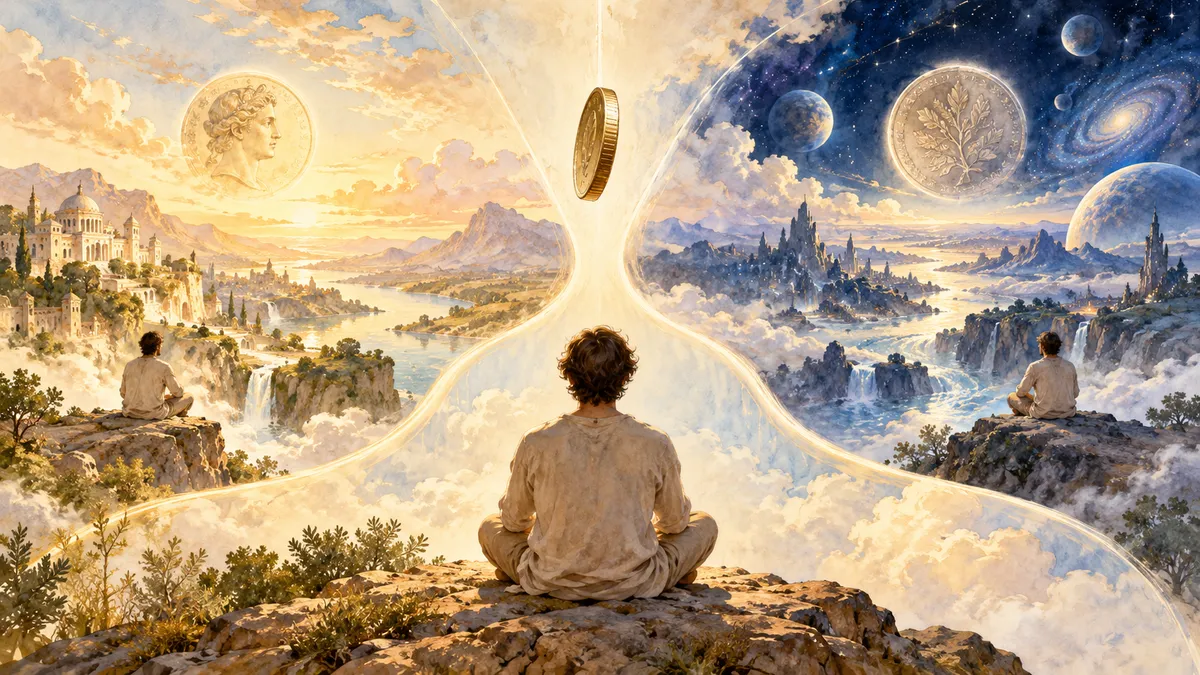
Thus, the king is interested in many questions concerning the nature of reality. Advaita teachings have answers to all these questions. Modern quantum physics now cites the Bhagavad Gita, Patanjali, and Sri Ramana Maharshi when explaining the nature of reality, the quantum state, parallel universes, branching universes, and the multivariance of worlds as manifestations of consciousness. Sometimes you read quantum physics and think: “Perhaps it is time for scientists to engage in basic practices.” And since all of this is a manifestation of consciousness, there is no way around Advaita Vedanta, because it is precisely the philosophy of Advaita Vedanta that teaches this most deeply. From the very beginning, it has always said that the world is a manifestation of consciousness. As many acts of consciousness as there are, so many variable universes exist. For example, when you take a coin and toss it, there are two possible outcomes: the coin will land heads or tails. Accordingly, at the moment it falls, the universe branches, creating a universe in which the coin landed heads and another universe in which the coin landed tails. In both variants, you exist as your consciousness. Accordingly, the branching of cause-and-effect relationships begins.
The teaching of parasatarka logic, which shows how the past can be changed while remaining in the present and how, by changing the past, one can in turn affect the present through the method of circular causality, fully corresponds to the teaching of the Yoga Vasistha. Worlds are multivariant, and this multivariance stems from the fact that all cause-and-effect relationships, space, time, and energy are not objective, do not exist by themselves, but originate from consciousness. Worlds are as if constantly blown out by consciousness, like bubbles on water. Since consciousness is characterized by polymorphism, multivariance, probability, and stochasticity, worlds are likewise created by infinite consciousnesses. As soon as we accept the fact that the universe is not objective but subjective, all these quantum qualities naturally become inherent in worlds.
There is a story that took place in Perm in the 1990s: a female student at one of the humanities universities went into the city with a friend, but forgot her textbook and said that she needed to go back to her parents’ home. She entered the elevator of a high-rise building to go upstairs. After she entered the elevator, no one saw her again. Searches and investigative measures yielded nothing; she simply disappeared—she entered the elevator on the first floor but never reached the upper floors. She disappeared during the ascent. Some time later, a note from her appeared, found inside the textbook: “I am alive, do not worry.” But her parents did not know what to think: perhaps she had gone somewhere, perhaps she had been kidnapped. Some time later, they happened to find another yellowed and aged textbook containing a different note: “I am alive; perhaps I will return to you soon.” And no one could understand what was happening. Approximately three years later, an elderly woman came to the parents (the student’s name was Masha) and said: “I am your daughter.” She explained that she had been abducted by a powerful spirit from a parallel universe and had been forced to serve it. But she had convinced it that it would be a good idea to send textbooks to her parents. She placed notes in the textbooks, secretly informing them about herself. But because time passed differently there, the textbooks aged faster, which was why they had become so yellowed. During the three years in the human world, she had lived a full lifetime; that is, time flowed completely differently in her subjective reality, and she had managed to grow old during that period.

The Subjective Nature of Time and the Space-Time Tunnel
Time, like space, has a subjective nature; it has no objective nature. Its subjective nature means that time as such, as a factor, is a sequence, a movement of samskaras, in which some events appear and disappear, and are replaced by others.
If we consider a person from this perspective, then a person taken locally, in isolation from the temporal component, is not yet a person in and of itself. In other words, when we see a person’s body and their present mind, we see only a certain temporary cross-section of the person, but this is not the person; it is merely one of their projections. It is as if a ship were sailing across the sea, but you could see only one of its superstructures and not the entire ship. If we take the fourth dimension—time—then from this perspective a person represents a spacetime tube or a spacetime tunnel. And if we take the date of their birth as the point of reference, here the person is an infant, and here is their death. Everything that constitutes their life is a multitude of different cross-sections. There is one cross-section of this spacetime tube where they are an infant, another where they are a young person, a third where they are an adult, a fourth where they are aging, a fifth where they are elderly, and a sixth where they are very old. These are simply cross-sections of one and the same spacetime tube.
The past and the future in this spacetime tube are inseparable; they exist simultaneously and as one. But because of the weakness of our perception in relation to the fourth dimension, to the perception of time, and because our mental capacity is insufficient, we are unable to encompass this entire spacetime tube with our minds. And all that we can see is merely a cross-section of the present, a cross-section of the now. Thus, when looking at a person, we see their momentary cross-section, although in reality they are such a complex being.
And if we acquire an even greater power of consciousness, then this spacetime tube with its various cross-sections may extend to the moment of conception, to before the moment of conception, when the person does not yet possess a body, into a past life, a life before that, into dozens of past lives, hundreds of past lives, thousands of past lives. Likewise, this spacetime tube with its cross-sections may extend to the moment of death, to the state after death, into the next life, dozens of future lives, hundreds of future lives, thousands of future lives.
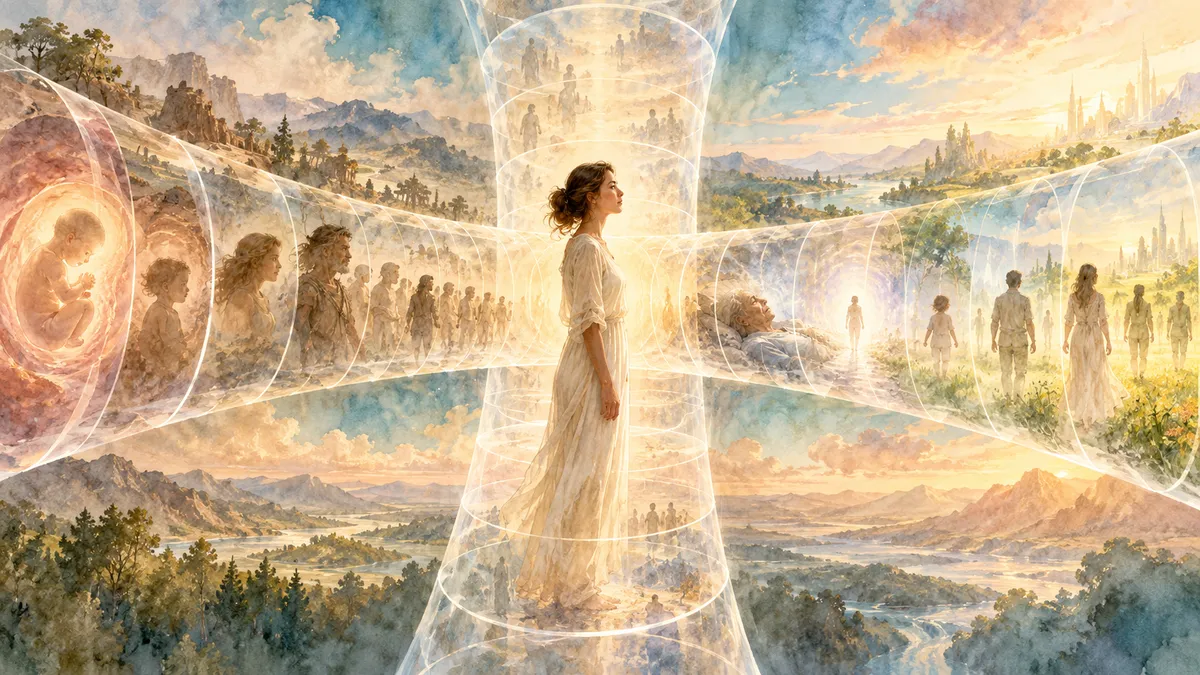
Thus, when the power of consciousness becomes sufficiently penetrating and we are able to enter into time, into the fourth dimension, we can see a person as something entirely different—as a spacetime tunnel extending infinitely in both directions, with infinite energy, samskaras, and karmas of the past, and infinite energy, samskaras, and karmas of the future. And the phenomenon that we now see in the form of a specific body and mind is merely a temporary cross-section. It is a very small cross-section of a vast spacetime tunnel.
Liberation from Being Bound by Time
When the past begins to merge with the future through such discriminating clarity, this is one of the signs that we are approaching the emergence of the “one taste.” Then our bondage to time gradually begins to fall away. We begin to separate ourselves from this spacetime tunnel and from these numerous cross-sections, which are called “lives.” Then we enter the state of sakshi—the witness, who is separate from all of this: from the movement of samskaras, from the vector of time directed from the past into the future.
For this purpose, anava yoga has a special meditation in which we look at any object and any thing precisely from this position. We try to trace the metamorphoses of any object through time, becoming convinced that these metamorphoses are infinite, while what we observe now is merely a very small local cross-section of that object. When we reflect deeply on this fact, we are literally shaken; we see how mundanely and blindly we have perceived reality. Our power of consciousness was simply insufficient to see this spacetime tunnel, but reality is precisely this way.
As we engage in contemplation and give rise to discriminating wisdom, we move away from consciousness being grasped by this spacetime tunnel. At present, our consciousness is indeed grasped by it. And within this tunnel, where there are numerous cross-sections—that is, our bodies and local incarnations—our consciousness is, as it were, stuck to this tunnel. And there is a vector from the past into the future, along which the samskaras move, and our consciousness is, as it were, carried along by this movement of the samskaras. Self-liberation and contemplation enable us to abstract ourselves from this spacetime tube, from the specific present incarnation, and to occupy the point where time ceases to hold power.
And the king asks Vasistha: “You say that the world is a manifestation of consciousness? Very well. But if several people possessing the same magical power think, ‘Let the moon appear in the sky,’ then why would so many moons not appear in the sky? If several people pray to marry the same girl, whose intention will come true?”
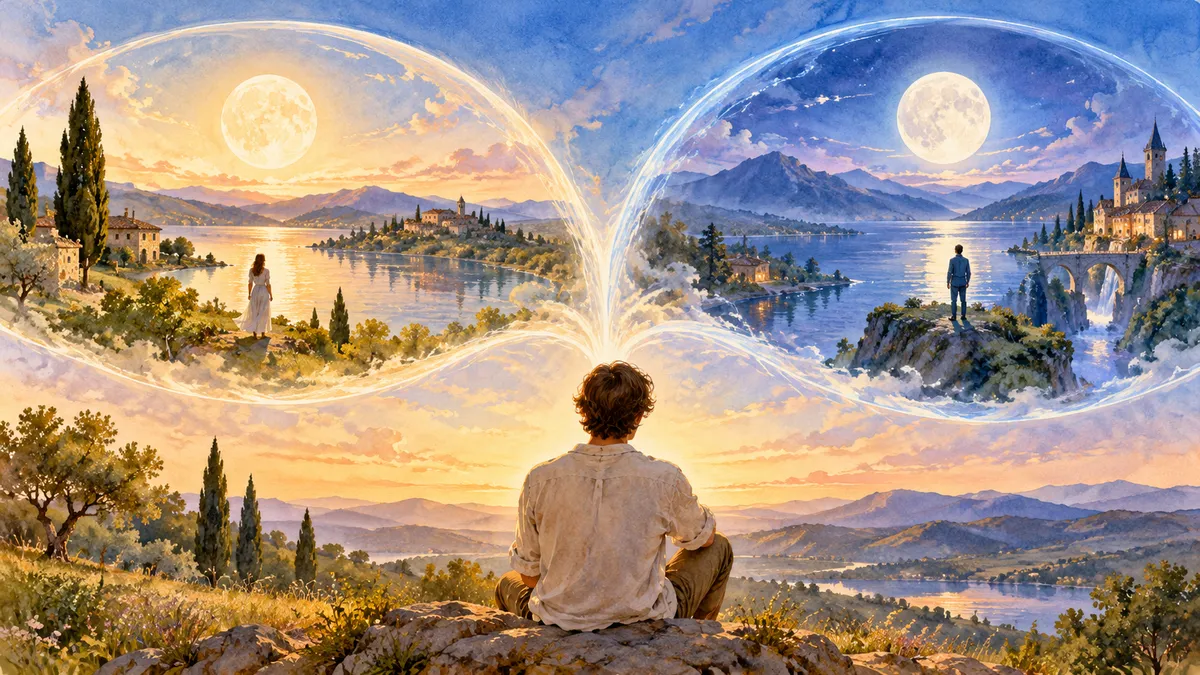
And Vasistha gives paradoxical answers that, from the standpoint of materialist logic, “do not make sense at all.” He says: “If two people pray to marry the same girl, each of them will get precisely that girl. Or if someone meditates, concentrating on the thought, ‘Let me become the moon in the sky,’ each of them will become the moon in the sky, but in their own universe, in their own tunnel of reality. He says: ‘As many consciousnesses as exist, that many times it will materialize,’ because there are no contradictions preventing the consciousness of each being from creating its own local universes, its own realities.
The Nature of Consciousness and the Principle of Transformation
“Vasistha said:
Listen, O king, I will answer your questions in such a way that all your doubts will disappear.
All objects in this world are always unreal, but they are also real, because consciousness is real—their only reality and their substance. Whatever this consciousness resolves, that it becomes, whether it is real or unreal. Such is the nature of consciousness.”
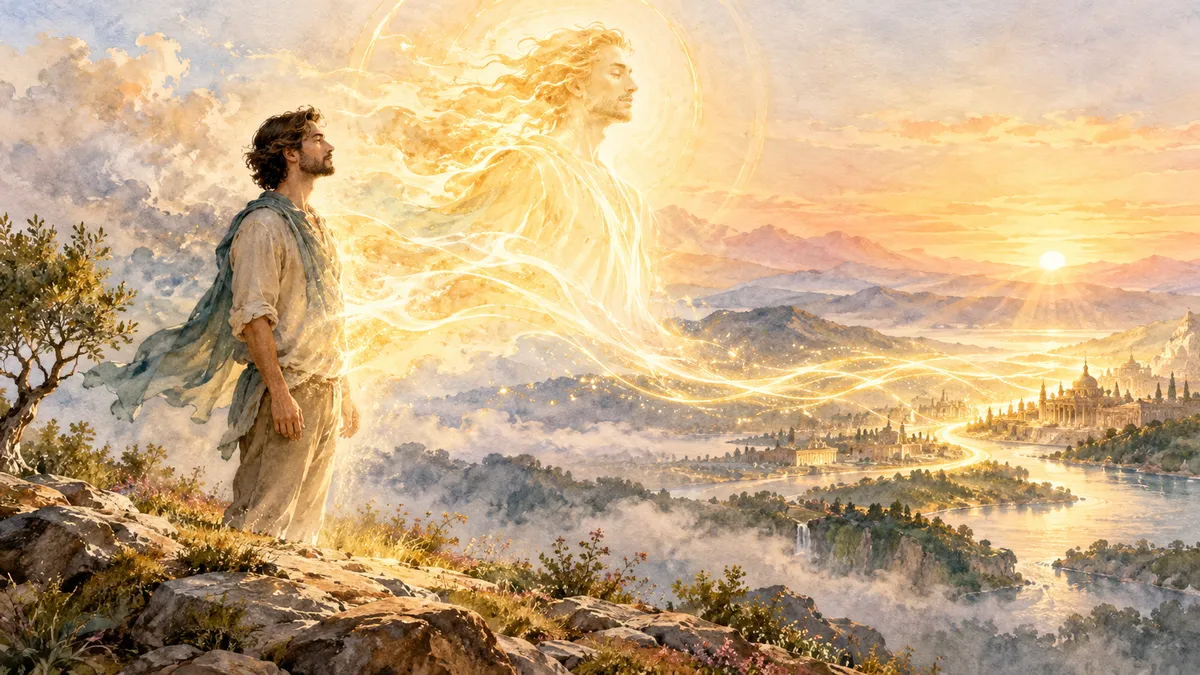
“Whatever this consciousness resolves, that it becomes.” This phrase of Vasistha is the foundation of the teaching of Advaita, upon which everything is built. If this phrase were not true, then the mahavakya “Aham Brahmasmi” would not be true either. Because no matter how much you practiced, no matter what you resolved through consciousness, you would not become it. And then we would be reading “Aham Brahmasmi” and practicing divine pride in vain. But we practice it precisely because this phrase of Vasistha is completely true. Vasistha says: “Whatever consciousness resolves and whatever it concentrates upon, that it becomes.” According to the principle: you become what you think about.
The method of visualization, the sadhana of divine pride, is precisely the method of transforming into the Absolute. In consciousness, we resolve: “I will not be a human being, but Brahman, Aham Brahmasmi,” or “I will no longer be this limited human being, but Dattatreya; I will transform into him.” And as soon as we have expressed such a sankalpa, the process has already begun. Perhaps we are not yet aware of it, but a variable, meaningful universe has already begun to form, in which causes and effects begin to unfold in precisely this way. We create causes and effects in which we become what we think about. It is only a matter of the strength of intention and concentration. And if our will is unbending and such a process continues for a long time, then we become precisely what we think about.
Balancing Contemplation and Intention in Practice
In the process of contemplation, it is very important not to lose the vector of intention, that is, the direction of consciousness. Despite the fact that contemplation itself has no vector of intention and is immediately absolute, such a vector of intention must nevertheless always exist on the relative level. In other words, we must clearly understand our future: whom we want to become, whom we want to make ourselves through practice, and what our ultimate goal is. We must believe in this goal, intend to embody it, vividly imagine and visualize it, and, of course, continually do what needs to be done. At the same time, we must not become eternally attached to this goal, nor fall into egoistic hopes, fears, and clinging. Rather, we must act from a state of contemplative presence.
