

Commentary on Bhātta Kallaṭa’s “Spandakārikā.” “Verses on Divine Vibration”
November 6, 2025
“What is spanda? The term ‘spanda’ does not occur in the principal āgamas. We find its first mention in verses 4 and 5 of the sixth section of the ‘Parāśambhu-mahimnaḥ-stava,’ a text dating from the second century CE and attributed to the sage Durvāsas, the aforementioned founder—or, more precisely, reviver—of the monistic Trika Śaivism, since he is considered to have been the teacher of the mahāsiddha Tryambaka. He described spanda as ‘the ability of Lord Śiva to set all that exists in the universe in motion and sustain it.’ The sage also asserts that it is through union with spanda that a yogin is able to attain the highest realization. Spanda is mentioned in two verses of the sixth section.
Vasugupta, who lived in the middle of the ninth century and belonged to the Tryambaka school, is considered the author of the ‘Śiva Sūtras’ and the founder of the doctrine of spanda. The ‘Śiva Sūtras’ are classified among the āgamas because they were not composed by Vasugupta but revealed to him by Śiva.
Bhātta Kallaṭa says that Śiva revealed the ‘Śiva Sūtras’ to Vasugupta in a dream on Mount Mahādeva. The commentators on the ‘Spandakārikās,’ Utpala Vaiṣṇava and Rāmakaṇṭha, as well as the commentator on the ‘Śiva Sūtras,’ Bhaṭṭa Bhāskara, agree that Śiva is the author of the ‘Śiva Sūtras.’ It is believed that Vasugupta received them from a certain siddha on Mount Mahādeva.
According to the version of Kṣemarāja, who lived 200 years later than the preceding figures, Śiva indicated to Vasugupta in a dream that he should move a certain stone on Mount Mahādeva. The next day, following the instructions from the dream, Vasugupta found a huge boulder, which he nevertheless managed to turn over with a single touch. On the reverse side of the stone he discovered the ‘Śiva Sūtras.’ It may be assumed that the text that appeared on the stone was continuous, and that the division in which it appears in modern editions may have differed from Vasugupta’s original division or may represent an alternative interpretation.
It should be noted that to this day, in a place called Darapaham, near Srinagar, the capital of Kashmir, there is a stone of Śaṅkara, Śaṅkarapāl, which continues to attract pilgrims, but no traces of a text have yet been found on it, although some scholars of the Trika, including Lilian Silburn, as well as the author of these lines, have attempted to find them. Subsequently, Vasugupta revealed in the ‘Śiva Sūtras’ the principle of spanda and the method of realizing it through yogic practice, which consists in constant, attentive self-awareness. This continuous pulsation of self-awareness is spanda. And regular practice of the intuitive realization of spanda leads to the understanding of the true nature of one’s Self, which is none other than the absolute Self.
Spanda as the Vibration of Śiva’s Consciousness
In Śaivism, awareness, self-awareness, is vibration; it is pulsation or, as it is also translated, the tremor of Śiva’s consciousness. Consciousness possesses vibration. If we examine the five tattvas, then, as is known, there are five pure tattvas underlying reality. These five tattvas seem to emerge from Paramaśiva, who is not himself a tattva but stands apart as the source of all tattvas. The pure tattvas that arise from within Paramaśiva-tattva are Śiva-tattva, Śakti-tattva, Sadāśiva-tattva, Īśvara-tattva, and Sadvidyā-tattva.
Each tattva corresponds to its own śakti, or power. That is, each tattva, each mode of Śiva’s being, pulsates on its own level of vibration:
Citi-śakti corresponds to Śiva-tattva
Ānanda-śakti corresponds to Śakti-tattva
Icchā-śakti corresponds to Sadāśiva-tattva
Jñāna-śakti corresponds to Īśvara-tattva
Kriyā-śakti corresponds to Sadvidyā-tattva
And what place does spanda occupy in the tattvas and in the shaktis emanating from the tattvas? Spanda is within them. Chit-shakti, pure knowledge, pulsates in spanda like light in a wave. Iccha-shakti, will, is spanda when it makes a decision, divine will: “Yes, I want this.” Jnana-shakti, meanwhile, is spanda already turning into a process of subtle mental activity. Ananda-shakti is spanda in bliss, when everything vibrates with love. When people say, “God is love,” this is ananda-shakti-spanda. In other words, you can say “God is love” in the language of philosophy, or you can say “God is ananda-shakti-spanda.” It will mean the same thing. Shiva-tattva is spanda without form, while Shakti is the dance of spanda. Ishvara-spanda is when various faces, various divisions and differentiations, begin to appear in this spanda.
But all of this is one breath. In other words, spanda is not merely inside these shaktis; it is the very breath of these shaktis abiding in the higher tattvas. And, of course, it is also the hidden breath in still grosser tattvas such as maya-tattva, the kanchukas, purusha-tattva, prakriti-tattva, buddhi-tattva, ahamkara-tattva and manas-tattva, all the way down to the element of earth, all the way to physical space, air, fire, water and earth. Spanda vibrates within everything, everywhere. Spanda is the breath of every element, including within our inner instrument, the antahchakra, our psychosphere. The antahchakra consists of our inner sense organs and the contents of our consciousness, our psychosphere. And all of this is also spanda.
Two Types of Spanda
Two types of spanda are distinguished:
Samanya-spanda — subtle, indivisible spanda. It is invisible vibrating consciousness present within this life as the observer.
Vishesha-spanda — grosser spanda. Life, the life force, is the primary form of external vishesha-spanda. When people say “life” or “life was born,” all of this is vishesha-spanda. In other words, it is the vibration that permeates all existence, including vibrating at the level of molecules, at the level of atoms, in the form of electricity and in the form of various states. It is this that gives rise to biological life of various types. The eight million four hundred thousand different forms in our universe, the Brahmanda, are all movements of vishesha-spanda.
The Twofold Direction of Spanda
“In Panini’s ‘Dhatu-patha,’ spanda is described as ‘spanda-kinchalanam,’ that is, the slight vibrating movement of absolute consciousness. Since movement is not physical or psychological in nature, it occurs rather at the level of spiritual essence, simultaneously inward and outward, representing two aspects of the Absolute — the transcendent, vishvottirna, and the immanent, vishvamaya. The inward movement is the state of the Absolute resting in Itself. The outward movement is the external manifestation, as if the outpouring of Absolute consciousness and the creation of the phenomenal world through this manifestation.”
Thus, spanda is a slight shimmering, a slight trembling, kimchinchalanam, which has a twofold direction: vishvottirna — inward, the transcendent aspect, and vishvamaya — outward, into maya, into manifestation, into matter, the immanent aspect. And this slight vibration, this barely perceptible shimmering inward and outward, creates the beginning of the creation of the Universe.
“Kashmir Shaivites believe that if the Absolute always rested in Its transcendent aspect, like the Brahman of Advaita Vedanta, then neither creation nor destruction would be possible, since individual consciousness is not different from the Absolute. Spanda is present in every living being.”
If there were only the transcendent aspect, unmanifested and beyond, and Shiva in His purity, we would not exist. There would be neither samsara, nor the Universe, nor nature, nor karma. There would be one Shiva, and there would be only one liberation, but there would be no concept of us as souls and individual beings.
But since there is an immanent aspect and vishvamaya-spanda exists, the Universe is therefore created, souls appear, and samsara is created as a platform for souls. Souls need a foundation that would activate their karmas. Without such a foundation—the Universe, Brahmanda—our karmas would not manifest, because karmas exert pressure on souls, prompting them to generate forces and kindle awareness. The Universe brings the karmas of different souls into contact, activating and provoking them, just as the soil in a garden awakens the dormant, hidden force in a seed. The seed begins to grow. It begins to grow and strives toward the light, sprouting either out of fright or out of joy. But seeds do not grow without soil; they are simply kept in a box. Their potential remains undisclosed.
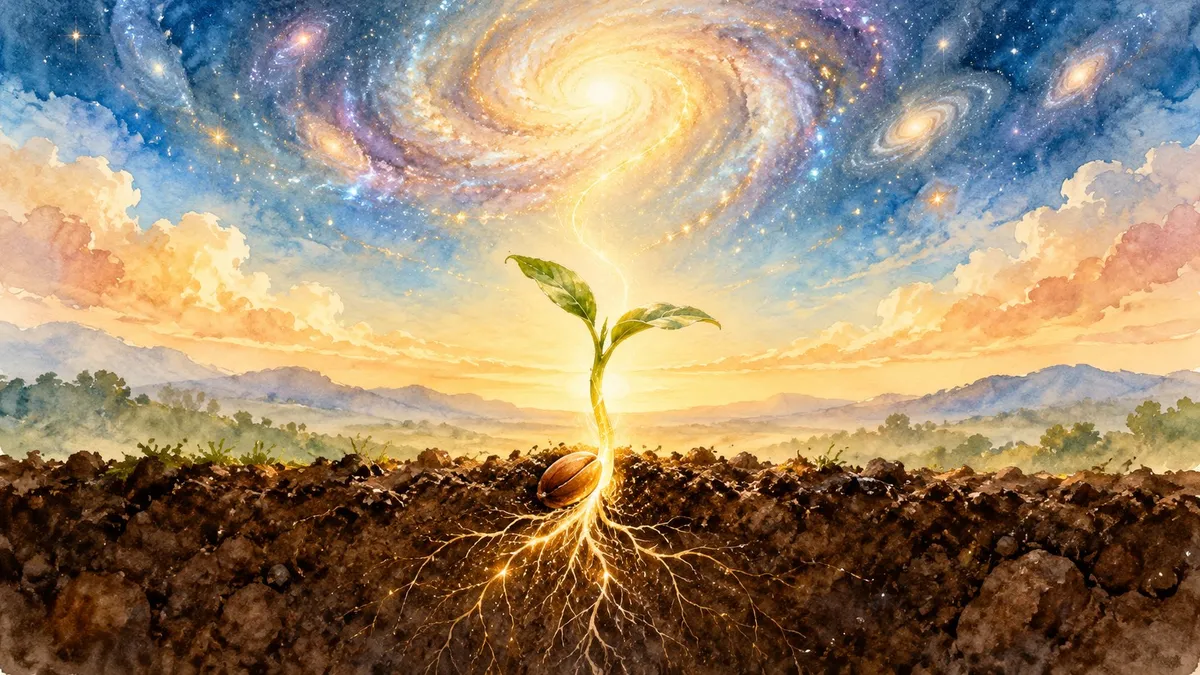
The same applies to souls. Until there is creation, it is impossible to unfold the potential of souls in the form of their shakti, and their consciousness will not grow either. As soon as a seed is placed in moist soil, some impulse is kindled within it, and its hidden force awakens. In the same way, the universe of Brahmanda in which we live and are reborn is the soil into which we, as seeds, the Creator’s spores, have been placed. It awakens within us vibrating forces, the will to live, the survival instinct, ambitions, aspirations, and, ultimately, moksha and mumukshutva. And all of this is the action of spanda.
At the lowest level, spanda manifests as karma—the immutable law that controls us, while we struggle against it. But in the course of this struggle, our consciousness is tempered and cultivated, and it can separate itself from spanda at the lower level, or rather, from the perception of spanda as karma. Then another perception arises: the perception of spanda as the play of the divine, as a tremulous pulsation, as throbbing and shimmering.
Unmesha — The Interval Between Thoughts
In Shaivism, great importance is attached to the concept of “unmesha.” Unmesha is the interval between thoughts. In the interval between thoughts, one can enter nondual awareness, where spanda can be perceived as a subtle aspect—not as karma, but as a play of vibration. This is a state of abiding in a state of probability, where spanda has not yet collapsed, has not become gross, and has not taken shape. And in the state of unmesha, one can recognize both the nature of consciousness and spanda, since at this level they are inseparable. The recognition of shivatva as spanda-tattva is the essence of anuttara tantra.
Experiencing Spanda in Everyday Life
“For example, awareness of one’s Self, which is present even in the state of deep sleep, sushupti, is the inner movement of spanda. The desire to know and act is its external manifestation. Continuous awareness of spanda requires the concentration of spiritual effort. But in ordinary life, it can be caught in moments of intense emotional elevation, sudden joy, terror, anger, amazement, or very rapid running. Spanda may be experienced by someone who is intensely angry, exuberantly joyful, pondering ‘what should I do now,’ or running ‘wherever their eyes may lead them.’ But such sensations are usually so fleeting that, being overwhelmed by the states themselves, we are hardly likely to notice the presence of spanda within them.
One of the chapters of the “Rudra-yamala-tantra,” the “Vijnana-bhairava-tantra,” another of the agamas, is closely connected with the Trika. Some of the dharanas, contemplative techniques, also correlate with the “Spanda-karikas,” as well as with the “Shiva Sutras.” Several dharanas enumerate states in which the highest reality may be experienced spontaneously. They are mentioned in this translation. Later, the concept of “spanda” developed in the “Spandakarikas,” written in the middle of the ninth century. In his commentaries on the “Spandakarikas”—the “Spanda-sandoha” and the “Spanda-nirnaya”—Kshemaraja mentions the following terms which, in his view, served as synonyms for spanda in the agamas: sphuratta—radiance, urmi—wave, bala—power, sara—essence, hridaya—core, essence. But it cannot be stated with certainty that they denote the same concept as spanda.
The word that seems most suitable for translating and conveying the essence of spanda in Russian is “tremor,” since, unlike the mechanistic “vibration,” it conveys spiritual fullness, pulsation, and movement simultaneously.

Spanda creates the activity of our sense organs; it vibrates and enlivens our inner sense organs, our antahkarana — manas, buddhi, ahamkara, our inner chakra. Our consciousness vibrates thanks to Shiva’s spanda. In other words, our life is Shiva’s spanda. We were created by his love, one might say, or by his vibration, which amounts to the same thing. Another aspect of spanda is that it vibrates everywhere. And these two aspects are samanya-spanda and vishesha-spanda.
Once, journalists asked a Naga-baba why they walked naked among society and why there was such a culture. Naga-babas walk naked; they may wear nothing but a garland or prayer beads. One of them replied that Shiva is always open, his nature is always naked, and it cannot be concealed by anything. This is called anashrita-shiva. And if our vision is deep and our recognition is deep, we can see Shiva’s spanda everywhere and see that Shiva cannot be concealed, that his spanda cannot be concealed by anything or limited in any way.
The Structure of the “Spandakarikas”
The text of the “Spandakarikas,” written by Bhatta Kallata, one of the sages, pandits, philosophers, and saints, consists of three chapters:
“Svarupaspanda” — “The Tremor of Shiva’s Nature”
“Sahajavidyodaya”
“Vibhuti-spanda”
We are considering the first text, “Svarupaspanda,” the first chapter.
“We glorify Shankara, the source of the power of the circle of shaktis, the one who creates the Universe by opening his eyes and, closing them, dissolves it.
The circle of shaktis, shakti-chakra, includes both the senses and the goddesses who preside over the senses and the letters of the Sanskrit alphabet, the eight mothers, ashtamatrikas: Brahmi, Maheshvari, Kaumari, Vaishnavi (Narayani), Varahi, Aindri, Chamunda, Mahalakshmi. The inner shakti-chakra may also include the goddesses Gochari (speech), Dikchari (the ten directions of space), Khechari (the sky or the space of consciousness), and Bhuchari (the earth).
Since our own nature — svabhava — is Shiva, we also have the opportunity to become masters of the shakti-chakra instead of remaining its playthings. It is precisely toward this that the recognition and practice of spanda lead. And, as stated in Karika 51, the yogin becomes the lord of the shakti-chakra.”
The Nature of the Shakti-Chakra
The fundamental view of Shaivism is that Brahmanda, the Universe, has the nature of shakti. Because Shiva is emptiness, pure consciousness, and light. But we do not live in emptiness or in the pure consciousness of light as we perceive it; we live in the objective world called Brahmanda, or Brahmanda-gocharam, that is, the Universe. People often say, “The universe is sending me signs.” Yes, this is called brahmanda in Sanskrit; the objective world of this universe is Brahmanda-gocharam.
And we do not live in Shiva; we live in shakti, we are immersed in shakti. Our life takes place in shakti and through shakti. Shiva resides within this shakti, but he remains undiscovered until we attain the state of prabodha. He enlivens it. But all the dynamism, all materialization and manifestation, are provided by shakti.
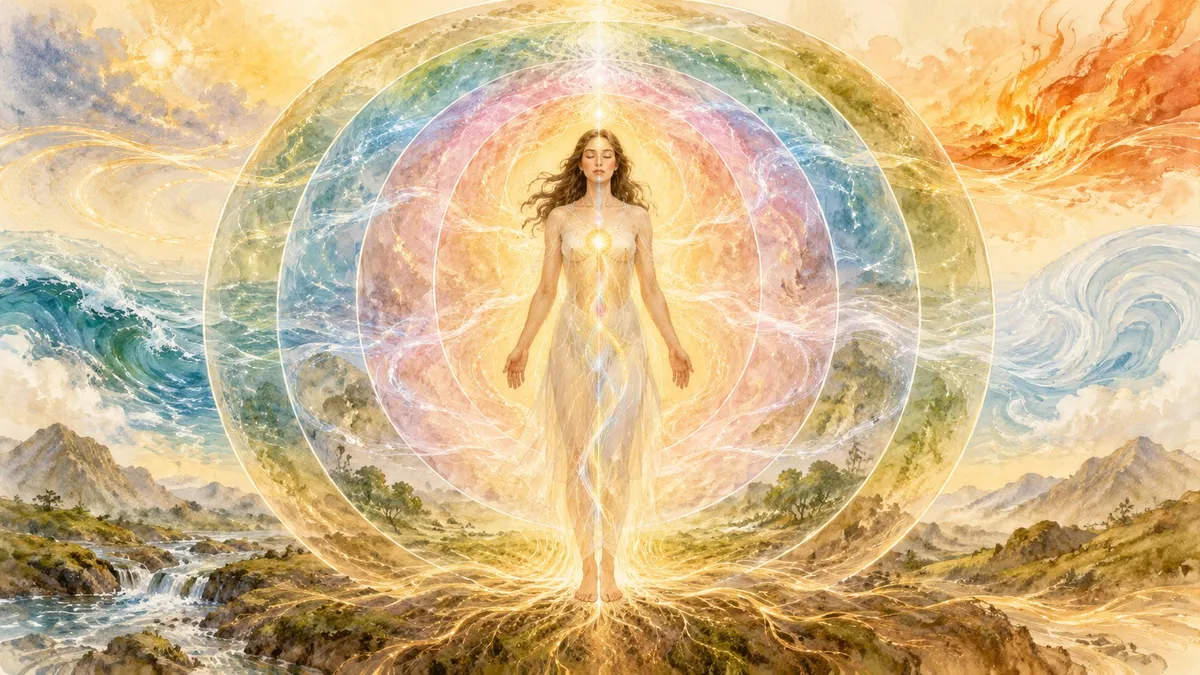
And shakti divides into many other, smaller shaktis. It surrounds us everywhere, from all sides: in the five external elements, in the chakras, in the goddesses listed above, in the body, in the sense organs, within the perception of objects, inside the sense organs, within ahamkara (the ego), and within consciousness. These shaktis are also called kanchukas, limitations. And they form the five sheaths, the five koshas familiar to you. These shaktis are called Khechari, Gochari, Dikchari, and Bhuchari. In other words, one moves in consciousness, in space-like consciousness; another moves in the ego; a third moves in the sense organs; and a fourth moves in the perception of the external world.
In addition, shaktis are within our body, and all these shaktis surround us, bind us, dictate their laws to us, and they are the source code, the software of this Universe. And these shaktis do not merely determine our body; they determine the fundamental physical constants and laws, such as the structure of the hydrogen atom, of any atom, the valence of atoms, and chemical bonds. Laws such as the law of gravity, Planck’s constant, and an infinite number of laws that run through this reality. All of this is the action of shakti.
Shiva, Limited by Shakti
And we are Shiva. By our nature, we are not shakti. We are shakti in terms of the body and energy, but by nature we are all Shiva. Yet the paradox is that at present we are, as it were, Shiva in bondage—Shiva surrounded by shakti, which controls this Shiva, envelops and binds him. That is, we do not cease to be Shiva, but we are Shiva in a limited form, and this is called purusha. Purusha means “Shiva,” but Shiva who is limited by shakti. And this entire state is called the “circle of shakti,” shakti-chakra. And shakti-chakra limits us as Shiva, reducing us to the level of Purusha.
Therefore, in essence we are Shiva, but in reality we are Purusha. And the best, the greatest, are also called Purushottama, the greatest purushas. Why are we not Shiva, but Purusha? Because these shaktis, these shakti-chakras, are active. In other words, imagine that certain goddesses are sitting there—karma, the laws of physics, the laws of chemistry, the laws of biology, the laws of the psyche. Some laws of the psyche are stronger than the laws of physics. And they surround you, and you are, as it were, bound and unable to do anything.
Awakening the Inner Shiva and Conquering the Shakti-Chakras
The whole point is to awaken our potential, turn our attention to spanda, and reveal Shiva within ourselves so that Shiva may spread his bhava, and these goddesses may transform into pure, peaceful ones. And they will say: “That’s it, karma is cancelled, let’s play, let’s dance, you are free, you are our ruler and lord!”—and become the lord and master of these shakti-chakras. The paradox is that they are our own shaktis, and our own shaktis bind us. But it is not that simple, because these are not only our personal shaktis; they are our shaktis as the universal Shiva. There are two types of binding shaktis: our personal shaktis, our small personal shakti-chakra in the form of the sense organs, our koshas, in the form of our inner Gocharis, Dikcharis, and Bhucharīs; and there are universal shaktis, which also bind us, but at a higher level.
The question is how to awaken the inner Shiva within ourselves by recognizing spanda within ourselves, and make our own shaktis subject to us. After all, they are our shaktis; they cannot and should not control us—we are their masters, yet it turns out that they control us. The shakti of the body, the shakti of vision, the shakti of the mind—we are subject to them because we are not yet very experienced as masters. And the first conquest is becoming the lord of our own mandala, shakti-chakra, of our body, speech, and mind. When, for example, we transform into a deity and turn ourselves into a mandala, or unite contemplative presence with all the sense organs and all the energies, then we do the same with the universal energies.
This is not about conquest in the egoistic, human sense. It is impossible to conquer them in an egoistic sense, because that is one of the forms of ignorance. Conquest takes place through becoming Shiva, through greater letting go of hopes, fears, and attachments, and through a greater recognition of ourselves as Shiva, as Shiva’s spanda. Then the energies of the shakti-chakra become the sammi-chakra-devatas, or a mandala of deities, while we become their central deity—Chakreshvara. By what means? By recognizing our nature as Shiva. These shaktis become subject to us.
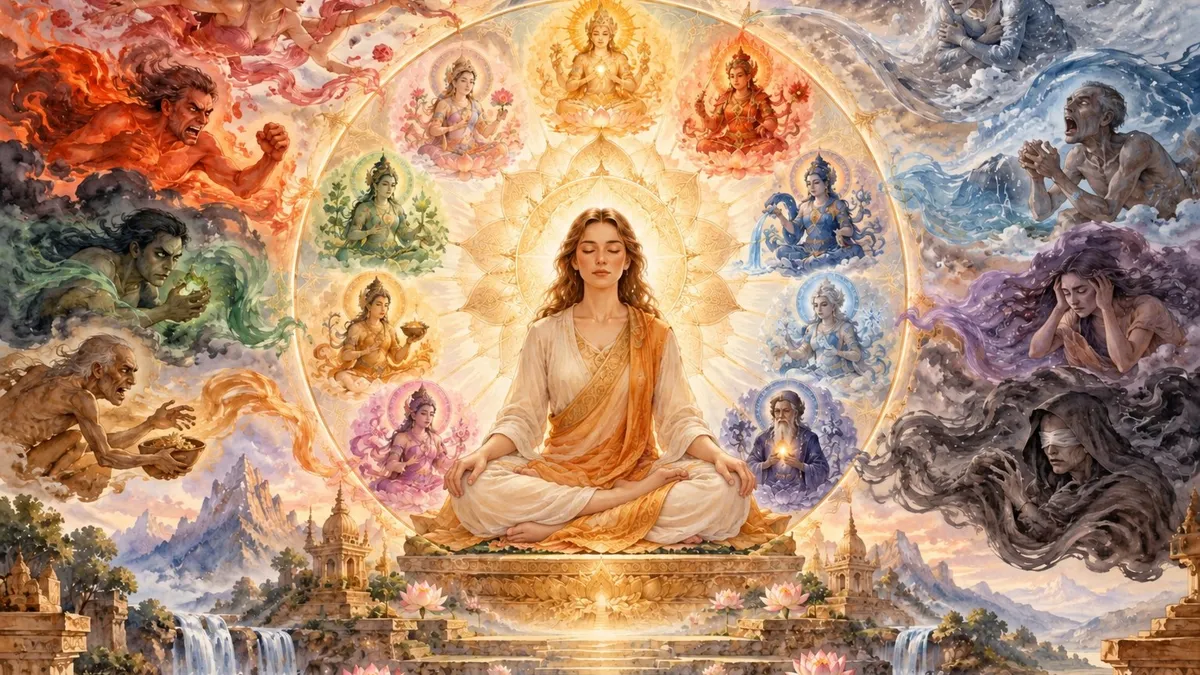
In essence, when we are influenced by lust, when we are influenced by anger, when we are influenced by envy, when we are influenced by attachment, when we suffer from hunger, cold, and thirst, when someone else’s emotions affect us, when attachment affects us, when ignorance, dullness, and drowsiness affect us, when hunger affects us, when concepts and ideologies affect us, when diffusion affects us—any kind of influence—all of this is the influence of shakti. This happens when we, as Shiva, have not yet established ourselves in relation to these shaktis. And therefore, they influence us. But when we open our consciousness, these shaktis become part of our mandala, our inner deities.
Purusha and the Origin of the Universe
Question: I am writing a treatise on the structure of the Vedic Universe, and it initially says that the Universe (Brahmanda) originated from Purusha. Am I correct in understanding that the Purusha from whom the Brahmanda was created is Purusha-tattva?
Yes, if by Purusha we mean Brahma. Brahma is also Purusha. He too is limited by his body, by his long lifespan, and his state is not absolute. That is, there is an absolute state within him, as Shiva is within him, but Brahma himself, as the Creator, remains within his own limits. Creators emerge from Shiva like specks of dust during breathing. Shiva gives birth to Brahma; he also gives birth to those who give birth to Brahma. He gives birth to those who give birth to those who give birth to Brahma. Vishnu, for example. And Vishnu gives birth to Brahma. Such is the principle. And Brahma here is Purusha.
Question: So, does going beyond the limits of the Vedic Universe itself and of everything generated by the mind take place through Purusha, the observer, through the dissolution of the observer?
Yes, one can put it that way. This can be interpreted both subjectively and cosmically.
The Nature of Spanda and the Shakti-Chakra
The salutation affirms the causality (karanatva) of our own nature (svabhava), whose essence is Shiva, creating and withdrawing the world through will and intention alone. Manifesting in the form of consciousness, He is the Source of the arising of Divinity of the Circle of Energies (shakti-chakra). “Nowhere is there any obstacle to that in which all creation abides and from which it originates, by virtue of the impossibility of concealing its nature.”
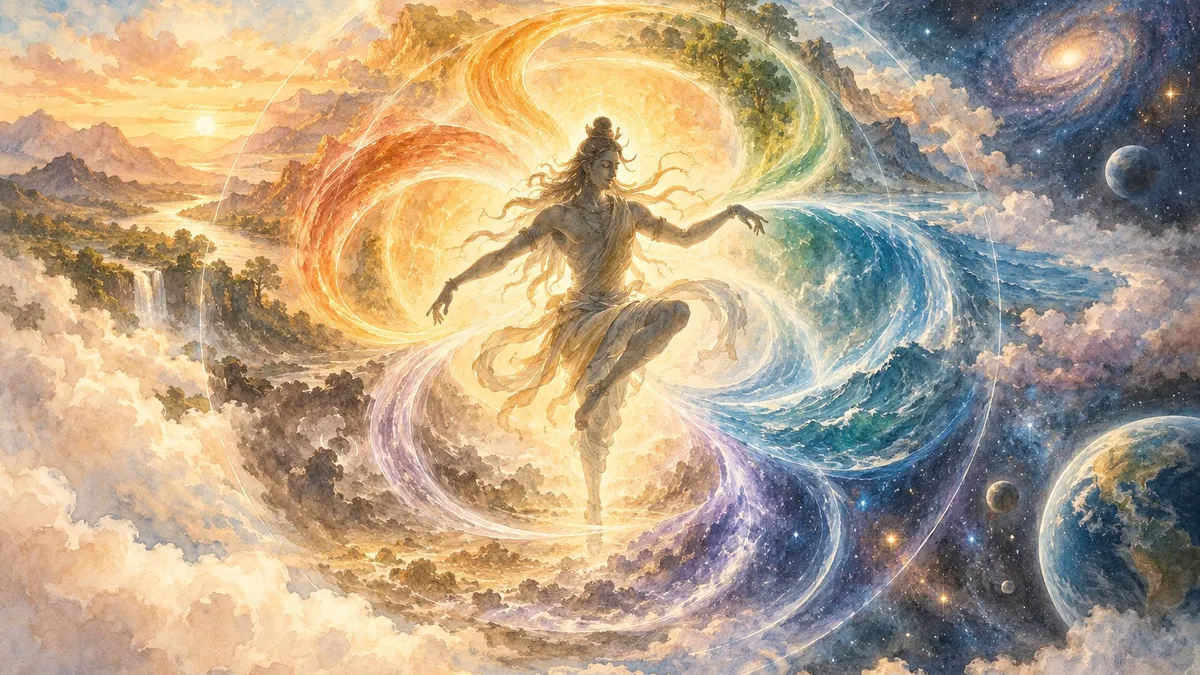
Thus, the shakti-chakra is where we live and that in which we live. It is both our body and the five sheaths, as well as the Universe. But spanda is distinct from the shakti-chakra. Spanda is the pulsation, tremor, and vibration of Shiva in manifestation, which permeates this entire vast shakti-chakra, this entire brahmanda, without obstruction. For example, there is the principle of pancha-kritya. This is the action of Ishvara when he creates, sustains, destroys, conceals, and liberates the universe. And spanda is not identical to pancha-kritya. Spanda fills pancha-kritya. It is within it. That is, creation, preservation, destruction, concealment, and liberation are the vibration, the tremulous breath of God. Shiva’s dance is also spanda. But the very concept of spanda is much broader than pancha-kritya. Vasugupta says: “One who comprehends the essence of spanda attains the highest reality.”
That is, it is the power of Shiva through which he is aware of himself and creates and sustains the universe (brahmanda). It is the impulse of consciousness. This is spanda. And what is the essence of spanda? The essence of spanda is shivatva. If we investigate spanda deeply, we discover that its essence is the nature of Shiva: pure consciousness, full of light and creative potential.
Question: Gurudev, could you perhaps clarify a little more this subtle difference between Shakti and Spanda?
Spanda is the vibration that exists in the union of Shiva and Shakti. When spanda is directed inward, it is Shiva. When spanda is directed outward, it is Shakti. In samarasyа, in the union of Shiva and Shakti, spanda exists. It is their union.
The Practice of Investigating Spanda
Question: What does it mean to “know the essence of spanda”? That is, when during meditation one manages to attune oneself to it and perceive this pulsation, what should one do next?
When you engage in investigation—for example, during thoughts, while experiencing emotions, while moving, while sneezing or yawning, during an intense experience of emotions, mental agitation, bliss, happiness, delight, ecstasy, or, conversely, some limited states—if you investigate these experiences, you discover their empty, luminous, pure essence. Perhaps not immediately, but you will certainly discover that these experiences are separate from your body and from your thoughts. They are something greater and subtler. Before you began to think, there was a vibration. Before you began to experience emotions, there was also a vibration. And you will discover that at first there is a certain vibration, and that we all vibrate at a particular frequency, and only afterward does this become thoughts, actions, and feelings.
And if you try to investigate where this vibration came from, you will discover that it came from pure, empty, tranquil awareness. And this pure, empty, tranquil awareness is spanda-tattva, and it is the nature of Shiva. The essence of spanda is shivatva, the nature of Shiva. And to recognize spanda-tattva behind all manifestations, behind all emotions, behind all perceptions, behind all elevated and base emotional states, behind all perceptions that we like and dislike, behind all sensory experiences such as hunger, cold, thirst, fear, anger, envy, joy, happiness, delight, bliss, behind all images, including subtle images of divine beings, and then to recognize shivatva—that is the path to liberation.
Question: So we can feel this pulsation not only in meditation, but also in everyday life?
Always. It is not only possible; it is necessary. If you engage in recognition, then you are practicing vichara: atma-vichara or brahma-vichara, or contemplation. Contemplation always contains an element of inquiry. And this element of inquiry during contemplation is also called vichara-spanda. Vichara-spanda is the investigative activity that we generate when we experience something. And when contemplation contains vichara-spanda, it is said to be good and correct. But if it does not contain vichara-spanda, people say: “You’ve gotten stuck there somehow; your awareness has faded.” The spirit of inquiry, or, in the language of bhakti, the spirit of fervent faith and love for the Lord, has faded. And we must never allow fervent faith and love in our hearts—or the spirit of vichara-spanda, in the language of jnana yoga—to fade. This investigative activity.
Pitfalls in Practice and Working with Bliss
Question: As one refines the practice of contemplation, one strongly experiences a kind of spanda pulsating in every cell. A blissful state. And one simply wants to sit like this for hours; nothing else is desired except to remain in this state. Where does one go from this state in one’s practice?
Have you heard about the three traps of a yogi? Bliss, clarity, and emptiness. If you become absorbed in simply remaining in it without doing your work, thinking, “Wonderful, how good this feels!”—and it is a blissful yet semi-conscious state—then it will be a trap. But if you generate vichara-spanda: “Oh, excellent, bliss is the path; bliss will allow me to be absorbed, but I will investigate bliss—what its nature is, what the source of bliss is, what I am, what my self-awareness is within this bliss,” then you can delve deeper into this bliss, move on from it, and you will successfully find the second trap: clarity. But this indicates that you are practicing well; you must not stop there. You must always distinguish yourself from experiences, investigate them, and discover their nature, their shivatva.
Question: And what if it is combined, for example, with sankalpa, divine pride, and descending power? Is that considered inquiry?
Yes. If there is vividness and clarity in the sankalpas, then your vichara-spandas are working. If you forget about them, then it will be a trap. But as long as they are working, everything is fine.
Question: Is there any sankalpa that should be established during meditation or while attending the 4BSB retreat?
You can create a sankalpa as an intention before the homa: “May my practice purify my limitations and guide me toward serving all living beings.” If there is a specific problem that you wish to purify, or you want to help another person, or resolve some of your own tasks, then the sankalpa should be expressed more specifically.
However, how can we call our nature, having fallen into the cycle of rebirths, Shiva? In response, one may say: that in which the entire world abides and from which it arose is not obscured even in samsara. There is no obstacle to it anywhere; therefore, in this case, they speak of the nature of Shiva, shivatva. Although there is a division into the waking state and so on, this—that is, spanda—pervades them as something indistinguishable from them, never changing its own nature as the perceiving subject. Despite the various states, waking and so on, its own nature is not obscured, since the nature of the perceiver remains unchanged in all three states, and it has no other nature. Just as the nature of a tree is contained in the seed, in which the five parts of the future tree are concealed.

The image of the Great Whole contained within the small, sometimes invisible to the eye, is widespread in both Buddhist and Hindu literature. For example, in Chapter 12 of the Chandogya Upanishad, the sage Uddalaka Aruni asks his son Shvetaketu to bring him a fruit from a banyan tree and break it open. And he said to him: “Truly, dear one. Here is the subtle essence that you do not perceive. Truly, dear one. Through this subtle essence this great nyagrodha—the banyan—exists. Believe this, dear one.” Then he asks him to break open one of the fruit’s seeds. “And this subtle essence is the basis of all that exists. That is the Real. That is the Atman. You are one with That, Shvetaketu.”
