

Commentary on the text "Yoga Vasistha. Chapter 5. On Dissolution"
We have all had the good fortune to join a spiritual tradition. This spiritual tradition belongs to Sanatana Dharma. The Northern tradition is associated with Advaita Vedanta, and the Southern tradition with the Tamil Siddhas. This means that we have come into contact with something very valuable and very precious. Now we have to unpack this jewel, to understand it, in order to apply it in our lives.
When we read the Pancharatna-pranama-mantra, the mantra of veneration of the Five Jewels, the Five Treasures, we remember again and again this jewel, that this jewel is God, the Absolute, Shiva, as the primordial Consciousness. Therefore, we say:
“Om Shivam sharanam prapadyam” — I go to Shiva for refuge, for protection.
This is the energy of Shakti, of which everything consists and without which nothing is possible. Therefore, we say:
“Om Shaktim sharanam prapadyam”.
It is also the dharma that opens the path for us. Therefore, we say:
“Om Dharmam sharanam prapadyam”.
Then there is the sangha, which represents the manifested dharma as a jewel, including both humans and gods. Therefore, we say:
“Om Sangham sharanam prapadyam”.
And the guru. Guru-tattva, the guru as a principle; the specific, initiating, and teaching guru is called the mula-guru, the root guru. Root means: you receive transmission from him, through which you can practice shravana, manana, and nididhyasana. You also receive diksha, the guru-mantra. Sometimes the root guru is the same as the diksha-guru, sometimes not. You receive shiksha from him. Shiksha-guru, diksha-guru, and the root, mula-guru. In addition, the guru principle means param-guru — the guru of your guru. Paramparam-guru — the guru of your guru's guru, the grandfather guru, the great-grandfather guru. And parameshti guru — the great-great-grandfather guru. Also, the guru-acharya, the founder of the sampradaya, the philosophical tradition. Furthermore, Adi-guru, Guru Dattatreya, Avadhuta Dattatreya, the one who is the primordial teacher of all gurus — this is the principle of guru-tattva. Therefore, we say:
“Om Sadgurum sharanam prapadyam”.
These are the Five Treasures. When we speak more briefly, we say: the Three Treasures. Three Treasures does not mean there are fewer treasures. It is simply assumed that the principle of guru-tattva—that which teaches, inspires, helps, and blesses us—contains within itself Shiva, Shakti, and Guru. Then we simply say: Guru, Dharma, Sangha, implying that this principle contains God, specific energy, and the guru-parampara.
Having taken refuge in the jewels, our task is to live so that we become rich through possessing these jewels. To extract energy, power, and wisdom from them. So that this energy, power, and wisdom create a life for us, and create such versions of ourselves, where we are free from the limitations of karma, time, and space. This is the purpose of human life.
The Base, the Path, and the Fruit
Vasistha gives instructions to Rama:
Cut the mind at its root with the help of the mind itself. Having reached a pure state, remain in it here and now.
The mind is what is inside us as our internal instrument, that through which we are born and die. The mind creates physical bodies for us. The mind remembers all our actions. In the mind, as an internal instrument, are contained memory, the conceptual mind, and our ego. It is this mind that is called the soul. All this is called the antahkarana, the internal instrument, and it reincarnates. It is this mind that desires to obtain bodies, to get pleasure, to enjoy, and it is also the one that gets entangled. In the depths of this mind, Pure Consciousness shines. Our task is to deprive this mind of its dictatorial power and discover Pure Consciousness within it. Therefore, Vasistha says: with the help of the mind itself, cut the mind at its root. This mind, which gives sprouts of karma, which creates bodies birth after birth, must be cut down. By cutting it down, we will cut down the entire tree of samsara. It is not easy to cut it down, because if we do not eradicate it completely, if we do not eradicate ignorance, this mind will sprout again and again. This mind, the tree of samsara, has such a quality that we cut it, and it sends out roots, fruits, branches, and leaves in the form of new tendencies. Therefore, it must be cut at the very root.
The gods do not suffer like humans; they live ten thousand years in heavenly dimensions, yet even they have suffering because they are not eternal. Asuras suffer from competition, envy, jealousy, bellicosity, and struggle, constantly suffering defeat from the gods. Humans suffer from attachments, lack of understanding, ignorance, and pride. Animals suffer from dullness, from ignorance, and from the suffering brought upon them by other animals and humans. Pretas, hungry ghosts, suffer from dissatisfaction, from greed that burns them from within. Hellish beings suffer from anger that consumes them from within, from terror, and from previously accumulated bad karma.
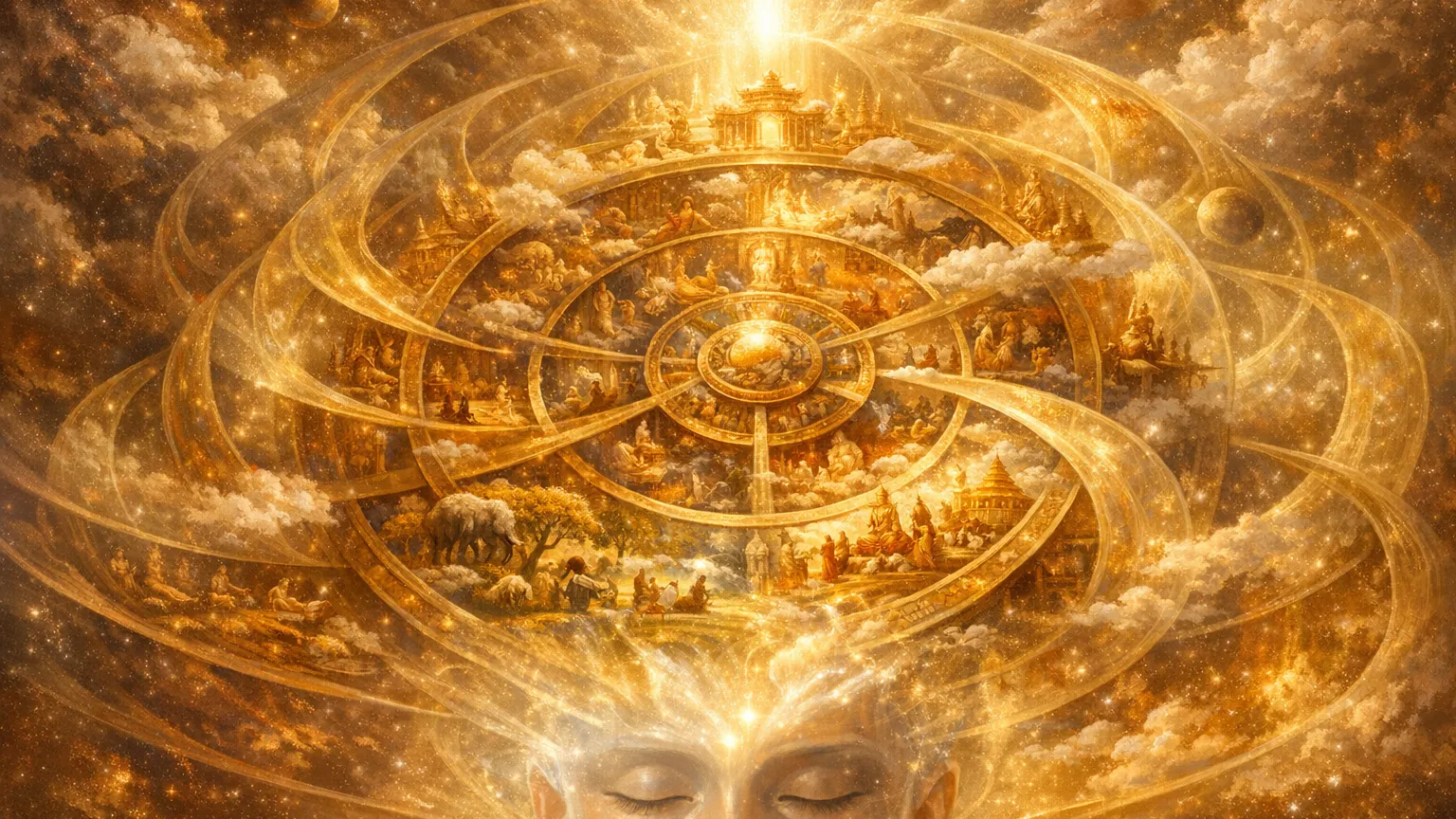
All this is one large wheel of samsara. This wheel of samsara is created by the mind. It is the mind that generates hellish dimensions, heavenly dimensions, asuric dimensions, and the human world. When a person leaves the body, their mind creates heaven or a hellish dimension in which they suffer, and eventually, they take a gross physical body in one of the worlds and are reborn. But it is the mind, if it is cut at the root, that becomes pure, devoted to the Divine Source, and contemplates the Divine Source. If it is surrendered to God. Our task is to cut this mind at the root through the practice of upasana, worship, faith, devotion, and contemplation. And to do it so deeply that the primordial Divine Consciousness opens during one's lifetime.
The Seven Stages of Wisdom and Signs of Realization
When the mind begins to think about God and contemplate Him with the help of non-dual sankalpas, it can continuously and steadily abide in the divine dimension. And the signs of realization come in this life. Then the attainment of the state of a jivanmukta becomes possible. There are specific signs of realization that indicate this state has been achieved. Such jivanmuktas can be identified by the stages of the Teaching of the sixteen kalas, or by the "seven stages of wisdom." For example, the state of a jivanmukta is the sixth or seventh "stage of wisdom." A state of ordinary enlightenment might be the fifth. A state of partial enlightenment might be the fourth. The state of an earnest seeker is the third. The state of an unsteady seeker is the second. And the state of a beginner is the first "stage of wisdom." Our task is to practice so as to rise as high as possible through these steps of the "seven stages of wisdom."
When you have the question of how to be liberated and reach enlightenment in this life, the guru says: pass the exam for the fifth level, fulfill the requirements of the fifth level. There is your Liberation, there is your salvation. Strive for it. Of course, this is not a school exam, and it is not that easy to pass. The theoretical part is the smallest bit. it includes practice, it includes meditative experience, and it includes dhyana and samadhi. We have such exams. You don't need to invent anything; just pass this exam. But before the fifth level, at least pass the first level. Because it is impossible... I practiced martial arts and I know that there is a step-by-step process everywhere. If you are a beginner and you come and say: I want to become a black belt master. They will tell you, right now you have a white belt, try to pass for the yellow one, and the black one will come later, after the green, after the orange, after the blue, after the brown. Then there will be the black belt. But first—this. It is the same here.
If you strive for Liberation, to rise to the "fifth stage of wisdom," you must start with the first. With the first step. The first step in our Teaching might correspond to the first stage of wisdom, or perhaps the second, depending on your level. This is the secret of Liberation. We must perform tapasya, we must perform sadhana.
Reasons for the Lack of Signs of Realization
Why do signs of realization not come to many? Sometimes people practice—there are many spiritual seekers now, many seekers study the teachings of Vedanta, the teachings of Tantra, travel to India—but there are no signs of realization. Why?
Simply put, some practice without a spiritual teacher, without a guru, without a teaching, without a guru-parampara. Therefore, they achieve nothing; they do not receive diksha, they do not receive initiation, they do not have a guru-mantra. And if there is no diksha, all the mantras they chant are a useless waste of time. Only concentration practice, nothing more. Because when you chant a mantra, you must receive it from a reliable source. Grace and blessing must flow through it. This must be preceded by a samskara; the mantra must be transmitted. Inside the mantra exists the energy of the deity, the deva, and the energy of the rishi; it needs to be unfolded. How will the deva and rishi manifest in this mantra if the mantra was taken from the internet or a book? No self-respecting rishi will want to enter such a mantra. He will ask, where is the parampara, where is the guru who will take responsibility for the disciple, where is the disciple as a vessel, where is the samaya connection, where is his faith and refuge? It is impossible. The signal of grace, the impulse of anugraha, will not pass through such a mantra. This is what many seekers are doing. Then such a mantra will work in a magical sense, giving some temporary success, but it will never give grace and Liberation. It is useless without diksha. Therefore, diksha is necessary. If diksha is necessary, then someone is needed to perform it, a connection is needed; this is the guru principle. Therefore, those who practice without a guru, without receiving diksha, cannot practice fully. This is one of the reasons why there are no signs of spiritual realization.
The Importance of Studying the Shastras
Other people, it happens, do not study the shastras. We must rely on the shastras. We must not invent our own theories. We must study our own tradition well. One's own tradition is deeper than any theories we can invent. It is deeper than any scientific theories created over all five thousand years. Actually, the shastra itself is a scientific spiritual theory of the highest order. We must study it; we must master it. No modern theory—scientific, psychological, theological—can surpass the shastras. Why? Because the shastras were given by Ishvara, the creator God. For example, the Vedas, Upanishads, Tantras. We must base our practice on the shastras. When a person does not rely on the shastras, practices, and has no guru, then there is no one to comment on the shastras; then there is a high probability they will have a false view, incorrect contemplation, and they will not receive the fruit of practice either. Shastras give us yukti, correct reasoning. This is a great jewel.
Correct Attitude Towards Mystical Experience
Sometimes spiritual seekers strive to gain mystical experience without knowing the shastras. If they practice, sometimes experience comes. It can even come from using LSD, even without practice. But the question is not about getting a mystical experience, but about having the right attitude toward it, about correctly liberating oneself from the experience. Because any subtle mystical experience makes a colossal impression on the soul, changing the line of destiny and its perception of the world. If it is a deep experience. We are not talking about superficial experiences. Any serious experience radically reshapes consciousness and changes the line of destiny. The question is: how do we relate to this experience? Shastra gives us the teaching on how to correctly relate to mystical experience. If we experience a mystical state without knowledge of the shastra, this experience can become a new stumbling block and a cause for a new rebirth.
For example, an astral experience is felt, a fascination with the astral experience arises, a connection is established with a loka of the astral world, a new fixation is established—the fixation is transferred from the physical body to the astral one, the mind becomes captivated by the subtle form in the astral world, where rebirth will occur. This is not about Liberation. The causal body, the causal world, is experienced. If the yogi does not know the shastra, they do not know how to relate to the causal world. The causal world is so deep, the causal body is so incomprehensible and captivating, that a connection with the causal world and the causal body arises. Where will the rebirth be? In the causal world, in the causal body. For example, pralaya-kala. But all this is not Liberation, it is not moksha, it is not the state of a jivanmukta; it is missing the target.
What does the shastra say? The shastra says that it is not the experience you undergo that is important—experience is good, it is a certain stage of your spiritual evolution—what is important is your ability to be independent of the experience. Because Liberation is the transcendence of any experience, going beyond experience of any level. Or it is an experience of a higher order, where there is freedom and independence from experiences of a lower order. In other words, the shastra of the Vedic or Tantric tradition very firmly establishes a hierarchy of experiences. It says: some experiences we should reject, and others we should strive for. It describes in great detail lower experiences and higher experiences, which ones should be rejected, and which ones should be sought.
What is this higher experience that should be sought? This experience is called Turiya. In the Svacchanda Tantra, it is said that a yogi must realize turiya. He must establish himself in it and check the authenticity of his turiya with a knowledgeable spiritual teacher. Then he must extend the state of turiya to the lower floors of consciousness. That is, into dreamless sleep, into dreaming sleep, and into wakefulness—jagrat, svapna, sushupti. He must pour the state of turiya into the underlying subtle and gross bodies. Shastra gives a detailed description of different types of consciousness, how turiya differs from other types of experience, and how to do this. But if we do not master the shastra ourselves or do not have the transmission of the shastra from a guru—and the guru transmits only the reasoning of the shastras, naturally from his own understanding and experience—it will be difficult for us to navigate these experiences.
Formal Acceptance of Diksha
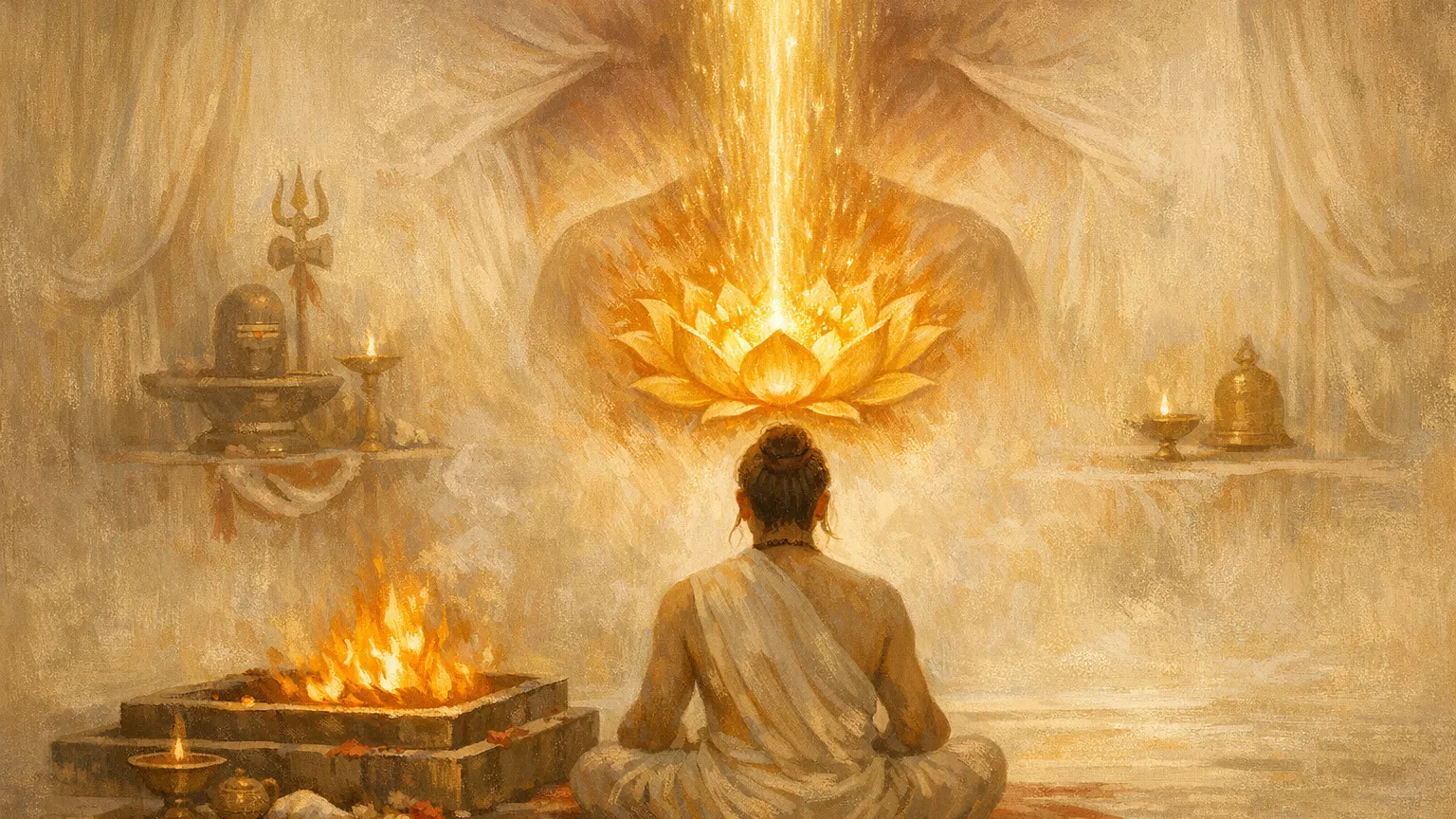
It happens that a spiritual seeker accepts a guru, receives diksha and initiation, but still has no signs of realization. Then one might ask, why? Perhaps they accepted diksha, but it happened formally. Their heart did not accept the diksha. Someone said that diksha is given there, not expensive. A group from the city is going, five people or so, you can get something there, listen, it's interesting, trendy. You can be called by a spiritual name. But diksha is a confirmation that we have matured on the path in the tradition of Sanatana Dharma. It is a confirmation that we are devoted to the guru, that we are devoted to the chosen deity, we are devoted to the Path of Liberation, that all of this is serious, that we are making a spiritual choice for a lifetime, and that the name we receive during diksha should be used by us for real, at least among samaya brothers and sisters. If your relatives do not call you by it, you shouldn't force them, saying that's it, I no longer exist for you under that name, call me only this. We do not oblige worldly people to conform to our spiritual standards. As the masters say, we must allow sentient beings in samsara to be sentient beings in samsara. But when we act for ourselves, communicating with sadhus, it is important for us. Diksha implies that we accept it with all our heart.
But it happens that if faith is insufficient, then the accepted diksha does not result in signs of realization. Sometimes a person receives diksha but fails to observe all its rules and vows. For example, karma-sannyasa is a serious status; although it is not monastic, it involves following various principles, such as constant service and constant sadhana. Before karma-sannyasa, we might say there is no time to do service, I was busy, I had no time to do sadhana. But once we have accepted karma-sannyasa, it’s already awkward; we swore before the altar to do it. Before karma-sannyasa, we might not follow many things. After karma-sannyasa, we might also fail. No one will tell us otherwise, but it is already a matter of our choice, our conscience, our values, our aspiration. Therefore, when we accept something, we must follow it. In karma-sannyasa, vows are given so that we can extract spiritual wisdom and spiritual power for ourselves. We do not accept them for someone else. The teaching is not for someone else; it exists for us. But it happens that if faith is small, it is difficult for a person to observe the vows of karma-sannyasa. Then they simply do not follow them, and then there may be no signs of realization. There definitely won't be. If you follow the principles of karma-sannyasa—and purna-sannyasis follow the principles of purna-sannyasa—you will certainly extract both spiritual wisdom and power from what you follow.
Obstacles on the Spiritual Path
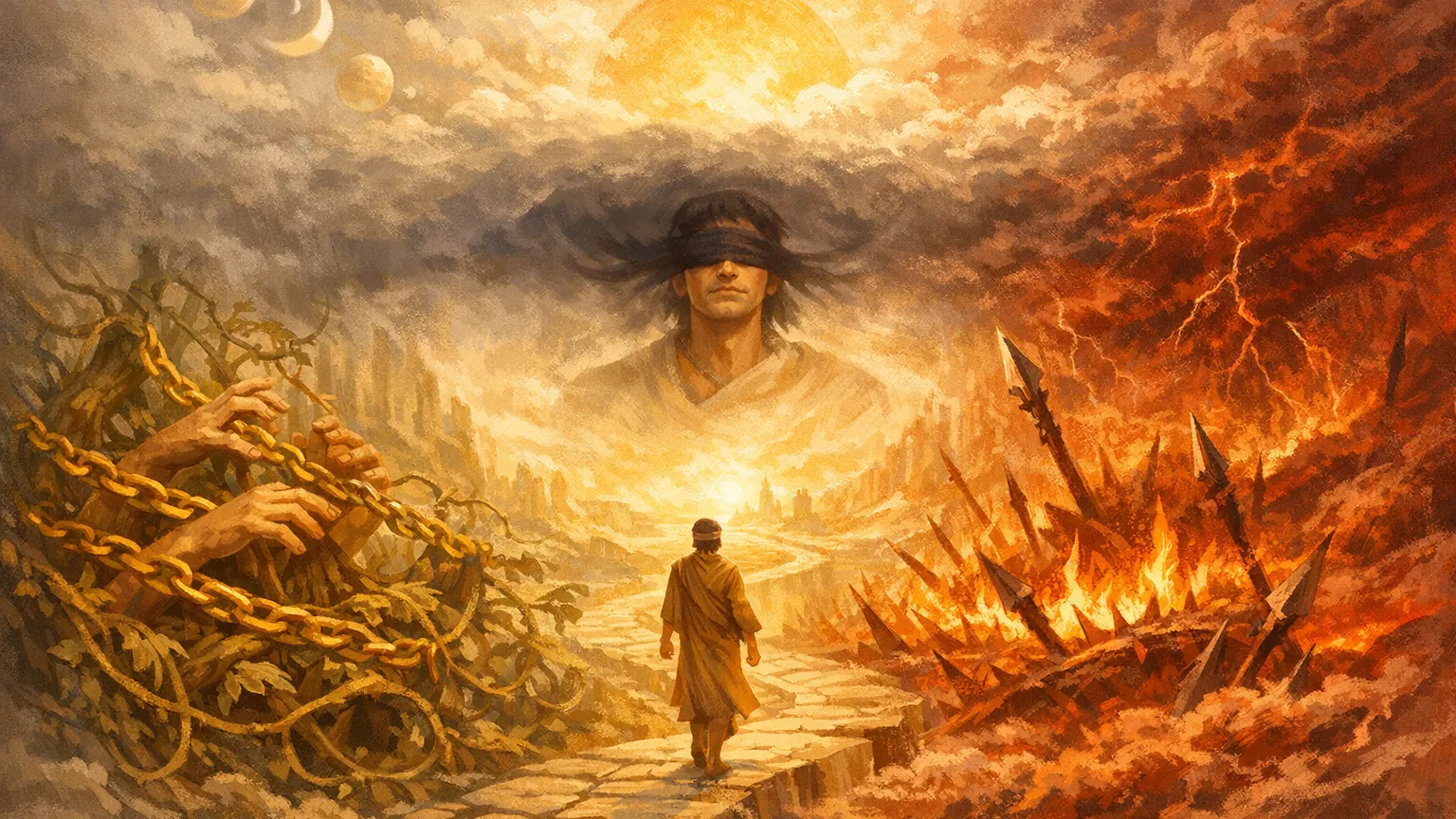
It happens like this: a person receives diksha, studies the shastra, follows the principles and vows, but there are no signs of realization. What is the reason? One must look deeper; perhaps there are problems in the horoscope: Rahu, Ketu, Sade Sati. Even if we have done everything perfectly, we are not insured against obstacles. Because we are karmic beings, subject to karma. The planets mirror and remember all our actions and return them to us in this life. Then we must look at the horoscope, order a horoscope from a Vedic astrologer. We must choose upayas, consulting with the guru, some special methods to neutralize Saturn, Mars, or something else, some malevolent planet.
In general, astrologers—Vishvadeva told us—say that according to astrology, when we are born, there are more malevolent planets than benevolent ones. There are more grahas than vidyas. This means we have a certain set of karma. It is against karma that a sadhu fights on the spiritual path to purify and transcend it. Due to a bad horoscope, there may be no signs of spiritual realization, even if you do everything perfectly, observe the principles, possess faith, do sadhana, and study the shastras.
The Importance of Samaya
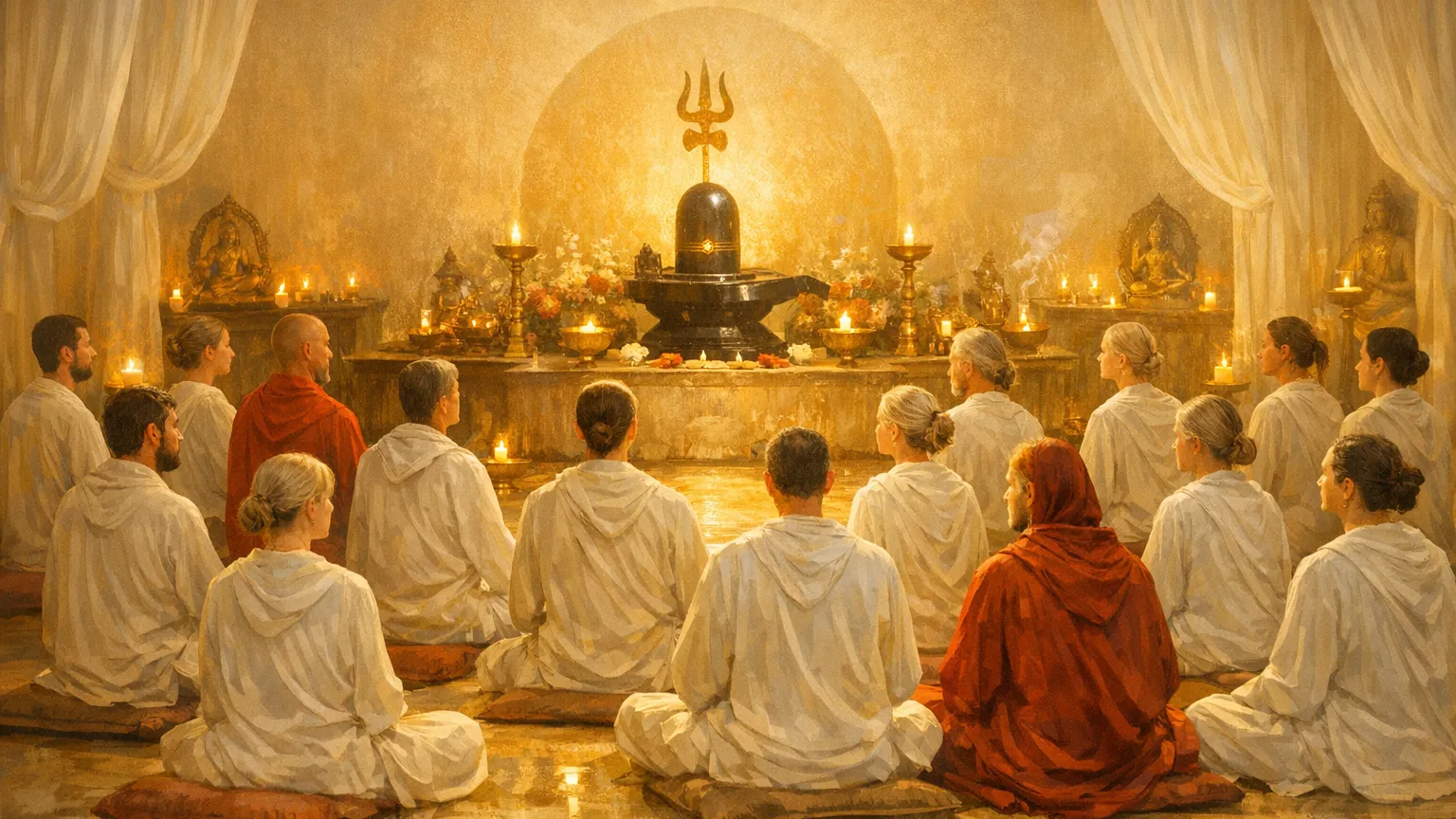
There is another reason why there may be no signs of progress or spiritual realization. This is difficulty with observing samaya. Samaya is very important; samaya means that we commit to establishing pure relationships based on the fourteen root vows and to carrying them throughout our lives. If your faith is strong, your refuge is strong, and you understand what pure vision is, samaya is not difficult to observe. But it happens that we forget everything, and some friction arises in the relationships between samaya brothers and sisters, some judgment, dissatisfaction, or impurity arises, and this can poison our samaya. If we didn't notice it in time, didn't purify it, didn't repent, it can also hinder spiritual life. This too must be looked at and purified.
Ultimately, if our samaya is pure, if our faith is strong, if our refuge is impeccable, if our sadhana is strong, if we follow the shastra, the guru, the prescribed sadhana and tapasya, we will certainly receive signs of realization. After all, the point is not just to study the teaching and follow it, but to become the teaching oneself, to gain the same experience described in the Yoga Vasistha.
For example, the text "Yoga Vasistha" is such a direct guide. Rama achieved enlightenment with the guidance of Vasistha. When you accept a guru, the guru plays the role of Vasistha; accordingly, you accept the role of Rama. If you practice in this way, you should get the same experience as Rama. This is the meaning of training, sadhana, and the guru-disciple relationship. Но in reality, it's not all that simple. We face many limitations, many obstacles and difficulties. Then the guru says: well, Rama was in the Dvapara Yuga, and now it's the Kali Yuga. Or, Rama is an avatar, he was divya, but who are you? Maybe the guru won't say it like that, but a dharma brother will.
Two Christian novices in a monastery were doing their obedience, their work, then it was announced that the power would be cut off, and they were running late with their service, and lunch was delayed. One novice was very dissatisfied with this and said: what kind of life is this, the work is such that there is no time to pray, the power is cut off, and lunch is moved. The second one was more experienced and wiser, and he said: listen, are you a sinner or not? If you are not a sinner, you must be a saint already. The first one said: probably. So, a sinner? For sure or not? They have it so clearly defined. He said: probably a sinner. And why should everything be good for you, a sinner?
Patience and Humility on the Spiritual Path
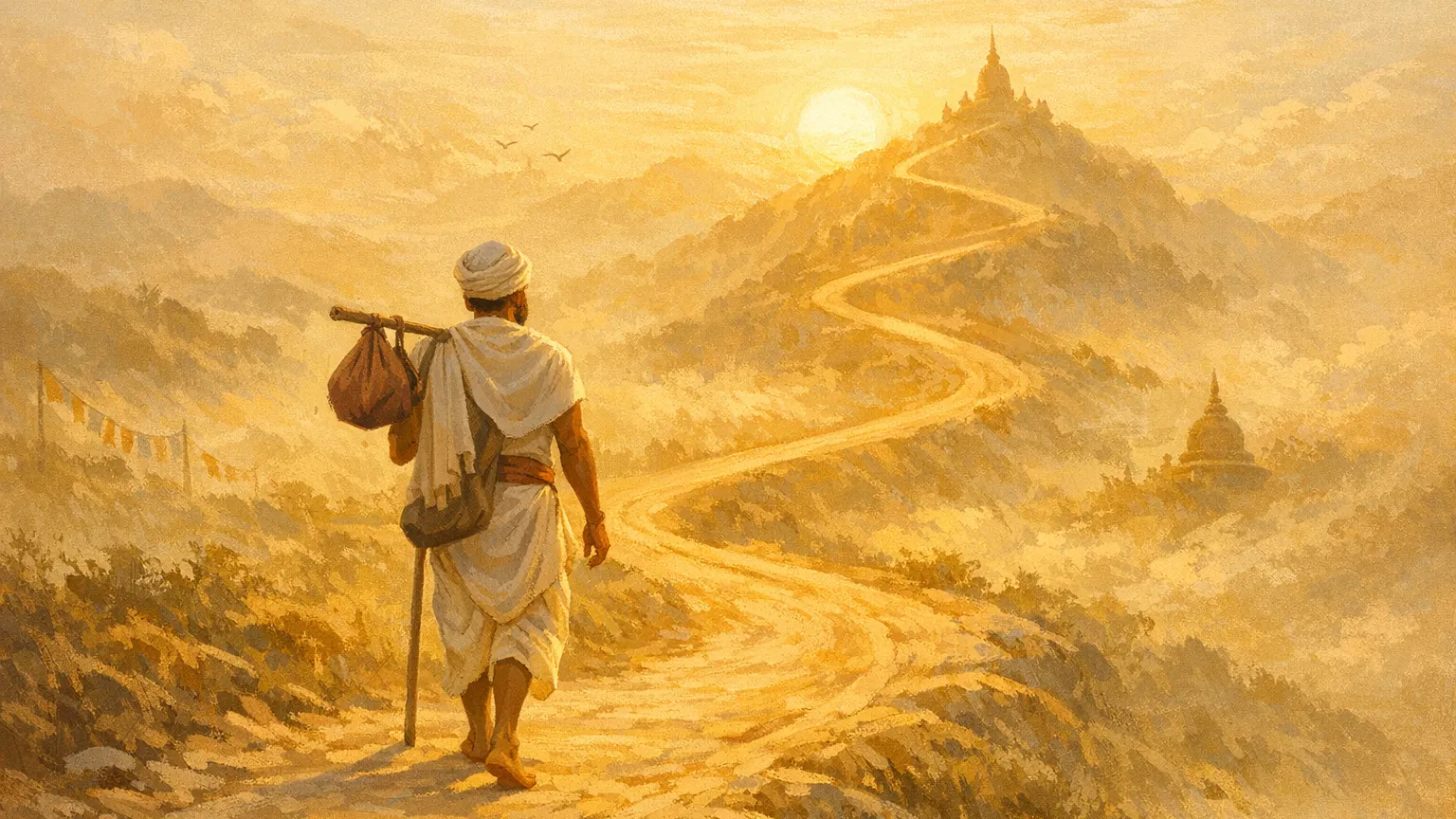
We come here with a load of karma, and one should not expect too much success in the first years of spiritual life. One should stock up on patience and humility and just practice. Then success comes. Karmas are purified. Usually, an inexperienced novice or a karma-sannyasi disciple sets a goal to achieve enlightenment in the first two years. He came to an enlightened guru, to a sangha where they talk about enlightenment, so he should be among the first to reach enlightenment. Но monks who have practiced for more than twelve years know what this path is and what they will have to face. That the first twelve years are not intended for enlightenment; they are intended for purifying the mind, cultivating the qualities of a sadhu, developing concentration, self-discipline, shaving off worldly patterns and stereotypes with which we are simply hardwired from head to toe, and simply for studying the teaching and becoming a normal sadhu. But he wants enlightenment right away.
Anuttara Tantra and the Four Padas
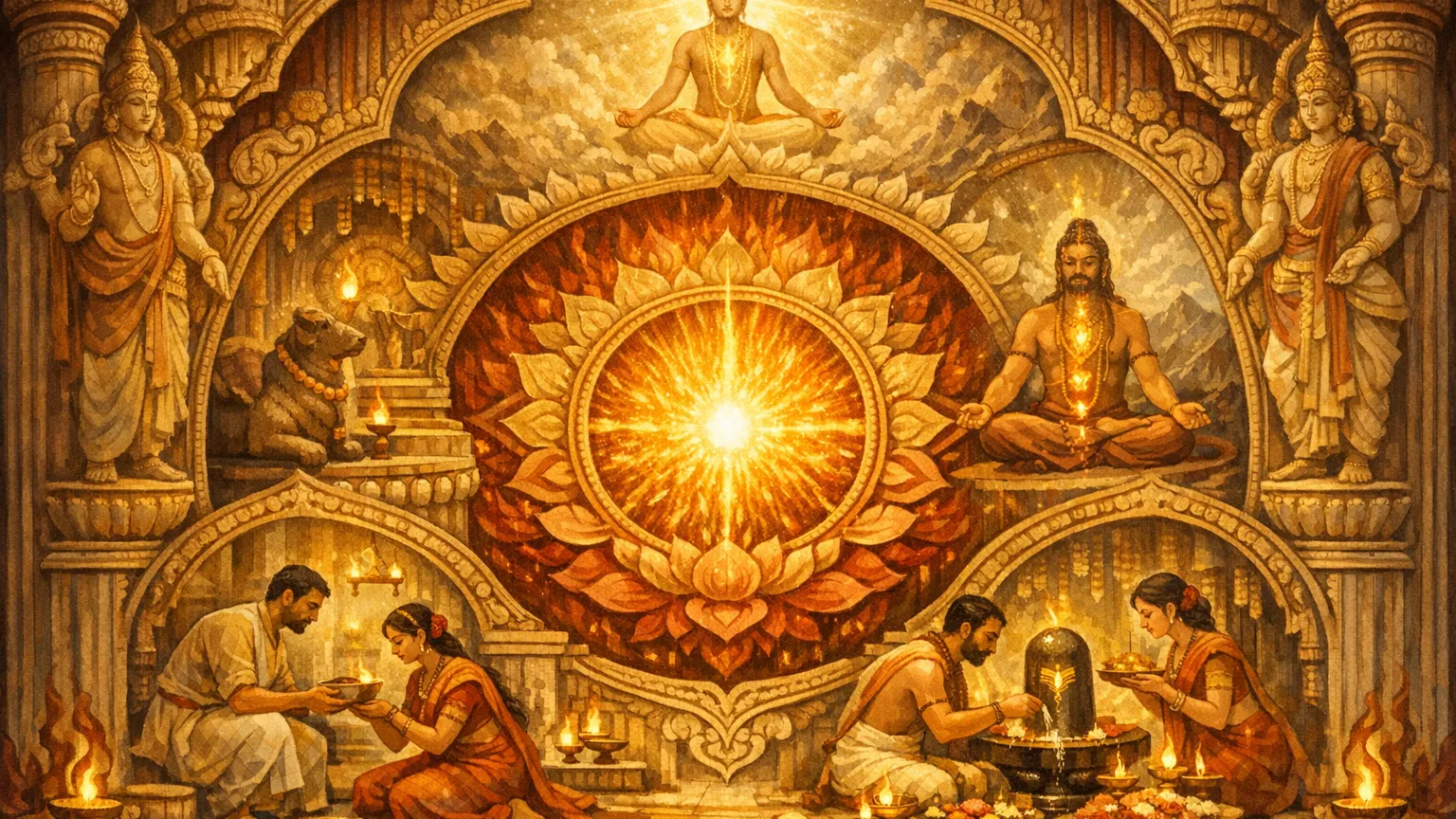
The teaching of Anuttara Tantra does not forbid this; it says: if you want to be enlightened immediately, be so. No one forbids it; everyone will only be happy. Therefore, the teaching of Anuttara Tantra is transmitted not quite traditionally, as in the four padas of Shaiva Siddhanta. In the four stages of Shaiva Siddhanta, the path of charya, righteous behavior, is transmitted first: karma yoga, discipline, vows, and observation of pilgrimages. Then the kriya-pada: cultivation of faith, devotion, upasana, and worship. Then the yoga-pada: Vedic practices, meditation, concentration, kundalini yoga, shat-chakra yoga, and yoga of the illusory body. Then the jnana-pada: transmission of the mahavakya "Aham Brahmasmi," direct introduction into contemplative presence, shravana, manana, and nididhyasana.
But when it comes to Anuttara Tantra, a direct introduction is given immediately, and the disciple must try to immediately enter the closest possible enlightened state. And then, however they maintain it—depending on how much they are able to maintain it—they must apply upayas of lower orders: yoga-pada, kriya-pada, or charya-pada.
Signs of realization will certainly come if we hold onto our refuge, if our faith does not decrease but deepens, if our samaya is pure, and if we hold onto our vows and perform tapasya. If we do not trade ourselves for worldly vanity, but do seva, sadhana, and svadhyaya. Regardless of whether one is a monk, a sannyasi, or a karma-sannyasi, signs of realization come, and we can see which "stage of wisdom" we are attaining.
Vasistha says to Rama:
Cut the mind at its root with the help of the mind itself and cast away the thought about the mind that denies the mind. Thus, you will eventually destroy the illusion of the apparent world.
The Four Levels of Spiritual Practice
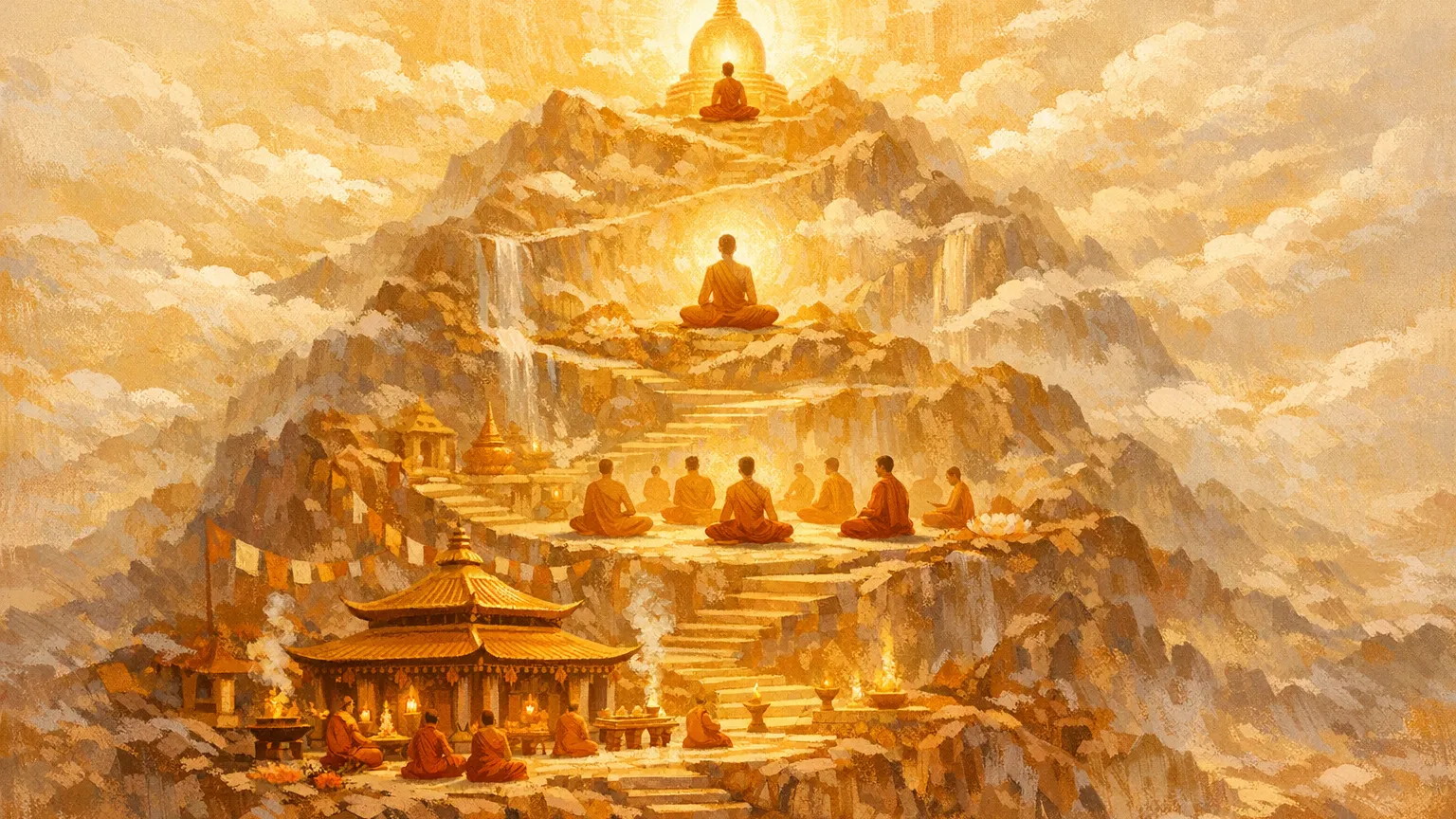
Spiritual practice has several levels: outer, inner, secret, and transcendent. The outer level is what concerns our social life, what we do, how we dress. For example, it can be seen that a person wears a mala, prayer beads, orange clothes—it's immediately obvious they practice. They wear white clothes, receive diksha. This is all the outer level.
The inner level concerns our learning, our reasoning, the flow of our thoughts. Whether we think in accordance with the sacred texts, whether we look at the world through the eyes of a sadhu, or whether we look at the world through the eyes of a layperson. This is a big question. This is the inner level. How we reason on topics of the world, economics, politics, relationships, views on men and women, nationalities, races, religions, scientific achievements, and consumer culture as such—through what eyes do we look at all this. One can look like Vasistha, like Dattatreya, or one can look like a worldly person; this is the inner level. Practice on the inner level means: teaching one's mind yukti, reasoning, like that of the saints.
Finally, there is the secret level. The secret level is not connected with the mind or evaluative judgments; it is connected with our ability to abide in awareness and practice subtle internal methods. For example, on the outer level, I may be sitting right here before you in a physical body, but on the secret level, I may simultaneously be in the palace of Dattatreya and have a three-headed form with six arms. And transform you into deities, and transform this place into the palace of a deity, and abide in the mandala, while simultaneously looking like a human on the physical level. This is the secret level. Or on the secret level, I can practice shambhavi mudra, divine pride, any of the twelve sankalpas at the subtlest level of the layer of consciousness. Simply abiding in natural awareness. In the same way, you can do the same. On the outer level, you may be like an ordinary sadhu, but on the secret level, you can abide in a deep state of contemplation.
Following the instructions of Vasistha, we must understand these three levels. These three levels correspond to: Sanatana Dharma — the outer level; the inner level — the philosophy of Advaita Vedanta or Shaivism; the secret level — the practice of yoga, yoga of the illusory body, or laya yoga; finally, the transcendent level is Brahman Himself, the Absolute, abiding in non-dual transcendental consciousness.
Vasistha says: with the help of the secret level, cut the mind at the root and cast away the thought of all concepts. If we have succeeded in establishing ourselves in primordial awareness and cutting at the root the mind that enslaves us by giving evaluative judgments, then the processes of internal creation, pancha-kritya, at the level of ourselves as a microcosm, cease to condition us. Then the energies of creation, maintenance, destruction, and concealment, which are continuously generated by our mind, cease to condition our eternal divine essence.
You will eventually destroy the illusion of the apparent world. When it disappears, misunderstanding will not arise again. The mind will no longer create apparent worlds.
The Mystical Experience of the Present Moment
Our mind creates apparent worlds and is conditioned by them because of misunderstanding. And conversely, because of misunderstanding, it creates apparent worlds. For example, our current life. It is also a mystical experience. This is a powerful, full-fledged, three-dimensional mystical experience. Imagine you are meditating and you experience the three-dimensional experience of a physical body. This sometimes happens.
One yogi, meditating in a cave, entered samadhi. In this samadhi, he created a body for himself in the form of a woman. In the form of a woman, he created a body from the five elements and began to preach his teaching. And since it was a young woman, rumors about this spread somewhere in the region of Tibet. Many scholars and pandits were surprised that some woman was transmitting the teaching with great power and might. The pandits wondered if it was the right teaching. They were surprised that someone other than them could transmit the teaching. They did not know that in reality it was not a woman, but the mind-created body of an ascetic. When they met with this woman and talked, this woman said: actually, I am illusory, and there is an ascetic over there in the cave, he is meditating, he created me. They went to that cave and saw this ascetic; they were extremely amazed.
The mind can create reality. In the same way, our three-dimensional physical body and this three-dimensional world are also a mystical experience of our soul, which is meditating, perhaps not quite skillfully. And how do you like this mystical experience? Do you remember yourself, that you are in meditation? Do you remember who you are? Do you remember that your goal is to achieve liberation from rebirth? Do you remember with what intention you sat down to meditate? Don't you remember the moment of forgetting? When everything went somehow wrong. At what stage did your thought develop so much that you entered somewhere into this body, into this world? And where are you now anyway? Where is your true state of mind? Where is your original home? Have you forgotten about it? Here it is, the mystical experience, right now. Our task is to return to this original mystical experience, to restore our initial divine consciousness. It seems we have been distracted very seriously. In this distraction, we have firmly established ourselves, identifying with karma. Therefore, a long time is needed for practice.
Performing Dharma Without Attachment
Further, Vasistha says:
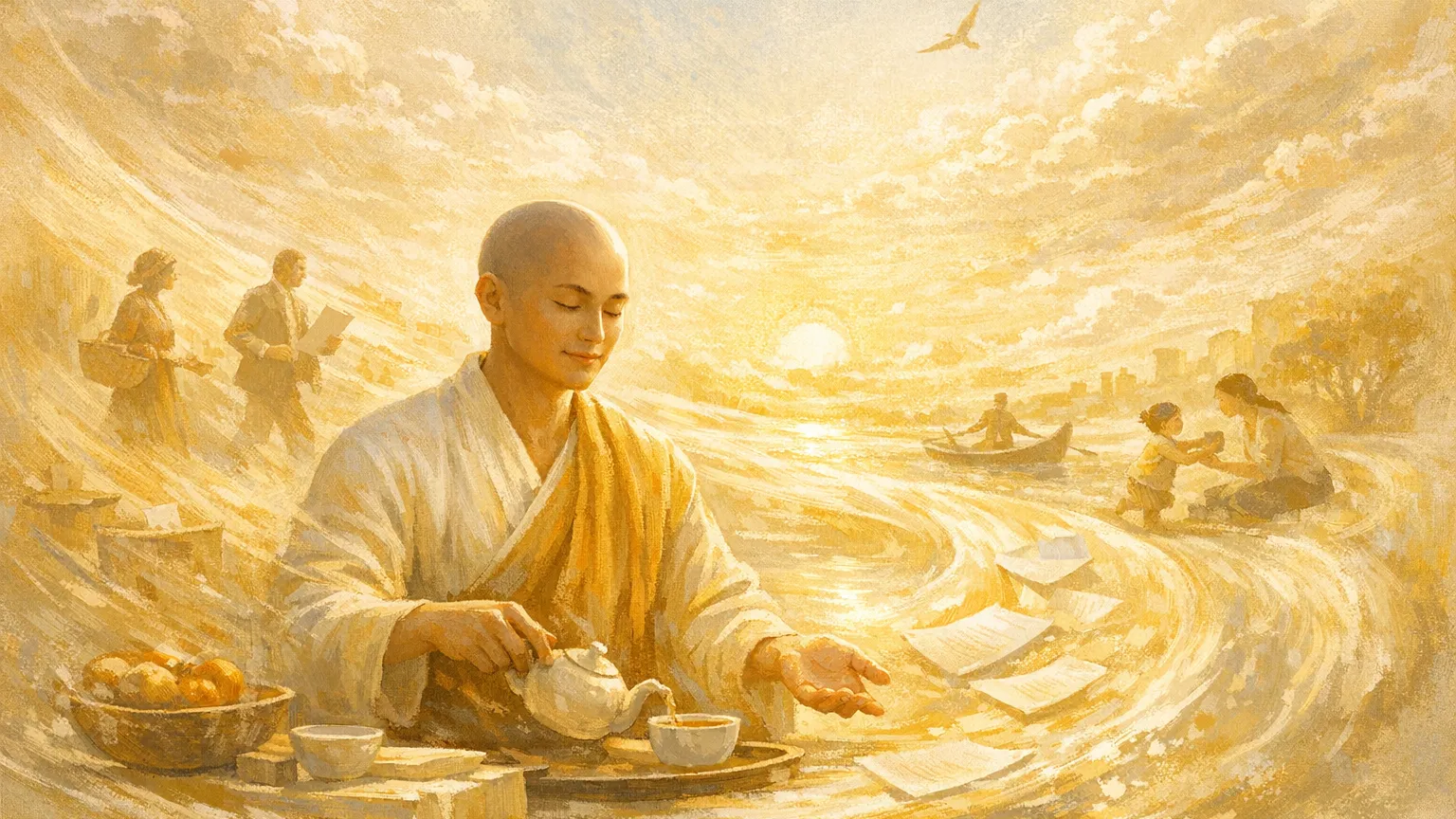
Abide in the awareness of the unreality of everything and give up all hopes and expectations. Let it only seem that you continue to act in this world.
Deep in our souls, we must detach ourselves from the illusion of this world, but outwardly perform our duties, perform our dharma. If you are a karma-sannyasi, please perform the duties of a karma-sannyasi. Do not try to perform the duties of a purna-sannyasi. It happens that a person receives karma-sannyasa but tries to live like a purna-sannyasi. But if he has the diksha of a karma-sannyasi, it is assumed that he will get wisdom and power from karma-sannyasa. But sometimes the opposite happens: a person becomes a purna-sannyasi but tries to perform the dharma of a karma-sannyasi. If you have a family, do not try to perform the dharma of a monk; otherwise, you will be unhappy, and those close to you will also be unhappy. But if you have monastic diksha, do not try to perform the dharma of a householder. You will also be unhappy. Monks may not be unhappy, but they won't understand either.
In other words, one must perform that dharma into which we received transmission, blessing, and initiation, into which we have diksha. This is important. It is assumed that it is through this dharma that we go to Liberation. But when it is received, it must be performed one hundred percent; only then can it bless us. And what happens if we are not satisfied with our status? If we have tried and it doesn't work for us. We can change our status, we can choose; spiritual life exists for us. If you received karma-sannyasa-diksha, it does not mean that you must be a karma-sannyasi for the rest of your life. One should try in another status, in the status of a vanaprastha or in the status of a sannyasi. Choices are possible. Но when you have received some diksha, it indicates that we have chosen this status, we need to respect it, and we need to fully follow its principles, rules, and prescriptions. Then it will endow us with power and wisdom.
A sadhu who abides in awareness performs his duties, performs his debt. This is his dharma in accordance with his diksha. At the same time, he should not be attached to the fruits and results; he should seek nothing but Moksha. He should only demonstrate this outwardly. Someone might ask, if he shouldn't be attached to anything, shouldn't strive for anything but Moksha, why demonstrate it outwardly? Who is there to deceive? This is necessary because there is karma. This karma must be lived out in the status you have chosen and in which you received diksha. When the karma is exhausted, you will understand for yourself. Perhaps your status will change, or perhaps you will simply achieve Liberation.
Question: Guruji, in the Yoga Vasistha there is a story in which a sadhu, having achieved some realization, remembers that he left his body, which has long since decomposed or dried up. And in Christianity, it's the same. He was carried away by some mystical experiences. He remembers that he had a body that sat in a cave somewhere. And in Christianity there is also such a mention, that they will enter the graves and rise from the dead...
In Christianity, rebirth and reincarnation have not been recognized since some council. All councils banned reincarnation. Perhaps some Christian saint had a personal experience and described it that way. There was a Russian philosopher, Nikolai Fyodorov. Based on this theory, he created his own theory about the restoration of all ancestors as genetic memory, their deification. He had a dream of making humanity immortal, of resurrecting all his ancestors and all the ancestors of humanity. But in reality, Liberation is detachment from past bodies and from the present ones, the opening of turiya, the dimension of turiya. It doesn't matter what body sits in the cave, illusory or real; from the point of view of Liberation, they are both illusory. By the power of consciousness, one can create any body of any density, so that the illusory will densify and become real, and the real will dissolve and become immaterial. If the mind is immersed in the Supreme Source, then wherever and on whatever Consciousness focuses, that it manifests. And here there is no logical linear connection.
Vasistha says:
Being in peace, doing what is appropriate for each situation, continue to live without effort. Just as it can be said of God that He does or does not do all things here, so you live without effort, doing and at the same time not doing what must be done.
