

16 Stages of the Waxing Moon of Inner Awareness (Kala)
We continue to study “Precious Instructions on the 16 Stages of the Waxing Moon of Inner Awareness.”
Our awareness is likened to the moon, which waxes from phase to phase. Awareness has the property of increasing if we work with it correctly. Why does awareness need to increase? In order to fully reveal our potential and grant us the opportunity to become free from being bound by the laws of cause and effect. With the awareness we have now, it is impossible to become free from the law of cause and effect; therefore, we must be very interested in our awareness increasing.
The First Stage: Dissatisfaction
Yesterday we found out that the first stage is called “dissatisfaction.” Impermanence, suffering, and death are connected with it. When we experience them, all of this is realized very acutely. This is not some abstract philosophy. A person who does not reflect on impermanence does not assess entirely adequately the situation in which he has found himself by being born in the material world. That is, he considers the material world to be some permanent and reliable refuge, he trusts it, and this is a fatal mistake, since the material world is not a reliable refuge.
I read that Bhagavan Shri Rajneesh traveled a great deal and rode on trains. His grandmother, who cared for him very much, said: “According to statistics, there are many train wrecks, and you travel so much! It is very dangerous.” Then Shri Rajneesh said: “Grandmother, but according to statistics, even more people die in their beds, and you sleep in yours every day! It is very dangerous.”
In general, life itself in samsara is dangerous if we have not attained liberation. This is the whole difficulty of human birth. If we were immortal gods, controlled time, space, sequences of events, and had many bodies, then we would say: “We like this world. We very much want to remain in this same status and continue to enjoy ourselves and have fun here.” But since we are not gods, there are very many uncontrolled factors. We do not know when one factor or another will wedge itself into our destiny; we cannot even foresee it. Nevertheless, these factors always wedge themselves in, since time exists.
The lesson a person receives at the stage of dissatisfaction is great humility. He thought he was really something! But for now he amounts to nothing; in samsara he is still no one, he has yet to become someone. He is not yet God, and therefore he does not control reality. He cannot even truly enjoy himself, since long-lasting pleasures are impossible in the material world. And the realization of this is always the strongest kind of experience, which is felt very acutely, because you thought you were young and strong, that you were the master of life, but it turns out that everything is the opposite—life rules over you.
It is precisely such an acute experience that prompts one to take responsibility for one’s spiritual practice and begin to engage in it seriously, since you begin to understand that you control nothing in this world, that if you continue in the same spirit and your consciousness does not develop, then these uncontrolled factors will someday scatter all your plans and goals, and nothing will remain of them.
Whoever doubts this should think about where the plans of Alexander the Great are now, who conquered half the world; where are his great ambitions, his great power, and all his kingdom? Where are the plans of Napoleon, Genghis Khan, and all the other so-called great people? Only memories remain of them now. They are now the dust of history. Do you not think that after some time we too will become the dust of history, that memories will remain of us, perhaps entries in encyclopedias saying that there were such laya yoga practitioners who gathered and talked about the Absolute.
But the question is whether this satisfies us. Of course, it does not satisfy us. Every living being wants happiness, prosperity, stability; it does not at all want to become the dust of history, to be subjected to complete oblivion, and at best to remain two lines in an encyclopedia. The nature of a living being is to develop constantly, to increase its potential, to bloom. We feel that this quality is always inherent in us from within, because we have an immortal part.
From this comes an understanding of the meaninglessness of life in delusion. We come to the conclusion that it makes no sense to continue remaining in delusion, that all worldly meanings are fake, false. And that which is fake and false must necessarily be defined as fake and false. In Sanskrit this is called maya, that is, illusion, delusion. In order to become enlightened and acquire a true vision of reality, one must define maya as maya, and truth as truth.
The Mechanism of Rebirth and Liberation
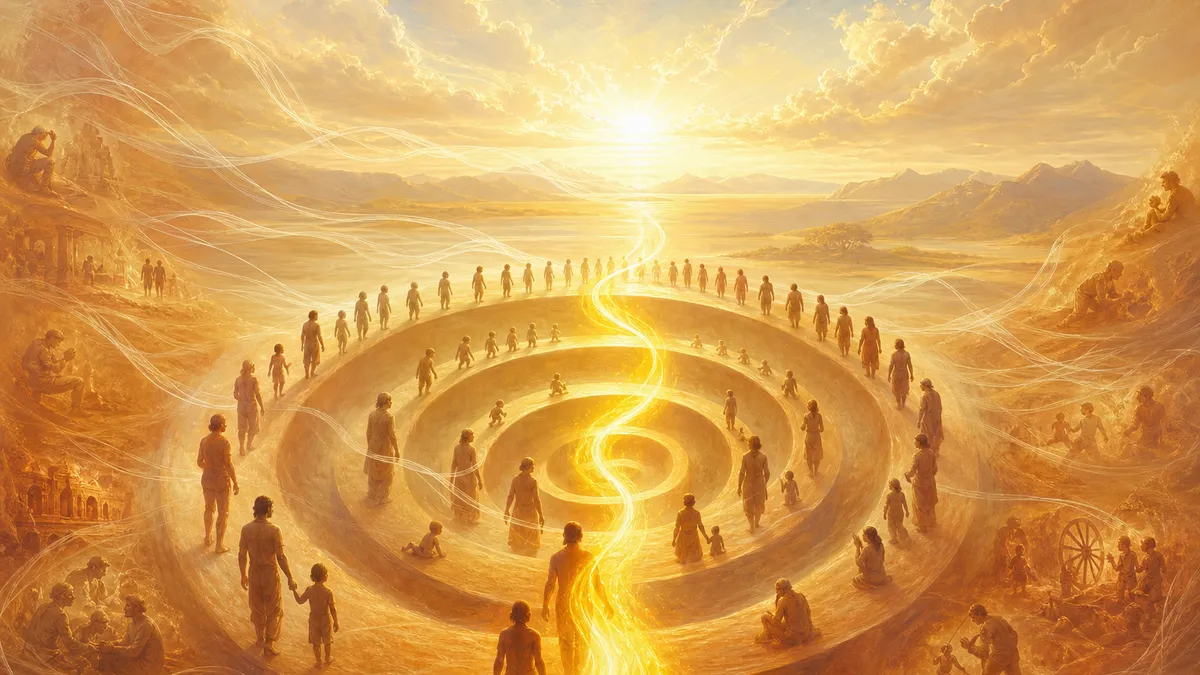
Consciousness, driven by the impulses of past incarnations (vasanas), continuously moves from one body to another, experiencing various desires. Why does it move? Because consciousness needs a body in order to satisfy desires. Desires are not exhausted; they remain from life to life. And consciousness, being reborn, again and again seeks a new body for itself in order to satisfy the desires it has.
Why do such desires exist? Because in the stream of the mind there are mental imprints (samskaras) that create motivating impulses (vasanas). The subtle body, driven by such mental imprints and motivating impulses, seeks a gross sheath for itself so that it can satisfy desires.
Liberation comes when there are no more samskaras and impulses; therefore consciousness no longer needs a gross physical body.
At present we have gross physical bodies. Moreover, we have become so accustomed to them that it seems as though we are these bodies. But in reality this is not so. We are those who drive these bodies, who control them, but we ourselves, as the soul, sit as if inside. We ourselves are not bodies at all. This is a well-worn truth. Perhaps you have read about it hundreds of times, but reading and realizing are different things.
Virtual reality is now spreading. People meet in virtual reality, creating illusory characters—avatars. They can even wave to each other or blow a kiss using an avatar. But they themselves are not avatars; they merely drive these figures while sitting at home at the computer.
This analogy makes it very easy to understand that “I am not this body.” Just as users of virtual reality are not actually avatars, but simply apply their consciousness to these figures and move them, in the same way in this material world we are not physical bodies, but simply move them with our consciousness. We also have many functions: we can wave a hand, spin around, smile, speak. That is, we have very advanced avatars, but the consciousness that animates them is different from them; it is a subtle substance.
Viveka-vidya (discriminating wisdom) means separating this subtle substance from the physical body and understanding that it is very important to develop it, because after a person loses the physical body, it is precisely the qualities, strength, and development of this subtle substance that determine their future. That is, the future of the user of this present body depends precisely on the development of this subtle substance.
The great task of a yogin’s life is to stop the cycle of reincarnations, that is, to break this vicious infinity of material causes and effects. Stopping the cycle of reincarnations is possible only when consciousness is purified and acquires tremendous spiritual strength, when it is capable of resisting all vasanas (inner impulses): anger, lust, greed, attachment, envy—everything that draws it toward the gross body.
Once Swami Rama described such an episode. His spiritual teacher sent him to a certain sadhu. This sadhu was naked and was performing the sadhana of ajagara-vrata (the vow of the python). Ajagara sadhana consists in not going anywhere, but constantly lying or sitting in one place and being immersed in meditation. A person who takes such an obligation remains in one place for several months or even several years and does not move anywhere. This sadhu was in a very blissful state—in samadhi. Swami Rama approached him and tried to awaken him from samadhi, saying:
“Swami, I have come. Could you give me some instructions?”
The sadhu did not awaken, and then Swami Rama tried to massage his feet, as is customary, because he thought this would awaken him. But when the ascetic yogin came to himself, he kicked him so hard that he rolled down the mountain and fell into a lake. Then Swami Rama lost control of himself, became angry, and thought: “Perhaps my guru sent me here to teach him a lesson in courtesy and cleanse his karma. Well, I’ll show him now.” And in great anger he climbed back up. And that sadhu, smiling, asked him:
“Well, how do you feel?”
Swami Rama was beside himself with rage. He said:
“You kicked me so hard, and now you ask how I feel?”
The yogin said to him:
“Your guru sent you here so that you would receive a lesson and free yourself from anger. I gave you that lesson, but it seems you have developed even greater problems with controlling anger. Until you learn to control your emotions, you cannot hope for liberation.”
The subtle body stops seeking a physical body when the stream of consciousness has been purified, when the samskaras and vasanas have been purified. Then the seeds of future karmas are, as it were, roasted in the frying pan of awareness, and therefore will no longer produce new shoots.
The Preciousness of Human Birth
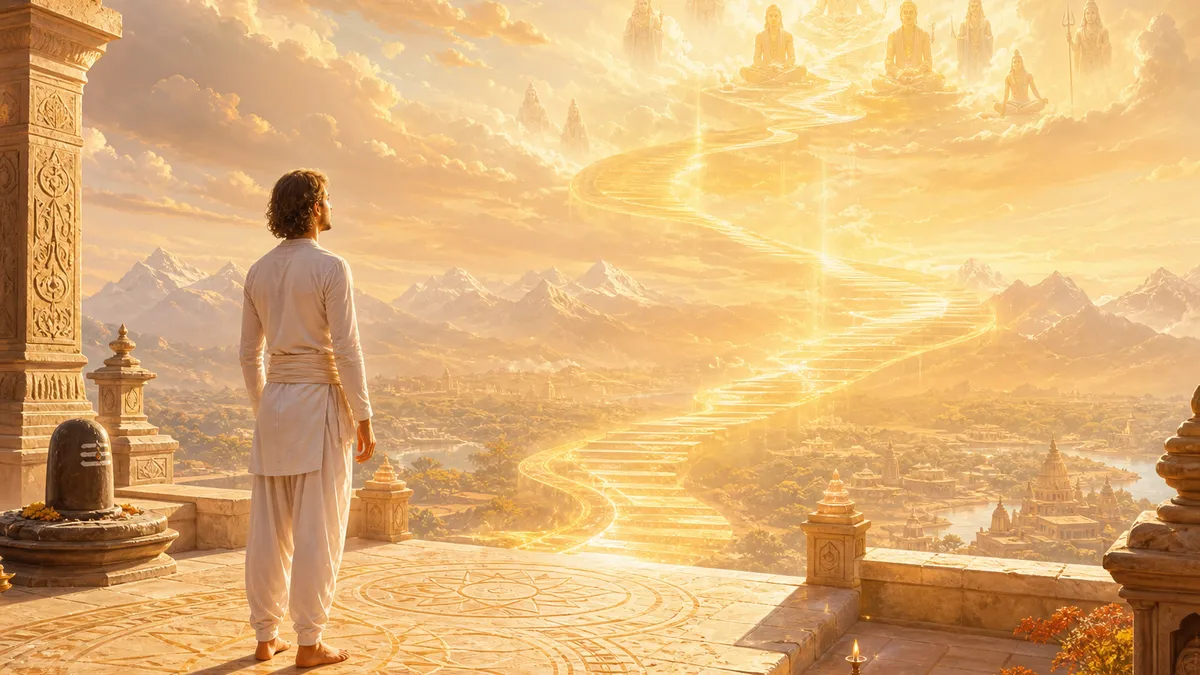
Human life is a unique and precious chance for us, since during this life it is possible to purify consciousness and accumulate the necessary spiritual power to break the cycle of reincarnations and make a decisive leap into the higher dimensions: the worlds of gods, saints, siddhas, and rishis. Human life, or the human world, is a kind of springboard, a launch pad from which one can make such a decisive leap and no longer return here against one’s will. When a yogin returns of his own will, being reborn, sending a part of his consciousness into a body, that is another matter.
The uniqueness and preciousness of human birth lies in the fact that in a physical body one can engage in spiritual practice, contemplation, and inquiry. In many worlds this is impossible, because the intensity of energies there is too great.
For example, the world of the asuras completely absorbs consciousness. There it is impossible to concentrate on inner awareness, since that world is very intense; it takes everything from you as soon as you get there, it demands complete involvement and constant concentration on certain external things.
The world of the gods of the samsaric sphere (kama-loka, the sphere of desires) is also more subtle and intense; it absorbs consciousness with joys and pleasures. In the world of the gods of the sphere of desires, it is also impossible to engage in contemplation, since it is a continuous carnival and fireworks display of pleasures.
For example, right now you are practicing; it may not be very comfortable for you to sit, and sometimes it is hot, but in principle the existing conditions allow you to engage in contemplation. But if you found yourself at a carnival that goes on continuously, where there are only sensual pleasures, where everyone feels good and everyone is joyful, would you be able to practice atma-vichara? Hardly, since the influx of sensual pleasures would be very strong. This means that such worlds are not favorable for rebirths or for practice.
It is the human world that is the favorable world in which one can develop the power of one’s awareness and make a decisive leap. Some saints say that the gods of the kama-loka sphere even line up to receive a human body. Therefore, it is very astonishing that many, having this precious body, do not use such a chance.
The Second Stage: Awareness of Limitations
So, the second stage of the teaching on the 16 kalas is called “awareness of limitations.” Having experienced dissatisfaction, we begin to reflect on its causes and to understand what the essence is. And then we begin to acquire awareness of limitations, for example, the law of cause and effect. We understand that the cycle of rebirths in samsara, the law of karma—all of this is one and the same state of conditionedness, when it is not the person who governs reality, but reality that governs the person.
And when we engage in vichara, reflect on the nature of our own consciousness, conduct inquiry and analysis of our own life, and reassess our values, we come to the awareness of such limitations inherent in the “I” in a state of conditionedness. Such a person comes to the conclusion that he himself and the world in which he lives are limited. There are causes and effects, there is the vector of the flow of time, there are the physical laws of nature, the constants of the universe, which are, as it were, built into us. That is, we are a kind of program into which certain initial settings and codes have already been embedded, which we are unable to change because we are not its developers.
Space, time, the mighty energies of the universe—all these are uncontrollable energies. Of course, the most important limitation is the process of unmanaged, uncontrolled rebirth from one body into another.
Rebirth from one body into another is not an abstraction; it is one of the most important moments in our life, much more important than moving from one apartment to another or entering into marriage with one person or another. It concerns us ourselves. And quite recently (several decades ago) we already underwent such a rebirth.
Saints often compare samsara, that is, the world of the cycle of rebirths, to a water wheel which, as it turns, now sinks beneath the water, now rises out of it. This dependence on mental imprints, on karma conditioned by ignorance, is what is called the law of karma. According to this law, consciousness rises into the worlds of gods and spirits, enjoying the results of its good deeds, then descends into the worlds of mortals and animals, or even into hellish dimensions, receiving karmic retribution for its sinful thoughts and actions.
Practitioners of Advaita often underestimate the law of karma, thinking roughly as follows: “Since everything is a manifestation of the mind, everything is an illusion, then what kind of karmic retribution can there be?” However, it is not that simple. For some beings, the law of karma truly does not exist; for others, it operates in full force. Everything depends on the depth and level of consciousness. For some beings, sinful actions create negative karmic reactions and inevitable scenarios of punishment, while for other beings nothing of the kind occurs. It all depends on the level of self-liberation at which consciousness abides.
The Law of Karma and Samskara Shuddhi
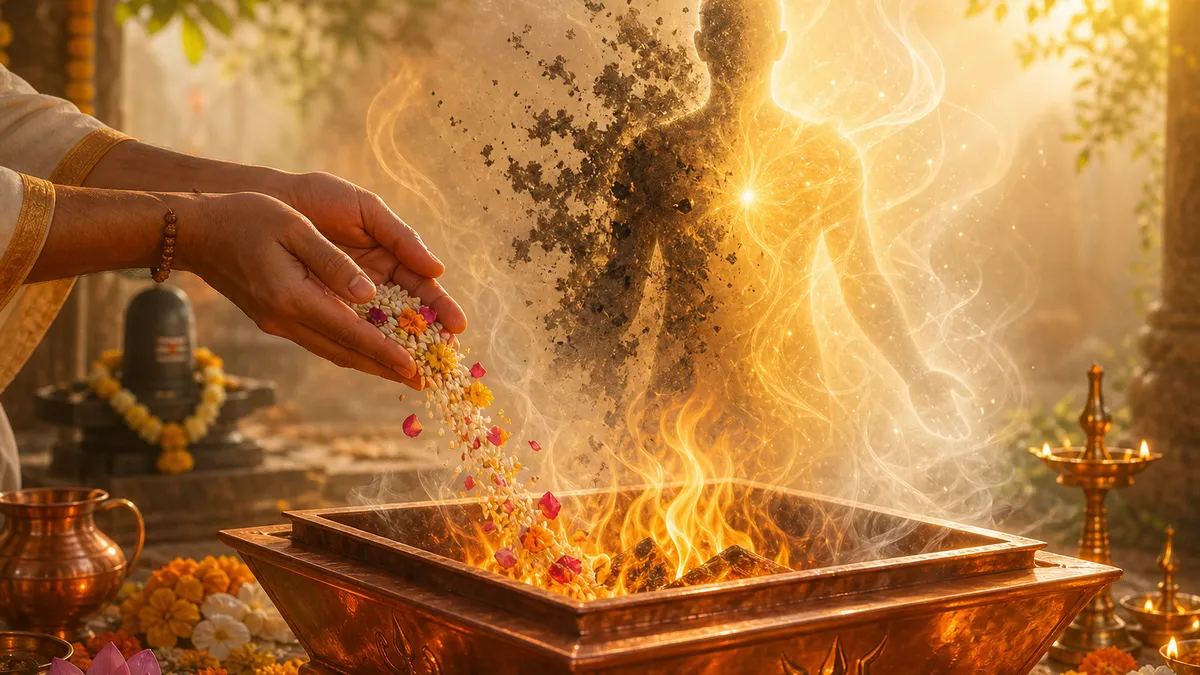
The best way to act in this world in order to purify one’s own karma is to accumulate good deeds that bring merit, to practice nishkama karma yoga, that is, to perform actions without attachment to their fruits and results, and to serve the divine forces that bestow enlightenment upon people.
Actions performed in an unconscious state are often based on egoistic attachments and lead to impure actions. Unrighteous, impure actions are traditionally called “papa,” that is, sinful. By committing them, a person dooms himself to karmic retribution. Karmic retribution is inevitable: every act of impure deeds entails consequences, karmic reactions, which are called “karma-phalas,” that is, the fruits of actions.
Such karmic reactions are like a dark, sticky substance that envelops and pollutes the subtle body, distorts the normal flow of prana in the human body, and manifests both in this life and in the next. Just as a huge tree can grow from a tiny seed, and from the tree an entire grove, so too karmic reactions, negative imprints and traces, under certain circumstances, can generate negative chains of cause and effect for a long time and move a person into a version of reality where they will continue uninterruptedly and manifest with great force, bringing suffering.
The Vedic spiritual tradition usually prescribes repentance (prayashchitta) for the purification of negative karma. Repentance is where we begin when we closely examine our consciousness and reassess our own actions, our own view. Repentance is like thoroughly cleaning and washing your apartment or house before inviting dear guests there. As long as the mind has not yet attained pure vision and self-liberation, repentance is truly a very useful sadhana.
Performing repentance is a kind of psychotherapy session, when we enter deeply into our subconscious, look closely into it, find darkened places and mental imprints there, and then erase them. Such a session is absolutely necessary in order to free one’s consciousness from all kinds of mental imprints.
Usually in the monastery, the practice of samskara shuddhi is performed once every three months. The monks meditate, looking into their past consciousness, and seek out dark corners there. Perhaps one said an evil word to someone, or some impure thought slipped out, or one caused pain to another person through some bad, obscured action, or out of ignorance insulted a deity or a saint. There is much that may still remain somewhere deep within. Perhaps we do not even remember it, but it has settled somewhere in the subtle body and distorts the flow of prana. And this may be precisely the reason why we have a chronic illness, for example, toothache or lower back pain; this may be where the causes of our failures and complexes lie, our inability to achieve what we have intended.
If a person performs samskara shuddhi correctly, he is freed from his own problems and limitations. That is, by reviewing his inner past reality, the yogin begins to purify it. He regards everything in pure vision. He regards it as an illusion, and then tries to experience this state anew as positive. Then he dissolves everything into pure light.
Purification of Inner Deities and Obstacles
Devotion, ascetic practice (tapas), and self-discipline are always prescribed to soften the process of burning away karmic reactions for past deeds. Repentance is the purification of the flow of the mind from negative mental imprints, the easing of the karmic burden, and the release from the stream of consciousness of inner deities that, for one reason or another, have been defiled.
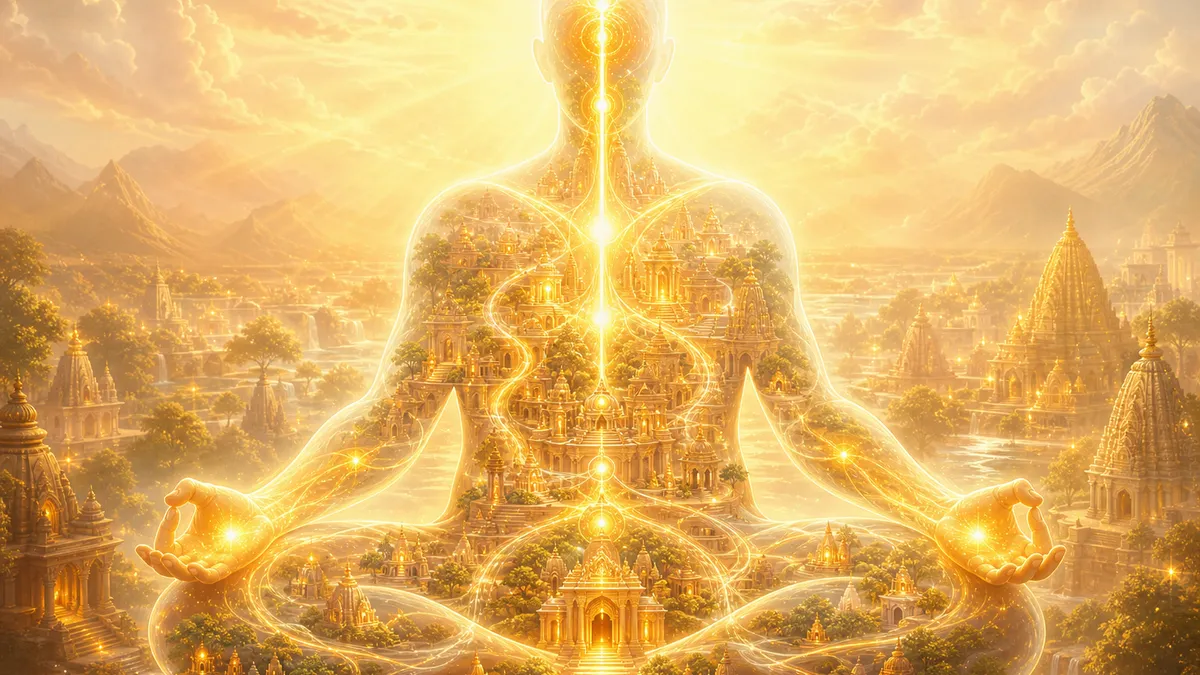
Inner deities exist within our body. It can be said that the body, according to the teaching of yoga, is a vast city with inhabitants. Its inhabitants are deities and various spirits. When we cloud some part of our consciousness, we defile some inner deity within ourselves, and then this inner deity can no longer properly perform its functions.
For example, if a person is born blind, it means that his deity of sight was defiled in past lives; he forbade himself to see something. When he performs samskara-shuddhi, it turns out that in past incarnations he witnessed some negative scene, for example, a scene of violence, and it caused such sharp rejection in him that he made a vow to himself never again to see anything like it. As a result, the deity of sight was defiled, and therefore in this life the subtle channel of vision is blocked, and in the end the person either sees poorly or does not see at all. But when he performs samskara-shuddhi, this deity is purified, the subtle channel of vision is purified, and the ability to see is restored.
Repentance also usually includes prostration performed one hundred and eight times before sacred objects, fasting, self-renunciation, public acts of repentance (kavadi), or severe ascetic practice (tapas)—all of these are means of purification.
Tapas as a means of realizing intentions
Question: “I practice and want to realize something, but why is it not being realized?”
Perhaps there are certain obstructing, unpurified factors in the flow of your mind, and therefore your intention is not manifesting.
It is usually considered that tapas is necessary for the realization of an intention. Tapas is asceticism, a persistent sadhana of self-restraint. The saints say that anything can be achieved through tapas. Especially if you feel that you need additional strength because some practice is not going well or your intention is not being realized. Always remember that tapas can do anything, work miracles. Everything is possible through tapas.
