

We will talk about such aspects of the teaching as pure vision and letting go of oneself.
If you want to evaluate a teaching, you should know that there is a structure for assessing a teaching: the basis, the path, the fruit.
The basis can be compared to the creed in Christianity. The basis is your foundation, the ground upon which practice is built. The path is the method of practice, that is, directly what you practice. The fruit is what you are meant to attain at some point in the future. For example, it may be samadhi, the rainbow body, salvation in heaven, rebirth in a pure land, or the cutting off of all attachments. There must necessarily be some fruit to which spiritual practice leads.
The Basis
It can be described by three terms: its essence, its potential, and the way it manifests. The basis is what we rely on; it is primordial awareness, prajñāna. It is a synonym for the unmanifest Brahman. It is a state beyond subject and object, the Absolute in its pure form.
From the point of view of the basis, nothing exists; everything is an illusion. Neither you, nor your relatives, nor film actors, nor political figures, nor houses, nor trees exist. There are no planets, no stars, no solar system, no hopes and fears of yours, no grasping—nothing exists. Even your most sacred beliefs and aspirations do not exist either. All of this is nothing more than illusions on the surface of this single basis.
A natural question arises: what, then, does exist after all? This single basis exists, in which there is neither subject nor object. It cannot be expressed in words, nor described by semantic qualities and categories. All holiness, all purity, all absoluteness, all perfection, and any unimaginable qualities in the Universe are contained only in this basis.
It can be said that from the point of view of this basis everything exists, but it all exists as a single undifferentiated substance. When we separate ourselves from this basis, the illusion of heterogeneity, differentiation, and the singling out of reality arises in us, in which, as we think, something exists by itself. But from the point of view of the basis, nothing exists by itself. This basis is our own awareness in its primordial purity, in its unborn state.
When we do not recognize the basis, we are asleep, we are blind to reality, we have no connection with the Supreme Source. This world is like a magical hologram, virtual reality, a magic trick, a dream, a rainbow in the sky, an echo in the mountains. It does not exist by itself. No matter how attached we may be to it, it is a product of consciousness; that is, the world is created by our consciousness.
There is the concept of Loka Bindu. It is the point that focuses and creates the Universe, which emerges from consciousness.
A man came to visit a magician. The magician gave him a drink. The man did not know that this drink had been enchanted and bewitched, and he drank it. Then his consciousness changed: he saw himself as a young man who went to the ocean shore, built a boat, and sailed very far away in it. Somewhere in the middle of the ocean he discovered an island inhabited by a tribe of unfamiliar people. There he met a beautiful girl, married her, had children, and lived happily, fully immersed in the life of the aborigines. But one day a powerful hurricane began, as a result of which his entire family perished. Out of despair, he decided to end his own life and throw himself into the ocean. At the very moment he threw himself into the ocean, he came to his senses, because the enchanted drink had ceased to act. Suddenly he saw himself sitting at a table in the magician’s little house. And even his tea was still steaming, because it had not yet had time to cool. He understood that only seconds had passed, but thanks to the magical potion he had managed, subjectively in his consciousness, to live an entire life and experience many sensations. Yet all of them were nothing more than an absolute illusion.
In the same way, your present life is the same kind of illusion, as if you had drunk such an enchanted drink, and therefore you perceive the surrounding world as real.
You cannot free yourself from this enchanted drink immediately. However, to acknowledge the existence of the basis means to try to detach yourself from this illusion, to constantly remember that everything is a phantasmagoria, a virtual reality caused by having taken such an enchanted drink. This enchanted drink is maya, illusion, one of the forms of the Absolute’s energy, tirodhana-shakti. It is that which enchants all living beings. One can free oneself from this illusion, which, like a magical potion, enchants the mind, when we constantly try to clarify the basis of our mind.
The foundation of our mind is non-dual awareness. Until we penetrate this foundation, we will continue to remain in the state of an enchanted person who has taken a magical potion and to whom something appears. The greatest illusion lies in the fact that we consider ourselves to be the subject and the world to be external in relation to us. The favorite trick of our “I” is to declare itself as existing separately, and to declare everything external as something independent of itself. Such a person is like someone who sat down to play a computer game and, seeing on the monitor screen a little man running through labyrinths, forgot that in reality he is the one sitting at the computer. He completely identified himself with the computer character and became so absorbed in this game that he forgot altogether who he was. That is, the experiences of this character began to be perceived by him as his own experiences, while he himself, as a person capable of making independent decisions, seemed to have ceased to exist altogether.
Such a situation is the result of the action of tirodhana-shakti, maya, illusion. That is why the saints say: “If you want to perceive the foundation, you must look at the world as an illusion, as a dream, as maya.” Perception of the foundation brings awakening.
When we perceive the foundation of our consciousness, we see that it is our “I,” our mind in its primordial naked simplicity. Our “I” is like space. Saraha writes about this as follows: “Understand that your mind is like space.” The saints repeat again and again: “Your mind is vast and infinite. It has no limitations. It has no obstacles. It is like space.”
Once a female disciple asked Milarepa for instructions. Since she was illiterate, Milarepa gave her instructions that she could understand. He said: “Look at the sky. Just as the sky embraces everything, having no boundaries anywhere, so too your mind has no boundaries anywhere. It is like space. Try to realize this.”
The qualities of this foundation are inconceivability (achintya) and infinity (ananta). It is also called primordial emptiness, stainlessness, niranjana. The foundation of our “I” is originally pure and perfect. It is not something we somehow create or attain in the process of practice. It is like the situation with a woman who was wearing a necklace around her neck and then suddenly forgot about it and thought she had lost it. Then she caused a great commotion in the house and began to look for it, but could not find it. All her relatives and children also helped in the search for the necklace, since it was very expensive, made of diamonds. Finally, when all the searches had been stopped and the missing item had still not been found, she realized that the necklace had been hanging around her neck all along from the very beginning. Then she suddenly calmed down and relaxed. Had anything changed? Had this woman really lost anything? In fact, if anything had changed, it was that she had lost her delusion. Originally, nothing had been lost. From the very beginning she possessed the necklace that was hanging around her neck. Likewise, we originally possess the purity and perfection of our consciousness. But why did the woman cause a commotion? Because she had false knowledge. She thought that she did not have this necklace. Then her search led to the fact that she did, after all, discover it on herself. In the same way, our false knowledge makes us believe in ourselves as the body, and in this world as self-existent.
But if we undertake a spiritual search, we discover that the primordial nature of our “I” is inconceivability, infinity, emptiness, stainlessness, and that it is always self-perfect. When a yogin attains enlightenment, he acquires that which he has always been. However, someone may say: “Since I already am this stainless nature, why not relax and declare that I possess it? Why not be done with this at last, if everything is so simple? After all, the necklace was never lost.” This sounds very tempting. However, the problem is that our mind cannot do this at once. Even if we loudly declare it, go out to the marketplace and proclaim it for all to hear, our dualistic thoughts will still remain. The kleshas and pranas will also remain. Because realizing this self-perfection means something much greater than a mere mental declaration. It is an awareness that is not yet accessible to us, and to sustain it we must first make serious efforts.
When we discover this awareness, the entire world suddenly appears as immersed in a state of luminosity and space. Just as in the depths of the ocean there are enormous whales and small fish, so too all the phenomena of this world are immersed in this spatial awareness.
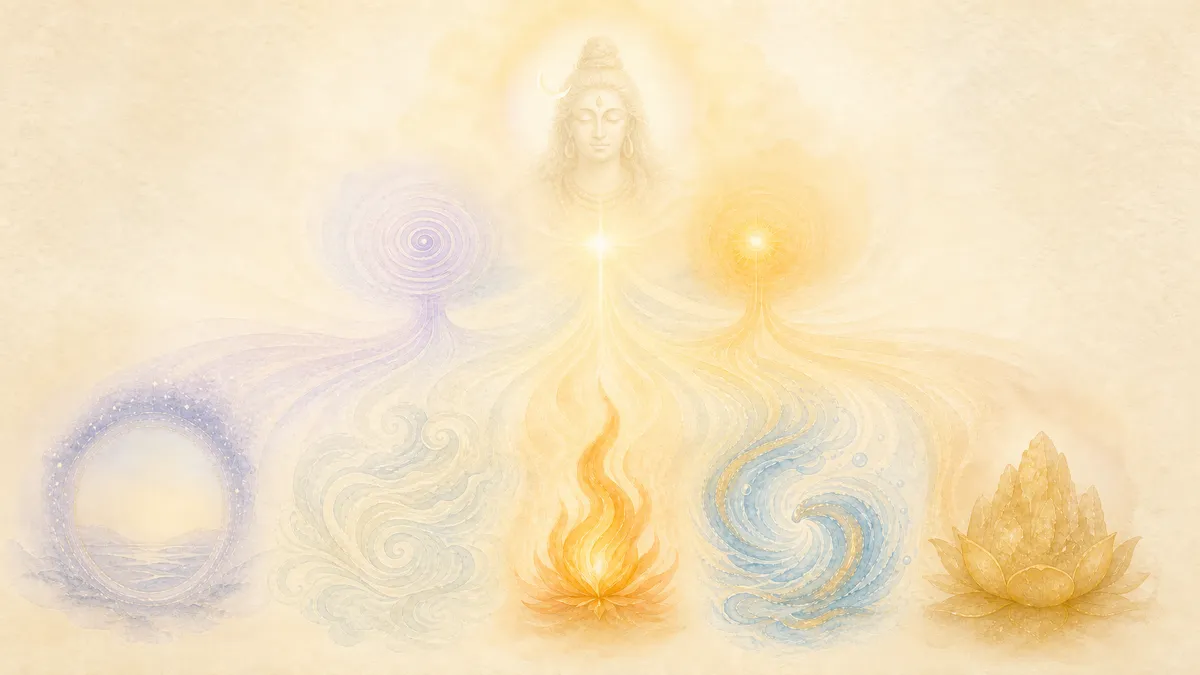
What is the further logic of the teaching? This basis, this primordial awareness, has the potential to constantly manifest as energy. When this primordial energy manifests, it manifests itself as nada, bindu, and kala, that is, vibration (sound), light, and radiance. On the subtle level, the five elements are formed by these three aspects. Following this, the five subtle elements begin to create the five gross elements, and thus our physical bodies are formed.
The Path
The path is how we realize the basis. The path is described as consisting of three aspects: view, meditation, and conduct. In Sanskrit, all three of these terms are described as follows: jnana, dhyana, and kriya.
View is what we adhere to in our practice. One could say that it is the basis when we have absorbed it with every cell of our being. Suppose, if you are familiar with the philosophy of Advaita, then your view will always be something like this: all this is illusion, all is Brahman, I am Brahman. At least on the level of concepts, you will accept that Brahman is awareness. That is, you literally perceive the mahavakyas “Prajnana Brahman” (awareness is the Absolute), “Aham Brahmasmi” (I am the Absolute), “Brahman Sat Jagat Mithya” (Brahman is real, the universe is unreal).
When we perceive these mahavakyas at the level of our own life credo, it is said that we have mastered the view. Before we can seriously practice sankalpas, atma-vichara, observation of the body, and other things, we must have a clear basis on which we should rely. And this basis is the view.
One could say that view is the same as a philosophical standpoint. We have not realized the path, but we have a certain basis on which we can rely in everyday life. It is something like a postulate of faith, although it has little in common with an orthodox dogmatic creed. Rather, it is an inner support that we orient ourselves toward when we perform techniques, meditations, mantra recitation, and so on. We know that all is Brahman, but we need to attain samadhi in order to know this fully. We know that Brahman is real and the universe is unreal, but we need to actually experience nonduality in order to clarify this completely, so that this declaration becomes a living experience.
After view comes awareness, or meditation. Meditations are how we try to embody our view. For example, when you practice the path of naked awareness, when you practice sankalpa, all of this relates to awareness. By and large, as soon as you enter the path of meditation, your entire life will shift into another plane. This means that the yogin constantly tries to apply his view through meditation.
How does one apply the view through meditation? By entering naked awareness beyond concepts, which in our teaching is called contemplative presence. Again and again, one should clarify whether you are in this naked awareness or are distracted, whether this state is correct or not. Finally, when this naked awareness is stabilized, it becomes part of our soul. It becomes a parallel world in which we begin to live. It becomes a universe that the yogin himself creates by the power of his awareness and into which he gradually moves to live. And in this universe there is no one else. Of course, he sees the bodies of other people and so on, but all these other people are created only by his awareness, according to his wish. He can let other people into this universe as certain characters or let them out, because when we realize the state of nonduality, there is no one else besides primordial awareness.
When awareness deepens and becomes strong, it penetrates our life, our conduct, and begins to manifest in everyday life. It reaches the very depths and manifests even in the smallest everyday situations. That is, our view and our conduct become inseparable. For example, if you are an experienced practitioner, it is unlikely that you will cut your finger while preparing food, because you are at the very least attentive. But let us imagine that it happened. Instead of suffering and worrying, you will contemplate even then. You will not become angry; you will simply contemplate the pain, and the pain will be part of awareness.
Once, during a retreat, I accidentally spilled boiling water on my hand. Since I was in a very deep state, I noticed: “Here the boiling water is pouring, here the hand is being burned, here pain arises in the body, here the body sends a signal to consciousness. Here the surface consciousness begins to waver, and here the deep consciousness has registered this and has not stirred. Here the pain has returned to the Source, and here the Source is in its primordial state.” All of this was noticed in the tiniest fractions of a second as a whole spectrum of experiences.
When you encounter the diversity of energies, all of this permeates your behavior. And when the view permeates behavior, complete liberation occurs. Then, for the yogin, there are no more hopes or plans, no fear, no past and future. He is fully identified with the unborn state of awareness and constantly abides in nonduality. Whatever experiences he encounters (anger or attachment, sensual pleasures or physical suffering), he always regards them as inseparable from the Ground. Experiences or energy may exist, but they are not rejected. They are simply regarded as one with the primordial Ground.
A monk named Geshe La was meditating in the mountains. He became famous for carrying out a very powerful sadhana and was considered a very advanced practitioner. He had a practitioner friend who liked to play jokes on others. He came and asked sarcastically:
“Geshe La, what are you meditating on?”
He replied:
“I am meditating on patience.”
The next time, this friend said:
“Geshe La, I heard you are meditating on patience. Here, eat some shit.”
Geshe La became angry with him and shouted:
“What?! What are you offering me, you idiot?”
He was beside himself with such fury. And then his friend said:
“Yes, I thought you were seriously meditating on patience. But it seems you are still at a child’s level.”
When our meditation permeates behavior, it means that all our old conditioned reactions cease to affect or disturb us in any way. All our egoistic attachments, our sense of self-importance, clinging, our desires to assert ourselves and to appear a certain way before others dissolve. Saints were often described as holy fools or mad sages who cared not at all about their image, fame, or anything else before society.
One holy mahasiddha, whenever he met people, constantly wept. He was remembered for the fact that when he came somewhere and noticed other people, or even pandits and priests, he would constantly weep and say: “Who are these people? How unfortunate they are!” Since he was always in contemplation, beyond duality, he saw that everyone was deluded, that everyone was abiding in illusion, that everyone was enchanted by this magical drink. And he had enormous compassion because living beings were abiding in such illusion, and therefore he wept.
The state of a yogin changes greatly when the view permeates his behavior. He ceases to be a human being. He becomes an incomprehensible, mystical super-being. So mysterious that he is mysterious first and foremost to himself. Even he himself does not know the limits of his own mysteriousness, his own enigmatic nature, and his own greatness. Therefore, no one is capable of realizing the boundaries of one’s own “I,” not even Brahma or Shiva, because the primordial “I,” the primordial Consciousness, is so incomprehensible and transcendent that it has no boundaries whatsoever. Nothing can serve as a measure for it; no one can realize its boundaries.
The State of Saints and Avadhutas
Therefore, sometimes saints whose state is absolutely transcendent, when meeting one another, say: “We cannot know the limits of each other’s greatness.” In this state, the yogin completely breaks with all attachments, the conventions of this world, standards of behavior, habits, logic, and so on. This does not mean that he discards them altogether. He uses them, but only in a utilitarian sense, that is, for convenience when communicating with others. Meanwhile, his “I” soars in a state of boundless freedom. Then it is said that the view has permeated behavior.
The behavior of such a yogin is not conditioned by any principles originating from the mind. It flows from his deep awareness, and he has no single standard of behavior. Such a state can be expressed in the words “flowing with the river,” because the yogin flexibly responds to the entire diversity of situations in the universe.
“The samadhi of the flowing river” is a term in laya yoga that points to sahaja samadhi. When a yogin is guided primarily by awareness, it comes to the fore in various situations and prompts the yogin how to respond in particular circumstances. This style of behavior is also called the mad wisdom of the avadhuta.

It is believed that the originator of this view and behavior was the holy avadhuta Dattatreya. When we hear “avadhuta,” we should not form a fixed idea that an avadhuta is someone who walks around naked, smears his body with ash, holds a skull cup in his hands, and resembles some kind of madman. I have heard that in India there was an avadhuta who graduated from an English college and wrote, for example, reviews of books by Leo Tolstoy. At the same time, he was a great mahasiddha.
The behavior of an avadhuta cannot be predicted. He is such a free and spontaneous being that he can manifest in the most unpredictable way. He may manifest as a hermit, as a monk, as a householder, as a king, as a politician, as a warrior, as a teacher. For him there are no limitations at all, since such a being is completely beyond reach and incomprehensible to ordinary logic. He does not actually abide in the human world, but abides in the world of nonduality. His own consciousness is the boundless Brahman.
But from this primordial awareness, some portion of energy may spill forth and manifest as a human body for specific needs. That is, when an avadhuta acts in some body, it would be incorrect to think that he is entirely within that body. In reality, he always abides in the transcendental state, but from this transcendental state he can manifest his energies in the form of illusory bodies, which, depending on the power of his realization, may number three, five, ten, a hundred, or a hundred thousand.
One body may be in the world of the gods, one in the world of the asuras, one in the world of humans. And each such body is assigned some specific function: to come into the world of humans in order to spread the Dharma, or to go to the world of the asuras in order to subdue some ruler, or to go to the world of hell in order to establish just laws there, or to go to the world of the gods in order to give teachings on sounds (nada yoga). Such illusory bodies are emanated from the very heart of the avadhuta, from his space of consciousness, and then take birth in various worlds with a specific mission. But his own consciousness is always beyond reach and incomprehensible, therefore he is not a body or a person with some ordinary human destiny. This is energy that is completely subject to the will of some incomprehensible consciousness.
The Fruit of the Teaching — the Three Bodies
The fruit of the teaching is the attainment of the three bodies: jnana-deha, pranava-deha, and shuddha-deha.
Jnana-deha is the body of the infinite wisdom of consciousness. This body is called a body only conditionally, because it is the infinite space of awareness that is realized in the process of practice. How can you determine whether you have realized such a body or not?
- If your contemplation at the first stage lasts only during the day, and at night you cannot maintain it, you have not yet realized it
- If your contemplation lasts during the day and in sleep with dreams, then you have not yet realized the body of wisdom
- If your contemplation lasts continuously during the day, in sleep with dreams, and in sleep without dreams, then you have almost realized it
- But if your contemplation lasts during the day, in sleep with dreams, in sleep without dreams, and also in the most subtle state where duality has been completely overcome, it is said that you have realized the body of wisdom
And then, since you have realized such an immortal body of wisdom, for you as consciousness there is no death. Being the space of awareness, this body is immortal. Even when the physical body dies and decomposes, there will be no break for your essential consciousness; it will always remain unchanged and will not be obscured.
Pranava-deha is the body of energy. It is also called the “body of light” or the “rainbow body.” It is an energetic body created from subtle-material substances, from the subtle parts of the elements. When a yogin realizes his consciousness and unites it with energy, such an attainment becomes possible.
Shuddha-deha is a physical body that, during life, has been transformed by the power of contemplation and the control of energies. Such a body can be visible and tangible, but it consists of a different basis. At the level of the elements, it does not consist of a gross physical basis. A sign of approaching shuddha-deha is that your energy becomes purified, you begin to hear the sounds of nada, and nectar may arise in you constantly. A high level of energy, a reduced need for sleep and food, the absence of desires, and being filled with joy and bliss — all these are signs that you are gradually approaching the attainment of shuddha-deha.
In reality, realization is very diverse. Some are more inclined toward the realization of shuddha-deha, some are more inclined toward the realization of pranava-deha, while others, possessing only wisdom, are interested in neither one nor the other, but are inclined toward the state of jnana-deha.
Paths to Attaining the Three Bodies
If you take Ayurvedic preparations made according to certain recipes and combine them with spiritual practice, you can attain physical longevity and even immortality. For example, Rishi Bogonatar, Nagarjuna, many saints, and Tamil siddhas practiced the art of rasayana, attaining the siddhis of longevity and immortality. Such siddhis are necessary for a practitioner in order to have enough time to complete the spiritual path in one body without rebirth.
If you have deep pure vision and make great progress in jyoti yoga, then you can realize pranava-deha, that is, the illusory body of light in the upper world of forms. If you have a strong inclination toward philosophy, toward meditation on emptiness, toward the practice of awareness, if you have strong detachment or constant immersion in non-duality, and you are little interested in the worlds of forms and everything that has form, then you are inclined toward the realization of jnana-deha, the empty body of wisdom.
In reality, when a yogin advances along the spiritual path, all three bodies are realized in various manifestations. And when this happens, one can say that the fruit of practice, the fruit of the teaching, has been attained.
Pure Vision
Pure vision is an aspect of the teaching that should be assimilated in the same way as divine pride, the principle of samaya, and Guru Yoga. If you do not understand what pure vision is, you may practice for a long time without favorable results.
First, one needs to reflect on the following. Behind every phenomenon of this world there exists subtle energy, but we do not always perceive what exists behind the phenomena that we see. For example, when we pick up a book, we do not suspect that behind this book stand intellectual writers, publishers, programmers, accountants, and others. One could say that a great many talents worked on it. When we travel by train, we do not suspect that there are drivers, an electronic railway management program, railway administrators, and that a great many talented, gifted, and intellectual beings are concentrating on ensuring that we arrive safely and on time.

Of course, we suspect this, but we do not think about it much. It would seem that such an innocent thing as a train journey occurs thanks to the efforts, concentration, and clarity of a great many people. That is, behind the surface there is always some depth and many subtle energies that manifest.
If, by this analogy, we begin to examine other examples, we will see that behind every small thing there exist certain very organized, powerful, and global structures. We cannot always perceive them because they are hidden from our superficial vision; nevertheless, they exist in every field.
For example, there are global power structures that we cannot even imagine. We cannot trace the dynamics of their manifestation, but they do exist.
Everywhere there is talk about Freemasons, about a secret world government, and about their secrets. There is an entire informational field for those interested in this topic. In reality, these secret structures do not interest us. This example simply reflects the fact that behind any phenomenon there exists something more conscious, more subtle, while the phenomenon we see in the gross world is only that which we are capable of perceiving.
Deities Behind Phenomena
In the same way, pure vision means that behind any phenomenon there exists a subtle form of manifestation. For example, behind every kind of art (music, painting, sculpture, literature, and so on) stand the deities who patronize them.
Patron deities are parts of awareness that exist within a person and in the collective mind of humanity, and that are connected with music, painting, and literature. Behind every kind of science, every season of the year, day, second, hour, week, month, every kind of sport, martial art, the four cardinal directions, stars and planets, different types of people, every person, animal, and species of plants, stones, minerals, liquids, and medicines, there exist subtle forms, subtle states that possess superconsciousness. These are governing deities of which we are not even aware.
For example, when a person drinks medicine, on the subtle level he perceives the karma of the deity associated with that medicine. If you drink a truly very high-quality Ayurvedic medicine, then in dreams you may see the full sun and the full moon. You may also see yourself climbing a mountain and entering a heavenly garden, where deities and dakinis meet you and hand you a casket or a green sphere, after which your condition improves. This means that in the dream you came into contact with the subtle form of this medicine. If we speak of Ayurvedic preparations, it is not so much the preparations themselves that heal, but their subtle forms, that is, the deities.
If a person, for example, uses drugs, then he may see demons, because within the subtle form of drugs there are demons that enter the person’s astral body. These demons, being the subtle essence of drugs, are interested in the person using them; therefore, when a person stops taking drugs, he begins to feel bad, since these demons again try to draw him over to their side and block his sahasrara chakra.
These are examples of the fact that behind any material things there exist their subtle forms. And pure vision presupposes that we constantly look at everything from the standpoint of its subtle forms. This is not something in which we somehow artificially exercise ourselves. It means that we see things as they are, that is, in a purer form.
Principles of Pure Vision
Classical pure vision is described as follows: “One should look upon the Guru as a deity. One should look upon the Dharma as precious nectar. One should look upon the sangha as a mandala, a mystical field of enlightenment. One should look upon oneself as a deity. One should look upon houses as palaces of deities. One should hear all sounds as the sounds of mantras or bhajans, sacred songs. All situations that happen to you should be regarded as lila, the divine play, a manifestation of the Absolute.”
That is, pure vision is a state in which we try to see everything as pure, divine, in a more subtle form.
Suppose that when you are sitting opposite me, in pure vision you are deities. That is, you are people, but at the same time you are also deities. And since I practice pure vision in reality, not merely in words, I perceive these deities that are within your bodies and receive darshans from them. That is, when people come to me for darshan, not only do I give darshan, but I also receive darshan from their subtle form.
It can be said that physical bodies are upadhis, that is, carriers of the subtle forms of these deities. For example, when matajis are perceived, the energy of deities (Lakshmi, Durga, Kali, Saraswati, and others) may act through them. Depending on this energy, they are interpreted as deities in accordance with the religious system in which you practice. Some of them are dakinis, some are various incarnations of Tara, some are wrathful, and some are peaceful.
In the same way, various deities can manifest themselves through the bodies of men and other living beings in the physical body. These deities manifest themselves as subtle energy that moves through the subtle channels — manovaha nadis. If a person has coarse consciousness, he perceives reality blindly and therefore sees only the body. He thinks: “A person is just a person. What kind of deity is that?” But if you practice pure vision, you can gradually perceive these subtle energies and see how they act.
The Practice of Pure Vision
Pure vision presupposes continuously training oneself to perceive everything precisely in this way, and then you develop a sense of the holiness, the sacredness, of everything you perceive. You see that in the universe there is actually nothing worldly; in the universe everything is holy and sacred. Stones, trees, clouds, and so on — behind all of these there exist their divine forms, and they are absolutely conscious. Behind all these manifestations there exist patron spirits and deities that possess superconsciousness.
Pure vision is also manifested in the fact that you become convinced that your body is also a vessel of the deity, of subtle divine energy. This does not mean that you see it with your eyes. You feel it. Although with a certain practice, for example with the practice of pure vision, you can see real images with astral sight.
When you go to a store to buy bread, you do not see a store, but a place where the deities of long life bestow nectar upon everyone, and someone makes offerings to them. That is, you do not see a salesperson, but a deity who distributes this nectar. And when you take out money, you are not paying with it, but making an offering, performing a ritual act. The deity accepts it in this way and gives you not bread, but blesses you with an elixir that grants long life, immortality, or siddhis. Approximately this kind of vision and feeling arises in you.
When you meet a conductor on a train, you see in him a deity connected with roads, and you make an offering to him in the form of a ticket, because this deity accepts offerings precisely in this way.
Each deity or spirit has its own ritual, its own style in which it accepts offerings. In fact, there is no need to think very much here, since we do not have a tradition of any particular rituals and so on. What is being discussed now is pure vision in general, that is, the state of consciousness evoked in you by the described practice of pure vision.
The Results of Pure Vision
Pure vision means that you do not criticize anyone, especially those who are above you in spiritual development, or those who are partners in the spiritual life. You try to regard everyone in pure vision, constantly attuning yourself to the subtle form of manifestation of living beings and viewing all situations as lilas (plays) that manifest in their purest aspect. This does not mean that, in a relative sense, you stop seeing anything. It is just that this relative common sense no longer deceives you, because now you see that behind the relative karmic common sense of the human world, certain very subtle energies manifest, which are divine and absolute by their nature.
It is believed that if you see beauty even in what is most ugly and repulsive, and purity in what is most disgusting and dirty, then your dualistic thoughts disappear very quickly. It is believed that this ability brings about a change in energy and consciousness on a subtle level and contributes to the prolongation of life, the acquisition of longevity, and the strengthening of vital force. That is, when we do not identify with negative, foul, suffering-bringing, dirty, and repulsive aspects, but on the contrary, see them in pure vision and are able to integrate them into our contemplation, then instead of losing energy, we acquire and strengthen our vital force.
Examples of Saints Who Practiced Pure Vision
Many saints practiced in precisely this way, because they had very strong pure vision. For example, there was the siddha yogini Machig Labdrön, who in her youth was recognized as an incarnation of Prajnaparamita. She recited the “Prajnaparamita Sutra,” was a very gifted child, received many initiations, and everyone admired her. She led a very strict way of life, but when she attained enlightenment thanks to her teacher, she began to be seen in the company of common people. She associated with shepherds and other strange people, that is, she began to live like a beggar. When she was reproached for this, she said: “You do not understand the practice that I practice.” In fact, her consciousness was so elevated that, living with common people and shepherds, having abandoned her exalted way of life and her movement in the highest secular circles, she was able to practice pure vision. And it was precisely thanks to this that her practice progressed very intensively.

Pure vision means that you are able to perceive even an impure or degraded person in a pure form. For example, you can see him as the avadhuta Dattatreya, as a mahasiddha who is playing with you, or as a wrathful deity. This does not mean that you need to sit next to him all the time, because your pranas may still be contaminated, and therefore you do not yet possess great energy, even if you practice pure vision. But at least at the level of consciousness, you can avoid generating dislike or aversion.
Pure vision means that if something unpleasant happens to you, you should regard it as the play of wrathful deities, as wrathful manifestations that are empty and absolutely pure in their nature.
Suppose you find yourself in a situation where someone insults you or slaps you. If you have pure vision, you can regard this person simply as a manifestation of a wrathful deity who is playing with you in this way. He simply has that kind of energy. Perhaps you are not yet ready to engage in such games constantly; nevertheless, no resentment or anger arises in your soul, because you understand that all of this is a game. You understand that the primordial Clear Light plays different games. If the games are peaceful, then the deities appear peaceful; and if the games are wrathful, then the deities appear wrathful. But all of this is still absolute, pure, and perfect. And no oppression, resentment, or suffering arises in you. It can be said that pure vision is an absolutely positive approach to the perception of all phenomena of the universe. It is not something we try to create skillfully. It is what the universe actually is, because behind any manifestations in the universe there appears the primordial luminous emptiness and absoluteness; we simply do not see it.
For example, when disciples establish a connection with the Guru, they can progress quickly by developing pure vision in relation to the Guru. For instance, when Ramakrishna was serving in one temple, the woman who had built that temple after making an offering was also present at that puja. Suddenly Ramakrishna approached her and slapped her. Everyone was outraged that a holy man could offend a woman in this way. But the woman herself said: “In fact, you should not be outraged. He did the right thing. It was through him that the holy Mother Kali slapped me. The matter is that I became distracted during the worship service and allowed worldly thoughts. I forgot myself, and Kali simply reminded me of this. And since Kali is a wrathful deity, she always acts forcefully and wrathfully. It was she who came up and slapped me, while Ramakrishna was simply the body, the vessel that conducted this energy.”
This does not mean that one can hand out slaps left and right to everyone, thinking: “Oh, a wrathful deity is acting through me.” One can go very far that way. Other people may not believe that a wrathful deity is acting through you. They may think that a demon is manifesting through you, since they do not have pure vision in relation to you. Rather, it means that we try to perceive the world in pure perception. Over time, this purity is perceived as the manifestation of the luminous foundation of all objects. And such pure vision in itself gives a powerful impulse to our own mind. We see that only our perception is impure, and that there is nothing else impure in the world; that only our vision is not sacred. In the world everything is sacred, everything is pure, everything is absolute. Only our way of seeing the world is impure, because we have a mind that is too captivated, constantly drawing boundaries and dividing into pure and impure, good and evil, sacred and worldly. It constantly accepts or rejects.
Pure Vision in World Events
When we practice pure vision, we constantly pay attention to this subtlety that stands behind all phenomena, and then all the phenomena of life suddenly appear before us as connected into something one, something very global and sacred. From this point of view, we can interpret any external events: wars, political events, and so on. We can see that behind all events there are certain higher forces.
For example, when the battle on the field of Kurukshetra was taking place, Arjuna was in a panic and said: “I do not want to fight. On the other side are my enemies, but they are my maternal uncles and other relatives. How can I fight them? They have come out as our enemies, but I do not want to shed blood.” Krishna answered him in this way: “Since they have already been killed by time, fight; have no fear. Simply know that you are not the doer.” When a battle takes place, from the point of view of pure vision, it is the wrathful deities coming to receive offerings; that is, Kali comes to gather the harvest. For the world of people, a battle, a war, a fight is, of course, something terrible. But even in this regard, one can manifest pure vision and see that these are simply fierce, harsh, wrathful energies acting. People’s bodies disintegrate, but this is simply the play of wrathful deities. In subtle form, it is seen simply as the play of wrathful deities among themselves.
Of course, people who are not ready for such games are better off staying away from them. That is, if you are immortal like Krishna, then you too can play in this way. But it is very important to understand how realistically, while in the body, you can or cannot manifest certain energies.
Nevertheless, any manifestations can be seen in such pure vision.
All living beings, all world systems, sciences, arts, and events that take place possess this exalted state of purity. It can be said that various energies of deities pass through all aspects of life. Sometimes the gods of Indra’s heavens act, sometimes the gods of the upper world of forms act, and sometimes those of the formless world. And life on earth is a multidimensional interweaving of various energies that develop and come into contradiction. When we penetrate into the essence of the consciousness of the gods who act behind these energies, we will see that the gods do not act in and of themselves, that the gods actually do not exist either, that they are simply an energy of the Clear Light subtler than the world of human beings, that any energies and bodies of the gods are empty, that the gods exist only when they are in presence, in meditation on the fundamental Ground, on the primordial Clear Light. Then our pure vision deepens, and we even cease to see gods and anything divine behind all forms, because we begin to see only the absolute, only this one fundamental essence that plays in all forms and bodies.
When Sri Aurobindo was sitting in prison, he spontaneously attained such pure vision. When he saw a young man standing under a tree with his legs crossed, he suddenly saw Krishna manifesting through his body. When the prosecutor in court was announcing his sentence, he suddenly saw Krishna in the prosecutor’s body, saying: “Do not be deceived. Everything that is happening is my play. Even if I act in this way, it is auspicious for you. Fear nothing; simply trust me.” That is, Sri Aurobindo saw the prosecutor announcing his sentence, but on the subtle level he saw it as the energy of Krishna, who had arranged everything in such a way that Sri Aurobindo would receive advancement. Perhaps, if Krishna had not supported Sri Aurobindo in prison, he would not have become the Sri Aurobindo known to everyone, but would have remained some ordinary political figure.
When we unite pure vision with contemplative presence, we truly begin to realize the depth of presence.
Bhajan Mandala is a practice in which we physically train in the practice of such pure vision. Prostrations, veneration of saints, sama, respectful relationships with dharma brothers and sisters—all of this supports the practice of pure vision.
