The Stages of the Great Path: From Layperson to Monk
04.06.2026
0 мин. чтения
0
Share
copy
search
add
share
Commentary on the text “Stages of the Great Path”
The spiritual path truly requires maximum dedication from us. If we seriously set out on the spiritual path, we should not regard it as difficult or impossible. We may have limitations; nevertheless, our present life and future rebirth depend on how quickly we transcend them. When we have an understanding of the nondual vision, the spiritual path begins to become clear to us.
The Nine Stages of Tantric Conduct
Now I will read a text called “Stages of the Great Path” and try to comment on it. This text explains how we progress in our spiritual evolution. If you can grasp and understand most of what is being said, the entire spiritual path will appear before you clearly, as if in the palm of your hand.
First stage: “Suffering in Samsara”
So, the first stage, or the first step, is called “Suffering in Samsara.” This is the state of a layperson, an ordinary person—that is, an ordinary, unenlightened, sleeping being.
“Taking myself to be the body, and the world to be reality, I am seized by ignorance, like a fish by a net, like a fox by a trap. I am stuck in illusions, like a fly in honey. I am struck by desires and passions, like a deer by a poisoned arrow. Careless, like a blind man walking toward an abyss, I am full of desires, unrealizable hopes and plans for this life, not knowing that they are like circles on water. And I myself am like a splinter, carried by the churning current of a swift river. There are many emotions in the soul, and the mind is like a mad monkey.”
We have no other way out; we all begin from this first stage. We all take ourselves to be the body, we all take the world to be reality, we are all seized by ignorance. If we were not seized by ignorance, we would be saints or gods; we would not be in this world, because this world is a prison, a cage, samsara, where all living beings are subject to the law of karma. They do not control their destiny, because their destiny is controlled by greater forces—the gods who govern karma. That is why it is said: “We are seized by ignorance, like a fish by a net, like a fox by a trap.”
Living beings who have not attained awakening are stuck in their illusions, like a fly in honey. Their desires and passions harm them. For example, few people understand that the lifestyle of an ordinary person is harmful. It harms the mind, conditioning it and worsening karma. It harms energy, taking away the possibility of living a long life. It disperses the life force, since worldly desires cause energy to leak away. Any master of yoga or meditation will confirm this, and therefore it is said: “I am struck by desires and passions, like a deer by a poisoned arrow.”
Although living beings may plan various goals and hopes, in reality their life is not so important if they do not set out on the spiritual path. One could say that they are moving toward dying and being born again in accordance with the law of karma. And this will continue countless times.
I have read Carlos Castaneda. I really liked what is said there. In fact, this teaching is related or close to ours, and this is not only my opinion; it is also the opinion of Tibetan lamas. There Don Juan says to Castaneda: “Listen, do you think you and I are equal or not?” Castaneda, being a graduate student, had a very high opinion of himself, so he thought: “What can this illiterate Indian do? Of course, I am superior to him in terms of intellectual sophistication.” But, not wanting to offend Don Juan, he answered him this way: “Perhaps we are equal.” Don Juan said: “No, I am a man of knowledge and a warrior, and you are a parasite.”
He said this to him not in order to display his pride or to mock him. He said that they were not equal in the sense that until Castaneda became a man of knowledge, his life would be aimless. It would pass just as fruitlessly as his past lives had passed in vain. The only thing that can bring awareness and meaning into human life is to set out on the path and attain freedom.
A living being is often compared to a blind man who carelessly walks toward an abyss. He has various desires, hopes, and plans for this life, not knowing that they are like circles on water, because they quickly disappear. Such a living being does not control emotions, and his mind is very restless. For example, monks train to develop dispassion. If you come up and slap an experienced monk, he will not become angry with you. Moreover, he will feel compassion for you and think: “This person must have some serious problems. What a pity that he feels this way.” And if someone slaps you, what will your reaction be? This is the principle of dispassion.
Second stage: “Lay Disciple”
“Oh, wonder! The Power of Awakening has touched me, and I have begun to reflect on the Great Path, as well as on impermanence, suffering, death, causes and effects, the meaning of this life. What is the Source of the Universe? Where is the Foundation of Being? Who am I? What is the world? What is the Great Path? I reflected and was horrified by my blindness. O Guru, in confusion and hope I turn to you for help, to step onto the path of Awakening! I am torn by doubts and tormented by desires. I ask you, show me the perfect path to Nirvana! Though my faith is weak and my resolve is small, I try to heed the Teaching, to practice and little by little accumulate white karma. I greedily read books and absorb new knowledge, like a bee drinking nectar. The mind is somewhat pacified, but there is still much distraction, and it is difficult to keep it in check.”
When the power of the spiritual path touches us, we begin to reflect on impermanence, the law of karma, suffering and death, to seek the Source, the foundation of Being, our own “I.” When we begin to do this, we are horrified by our blindness, because we see how immature we are, how deeply we are mired in illusions, how distorted our understanding of the world is, and how much we ignore reality. Then a need arises in us to seek a teaching or a spiritual Teacher, since we understand that through our own efforts alone—that is, without a master, without a teaching and a school—it is virtually impossible to attain liberation. At this stage we are also tormented by many desires and doubts; we are in a marginal state, since our faith is still very weak and our resolve is small. But we are already trying to practice something and little by little mastering control over the mind and emotions.
Eight Types of Tantric Conduct
This stage is called the “bee stage.” At this stage, the yogi visits various organizations, studies different teachings, and meets with teachers.
The “bee” stage is the first level of conduct among the eight types of tantric conduct:
The “bee” stage – the yogi visits various organizations, studies different teachings, and meets with teachers
The “deer” stage – the yogi already purposefully chooses his path and practices in retreat
The “mute” stage – the yogi attains a state of thoughtlessness and trains in the state of samadhi
The “madman” stage – the yogi realizes a consciousness that transcends concepts (not in the sense that his reason becomes impaired)
The “lion” stage – the yogi experiences enlightenment and expresses it with particular power, directly
The “dog-pig” stage – the yogi attains a single “taste,” perceiving good and evil, pure and impure, right and wrong, honor and abuse equally
If you understand the logic of progressing through these stages from “bee” to “dog-pig,” you will never go wrong in spiritual life. Unfortunately, most spiritual seekers remain at the stage of the “lay disciple” or the “bee” stage. They visit various organizations and develop a taste for it, doing this for years. One could say that they become spiritual tourists, stuffing themselves with a great deal of knowledge, but they are unable to integrate it into a single whole, unable to focus on practice. The years pass, they grow old, yet they never obtain any results, because this is not enough. Their mistake lies in the fact that they have not changed their style of conduct. Like a bee that has gathered a critical mass of nectar, they need to begin digesting this nectar into honey, that is, into something different.
Four Categories of Spiritual Seekers
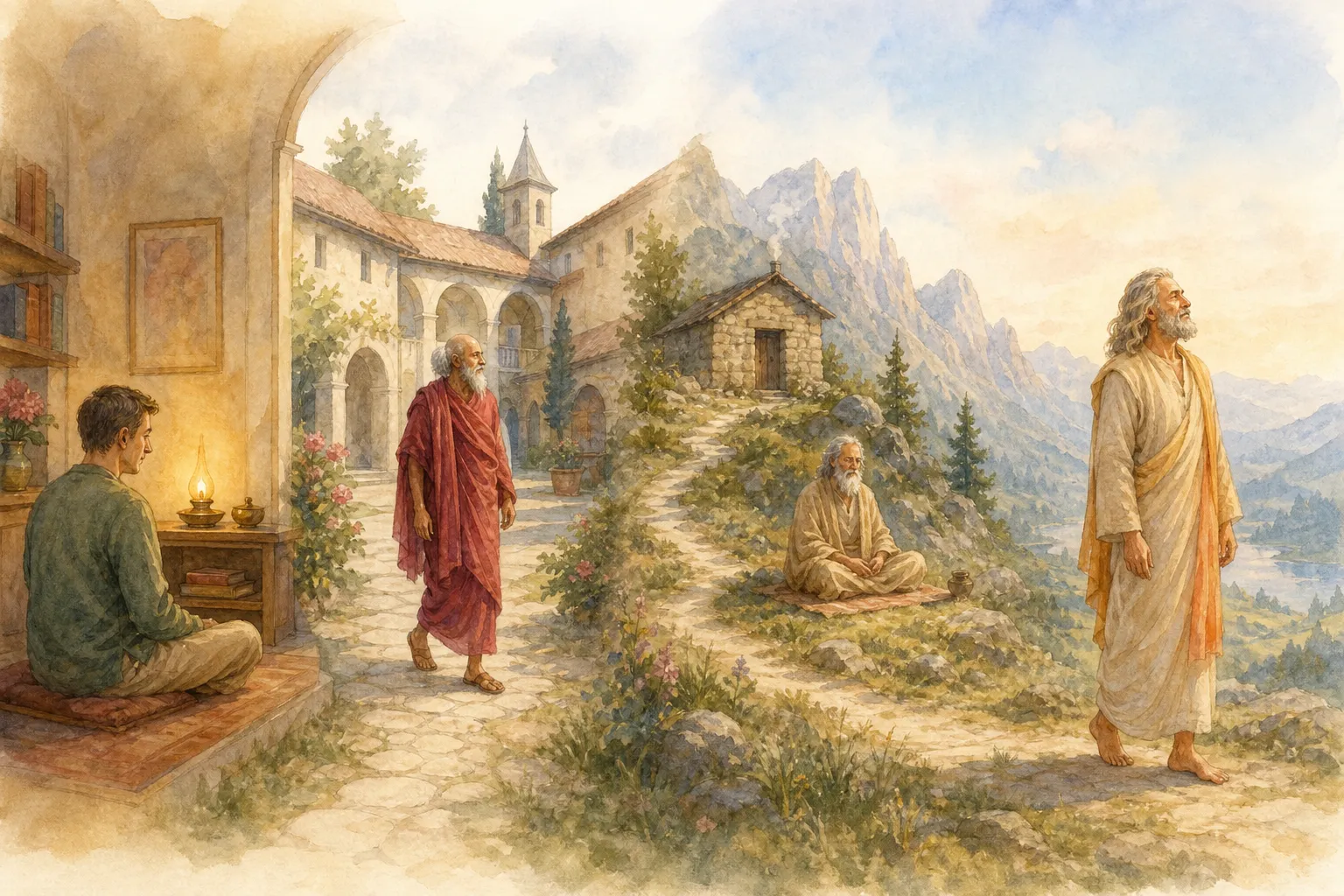
The next stage is “going forth as a monk.” When I say “going forth as a monk,” this does not mean that I am calling everyone to become monks. Although I do consider this the shortest path, some people’s karmas may not correspond to monastic life, so in such a case I recommend adopting some other, more advanced status, for example the status of a “hermit” or the status of an “avadhuta.” There are four categories of spiritual seekers in our monastery: laypeople, monks (the main category), hermits, and avadhutas. Depending on your inclinations, you can choose one status or another.
The status of a layperson means that the disciple receives transmission, gradually accumulates merit, and trains independently while living in the world. For the first few years this is quite normal.
The status of a monk means that the disciple practices intensively in the monastery according to a higher training program, undergoes retreats, and communicates directly with the spiritual Teacher and mentors. Many people do not quite understand the principle of monastic life and have immature ideas about it. Monastic life is required for intensive practice, because intensive practice is possible only under certain conditions. And if such conditions are absent, then intensive practice is also impossible.
The category of “hermits” is what I recommend to laypeople who have completed the basic practices and have advanced sufficiently. I recommend that over the course of twelve years they change their place of work, change their place of residence, part with all their friends from worldly life, live in seclusion, and find time for a long retreat in order to practice in retreat for three months, six months, or even a year, if possible. Monks practice the same thing, but monks do this in the monastery. If it is impossible to set aside such time for practice, then it is difficult to obtain a result; however, this should not be done immediately. If you have only just become acquainted with the teaching and immediately want to sit in retreat, it may be difficult for you, because hermit life has its own pitfalls. There are many temptations, delusions, and obstacles on this path. You will have to battle the “devil” of your own mind if you have not prepared yourself properly.
The stage of the “avadhuta” is the stage when a yogin abides beyond all rules and limitations. However, this is not a status, but rather a spiritual level, when the yogin has developed contemplation to such an extent that he can practice under any circumstances. He does not need formal practice, because his practice continues uninterruptedly. However, such a stage is inaccessible to most beginners. The stage of the “avadhuta” is the level of a siddha.
I told one person about this. He said, “The stage of the avadhuta suits me; I would like to practice that way.” This sounds very tempting, but it is not possible right away; we must first undergo the appropriate training. One could say that the stage of the avadhuta is the same as being an international-class master of sport. Such a master is no longer a beginner; he has already gone through basic training and reached a certain maturity, and therefore can train on his own. However, for ten or twenty years he trained diligently in order to win those gold medals and become an international-class master of sport. In other words, without receiving full-fledged training, we cannot become either a good monk, a good hermit, or a good avadhuta. Otherwise, we will have questions concerning the spiritual path, we will encounter obstacles or difficulties, but we will not know how to deal with them. Therefore, the stage of the avadhuta is, as a rule, the stage of a master.
These four stages connected with conduct are recommended for practitioners to adopt depending on their karma.
The status of a monk presupposes that you can experience all four statuses: layperson, monk, hermit, and avadhuta, since the status of a monk is the most complete status.
Third stage: “Going forth as a monk”
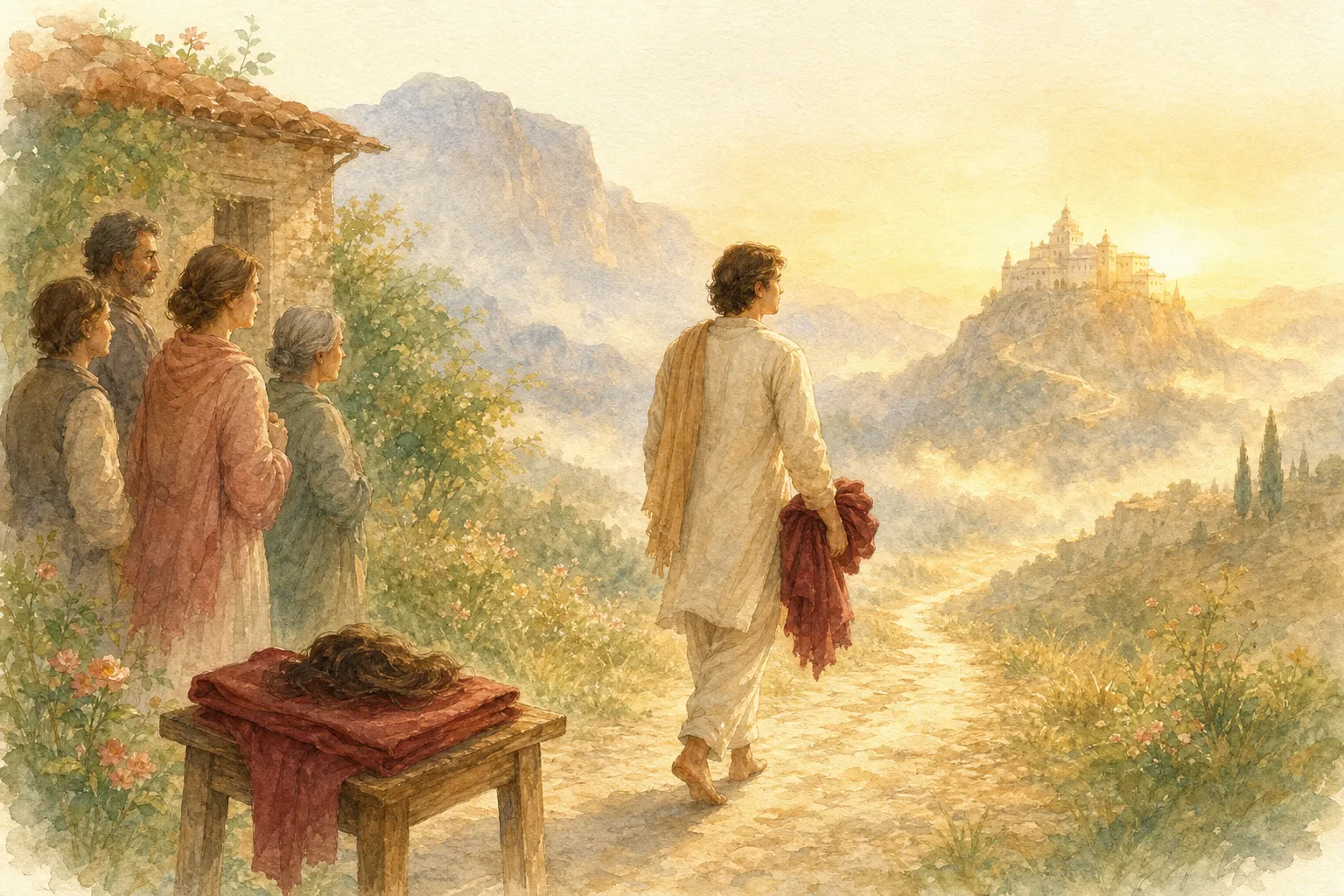
“Little by little I am growing accustomed to the contemplative life, attaining serenity. All life is a dream, and its only meaning is to awaken as quickly as possible. A great renunciation has arisen in my soul, a great faith and the resolve to follow the Great Path! I reject desires and kleshas as deadly poison. At any cost I strive forward — toward Enlightenment! I reject worldly life as a dangerous trap of samsara. I look upon mountains of gold as sand and pebbles. I look upon all worldly cares and plans as children’s games in a sandbox. I look upon kings and rulers as beggars. Who is my mother, and who is my father in this deceptive Universe of Dreams? Farewell, relatives, male and female friends, who failed to understand me. If you wish to keep sleeping, abiding in illusions, that is your affair. Though I have compassion for you, having left everything behind, I go forward alone on the path to Enlightenment, without doubt or fear, like an elephant going to the water. Like a warrior applying war paint before battle, I shave my head; Like a knight putting on chainmail before a duel, I try on monastic robes; As though to the mystical land of Shambhala, I seek the road to the monastery.”
Such is the third stage. This is the stage of renunciation, when we completely reconsider our positions and relationships with the world in order to dedicate our lives to spiritual practice. All saints pass through these stages. We will stop at the three described, and consider the next ones on other days. The following stages are more complex, and therefore require deeper commentary.
Read 13 times
Articles
Vidya AI
Search
Lectures
November 5, 2026
Mantra of the day
ОМ ЭКАЙА НАМАХ ОМ Единому – поклонение!
Auspicious Times(Rome)
Brahma Muhurta:
04:56 - 05:51
Abhijit Muhurta:
11:33 - 12:14
Sayam Sandhya:
16:40 - 17:21
Mokshada Ekadashi (6 November)
Ekadashi of liberation. Helps to achieve spiritual enlightenment.