Svatantrya-vada and Abhasa-vada: the Will of Shiva
06.07.2026
0 мин. чтения
0
Share
copy
search
add
share
Now we will continue studying the teaching connected with view. If you study Advaita Vedanta, you need to understand what vivarta-vada, bimba-pratibimba-vada, drishti-srishti-vada, and satkarya-vada are. These foreign words should become very clear and natural for you, so that you can apply them in life.
Scholars study them, write books and monographs, defend candidate and doctoral dissertations — they turn them into thought constructs. But a sadhu studies them for another reason: he uses them just as he uses a fork or a spoon. For him, this is not something distant — it is everyday life; there is nothing intellectual here — it is life in a particular vision.
In the same way, when we study Shaivism, it is important for us to understand certain vadas — schools of thought, philosophical views, perspectives, and teachings. In Shaivism, svatantrya-vada and abhasa-vada are important. The vadas teach us how the saints looked at the world, how the sacred scriptures look at it.
Based on the study of the vadas of different traditions, of thinking and view, we must form our own personal vada. A personal vada is not a fantasy world that we have invented in order to live more comfortably. It is our own interiorization, our inner interpretation of those teachings that we have passed through ourselves, and now they have become our own views.
Vadas, however beautiful they may be, if they remain external, will not help us; they will not save us until we let them inside and make them our own personal vada. This personal vada should not differ from the vadas that we study in the transmission lineage of the Guru-parampara, but it must be allowed inside, and we must learn to think, reflect, and apply it just as the saints did. Then we will cease to differ in worldview from the saints — this is the meaning of studying the vadas.
This is not a philosophical approach. For example, at a department of Eastern philosophy or in an institute of Oriental studies, there are people who study the vadas and have a very good command of the philosophical apparatus and categories, but a sadhu studies them for something entirely different. He studies them in order to use them in life and to form his own personal vada. He will not be satisfied with an intellectual comprehension of a vada — that is the point.
Svatantrya-vada
The Absolute in this system is known by the names Chit, Paramashiva, and Maheshvara. He is called Maheshvara not in the usual sense of God as the first cause, inferred from the order and structure inherent in nature. He is called Maheshvara because of his absolute sovereignty in the aspect of will — svatantra and svatantrya.
If in Advaita Vedanta the aspect of sat-chit-ananda (being, consciousness, bliss) is emphasized and the Absolute is inactive, then in Shaivism the aspect of will is very important. The universe is created by an act of Shiva’s spontaneous will. In Shaivism, God is active; he is not the static Brahman as in Advaita Vedanta.
Advaita Vedanta considers the Paramashiva-tattva. Shaivism considers Shiva-tattva, Shakti-tattva, Sadashiva-tattva, Ishvara-tattva, and others, and Shakti is connected with these tattvas — the principle of Shakti is very important. The creation of the world and God are considered through the prism of the manifestation of divine will.
In Advaita Vedanta, divine will is not essential, because it soars in other spheres. It soars in the sphere of pure consciousness beyond subject and object, where there is nowhere even to apply will. Will exists, but it has little significance for the realization of Brahman. In Shaivism, the principle of will has enormous significance, and this is very good news for us, because it is precisely through will that we ourselves develop, and it is much easier to realize will as Shakti than to realize pure consciousness at this stage of our evolution.
The Principle of Divine Will
Svatantrya-vada is a description of the principle of divine will, which we must assimilate and apply to ourselves. We must understand our own will:
What is my will?
To what extent is it connected with the divine, or could it be something not divine at all?
How can I unite my will with the divine?
How does it feel when your will and the divine have united?
How should I apply my will so that it embodies the divine will and liberates me myself?
What is true humility?
All this is the principle of svatantrya-vada applied to oneself: where one must remove the will, and where one must manifest it—such questions arise very often in service.
This absolute sovereignty or free will is not a blind force, but svabhava (one’s own being) of universal consciousness (chit). It is this sovereign free will that brings about the objectification of its ideal content. It is free because it depends on nothing external to it—it is free and capable of creating practically everything. It abides beyond time, space, and causality, for the latter owe their existence to it.
One has met such people; there are people like this: whatever happens, they say, “God’s will”—they, too, adhere to svatantrya-vada. Svatantrya-vada is that system of thought which sees the divine will as absolutely independent of anything, absolutely sovereign, relying only on itself, and creating the world by manifesting its own diverse aspects.
The whole world already exists in a folded-up form within the Absolute, but this will enlivens and manifests everything that exists in a folded-up form and manifests it outwardly. It seems to us that the world comes about through a combination of various causes, that someone does something and something appears; but from the point of view of svatantrya-vada, the world already exists in a folded-up form. The divine will merely manifests what already exists through niyati—the established order of things.
Union with the Divine Will
We, as jivas, souls in samsara, follow the law of this divine will—it manifests everything. If we understand this principle of the divine will, unite our own will with it, and live in unison with the universal divine will, then the divine will will partly become our own will as well. Having united with the divine will, we will even be able to create universes and govern this reality in the future. This is what svatantrya-vada teaches.
The teaching of svechchha-chara: one’s own will is the Lord. This means that that particle of our small, tiny human will is in fact not entirely ours—it is the will of God within us, but it has been given to us in a very small amount, at our disposal to a very small degree.
We can come to know the divine will on much greater cosmic scales, but for this one must attach one’s own tiny will, unite it with the divine. As long as our will is separated from the divine, it communicates with the divine will very little; but as practice progresses, this communication becomes greater and greater, increasing until complete self-surrender takes place.
When the yogin realizes: “I am not my own. I am God’s, and since I am God’s, all the divine will is now a part of me; it is even at my disposal, but I am no longer there. I have given myself to God, and God acts through me.” Such paradoxes occur in meditation on the divine will.
“The divine power is known by the name Chiti. Its essence is self-awareness. It is also known by the name para-vak. It eternally abides in itself and is the source of all visible changes; it is mahasatta, or absolute being, since it is free to be absolutely everything; it is the source of everything that can be called existing in any way whatsoever. It abides beyond the determinations of space and time. One may say that, in its essence, this free sovereign will represents the very heart or core of divine being.”
Svatantrya or Maheshvarya means absolute sovereignty or freedom of will. It implies the unhindered fulfillment of the divine will and is an expression of self-awareness.
“Svatantrya means the power to act according to one’s own will: it is an unhindered and unlimited flow of the expression of the divine will.”
Shiva is svatantra — self-dependent, relying only on himself, on his own free will and on nothing else. All living beings are asvatantra (not self-dependent); they all rely on this supreme will and are subject to it to one degree or another. Why? Because the will of living beings, their svatantrya, is suppressed by niyati-shakti and by many other shaktis, kanchukas.
At the moment when the kanchukas are overcome, the coverings are cast off from our will, and it truly blossoms. Therefore, one of the tasks of a sadhu is to perfect his will so as to cease depending on niyati-kanchuka, on the other kanchukas, so that this will gradually begins to see within itself the freedom of the divine will. This shakti within us must blossom, and as you practice, little by little you discover how it is blossoming within you.
Temptations of Power
When free will begins to blossom, it inevitably attracts various shaktis (power). One who has gained power in freedom of will attracts shakti, and here, for the yogi, a period of temptations begins, because if he has no viveka and self-surrender, he may attract various powers, even those he does not need.
Psychic powers, magical abilities, wealth, authority, influence over people — all these are various riddhis and siddhis, but a yogin must cast aside these powers, not become attached to them, not cling to them, and offer everything to God, because by attracting powers, by becoming carried away by powers, he may lose God — the main goal — and remain with powers but without God. This is a very unequal exchange, therefore mastery of freedom of will always goes together with faith, devotion, viveka, and self-surrender.
For example, a certain shakti, charisma, increases in you, and your fame grows. Suppose you begin to preach, become well known, many people begin to respect you, give you gifts, revere you — this means you begin to resemble whom? The six qualities of Bhagavan — kirti, yashas, an expanded aura. You may become very famous to millions, an idol of millions, but sadhus say: “Careful, you have exactly three seconds to offer this fame upward through the parampara; do not become attached. It is not yours — it is the glory of God through you. He has simply taken you as an instrument and manifests his glory, but through you. You have exactly three seconds to offer it back.”
Question: Om, Guruji, tell me, are there situations when you do not know what to choose; that is, if, for example, a door is open, there are certain paths, and all of this comes easily, while there are closed paths, and you do not know what is good there, but you think it may be better there. How can one understand where obstacles are hindering you and you need to make an effort to overcome them, and where you need to let go, because perhaps there, behind the closed doors, monsters may be sitting — that is, life will become worse. The Lord simply does not allow you to open them so that you do not go there. How can one understand whether to go or not to go?
First, one must become established in the view of the one who neither comes nor goes anywhere. If you abide in such a view, it equalizes both closed and open doors. Second, one must act while always turning for blessing to the saints of the Refuge Tree. Such action intuitively develops you, showing different possible events. The habit of turning to the Refuge develops your intuition.
Abhinavagupta’s Teaching on Svatantrya
“Svatantrya means the power to act according to one’s own will: it is the stream of expression of the divine will that knows no obstacles or limitations.”
Svatantrya-vada, or the doctrine of the absolute sovereignty and freedom of the divine will to express or manifest itself in any way it desires, is splendidly explained in the following statement by Abhinavagupta:
“Thus, Lord Paramashiva (absolute reality), whose own being is consciousness possessing the nature of prakasha and vimarsha, and who, in the form of an indisputable eternally existing reality, manifests as the subject throughout the entire series from Rudra to immovable entities — such as blueness or pleasure and the like, which appear as something separate while in their essence not being separate, through the action of the radiant power of svatantrya (free will), which is inseparable from samvit (universal consciousness) and in no way conceals the true nature of the Supreme. Such is the description of svatantrya-vada (the doctrine of svatantrya).”
The Development of Inner Freedom
Our svatantrya-shakti must increase in the process of spiritual life. Our inner freedom, inner experience, inner liberatedness must increase. We can live our whole lives according to monastic principles and rules, within a certain routine, yet our inner freedom can grow to infinite dimensions.
A true monk-sannyasi can humbly prepare prasad in the kitchen, and then in the evening or at night enter samadhi, transform into a vast universal deity, pass into a world created by his own will, and in a heavenly palace teach thousands of celestial beings, receiving signs of grace, blessings, worship, and offerings. Then, by the power of transformation into a wrathful deity and mantra, he can subdue terrifying demons. Then bless kings in other dimensions, then descend into hell and save souls from hell. Then return to the body and, as if nothing had happened, go in the morning to prepare prasad, humbly receiving instructions from the manager. This is a manifestation of svatantrya-vada, inner freedom.
Your inner freedom increases when you:
Open the subtle bodies of other dimensions
Open divine powers (shaktis) within yourself
Discover within yourself the space of self-liberation
Recognize the emptiness and illusory nature of this world
Understand the playful nature of all phenomena and their inseparability from consciousness
You become free from the influence of the external world, connections, relationships, and most importantly — from your mind and from your ego, which represents shakti no less seriously than the external material world, and sometimes more seriously. No chains hold as strongly as the chains of the mind, the inner chains that exist in consciousness. No external world holds as tightly as one’s own mind, one’s own desires, one’s own ego, and kleshas.
True Freedom of Will
Svatantrya means that you become free from both the external and the internal; your power of inner freedom increases. You know how to be free when your will manifests and when it does not manifest, when everything goes your way, as you want, but also when everything does not go your way at all and not as you want. You know how to be free in both states.
That is, freedom of will does not necessarily mean that everything must be my way. In fact, until you have become Shiva, it will never be the case that everything will be your way — somewhere, somehow it will be your way, and somewhere not quite. Svatantrya means that you are always free, and the energy of freedom within you is always present, and nothing can touch it, because at the deepest essential level it only increases within you.
You begin with verbal and mental self-liberation — these are the seeds of your svatantrya. Then, with the help of contemplation, you can practice self-liberation — this too is the increase of svatantrya-shakti.
Then, thanks to contemplation, the space of awareness opens within you and subtle vision is formed, independent of anything; vairagya arises, along with the ability to separate your space of freedom from the conditions of samsaric existence.
The Freedom of a Sadhu and Worldly Confidence
A true sadhu is an extraordinarily free being, never constrained. A very free and very confident being, but this freedom is not selfish and not self-assured, not in the ego. The confidence and freedom of a sadhu are in God and come from understanding the divine will and uniting with it.
In the world there are quite a number of powerful, wealthy, confident, very self-assured worldly people — businessmen, politicians, stars, masters of their craft. They feel very confident; there is power behind them. These are people of power: if you interact with them, you will feel how an aura of authority, an aura of ease, an aura of looseness, an aura of play, an aura of freedom, or an aura of deep vision emanates from them. There are quite a lot of such people; they are all very creative, all very deep and very strong, but this is not the freedom of a sadhu. There, if you dig just a little deeper, there is such a force of ego (ahamkara), that is, all of this is created by means of ahamkara.
The True Nature of a Sadhu’s Freedom
The freedom of a sadhu arises from something else — from the understanding of God’s nearness, self-surrender to God, subordinating oneself to the divine will, and conducting the divine will through oneself. A sadhu is the freest being on the planet; above him are only the siddhas. Siddhas are the most exalted among people.
The freedom of a sadhu lies in the fact that he has come to terms with inner svatantriya, has subordinated his will to God, has given himself to God. A sadhu can be free in any situation and under any conditions.
Usually, all of us sometimes feel free and sometimes constrained. For example, we live alone in a room — we are free; another person is moved in — we are already constrained; a third creates discomfort altogether. As long as our affairs are going well, we feel on top of the world; when everything goes wrong, the mind already contracts.
A sadhu always feels free in any company, under any conditions, in any place, at any time, in any circumstances. He possesses a single “taste” with regard to freedom.
The Single Taste of Freedom
Whether his feelings and desires are satisfied or not satisfied, he feels at ease and free. He feels free with those who are senior, junior, and equal.
A worldly person feels free with those who are lower. For example, all people love animals, because a person feels very free with animals — animals are foolish, and a person can manifest the bhava of patronage and generosity.
With equals, tensions already arise among people — it will not work as it does with animals, because they are your equals, and here arise “my preference — yours, my will — yours”; already incomprehensible things begin.
With those who are higher, stronger, wiser, and older — there consciousness contracts altogether; everything is very cautious, it is completely unclear what is here, sankocha-shakti is at work.
These are different levels of svatantriya: with animals or insects, with those who are lower, a person can feel like Bhagavan, can feel like Ishvara. With equals, already sometimes as a rival; with those who are higher, he himself becomes — anava-mala is at work, he himself is like an ant, especially if the other is strong. Before the gods: “Who are you at all?” — a deity has appeared, and you are nobody, a little bug.
These are different levels of svatantriya — it contracts, sankocha-shakti acts, or it can expand. When a yogin realizes the inner svatantriya-shakti, he becomes equally free with everyone. He may see a deity, he may see an ant — he will not abandon his free nature.
He understands the hierarchy of the universe: to whom it is necessary, he expresses signs of attention and respect; to whom it is necessary, he gives patronage; with whom it is necessary, he befriends and communicates as with an equal. But his svatantriya-shakti does not contract; it is always wide open, expanded, and his inner freedom is not lost.
Therefore it is said that a sadhu will not abandon the natural state even when he sees thousands of gods, and he will not be frightened even when he sees thousands of Maras who have come to take him away. He does not rejoice in heaven and does not fear hell, because his svatantriya (inner energy of freedom) is never lost and never contracts.
Samarasya (the single “taste”) means that we never lose our own freedom anywhere, because we are united with the divine will.
Abhasa-vada
From the standpoint of the creative activity of the supreme reality, this philosophical doctrine is known as svatantrya-vada, but from the standpoint of its manifestation it is known by the name abhasa-vada.
Abhasa-vada is the second important teaching for the philosophy of Shaivism, which explains how the universe manifests and what the mechanism of its manifestation is.
In the supreme reality, all the manifest diversity of things exists in perfect unity as an undifferentiated mixture, just as the variegated tail of a peacock, with all its magnificent multicolored adornment, abides in a state of undifferentiated mixture in the plasma of a peacock’s egg. The principle underlying every manifestation is chit, or pure universal consciousness.
The Nature of Creation in Shaivism
From the standpoint of Shaivism, the process of creating the universe, the manifestation of anything, is not the creation of something new out of nothing. It is the manifestation from within divine consciousness of that which already existed in it.
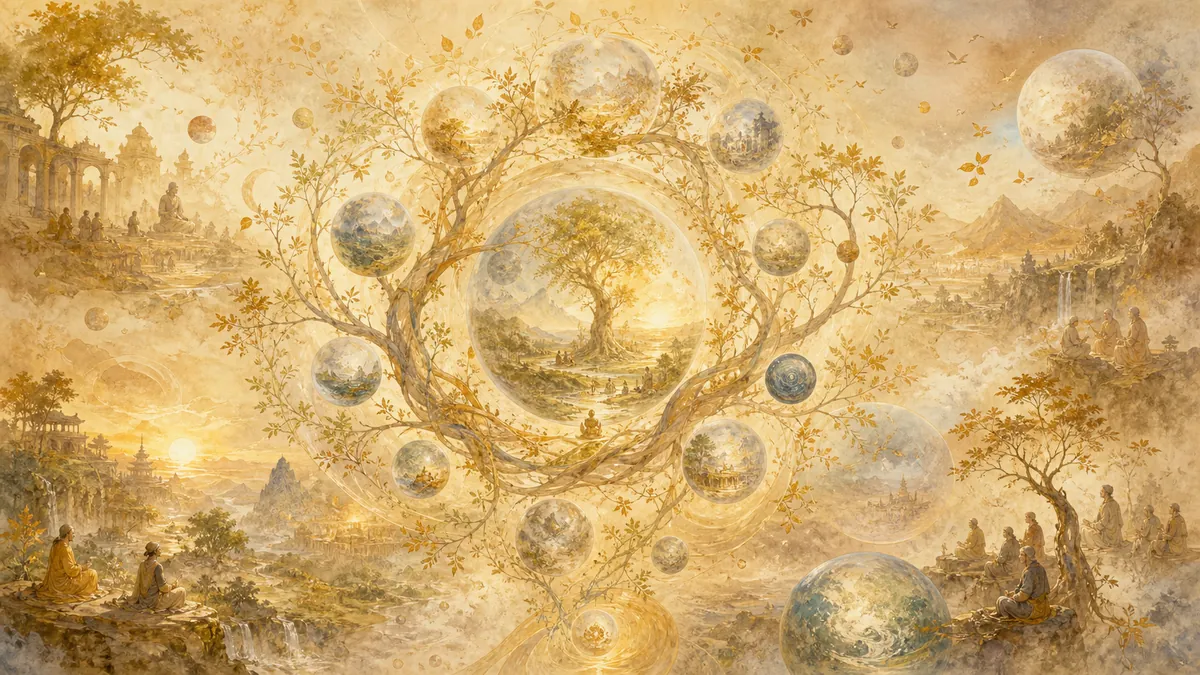
For example, stars and planets were created, life arose, civilization, humanity, wars, politics, and culture emerged. This means that all of this already existed within divine consciousness, but in a folded state. It is not something that was created — as if it did not exist, and suddenly appeared from somewhere. In reality, all of this was already within divine consciousness — it is only manifesting, moving forward according to the plan of niyati.
In the “Yoga Vasistha,” Vasistha says to Rama: “Rama, it was this way and that way; this is not the first time you have asked me these questions, and it is not the first time you and I have met.” And it is not the first time Krishna explains to Arjuna on the battlefield of Kurukshetra what is happening. These cycles have already occurred many times, and all of this has already unfolded. The world folds and unfolds, but at the same time it does not cease to exist within divine consciousness — only separate branches of it are emphasized or activated.
Definition of Abhasa
The world of eternally changing forms is merely an expression of chit, or sanvid. Everything that manifests in one form or another — whether an object, or a subject, or knowledge, or the organs of cognition, or the senses — everything that exists in one way or another is only abhasa — a manifestation of universal consciousness.
The word abhasa = a, that is, ishat (sankochena); brasah = brasanam or prakashana. Thus, abhasa means manifestation or appearance in a limited form. Any kind of manifestation is characterized by certain limitations. Every accompanying thing is a separated configuration of abhasa.
“Just as on the pure surface of a mirror various forms of a city, a village, and so on appear, seeming as if they differ from one another and from the mirror itself, although in reality they are not something different from the mirror itself, in exactly the same way the world, being no different from the pure consciousness of Paramashiva, manifests as filled with differences both among its numerous objects and as differing from universal consciousness.”
The Mirror Theory
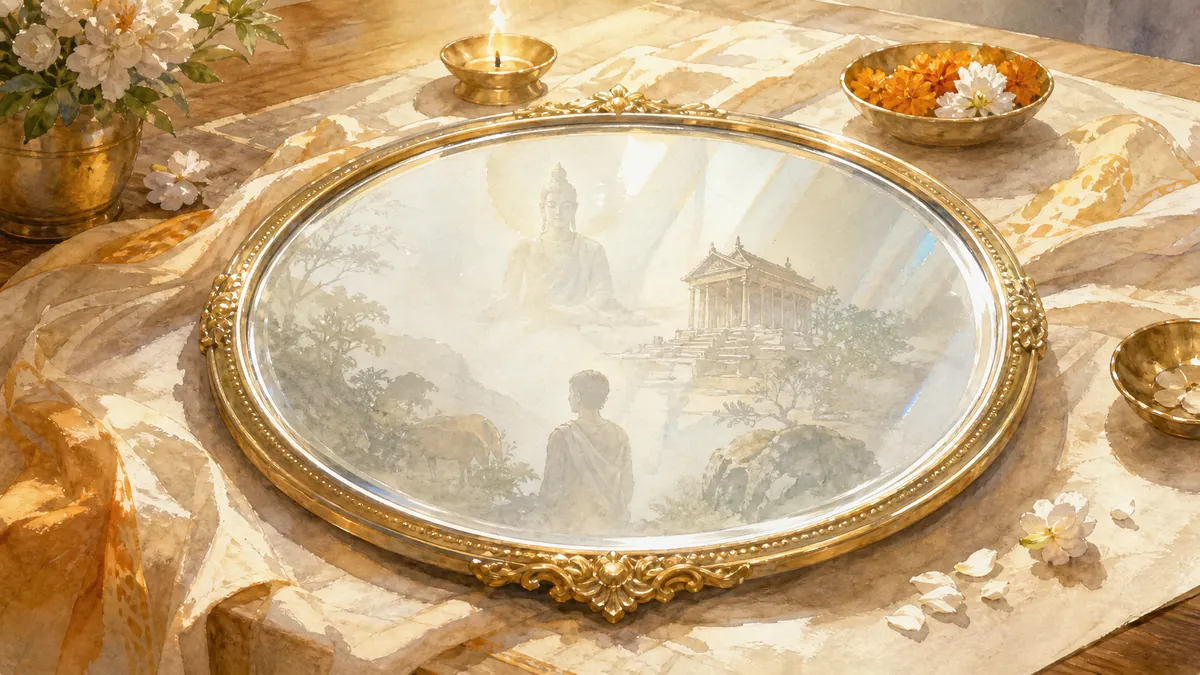
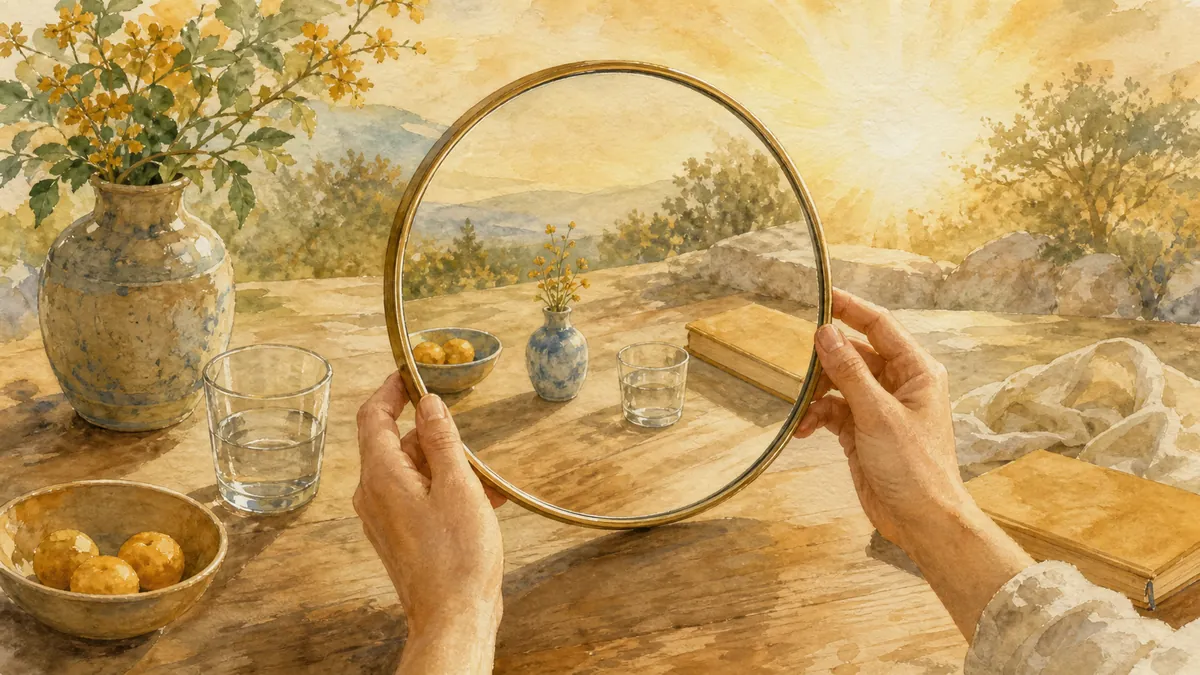
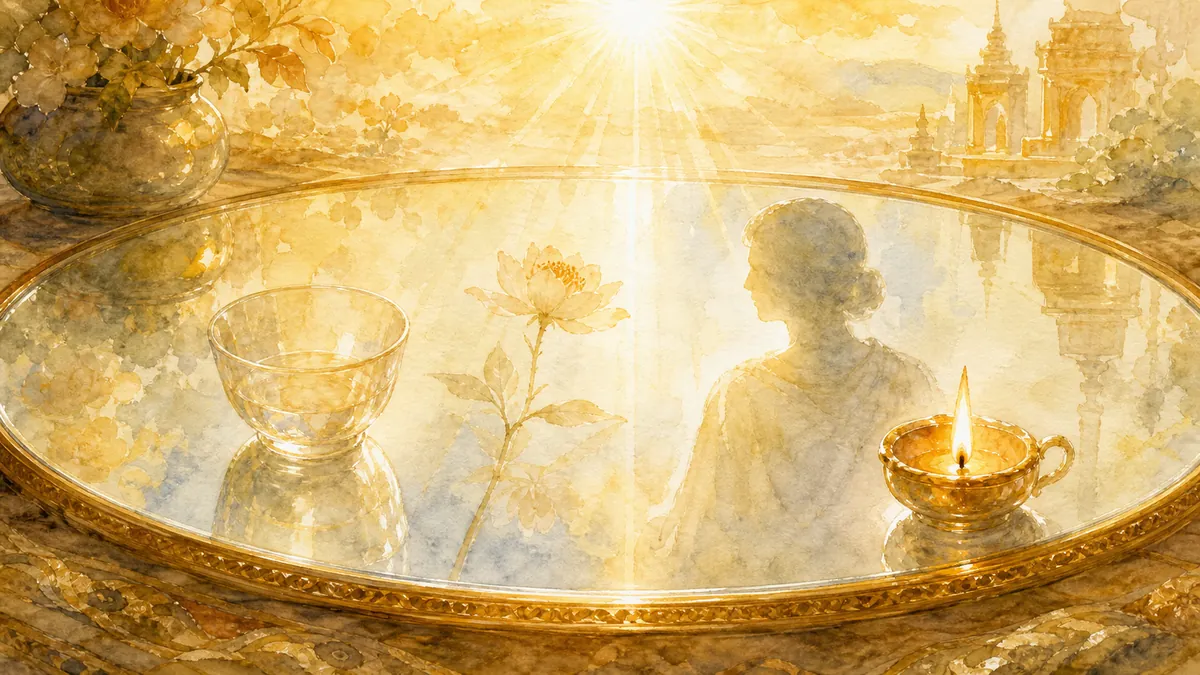
So, abhasa is the theory of the manifestation of the world as a reflection in a mirror. Chit (pure consciousness) is the surface of the mirror. Stars, a house, a person can be reflected in a mirror — all of these are reflections on the surface of the mirror.
This mirror, as chit, has certain features. For example, if one person or one object, or a million, or a billion, is reflected in the mirror — will the mirror be stained, will its reflective capacity diminish? Obviously not; the mirror does not care how many objects it reflects.
For example, if a Buddha, a deity, then a person, then a pig, an unclean animal, or a dog is reflected in a mirror — will the mirror become stained, lose its reflective capacity, or somehow become colored, or not? Obviously, no. All reflections are unreal for the mirror and do not in any way affect its reflective capacity or its essential characteristics.
Moreover, from the point of view of the mirror, all reflections are unreal; they arise without leaving the mirror itself. Behind all reflections there is nothing real and nothing essential. Within the framework of this example, only the mirror’s reflective capacity and the mirror itself are real. It is a magical phenomenon that produces all these reflections; it can also fold up all these reflections, the reflections may disappear, but the mirror itself remains as it was.
In other words, within the framework of this example, the mirror is more important than the objects reflected in it; it is the source that generates these objects within the framework of this example. It is very important for us to understand the difference between the mirror and the reflection. The mirror is Shiva’s chit (pure consciousness), and therefore our consciousness as well; the reflection is all external manifested phenomena. The mirror is the space of pure awareness, while the reflections are all the objects of the material world that arise within it.
Practical Application of the Teaching
We all pay attention to the reflection, but we constantly forget the principle of the mirror, we forget to look at the mirror, and therefore we miss how everything is actually arranged.
For example, we see: this is a wall, this is a murti of Shiva, this is a brahmachari, this is the ceiling, this is a lamp — we see reflections, we are dealing with reflections. Or music — this is a bhajan, these are words, this is a concept, this is an image in the subtle body — all these are reflections.
When we recognize the principle of chit, we recognize pure awareness. Then this is a wall, but behind this wall there is a subtle space-consciousness; the observer sees this and is one with it. This is a person, but I perceive him as an observer, as not different from the observer, and I perceive the space. This is music, but I perceive it as witnessing awareness and as the space against the background of which the music unfolds.
When we abide in the mirror, we abide in the source of all things. We see pure consciousness as space, the source of all phenomena, inseparable from the mirror. When we forget to recognize the mirror, we become entangled in objects, in reflections; we wander in the labyrinths of reflections.
All living beings in samsara have become entangled in the labyrinths of reflections; they have become entangled in mirages because they do not recognize the mirror. Viveka, both in Vedanta and in Shaivism, consists in understanding the difference between the mirror and the reflections and in understanding the illusory nature of the reflections. Within the framework of this example, all reflections inside the mirror are illusory; they are inessential; in a certain sense, they are empty. They are merely a property of the mirror’s reflective surface, its ability to reflect, while the source of everything is the mirror itself.
Managing Reality Through Understanding the Mirror
For example, if we want to change the position of an object inside the mirror, we will not be able to do this unless we change something outside. For example, there are objects whose position cannot be changed — suppose the sun or the stars cannot be rearranged; then we cannot influence the objects inside the mirror, we cannot change them in any way. But if we have entered the state of the mirror, for example, we are holding the mirror in our hands, that is, the mirror is one with us, then we can calmly change the position, we can influence them by rotating the mirror.
In the same way, when we come closer to understanding chit (pure awareness), managing our own surrounding reality also comes closer to us; it is as if it falls into our hands.
To recognize the mirror means to abide in knowledge, in contemplation, in the view. Not to recognize it and to see only objects and become attached to them means to become entangled in reflections. This should also be assimilated in everyday life — we must always ask ourselves: “Is this the mirror or a reflection? Have I become entangled in reflections, or am I aware of the mirror?”
If I am aware of the mirror, then the reflections are not so important and they do not influence my consciousness so much. I take them into account, but they no longer bind me. Our most important task is for reflections not to confuse us, not to bind us, so that we always see this wondrous surface of the mirror. When we see this wondrous surface of the mirror, we can investigate its nature, and this nature is Brahman. All wisdom, all power comes from understanding the qualities of this mirror. This is the teaching of abhasa-vada.
The Philosophical Basis of Abhasa
“Abhasas are explained by analogy with a reflection in a mirror. Although a reflection in a mirror, appearing as something other than the mirror itself, is at the same time in no way anything other than the mirror itself, in the same way abhasa, being inseparable from Shiva, appears as something different from him. Just as the reflections of a village, a tree, or a river in a mirror appear as something different from the mirror itself, yet, strictly speaking, are nothing other than the mirror itself, in exactly the same way the world reflected in universal consciousness is in no way different from the latter.”
It seems that objects are different from the mirror — the objects within the mirror. We are not speaking about objects outside; we are considering only the example connected with the surface of the mirror, but in reality these objects are not different from the mirror in any way. Moreover, they are the mirror; they simply manifest the mirror’s reflective capacity.
This example is important to understand and apply to our spiritual life. We see objects, but these objects are not different from primordial consciousness; they point to this primordial consciousness of the mirror. In essence, they are not something in themselves; they are this primordial consciousness.
Practical Recognition of Unity
That is, for example, you go to seva, to the third area, meet a brahmachari — you think that this is a brahmachari, but it is the mirror of pure awareness, not different from pure consciousness. You encounter this awareness, but you do not recognize it.
You were doing seva in the third area and then went to the kitchen, encounter prasada and other people — you think this is prasada, these are other people, but in reality it is the same reflection of the mirror of pure awareness. You encounter pure awareness, but you do not recognize it.
There are different reflections in the mirror: pure and impure, good and bad, what you like and do not like — you encounter them again, but you do not recognize them. You pay attention to their color, configuration, and so on, but if you do not see the mirror, then you do not recognize that this is the same pure awareness.
At the moment when viveka is revived and you begin to recognize pure awareness behind everything, you laugh. Colors are no longer important to you, words are not important, names are not important, forms are not important — what is important to you is the mirror of pure awareness. You recognize it, and you are no longer misled, and all these colors, names, and forms will not mislead you and will no longer deceive you. Thus the single “taste” gradually comes.
Attaining the Single “Taste”
The single “taste” means: you develop an inclination to recognize consciousness, you develop the wisdom that consciousness can be recognized behind everything, and you begin to pay attention to divine consciousness rather than to the reflections it produces.
Yes, divine consciousness produces phenomena (reflections), but this is a play. This play is empty, it is illusory, and it is far more important to know divine consciousness itself than its phenomena. You begin to pay attention to divine consciousness itself and to pay less attention to phenomena. Then phenomena, too, gradually begin to submit to you.
Previously, when you did not understand this, life was confused and complicated in the sense that you were bewildered, because it was separate from this consciousness. When you began to recognize the mirror, phenomena gradually become ordered in your life. Life is purified to the point that it becomes a mandala of pure awareness, inseparable from consciousness, because you have understood the principle of the mirror.
The single “taste” means always and everywhere recognizing pure divine consciousness, not being enchanted by reflections, not attaching importance to them.
Limitations of the Analogy with the Mirror
“In the analogy with the mirror, however, it is necessary to point out two aspects that make it incomplete. First, in the case of a mirror there is some object that is reflected in the mirror, whereas in Maheshvara, or universal consciousness, only its own ideation is reflected. In the case of a mirror there is an external source of light, thanks to which reflection becomes possible at all, while in the situation of universal consciousness there is only its own light—the light of all lights, and no external source of light is required here.”
This physical example has its limitations, because it is a physical example, and this is what is being discussed here; but at the level of Shiva, these limitations do not exist. Shiva shines by his own light, and he does not reflect any external objects; he reflects his own energies.
“Second, a mirror is an object not endowed with consciousness, as a result of which it knows nothing about the reflections appearing on it, whereas universal consciousness knows its own ideation, which appears within it.”
Thus, the true consciousness of Shiva is a self-aware mirror, knowing everything about the reflections that occur within it, endowed with its own light and not reflecting any external objects, but reflecting its own energies. When we understand the limitations of the material example and the fact that pure consciousness does not have these material limitations, we can fully apply the teaching of abhasa-vada.
“Abhasas are nothing other than the ideations of universal consciousness, appearing as external objects in relation to the empirical subject. ‘Just as the entire diversity of objects appears in a mirror, so the whole universe appears in consciousness, or the Self. However, consciousness, by virtue of its vimarsha, or power of self-awareness, knows the world, unlike a mirror, which does not know the objects reflected in it.’”
“All abhasas arise like waves on the surface of the sea of universal consciousness, and just as the sea gains nothing when waves arise and suffers no harm when they disappear, universal consciousness gains and loses nothing with the arising and disappearance of abhasas. Abhasas appear and disappear, but the consciousness underlying them remains unchanged. All abhasas are nothing other than the external projection of the ideation of the divine.”
Divine Creation Through Will
“The Divine Being, whose essence is chit (universal consciousness), causes the entire multitude of objects hidden within it to manifest outwardly by its own will alone, without any external material, just as a yogin causes his inner images to manifest outwardly by his own will alone.”
The principle of abhasa-vada reveals to us the secret of the material creation of the universe and the secret of our own creativity, the secret of manifesting siddhis and the secret of managing reality. We understand that deep within us there is this very same profound divine consciousness, which, like a mirror, miraculously manifests all objects. Then we begin to relate differently to cause-and-effect relationships, to the materialization of phenomena. We begin to understand that the main factor that materializes all phenomena in the universe, from the point of view of both Shiva and the individual, is will, and will is directed by attention. We understand that consciousness can manage reality, consciousness can create any event, materialize any object.
For example, if you possess willpower, you can even materialize a person with specified qualities and characteristics, even with a specified past, though in doing so you will have to accept responsibility for them as their creator. If your consciousness is developed, you can manifest any cause-and-effect connection, any event; you can manifest any of your desires out of emptiness, if you have enough power, concentration, enough light of merit, and tamas does not hinder it. In this sense, the nature of the Mind is like a magical three-dimensional 3D printer — by giving it a program in the form of sankalpa, you can print anything you wish.
The Awakening of Creative Powers and Sankalpa-Vidya
When you understand this principle, your creative powers begin to unfold and blossom, and you begin to understand parasattarka logic, the teaching of Vasishtha, the creation and formation of the universe. The capacity for sankalpa-siddhi opens within you, and sankalpa-vidya begins to awaken inside you — the art of manifesting intentions through willpower.
You begin to understand how energies gather out of emptiness and materialize one situation or another; how, from among the variants of events, from the fan of events in the universe, the necessary event, the necessary connections and relationships, are singled out and materialized in this world. Suddenly you begin to understand the statement from the “Yoga Vasistha” and other texts: “Whatever you think about is what manifests. Whatever you think with is what you become. Wherever and whatever consciousness in the universe conceives — there, then, that manifests.” All these things begin to become clear to you. The secret of the fulfillment of desires becomes clear to you.
The Worldly Application of the Principles of Creation
There is an American film called “The Secret,” a very well-known one, and in it scientists, quantum physicists, and businessmen explain that scientists conducted research, gathered statistics on how their desires come true, and that if you conceive of something, if you have a dream and hold to it with great strength, sooner or later it will come to pass and materialize.
Americans are an enterprising people; they immediately began using this for enrichment, for the materialization of their worldly desires. They began conducting coaching seminars, and many trainers appeared: creative visualization, how to achieve goals; that is, the principle “think and grow rich” — this is a well-known book, and billionaires began writing books on this topic. The exploitation of this principle began.
There is a very famous worldly Hollywood actor, Jim Carrey, and he told how at the age of 21 he visualized himself as a billionaire. He visualized a check for 10 million dollars, and he visualized it for an entire year, and in the end he received this check and became successful thanks to this. In other words, people felt the power, lost their fear of samsara, and understood: “I can create reality, I am God. That’s it, life is a success.” They began to exploit this ability simply for the sake of enrichment, gaining power, influence, money, and wealth. This is an example of how even a little knowledge can change even the lives of worldly people.
A Sadhu’s Mature Attitude Toward Creative Power
From the point of view of a sadhu, this is not a very mature attitude toward wisdom, toward the understanding that your consciousness can create reality, that it is much better not to spend the merits of your consciousness on materializing worldly desires, but much better to materialize something truly worthwhile. A sadhu, too, is not averse to materializing something — for example, the body of divine wisdom, the illusory body, the state of liberation, enlightenment; that is, his materialization pertains to far more eternal, divine, and immortal spheres.
In practice, what we do is this: using the knowledge of abhasa-vada, we manifest that version of reality, that version of the universe in which we are liberated, enlightened, and endowed with virtuous qualities; but for this one must engage a great deal in creative visualization, for example, the yoga of the illusory body.
Creative visualization is a secular term, but the yoga of the illusory body existed millions, thousands of years ago, even before those people and their worldly knowledge. All of this is the proper application of iccha-shakti, when this process is known to us — sankalpa-vidya.
The Universality of the Principle of Creation by Will
There are many people who wish to control reality once they have come into contact with this knowledge and understood it, but the question is what we want to materialize, what reality we want to manifest. There are many sorcerers and magicians who use and operate with it — this property is universal. It is not only Shaivism or Advaita — it is a universal property of the universe. Abhasa-vada describes this facet of creation, and as soon as we approach the understanding that the world is consciousness, wherever and whatever it conceives — that is what manifests there; and consciousness is directed by will and attention, will and attention generate spanda in the subtle divine spheres, and spanda, personified by Shiva’s drummer, begins to create new causes and effects, gives rise to new vibrations, and they inevitably materialize.
At the same time, the materialization of will occurs strictly in accordance with the strength of will of the person who has conceived it; and if there is no materialization, it means that the will was weak and the previous will, in the form of tendencies, samskaras and vasanas, was stronger and was not overridden. Dattatreya speaks about this in the “Tripura Rahasya,” that is, these are universal principles, and when people penetrate into them, they begin to use them.
The Highest Goal of a Sadhu — Becoming God the Creator
What does a sadhu strive to materialize? The tenth chapter of the “Yoga Vasistha,” the story of the ten Indu brothers, speaks about this. A sadhu strives to manifest this will and this principle in such a way as to become God the Creator himself, having created a new universe. Just as the ten Indu brothers performed tapas for ten thousand years, and in the end each of them became Brahma the Creator, creating his own universe.
This process of creating one’s own universe is the unfolding of the full divine potential of all five shaktis — chit-shakti, ananda-shakti, jnana-shakti, iccha-shakti and kriya-shakti — and the attainment of the capacity for panchakritya. Just as Shiva creates, sustains, destroys, conceals, and manifests the divine, so too does the sadhu unfold his entire potential of creation, moving in this direction — this is the stage of the sixteen kalas. Dattatreya Shripada Vallabhacharya, in this aspect as an avatar, possessed such boundless potential of creation. This is our future — this is how we apply this principle.
The Nature of Divine Creation
“Divine being does not create in the way a potter does, shaping pots from clay. Srishti simply means the outward manifestation of what is contained within. The Divine needs no external material for this. All of this is accomplished simply by its will. Things identical with the knowledge, or jnana, of divine being manifest, through its will, as jneya, or objects; things identical with its self, or ‘I,’ manifest as ‘this,’ or the universe.”
One disciple from Moscow told how he applied parasattarka logic. He needed money very much, and he meditated with great strength and faith. By evening he found five thousand rubles in banknotes somewhere under a bench. With great delight he said that the teaching works. This is the everyday application of sankalpa-vidya, the teaching of abhasa-vada.
However, in essence, we must understand this mechanism, this universal cosmic mechanism, by which our intention, creating something from within, manifests it outwardly. This is the principle by which Shiva’s universe is created.
Subordinating the Will to the Divine Principle
As our will grows, we can achieve the materialization of this will, but we must understand where our will is directed, what we want to materialize; and here we say: “Our will must be subordinated to Shiva.” If we want to materialize small objects, this is not necessary. Small objects can be materialized, manifested even from the ego — for example, a small amount of money, a little success, a little fame, small qualities.
When it comes to realizing global things, the principle of self-surrender must necessarily operate here. All this is done not by the power of the ego, but by the power of divine grace. There have been those in history who relied on ahamkara — Ravana, Hiranyakashipu — who wanted to make the ego the new Bhagavan, but in the end they failed.
“In relation to empirical subjects, they manifest as something external to them. That which manifests in the form of subjects and objects is universal consciousness itself. Thus, this manifestation cannot be called false. This manifestation is not distinct from the fullness or perfection of universal consciousness. This philosophy of svatantriya-vada stands in opposition to vivarta-vada, abhasa-vada to parinama-vada.”