

Commentary on Garab Dorje’s text “The Golden Letters”
Clear Light and Union with It
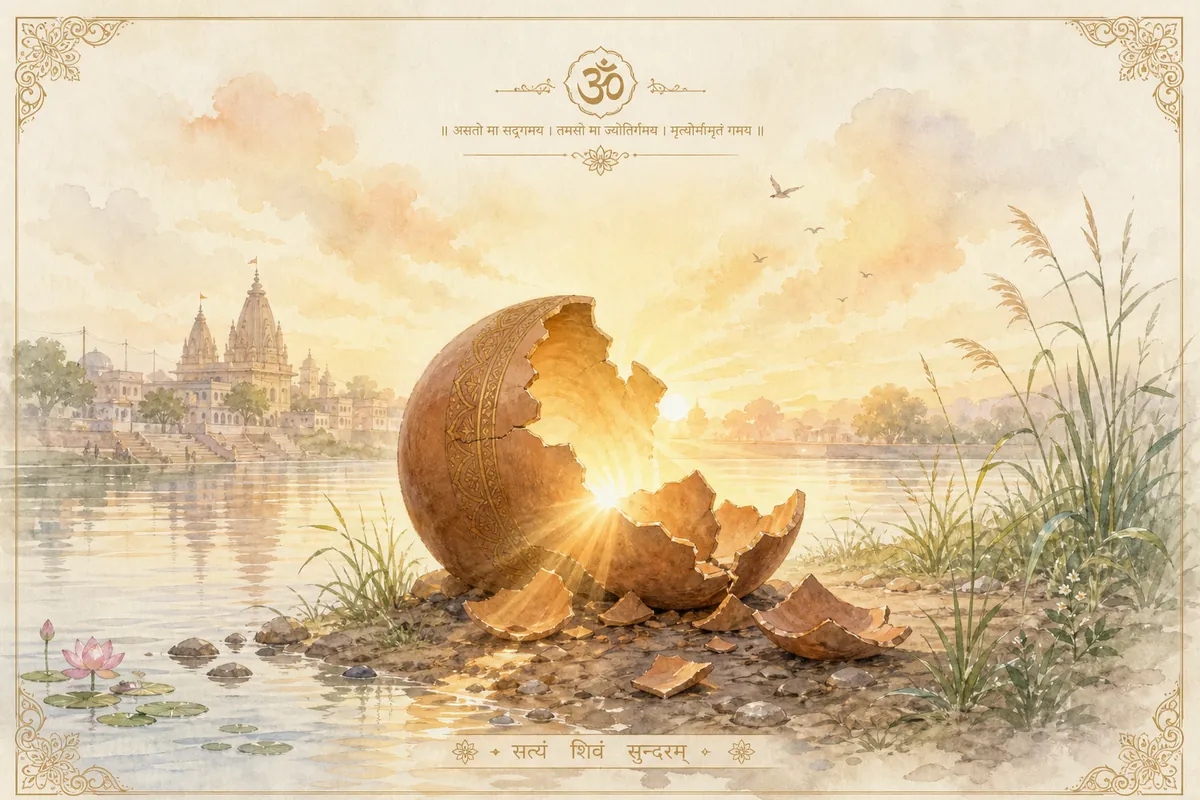
“It is like the meeting of the sun’s rays with the sun, and, in essence, represents the dissolution of light into light.”
“The meeting of a ray with the sun,” “the dissolution of light into light”—analogies of this kind are often mentioned in the texts. In the state of nonduality, it is discovered that our consciousness is something inseparable, that our own light is part of a vast, infinite light.
At first, we think of the practice of enlightenment in terms of personal growth: “I will attain samadhi. I will develop such-and-such qualities in myself.” We see the Buddha and the mahasiddhas as being like supermen. We think that they are simply beings who have developed certain qualities in themselves that are higher than the qualities of humans and even gods. Undoubtedly, they have somehow perfected themselves; that is, they are certain super-individualities.
However, we think too “lowly” of saints and buddhas if we see them simply as super-individualities. In reality, they are not individualities at all, although they use individuality in the course of their activity. Enlightenment, however, implies a much more radical leap—a leap not into a developed individuality, but beyond any individuality whatsoever.
Therefore, the personal light that is born in us in samadhi is only the very beginning; it is called the “light of the son.” How can this light be defined? If you have clarity and an incomparable experience of emptiness within, then this is your light of the son. When, during meditation, your mind expands in the ten thousand directions, you see white light or golden light, like an ocean. This is the light of the son. However, even this deep inner light and inner clarity must unite with something immeasurably greater—with the light of the mother, with the primordial Light.
One day you will discover that this separation was a fiction, that it is one and the same Light. It is like the space inside a broken jug and outside it being one and the same. Then suddenly we understand that there are neither buddhas nor mahasiddhas, that all this is a kind of transcendent deception. The Buddha is visible only to the unenlightened, because there is no person called Buddha; there is only the Absolute. Mahasiddhas appear to people as people, but mahasiddhas are a vast empty ocean of light, inseparable from living beings. That is, we were deceived by this light: it manifested for us as gods, as mahasiddhas, but it is one and the same light. We were deceived by our false ego, because in reality we too are this very light. As a result of such understanding, the transcendence of the personality occurs.

When one monk attained enlightenment, he laughed loudly. He was asked:
— Why are you laughing?
He replied:
— There is nothing special in the Buddha Dharma.
What did he mean? Does this mean that the Buddha was simply a superficial seeker who set forth banal maxims, and that the monk had realized a deeper Dharma, since he spoke this way? “There is nothing special” means that the monk discovered that what the Buddha transmitted was not something different from him, that everything transmitted by the saints had always been no different from this universal light.
The Seen Is Liberated by Seeing Itself
“Everything seen attains liberation in the radiance from the One; the seen is liberated by seeing itself. We can learn about the mirror only by looking at our reflection in it.”
“The seen is liberated by seeing itself.” The seen means objects, and seeing means the direct recognition of one’s empty ground. In the position of an ordinary person who is not liberated, the seen cannot be liberated, and therefore it exerts an influence. Every visible object causes the channels, energy, and mind to respond. Nothing can be done about this, because consciousness responds.

If you are shown a deity or a ritual is performed, then your subtle channels of pure vision will respond, you will enter a meditative state, and the winds will flow through the subtle channels or even enter the sushumna. If you are shown something threatening or wrathful, then your coarse channels, the lower chakras, will respond.
We respond to what is seen with the mind and the pranas. However, here it is said that what is seen is liberated. The single “taste” is a state in which all channels, chakras, and consciousness respond in the same way to all stimuli. When you see a dog, a saint, or a statue of the Buddha, the response in the channels and the mind is the same. When you eat delicious prasad and fish entrails, like Luipa, the response is the same. When you hear abuse directed at you or enthusiastic praise, the response is the same.
What has happened? The objects have not changed, but the mind and pranas now respond differently; they have begun to respond in such a way that the energy enters the central channel. By what means does such liberation occur? By means of vision. In laya yoga, vision is a very important concept.
There is a saying: “What matters is not so much meditation as becoming accustomed to the vision.” This is the habituation to being in nonduality. Vision is the constant recognition of one’s empty basis, empty luminosity. When we recognize this empty basis, everything seen is liberated by such vision. For example, you see something, yet at the same time you have the vision of the empty basis, and it is more important to you than what is physically seen. Then a dialogue occurs in the mind approximately like this: “The empty basis is more important, while what is seen is unimportant.” What is seen is devalued by itself, and the empty basis of what is seen is laid bare. And then the same reaction occurs both to the “pure” and to the “impure,” both to “like” and to “dislike.” Everywhere this empty luminous basis is liberated, and this is not merely a philosophical term, because we feel it with the body and the mind. Laya yoga is least of all connected with philosophy, although it does use it.
Vision in laya yoga is not a philosophical concept, but is connected with the living experience of contemplation. One of the instructions gives the following example:
- If a person of the sutra sees something that diverges from his ideas, he thinks: “How impure this is, how vile, this does not accord with the Dharma!” He turns away from it or runs away.
- A person practicing tantra, upon seeing something that contradicts his concepts, thinks as follows: “This appears vile, not in accordance with the Dharma, but in reality it is all pure. All of this can be transformed into heavens if the method is applied.” Having instantly applied the method, he turns all of it into something pure, beautiful, and Dharmic.
- The practitioner of anuttara tantra does not turn away and does not transform; instead, he simply remembers luminous emptiness and looks at what manifests through the eyes of luminous emptiness. He does not think: “Let me dislike this, but I will make it so that I like it through transformation.” He immediately sees in such a way that this emptiness is revealed.
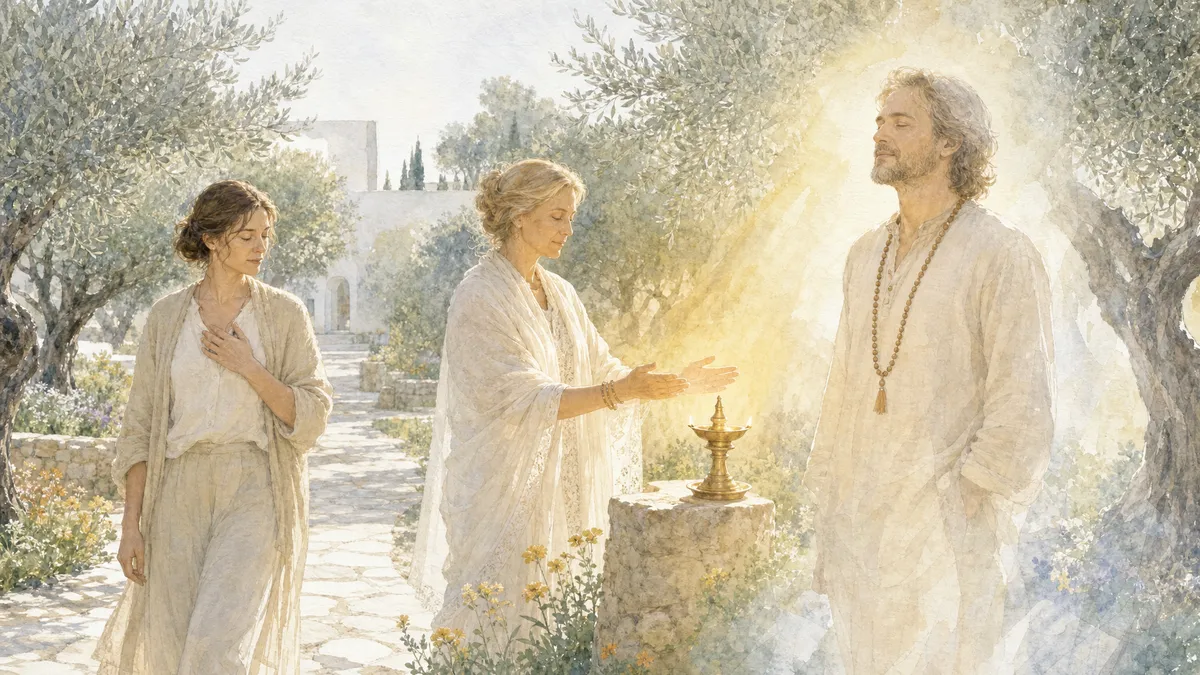
Then he has the same reaction to everything: there is fear or pain, there is something pleasant to which the mind clings, or something unpleasant, but luminous emptiness is laid bare in it, and therefore his reaction to everything is the same. Such a yogin lives in the state of a single “taste.” A single “taste” does not mean that everything perceived becomes somehow bland and monotonous. In the natural state there are many different tastes and shades; nevertheless, all of them, as it were, have one nature.
The Son’s Meeting with the Mother
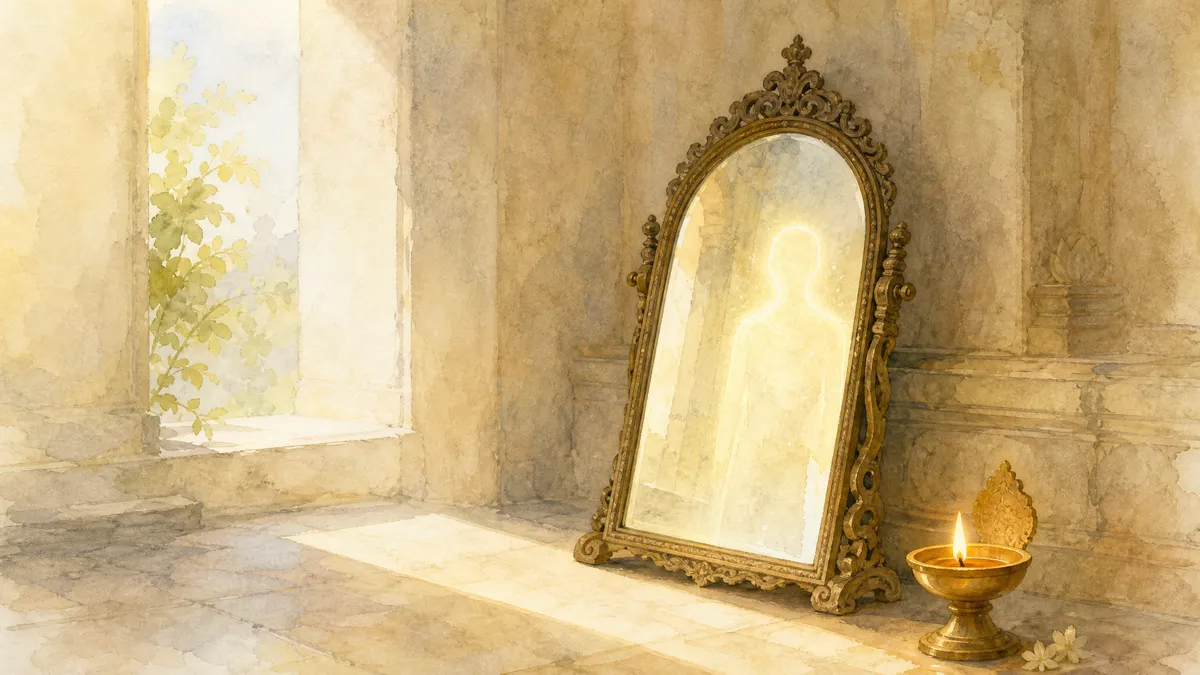
“The son, who is primary consciousness, also meets himself. The son, who is the cognitive faculty, or the primary awareness of any objects of perception, manifesting before the mind begins its activity, appears nakedly to contemplation, or the natural state. This is like looking at one’s reflection in a mirror. The mirror is the mother, or the primordial state of enlightenment. The son is primary perception, an individual act of primordial awareness or vision. In individual experience there always exists an infinite variety of such acts of awareness. But they are all children of one mother. A multitude of perceptions, one in their nature, and only one natural state.”
Here the following example is given: the consciousness of the son, or individual consciousness, resembles looking at one’s image in a mirror. This is difficult to understand. The mirror is the originally reflecting emptiness, while our personal consciousness, which thinks, considers itself unenlightened, and becomes enlightened, is the looking at its own reflection in this mirror of primordial emptiness.
Every time we think, feel, make a decision, or react emotionally, this is a reflection in this mirror. Under no circumstances should we think that our thoughts, emotions, or any actions are separate from this emptiness. On the contrary, all of them are its purest manifestation.
What, then, is the difference between ordinary people and the awakened? It is that ordinary people cannot trace the Source of all thoughts and emotions, while the awakened always know this Source, and they are never deceived by them. Instead of being led by thoughts, they instantly recognize this pure Source. Moreover, an experienced Master does not even need to recognize this Source, because he constantly abides in it, and whatever arises instantly returns to this Source.
Suppose you are cold because it is minus twenty-seven outside. In the ordinary sense, this is negative; it causes rejection. You may become upset, angry at the weather or at yourself because you dressed too lightly. But if you know the source of the cold, the source of your suffering, you instantly recognize it, and then the cold brings a certain joy instead of bringing suffering. You regard everything as a manifestation of this source, or as a way to test your presence.
Similarly, if you do not recognize the nature of tamas, you become immersed in it, and it dominates you. But if tamas overwhelms you and you recognize its source, then within you there is a certain deep current that remains even in a state of tamas. In the sutras there is the concept “the Bodhisattva sleeps.” But this does not refer to those who abide in tamas; rather, it refers to the case when behind tamas there is pure luminous emptiness, which is preserved under any conditions, even when the surface mind is switched off and the surface energy truly abides in tamas. It is important that depth be preserved behind tamas. This is possible when a person has developed the ability to be aware of himself even in dreams. Therefore Marpa always said: “Regardless of the state of my channels, pranas, and mind, my primordial Source is never lost.”
It can be said that a Master accustomed to recognizing the primordial Source is invulnerable both on earth and in heaven.
Self-Liberation of Awareness
“Awareness is self-liberated by awareness; it is like water being poured into the sea.”

When this Source is discovered, a paradoxical thing occurs: that part of the Source which constitutes our false ego begins to reunite with it. What was divided now appears united. We feel that behind every thought, experience, event, and object there are great forces that we begin to discover.
If we did not know this before and perceived all objects as separate, seeing nothing behind them, then suddenly we begin to feel that some forces stand behind every object. These are the forces of primordial emptiness, of the Clear Light. It is as if we discover an invisible spirit that permeates everything.

One can give another, semi-worldly example. Suppose a person lived in society and naively believed in politicians, in television advertising, and had some banal, primitive worldly ideals. Then he learned about a secret government, about Freemasons, about globalists, about the existence of certain hidden global structures that govern the world. He began to track major financial flows, transnational corporations, the logic behind the replacement of presidents in different countries, certain elusive political influences; he began to discover agents of influence within the government, to uncover global transnational currents, the dynamics of connections among the UN, UNESCO, NASA. Suddenly, an entirely different picture formed for him. He began to see the global processes taking place in the world, which he had not even perceived before. He began to realize that behind wars, the migration of peoples, natural disasters, advertising, and other things there stand certain great forces, and that all of this does not in fact happen by chance. He began to see those who can manipulate and control it.
It can be said that such a person has begun to gain a slight insight into the level of worldly deities. He has begun to understand that there are people who make computers, films, advertisements, airplanes; there are worldly gods who invest their shakti in this; there are powerful forces that work on it, and these forces are superior to him in intellect, clarity, and power of concentration; there are worldly gods who make films, produce advertisements, impose a system of consumption on people, develop computer programs, control passport and visa regulations, control territories, and so on. Suddenly he began to understand that there exist structures that far surpass him in clarity, that these are wiser and more creative beings, behind whom stand even stronger beings.
It can be said that when he began to discover this, his vision rose slightly to the level of worldly gods. If he immersed himself even more deeply in this new awareness, he would see that behind the elements, the directions of space, seconds, hours, months, and years, behind every action, object, sport, art, or science, behind the processes of marriage, childbirth, life and death, karma, eating, and so forth, there stand various subtle forces, more subtle beings, patron deities. Such insight is the initial insight into the single spirit that permeates all forms.
However, even this is not yet full insight; it is only a small insight in the direction of pure vision. But as contemplative presence deepens, such insight intensifies toward luminous emptiness. A person sees not only the people who govern various currents, and not only the worldly deities who govern the development of science, the arts, and so forth within the hierarchy. He sees the single foundation of people, deities, and everything else. This single foundation is completely transcendent; it has no form whatsoever. Even the gods and beings who govern different processes are also subject to it, being merely its insignificant manifestations.
Encounter with the Single State
“If you seek this single state, you will encounter your own single state.”
In the end, discovering these powerful forces standing behind everything, a person comes to a paradoxical conclusion: it turns out that all these forces are not external, but belong to his own consciousness. And then he discovers that his own consciousness possesses all these deities, pure manifestations, and pure forces, that all of them radiate from his deep inner state. Of course, this does not refer to surface consciousness.
“In seeking this single state, one encounters this single state directly. This is precisely what happens when the practitioner learns to recognize this single and unique state of awareness in all his many experiences and perceptions.”
An experienced yogin can recognize this single state wherever he may be; he has such a habit. He seems to twist out of any experience and find this empty foundation. For an inexperienced yogin, the ability to find it depends on specific circumstances, on the practice being performed, or on seated meditation. Nevertheless, when we become accustomed to the vision, we acquire a unique ability to find this empty foundation in any situation. It is something like faith that is not conditioned by place and time.
The Dissolution of Space into Space
“One’s own primordial nature encounters itself, but its essence lies beyond verbal definitions. This is like the dissolution of space into space, or a snake untying the knots of its own body.”
At first we discover inner space. When contemplation deepens, we understand that there is no such thing as inner space. Inner space is placed within something more global. Then the inner and the outer begin to mingle and cease to have an inner meaning. All this begins to be discovered as one and the same.
A yogin who has mingled inner and outer spaces has completely freed himself from inner fixed ideas and attachments. Such a yogin feels an inexpressible unity with all external objects, as if external objects were a part of him.
In what case can one feel such an inexpressible unity? Only if we erase all clinging to our inner experience, stop holding on to it and regarding it as a support. For example, you have certain fixed beliefs: “this is bad,” “this is good,” “this is right,” “this is wrong,” and you believe that this is actually so. Erasing formed experience means that you stop perceiving things unambiguously. In a relative sense, you continue to understand that this may be bad and that may be good, this may be right and that may be wrong, and such discernment is helpful; however, inwardly you no longer think this way—you feel that both are the same, since all pairs of opposites arise from the one Source.
“The practitioner’s own primordial nature, his true face, meets itself or discovers itself. Coming face to face with oneself is like someone looking at himself in a mirror and then suddenly discovering that he himself is that mirror. Our own true essence possesses such a mirror-like nature; it is a state of emptiness and lies beyond verbal definitions. This kind of experience of identifying oneself with one’s own nature is like the dissolution of space into space. The inner space of our own deep awareness and the outer space of that dimension in which all phenomena manifest are integrated, as a result of which the complete identity of the two is realized. It is like when a clay vessel is broken: it seems that there are no longer two different spaces, outer and inner, but only one space, or dimension of being, while space itself has not changed in the slightest.”
Pure Vision and the Manifestation of Divine Energies
In this connection, the following example may be given. When you practice pure vision, contemplation, you may see some person or communicate with him, and you understand that he acts on the human level, that is, as an ordinary person. But at the same time, other forces and manifestations may act through him—the forces of deities.
When this person, for example, explains the teaching using speech, the power of the deity Saraswati acts through him—a subtle energy connected with speech and teaching. When he skillfully performs some kind of service, for instance sawing something out or building, the subtle energy of Vishvakarman manifests through him. When he performs operations connected with prosperity, money, or management, the subtle energy of Lakshmi or another deity manifests through him, which you take as a reference point for subtle vision. And when he is in fury or anger, the energy of a wrathful deity manifests through him, for example Durga, Kali, or some wrathful aspect of Bhairava, Guhyasamaja, depending on which deity you take as a reference point.
That is, this person is not yet a visible deity. The energies that manifest through him are subtle; they express the forces that stand behind these energies. The more you practice contemplation, the more clearly you can see this.
Finally, when your capacity increases, you see that behind these manifestations there is an even more transcendental and even subtler energy that manifests through all his qualities. This is the energy of the Clear Light, which is the Source. This is approximately how understanding arises when we begin to see the deeper forces that act through everything.
The Lila of Brahman — the Play of Primordial Energy
In the end, we become convinced that the primordial energy of Brahman acts through everything, that everything is a creative manifestation of the energy of emptiness, and that there is nothing else. From this point of view, the energy of emptiness is now speaking to itself at the lecture; some part of it is explaining something about itself to another part of it.
Therefore it is said that the whole world is the lila of Brahman. Brahman plays with its energies, reflecting itself in itself, in its energies, and clarifying itself through its play. When we begin to see this clearly, then at the moment of such insight we ourselves take the position of Brahman. This is not even a question of realization; it is something we must accept as a vision. Realization means holding such a vision continuously.
The Connection Between View and Behavior
If we are unable to accept a profound vision, then Advaita will be inaccessible to us, and our practice will remain in a state of duality. There is a saying: “We move toward the view by relying on conduct,” or “Ascend to the view, do not descend to conduct.” This means the connection between absolute and relative truth. Unambiguously accepting non-duality as the vision, in a relative sense we distinguish it as conduct.
If someone has understood at least thirty percent of what has been said, then he should be very happy now, and his mind should be open and clear. He should instantly eliminate all his fears and confusion and feel how exalted he himself is, his position, understanding, and the dharma he follows, and how exalted the process taking place in this hall is.
