

Commentary on the text “The Light of Supreme Grace”
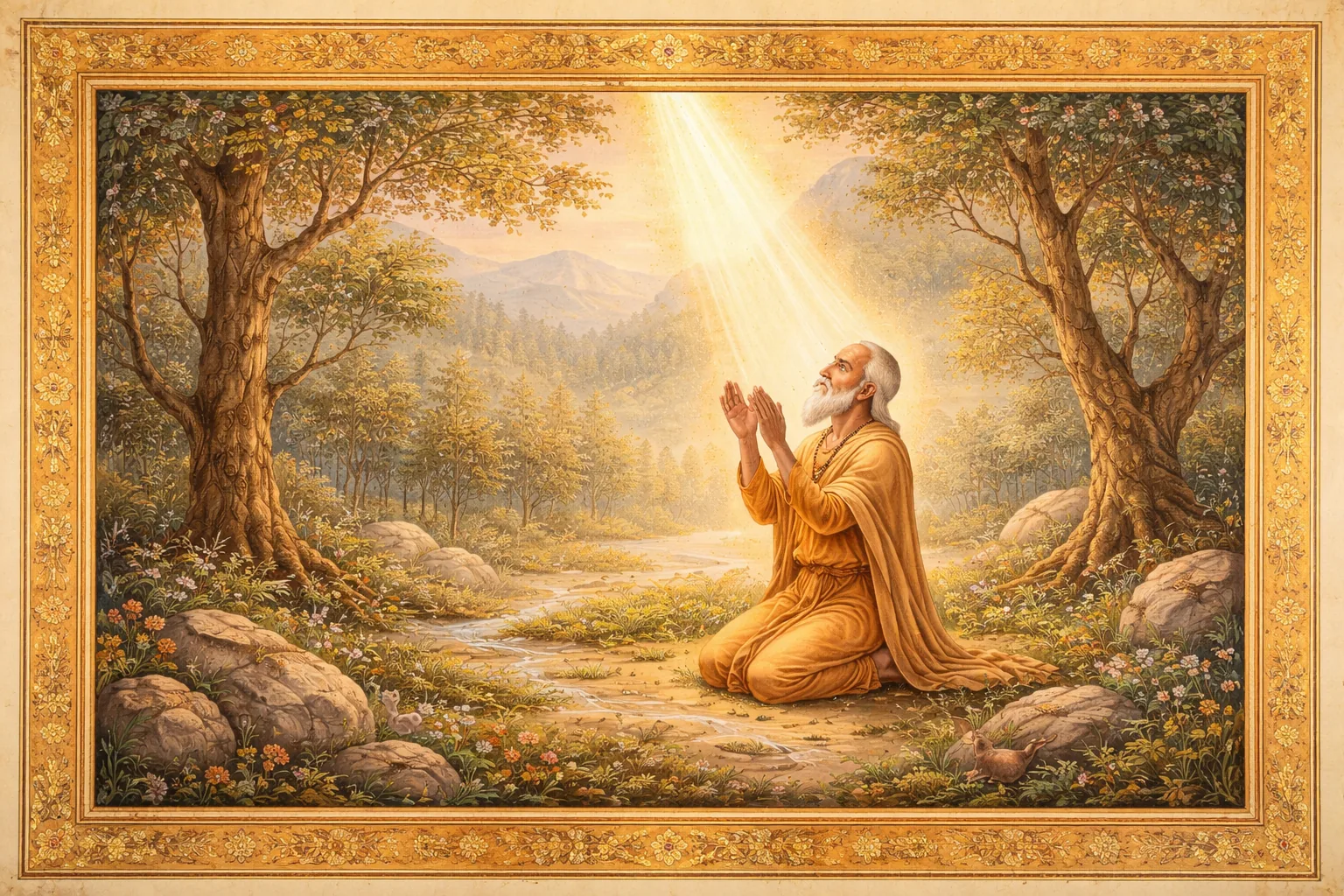
As I promised, we will discuss with you some shlokas from Ramalinga Swamigal’s text “The Light of Supreme Grace.”
According to my assumptions, our yoga monastery arose as the result of a prophecy by Saint Ramalinga. He said that his mission in India had not been crowned with success, but that somewhere far to the north there would appear people who would preach his teaching. Since I do not know of any other north or any other people who are doing this, I came to this conclusion by comparing the prophecies and my own visions.
The hymn “The Light of Supreme Grace,” Chapter 1, “The Transcendent Nature of Radiance.”
O Light of Supreme Grace!
The Light of Supreme Grace is the heavenly path, the great ocean of life, and the radiance of the Supreme.
The Light of Supreme Grace, rising above all knowledge of the Agamas and Vedas, surpasses them. The Light of Supreme Grace, through the destruction of the ego, is revealed as the primordial foundation of this and other worlds.
The Light of Supreme Grace fills and surpasses both this world and others, without diminishing the power of its influence.
The Light of Supreme Grace is the lord of the great space beyond speech and mind.
Ramalinga is extraordinarily lofty even among the holy siddhas. What Ramalinga writes about is extraordinarily lofty.
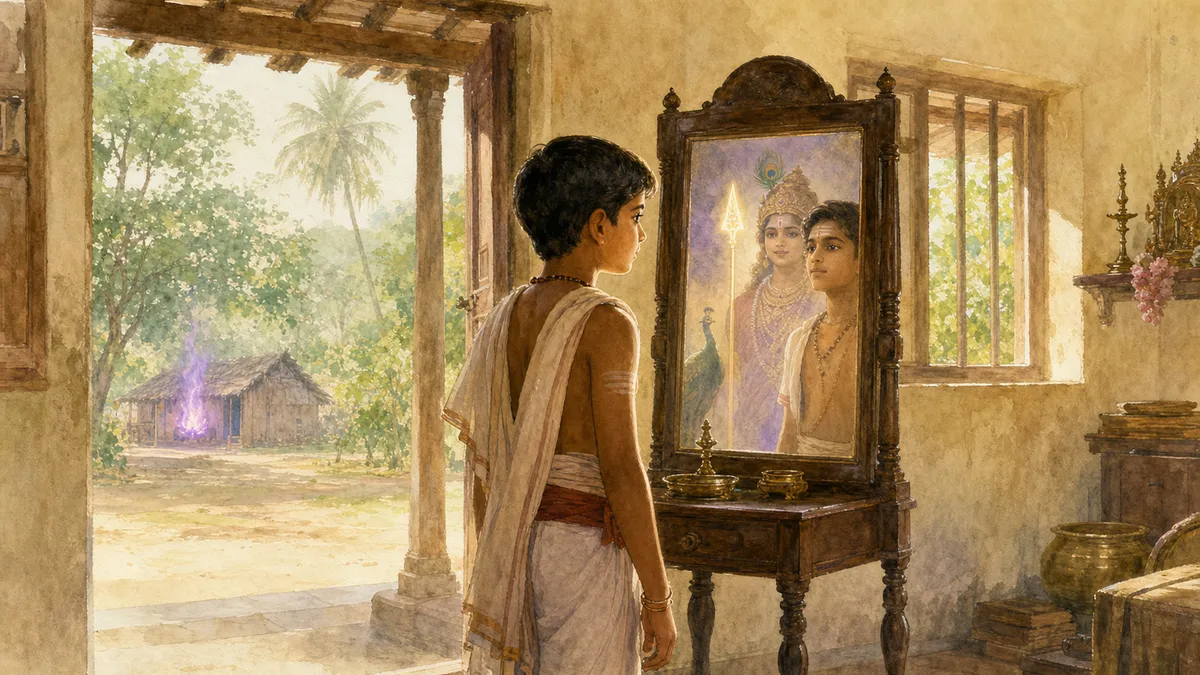
Ramalinga attained realization as a child. He saw the deity Kartikeya in a mirror, receiving a direct transmission from him. From that time on, his mind was completely enlightened. Abiding in contemplation of nondual light, by the age of fifty he had completed his path, completely dissolving his physical body so that it cast no shadow. And in 1874 he disappeared, dissolving in a flash of violet flame in his hut.
Ramalinga is unique even among the siddhas. He is an extraordinarily holy person, so simply listening to his instructions is already one of the greatest blessings. Understanding him is not easy. When you listen to the shlokas, they may seem simply like intricate poetry. However, what Ramalinga speaks of is something beyond all limits. It is the highest mastery of spiritual practice.
Flashes of Spirit and Fleeting Samadhis
From the point of view of an intellectual understanding of the teaching, he speaks about the second stage of Anuttara Tantra — prapatti (self-surrender), that is, self-transcendence. When you develop the principle of awareness, your awareness begins to generate flashes of spirit, flashes of clarity. In the “Tripura Rahasya,” Dattatreya describes them as fleeting samadhis.
These are moments when the conceptual mind is paralyzed, as a result of which your deep “I” comes to the surface literally for a few seconds, and then you experience a very deep state, the brightest flash of clarity. In Anuttara Tantra (in Laya Yoga in particular), in Kashmir Shaivism, very great attention is given to such flashes of spirit. For example, the “Vijnana Bhairava Tantra” describes 112 ways of obtaining such flashes.
Traditionally, there are certain moments when such flashes occur. Even without practicing, you can discover these flashes:
- in the first moment after awakening, when you are not yet oriented as to where you are, when your conceptual mind is not yet functioning;
- in the first moment before falling asleep;
- at the moment when yawning or sneezing occurs, and your pranas partially enter the central channel;
- at the moment of shock, fear, or stress, when the mind shuts off, and therefore deep consciousness comes to the surface from within you;
- at the moment of perceiving a paradoxical concept, when, for example, the master asks the disciple: “What is the name of the child of a barren woman?”
- at the moment when you find yourself in an inadequate situation, one that diverges from your ideas, a sensorially unpredictable situation;
- at the moment when perception passes from one situation to another, that is, a certain borderline state (for example, when you meet or say goodbye, when there is movement or a change of pranas; if you catch this moment and try to stretch it, this will be what helps activate such a flash);
- at the moment of feeling shame, when the conceptual mind is paralyzed by moral notions (when you find yourself in an awkward situation, your ego feels compressed, but your deep “I” at that time can manifest with great force);
- at the moment when you contemplate something beautiful, when your spirit is captivated (for example, when you listen to a wonderful piece of music);
- at the moment when you look into infinite space.
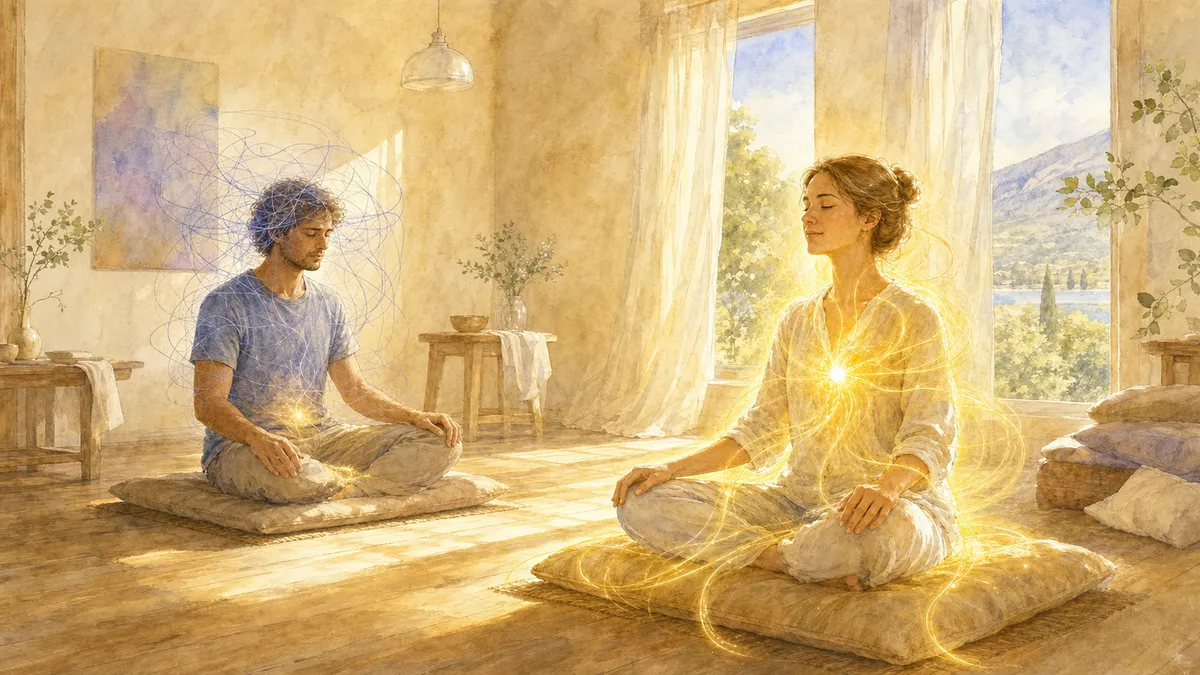
These are examples of moments that generate such flashes of spirit. Ordinary people ignore them because their consciousness is too occupied with conceptual activity. But a practitioner constantly lives in very vigilant awareness, and therefore continually seeks these flashes, attunes to them, and catches them. He does not allow them simply to pass away.
For an ordinary person, such flashes are useless. Even if he experiences a fleeting samadhi, his ego quickly restores its continuity, and therefore meditative consciousness disappears. But a practitioner can paralyze his conceptual consciousness, block his mind for a time with the help of these flashes, and bring deep consciousness, the intuitive mind, to the foreground. If he knows how to remain in it, contemplate, and abide in continued contemplation, then this intuitive mind comes to the foreground and takes the lead. And then the fleeting samadhi, instead of fading away, begins to develop and becomes prolonged.
The Development of Continuous Contemplation
The search for such fleeting samadhis, entering them, and continuing them is what a practitioner does throughout his entire life once he has discovered the natural state. In essence, masters do nothing but search for such flashes and constantly generate them, strengthening them all the time.
When many such flashes accumulate and a saint continuously abides in contemplation, he no longer needs to seek them in any special way, since they manifest naturally on their own. His consciousness blazes very brightly, because his conceptual mind is constantly dissolving through the maintenance of divine pride or natural presence in awareness, and then his intuitive consciousness comes to the foreground. And then such flashes begin to come of their own accord. If you are attentive, you can receive such a flash simply by looking at a flower, simply by seeing a dog or a tree, by hearing even a worldly song, because you look at everything through the eyes of this intuitive consciousness.
And, finally, for a saint such flashes begin to flow continuously, one after another, ever brighter and brighter, until they become a whole avalanche that spreads like a forest fire, like a gigantic wave of light, when the disciple finds himself in a world consisting of such continuous flashes. This is a very grand and majestic state.
And then the disciple sees that everything around consists of these flashes, that Reality literally blazes with them, that the universe is the boundless manifestation of this blazing consciousness and not samsara, not an illusion, and that it was his own notions that were the illusion. The universal force begins to descend upon him without mudras, mantras, pranayamas, efforts, rituals, or meditations, simply through his openness, clarity, self-surrender, and abiding in the natural state. It begins to pour into him in megatons, in terabytes. And he sees that this happens apart from his will. When saints say, “Everything is Brahman,” this is the same thing. That is, it is a state in which a person sees God even in the very smallest manifestation.
In the apocryphal Gospel of Peter there are these words: “Split a piece of wood, and you will find Me. Lift a stone, and I am there too.” This is God speaking in this way. It is approximately such a state. At this stage, a person opens a notebook and sees God; he looks out the window—He is there too; he turns and looks into the eyes of a neighbor or relative—He is there too. There is nothing except God.

The Stage of Prapatti (Self-Transcendence)
This is the stage when an avalanche of flashes continuously descends and displaces the entire relative personality. And all that remains for him is to abide in it continuously. Since it is attained without effort, it is called akin to grace. That is, it is no longer yours; it is like a royal gift. You did not even expect that you were worthy of such a thing, but it happens like some causeless gift. And in Laya Yoga this stage is called prapatti, or self-transcendence. When a yogin has reached it, he encounters this descending force, which seems to him an incomprehensible gift of the Absolute. He simply needs to give himself over to it, surrender before it, and restructure his values in order to recognize this force as his own “I.”
Ramalinga describes precisely this stage of effortless contemplative presence. It is extraordinarily high. Ramalinga soars so high that he does not even describe any initial practices: yama, niyama, the teacher-disciple principle, meditation, renunciation, and so on. He gives this stage immediately. But in order to understand him, one must grasp how high Ramalinga soars.
The Nature of the Light of Supreme Grace
Ramalinga says that this Light of Supreme Grace is the great ocean of life itself. This light surpasses the knowledge of sutras, tantras, agamas, and Vedas, because it is non-conceptual. All knowledge is bound by concepts, but true knowledge is beyond words. Ramalinga says that this light is revealed as the primordial foundation, as the fundamental Source of everything. And nothing exists apart from it. The external material universe consists of light; it is nothing other than an interweaving of threads, of radiations of this light. We examine this in especially great detail in the section on jyoti yoga.

Light emanates from within our body, from the region of the heart and the eyes, just as the light of a candle flame emanates when placed inside a clay doll with empty eye sockets. This radiance emanates and projects what we call the material world. But in fact, what we see as the external material world is the radiance inherent in our body and energy. Shining, our energy radiates. These radiations manifest as subtle threads. When we perceive in duality, the interweaving of these threads appears to us as material objects. But in reality all of this is the radiation of the boundless single light.
At a high stage of practice, the yogin sees the light that emanates from the space between the eyebrows and from the center of the chest. This light manifests as bindu (spheres of light), tigle, swastikas, Om signs, deities, and pure visions. These visions are seen by yogins while awake, in parallel with the perception of ordinary objects. This is one of the phases in jyoti yoga, when visions arise.
Jyoti yoga allows us literally to see light with subtle-material vision.
The Space Beyond Speech and Mind
The Light of Supreme Grace is the sovereign of the great space beyond speech and mind.
At the foundation of everything lies space filled with light. If we speak of a form of God that is close to us, it is the Absolute in the form of space.
Since in laya yoga great importance is attached to contemplation of space, of the sky, practitioners of anuttara tantra are sometimes called sky-worshippers. Formless space is the only image of God that satisfies us.
But in fact, the primordial Foundation, the nature of Mind, is even deeper than space. Space is the subtlest of the elements; compared with earth, water, fire, or wind, it contains the least coarse tattvas, and therefore the least illusion, maya. However, even space is a derivative of consciousness, and therefore the primordial foundation lies even deeper than space.
Chapter Two. “The Bestower of Blessings”

The Light of Supreme Grace bestowed upon me aspiration, discernment, a radiant body, and prosperity.
The Light of Supreme Grace ferried me across the dark ocean of endless births and freed me from suffering.
The Light of Supreme Grace raised me to an unattainable height and showed me the lower paths of religions lying at the foot below.
The Light of Supreme Grace dispelled all my doubts and false notions, and also purified the bodily system of an excess of phlegmatic nature.
Contemplation Beyond Concepts
When we engage in the practice of contemplation, we say that our mind must be established at a point beyond concepts, in the state of space. This point beyond concepts does not mean that we reject thoughts. Thoughts may appear and arise, yet our mind is deeper—in the state beyond thought. When we maintain consciousness without fixation at such a point, it is said that we are practicing the path of contemplation, the path of self-liberation. Divine pride is one of the lines of such practice. If we have not understood where we need to hold the mind, then it is said that we have not yet mastered contemplation. To contemplate means to maintain the mind in a state beyond thought, without focusing it on anything.
When we maintain such a state beyond thought amid the manifestation of thoughts or actions, all our thoughts or actions self-liberate, and then we gradually unite with the Clear Light. The Clear Light is the essential primordial foundation of the being of the entire universe and of our “I.” It is precisely this light, like grace, that liberates from the cycle of birth and death.
Ramalinga says: “The Light of Supreme Grace dispelled my doubts and false notions.”
Until we have discovered this luminous, non-conceptual, paradoxical space, we have many doubts, many false notions. We may be confused by certain concepts, we may see something and not know how to relate to it, we may be tormented for various reasons, believe in one thing and not believe in another—all of this is the result of the activity of the conceptual mind, which misleads us.
But when we open this non-conceptual space of awareness, our doubts and false notions depart. We begin to see reality in its suchness, that is, as it is.

Mystical Heat (Shuddhi-Ushanam)
Ramalinga says: “This Light cleansed my body of an excess of phlegmaticity.”
What does this mean? In yoga there is the concept of mystical heat, or sacred warmth (shuddhi-ushanam). In the Six Yogas of Naropa in the schools of Tibetan Buddhism, there is a yoga called tummo yoga (the yoga of heat). Its adepts consciously kindle the inner fire in such a way that they can dry up to several sheets on their backs in a single night. They wear light cotton clothing all year round. Their inner fire is truly very strong, so they have no need to dress warmly. Among the monks of their order there is even a rule: to wear nothing but cotton clothing, even in severe frosts. They generate tummo (inner mystical heat) through kundalini yoga exercises, visualization, and work with pranas, channels, and essential drops. When, through practice, they generate strong inner heat, this inner fire begins to burn the mucus out of the channels. Blockages in the energy channels (mucus, phlegm) are what hinder the free circulation of prana (energy). And when it has such obstacles to free circulation, because of this a person ages, falls ill, and dies.
To achieve the stage of tummo, the yogin is forced to engage in severe exercises, pranayamas, mudras, concentrations on the chakras, and work with the rising of the fire (for example, as in the practice of chandali). When he can control his wind and fire, the fire dries up the phlegm in his channels, and therefore the body becomes different; his impure karmic pranas are replaced by the pranas of wisdom.
But Ramalinga says that he did not do any exercises, techniques, or visualizations. He simply opened this light, and the light itself generated mystical heat (shuddhi-ushanam) in his body. This mystical heat, without exercises, cleansed his body of blockages in all the energy channels and gave him different flesh.
Effortless Natural Contemplation
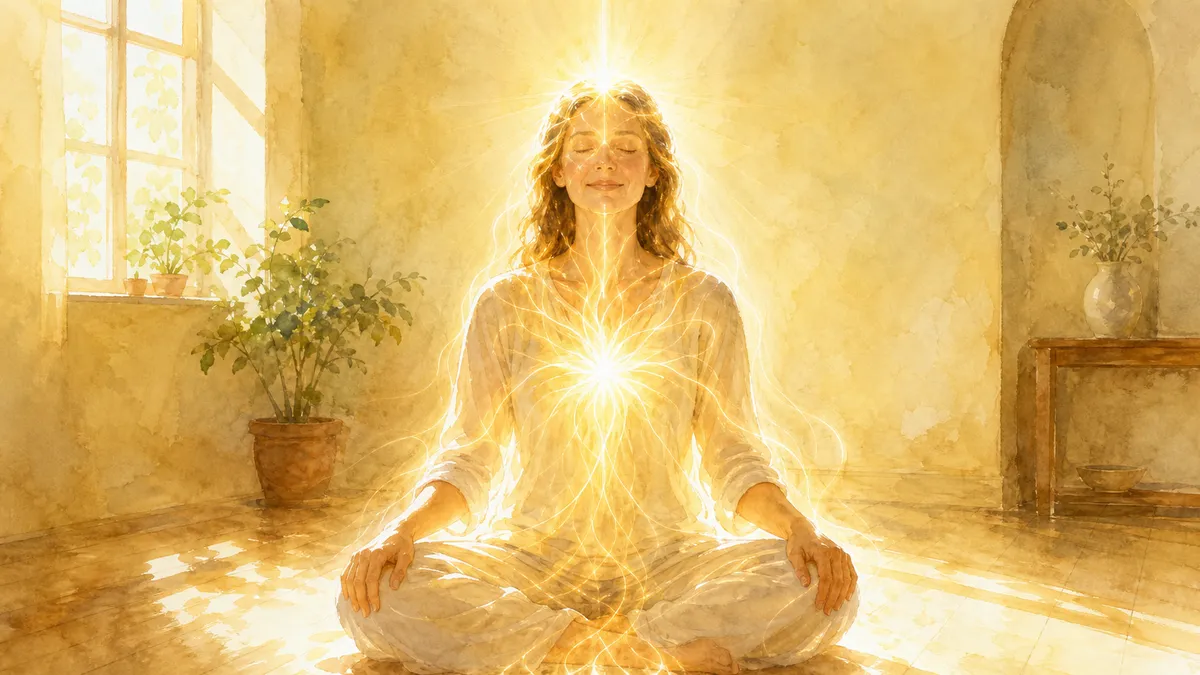
This is a very great attainment, when a yogin can generate inner heat by the power of contemplation alone. In the tradition of laya yoga, similar instructions are given: having opened contemplative presence, you must learn to merge it, realizing the principle of mahasukha or sukha-shunya, which means “the unity of the bliss of the energies of empty awareness.” This means that you move your principle of contemplation and divine pride into the chakra, into the element, begin to feel the energy of this element, and very slowly merge the empty consciousness, similar to space, with the energy of this element until the chakra begins to function and its channels are purified. It is precisely through such merging that the experience of shuddhi-ushanam is attained.
For example, an experienced master can, by the power of his consciousness, without making any effort, without exercises or asanas, but simply by relaxing, generate strong heat in his body, open the muladhara chakra, and make the winds enter the central channel. Even without meditating, but simply by relaxing and directing the flow of descending power into any of his centers, he can strengthen one center or another. This happens through effortless natural contemplation.
The Light of Supreme Grace became my support, granting me clarity to comprehend the essence of everything without the help of the intellect.
The Light of Supreme Grace is worshiped by those who have renounced the six attachments that defile the soul.
The second chapter of Ramalinga’s text “The Light of Supreme Grace” is completed.
