

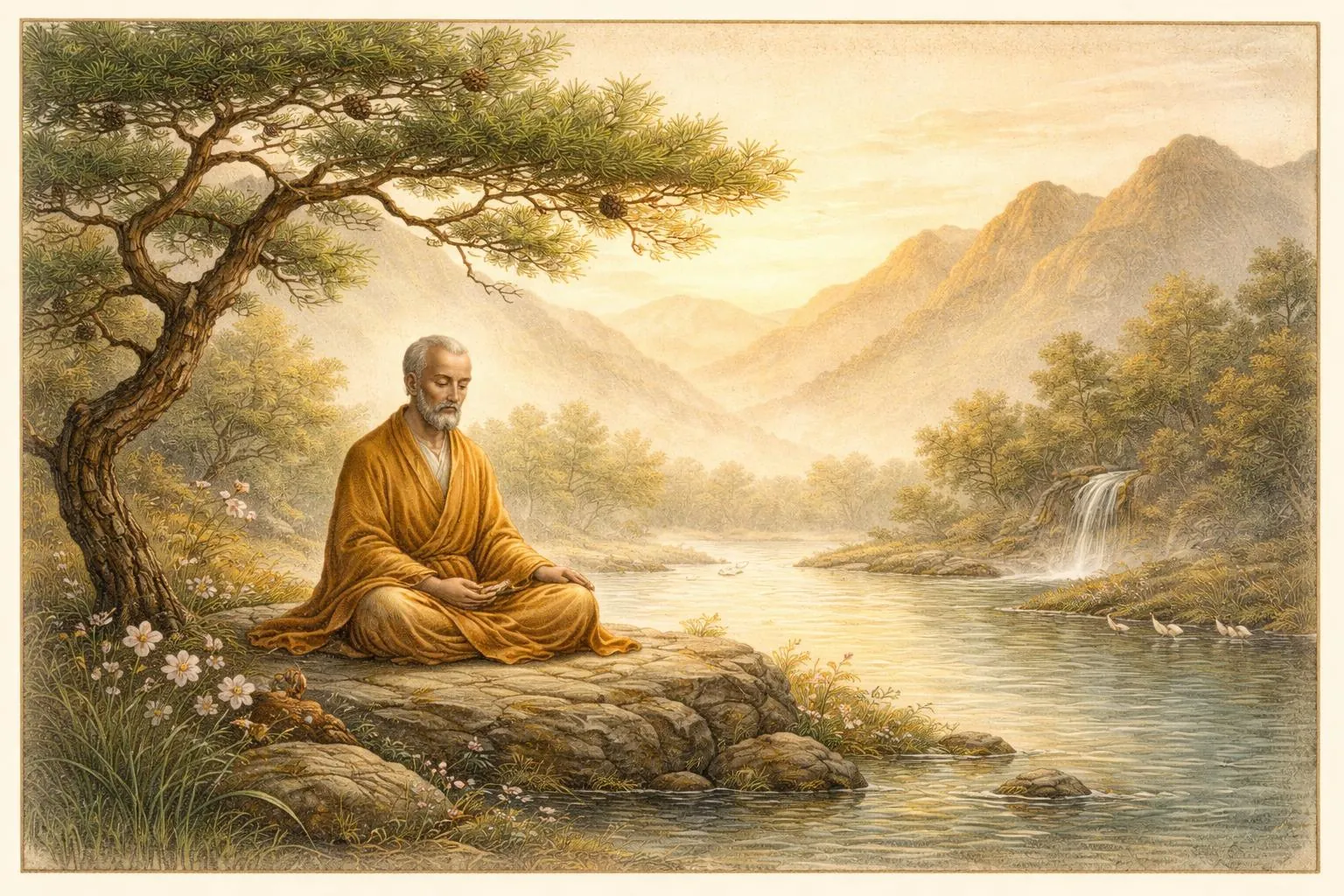
Commentary on the text “Chaturashiti-siddha-pravritti.” Niguna
“Niguna, ‘neither this nor that,’ was the son of a low-caste householder in Purvadesha. He grew up lazy, gave no thought at all to worldly affairs, and was indifferent to what was considered bad or good. If he saw a fruit he wanted, that was good, but if he could not get it without effort, he considered that bad.
One day a passing yogin suggested to him:
“Let us go to the city to ask for alms.”But Niguna said:
“And if they give us nothing, then what?”—and he did not even lift himself from the ground.Out of compassion, the yogin brought him something to eat, saying:
“Listen, do you have any virtues at all?”“Yogin,” replied Niguna, “if someone has been called ‘Niguna,’ you certainly will not find any virtues in him, even if you search by daylight with a torch.”
“Are you not afraid of death?” the yogin asked him while Niguna was finishing his food.
“I am a little afraid,” he answered, chewing, “but what can I do in advance?”
“If you will practice, I will give you one method.”
“All right,” Niguna wiped his mouth, “I will practice every day when I wake up.”
Thus the yogin gave him initiation. Then he instructed Niguna in the practice of uniting appearance and emptiness:
“Neither you nor all that surrounds you are real in themselves, although you are not yet enlightened. Suffering, beings are unhappy in their torments, which are unreal from the very beginning. What appears is inseparable from emptiness; the pure light is constantly present. And however you may conduct yourself, the pure city is open to you.”
The yogin often spoke in this way, and Niguna gradually began to practice. Having reached the complete integration of the pure light, he attained siddhis. He wandered about without choosing his path, pointing around with his finger and asking:
“Who are these people?”
Whoever he saw, he would say:
“Unfortunate, unfortunate ones,” and burst into tears.
To those who dared to study with him, Niguna showed the path of the non-separation of phenomena and emptiness. Like an ocean ship, he passed through the milestones and buoys of delusion. Having attained the siddhi of the natural state, he departed in his body into the Clear Light.”
The Nature of the Concealing Force and the Path to the Natural State
The purity of the Clear Light radiates from the very beginning, yet we cannot perceive it because of the force that conceals this purity. This concealing force does not radiate from somewhere outside; it radiates from within ourselves. It turns out that we are like a person who has a helmet with a lamp on his forehead or on his head. This lamp shines, but the light that spreads around refracts reality. Reality shines by itself with its own light. When this light refracts reality, a person ceases to see.
At first, we abide in complete ignorance, and only suffering or dissatisfaction with this state brings us onto the path of practice. Then we begin to practice and passionately strive for liberation. We do many different things until our mind gradually becomes purified. Sometimes we try to concentrate continuously on practice, making the most incredible efforts. Sometimes we feel that our efforts are insignificant compared with the efforts of saints, that we are making little effort, that we must make more effort, that if we do not make efforts but continue to remain in prostration, we will not attain any realization.

If we have not understood the path of the natural state, then we make efforts, and soon our entire life becomes one continuous effort. We can develop great willpower, we can develop certain mystical powers, but we see that we still lack something, that we are not empty inside, that the enormous effort we have made has completely changed us and made us very experienced yogins; however, transcendence has not occurred—we are still “humans.” Perhaps we are no longer ordinary humans; we are super-humans, because we can sit in padmasana, stop our breath for some time, or emanate a subtle body; we have almost no desires, we can eat once a day, but we are still humans nonetheless.
Then we understand that we lack emptiness from ourselves, freedom from effort, and freedom from the one who makes the effort. Because the effort itself and the one making the effort were precisely the concealing force that we were imposing on reality. This does not mean that one should make no effort and remain in lethargy and prostration—such a path will certainly lead nowhere. Rather, it means that we need to reconsider the very principle of applying effort and apply it inseparably from empty awareness, with the understanding that there is no one who makes the effort.
The Path of Naturalness and Harmony with Rita
When we understand this, simultaneously with applying effort in sadhana, we become receptive; we change positions. Previously, we attacked reality and tried to attack the Absolute as if it were a fortress, rushing at it with a sword or spear. Having understood that this attempt is futile, we now try to approach from another side: we relax and follow the path of naturalness, becoming receptive.
There is the concept of “Rita.” Rita is the same as the Tao. It is the universal cosmic law, the law of the universe, permeating all things. One can say that it is prajnana, that is, awareness in its other aspect. When we empty ourselves, completely eliminate our own judgments and preferences, follow the path of naturalness, and learn to strive without striving, to apply effort without the one applying effort, we suddenly enter into harmony with this universal law, Rita. We can let go of ourselves and give ourselves spaciousness and emptiness; then suddenly we discover that what we had been striving for so intensely has always existed, and that it was only important to remove our own projections, that our own projections prevented us from perceiving reality.

Do not think that it is easy to free oneself from these projections. If someone is an asura by birth, he looks at the world through the eyes of an asura, and therefore even in nectar he will see a weapon of war, and in a blessing hand—a fist. Such is the nature of an asura: he is always in a fighting stance. Therefore, to transcend one’s own karmic vision and one’s own projections is equivalent to completely renouncing oneself, becoming absolutely empty, becoming receptive. And when we become completely receptive, the great sun of awakening begins to shine, and we find it simply laughable that we could not notice this before. We could always have been in this supreme state, because it is that in which all that exists abides. However, because of our own projections, we stubbornly refused to see it, like a stubborn donkey that, instead of eating excellent food, wants to eat some second-rate grass.
Integration and the Union of Subject with Object
When, at last, we enter this natural state, we can no longer say that there is an application of effort or that there is some “we” entering this natural state. The subject slowly begins to unite with the object, and integration occurs. Then it is no longer we who eat; rather, reality through our body sustains itself. We seem to flow together with Being; we abide together with Being, moving naturally in harmony with Rita, with the natural course of Being. The subject within us, which we considered to be our personality, begins to unite with the object. The world, which we considered an object, ceases to be external and begins to be felt as our own vast universal body.
Then suddenly we see that the limitations of our bodily shell begin to disappear: we can easily feel ourselves to be a tree, an ant, a person in distant Africa, poor or rich. We see that we possess a shared consciousness; our head seems to be connected by billions of threads to the universal subconscious. We can simultaneously feel what others feel: groups of people, nations, ethnic groups, planets, stars, galaxies, other beings (gods, spirits, and others). We see that there are no limitations whatsoever to our feeling.
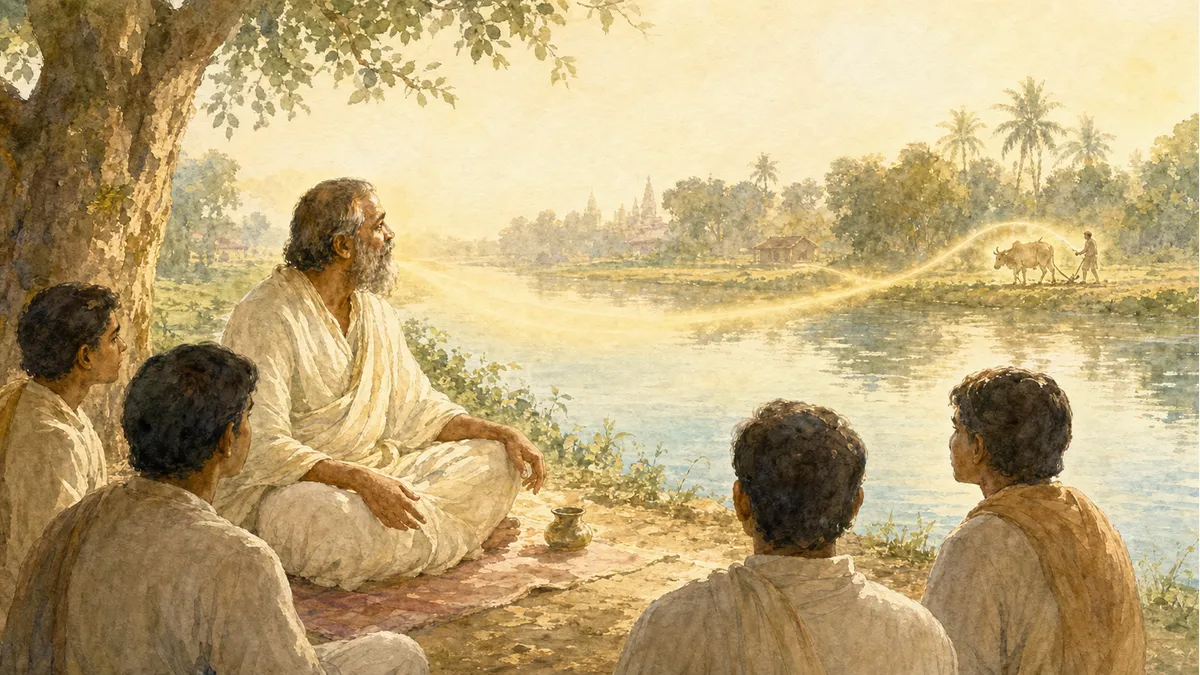
Ramakrishna once observed a man on the opposite bank beating a bull with a whip. Welts from the blows appeared on the bull’s back. Ramakrishna also cried out in pain. The disciples said:
“This is too much! Guru, we know of your great compassion, that you have compassion even for animals and insects, but to suffer so much because someone is beating a bull...”
Ramakrishna showed them his own back, which was striped with welts, and asked:
“Do you think this is too much, or not?”
Since Ramakrishna was united in his consciousness with all living beings, he could identify himself with any living being; therefore, at the moment of identification with the bull, he felt the same pain as the bull.
Self-Recognition and Complete Transformation
Gradually, when all our ignorance is removed, subject and object are completely reunited. Then we come to the view that ignorance never existed, while vidya (true knowledge) has always existed; that the life we led in ignorance has completely disappeared, all delusions have been absolutely dispelled, and the sun of jnana exists always. When we understand this and see that there is no one left to become, that everything that exists is already you, and moreover this is not a static state but an infinitely dynamic and ever-new one, then self-recognition takes place: “So this is who I am, it turns out!”
I explained this principle to one novice, and she asked:
“And what comes next? We attain liberation, and then what?”
I thought: “Well, now! How can one even ask such questions? Will ‘you’ remain when you realize this? And in any case, won’t the entire set of life’s concerns change for you? Will you really be asking such a question when you become the moon, the sun, the stars, the planets, all bodies, the beings of hell, the gods, and other things? Will there be an ‘after’ when you go beyond the limits of cause and effect, time and space, past and future? Will there be a subject asking this question? To whom will you address this question? Will there be any limitations anywhere, at any time, in anything?”
It is like a caterpillar asking a butterfly:
“Suppose I become a butterfly—what then? Will there still be that green leaf I’m used to biting?”
The butterfly can say to her:
“You will be able to fly from one tree to another, you will have thousands of leaves, you can fly to another forest, you will have the whole sky.”
But the caterpillar still doubts, because she cannot even imagine what it is like to be a butterfly. She simply has to be reborn into one, to become completely different.

The Living Transmission of Realization
The same is true of realization. All our ideas about realization before it actually occurs are nothing more than dreams, reveries, and illusions. Even when we read the scriptures and try to understand them, this is nothing more than reveries from the scriptures that we absorb on the basis of the scriptures. The scriptures describe everything correctly, but we cannot understand their essence, because their essence can be revealed only after realization.
Behind every word of scripture, behind every line we read at the morning sutra, there stands the energy of billions of megatons. However, they seem to us like ordinary words, because human language is unable to adequately convey the truth before realization. Therefore it is said that the transmission of realization comes from those who themselves received this realization in due time from other realized souls. Such a transmission is called living, in contrast to the transmission of texts or scriptures alone.
