

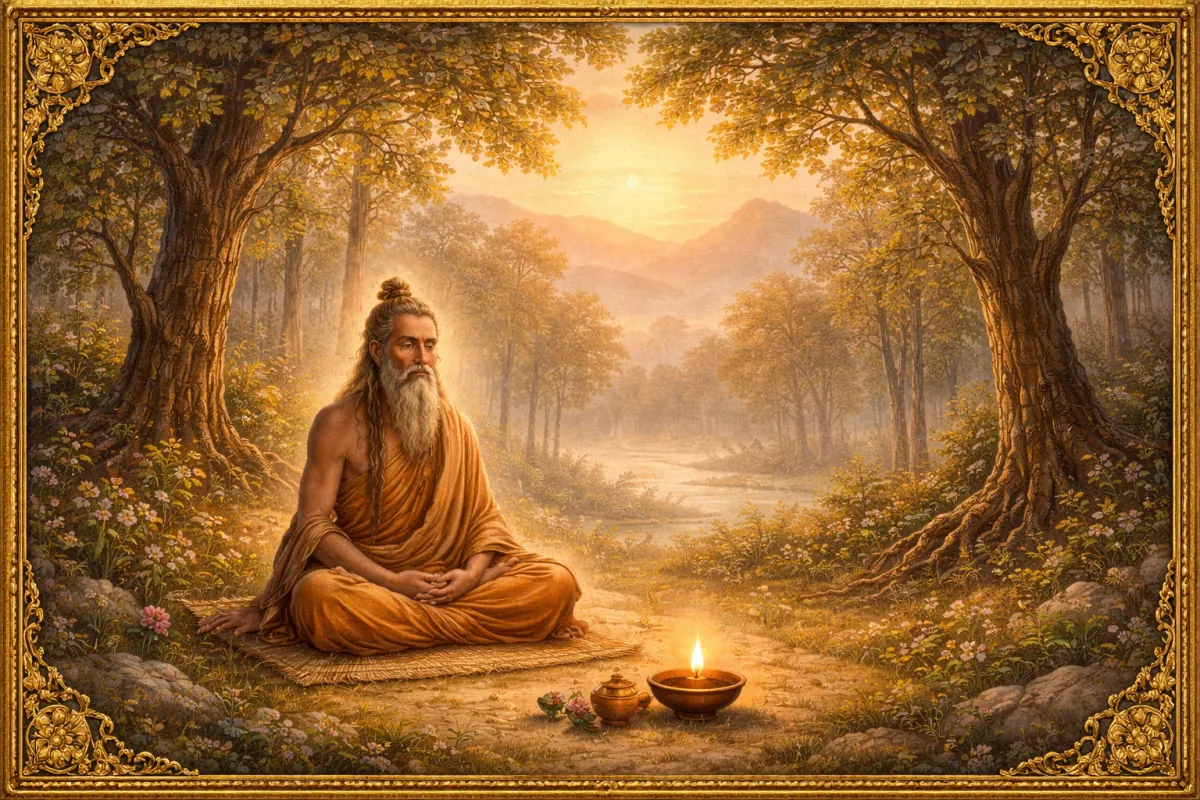
What can a disciple offer the Guru? Their love, devotion, faith, seva, and sadhana. In other words, a disciple is one who offers these things to the Guru. This is easy to verify: if they offer them to the Guru, then presumably they possess them, since one can offer only what one has.
Love... But this is not worldly love, of course. We do not create worldly relationships; this is a more exalted love than worldly love, and therefore it also becomes devotion. Devotion is love expressed through self-surrender. And love and devotion to the Guru are not directed toward an individual. First and foremost, they are directed toward the Guru-tattva. This is very important for a disciple because it is the source of their realization and all blessings.
Faith is the ability to see the Guru-tattva in the Guru and the ability to see the Atma-tattva in the Guru-tattva—that is, to see God. This, too, is very important.
Seva means... to put it simply, performing service, but on a subtler level, it means channeling the energy of the Guru-tattva through oneself and serving it.
And sadhana is what the disciple does within; it is following the Guru’s instructions, and it is what matters to the disciple themselves. All these things are important for the disciple themselves. In other words, if you ask, “What is all this needed for?”—it is so that there may be happiness, so that liberation may be attained. This is the mechanism for attaining liberation described in the sacred scriptures, in the tantras and teachings.
And a disciple is one who cultivates these things within themselves and offers them to the Guru. That is why a bow contains so much. Of course, sometimes, especially when there are many people, they come up and bow—everyone bows, so one must bow. But in fact, this implies that the bow expresses that you are offering and presenting something; in other words, it is an offering. And usually, when we present something, we prepare it—for example, flowers, incense, upacharas. Here, however, we must prepare these upacharas within ourselves. Sometimes, if something is missing, the administrator or mahant says, “Where are the flowers? Where is the incense? Hurry and get the incense, hurry and get the flowers.” In the same way, your inner administrator must look within you: “So, there is love, there is devotion, there is faith, there is seva, there is sadhana. Now, where is faith? Hurry and get faith! Nothing will work without faith. Where is devotion? Hurry and get devotion!” This is puja, the offering symbolized by the bow. Simple actions actually mean a great deal in Dharma, and we will spend years deciphering their meaning.
Six Types of People on the Spiritual Path
“Through the good deeds performed by a person over the course of many lifetimes, the cell of their sins was destroyed. Such a person, possessing a pure mind, is called ‘pinda.’”
Shri Siddhanta Shikhamani, Chapter 3. Sthala “The Purified Mind”
Thus, from this perspective, there are six types of people.

The first do not know that they are ill or that true health exists. The illness here does not mean a bodily or physical illness, but the illness of ignorance, the illness of the material world and material existence, since this world is called “dukhalayam ashashvatam,” that is, a world of suffering and impermanence.
There was a famous actress, Elizabeth Taylor. I believe these words are attributed to her: “Everything in this world that brings pleasure and enjoyment is either immoral, illegal, or fattening.” In other words, this material world is not intended for enjoyment. It is intended for the purification of one’s karma and self-realization. But foolish souls do not know this and try to enjoy themselves instead. And they are the ones who do not know that they are ill or that true health exists.
The second type of souls are those who know but do not seek treatment. There are people like this; they are told, “With your condition, you need to follow this diet, or you must not smoke, and you must not drink alcohol.” — “Yes!” In other words, they neglect their health.

In the same way, they listen to the shastras and instructions, but do not heal themselves — they lack Chit-Shakti, the power of consciousness. Weak Chit does not allow it; the karma of the body, the vasanas of the body, are so strong that Chit cannot overcome them. It is not because they are bad or very foolish — they may be wise, they may know the shastras and be intellectuals, translate Sanskrit texts, and I have known such people. But Chit cannot withstand the pressure of karma. Professors, Sanskrit scholars, simply intellectuals — they already know, but still do not heal themselves; such people smoke and drink.
The third type — they know and heal themselves, but incorrectly or weakly; such people also exist. Their healing is unsystematic and chaotic: today they practice Reiki, tomorrow Osho’s dynamic meditations, after that they receive a Vajrayana initiation from a Tibetan lama, then they go to a meditation camp, later try Maharishi’s TM, then go to a Christian church, where they become bored because they are told to observe holidays, customs, and commandments. These people go to the Vaishnavas, eat prasada, listen to bhajans and lectures, and after some time they become bored there too — and go around in circles: then Osho dances again, festivals, seminars, and this running in circles continues. Twenty years have passed: “Where have I been? What have I practiced? Where have I arrived? Maybe I should continue?” One’s entire life can be spent this way. Unsystematic treatment that, in fact, does not heal. In fact, an experienced doctor knows that when certain medicines are prescribed, they have their own regimen: one must take a certain dosage so that the concentration in the body builds up, and then there will be a therapeutic effect. The doctor knows the contraindications and the combinations appropriate for particular symptoms. A systematic approach is needed. This is called self-treatment.

Dharma is self-treatment, but self-treatment under guidance, in order to avoid being unsystematic.
The fourth type is the one who truly recovers, the one who follows sadhana, purifies the mind, and gradually receives certain signs of realization. It is not necessarily samadhi — that is too high a state to expect right away. To begin with, it may be the strengthening of faith, pure vision, calming of the mind, the development of sattvic qualities, self-control, and concentration. This is one who is truly recovering: deepening the connection with the Refuge and gaining stability in sadhana. The characteristic of such sadhus is constancy. They are constant in their practice and seva; year by year they grow ever deeper into an understanding of Advaita, an understanding of Siddhanta, or an understanding of Anuttara Tantra, and this depth liberates them.
The fifth type — those who have attained true health, who have healed. These are those who have developed their Chit to such an extent that Chit has calmed the mind, subdued the energies, and penetrated into turiya, or at least into sushupti, into the subtle realms to some extent, and resolved many issues, purifying a large layer of karma. These are those who are no longer dependent on the kleshas and have broken the eight bonds that hold the soul, the pashu, captive. They have purified the three principal kleshas: krodha, kama, and moha (anger, attachment, and ignorance). Such souls are worthy either of liberation or of birth in higher dimensions, where they will continue their practice. However, although they have healed, this is not yet final, since in the future, under certain circumstances, it is still possible for them to fall downward.

The sixth type of souls — those who have healed forever and become immortal, who will never, under any circumstances, fall into this material world. They are called nitya-siddhas, jivanmuktas, eternally liberated, eternally perfect souls.

The Parable of the Gardener and the Cow
There is a story about a man who had a garden, and this man tended the garden and was very attached to it. Perhaps he was a Vaishya. He worked in this garden, and it was very beautiful. One day, a cow wandered into the garden, and he wanted to drive it away and threw a small stone. Somehow, the stone flew badly, struck the cow, and the cow fell down—dead. And this man thought: “It happened by chance; I did not do it intentionally, I had no intention of doing it, my motives were pure, I only wanted to drive it away. It must have been fate. In other words, Brahma had allotted that cow such a lifespan that the stone flew off so unfortunately and killed it. Therefore, there is no fault or sin on my part.”
And when this man had grown old, Yama’s servants—the Yamadutas—came for him to pull out his soul and lead it where it needed to go—to Yamaraja’s court. Among other things, he had led a very good, pious life, followed all the commandments, practiced sadhanas, worship, upasana, recited mantras, did not eat meat—he lived the life of a pious householder.
But the Yamadutas said: “You bear the sin of killing a cow, and therefore you must suffer for it in hell for some time, and only afterward make use of your merits. You must answer for this sin.” But he began insisting that there had been no sin in this, that his motives had been pure, that he had not intended to kill the cow, and that there had been no personal action on his part; he had only thrown a small stone to drive it away. Stones had never killed cows before; it had simply happened that this was obviously a fate created by Brahma, and therefore he was not responsible for the fact that Brahma writes such scripts for souls. There was no sin, no malice; he had not wanted to kill any cow. And he insisted on this very strongly and confidently, so the Yamadutas and Yamaraja began to wonder: one cannot send an innocent person to hell if he is pure, if his soul is pure, if he does not take responsibility upon himself and does not acknowledge his guilt.
Then Yamaraja thought that he needed to extract an admission from him in some other way. He created a girl as an illusory body, transformed himself into such a girl, and began praising him for his life and his garden—for how much he had done, what a wonderful garden it was, how much benefit he had brought to people, how beautiful it was and what wonderful qualities it possessed, and for having built many wells in this garden, from which many people had benefited, and for being such a good person. The man’s self-esteem immediately rose, along with his sense of “I.” And he began to say: “Yes, yes, I did all this; I did that too; this is all me, I deserve the credit.” And his “I” immediately emerged as the doer.

Then Yamaraja said: “And who killed the cow?” And immediately his identified “I” fell into this duality, because as soon as we begin to claim credit for our merits, our sins are also attributed to us in turn.
And this root is the “I.” When we surrender everything, our sins are not attributed to us either, because there is no action of ours here.
The Teachings on Shiva, Shakti, and the Jiva
“In this world, which has appeared from Shiva and Shakti, a pure person who has accumulated many good merits and freed himself from sins stands out among others. Such a person is called ‘pinda.’
There is only one Shiva; by nature, he is Consciousness, Eternity, and Bliss; he is Omnipotent, Unchanging, Formless; there are neither qualities nor diversity in him. His particle, bound by beginningless ignorance, is called the jiva.”
Shiva, Shakti, and the jiva are the subject of eternal meditation and contemplation on the path of Siddhanta.
In the scriptures, Purusha is called Shiva, and is called Shaktiman Purushasvayam—the self-existent, mighty lord of this world. Shambhu is translated from two syllables. “Sham” means happiness and bliss, and “Bhu” means to be. This is Shiva.

On the other hand, there is Prakriti, material energy. And the entire material universe is called Devi Dhava, that is, the abode of the Great Mother, her universal body.
And thirdly, there is Atman. Paramatma, if translated, means: “Parama” is the one who possesses the supreme Shakti, Maya, and “Atma” is the one who exists in everything.
And these three—jiva, Ishvara, and Prakriti—are the subject of consideration in Siddhanta; they are all Brahman, but in its different aspects. They should be studied deeply.
For example, there is such a concept as nimittakarana. Nimittakarana is Purusha. Nimittakarana is also called the “instrumental cause”: the one who inspires something is the enlivening impulse. For example, if there is a pot, the pot does not mold itself; there is a certain force that molds this pot, and that force is the potter.
And the second concept is upadanakarana. Upadanakarana is the material cause. In this case, the material cause is clay. Even if there is a potter, without a material substance, without clay, the pot will not come into being.
And when these two causes—nimittakarana and upadanakarana—come together, a pot is produced. Thus, the pot comes into being as a result of the union of the potter’s will and clay. As a result of the enlivening instrumental cause and the material cause. The first is called the primary cause, and the second—the secondary cause. The secondary cause is the entire diversity of the material world; this is Devi Dhava. And it is understood as follows: a glimpse of Purusha activates raja-guna in Prakriti, in material energy, and this is the beginning of creation. Under the gaze of Purusha, Prakriti begins its cosmic dance. Here, Shiva is Purusha. Shiva is Brahman that has come into motion, begun to actively manifest, and cast its gaze; this gaze fertilized Prakriti. And this interaction of nimittakarana and upadanakarana, the primary and secondary causes, creates the entire diversity of these manifestations, the endless dance of Shiva and Shakti.
Of course, we all see, when they show a film about Shiva, about Mahadeva, how Shiva dances with a beautiful girl in the mountains on Kailasa, but these are, so to speak, images for understanding. In reality, neither Shiva nor Shakti can be measured or understood, but they dance their dance. Yet they are usually depicted dancing—a symbol of how energy and awareness interact. Awareness fertilizes energy. Awareness is chetana. Energy without Shiva is inert, tamasic; it possesses an extremely low level of activity. But thanks to Shiva’s gaze, it begins to move and manifest, because Purusha activates raja-guna within it, and raja-guna begins to activate the other gunas.
The Unity of Atman and Ishvara in Brahman
“Jivas exist under various conditions corresponding to various births, in the bodies of gods, animals, human beings, and so on. Maheshvara—the ruler of Maya—dwells in the hearts of all beings as the one who guides them. Just as water is hidden in a moonstone, fire in a sunstone, and a sprout is hidden in a seed, so Shiva dwells in the Atman. Just as an object and its reflection are both perceived thanks to the Sun, so Atman and Ishvara both exist in the one Brahman.”
Atman is our own true “Self.” Ishvara is the cosmic “Self” that fertilizes Prakriti, but both exist in the one Brahman. The Mahavakya “Tat Tvam Asi” invites us to reflect on this in order to understand what equates our individual Atman with the universal Ishvara.
For example, there is the Sun. As the Sun is reflected, it shines in the water; the Sun is also reflected in the water. This reflected Sun, one might say, is Atman, while the Sun in the sky is Ishvara. But if we look closely, both the reflected Sun and the true Sun are in the sky, and Brahman is the sky.
The Union of Two Truths

Viveka allows us to understand both the differences between Ishvara, Atman, and Brahman and their identity. Someone may say: “If we follow Advaita, why do we need distinctions? We must realize their identity—and everything will be fine; it is enough to realize identity alone, and that is all.” Or the opposite. Why do we need to understand both? This is necessary because we find ourselves in a difficult situation, having entered this material world. And in this material world, there is absolute truth and relative truth. We need to understand how to apply these two truths in accordance with desha-kala-patra (place, time, and circumstance).
And usually the formula is as follows. Advaita is for the view, for what is within. The distinctions between Purusha and Prakriti, Siddhanta is for conduct, for a multifaceted understanding of the phenomena of the material world; and Sahaja is for contemplation. In the Kularnava Tantra there is an expression: “Outwardly, Shaiva; inwardly, Shakta; in assemblies, like a Vaishnava.” Someone may wonder how it is possible to combine all this at all—is it religious hypocrisy, or what is it? In fact, this is how a normal sadhu feels, how he combines the transcendent view, contemplative presence, and conduct. Without making such distinctions, it is impossible to live and act in the relative world. This is called the “union of the two truths,” the “union of view and conduct”; they should not be mixed. As soon as you try to mix them, you will immediately find yourself in a difficult position, because the Advaita view will prove inapplicable in the material world, since you have not realized it, yet you are trying to apply it. It is like a check that no one will cash for you here—for now. The check may be for a trillion dollars, but they refuse to accept it for now.
The Four Levels of a Sadhu’s Manifestation

Every sadhu has four levels of perception or four levels of manifestation.
The external level is conduct. We all behave in some way in the external world. And a sadhu’s conduct is connected with ethics. For example, we follow precepts, various principles, and monastic ethics, and this ethics is quite detailed and complex. In some respects, it differs—the ethics of karma sannyasis from the ethics of sannyasis; monks also have their own hierarchy: sutra—tantra—anuttara tantra, and relationships of “seniors,” “juniors,” and “equals.”
For example, if you see a senior, you should express joy; to begin with, be glad to see them. If you are not happy to see a senior, then something is wrong, because this is your opportunity to raise your level a little. What else can you do? Offer your seva—this is also normal; it is ethics. What else? Respectfully ask questions, if necessary, that could help you in your spiritual life. This is the junior-senior relationship.
And if the relationship is with equals, then what? You should become friends, not boast, and not compete. This is a relationship with equals. You should always establish good relationships and be friends with everyone.
And with juniors, you should show compassion and help them, and under no circumstances humiliate or belittle them. This is the proper attitude. And this viveka in relationships is precisely the principle of a sadhu’s conduct. There is a sadhu ethic: observing precepts and vows—all of this is conduct.

The inner level is our practice. Outwardly, you conduct yourself in such a way as to observe the basic principles—for example, ahimsa, not stealing, not lying, not consuming alcohol, drugs, or cigarettes, not eating meat, following the eight precepts for karma sannyasis or the eight principal vows for monks—all of this is external. But inwardly, your inner level is your sadhana. For example, you recite a mantra or perform a visualization. This is something that cannot be seen, but that you know, or that your Guru knows, or your close friends with whom you communicate know. This is called the “inner,” your inner affairs, your inner doing, your inner work.

The secret level is even subtler than sadhana—it is contemplation. Contemplation as such, for example, based on a sankalpa, is already connected with your worldview and your way of seeing the world and the method. For example, atma-vichara, the sankalpa “Dream.” Subtle contemplative practices. This is already so subtle—for example, if you recite a mantra, that is still understandable; if you engage in visualization... But contemplation is very subtle. Therefore, alongside mantra recitation, there may also be atma-vichara as the inner essence.
The Transcendent Level is your view, it is the state of unrestricted turiya, it is Brahman without any limitations. It is very difficult to attain such a realized view, but we cultivate it and grow accustomed to it.
Therefore, every experienced sadhu recognizes these four levels within himself and, through the view, through transcendent turiya, descends—that is, he brings the transcendent down into his life. And through conduct he ascends, that is, he goes higher and higher, relying on his manifestations and methods. Thus, view and conduct, the two relative truths, are united.
Those who do not distinguish between them sometimes overestimate the view. For example, if such a person comes and is asked where he arrived from—from Ukraine, Russia, or Europe—he says: “I do not come from anywhere and I do not go anywhere; I am transcendent.” “Oooo! Namaste! Dattatreya himself has come to us.” But how long will he be able to maintain such a vision? As soon as it is time to go for prasada, he comes to the prasada, and the manager says: “You are not one who tastes, not one who eats; you are the Supreme Enjoyer, you enjoy the flavors of all living beings. Why do you need prasada?” This means that he has confused view and conduct.
The Nature of the Supreme Essence and the Three Aspects of Being
“The nature of this supreme essence is consciousness. Dividing into the three gunas within the supreme principle of the consciousness of Atman, it appears as the object of enjoyment, the enjoyer, and the inspirer.”
The enjoyer is the soul and Atman, the object of enjoyment is Prakriti, and the inspirer is Purusha, that is, Shiva. Ultimately, we must discover Ishvara as the one Supreme Enjoyer and abandon the concept “I am the enjoyer.” Purusha can enjoy Prakriti because he possesses the power to awaken, move, and initiate her; she is his derivative. When the jiva attempts to enjoy material energy, it is always doomed to suffering. But what does the jiva enjoy? It enjoys Purusha himself, Brahman himself, his grace, his blessing.
The Importance of Ananda on the Spiritual Path
There must be ananda on the spiritual path; the spiritual path is not a joyless journey based solely on torment, suffering, willpower, and renunciation. Renunciation must certainly be present, but Brahman is Sat-Chit-Ananda, and therefore ananda, spiritual bliss, is inevitable; it is the essence. God is joy and happiness; He is not merely something somber and renounced. True renunciation should lead only to a greater experience of ananda; ananda is grace. And how to renounce correctly through viveka, how to reveal the true blessing so that practice may be graced, how to live in ananda, how to reveal God as Sat-Chit-Ananda—this is a major question.
If one fails to reveal grace, then it seems that a person is doing everything correctly: reciting mantras, meditating, concentrating, studying texts, performing rituals, yet there is no grace—and then everything rests on willpower, everything rests on the mind, everything rests on duty, or everything rests on the fear of impermanence; because of an understanding of the law of karma, one must always force oneself.
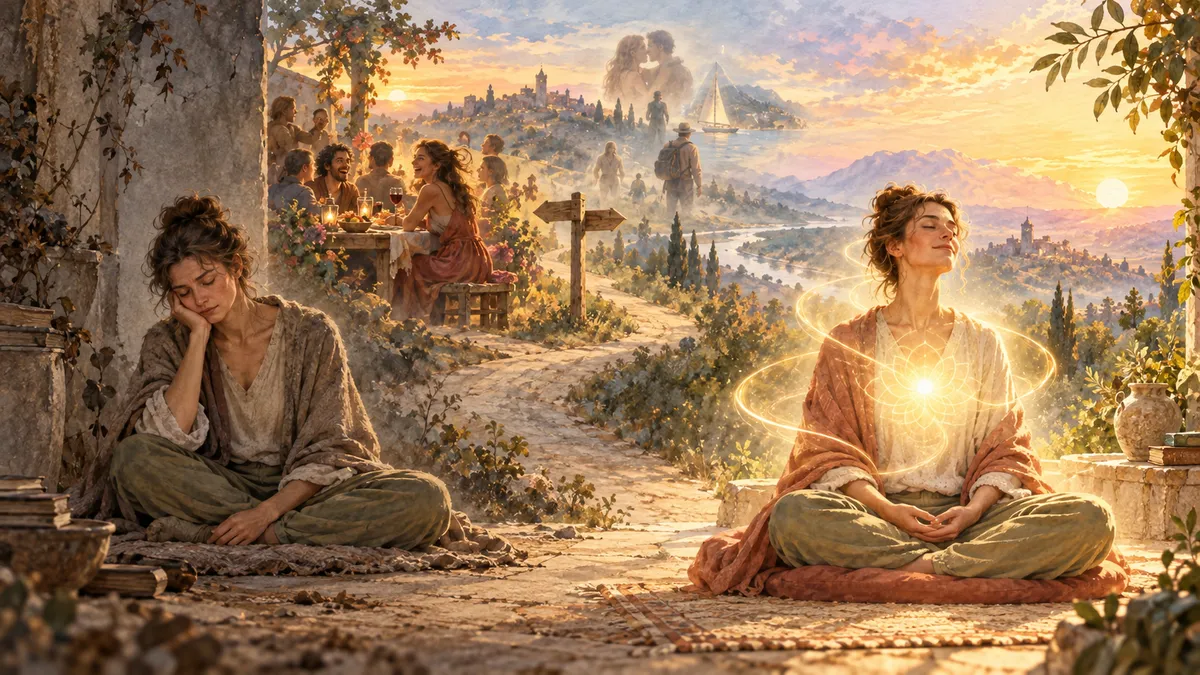
And sooner or later, the mind, having received no enjoyment for 10 or 20 years, thinks: practice brings no enjoyment at all; perhaps I should look for enjoyment somewhere else. Then it begins to evade practice; practice becomes bland and monotonous, no longer interesting. It feels: I have already tried this and I have already tried that, and such a sadhu becomes indifferent, apathetic, tired of practice, and finds himself in a crisis.
A crisis means that he has failed to reveal grace, that he has not experienced ananda, subtle bliss, and his mind may well incline toward once again deriving at least some bliss from material nature, from the material world. But if one conducts an analysis and establishes oneself in the correct practice, it is possible to reveal grace, and practice can become graced; then spiritual enthusiasm reappears, great qualities awaken, and spiritual zeal and spiritual joy arise once again.
And many people deviated from the spiritual path because of the absence of grace, of swift grace; they expected grace to come quickly. Swift grace should not be expected. It will come neither later nor earlier, precisely at the time when it is permitted, after the purification of karma. But one must attune oneself to it, one must believe and be certain that God, Brahman, Ishvara—that this is bliss, this is grace, this is joy; it is not a neutral state, but an absolutely grace-filled state. Yet this is not the sensual happiness that exists in the material world and is neither eternal nor indestructible.
Question: Should we understand that this bliss, this ananda, is manifested Shakti, while Shiva is this fullness? And clarity appears here as the jiva itself, which recognizes Shiva and Shakti in the dance?
Yes, bliss is Shakti herself when Shiva is recognized within her. When Shiva is recognized within her, she manifests as bliss—not worldly, but spiritual. But if we do not recognize Shiva in bliss, bliss becomes a trap, a subtle maya. This is the subtle point: whether we recognize it and surrender it, or fail to recognize it. If we do not recognize it, it becomes a subtle trap that draws us along the path of pleasures. When we recognize it, it becomes grace.
Question: So does it turn out that the whole life of the jiva, the entire jiva, is the dance of Shiva and Shakti, which it recognizes—is that how it is?
Yes, the jiva is the union, the mystical union, of Prakriti and Purusha, where Shiva becomes aware of himself and liberates himself.
Question: GurujI, is Shakti tamasic when Shiva does not move her?
Yes.
— And if she stops completely, does she become Shiva?
No. She remains Prakriti. Shiva is the purest sattva, the purest light; Shakti is inert until Shiva touches her.
— Is Shakti a part of Shiva?
Yes, but a tamasic part, utterly motionless and immobilized until Purusha casts his gaze upon Prakriti. Stones, trees, minerals—the lower they are, the less everything moves within them. Chaitanya is Shiva; supreme consciousness is chaitanya, awareness, while Prakriti is achaitanya, that which is devoid of consciousness. Of course, even there there is the weakest movement of consciousness, which is why this too is a part of Shiva, and this too is Brahman. But this consciousness is so deeply hidden, veiled by various kanchukas and material elements, that it is practically imperceptible to ordinary souls; it is perceptible only to Purusha himself.
— GurujI, when he moves her, does she become rajasic and become Kriya Shakti?
Yes.
— And when is she sattva?
When is she sattva? She becomes sattva under conditions in which Purusha fills her sufficiently for her to become radiant and transparent. For example, in the bodies of gods and angels, and in Ishvara’s own body, she is pure, unmixed sattva. There is mixed sattva combined with rajas and tamas in human bodies. In the bodies of angels, sattva is mixed with rajas. The more Purusha there is, the more sattva there is.
Reasons for the Absence of Bliss in Practice
Question: GurujI, what about those who practice and practice but do not attain bliss for a long time, despite their sadhana? Does that mean they are practicing from the wrong place—from effort, from ego? Is that why they cannot purify the mind?
There can be various reasons. Sometimes the time has not yet come for sattva to manifest. Sometimes they do not attain bliss, but they gain clarity of awareness, and clarity of awareness can also bring subtle joy. But if they receive absolutely nothing—not clarity, not experiences of nonduality or emptiness, and not bliss—this means that karma is still preventing it, that it has not yet been purified, and that the channels and granthis have not been cleansed. But usually, a practitioner receives something.
It may be either joy, if a person practices in the spirit of bhakti and devotion—joy comes first, ananda comes through devotion—or clarity. Clarity is for those who practice in jnana bhava, for those who are good contemplatives and meditators. If none of this comes, one must purify karma, place emphasis on the path of devotion, and continue purifying the mind so that it may penetrate into clarity.
And those who first experience clarity feel that a great future lies beyond clarity; emptiness— their eyes light up, and they need to place emphasis on studying the texts of Advaita. But they feel that this clarity gives them wings, though on such a subtle level, while outwardly everything, both in the body and in the pranas, is so joyless: no joy, no bliss, only clarity. And they think: clarity is certainly there, and that is good, but it would be nice to have something denser, coarser. Therefore, worldly desires sometimes tempt them, because a worldly desire is right there, while clarity soars too high, and neither the body nor the pranas can keep up with it or rise to its level. This is the type who initially chooses the jnana path, the path of nondual consciousness, one who has a strong intellect and a capacity for contemplation. And their practice has this mixed character. On the one hand, clarity is a clear sign of grace, their own clarity; on the other hand, the body and mind do not feel grace—they are without grace, so to speak, as far as the body and mind are concerned; there is only clarity, and that is all.
There is another type, those who practice the path of devotion. They experience bliss and joy, but there is no clarity, and they still have a great deal of rajas, so they cannot subordinate their joy and bliss to inner awareness; this also happens.
And then we must coordinate and harmonize our practice, looking at what we lack. Those who have a great deal of clarity but lack bliss should place emphasis on self-surrender and devotion. Those who have sufficient bliss and joy should continue to emphasize contemplation and jnana.
Three Aspects of Manifestation in Brahman
“The eternal Shakti, consisting of the three gunas, abides in Brahman, the supreme Shiva. It is precisely through changes in her that three types of objects arise in Brahman. That which consists of rajas mixed with a small amount of sattva is designated by the term ‘enjoyer.’ That in which tamas substantially predominates is called the ‘object of enjoyment.’ That supreme spirit, Brahman, which is called the supreme essence, is Ishvara, the inspirer.”
Thus, Ishvara inspires; the jivas enjoy—or rather, attempt to enjoy, unsuccessfully; Prakriti is the objects, that which is enjoyed. For example, ice cream is Prakriti, a person is a jiva attempting to enjoy it, while Ishvara is the consciousness that inspires him to enjoy, because in reality the only enjoyer is Ishvara himself; all enjoyment belongs to him, but he does not enjoy directly, rather indirectly, through our bodies.
We are channels for Ishvara’s enjoyment; therefore, logically, we should practice self-surrender, offering all enjoyment to Ishvara, because that is precisely why Ishvara created us. And when we offer everything to God, we fulfill our purpose, our dharma, and remain in harmony with the cosmic intelligence. But if we do not offer it and instead appropriate it, then we are, as it were, stealing from Ishvara. It is just as if you had created some remote device, a lunar rover, to transmit data to you—data of perceptual experience—but it does not transmit anything and stores everything for itself. You created it for that purpose. Then you have a complicated relationship with the lunar rover, and you may simply dismantle it in order to rebuild it from scratch.
And there is the concept of “svamshas”—that is, creations of God, direct creations of God; for example, the Avatars, the seven primordial rishis, and the Kumaras—all of these are svamshas, a category of souls directly created by God. For example, the rishi Vashistha is considered to have emerged from the mind of Brahma, a manasaputra; that is, he was not born from a human womb. There are vibhinnamshas. A vibhinnamsha represents the marginal energy; these are human beings and many others. They may be pitris, spirits, gods, or other beings that have risen to the status of divine beings in the process of evolution, but this is a difference, a different origin of souls.
“Due to differences in the gunas, these imagined three things arise in undivided consciousness, Brahman: the enjoyer, the object of enjoyment, and the inspirer.”
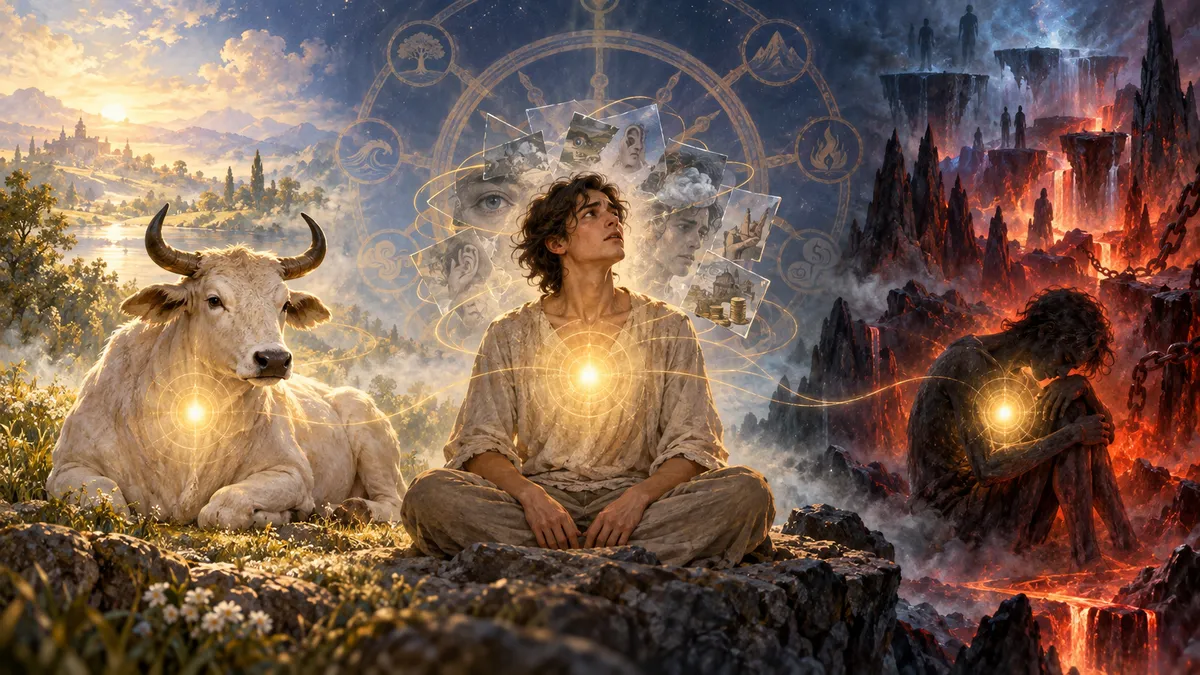
Why is there a tendency to enjoy? Because Ishvara himself inspires this feeling in us. But we do not have enough awareness of Ishvara, enough viveka, to dedicate all enjoyment to him. We believe that it is we who enjoy; we attribute enjoyment to ourselves. Besides this, we become entangled in material pleasures. Ishvara within us is never entangled. When we become entangled, he does not. Thus, even in the most depraved drug addict, drunkard, or lascivious person, in the lowest animal, Ishvara remains perfectly free from entanglement; he receives his share of enjoyment, that for the sake of which he created all this. But the jiva, the marginal energy, the soul of this person, becomes entangled. And then it says: “Lord, why have you cast me into this material world? Why are you so cruel to me? Why have you abandoned me?” He says: “And who are you, anyway? You do not exist; you are simply the Self, you are the remote Self, you are my cell, my finger, my remote device. Give everything back to me and surrender to me, and you will never suffer; I have never abandoned you.”
Ishvara never becomes deluded; even in the body of a bull, he is present within it as the Atman. He never becomes deluded in the body of an ignorant person. Every worldly person, no matter how deluded he may be, is a bearer of Ishvara, and Ishvara within him is not deluded. But his mind, body, senses, and ego interpret the data of sensory experience incorrectly and, not feeling ananda, think that they are deluded. Not think—feel, truly feel.
Even in the bodies of sinners in hell, Ishvara is not deluded and enjoys this. There someone is being sawn, cut... There are various descriptions of hells: cold, hot, piercing, cutting; a hell resembling a cold mountain, one resembling a rotting corpse. But Ishvara in these bodies also delights in such vajra-like, wrathful games, drawing shaktipat and enjoyment from them.
Classification of Beings According to the Gunas
“Here is the inspiring Shambho; he is Maheshvara, and his quality is sattva. All those who possess mixed qualities are enjoyers; they are known as pashu. The object of enjoyment is also called the unmanifest, avyakta.”
Every living being strives to enjoy; enjoyment is inherent in nature: vasanas, samskaras—nature as a whole operates toward this. If there were no principle of enjoyment, nothing in this world would move. Purusha himself initiated all this by awakening Prakriti. The world revolves for the sake of enjoyment because bliss is the nature of Brahman and the nature of Ishvara. But the question is that some souls become deluded and enjoy incorrectly, while others do so correctly. Correctly means enjoying God, Ishvara, his pure tattvas. Incorrectly means enjoying Prakriti without dedicating this enjoyment, becoming attached to it.
What lies behind the soul’s tendency to have a family, a car, a house, power, money, friends, social status, prestige, to live in a large city? It is the same tendency—the desire to enjoy. But when misunderstood, it always leads to disappointment and suffering.
What lies behind a practitioner’s desire? The same desire to enjoy, but the practitioner is more cunning: he wants to enjoy for a long time, subtly, and without getting bogged down in the material world, so that this enjoyment will not be destructible. He is doing the right thing; he is adopting the right position. And so that this enjoyment may never end or be destroyed, and so that he may remain a conscious principle within it, so that he may not lose himself in this enjoyment but, on the contrary, reveal himself through it. Therefore, he seeks the most refined pleasures. And what are these refined pleasures? Enjoyment of Brahman, Ishvara, and his energies—the most subtle, immaterial pleasures. And people cannot understand that this is the true capital of a sadhu: prana, powerful Chit, visualization, accumulated merit—this is wealth. All the rest are paupers, one might say.
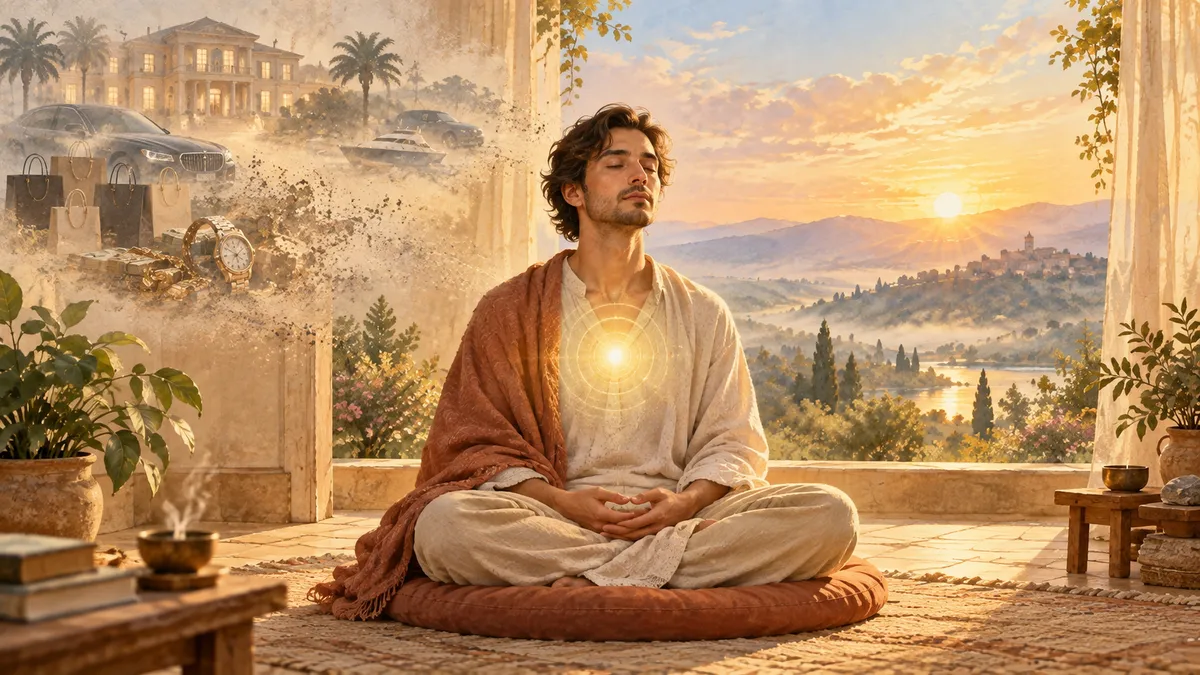
All these oligarchs, billions, all the cars and houses—this is nothing; it comes, goes, can be destroyed, is not eternal, temporary. But the power of the soul, the power of the subtle body, merit, prana, the number of mantras recited and spiritualized, connection with saints, strong Chit, strong prana, auspicious visualization—this is wealth. Therefore, saints are truly rich; they are rich in subtle prana, subtle Shakti, which enables them to live in heavenly worlds. What is the use of spending your whole life saving, working, accumulating, striving, even deceiving and sinning for the sake of it—and then going to hell? You lived for 80 years—and what then? What was the result? Delusion, the wrong path chosen, the wrong meaning, the wrong values of life chosen.
And what about a sadhu? He, too, has hardly any possessions, observes the vows of celibacy and non-possession, and lives, from the perspective of worldly people, an inconspicuous, not particularly bright life. But within him, palaces blossom, pure light blossoms, and he becomes a truly wealthy person. As the song goes: “We could have served in intelligence, we could have acted in films”—there are many opportunities to become deluded in samsara, but all this bright life means nothing to a sadhu. That is why a sadhu understands and values the choice of monasticism, the choice of being a sadhu. What he accumulates is far more beautiful, but it is difficult for people attached to the material world to understand; otherwise, a thousand people would be sitting here. But it is difficult to understand, difficult to believe. People believe in real money, in real material benefits, while all this is ephemeral; many are simply not destined to understand it, no matter how much you try to convince them. They think they are being fed fairy tales, that they are being told fantastic things.
Unmanifested Prakriti as the Object of Enjoyment
“The object of enjoyment is also called the unmanifested. It is a form of pure tamas. The inspiring Shambo is omniscient.”
The object of enjoyment is the unmanifested Prakriti, a form of pure tamas.
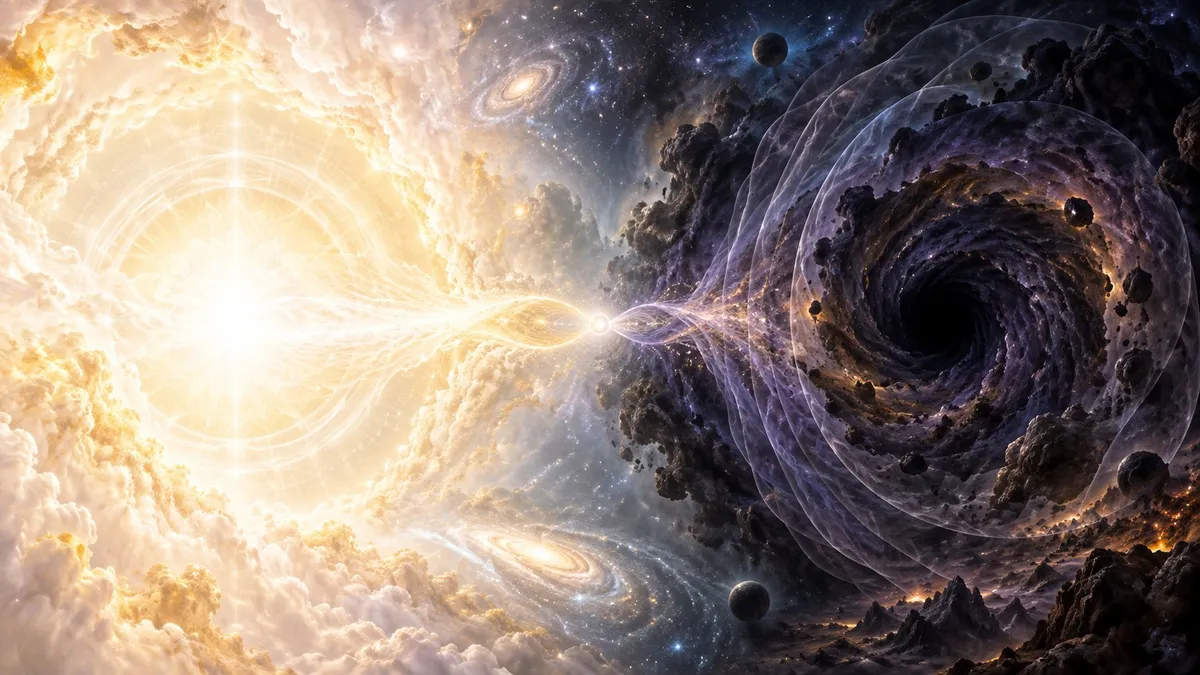
Prakriti is originally unmanifested. Before manifesting, it exists at the level of primordial matter. What can primordial matter be compared to? It is like a black hole in which the laws of physics have not yet begun to operate; this is the original state, what is called Mulaprakriti. Galaxies begin to be born from the black hole, singularity, the Big Bang; the universe begins to appear, dimensionality appears, and in this state Prakriti represents the ultimate tamas. And this is how the object of enjoyment unfolds its attributes.
Question: “Om, Guruji. How does Mulaprakriti differ from shunya?”
Mulaprakriti is already matter; it already contains the kanchukas, maya, while shunya is much higher. Shunya is an aspect of the unmanifested Brahman; they must not be confused. Mulaprakriti is Brahman that has begun to pulsate and has already become enveloped in the maya-kanchuka and other kanchukas.
Brahman is pure consciousness, shunya, and the light that emanates from it is Ishvara, while Prakriti is tamas. It is also unmanifested, but it is primordial matter at a stage of an extremely dense, extremely inert state. In other words, this is consciousness, and this is matter in its original, unmanifested, tamasic state. It is like there are black holes, and there are white holes; such concepts exist in astronomy. Brahman is a white hole, while Mulaprakriti is a black hole, one might say.
Question: What is a white hole?
Astronomers introduced this new concept; I myself do not really understand what it is, but I am simply using it as an image for illustrative purposes. As I understand it, a white hole is something connected with extremely subtle energies, from which pure tattvas are born.
Question: And have astronomers seen it?
No, astronomers are developing the concept of white holes. But as applied to our teaching, astronomers are useless here. It is only an image useful for understanding.
Shunya is Chit, consciousness; matter is Achit, inert, that in which consciousness is not as vivid as in shunya. And here we need to understand: chetana and achetana. That which is endowed with consciousness and that which is not endowed with consciousness.
Question: Guruji, Om. There is only Brahman, after all. How can there be a lack of consciousness in it?
It is there too, yes, but it is in such a weakened state that it is imperceptible to the souls. For example, can you perceive consciousness in a log? No. It is imperceptible to the souls, but it is perceived by Ishvara; it is perceived by Brahman as part of itself. But it is imperceptible to the other souls, and therefore the souls seek to enjoy it—that is, it appears to them to be devoid of Chit. There is consciousness there too, but it is so slow, so inert and hidden that it cannot be seen. This is the secret of how the kanchukas arise on the pure tattvas. You must meditate on the 36 tattvas until you receive an illumination.
Question: Guruji, is Prakriti, primordial matter, the 13th tattva?
Yes. Wherever Purusha is, Prakriti is always present with it; they always go together. This occurs after the kanchukas, after the raga-kanchuka, the niyati-kanchuka and the others; all of these arise before Prakriti.
Differences Between Ishvara and the Jivas
“The inspiring Shambho is omniscient, while the jiva, the enjoyer, has limited knowledge. The unmanifest, the object of enjoyment, is called inanimate; it possesses consciousness that is extremely inhibited.”
Extremely inhibited, that is, tamasic and motionless.
Question: “Om, Guruji. Why is it unmanifest if it is manifest?”
No, this refers to the unmanifest. Manifestation in the form of worlds, trees and other inert matter is the next phase. Before manifesting, Prakriti remains in an unmanifest state; it is like primordial matter, in which the atoms have not yet begun to group together.
“It is also said that upadhis are of two kinds: pure and impure. The pure upadhi is the supreme illusion, maya, which abides in the primordial Shiva and gives rise to delusion in him. The impure upadhi is ignorance, avidya; it gives rise to delusion in that which it inhabits. Because of the differences arising from the power of ignorance, avidya, there exists a diversity of living beings.”
The pure upadhi is Ishvara’s body; the impure upadhi consists of the bodies of the diverse beings derived from Ishvara, in which ignorance arises.
“Under the influence of the power of illusion (maya), the Lord assumes many divine forms. He is the omniscient, omnipotent and eternally free Maheshvara. On the other hand, living beings, the jivas, possess limited abilities and limited knowledge. They are bound by beginningless embodiment.
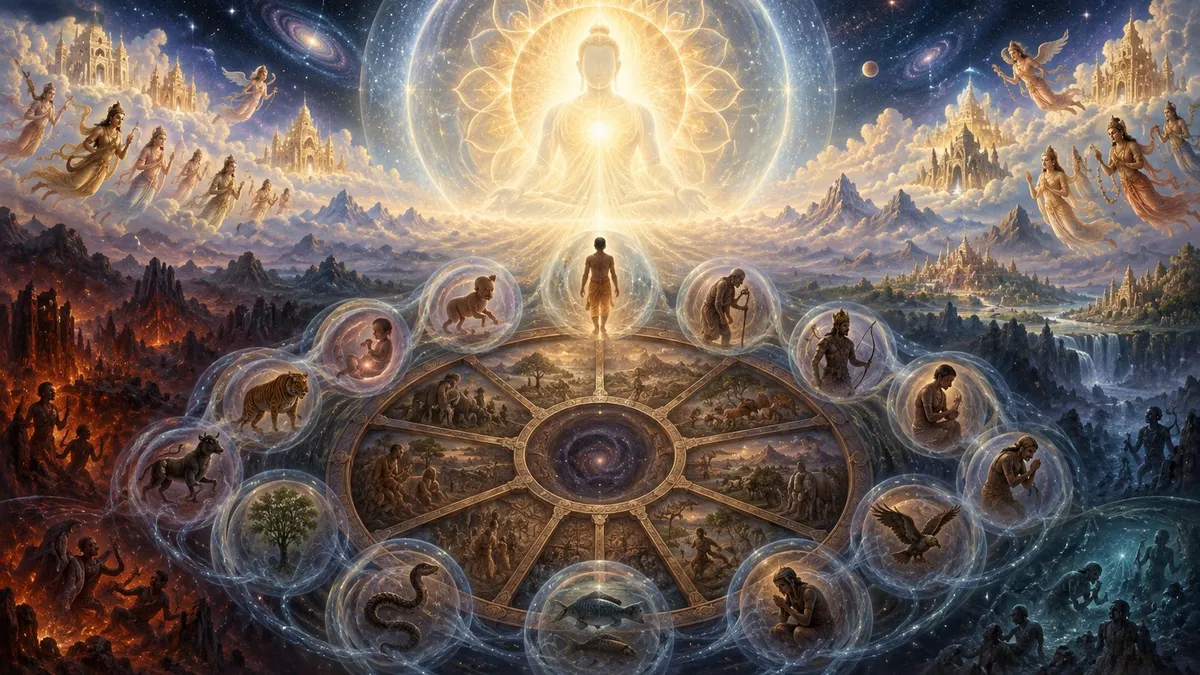
The jivas are enchanted by ignorance (avidya) and deprived of knowledge of their unity with Brahman. They revolve in the wheel of births and deaths and, in accordance with their previously performed actions (karma), take birth in various wombs: those of gods, animals and humans. Embodied in bodies, beings spin like the rim of a wheel. The sole cause of differences in bodies, lifespan and experience is accumulated karma.”
Question: “Can one say that, for my sense organs, for example, the snow outside the window is currently unmanifest Prakriti? I do not perceive it, so it is unmanifest, but for Chitta it is manifest, and for Buddhi it is manifest?”
You can put it that way. In the mind there is an idea of manifestation, but for the sense organs it has not yet manifested.
