

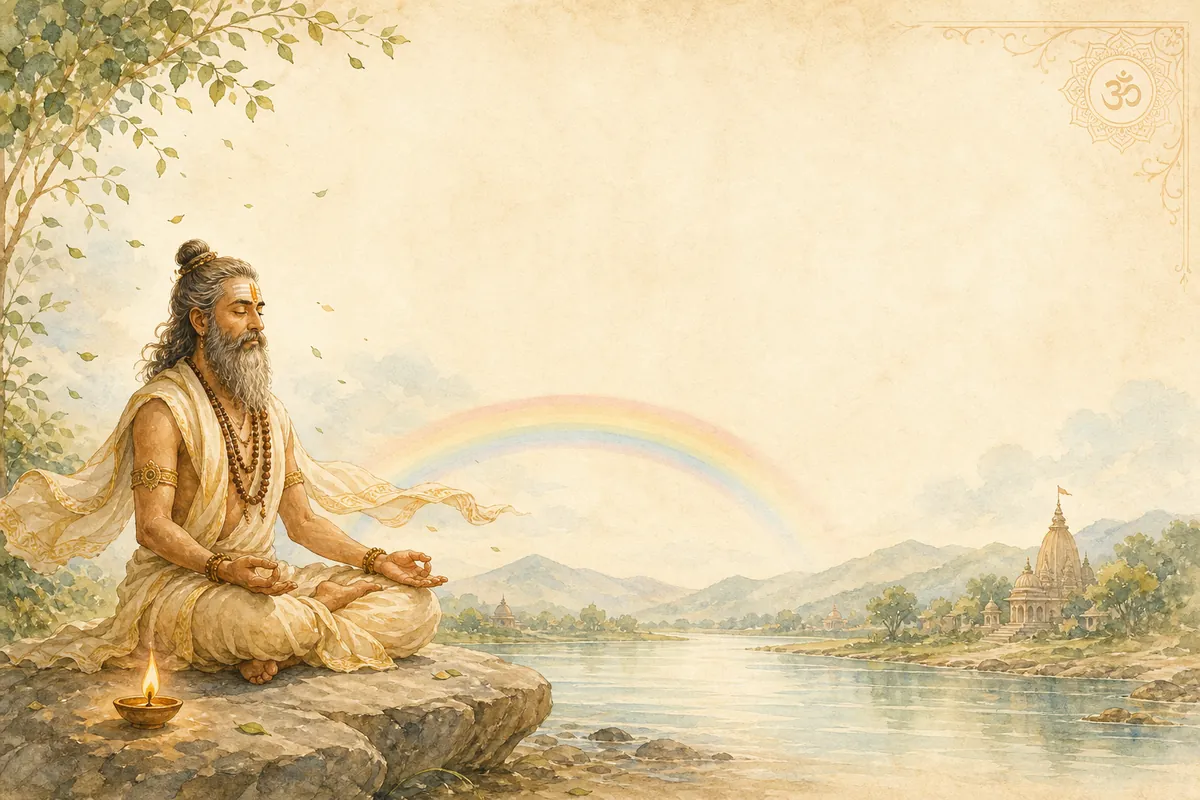
In the section on prajna-yantra, we speak primarily about the basis of the natural Mind. However, in the relative dimension, the basis of the natural Mind always rests upon something. This support is energy and the elements; therefore, in the section on shakti-yantra, we practice working with winds and elements, and in the section on anuttara-tantra, we practice sadhanas of uniting presence with the elements in the body or with the external elements. The success of our spiritual practice depends on how balanced our elements are; therefore, it is important to have an understanding of the five elements that constitute us.
For example, the following physical properties are attributed to the elements: earth – density, water – the force of cohesion, fire – temperature, air – movement, space – the containing dimension that gives room to the other four elements. From the five elements arise the five senses and the five fields of sensory experience, the five harmful emotions and the five wisdoms, the five limbs of the body.
Mahasiddha Goraksha wrote in the “Precepts of Goraksha” (“Goraksha Shataka”): “What can a yogin hope for who does not know the five spaces in his body?” The five spaces are the five elements. When you begin concentration on the chakras, you enter into an understanding of the five elements. It is believed that an ideal yogin should feel his seven chakras and five elements as well as the five fingers of his own hand. He must fully know and sense how they function within him. If you perform concentration on the chakras, you can understand how your consciousness, state of mind, and even life circumstances change depending on your concentration.
The five elements are the five primary pranas, or life energies. They form all physical, mental, sensory, and spiritual phenomena. According to the nontraditional view, flesh is earth; blood and other bodily fluids are water; electrical and chemical energy, digestive heat are fire; inhaled and exhaled gases, oxygen and others are air; the space of the body cavity, as well as consciousness, is the element of space.
Understanding the external elements and the fact that they make up the body leads to a sense of the inseparability of oneself and the external elements. Our body does not live in a vacuum; it lives in the elements of the five elements: it can exist only where there is earth, water, fire, and wind. Reflecting on this, we understand that we are not some separate, self-existing substance. This is an illusion. It can be said that we have borrowed elements from the external environment for our body.
Three Levels of the Elements
At this level, the elements are not only the gross elements of our sensory perception. We live on the earth; this is what pertains to the external level.
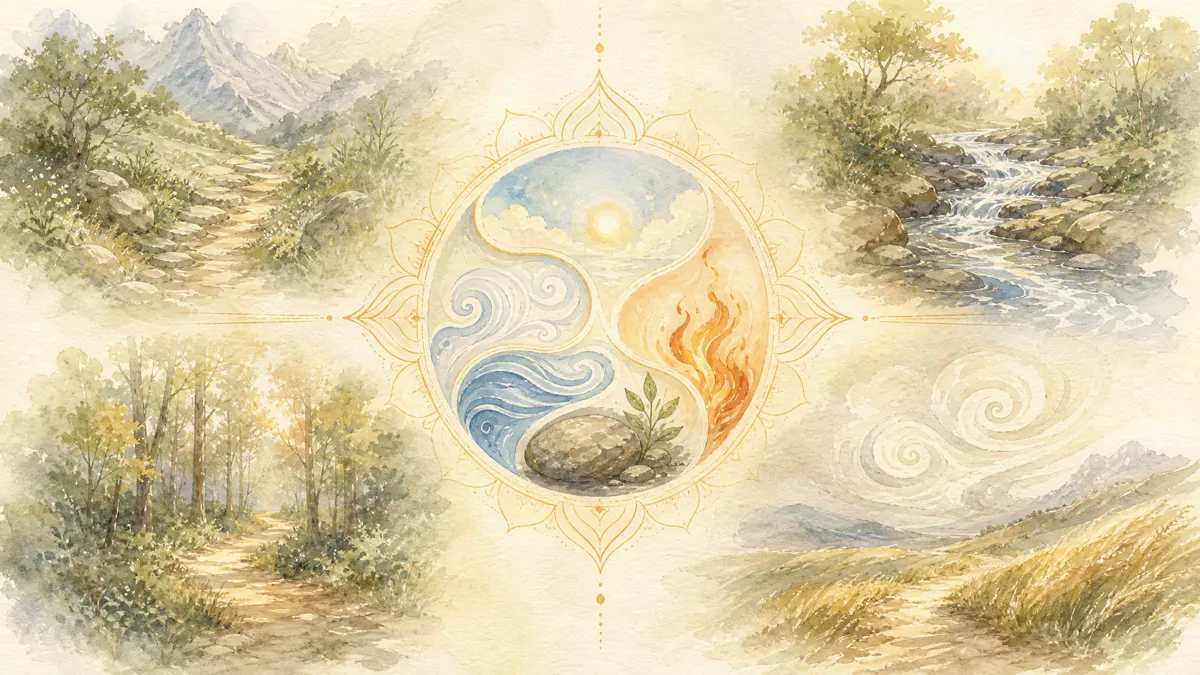
There are different approaches to the elements. They mainly speak of the Four Vehicles. Three are known to you – Sutra, Tantra, and Anuttara-tantra: the path of renunciation, transformation or self-transformation into a deity, and the path of the natural state. There is also the lowest Vehicle, which is called shamanism. It is also called the Vehicle of causes and effects. It is believed that Enlightenment cannot be attained by it; however, one can, for example, harmonize a situation, achieve success, heal an illness, or make a prediction. Depending on which Vehicle the elements are considered in, their external manifestations, subtle manifestations, or most subtle manifestations are examined.
External level. At this level, the elements are not only the gross elements of our sensory perception. We live on the earth, drink water, warm ourselves by fire, breathe air, and move in space, but also the spirits connected with the elements. Among them are elemental spirits and other beings.
In fact, all elements have both a gross and a subtle nature. In the subtle sense, the elements are deities, subtle energies.
Internal level. The internal elements are energies of the elements rather than their forms. In our body, they are present as physical energies that pump our blood, digest food, stimulate neurons, and also as subtler energies on which our health and abilities depend. Tantra uses these energies by controlling them in the human body to perform specific tasks. Direct methods of yoga are applied in this: bodily postures, breathing, visualizations, and mantras. In tantra, energies are considered the powers of deities.
The secret level. The secret dimension of the elements abides beyond duality, and therefore it is difficult to describe it in words, which inevitably dissect experience into separate objects. This subtlest dimension of the elements is the radiance of Being – the five pure lights, aspects of luminosity inseparable from emptiness – the basis of everything.
In the teaching, we are concerned precisely with this subtlest level of the elements. At the subtlest level, the elements are the five colors of the rainbow. Of course, they then become more substantial, but in anuttara tantra it is precisely this aspect of the elements that is emphasized.
Attitude Toward the Sacred
The elements are regarded as the sacred primary causes of Being. Since they are sacred, everything that arises from them, that is, everything without exception, is also sacred. The surrounding nature is sacred, and the body is sacred. The outer and inner elements arise together from one and the same source. The warmth of the sun and the warmth of the heart differ in degree, but not in essence. The waters of the ocean do not differ from the moisture of our bodies. Our flesh is created from the earth element and will dissolve into the earth. The air in our lungs is the same air in which the hawk soars. The space in which the Universe arises; the space occupied by a sofa in the living room; and the space in which our thoughts arise are one and the same space, and it is sacred. And everything that is in space, tangible and intangible, material and spiritual, is the elements. Since the elements of the body are sacred, the consciousness that arises from them is also sacred, as are wisdom and passion, dreams and nightmares. The living experience of beings is a manifestation of the pure elements interacting with awareness. Primordial awareness is also one with the elements. This is the perfectly balanced, purest, and subtlest level of the five elements, the quintessence of the basis of Being. Without a sense of the sacred, it is difficult to have faith in religious instructions. In Tibet they say that if you treat your Teacher like a dog, the teaching will be good for nothing, like rotten food. If you treat your Teacher like a friend, the teaching will be nourishing, like fresh food. But if you treat your Teacher like a deity, the teaching will be divine nectar.
It is important to extend this attitude not only to the Teacher and the Dharma, but also to everything we see, and to one another as well. Sometimes practitioners understand how one should relate to the Teacher. At the same time, they may relate to the Teacher correctly, but to one another as to a dog. This is not very right, because enlightenment implies that everything is divinized, including ourselves. In the absolute sense, everything is absolute. If we do not see this absoluteness, that in itself says nothing, since we fail to see many things, which is why we are considered deluded, unenlightened. One could say that we see nothing at all. Nevertheless, even knowing this, we allow ourselves constantly to judge right and left, one person and another, thinking: “These ones are like this, and those ones are like that. I like these, but not those.” Of course, in relative reality one sometimes cannot do without this, but such manifestations must still be subordinate to pure vision and a sense of the sacred. Therefore, in tantra it is recommended to regard those who are near you and the members of the sangha with pure vision, that is, as deities, as potential buddhas. Perhaps their qualities have not yet fully manifested, nevertheless, for your own benefit, you have no right to think of them badly, negatively, or incorrectly. At most, you can think that their qualities are present in potential, and therefore are not visible to you. If you adopt such a pure view, your realization will advance.
If, as in tantra, one sees the body as a divine palace, considers it the fruit of great fortune, the best vehicle for attaining enlightenment, then it will indeed be such a vehicle, capable of carrying us beyond death. If one relates to the Dharma as a spiritual teaching capable of leading us onto the path of Truth, it will truly lead us to Truth. If one relates to the elements as the world of nature, and to one’s body and mind as sacred, they will be sacred. This is not merely a psychological technique; it is the awareness of one’s true position.
“Sacred” means “subtlety, subtle energy.” One can attune to this subtle energy through such an attitude. In the Absolute there is everything: both the sacred and the impure. But what we see around us depends on our desire to attune to something or not to attune. When we want to transform our impure samsaric vision into pure vision, we need to accustom ourselves to attuning to the sacred. This attunement does not imply some artificial creation of a sacred image; rather, it implies the revelation of what is, but is not manifested because our impure vision dominates. For example, if a radio station is tuned to the wrong frequency, it simply tunes to the right frequency in the necessary range; that is, the level of perception of radio waves is readjusted. The necessary wave already exists, but because of insufficient attunement it is not yet being picked up by the receiver.
In the same way, pure vision (the feeling that everything is sacred, seeing living beings as deities, and at an even higher level as the Absolute, relating to everything as a manifestation of the Absolute) already exists, but is not perceived by unenlightened consciousness because of improper attunement.
A connection with the sacred leads us to the deepest sense of ourselves, to what is sacred within us. A practitioner of tantra discovers that devotion to deities leads to the realization that his deepest “I” is the deity. In Guru Yoga, the disciple needs to discover the Teacher’s mind within himself. A sacred connection with something sacred outside can be realized only by that which is sacred within.
Let us take, for example, an image of Dattatreya. Looking at Dattatreya, you admire his holy, transcendent qualities. As you practice contemplation, you discover that the perception of Dattatreya is within you, in your mind, that without your consciousness nothing would arise from Dattatreya. Then you understand that both the qualities of holiness and all abilities also depend on your mind. One can say that they are inherent in your mind from the very beginning. Suddenly something turns over within you, and you acknowledge the holiness and boundlessness of your mind, because if your mind did not possess holiness, it would not be able to perceive external holy objects. When you understand the holiness of your mind, suddenly you change your idea of your own personality; you begin to understand: “I am a true saint, a deity, the Absolute, and not this petty personality limited by kleshas.” Although limitations exist, nevertheless the vision of oneself changes.
How can one develop a sense of the sacred within oneself? Remember that the Source of everything is holy, that space and light are sacred. Any visible manifestation is beautiful if one steps away from prejudice and recognizes the vibrant, radiant nature of phenomena. Remember that all beings have buddha nature; remember the sacredness of the spiritual tradition.
The Five Pure Lights
The subtlest dimension of the five elements is called the “five pure lights.” For each of us, everything begins with primordial space, the great mother who gives birth to everything, in whom everything exists, and into whom everything returns. In this space there is movement. What causes it, no one knows. The teaching only speaks of the movement of the winds of karma. This movement at the subtlest level is prana, energy, filling infinite space without defining characteristics or boundaries. The flow of prana is inseparably one with the flow of primordial awareness, pure and free from a separate “I.” The five lights are aspects of primordial luminosity. The five lights are the subtlest level of the elements. We speak of the radiance and color of the five pure lights, but these are only symbols. The five pure lights belong to a level subtler than visible light, subtler than anything perceived by the eye, subtler than any energy that can be measured or sensed in any way whatsoever.
The property of the absolute Mind is emanation, the radiation of energy. In the case of an unawakened living being, there is a misleading prana at rebirth. I hope you understand that samsara is a state of mind; in the absolute sense, samsara is neither created nor destroyed. In the relative sense, people speak of the cycles of the Universe, of how it is gradually created and gradually destroyed. But in reality, it is ignorance that gradually arises and disappears. For some beings, samsara is created and destroyed in accordance with the cycles of the universe. For other beings, samsara has long since disappeared; it does not exist, because samsara is a property of the mind. In the case of the awakened, the radiation of energy does not hurl them into duality, and therefore the five pure elements remain pure even when energy manifests. In the case of the unawakened, the misleading prana throws them out of the natural state. Therefore, the five pure lights are not recognized but become coarse, substantial material objects. This process occurs at rebirth for every living being.
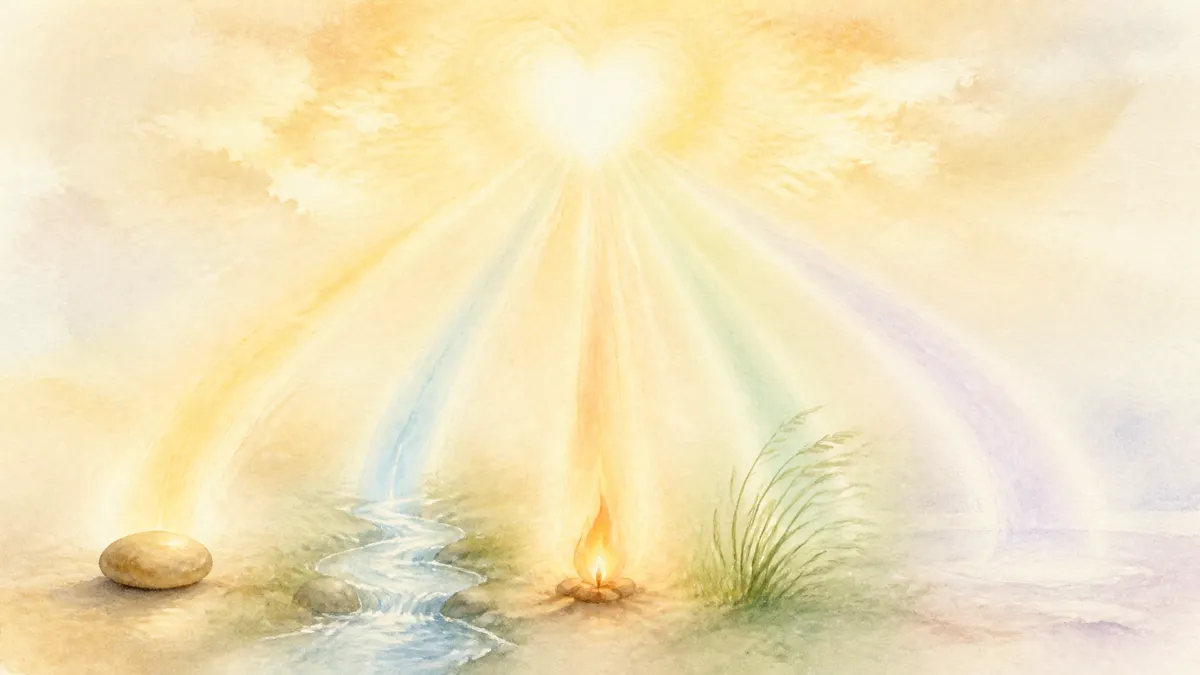
The five pure lights are the energies from which all other energies arise, including visible light. White or colorless light is space, green light is air, red is fire, blue is water, yellow is earth. Such are the five aspects of the pure luminosity of the rainbow energies of the Single Sphere of Being. If the five lights are perceived dualistically, as objects perceived by a subject, then they seem to become more substantial. The five lights do not become coarser, but due to the distortion of dualistic vision they are perceived as coarser.
What does it mean to perceive the lights in duality? It means losing contemplative presence and perceiving them with the conceptual mind. The five pure lights are contained in our body. If a yogin concentrates well on the chakras or unites contemplative presence with the elements, he will certainly discover space within the chakra. For example, you are meditating, and suddenly green space flashes out in all directions at the level of the anahata chakra. This is the discovered space of the element of wind. You should know that you have entered the space of the element of wind. A disciple of Srila Prabhupada once chanted the mantra for many rounds in a row and saw green space. She asked, “What is this?” Prabhupada said, “Keep chanting, it will pass.” In general, he said the right thing. From the point of view of practice, we must regard all experiences as inseparable from the natural state. Nevertheless, this is how the elements manifest. Or you meditate and fly into a space of violet or blue color—this is the element of space of the vishuddha chakra. You simply discover a violet or turquoise blueness that spreads in all directions. You could not even have imagined that such a space was possible. Or you meditate, and a golden, yellow-golden space opens to you—this is the muladhara, the element of earth in its pure state. Or you enter a red space surrounding you on all sides—this is the element of fire. By concentrating on the chakras and learning to unite contemplative presence with the elements, you understand these spaces in your body.
As the elements appear more and more substantial, still more distinctions are made within them, and through their interaction they give rise to all phenomena. In the end, the five lights become coarse, natural, physical elements and five categories of qualities belonging to external reality. They become different dimensions of Being, that is, different worlds inhabited by beings that either possess form or do not possess form. As for the inner aspect, the five lights, becoming denser, form the organs, the five branches of the body, five fingers on each limb, the five sense organs, and the five supports of the senses. If we remain in a state of delusion, the five lights become the five harmful emotions; if we realize their purity, they become the five wisdoms and the five buddha families.
Understanding the principle of light is especially important in jyoti yoga. We must truly understand that this body is woven first and foremost of light, and only afterward did it become material elements. In the same way, if, while working with light in jyoti yoga, we work with their liberation, then the elements of this body are also liberated, all the way to rainbow light. The solidity of the elements is apparent. On the subtle level, all elements consist of various levels of interweavings of light.
The Wisdoms of the Elements
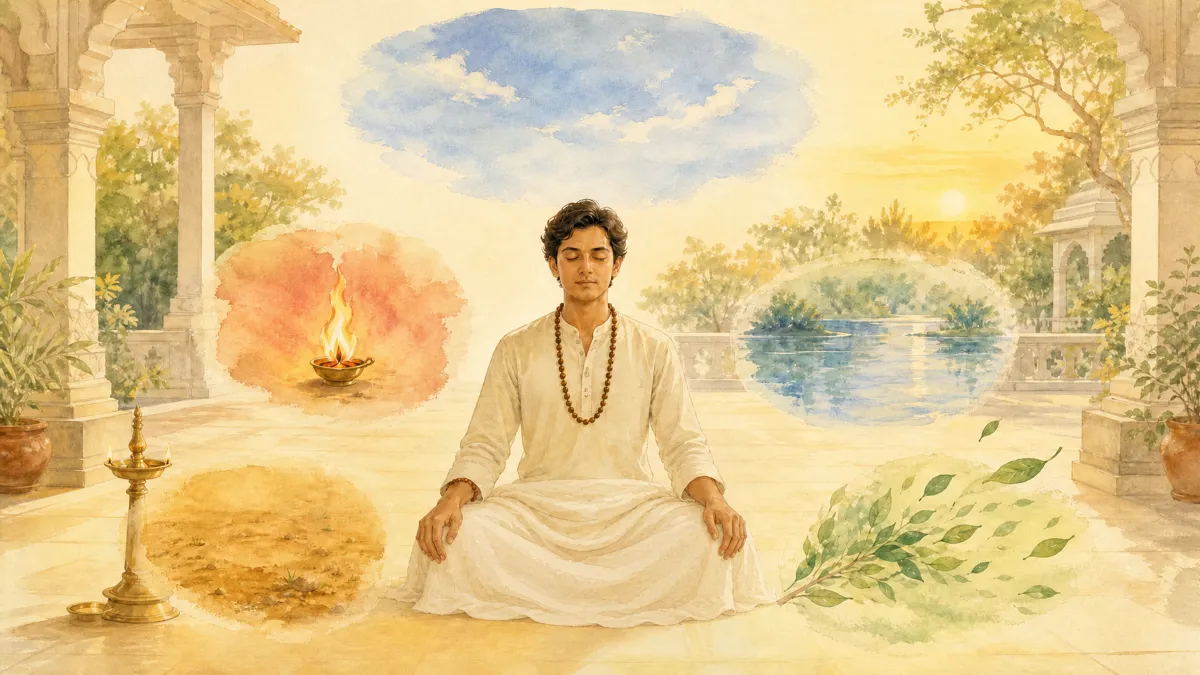
When we reveal the various kinds of light and space in our body, wisdoms (vidyas) arise in us. These wisdoms are qualities of the revealed natural state, connected with a particular element. They manifest as specific creative abilities or as knowledge. Suppose, for example, that you have learned to unite contemplative presence with the element of fire; then strong intellectual abilities, clarity, and discriminating knowledge arise in you. If you have learned to unite contemplative presence with the element of space, you develop an all-encompassing, synthetic vision; in any situation you will not be caught by particulars, but will be able to extract the essence, the quintessence, easily synthesize any knowledge and take its core, its essence; separate details will not seize hold of you. If you have realized the natural state at the level of the element of water, you will be able to reflect perfectly, practicing mirror-like wisdom (pratibimba-vidya). This means that you have developed quick understanding, the capacity for Guru Yoga, for feeling, for transmission, for receiving, and the capacity for artistry. If you have learned to unite presence with the element of earth, you will have developed a sense of a single “taste,” a sense of equanimity, the quality of impartiality, the ability to look at everything with the same eyes, to see behind the diversity of things their indistinguishability, their single foundation.
The Manifestation of the Elements in the Bardo and the Choice of the Path
“This is not about the creation of the world that took place in the distant past. It is about our life as separate beings, about our ignorance and enlightenment. If in the five lights one recognizes the nondual, continuous manifestation of the pure ground of Being, nirvana begins. If the five lights are perceived dualistically and it is thought that they exist externally as objects perceived by a subject, samsara begins.”
During rebirth, a person in the bardo of dharmata sees his body as consisting of light; he sees the external elements not as he usually does. At first he is drawn into the dimension that is more familiar to him: he sees a familiar landscape, nature, and so on. However, he now sees everything (earth, water) differently: he sees everything as woven from light. He sees earth as yellow light, water as white, space as violet. It can be said that this is a luminous vision. At that moment he can attain liberation if he remains in presence and unites the elements with his state. It is said that the division occurs here; samsara or nirvana begins here. To see these lights as external means to follow the path of samsara, while to see them as part of the natural state and as one's own manifesting lights of the five wisdoms means to follow the path of liberation.
“The natural state neither turns into delusion nor becomes Enlightenment; it remains nondual and pure, but the qualities that manifest in it may be either positive or negative. If the natural state unites and identifies with pure qualities, a buddha arises from the ground; if with impure ones, a samsaric being arises. This process is happening right now, at this very moment. Depending on whether we unite our immediate experience with the nondual, natural state or are attached to the false singling out of ourselves as a subject perceiving external objects and living beings, we will be, respectively, either in the nondual, natural state or in the state of deluded thinking. Karmic predispositions and conditions determine the character of the world in which we live. What we perceive as external is a projection of the internal. For some people our world is hell; for others, paradise. The elements provide us with profound metaphors that help explain processes occurring deeper than those they describe. Through understanding the elements, we can see that the seemingly different dimensions of our perception are in fact only subtler or coarser levels of the elements. For example, an excess of fire manifests in the physical, energetic, mental, and spiritual dimensions. In reality these are not different dimensions, but a sequential series of increasingly refined ways of representing one and the same ground. Therefore fire is both the life-giving energy of the sun and the forest fire that destroys all living things; fire is the warmth of the digestive system, the creative capacity of the mind, the red color of the rainbow, phenomena of temperature, the emotions of hatred and desire, the warmth of compassion, the wisdom of discrimination, and one of the five subtlest and deepest aspects of Being.”
Gradation of Elements from Gross to Subtle
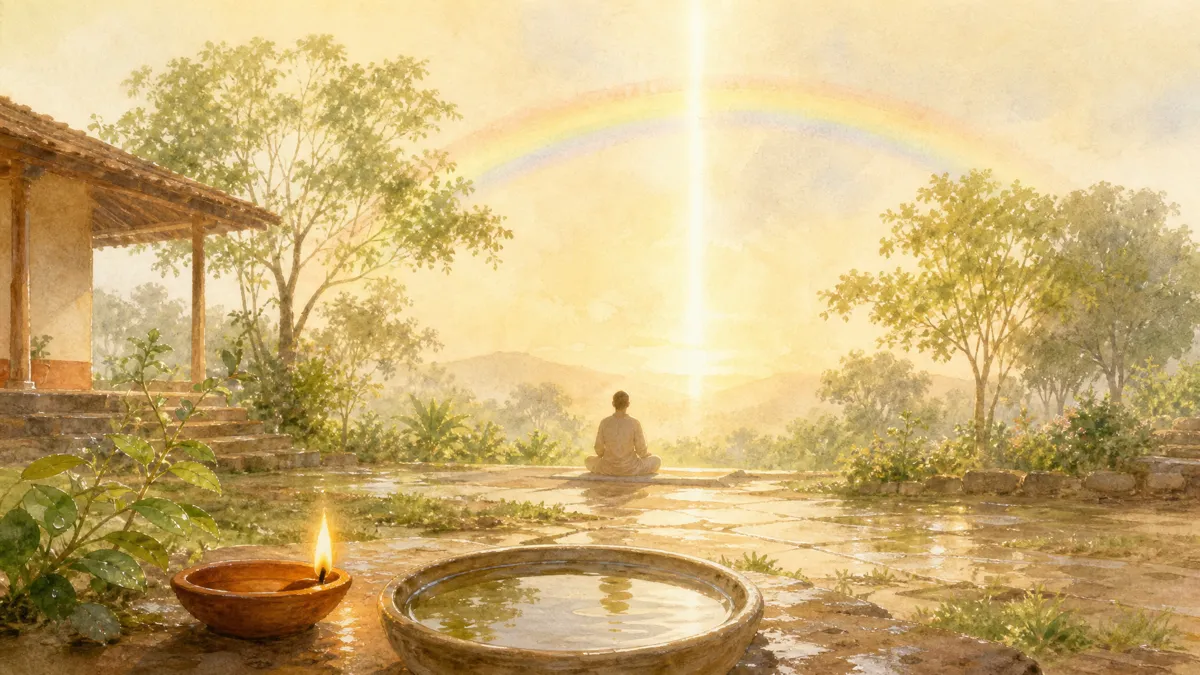
As you know, there is a gradation of elements; there are external or gross great elements (mahabhutas), for example, external fire or external earth. There are more refined elements. These are the elements in our body, for example, the digestive fire in the body, or bones and flesh as the element of earth. There is an even subtler basis of the elements, for example, the five colors of the rainbow. The element of fire is simply the red color in the rainbow. By rainbow here is meant the primordial luminous basis of the unborn Mind, which has the property of manifesting. The colors of the rainbow that you see are these same colors manifesting on a subtle level.
Therefore, it is often said that rainbows are subtle auspicious phenomena, certain signs accompanying the appearances of deities, saints, or certain projections of a subtler world. For example, rainbows may accompany important initiations, entering or leaving retreat, the arrival of a Master, or religious holidays. Rainbows accompany the descent of deities or dakinis. Sometimes there may even be pillars of light. About a year and a half ago, we observed a great radiance in the place where the “Magic Aroma” house, the Guru’s house, and the novice nuns’ house are now located. This means that the lights manifest in a purer form.
Interaction of the Elements
“If we understand the all-encompassing nature of the five elements, then we see that all phenomena arise in interconnection; they are inseparable and influence one another. The interactions of the elements are complex enough to give rise to everything in the world. Each element contains all the others within itself, and in various forms of interaction they work both together and against one another. For example, if fire is strong, air supports and fans it; if it is weak, the wind blows it out. In exactly the same way, all the other elements in our experience support and suppress one another.”
Suppose a person feels tamas after eating. This means that their fire element is weak; the fire element is not fully coping with the food, then the wind element also weakens, and their clarity decreases, the amount of prana in the head and the sahasrara chakra diminishes, they become dull and feel sleepy. But why do they have a weak fire element? Most likely because, initially, the wind circulates more weakly due to insufficiently purified nadis. If, however, they strengthen the fire element, then a sensation of vital warmth appears, spreading throughout the entire body, all the way to the fingertips. Then fire begins to move the wind, and the wind also begins to circulate throughout the entire body. A person always has a clear mind regardless of whether they have eaten prasad or are tired; they tire little. This means that the quality of the elements has changed.
Or, for example, a person is not sufficiently harmonious in relationships; they constantly do foolish things, draw criticism from others, and do not know how to establish contact with others. This means that their water element is not sufficiently activated. All these manifestations can be eliminated or transformed into virtues if the elements develop and become balanced.
Imbalance of the Elements and Its Manifestations
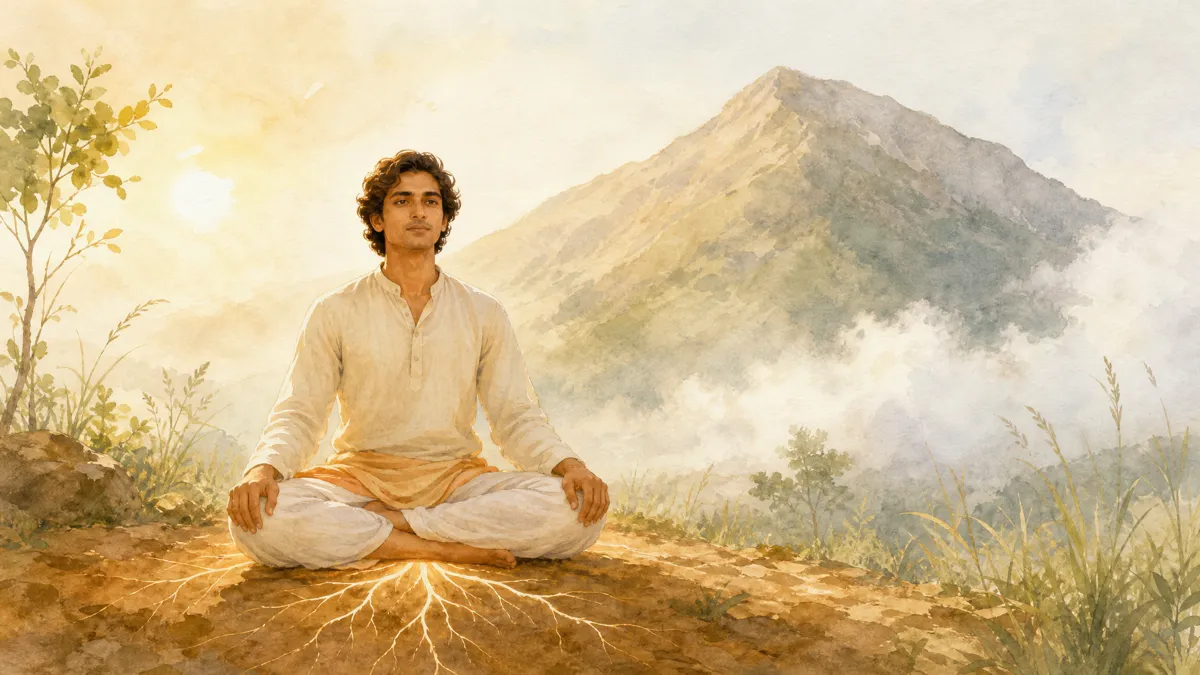
If a person’s earth element is balanced, such a person feels confidence and stability; they are like a mountain. However, if there is too much earth, then such a person is slow to get going, sleepy, lazy, dull, sluggish, and has a lot of tamas. These are excessively inert qualities of earth that lack movement. Their thinking is slowed, devoid of creative abilities, and they have no imagery. An excess of earth can even lead to lack of will or depression, an inability to progress in practice or in whatever they are engaged in. Such a person likes to sleep and constantly nods off during meditation. This means that they need to balance the earth element and strengthen the other elements.
And what happens if a person has too little of the earth element? Such a person seems to have no anchor; they are fickle, they have no support either in the nature of Mind, or in control of emotions, or in stability in practice; they cannot complete what they have begun, they have no refuge anywhere, and they are always searching for something that would give them stability. This means that the earth element is not activated.
It is said that people in whom fire and air predominate quickly gain experiences and progress. Nevertheless, these experiences also disappear quickly. Those in whom the earth element is strong gain experiences and progress slowly, but they are preserved for a long time. Gradually, the yogin begins to become aware of each element in his body and brings it into harmony.
The Manifestation of the Elements in Practice
In practice, one can sometimes see various tigles, bindus, and spheres. This especially applies to retreats (both dark and ordinary ones). The element that dominates manifests first. For example, if white and blue spheres appear, this indicates that the elements of space and water are dominant. That is, the element that is most activated is shown first, since the elements can be present in different proportions. But gradually a bindu of all five colors arises. This means that all five elements have been harmonized and manifest equally. The ideal state of the elements is their complete equilibrium, not excess or deficiency.
For example, a person whose air element is activated can do a great deal. He can move mountains, but sometimes he lacks the perseverance to bring what he has begun to completion; he may take on everything, but leave it unfinished. He may be very active at the initial stage, but lose enthusiasm when it is necessary to engage in long, routine work. It can be said that if a person’s fire element is more imbalanced than necessary and is not in harmony with the earth element, then he will manifest as an irresponsible person who cannot be relied upon.
A person who has an excess of the space element always feels lost. This happens with spiritual seekers. At the stage of transition from anahata to vishuddha, a person loses human notions and immerses himself inwardly. And even if he goes to work, for him work is not work, family is not family; he constantly remains in a state of a certain prostration. Conversely, a person who has little of the space element is too absorbed in external circumstances. He has responsibilities, practice, and other things, but he cannot bring everything together, cannot find the proper place for everything in his life. A person whose space element is balanced can accommodate everything, can synthesize everything, and therefore everything in his life will take its proper place. His mind does not identify when encountering anything; he does not carry it within himself for a long time, but self-liberates it. Nevertheless, he relates harmoniously to what manifests; in his consciousness everything is capable of manifesting or falling into place, since his mind is like space and does not cling to anything.
A person who has an excess of the water element may float in his emotions or be weak-willed. If, however, he has a deficiency of the water element, he does not feel joy in spiritual practice and has no liveliness.
Ideally, all five spaces of the yogin are always balanced and strung upon the single space of consciousness.
