

When you study the five elements, this does not mean that you are studying some science separate from the practice of contemplation, the natural state, and self-liberation. Rather, it means that the practice of contemplation also extends to energy; that is, it is studied in a deeper sense. For example, in Zen and Theravada Buddhism, no importance is attached to the study of the elements, channels, or winds. It is considered sufficient to have awareness, which must be deepened and maintained throughout one’s life, and this is regarded as perfection.
However, in Tantra such an approach is considered insufficient. As soon as we begin to deepen and perfect it, we see that energy exists, and that this energy has its own laws, which we cannot ignore. Therefore, in Tantra, great importance is attached to the study of the elements and everything connected with energy. When we practice, our elements must be balanced. Our success in the practice of contemplation depends on how harmonious they are.
The Elements and the Stages of Spiritual Development
There are different types of behavior during spiritual practice, to which various elements in the body correspond. For example, at the stage of the bee, the elements of fire and air are important. At this stage, a person is only a spiritual seeker, and they need to free themselves from many things: attachments, samsaric society, and so on. And for this, an impulse is needed—the dynamism of the fire element—as well as air, which destroys all fixed ideas and allows one to cast off the conventions of society and the like. This is precisely why, at the stage of the bee, a person feels great aspiration, enthusiasm, and a tendency to destroy all established fixed ideas, to free themselves from society and so on; that is, they move into the element of air.
Such a person thinks that they will always remain in the element of air; however, when they find their path and decide to become a monk or begin to practice intensively, they will need support from another element. For example, at the stage of the deer, the element of earth is very important—that is, stability—while the element of air no longer has such significance. Why is the element of earth important at this stage? Because if, in retreat, one does not allow one’s experiences to gain stability, one will not be able to acquire patience, and spiritual experience will not mature.
Often, having moved into the element of air at the stage of the bee, a person feels great inspiration, makes many plans, and acquires a very mobile consciousness. But when they come to the monastery, they are given not air, but the element of earth (stability) and the element of water (flexibility), as if saying to them in this way: “Your flights are not important to us. We need your stability and patience.” And then the practitioner feels that they need to develop the element of earth, because without this element all their spiritual searching will be something superficial.
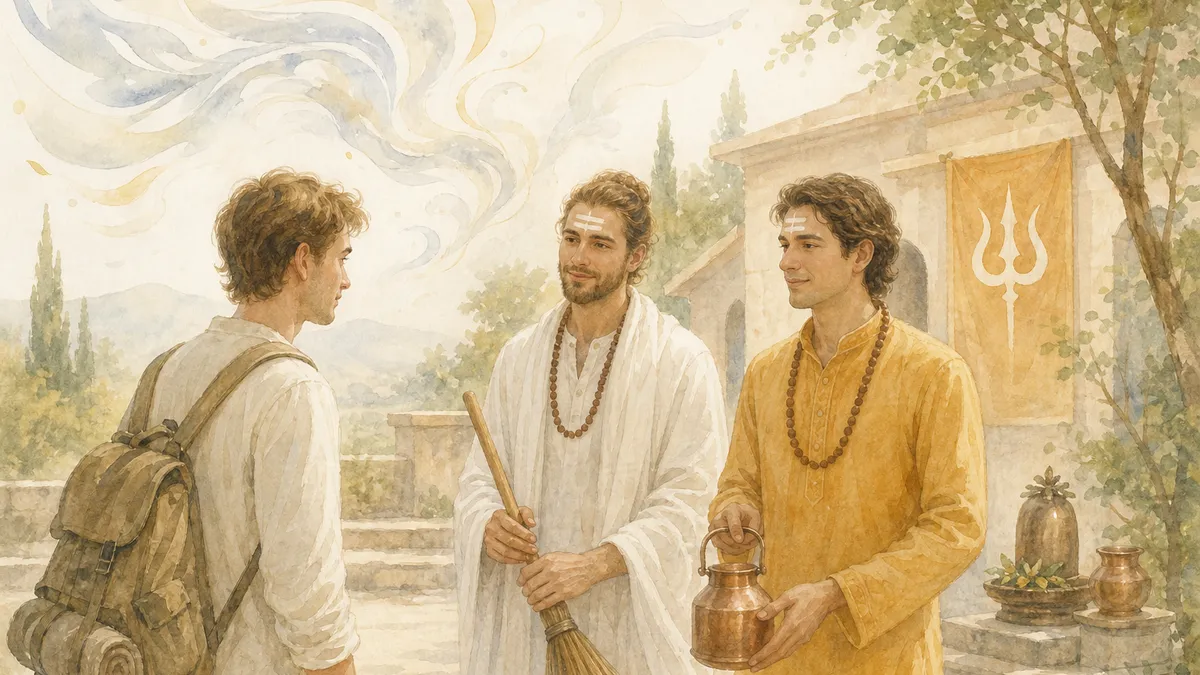
In retreat, the element of earth allows all experiences to become firmly established.
Then comes the stage of the mute, which corresponds to the element of space. At this stage, the yogi needs to leave behind all connections with the other elements and draw closer to space, maintaining only the subtlest awareness, forgetting everything, even the body, and not distinguishing either word or meaning. This can be achieved only in deep states; in worldly life it is impossible to attain. If a person wants to realize this state in the world, outside special conditions, they simply will not be able to cope with society and household responsibilities, because when the element of space is active, all actions in the material world, all relationships and plans are devalued, and only emptiness and awareness have significance.
At the stage of the madman, the yogi goes beyond the five elements. He is in the deepest state, which is beyond even the element of space. This is the state of nonduality. Nonduality can manifest through any elements: through the element of fire, air, or wind. This stage is called the stage of the madman because the natural state manifests in the most paradoxical way through any elements. All the actions of such a yogi look like rushens, that is, behavior that completely self-liberates everything. Since this stage is possible only at the level of realization, it is very specific. Under ordinary conditions, in ordinary relationships, this stage cannot be realized. Because nonduality, going beyond the elements, is completely transcendental behavior and self-expression.
Finally, at the stage of the lion, the yogi harmoniously unites his natural state with one of the elements, for example with the element of water or fire, and preaches the Dharma to others. Now he manifests his nonduality more wisely.
At the final stage of conduct — the dog-pig stage — he manifests the single taste of all phenomena, developing the wisdom of equality, uniting nonduality with the energy of the earth element, the muladhara chakra.
Thus, in the process of spiritual practice, all the elements are developed and all five types of wisdom are revealed.
Assessing the State of the Elements
A yogin must understand how the elements work in his body and help him practice. Usually an element is assessed from the following perspectives:
- a harmonious element, that is, the element is in harmony and manifests harmoniously;
- excess, that is, there is too much of some element;
- deficiency, that is, the qualities of a particular element are lacking;
- perfection, that is, the element has transformed into wisdom, becoming like light and space through the practice of contemplation and the unification of contemplation with the element.
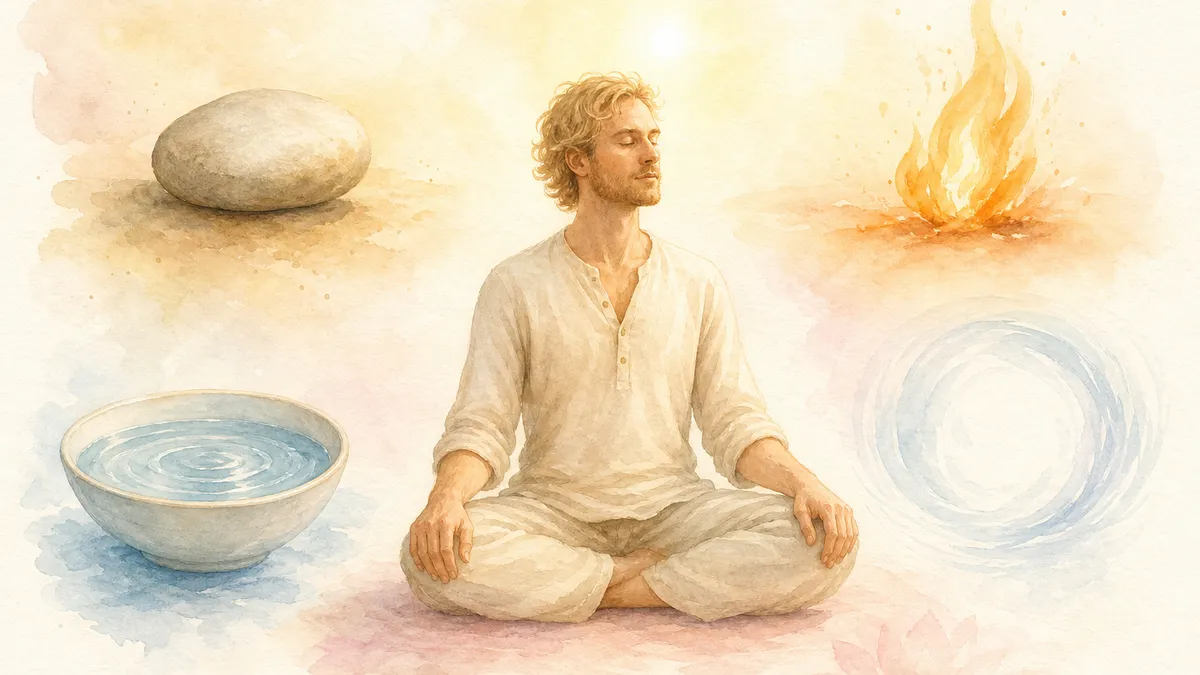
For example, a person has an active wind element. He easily obtains experiences, but he lacks constancy; he has no support, and therefore he cannot consolidate them. He thinks: “I do not know what my consciousness will be like tomorrow.” He is sure of nothing, cannot answer for his words or make promises. It can be said that such a person is not suited for monasticism, because he cannot take on any obligations and follow them for a long time; that is, he is unreliable. He lacks support and patience; he is too susceptible to the waves of his consciousness, and therefore he must develop in himself the quality of reliability and patience, that is, the qualities of the earth element. When he develops them, he will acquire a firm support and the necessary stability.

When there is an excess of the wind element and a deficiency of the earth element, the yogin’s consciousness is too flighty. When a spiritual seeker, overflowing with his experiences, comes to the spiritual Teacher while in a state of great spiritual delusion and considering himself almost a saint, then the Teacher gives him a service corresponding to his “high” level: cleaning cowsheds, digging the vegetable garden, and so on, as if saying to him in this way: “Dear one, for now unite yourself with the earth element, learn patience, steadiness, and stability. And we will continue your flights later.”
Stability and steadiness are very important qualities, because without such steadiness and patience the yogin’s spiritual experiences will be superficial; they will not take root. The spirit will not descend into matter and will not unite with life; that is, the yogin will continue to stew in some of his own pseudo-spiritual illusions.
This is one example of how the elements can manifest and how they should be harmonized.
Another example can be given. A person is obsessed with spiritual practice, constantly wants to move forward, and experiences great enthusiasm, but cannot relax and let himself go. He is constantly winding himself up about something and cannot in any way catch this point of the natural state; he is neither here nor now. This is an example of an unskillful vira-yogin who is so obsessed with enlightenment that he is ready to smash his forehead, but, not understanding how to attain it, places great hope in effort. Such a yogin makes enormous efforts and may exhaust himself to the point of being drenched in sweat during training, but all of this is done unwisely. He lacks the water element to harmonize his fire element. He misses contemplative presence precisely because he is in too much of a hurry, running too far ahead. Then dissatisfaction arises in him; there is no joy in the practice, but there are clinging, hopes, and fear for the future. Instead of taking root in genuine contemplation, he is constantly either in anxiety or in unwise enthusiasm. All of this is caused by the fire element. The fire element gives such a quality.
Such a yogin may have many ideas. He is constantly trying to adjust one thing in his practice, then another, but the more he adjusts, the further he moves away from the essence. He constantly changes one method for another, remaining in some kind of continuous superficial experiment. But he cannot take up anything deeply enough to obtain a result, because the excessive element of fire does not allow him to practice so deeply. For example, he may recite mantras or repeat a prayer while standing, but after half an hour he becomes bored with all of it, and then he approaches the Guru and asks for some exotic pranayama or some special walking meditation practice. Having received it and practiced it, he feels that it does not satisfy him either, so he begins to dream of a new practice. And such a state, if the essence of the practice is not grasped, may continue for months. This is how an excess of the element of fire manifests.
If such a yogin pays attention to the element of water and balances his practice, then it will become firmly established and bring real fruits. From any sadhana he will receive bliss and the depth of clarity.
The Meaning of the Elements in Laya Yoga
In general, in laya yoga, union with the element of water is very important for yogins, because it is connected with the ability to accept a situation as it is, the ability to let go of oneself, the ability to be in unity, in harmony with Being. The samadhi of the flowing river (this is another name for sahaja samadhi) is connected precisely with the element of water. Fluidity, flexibility—these are very important qualities in laya yoga. It can be said that in tantra, for yogins, the element of water is one of the most important elements. The ability to be flexible, to have sufficient fluidity of mind, and to manifest contemplation in behavior—these are qualities of the element of water that are very important in practice. The element of water is also responsible for the ability to put oneself in another’s place, to have compassion, to exchange concern for oneself for concern for others.
Another important element in laya yoga is the element of space, because space is closest to the natural state. It is the subtlest element, which directly points to awareness.
The element of earth gives a single taste, the wisdom of equality toward everything, an equal perception of all phenomena.
When we understand all five elements, our practice gives us the opportunity to deepen through establishing a connection with them, and in this way we begin to understand ourselves better. But this does not mean that we try to fine-tune our elements like the knob of a television and somehow constantly change them. Rather, it means that we discover different facets of the natural state in our body and in the Universe through the knowledge of the five elements.
The Element of Air
The element of air.
This is the element that brings change. And when it is developed, a person can transform the negative into the positive, hatred into love, jealousy into openness, greed into generosity, pride and egoism into peacefulness.
Air is connected with curiosity, a thirst for knowledge, and flexibility of mind. In its highest aspect, it is all-accomplishing wisdom.
In general, it is considered that there are two kinds of action of the elements. The first kind of action manifests when the element dominates in the right channel; the second, when it dominates in the left channel. The dominance of an element in the right channel means that it manifests through the activity of the physical body, speech, and so on, while in the left channel it manifests in a subtle state. It is considered that when the elements of air or fire dominate in the right channel, this is not very good. That is, these are destructive elements, all self-liberating and impermanent. Therefore, the elements of wind and fire in service are good only at the initial stage, in order to give some impulse. At the following stages, they do not provide the opportunity to realize anything, but instead take away all the fruits.
For human life, the elements of earth and water are very favorable. These are the elements of which our body consists by 80%, and therefore they are the best for service and relationships.
The elements of fire and air are good for creativity, for certain subtle ideas. But in a gross sense, they are unfavorable for use. For example, the element of wind is recommended in svara yoga during war, during battles. The one whose element of wind is activated in the right channel during battle will win. That is, the destructive action of this element can be seen here. But when activated in the left channel, these elements in the process of creativity give clarity and inspiration, since they are connected with subtle intuition and quick-wittedness.
If air predominates, the qualities of earth and water are usually lacking. In such a case there is little stability and contentment. It is difficult for a person to concentrate on anything. It seems to him that things are good where he is not, while in a new place everything repeats itself.
The element of water is connected with the feeling of joy. When a person has a strong water element, he is always here and now; he feels good where he is. Therefore, we say that this element is very important for us.
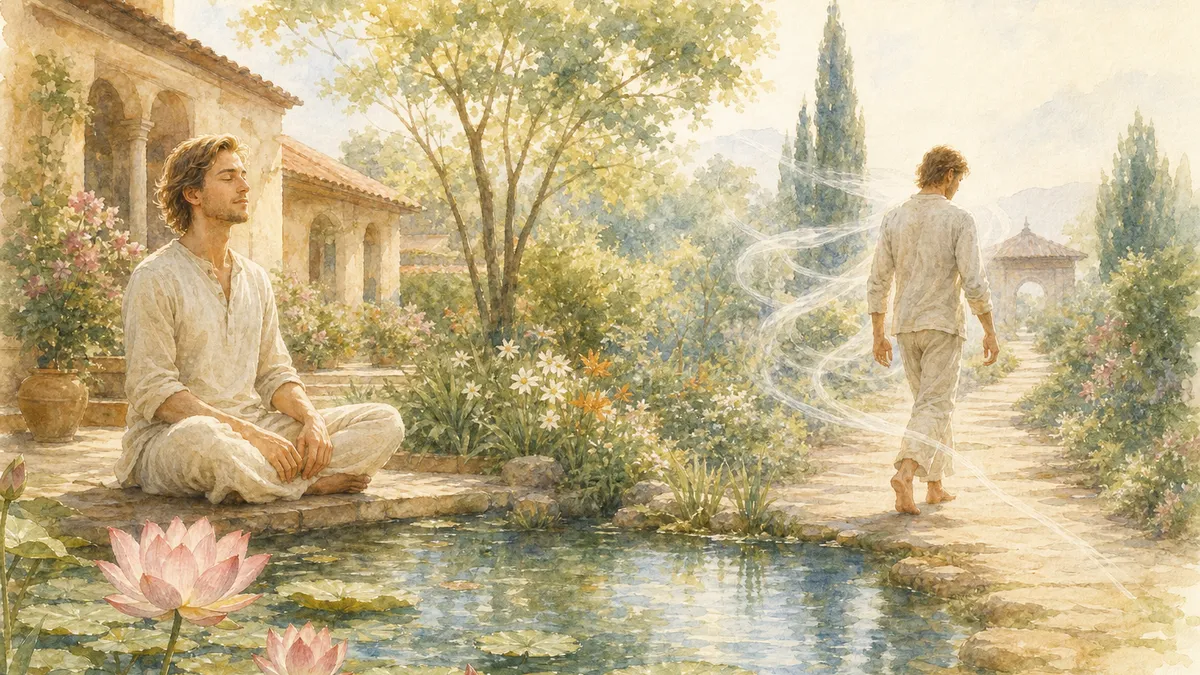
Air, on the contrary, is associated with a tendency toward change, impermanence, and the desire to search for something. Unbalanced air gives rise to dissatisfaction. That is, wherever a person may find himself, he wants to be somewhere else. This is simply a property of the air element. Also, under the strong influence of the air element, a person is inclined toward nihilism, toward the destruction of accepted rules, principles, and norms of behavior. At the stage of a wandering avadhuta, a madman, and so on, this is good. But at the stage of a novice and a monk, it is not good. At the stage of a novice and a monk, the elements of water and earth are good. And if you confuse which element to apply, you will encounter difficulties.
Question: Is integration with two elements at the same time possible? For example, with the elements of earth and water, when you imagine yourself sitting in water, but the lower part of your body is touching the shore. Is it possible to integrate with these two important elements simultaneously?
And in front of you a bonfire is burning, and above you the sky is spread out... You can even do it with four, if you have enough imagination.
I think it is possible. Although it is described that in deep practice preference is given to one particular element.
But if you are simply doing the practice for stabilization or for opening the lower chakras, the red bindu, then this is normal.
It is difficult to accept things as they are. It is difficult to find peace in what is. Such a person may be anxious, restless, unable to concentrate, and inconstant. Joy gives way to sorrow in him even at a minor unpleasantness.
Serenity is usually governed by the svadhisthana chakra, that is, the element of water. Constancy and firmness are governed by muladhara, that is, the element of earth. Dynamism is governed by the element of fire, while change, movement, and activity are governed by the element of air.
Determination gives way to uncertainty; faith is easily destroyed. There is no inner weightiness in him, so external influences carry him first in one direction, then in another.
A person at the level of the air element receives many experiences. He is constantly in clarity. That is, he is no longer an ordinary person, but an inwardly very complex creative individual. But if his other elements are not balanced, he cannot manifest his depth and complexity either in behavior or in experiences. It does not become established in him; that is, as it comes, so it goes. Therefore, it is very important to connect your experiences and balance them with the element of water and the element of earth.
An Example of a Deluded Wanderer
This is often the example of a spiritual seeker who has had a couple of experiences that changed his consciousness, and as a result he lost action in awareness. I have seen such people who, with a knapsack over their shoulders, go from one place to another, talk all sorts of nonsense, and consider themselves great naljorpas or avadhuta yogis. At the same time, if they are placed in retreat, they will run away from it after a week, unable to endure it. Of course, they are no longer ordinary people at all. They have no attachment; they are immersed in inner data. However, I would not say that they have become accomplished as practitioners. Somewhere they failed, lacking the guidance of a spiritual Teacher.

The element of air draws them, so they constantly wander like migratory birds; however, they have no depth of understanding, no concentration or patience to make an effort where it is needed. They follow the path of least resistance and flight. If they do not like something, they are immediately ready to leave everything and have nothing to do with you at all, as long as they can preserve this supposed freedom. But this is pseudo-freedom, because they still retain the distinction between “like” and “dislike,” and they show great sensitivity in this matter. They are an example of a deluded wanderer.
As a rule, such spiritual seekers are very repelled by monasteries, because in a monastery they feel restrictions on the element of air. But it is precisely they who would benefit greatly from monastic discipline, in order to remove their acceptance and rejection, and to develop the quality of connection with the muladhara chakra (the element of earth) and the svadhisthana chakra (the element of water). Because, possessing true freedom, you will feel good even in prison; even if you have to carry stones, like Milarepa, your freedom will not be shaken. But if your freedom is afraid of elementary self-discipline or relationships with others, then it is only superficial.
As a rule, it is very difficult to help spiritual seekers with an excess of the air element, because they are strongly connected with their inner data and clarity, and therefore have difficulty perceiving anything in spiritual practice.
An Example of an Imbalance of the Air Element
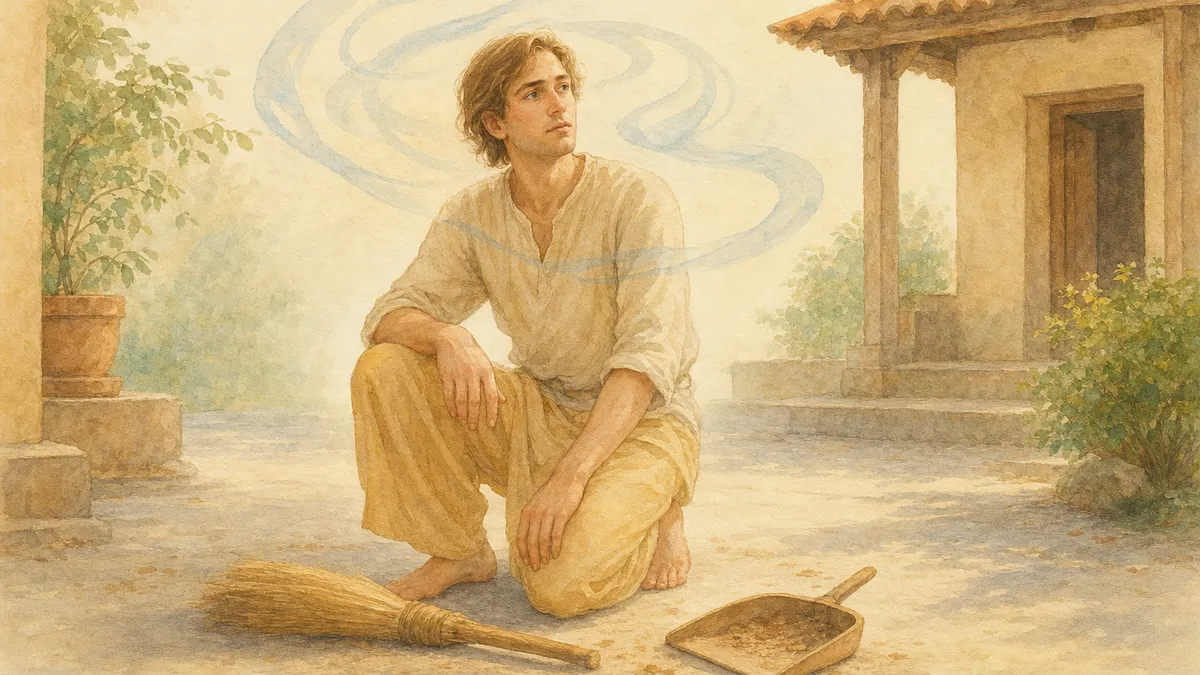
About seven years ago, a man who practiced kundalini yoga came to my ashram. He had left his family and had been a monk for some time in a religious organization. He was a very strange person. For example, when he was given the task of sweeping the yard, he would start sweeping, then abandon the service and look at the dustpan and broom. After a while, he would start sweeping again, and this would happen several times. That is, he could not perform even the most ordinary service. I asked him:
“Why do you do this?”
He answered:
“As soon as I want to do something, a tendency arises in me to do the opposite. After all, all this is illusion, duality, so I want to do the opposite and throw down the dustpan. And as soon as I throw it down, I again want to do the opposite, that is, to sweep.”
And so he was thrown from one extreme to another. I wanted to ask him: “And when you eat prasad, do you not have the desire to do gaja-karani? After all, that too is an illusion.”
This is an example of self-liberation at the level of the air element, when self-liberation has not entered the element of water or the element of earth. But when self-liberation is deep, a yogin can accept any opposites without making a problem out of it, because no things bind him in any way at all.
Deficiency and Balance of the Air Element
If there is not enough air, a person is too inert. It is difficult for him to change anything. When some anxiety arises, it does not go anywhere. Even a minor concern holds firmly inside.
The positive qualities of the air element are lightness, that is, the ability to perceive everything easily and change one’s state. A person of the air element does not keep problems in his head for long; they quickly self-liberate.
If, however, air is balanced, then worries and concerns give way to something completely different. A person gains determination. Balanced air makes it possible to be flexible. Even if things are going badly, we are still able to appreciate other aspects of life.
Even after receiving bad news, we are able to see the beautiful blue sky. Air gives the mind the ability to move in a new direction, to see things from another point of view, and this contributes to the accumulation of knowledge and understanding. How quickly you can transform your anger, or depression, or irritation, or self-pity into something beneficial depends on how developed the air element is within you.
The air element means the ability to change one’s thinking. This is not simply the flexibility of the water element, when a situation is accepted as it is, but the ability to completely change one’s vision of a problem. For example, you see a situation in one way, but, if necessary, you can look at it in a completely different way. You had certain hopes or plans, but, if necessary, you can get rid of them.
This is an example of an ideal monk. For example, he is sitting in dark retreat, but suddenly he is told: “You need to leave the retreat and do service.” This is no problem for him; he adjusts very quickly. And if he is immersed in service, but the time has come for his year-long retreat, it costs him nothing to switch quickly and enter into another vision. At the same time, he does not experience any serious shocks. He does not feel that something has changed radically. His mind has simply entered another current, but as a yogin, as a practitioner, he does not feel any anxiety in this, does not perceive it as a problem. If such a yogin is told, for example: “You will spend your whole life sitting in dark retreat,” he perceives it as if it were an ordinary bhakti meeting. He feels that nothing in particular has changed in his life. That is, this is a state of very great flexibility, which is given by a balanced air element.

Air as Prana and Its Excess
The element of air is also prana, which carries the mind. That is why, in tantra, physical movements and postures are recommended in order to control the element of air and thereby maintain the necessary experience.
When disturbances of the air element arise, it is difficult for the mind to concentrate. It is difficult to sit still in meditation. A person becomes impatient. Many questions arise in him that he wants to ask.
When there is too much air, it is difficult to attain the experience of the empty universal ground.
If a person, for example, intensely follows the path of worship and develops the anahata chakra, then it begins to function very strongly. In a bhakta this is called “transcendental madness.” He constantly searches for his deity, rushes from one place to another, runs everywhere, and thinks: “Where is Radha, where is Krishna?!” He is constantly in such projections. His mind is always very mobile, labile. But if he is aware and abides in the natural state, then this is simply the behavior of the madman stage, normal for a bhakta. Examples of such a state are Ramakrishna, the gopis of Vrindavan, and Sri Chaitanya. If, however, this is not connected with the natural state, it becomes a drawback.
Sri Chaitanya was an utterly unique yogin-bhakta. Sometimes he would fall into the water, and fishermen would pull him out with nets like a fish, breathless, with his legs unnaturally twisted. Then he would come back to life. Sometimes he danced in ecstasy for days and nights; sometimes for whole weeks he wandered through the forest from one place to another without food or water; sometimes he preached. That is, he was an absolutely unpredictable saint.
This is an example of a strong wind element.
Bhakti sometimes has a tendency to activate the anahata chakra. In this regard, I read the remarks of one Daoist. There are some people in whom wind enters the heart center in excess. They mutter high-flown verses and imagine that they have achieved a great deal. But this is simply an imbalance of the wind element, which influences the mind. In general, this observation is correct. If we do not take great saints into account, then this is indeed so. And we must know all these nuances.
Air in Magical Practices
Air connects everything. It is related to all forms of connection. As prana, the element of air fills everything and everyone. It is an integral part of being.
In some tantras, air is spoken of in connection with magical powers. Magic always uses transformation. Without the energy of the air element, no transformation occurs.
The subtle body consists of the wind element. It is very important in occult practice and in magic. It is also important in the practice of astral samadhi.
In the subtle world, in the bardo, there are areas one can enter and areas one cannot enter. These areas are not separated by walls or barriers as in the human world. Rather, these barriers consist of the wind element of a different quality. That is, it happens like this: you move in the astral body, and suddenly another world begins, one that you cannot enter. And this is felt as wind of a different quality.
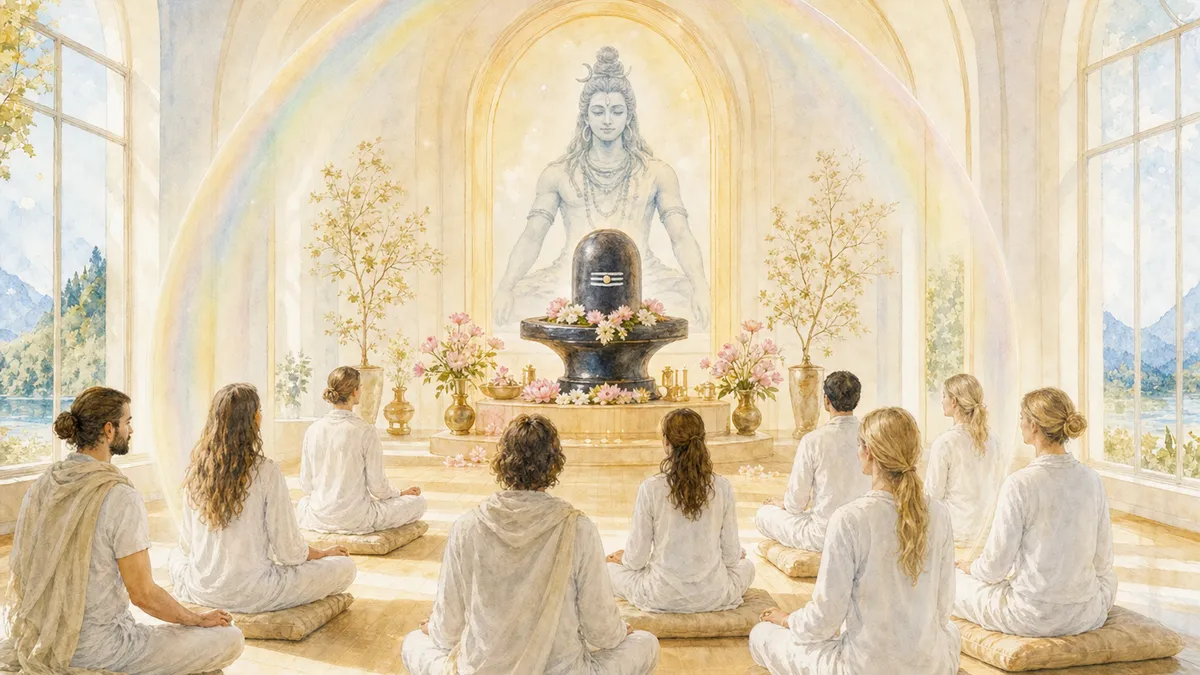
The wind element can be activated by magical rituals or visualization. For example, if you visualize a rainbow sphere around this hall, then at the level of the wind element this will truly be happening. If you visualize tongues of flame around the hall, then at the level of wind in the astral body they can truly be seen, and spirits will not be able to penetrate through them. That is, your visualization influences the wind element; it materializes in the subtle worlds. All magical practices are based on this. If a yogin, through the power of consciousness and the wind element, creates some visualization or blesses some object, then this is an effective practice.
Pure and Impure Prana
When there is a deficiency of air, progress in spiritual practices is often insufficient, and a person is unable to turn what arises into practice.
There are practices that develop air. In them, one works with the channels and pranas of the body. These practices include practices connected with the material body: the practice of transferring consciousness, breathing, and contemplation, during which the central channel opens through breathing and visualization.
Usually, in practices related to air, pure and impure prana are distinguished, which implies a simultaneous distinction between pure and impure states of mind. Air is the element that makes it possible to distinguish these states.
The concepts of pure and impure are also concepts of wind.
When you encounter pure manifestations, this activates your pure prana, or jnana-prana. Impure manifestations activate klesha-prana, which moves through the right channel and is connected with impurities. And the state of one taste is the state in which a yogin can perceive both pure and impure objects, but only pure prana—jnana-prana—is activated in him.
For example, contemplating beautiful images and listening to bhajans all activate pure pranas. Therefore, when for many years you contemplate pure images and accustom yourself to living in a state of pure prana, a process of purification takes place. Conversely, if a person violates the commandments, communicates and lives in an impure atmosphere, then klesha-prana begins to dominate in him, that is, the coarse energy moving through the right channel. Klesha-prana causes the deposition of kleshas in the energy body and the accumulation of new samskaras.
The highest yogin is one who has developed his spiritual power and contemplation to such an extent that he can maintain pure prana even when he finds himself in some impure circumstances. His impure pranas are no longer activated, even if he contemplates in an unfavorable environment. One must possess a great capacity for pure vision and for the natural state in order, even from impure and wrathful experiences, to shape wrathful deities in one's vision.
Sensitivity and Vulnerability of the Wind Element
When a yogin moves to the level of the wind element, he may become very sensitive. Other people's thoughts become open and accessible to him. He may be sensitive and very easily draw other people's karmas onto himself. Simply sitting next to another person, he may feel that person's pain. Or he may feel the mood of the one who prepared prasada in the kitchen that morning. He senses it as if it were entering into him. Sometimes he may, for no apparent reason, feel increased activity or, conversely, lethargy. All these are manifestations of a disharmonious wind element.
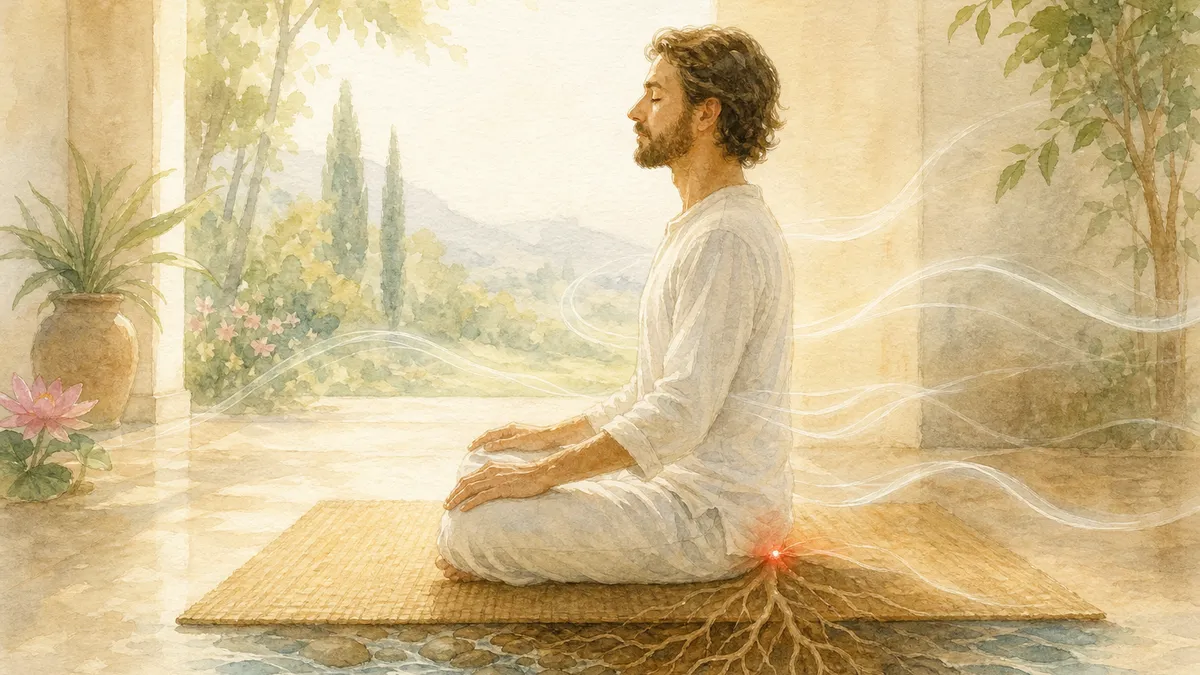
If a yogin does not know how to unite his consciousness with the lower elements, with the elements of earth and water, and the wind element is strongly activated in him, then he may feel great lightness in the body, and mystical experiences may easily arise in him. However, this lightness does not give him the opportunity to become rooted. He does not feel rootedness in the body, the power of the red bindu. That is, his mind is moved by the wind, but he has no stability in the lower part of the body, and therefore he may be open and vulnerable to external energies. And it may happen that, having integrated with some energy or having spoken intensely with someone, he may feel emptied. He unskillfully loses a great deal of energy in such contacts. But if he has a good connection with the lower part, that is, if he is rooted and his red bindu is strong, then the elements of earth and water are strong in him, and therefore he does not lose energy in such contacts; the wind element does not knock him off balance. And then he can eat any food, even if it was prepared by someone who was in an impure state. He can digest all of this without particular difficulty; he is not so fastidious.
A person who lives at the level of the wind element without uniting it with the lower elements has a strong tendency toward purity. Any impure things strongly throw him off. He hates sitting with people whose channels are dirty. He cannot communicate with those who do not speak about God, about the Truth. It becomes painful for him, and his prana is disturbed by it.
If he sleeps or lies in a place where some energy is manifested, he may feel problems with the wind in that place. Even small fluctuations can cause him certain problems. This is hypersensitivity, which indicates that the wind element is not balanced with the other elements. But if it is balanced, then the yogin can feel everything, yet it will not affect him. He can, like Luipa, eat fish entrails and at the same time not feel that he has any problems with his pranas or with his consciousness. He is invulnerable, he is reliably protected, because the lower element gives him such protective power.
Ideally, all the elements in a yogin should be strong and developed.
