Tattvas and Kanchukas: The Path to Liberation in Kashmir Shaivism
27.07.2026
0 мин. чтения
0
Share
copy
search
add
share
Tattvas in Shaivism: Presiding Deities and Classes of Beings
We continue our detailed study of the tattvas in Shaivism according to Balajinnatha Pandita’s book “Paradvaita: Foundations of Kashmir Shaivism.” Although the specific features of Kashmir Shaivism are discussed here, all these principles and texts are authoritative for our branch of Shaivism as well; that is, they are common to us all. The tattvas are common to all Shaivites, and the texts and saints to whom we refer are also authoritative for us—there is no division here.
The deity presiding over Maya is the same Lord Anantanatha (the lord of Mahamaya). He “shakes” Maya, causing it to extend into the next five tattvas, known as kanchukas, or coverings.
In the previous lecture, we established that the first and second tattvas, presided over by Shiva and Shakti, are inhabited by beings of the akala class. Akalas are those who have no form, manifestation, qualities, or characteristics. The beings of the first tattva are called shambhavas, in whom the awareness of “I” predominates. The beings of the second tattva are called shaktas, in whom the awareness of “I am” predominates. In the former, chit-shakti (the universal cosmic power), consciousness, parasamvit, predominates in the reflection “I,” in the subtle vibration of “I.” In the second tattva, ananda-shakti predominates as a consequence of the energy of the awareness “I am.”
Next, beginning with the third tattva, is Sadashiva-tattva. The beings dwelling on this level are called mantramaheshvaras, and they are governed by the deity Sadashiva Bhattaraka. Bhattaraka means “noble lord,” the Supreme Lord, the symbol of the eternal, immutable, all-pervading reality of all that exists. Sadashiva Bhattaraka is Paramashiva himself descended; that is, Paramashiva descends as an avatar on these levels, incarnating as pure, immortal, omnipotent consciousness in order to bless the beings of this level.
Then comes the fourth tattva—Ishvara-tattva. The beings dwelling in it are called mantreshvaras, and it is governed by Ishvara Bhattaraka. In general, according to the philosophy of Shaivism, Ishvara Bhattaraka descends as far as Prakriti-tattva, that is, all the way to the earth itself, permeating all subtle and gross beings and all five elements; and in the gross elements he manifests as Shri Kanthanatha—the one who disturbs the equilibrium of Prakriti and transforms it into the final twenty-three tattvas. The domain of the final twenty-three tattvas, down to the grossest tattva itself (the earth element), belongs to Lord Shri Kanthanatha. He is the same Ishvara Bhattaraka, the great immutable Lord who descends, permeating all the elements and all the tattvas down to the densest levels in the form of the subtlest light of consciousness.
For example, to us a stone is a stone, but to Shiva a stone is not a stone; it is the light of consciousness. We cannot see the light of consciousness within the dense matter of a stone, but Shiva does not perceive a stone. It too is part of his own consciousness. All of this is Ishvara Bhattaraka, but Ishvara Bhattaraka’s own tattva, his own abode, is Ishvara-tattva, in which he presides over beings called mantreshvaras.
Below it lies Shuddha-vidya-tattva, whose inhabitants are mantras and vidyeshvaras, and it is governed by Lord Anantanatha. Anantanatha is Ishvara Bhattaraka descended to this level in order to reign over the realm of Shuddha-vidya-tattva. Still lower lies Maya-tattva, and Maya-tattva is inhabited by both pralayakalas and vidyadharas—those who have managed to free themselves from the engulfing influence of Maya-tattva—and here too the presiding deity is Anantanatha.
In fact, all these deities—Sadashiva Bhattaraka, Ishvara Bhattaraka, Anantanatha, and then Shri Kanthanatha—are one and the same descended Paramashiva. The same Paramashiva, descending to deeper levels, simply manifests as the presiding deity, the one and the same nondual Brahman.
Our Future Depending on Our Level of Awareness
Why do we need to know about these abstract levels of beings—akala, vidyadhara, and pralayakala—which seem so remote from us human beings, or sakalas? So that we may understand that this is our future. Depending on the level of awareness in which we become established through contemplation and the depth we attain, we can become one or another type of enlightened being.
For example:
If you become established in the awareness of pure subjectivity, “I—nonduality,” this means your future is to become a shambhava being—Shiva
If you become established in the awareness “I am,” in which ananda-shakti predominates, your future is to become an infinitely powerful divine spirit, cosmic consciousness—a shakta
If you become established in the dimension “I am this,” your future is the abode of Sadashiva-tattva, becoming a mantramaheshvara
If you become established in the state of subtle identification, “all this is I,” your future is Ishvara-tattva, becoming a mantreshvara
Became established in the enlightened vision of separateness, “I am this,” where “I am this” has the single foundation of consciousness—your future is Shuddha-vidya-tattva: to become a Vidyeshvara, to become a being called mantra
Remained suspended in the samadhi of the unmanifest void in the sixth tattva—your future is a pralayakala
Freed yourself from the engulfing influence of the void of Maya-tattva and managed to awaken the light of pure consciousness—you manifested as vidyadharas
The subtle nuances of consciousness that we realize determine our destiny, our future, and the infinite world in which we will dwell. If we realize the supreme consciousness beyond all tattvas, we merge into Paramashiva, become Paramashiva, and recognize ourselves as Paramashiva, like milk, like a flowing stream of oil merging into oil. Such subtlest nuances of awareness shape our future.
If any dual manifestations remain in the form of raga-kanchuka, kala-kanchuka, kalaa-kanchuka, or other kanchukas, we become Purusha and realize Purusha-tattva. We become a semi-enlightened being endowed with siddhis, sufficiently immortal, a cosmic spirit that nevertheless has limitations—we become Purusha, a siddha who has realized their immortal essence but is still limited by time or space, causal connections, or the desire to know.
If we realize Prakriti-tattva, we become a being that has attained partial realization. All these become sakalas; all this is already the abode of sakala beings. There are a great many sakala beings; sakala is simply a class of beings with common characteristics, including humans, gods, gandharvas, rakshasas, bhutas, pretas, asuras, samsaric gods, nagas, hell beings, and animals. This is an immense class; what is called sakalas is the whole of samsara. When people speak of samsaric beings, they mean precisely sakalas. One should meditate on these abodes of beings in order to understand the level at which our consciousness resides.
Kanchukas—the veils that limit the true nature
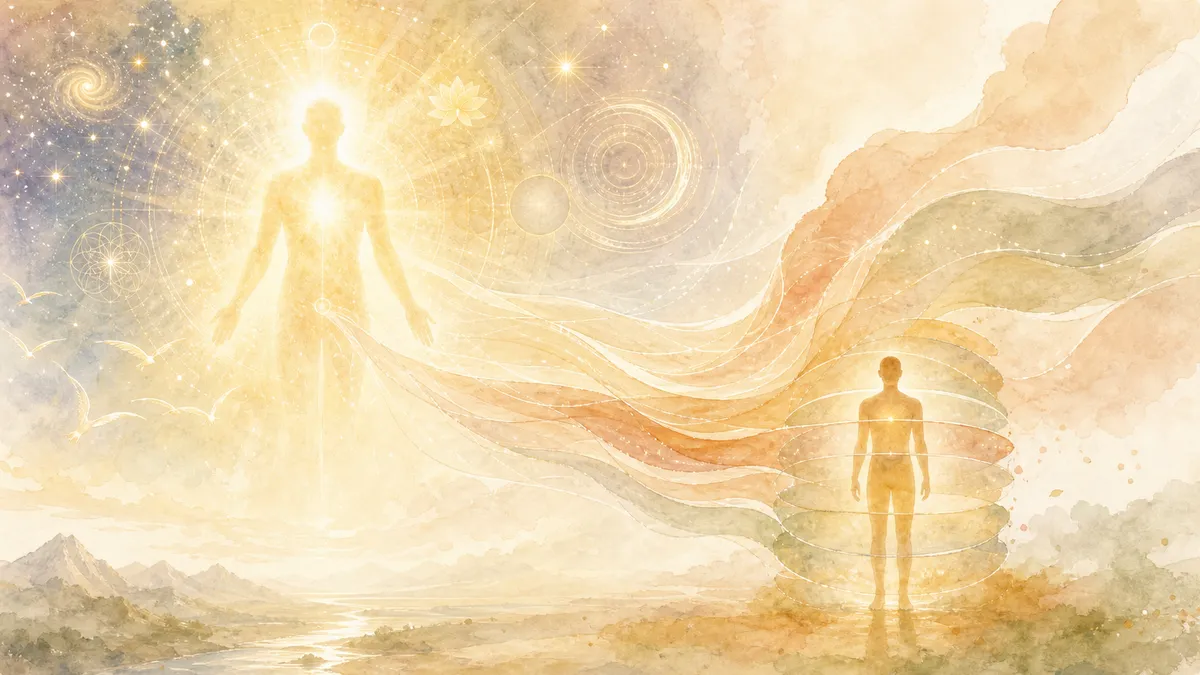
Kanchukas, or “veils,” conceal the true nature of the knowing subject. They are sometimes referred to as the elements from kalaa to kala. Maya itself is the greatest of these limiting tattvas and is also sometimes regarded as one of the kanchukas. Thus, their number reaches six.
Sometimes Maya-tattva is included among the kanchukas and is called the sixth and highest kanchuka, from which all the others originate. However, it should be understood that Maya-tattva has two aspects: one is a kanchuka that obscures, while the other is more enlightened, and those who attain this enlightened aspect are also considered to have reached the lowest level of liberation.
Together with Maya, these five kanchukas penetrate the I-consciousness, limiting people and their abilities. As noted above, Maya fills us with desires for external events and things as compensation for an imagined sense of deprivation. To enable us to satisfy these desires in some way, Maya endows us with a slight power of action capable of achieving a limited result. This limited capacity for action is called kalaa—it is the seventh tattva.
Since action is impossible without knowledge, Maya also permits a limited capacity to know up to a certain point. This limited capacity for knowledge within Maya is the eighth tattva, called Vidya, or Ashuddha-vidya. To further restrict the scope of our actions and knowledge, Maya appears within us as raga, or limited interest. Raga-tattva is the ninth level.
Because of this limited interest, we do not strive to use the full potential of our inner abilities or attain the highest possibilities. We stop at what we do and know only within narrow limits, and we highly value these partial achievements. Raga also limits the scope of our kalaa and vidya—the capacities to act and to know—and compels us to reduce our actions and knowledge to that in which we find some interest.
Before encountering Maya, it was still Paramashiva, still Shiva, endowed with six different qualities: omniscience, omnipresence, omnipotence, eternity, perfection and wholeness, and svatantrya (freedom). But after encountering Maya and the fragmentation of the shaktis, when these shaktis gradually began to influence this pure consciousness, they gradually began to take away and destroy these powers. For example, vidya-kanchuka destroys omniscience, while raga-kanchuka destroys purnatva (wholeness and self-sufficiency). The other kanchukas—niyati, kala, and kalaa—likewise destroy omnipotence and eternity. In this way, consciousness becomes denser and contracts, and consciousness compressed by the kanchukas becomes Purusha (limited Shiva).
Raga differs from attachment, which is a property of the intellect (buddhi) and is included among its eight dharmas in the Samkhya system. Raga-tattva narrows the scope of attention and activity to a small number of specific events, thus excluding a significant portion of potential knowledge. The absolute limitation of the spheres of kala, vidya, and raga is caused by niyati, the tenth tattva. Niyati is the law of nature that establishes the sequential order in which all phenomena arise—that is, the law by which a tree grows from a seed.
Niyati-kanchuka is the law of cause and effect and spatial limitation. The mechanism behind these actions, these kanchukas, consists of the energies known to you: khechari, gochari, dikchari, and bhuchari. All these energies emanate from the primordial Vameshvari-shakti. Vameshvari-shakti is the energy of primordial consciousness that assumes the form of Maya-tattva, from which these energies then emanate. These energies penetrate the living being, enveloping it.
The Process of Liberation Through the Dissolution of the Kanchukas
The process of liberation begins when we start dissolving all these inner enveloping energies. It is like casting off shackles. When we cast off raga-kanchuka, our purnatva increases. When we cast off niyati-kanchuka, our svatantrya increases. When we cast off kala-kanchuka, our ability to act—our omnipotence, or sarva-kartritva, the siddhi of all-accomplishing action—increases. For example, when you detach yourself from the sense of doing and of being the doer, from authorship and clinging, your actual ability to accomplish things and achieve results becomes much greater.
The destruction of these limiting energies and kanchukas is accomplished by deepening contemplation through the six mudras. When we practice every day in nitya-sadhana, in daily sandhya-upasana, we conclude our sadhana with contemplative practices: agochari-mudra, bhuchari, chanchari, shambhavi, and krama. Each of these mudras pacifies a particular type of shakti, blocks the activity of the kanchukas, and unlocks our powers of Ishvara.
For example, we meditate, our contemplation deepens, and suddenly we experience all-encompassing wisdom—this means that our omniscience has been unlocked and vidya-kanchuka has partially dispersed. We feel that we have begun to perceive time somewhat beyond the past and future, and then we enter a timeless dimension—this means that kala-kanchuka has temporarily ceased to function and our state of nityatva (eternity, immortality) has been unlocked. We meditate, and the state of svatantrya is unlocked; suddenly, we experience an immeasurable sense of spontaneity and freedom.
Thus, little by little, we unlock our primordial energies, weaken the kanchukas, and diminish the influence of the gochari, dikchari, and bhuchari energies. Or we meditate and feel that the world has ceased to captivate us, that the inner observer, which is like space, has developed to such an extent that we no longer see the world as a dense mass of material objects. It is as though our consciousness begins to penetrate stones and trees, perceiving the emptiness, illusoriness, and luminosity of the external world. This means that bhuchari-shakti has ceased to act so strongly; it has stopped bewitching us, and the world has ceased to exert pressure on our consciousness. We have unlocked our perception of the world, the aspect of all-pervasiveness—vyapakatva.
Little by little, we unlock these shaktis, dissolve the kanchukas, and unlock our qualities of Ishvara until they attain complete fullness. And most importantly, we unlock our primordial consciousness—chit-shakti, or samvit—from which all these limitations and all these qualities of Ishvara emanate.
Question: Guruji, please tell us, can we penetrate directly into Vameshvari so that all its derivatives dissolve—will it dissolve, and must all the derivatives dissolve as well—or do we need to reach it gradually, and if it is possible, by what methods?
In reality, very little in spiritual life happens step by step in the way it is explained in the teaching. It is presented in a structured way solely for instructional purposes, but in spiritual life it does not happen that today you contemplate raga-kanchuka and tomorrow vidya-kanchuka. It will happen spontaneously and unpredictably; there are too many factors involved.
To immediately reach the level of Vameshvari means reaching the subtlest level of pure consciousness—this is what we are trying to do, but it is unlikely to happen instantly. This is precisely what Anuttara Tantra deals with. Practicing the path of nondual natural awareness means rising to the level of Vameshvari Shakti and recognizing it as pure consciousness, chit—indestructible samvit—but even so, this will not happen instantly or quickly.
The question is like this: suppose you have three thousand dollars for a small car and you say, “Can I buy a Bentley right away?”—try it. Of course, it would be good to do so right away, but merit is needed, tapas is needed, as are the power and wisdom capable of penetrating and becoming established in Vameshvari Shakti. When there is enough tapas, it is possible—it is possible to make a big jump—but we accumulate the power of tapas gradually.
Kala Kanchuka and the Perception of Time
The law of nature operates as the law of limitation and causality. While absolute consciousness is always present everywhere and is constantly connected with everything, under the influence of niyati, the experience of limited scope and limited relationships arises. Here, things are perceived as having causes and as being arranged sequentially. These four tattvas limit only the sphere of our actions and knowledge, but the fifth kanchuka limits our very being. This element, the eleventh tattva, is known as kala (the sense of time). Our true Self is in fact infinite and is in no way conditioned by the concept of time. It is akala, that is, beyond temporal sequence, but because of this particular limitation imposed upon us by Maya, we feel that “we were, are, and will be.” Thus, we impose upon ourselves the framework of temporal sequence, and this is so deeply ingrained that we cannot think about or do anything without this sense of time.
The kanchukas can be likened to the subtlest patterns, the subtlest dualistic concepts embedded in the stream of our consciousness, in the flows of our sheaths, in the subtle bodies, and these patterns are directed by the universal will, because kala kanchuka, like all the other kanchukas, is a reflection of the higher shaktis emanating from Ishvara himself; however, refracted in Maya Tattva, they become patterns.
For example, we are caught in the pattern of time, and we think of ourselves in terms of becoming. The category of becoming means this: we incarnated; before that, we were unincarnated and awaiting incarnation; we incarnated, received a body, and were born. Once born, we grow. We become adults during the period of becoming, and then we are fully grown. Then begins the period of aging and the deterioration of the body; we grow old. Then begins the period of dying; during the period of dying, one passes through what is called the bardo or antarbhava—the passage through intermediate states, the trial of the three gunas, the trial of the clear light, and the falling away from the clear light.
Those who succeeded manifested through a seed syllable as a deity and manifested a pure land; those who did not continued the process of becoming, experienced various kinds of intermediate states, and regained awareness somewhere in an indeterminate state, already perceiving their own subtle body. Then they are led to Yama’s judgment to have their sins and merits weighed and their future birth determined. Once again, they prepare for a new incarnation according to their sins and merits, or the practices they have performed, their spiritual connections, and blessings. All of this takes place in time—this is the entire period of becoming.
When kala kanchuka is transcended, we see the subtlest layer of awareness that is beyond becoming. Whatever happens, it turns out that it is all simply the play of energy. To us, it seems to be life, birth, and death, but from the perspective of this subtlest layer of consciousness, it is the play of its energy, something not especially significant. This subtlest layer of awareness is unchanging; it is not subject to time; it is entirely beyond the past, beyond the future, beyond becoming. No birth takes place in it, no death takes place in it; it always remains—this is our layer of awareness, our clear light. When we penetrate this layer, we see that time does not touch it, which means that none of these transformations, transmigrations, or reincarnations touch it either.
Question: So, if we look at it this way, there are only four paths, and the fourth path (jnana marga), as the path of contemplation, brings the greatest merit, right?
What are the previous three? You posed the question that way right from the start.
— The four padas.
Yes, in Shaivism there are four padas—the four stages of spiritual life.
— The path of contemplation gives the greatest merit, right?
Yes, but it is also intended for people with the greatest merit.
— So the indication that this path is effective is the presence of grace, right?
The presence of grace that dissolves the kanchukas.
— That is, if there is no grace.
Then it is ineffective specifically in your case. Generally speaking, it is effective, but it may not be effective for you.
— Should the pada be lowered?
Yes, lower the pada in order to attract grace through a lower pada and dissolve these kanchukas anyway. In principle, it does not really matter how you dissolve them—the main thing is to dissolve them.
It is like reaching the other, saving shore. For example, you live on an island where everything is burning, and you need to reach the neighboring island. It does not matter whether you get there by scooter, jet ski, raft, steamship, yacht, rowboat, or even by swimming. Once you have arrived, you have arrived. If you have a great deal of merit, an ocean liner is at your disposal; if you have little, then a fishing boat. Someone may barely make it on a raft with a life buoy, but the main thing is that they reached the shore. It is better to make it on a raft than to travel on an ocean liner and fail to arrive, thinking, “I’ll be comfortable here,” while in fact you may not make it because you did not have enough merit for a ticket aboard such a liner.
The Nature of Time and Overcoming the Kanchukas
What, after all, is time? In fact, it is not something that exists independently of the perceiving individual. Time is an imaginary concept. A person forms a unified idea of the various events occurring around them and of their own diverse actions. All of this is chronologically interwoven with a sense of imagined sequence, but such a sequence is merely an immaterial concept based on imagination. This concept is the sense of time imposed by limited beings upon themselves and everything around them.
It is not merely a concept—it is a certain subtle energy of the subtle world, which is Ishvara’s shakti and emanates from Ishvara himself. But when we perceive it in a conditioned state, we are subject to its influence. For example, when the power of consciousness increases and dharana, dhyana, samadhi, or deep contemplation arises, kala-kanchuka begins to weaken, and niyati-kanchuka begins to weaken as well. I say this entirely from my own experience too.
Suddenly, we understand that causes and effects are not absolute. The “Yoga Vasishtha” states unequivocally that cause and effect are connected to each other in the same way as a crow and a coconut. A crow landed on a palm tree, and a coconut fell. It seems that the coconut fell because the crow shook the palm tree, but in fact it was a coincidence, merely a conjunction. Yet we believe in and identify with this conjunction so strongly that it becomes a law for us.
Time Travel Through Samyama
Kala-kanchuka begins to weaken. For example, through the power of samyama, you can travel into the past; you can actually travel into the past. For example, you practice samskara-shuddhi—this is also a technique akin to time travel. If you immerse yourself in it deeply, you can travel into your subconscious past, relive the past there, and change something, as if traveling in a time machine. And if your power is greater, you travel not only into the past of your own subconscious but also into the collective subconscious, where you may even purify something.
Or, if your ajna chakra opens and you meditate deeply, you can travel into the future. You can see the future in dreams or in the subtle body. Having traveled into the future, you suddenly understand that the past, the future, and the present exist simultaneously in your consciousness, that they already exist there—it is one unified, integral consciousness. This means that kala-kanchuka no longer affects you so strongly.
Overcoming Niyati-Kanchuka
Niyati-kanchuka ceases to operate and begins to weaken—suddenly, you begin to understand that the universe is multidimensional, that every act of consciousness shifts you into an alternative reality, that we live in a multitude of multiverses, and that each of these universes is created by consciousness. By changing our consciousness, we can move slightly into a version of reality in which causal events unfold somewhat differently. We do not even notice these micro-transitions, but consciousness creates such a universe at every moment; every act of perception is the creation of this instantaneous universe.
There is a theory called the theory of the instantaneous creation of the universe, according to which each of our actions is an act of transition into another universe, completely imperceptible, though to us it appears as a cause-and-effect relationship. For example, you prepared some food and ate it; before that you were hungry, and then you became full. Naturally, the cause is that you prepared the food and ate it, while satiety is the effect. There is an obvious connection between cause and effect—a law repeated millions of times. You know that if you do not eat or prepare food, you will remain hungry. A very simple cause-and-effect relationship.
But from this perspective, as the power of your consciousness increases, you can understand that preparing food is not necessarily the cause, while satisfaction from eating is not necessarily the effect. There are different possibilities. Secondly, this does not occur as an act within a single state of consciousness. By preparing food and eating it, you simply transferred yourself into the version of the universe where you are full, where you are always full, but you remained in it only temporarily.
Each of our actions is a kind of ritual—a ritual for transferring consciousness into an alternative universe where a certain result already exists. For example, a person worked for a month and received a salary. Logically, work is the cause and the salary is the effect; they spent it and became a little wealthier. From the perspective of weakening niyati-kanchuka, when niyati-kanchuka weakens and consciousness grows stronger, one can see work as an offering, a ritual act performed in order to move into a universe where there is a little more wealth, where there is abundance.
This means that niyati-kanchuka is beginning to be overcome. In fact, it is very difficult to overcome—it is one of the last kanchukas to be transcended. This is precisely how siddhas live: for them, the law of cause and effect that applies to human beings does not exist. What is a law for human beings is, for gods and siddhas, a variable reality that can be manipulated depending on the power of consciousness. For them, there is no such rigid division between the past, future, and present.
Therefore, it is possible to intervene in destiny; it is possible to change the past, and the present will change; it is possible to change the future and the trajectory of a person's destiny extending from the past into the future. All of us are such vectors of consciousness. We do not live only in the present; we simultaneously carry our past within us, because the past, in the form of imprints, is always present in our subtle body. If you look closely, the seeds of the future can also be seen in the subtle body, because the seeds of the past sprout into the future through the present. We are a kind of soul, a wave flowing from the past into the future, but when the power of consciousness rises above kala-kanchuka, it is possible to transcend this wave and rise above it.
Question: Guruji, can we say that dharana, dhyana, and all these things—in other words, the development of consciousness—are needed simply to remove everything superfluous that prevents us from choosing the desired reality tunnel, if we speak in this context? Essentially, that is what is needed, right?
Yes, the superfluous things are the kanchukas; they must be torn apart.
— By “superfluous,” I mean that everything is consciousness, everything is the activity of consciousness; the external and the internal are all products of the mind's activity. The mind is like a madman—that is, it is chaotic, filled with vasanas, samskaras, and karmas—and essentially, all practice and all this accumulation of merit are needed in order to remove everything superfluous from the mind and leave only what is truly necessary.
Remove everything superfluous and leave only Brahman.
— So that is correct, right?
Yes, indeed, practice is not about creating something new; it is about removing what is superfluous. It is not about perfecting something imperfect. The perfect already exists, God already exists, and He is already perfect. It is about removing the layers covering the perfect. We cannot create God, we cannot create perfection, but we can remove what is superfluous—this is purification. It is not a path of acquisition; it is a path of purification and a path of relinquishing what is superfluous. It is a somewhat different path. For example, in sports, music, or craftsmanship, we acquire something, whereas here we purify ourselves and attain the originally perfect state that exists and has always existed.
Question: Om, Guruji, regarding samskara-shuddhi, if we take the following situation: at the age of ten, for example, I implant a sankalpa in myself so that at the age of ten I become a monk—in other words, to change that turning point when I ran away from home and joined the community. What would happen in that case?
It is better to purify the most difficult moments; there is no need to interfere so deeply in your destiny. Samskara-shuddhi is intended primarily to purify negative experiences—vasanas and samskaras—and to dissolve vasanakshaya.
From the sense of time arise the notions “I was, am, will be; this was, is, will be,” and so on. While the actions of limited beings are not necessarily performed in any particular order, some events always occur in a strict sequence. For example, sunrise, sunset, the phases of the moon, the changing of the seasons, the flowering periods of plants, and the ripening of fruits and crops always occur in a strict sequence. Under the influence of kala, people measure events that have no sequence by means of events that do, and as a result, this imaginary sense of time extends to everything. I-consciousness, reduced to extreme limitation, becomes the twelfth tattva, known as Purusha.
Question: Guruji, the illusory biography—is the essence of this practice that you choose an alternative tunnel in the past, which generates a chain of consequences that is reflected in the present, right now, in this way?
First and foremost, to disidentify from your samskaras. Not exactly—to disidentify from your samskaras.
— It is just that the point is, there was a certain chain.
Yes, to see that these are not your samskaras.
— They are sort of mine.
They are not your samskaras; they only seem to be yours.
— This personality has traveled a certain path and acquired certain experiences, but I can change the coloring of those experiences right now, my attitude toward them, to the point where the characters can be transformed, and the situation and outward form remain the same, but the essence and bhava are completely different. It can be changed right now, correct?
It can be changed in memory, yes, it can.
— As a result of this, they manifest.
The past does not exist; it exists only in the form of memories, and to the brain, as well as to the subtle body, it makes no difference whether something was experienced in reality or whether an imprint was created in the imagination. It is only a question of intensity and duration.
— Even without being a siddha, without being at the third or fourth stages—that is, the wisdom of the earth—this is, in principle, a workable method. You change right now.
In principle, it is a workable method.
Purusha-tattva and Prakriti-tattva
Purusha-tattva is called pumstattva, jiva, pashu, anu, and so on. All these terms refer to completely limited I-consciousness. The object, or the “this-ness,” of I-consciousness becomes the thirteenth level, called Prakriti. It is also known as mula-prakriti, the fundamental primordial matter, and as pradhana-tattva.
Thus, Purusha-tattva is I-consciousness limited by the kanchukas. The thirteenth, Prakriti-tattva, or pradhana-tattva, is the stage at which the external objective world begins to emerge. It has not yet manifested as the five elements, but it already exists as unmanifest dark energy, figuratively speaking.
Prakriti is the source of all the remaining twenty-three instrumental objective tattvas developed by the Samkhya philosophical school.
Prakriti-tattva means the three gunas—the three gunas that operate in our consciousness but are still in an undifferentiated state of equilibrium. They are on the verge of falling out of equilibrium and manifesting as the elements. This is the state before the cosmic Big Bang, when there are neither stars nor planets, but the world exists as a vast black hole, ready to explode from a point of singularity.
According to Kashmir Shaivism, Purusha and Prakriti are, in essence, subsequent creations of Lord Anantanatha. Ishvara Bhattaraka descends to the level of Prakriti-tattva and manifests there as Shri Kanthanatha, who disturbs the equilibrium of Prakriti and transforms it into the final twenty-three tattvas.
Here we come to the theory of a Creator. As you know, creationists refer to the original debate about the creation of the universe between the theory of intelligent creation and the Big Bang theory. Here the philosophy of Shaivism says that Ishvara Bhattaraka, that is, the Supreme Lord, descends to Prakriti-tattva and, manifesting as Shri Kanthanatha, disturbs the equilibrium of Prakriti and transforms it into the subsequent earth, water, and the twenty-three elements. Consciousness churns the universe and brings about this creative impulse of the material universe, which then manifests in the form of physical laws.
As one person said: “If you think that the universe came into being by chance as a result of some purely material laws, that there is no guiding will behind it, it is as though you thought you could throw a grenade into a pile of scrap metal and a Boeing 737 would emerge there as a result of the explosion—that as a result of the Big Bang everything simply came into being: the planets, the stars with their orbits, the universe, humanity.” This is a purposeful act of creation by a guiding will, carried out by Ishvara Bhattaraka, who descended to this level in the form of Shri Kanthanatha; that is, Shri Kanthanatha is the one who churns these energies. Ishvara Bhattaraka is the same Paramashiva who descended; that is, Paramashiva, the unmanifest Brahman, descended into the grossest layers and vibrates at the level of matter, bringing forth creation.
The Three Gunas and Their Origin
Kashmir Shaivism adopted the Samkhya concept of Prakriti, consisting of the three gunas in a state of perfect equilibrium. But what are the gunas, and where do they come from? According to Samkhya, there are three gunas—sattva, rajas, and tamas.
Radiance, movement, and inertia (stillness, darkness).
Sattva is illumination and enjoyment, rajas is restlessness and pain, and tamas is ignorance and apathy. Sattva is light, tamas is heavy, and rajas is mobile. This is how Samkhya explains the nature of the three gunas, but without clarifying where their source is located or why these qualities arise. Other schools of thought likewise provide no answer to this question. The thinkers of Kashmir Shaivism explored both of these issues and explained them as follows.
Infinite self-consciousness possesses limitless capacities to know, act, and generate diversity. These limitless capacities are known as jnana, kriya, and maya. Self-consciousness is a monistic reality; there is no distinction between these energies and the entity that possesses them. Nevertheless, because infinite self-consciousness appears in limited forms, it loses the nature of unity. As jnana, kriya, and maya acquire the qualities of a limited being, they can no longer be regarded as the limitless energies of self-consciousness. In the realm of diversity, these energies become merely properties, or gunas. Jnana becomes sattva, kriya becomes rajas, and maya becomes tamas. This is how Kashmir Shaivism explains the source of the three gunas.
This philosophical tradition explains the nature of the three gunas in terms of their relationship to the fundamental nature of the Absolute. Infinite self-consciousness is omnipotent and all-blissful awareness. A person’s limited self-consciousness also experiences bliss in moments of happiness and clarity. These experiences of pleasure and illumination are a person’s sattva. In states of deep sleep, astonishment, or agitation, the bliss experienced by the individual is not clearly recognized. The resulting loss of clarity, inertia, and apathy create a particular darkness—that is, tamas. This is the complete absence of awareness of the bliss of the “I.”
Finally, there are times when people experience the existence of their true Self, but the experience is incomplete, not as they would wish it to be. This combination of sattva and tamas causes restlessness and, consequently, the pain known as rajas. As an example of the arising of rajas, imagine a parent who, after many years of separation, sees their beloved child lying in a hospital. Awareness of the beloved child’s nearness is bliss, while awareness of the child’s illness is the absence of bliss. Such mixed emotions are the pain and restlessness of rajas.
According to Kashmir Shaivism, the three properties (gunas) are thus features of Purusha’s worldview. He observes the objective element, all “thisness,” through the prism of these three properties and experiences it as pleasure, pain, and ignorance, while at the same time remaining in a state of equilibrium.
We also experience the three gunas as anger, attachment, and ignorance. Whenever we undergo an experience in an obscured state, whenever we experience sattvic, rajasic, or tamasic feelings, we should observe within ourselves the play of the three gunas, because we are not merely experiencing feelings of goodness, activity, or obscuration; rather, this is contact with the universal energies themselves. These universal energies are experienced by us on the subjective level.
Tracking the gunas within yourself is the path of observing Prakriti-tattva. When you are able to track and observe the gunas, you see how Prakriti-tattva operates within you, and you yourself assume the position of Purusha-tattva (the twelfth tattva). That observing subject, the witness—if you have become established in this and are able to track the gunas down to their subtlest level—means that you are at the twelfth tattva. Someone who is unable to track the gunas is at the lower level of buddhi-tattva; they are only capable of a certain degree of intelligence and abstract thought, but they do not see the gunas, which means that this is a lower tattva.
Someone who is unable to think rationally or abstractly, to detach themselves, or to possess intuitive intelligence is at the level of ahamkara-tattva; for them, the entire world is compressed to the size of their ego, and they are concerned only with their own narrow notions. Someone who has not even formed an ego, who has not yet developed as a person, has only a limited reactive conceptual mind functioning—the still lower manas-tattva. Someone who does not even possess a reactive conceptual mind and lives solely through the senses (indriyas) is already at the level of animal consciousness; they do not even have such a faculty.
Question: Om, Guruji, regarding ahamkara-tattva, can we discuss it in the context of Shaivism through Brahman?
Yes, we can.
Question: At which tattva do we say that Brahman—that is, Paramashiva—is found? Which tattva is Brahman in general?
Paramashiva is the zeroth, beyond the first. Brahman is beyond all tattvas. The Creator is represented by the first five tattvas, especially the fourth, Ishvara-tattva.
Question: Once manifested, is it not Brahman the Creator?
Everything after Purusha-tattva is the manifestation of Prakriti-tattva and below, down to the last one—Prithivi-tattva, earth. Everything down to the thirty-sixth is the manifested world. In other words, in Prakriti-tattva nothing has yet manifested, but imagine, figuratively speaking, that there is a black hole. In Purusha-tattva, there is not even a black hole yet, but there is only consciousness; it feels limited, yet possesses the power to create. Everything below Prakriti-tattva is already the manifestation of the universe.
Question: So, from Purusha-tattva to Prakriti-tattva is the state of Brahma the Creator, and below that is already his creation, while above it is Brahman the Absolute?
Once again, how are you thinking about it?
Question: From Purusha-tattva to Prakriti-tattva.
The state of Brahma the Creator does not necessarily begin with Purusha-tattva. Brahma the Creator is the taijasa dimension. The taijasa dimension means that the same Brahman, the Absolute, is reflected in the taijasa dimension and becomes Hiranyagarbha—this is what we call Brahma the Creator. If we speak in terms of tattvas, the Vedantic and Shaivite tattvas do not entirely correspond here, but one could say that it begins here with Purusha-tattva. Ishvara-tattva is also involved in this.
Question: We speak of the two lower gunas, rajas and tamas, and in general, where is the balance?
All of this is Prakriti-tattva and below—that is, buddhi, ahamkara, the creation of the subtle instrument. Buddhi and ahamkara mean that the gunas have already fallen out of equilibrium.
Question: Can we say that the gunas are like subtle elements of which Brahman the Creator consists?
Brahman does not consist of the gunas. He operates with them and sets them in motion, but he is not composed of them. He consists of pure energies. Here again, it is incorrect to combine Shaivite terminology with Vedantic terminology, because discrepancies will inevitably arise when describing these two terminological systems: to explain the Vedantic terminology, one would have to introduce Shaivite kanchukas and other concepts that do not exist in Vedanta. Therefore, the comparison would be inaccurate.
Question: Om, Guruji, from the perspective of the sixteen kalas, which stage of realization among the sixteen kalas corresponds to Purusha-tattva?
Purusha-tattva can be experienced from the stage of conception through the stage of birth and beyond; it is very extensive and encompasses a very broad spectrum.
Distinctive Features of Kashmir Shaivism in Understanding the Gunas and Tattvas
No other school of Indian philosophy regards the gunas as attributes of Purusha-tattva in this way. The gunas are usually considered exclusively as properties of Prakriti. The three gunas were discussed in this light by Utpaladeva in his “Ishvara Pratyabhijna” and were also explained in detail by Abhinavagupta in his commentary on this work. This is another example of how the thinkers of Kashmir Shaivism clarified and deepened various concepts of Indian philosophy.
It is important to remember that, according to Kashmir Shaivism, the classification of all phenomena into thirty-six tattvas is not an absolute truth. It was developed as a tool of understanding for the ever-active and inquisitive mind, and as a form of contemplative meditation. Through further analysis, the number of tattvas can be increased. Likewise, through synthesis, their number can be reduced to a single tattva.
In fact, this was done in the “Tantraloka,” where systems of meditation on fifteen, thirteen, eleven, nine, seven, five, and even three tattvas can be found. In Trika practice, only three tattvas are used on the path of rapid sadhana: Shiva, representing absolute unity; Shakti, representing the link between duality and unity; and Nara, representing ultimate duality. Finally, a Shaivite yogin who has attained a high degree of perfection sees only Shiva-tattva throughout creation.
In any case, since the contemplative practice of tattva-adhva-dharana, employed in anava-upaya, includes meditation on all thirty-six tattvas, this number is generally accepted by Shaivites in both northern and southern India.
Ishvara-tattva and the State of Brahma the Creator
Question: Guruji, and where is Ishvara in relation to Brahma the Creator?
It is important to understand what we mean by the term “Brahma the Creator.” It is a general designation for Ishvara-tattva, for beings who have attained Ishvara-tattva.
Question: Is Ishvara the level of Ishvara-tattva? In the context of the thirty-six tattvas.
That is, one who has mastered the creative powers to such an extent that he can create his own universe. Let us look at what Ishvara-tattva is. Ishvara-tattva consists of beings of the mantreshvara class, governed by Shiva under the name Ishvara Bhattaraka. Therefore, when a yogin, a siddha, attains the fourth tattva, we conventionally call him a creator, and thus call him Brahma the Creator—one who has attained at least the fourth tattva. This means that the fullness of his jnana, iccha, kriya, and other shaktis has increased to such an extent that he is capable of creating his own universe. Mantreshvaras who have attained Ishvara-tattva are engaged in creating new universes.
Question: So that is the fifteenth stage, right?
It is the sixteenth stage. Again, this is already within the context of Anuttara Tantra; we must distinguish between speaking in the context of Advaita Vedanta, in the context of Shaivism, and in the context of Anuttara Tantra terminology. The same terms may have their own unique meaning in different lineages and contexts, and we must know how and when to apply them.
The Descending and Ascending Paths of Creation
Question: Guruji, does this mean that the state of mantreshvara is the state of one capable of creating, the state of Brahma the Creator, but that this is the ascending path, when a siddha who has attained such a state is able to create; but what about the descending path, when it proceeds from Paramashiva-tattva? How should this be understood in this context—after all, there must have been a first one?
The question is not entirely clear. In the case of the descending path, it is the same one: that which is called Paramashiva assumes different forms. At the level of the third tattva, he becomes Sadashiva Bhattaraka. At the level of the fourth tattva, the primordial Paramashiva, descending, becomes Shiva Bhattaraka. At the level of Shuddha-vidya (the fifth tattva), he becomes Anantanatha. At the level of the sixth tattva, the same deity, Anantanatha, governs this tattva. At the level of all subsequent tattvas, he is what we call Shri Kanthanatha.
Question: Descending to a certain level, does he manifest himself through rishis and others by analogy, manifesting his first assistants, so to speak? That is, where did the first mantreshvara, for example, come from?
The first mantreshvara arose from a mantramaheshvara, a being dwelling at the level of Sadashiva-tattva. The first mantreshvara arose from Sadashiva Bhattaraka. Then the question is: where did the first mantramaheshvara, or Sadashiva Bhattaraka, come from? He arose from the one above him—Paramashiva.
Question: So all those who subsequently emerged from maya-tattva and ascended through these stages occupy their respective niches and continue onward.
Consider this merely a convenient explanation for the mind; in reality, divine reality is far more complex. The creative capacities of consciousness are limitless. There are, conventionally speaking, gods who create reality. There are other gods who create gods who create reality. Above the gods who create reality, there is a god who cultivates such gods, and they are arranged, so to speak, in rows before him. There is the Supreme God, from whom these gods who cultivate the gods who create gods that create reality emanate like specks of dust from his consciousness—myriads of them arising from his consciousness. Such is the paradoxical picture of the universe. The deeper your consciousness is, the more capable you are of penetrating one level or another of reality; and when you think you have already reached the edge of the universe, you suddenly discover that there is a deity from whom these universes emanate like bubbles, like tiny specks of dust—myriads of them arising from his bodies.
Question: Om, Guruji, I think Vidyadhara wanted to ask this question: there is a deity that creates reality. For example, it created a reality, and in that reality, in that world, some person attained a high level of spiritual development. Can that person become greater than the deity that created that reality?
Yes, because both the human being and the deity are based on Paramashiva, and Paramashiva can evolve through any being. The person simply transcends the reality created by that deity, as if breaking through its laws, and then creates on another level. That is precisely why liberation is possible; if this were impossible, liberation would be impossible as well.
However, if, for example, a yogi attains a certain level of liberation—sayujya-mukti—and ascends to the level of the highest loka, Satya-loka, but lacks the power to overcome the gravity of the sankalpa of Brahma the Creator, then it is believed that until the end of the kalpa, until the end of Brahma’s life, he remains with him in Satya-loka. At the moment of mahapralaya, when Brahma dissolves, the yogi also dissolves and becomes a new creator in the next kalpa. There he sits upon the throne together with Brahma, on the same level—that is, on the same level of consciousness.
The Theory of Non-Creation
Question: Om, Guruji. Please tell us, what does all this look like from the standpoint of non-creation?
If we consider it in the context of Advaita Vedanta, then from the standpoint of non-creation it appears as follows: now contemplate deeply that all this is illusory, that none of it has an essence of its own, that it is all derived from consciousness, but our consciousness is so powerful that it creates all of this. It is not our consciousness, but the consciousness of Brahman (Paramashiva), and from the standpoint of the theory of non-creation—speaking in the language of Shaivism—all of this never leaves Shiva’s own consciousness. Shiva himself does not forget himself for even a moment within this creation. It is Shiva’s chit-shakti-vilasa (the illusory play of energy), full of bliss and joy, empty at its core, and entirely illusory.
From the standpoint of Advaita Vedanta, it is merely a projection, a superimposition upon absolute consciousness, and this projection was generated by our own consciousness. In reality, the universe was never created, and the universe was never destroyed. If you read Gaudapada’s “Mandukya Karika,” the chapter “Alatashanti” (the extinguishing of burning embers), he will explain this to you. It is like this: suppose you are dreaming, and within the dream there are various experiences, various creations, and so forth, and you study these different experiences; but from the standpoint of an awakened person, all of it was completely unreal. When he awakens, he sees that it was only a dream and that none of it ever left the dreamer’s consciousness.
Liberation
Kashmir Shaivism
Maya
Tattvas
Prakriti
Purusha
Kanchukas
Paramashiva
Author Гуру
Read 14 times
Articles
Vidya AI
Search
Lectures
November 2, 2026
Mantra of the day
ОМ САХАДЖАЙА НАМАХ ОМ Естественному – поклонение!
Auspicious Times(Rome)
Brahma Muhurta:
04:53 - 05:48
Abhijit Muhurta:
11:33 - 12:14
Sayam Sandhya:
16:44 - 17:25
Mokshada Ekadashi (6 November)
Ekadashi of liberation. Helps to achieve spiritual enlightenment.