

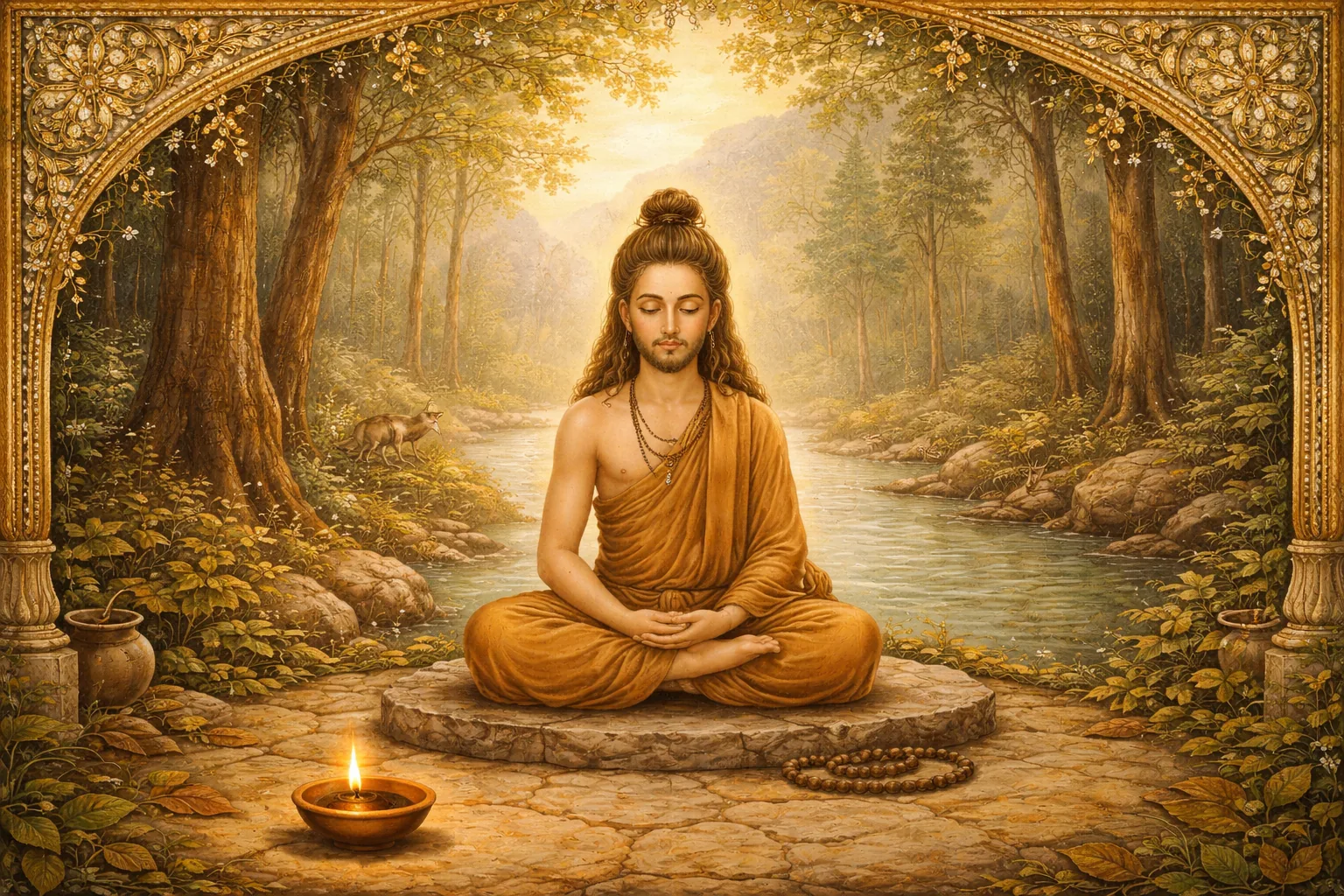
We begin with guru yoga, and along the way I will give explanations of this practice.
When we have performed the prarthana mudra, joining the solar and lunar channels, at that time we enter contemplative presence. Having generated it, we let ourselves go.
What is the meaning of this practice? Having entered presence, we let ourselves go even more and, through such letting go, try to feel within us a certain subtle channel with intuitive consciousness (buddhi). And when you have caught it, you will have the sensation that you have shifted to another level of perception, as if a certain subtle space within you has opened up – this means that you have already entered contemplation. Just as a medium or shaman lets a spirit into himself, having relaxed and let himself go, and then the spirit begins to speak through him, so here, at this stage, we relax, let ourselves go, and let into ourselves the pure subtle space of light.
From this position we visualize OM in the center of the chest. And when we sing OM for the first time with our supplication, our prayerful invocation, we imagine how the radiating light goes out into the space of the Refuge Tree. If you have the booklet “Guru Yoga with OM,” there is an image of the Refuge Tree there. You visualize such a Refuge Tree and the most important saints of the Refuge Tree. Your prayerful mood is approximately this: “O Dattatreya, O Matsyendranath, Gorakshanath, O holy gurus! You have attained awakening, you abide in the state of clear light, while I am still here, in samsara, in a limited state. Please send me the rays of your blessings!” You imagine how the radiating light from the center of your chest penetrates through the dimension of space and time and reaches these saints.
As you sing OM for the second time, you imagine how rays of light begin to emanate from the Refuge Tree. The outgoing impulse of Anugraha Shakti enters the center of your chest, sending you these blessings. The rays of light dissolve into you and spread throughout your entire body, purifying all blockages in the channels, so that your body is filled with white light.
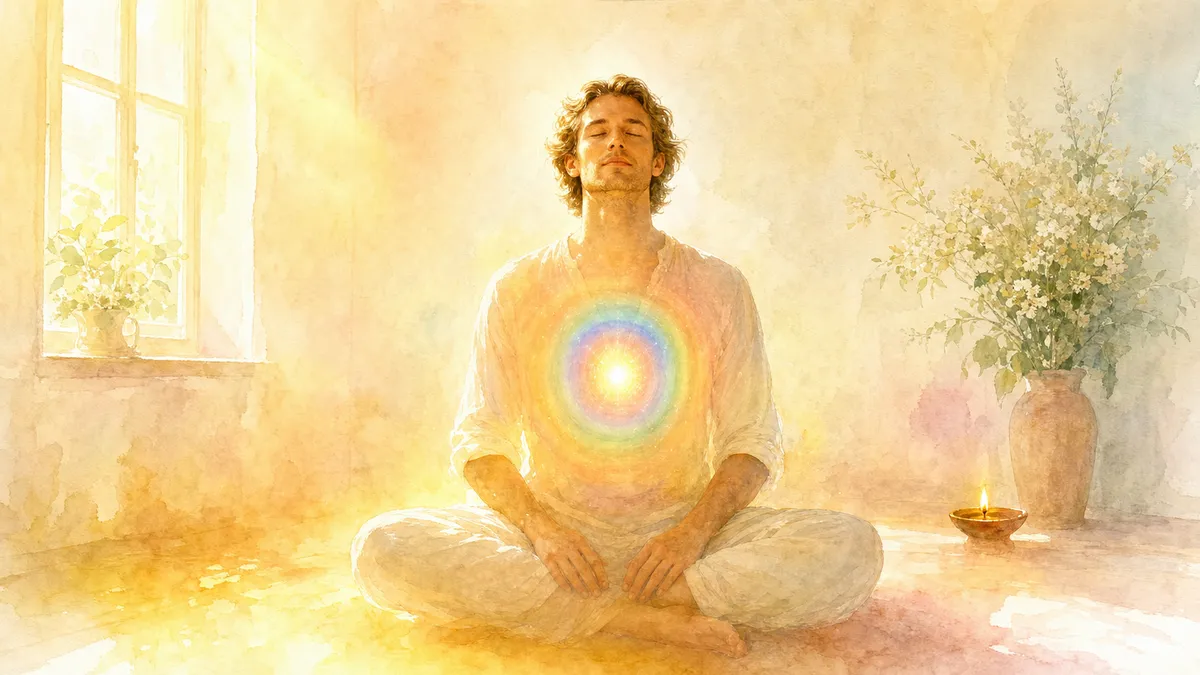
All this time you contemplate the syllable OM in the center of the chest, surrounded by five colors: red, orange, yellow, green, light blue, blue – five rainbow colors. You regard OM as your essence, as your primordial state with which you are reuniting, as the unity of all the saints of the lineage. At the same time, you meditate on the sound OM, trying to merge with the sound OM, to become the sound, to dissolve into the sound and to know its spatial nature.
Finally, when we sing OM for the third time, our luminous body dissolves into the space of light. We unite presence with this space, and then nothing remains except this space.
Pure Vision
Usually I require students to study the subtleties of the teaching deeply, since the teaching is very subtle and highly effective. If you study it, it brings you great benefit, but if you fail to grasp its subtlety and depth, the benefit will be corresponding.
The teaching says that we, as emanations of the Absolute, possess a primordial enlightened state. Our primordial enlightened state already exists; there is no need to create it or correct it. Nevertheless, although it exists, it is closed to us, because there is a certain obstacle that prevents us from being aware of this enlightened state and abiding in it. What, then, is this obstacle?
What is the difference between an awakened person and an unawakened one? Let us imagine a poor peasant who is forced to work hard in order to provide for his life. This person has a billion-dollar bill sewn into the lining of his coat, but he does not even know about it, and therefore cannot use it. This is the state of an unawakened person, when one’s own potential is not recognized and cannot be used. It exists as a possibility, as a function. The state of an awakened person resembles someone who has learned about this bill, ripped open the lining of the coat, taken it out, and is using it to the fullest. He no longer needs to suffer, to be conditioned, limited, because he receives into his hands an inexhaustible potential. In essence, there is no difference between the first and the second from the point of view of potential, since both the first and the second are full-fledged possessors of such a bill. Nevertheless, the first, for all practical purposes, does not have it, since he does not know about it and will not be able to use it even if he learns about it.
This bill represents the inner potential, our boundless “I.” Despite the fact that it exists, we are like such a poor person who can derive no benefit from it, and as a result his life passes in limitations. Our task is to rip open the lining of the coat, take out this bill, and begin to use it.

For example, if we consider divine beings, they make use of it; for them there are no limitations like those of the human world (time, space, mortality, and so on), because they draw upon boundless creative power by using this potential. This potential is our very nature of Mind. But what prevents us from revealing this potential and using it? There are obstacles that must be removed, and these obstacles are generally called the ego. In Sanskrit there is another name for it—rudra.
The Nature of Error and the Birth of the Ego
In beginningless times, an error (bhranti) crept into our life. This error consisted in the fact that the Absolute, emanating and manifesting itself, granted freedom of will to its various parts. It is like a programmer who created a virtual reality with complete freedom for the characters within it; he even gave them the freedom to be mistaken so that this reality would be believable. The characters, using this freedom of will, this freedom of choice, went astray. And we too, like these characters, have thoroughly gone astray, because an error (bhranti) crept in, as a result of which all of life went not as we would have liked. In other words, we possessed primordial freedom, primordial immortality, primordial potential. Precisely because our “I” chose the path of primordial freedom and overestimated its abilities, upon coming into contact with the gunas of material nature, it entered a state of error, of delusion.
Why were we born as humans? We could have been born as gods. Our act of birth is merely the result of an incorrect choice in the intermediate state. In Sanskrit it is called “antara-bhava,” and in Tibetan, “bardo.”
Why were we born as humans at all? We received a physical body because, in the intermediate state, we saw our parents, mother and father, engaged in sex. This powerful vibration captivated our consciousness. Because of this, we received embodiment in the mother’s womb and development in a physical body. In other words, we did not manage to remain in the subtle astral dimension; we were forced to come into contact with gross matter and receive such a body.
Someone may think: “So what? I received a gross body—this too is an experience of a mode of existence.” In fact, this is not entirely so, since gross matter is a certain level of chaos that is almost not governed or controlled by us. To operate with such dense things, a completely different level of awareness is needed than the one we have as human beings. It turns out that we received rebirth unconsciously, without awareness, having made a mistake, instead of remaining in the subtle astral dimension. Life in a physical body is a kind of lesson in awareness and consciousness, giving us the experience of suffering and reminding us: “Do not touch those experiences for which you do not have the power of self-liberation, since you will suffer from them.”
Why did we end up in the astral world? We ended up in this world because we failed to maintain consciousness in higher spheres, namely in the formless world (arupa-loka), in the causal world. While in the causal world, our “I” was not sufficiently developed, and it wanted to experience the world of images, the world of the subconscious, and the world of forms. Thus our higher “Self,” successively making a series of mistakes, came to embodiment in a physical body and found itself at this moment in the state in which you and I now are. In doing so, it lost its primordial memory, freedom, and capabilities, and became very strongly identified with the physical body. It became so identified with the physical body that its spatial and temporal consciousness disappeared; its globality, breadth, openness, and absoluteness were displaced by petty experiences: the needs of the body, sensual desires, and conceptual thinking.
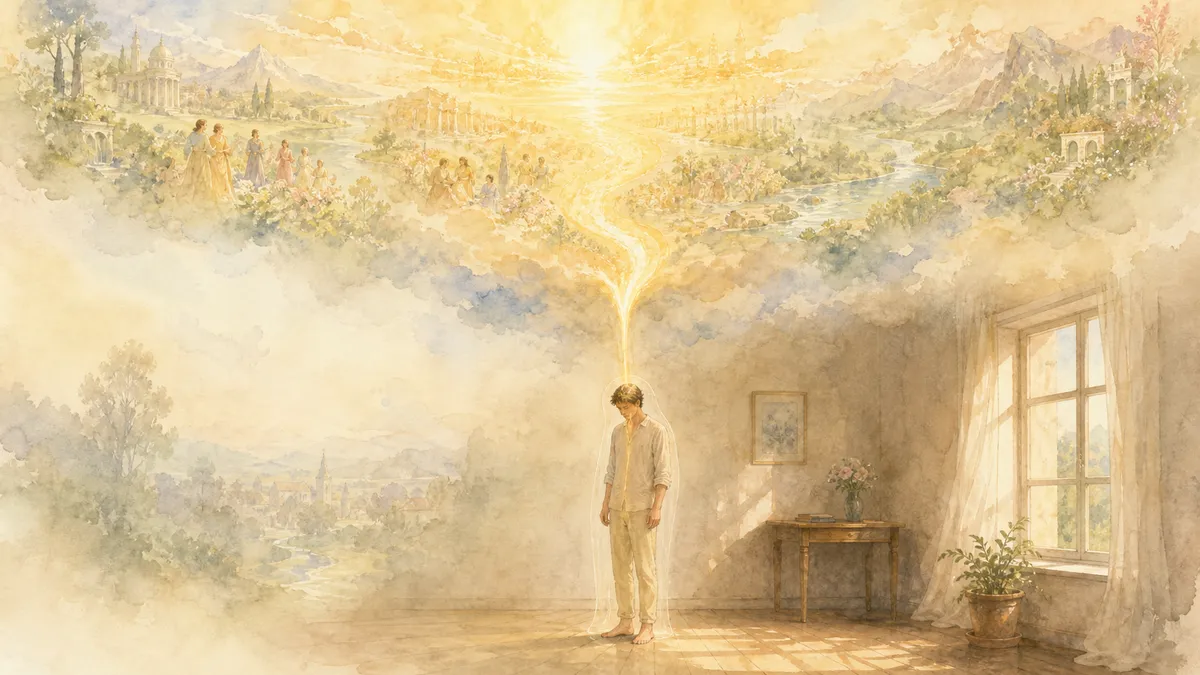
As a result, there was nothing left to do but identify oneself with the notions “I am this body,” “I am a human being,” that is, to attach a certain label and create for oneself a certain psychological continuity—what is called the ego, ahamkara, the human personality. As a result, this ahamkara was formed, and it is constantly deepened and reinforced. A belief arises that it represents a certain stable structure, a certain self-existent being.
Ahamkara becomes entangled in complex social, family, kinship, value-based, and many other connections. As a result, the notion of oneself arises as a separate personality that supposedly has an independent existence. In the teaching, this is called a fatal error that was committed by our consciousness and that must be eliminated. It is precisely this error that prevents us from realizing our originally primordial nature. It is called “rudra.”
The Three Rudras as Obstacles to Liberation
Rudra as the ego is confusion, ignorance that does not allow one to realize one’s absolute nature. The practice of the teaching is the taming of this rudra. Usually Rudra is one of the names of the god Shiva. But here rudra is meant as a form of ignorance, as a certain energy that binds our consciousness, and the practice of the teaching consists in taming this rudra.
The ego appropriates the functions of body, speech, and mind, ensuring its own safety and expanding its influence. In the process of such appropriation, the illusion arises that the ego is some self-existing substance that is independent of the state of being, of the Absolute. It is usually said that there are three rudras: the rudra of the body, the rudra of speech, and the rudra of the mind.
The rudra of the body is the connection between mind and body; it is the bodily aspect of consciousness that needs constant reinforcement, that is, the thought “I am the body,” ahamkara-buddhi, the bodily mind, when we constantly identify ourselves with the physical body. For example, we see someone and judge them by their body. We do not really think about the fact that this body has a mysterious soul that may have already reincarnated billions of times, that came from the world of the gods, or perhaps from the lower world. For us, the most important thing is the body. Such perception of oneself and others is called the rudra of the body.
The rudra of speech is the so-called rudra of speech, speech as a form of prana. It is connected with the energetic level, the energetic sensation. These are fixations on sensations, on emotions, on energetic experiences, on everything that constitutes our energetic experiences. All desires to which a person is subject are a manifestation of the rudra of speech. Sexual desire, the desire to satisfy hunger, anger — all these are various phenomena of energies arising in our energetic body, and when we identify with them, it is said that the limitation of prana or the limitations of speech are at work.
The rudra of the mind is belief in happiness or salvation outside one’s “I,” when we rely on something separate from our consciousness, when we place our hope in something external, not connected with our own awareness. It can also be belief in one’s own clarity, in understanding, in one’s own concepts, in the efforts of the ego, in the idea that, in attainment, more is produced than is revealed. That is, the rudra of the mind is a kind of spiritual materialism.
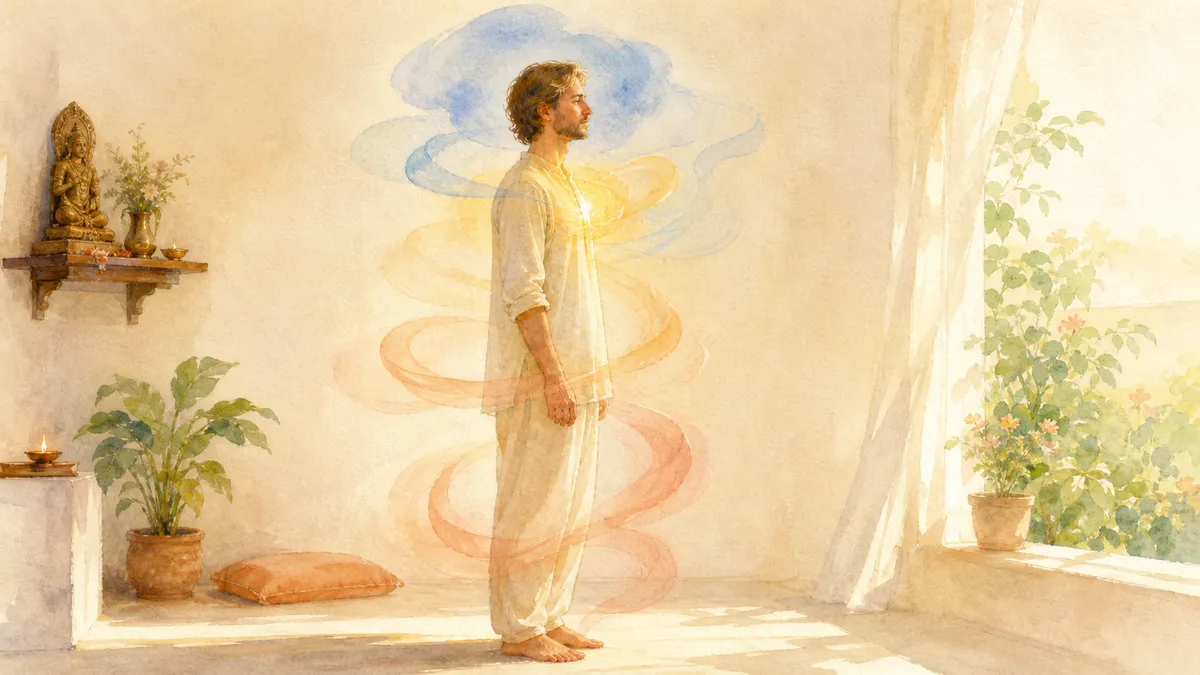
These three rudras (three limitations) are precisely the “stumbling block” that does not allow us to discover our originally perfect nature.
The following example is often given: if a ray of light is directed at a crystal with various facets, it can instantly reflect rays of light, and these rays of light are the nature of the crystal. When we direct a ray of light at a crystal, we do not need to create anything. It is enough for us to create a certain cause, and the crystal will immediately manifest its function — it will manifest the rays of light that will be reflected from it.
In the same way, in the process of practicing the teaching, we need to create certain conditions so that the crystal of our higher “Self” fully manifests its functions.
The task is to transform these three rudras, or three limitations, three bodies, into three mandalas, into three pure dimensions of body, speech, and mind.
The Concept of the Mandala and the Pure Dimension
In the teaching there is the concept of the mandala. What does this mean?
A mandala is a pure dimension; it is a fully enlightened state. For example, it is said that right now we are in an impure karmic vision, in an impure karmic dimension. This means that we look at the world through a certain vision. This world of samsara consists not of divine elements (divya-tattva), but of elements that disintegrate (mrityu-tattva). In this world, everything is seen as alienated from our “I,” as separate — this is the manifestation of the impure dimension. The Supreme Source is not recognized in this world. But it is said that all the inhabitants of the mandala in the divine worlds or heavenly abodes meditate on the Supreme Source, that is, they have a connection with God. When we go out into the street, however, we do not see that all the inhabitants are meditating on the Supreme Source and feel a connection with the Absolute. This means that in our dimension living beings do not recognize the Absolute as such.
I have read descriptions of paradise by one of the Christian saints. He says that paradise consists of divine beings, angels, who continuously give glory to the Lord, and they sing something like: “Holy, holy is the Lord of Hosts”; their entire life is the glorification of the Lord. He was describing a real manifestation of the pure world, in which all inhabitants are in a meditative state and do not lose their connection with the supreme Source for even a second.
In the “Moksha Dharma,” in the book “Narayaniya,” there is a description of the pure land of God Narayana – Shvetadvipa. It describes how two holy rishis, after many ascetic feats, were admitted into the pure land of God Narayana. There they saw divine beings whose bodies consisted not of flesh and blood, but of light. These divine beings were continuously in sahaja-samadhi. They continuously meditated on the central deity – the creator Narayana, lord of all universes – as their own essence. They meditated on him as an immense space of light, like a billion suns. And they were so immersed in samadhi that when these rishis arrived, paid homage to them, and expected to be greeted in return, no one even noticed them, so deeply was everyone immersed in such samadhi, meditating on the central deity of their mandala. These rishis, in bewilderment and even disappointment, said:
“We too are saints; we came here and paid homage, but no one even noticed us, let alone greeted us.”
Then God Narayana, the central deity of Shvetadvipa, appeared before them, and he said:
“You are very fortunate to have come here at all, to have been admitted here. Although you yourselves are saints and have spent many years in ascetic feats, not everyone is allowed to come here, but only those who are so devoted to contemplation and so deeply one with the supreme Source that nothing else exists for them anymore. Do not be surprised that you were not greeted. Here everyone is engaged in the highest level of contemplation, and therefore they did not even notice you; to them you are no more than dreams, an illusion. Now return to Earth. You will be admitted here in several hundred years; you are not yet ready to abide here permanently.”
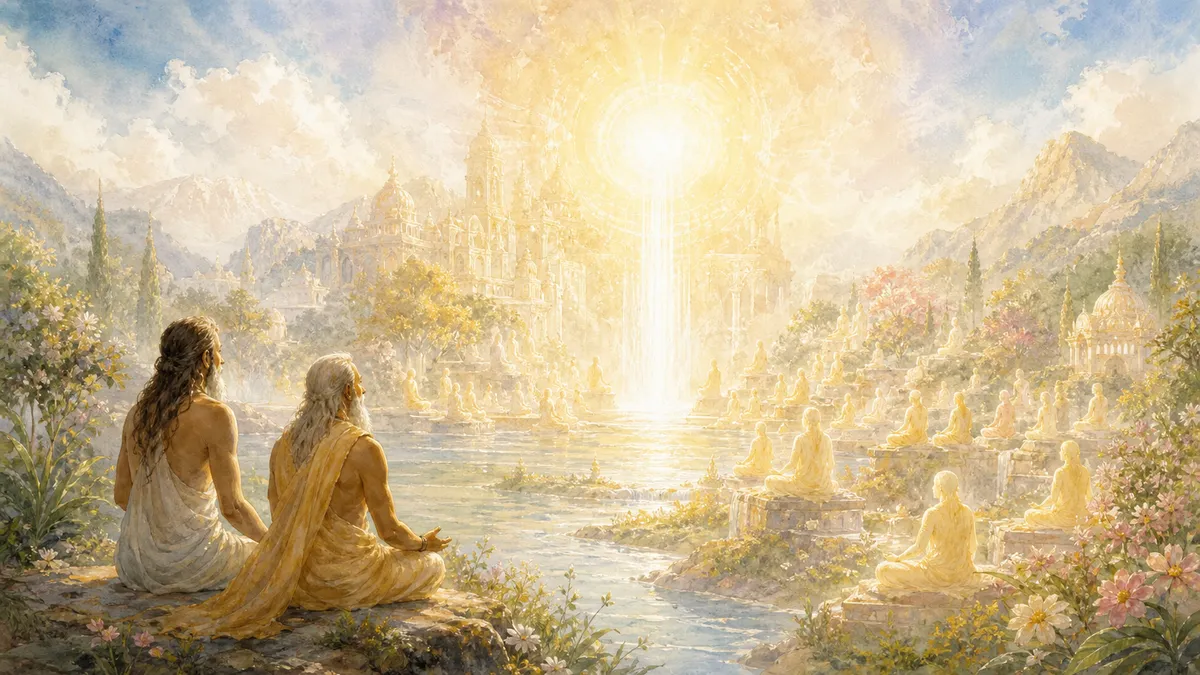
This is a description of the pure land of Shvetadvipa. “Shvetadvipa” is translated as “white island.” Perhaps this is one of the prototypes of Shambhala (or Belovodye), which is described as early as in the “Mahabharata.”
Our task as practitioners is the radical transformation of ourselves up to the level of a deity and movement into precisely such a dimension of pure vision, since if we transform ourselves to the level of a deity, then for us as new beings there must also exist another, new environment. Gods do not live in the ordinary world of humans; they live in their own environment. And the transformation of oneself to the level of a deity automatically presupposes a change in the surrounding environment, a change in the world in which we live. It is impossible, while remaining a deity, to abide in this world, to abide as an ordinary human being. Perhaps this is even possible, but there is no meaning in it.
In the state of impure karmic vision, there is conditionedness, constraint by concepts and emotions, and various limitations exist. For example, there is the law of karma (causes and effects), subject-object relations, there is no samadhi of contemplation, there is death and birth – all these are signs of impure karmic vision. By contrast, in the mandala of the pure dimension there are none of the limitations in which ordinary people abide. In pure karmic vision there is no law of cause and effect (the law of karma).
In the state of the mandala, all living beings are in a single “taste” (samarasya); for them good and evil, pure and impure, truth and falsehood, action and non-action, past and future are equal – all this is seen by them as whole, as one. For us, of course, such a thing does not exist. We understand that there are things we like, there are things we do not like at all, and we are very far from a single “taste,” because our ego and intellect impose very strong limitations.
Unity in Diversity
For divine beings in the pure dimension, everything is seen as whole, as a certain unity. For the divine beings of the mandala of pure vision, everything appears as the supreme Source. Instead of a world of multiplicity, they perceive a world of unity.
For example, in the human world we have multiplicity; that is, we distinguish between gods and demons, spirits and humans, life and death, male and female, bad and good, various levels of taste, state political systems, cultures, nations, and traditions—all of this is the world of multiplicity. In the mandala of the pure dimension, on the contrary, all these manifestations are seen as manifestations of one supreme Mind, according to the principle of unity in diversity. This supreme Mind simply plays at differences, but they are not essential. Yet in our world the unity of all these differences has been lost; we see only multiplicity, only differences, because we lack the wholeness of consciousness needed to perceive this unity.
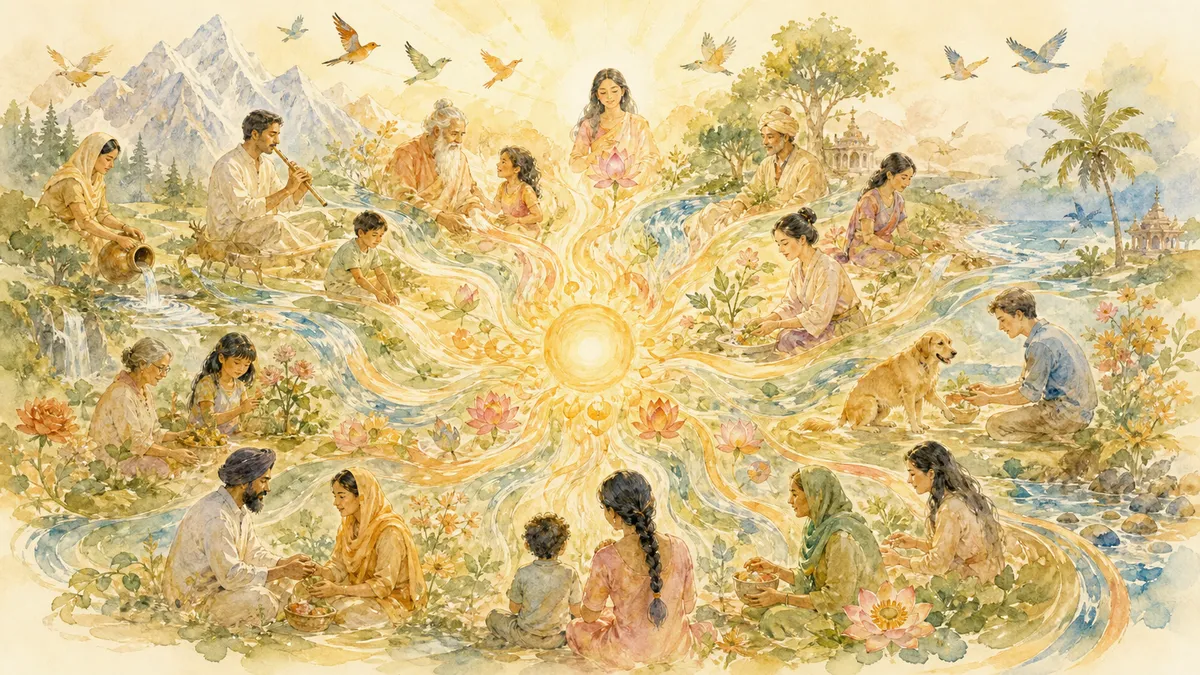
Also, in the mandala of the pure dimension, living beings are bound neither by emotions nor by thinking—they abide in self-liberation.
The Principle of Self-Liberation
What does self-liberation mean? There are two fundamental ways of dealing with one’s mind: either to be limited by it, or to self-liberate. For example, we begin to think about something, thoughts begin to seize us, we acknowledge their reality—this is an example of limitation. There is another way: when we begin to think about something, but these thoughts do not limit us; we understand that behind these thoughts there exists a subtle level of non-conceptual awareness, and therefore we do not attach great importance to the thoughts. We can recognize their play, their unreality; we can even laugh at them. This is the way to be in a state of self-liberation.
There is a story about a man whose axe disappeared from his barn. He tormented himself with thoughts about who had stolen the axe from him. He thought, calculated, and came to the conclusion that his neighbor had stolen his axe. When the neighbor came to visit him in the morning, this man began to observe the neighbor furtively. He thought: “Exactly! He walks like someone who has stolen an axe, looks like someone who has stolen an axe, and talks the same way.” That is, his thoughts created such a reality in which he believed that the neighbor really had stolen the axe. He was already making plans for revenge, but one day he looked into the cowshed and saw his axe under the cow feeder. And then he remembered that, as it turned out, he had simply forgotten it there in the evening. Suddenly he received a powerful insight: he saw how his own mind had been fooling him, and that in fact no neighbor had stolen the axe. And when the neighbor came to visit him again the next morning, he looked at him and thought: “He walks like an ordinary person, plays like an ordinary person, speaks like an ordinary person, and looks like an ordinary person. How much the mind can fool me! I imagined all of this myself, and it seemed like reality to me.” This is an example of being bound by conceptual thinking.
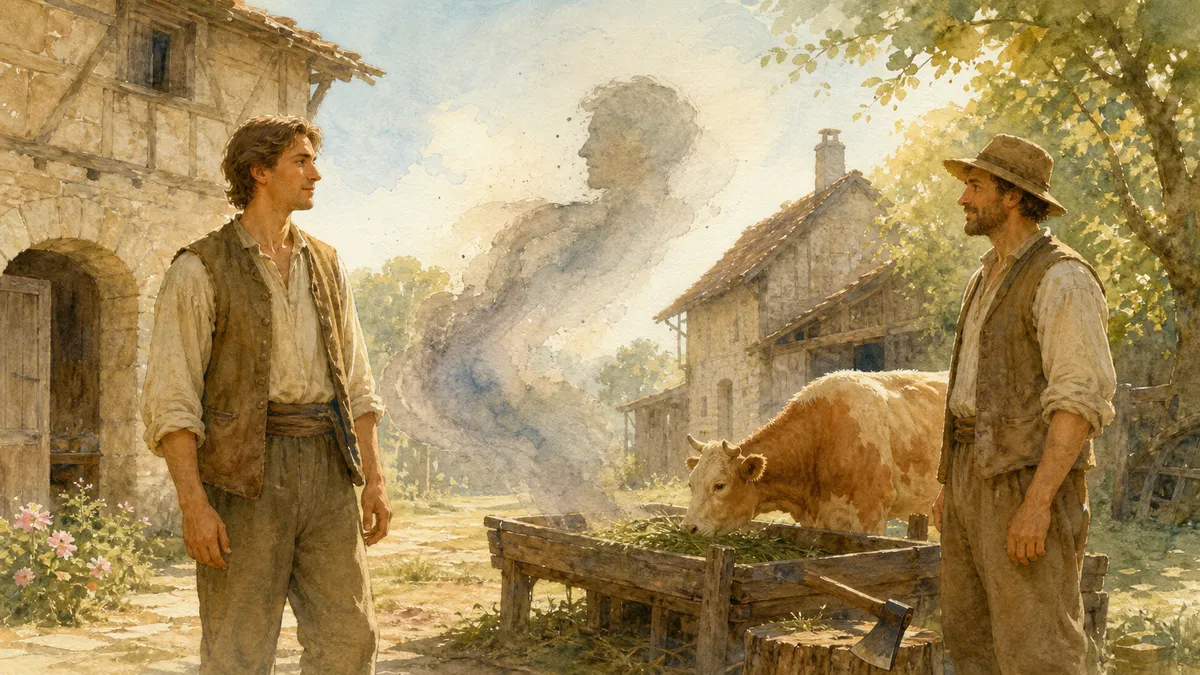
That is, when there is no self-liberation, we resemble such a person who thinks that someone has stolen his axe. His own thoughts hurl him into a certain stream of reality, and this reality begins to have power over him. With his own thoughts he envelops himself as if in a cocoon, and this cocoon forces him to remain within certain limitations.
But deities in the state of pure vision, on the contrary, are not bound by conceptual thinking; they constantly live in a self-liberated state. Neither thoughts, nor emotions, nor feelings have power over them, because they have a certain subtle center, like a magnet that attracts all metal filings. This center is unchanging; it cannot be influenced in any way, while thoughts, emotions, and feelings are merely ornaments of this center, a play. Therefore, when they think, speak, or act, for them it is not the same as it is for limited people; for them it is a kind of play, an ornament that is self-liberated and from which no problems arise.
Qualities of the Pure Dimension
Beings in the mandala of the pure dimension are characterized by lightness, play, beauty, purity, harmony, spontaneity, grandeur, blossoming, abundance, creativity, development, joy, and freedom. All these are different energies that manifest through abiding in contemplative presence. Beings in impure karmic vision, unfortunately, do not possess these qualities, or possess them only to a very small degree.
We can recall few such states when a fountain of creativity, joy, harmony, sacredness, and grandeur would pour out of us. Of course, such states do occur, but unfortunately they do not occur often. Some people never experience them at all. To earn such states, one truly needs to purify one’s consciousness. But for divine beings, such states are something normal. They experience them from birth and throughout their entire lives, never ceasing, living in them. Therefore, divine beings do not so much live as play; they are not subject to the law of karma.
Finally, beings in the pure dimension are immortal; for them there is no transformation of the flesh, no birth or death as in the human world, since the elements of their body (divya-tattvas) do not disintegrate. On the contrary, for beings who are in impure vision, mortality exists depending on time and events; for them karma and fate exist. The gods in the pure dimension are dependent neither on karma nor on fate (daiva). They themselves can direct their destiny; karmic causes have no power over them. But living beings in this world are victims of fate, destiny, that is, they are not able to foresee what is happening to them, or if they are able, then only to a slight degree. It is often said that the gods laugh at the plans of people when they see in advance what these plans may turn into.
Perhaps all of you understand this. For example, if we analyze the lives of great military commanders, businessmen, and political figures who built global plans (Hitler, Napoleon, Alexander the Great, and others), we can understand how all their plans ended. If, for example, Hitler had foreseen how his campaign against the Soviet Union would end, he would hardly have carried out that attack. If Napoleon had known how his rule would end, he would hardly have started it all in the first place. This is an example of the limitedness of human beings in forecasting the further development of causes and effects.
Symbolism of the Mandala
So, when we understand that there is a limited dimension and there is a pure dimension, when we understand the difference between these worlds, then our task is to transform these three rudras (the three limitations) and move from the limited dimension into the dimension of absolute freedom, absolute happiness, play, and immortality. This is precisely the state of the mandala.
The mandala is symbolized by a circle, at the center of which there is a point. This circle signifies the equal distance of all points from the center. The center symbolizes our consciousness, while the points on the periphery, that is, on the circumference, symbolize the entire diversity of objects we experience. This symbol indicates that in the state of the mandala, or the pure dimension, all living beings are at the center of the universe. It is their consciousness that is the center, and everything they perceive is interconnected with this center.
Spiritual Practice as Transformation
Spiritual practice is not only the development of awareness or work with energy. Above all, it is a change in the meaning-forming vector that determines values. It is transformation on all levels, when we can say that we build a new inner life and an outer one on the basis of the inner. Of course, it is impossible to build such a new life and to build a new self just like that. For this, we must develop new qualities within ourselves. These qualities are described in traditional texts as the qualities necessary for a disciple.
Qualities of a Disciple
And what are these qualities? Different texts give different descriptions, but we will dwell on the most important ones.
The first is faith. What does faith mean? It means trust, openness, expansiveness in relationships with the teaching, with the teacher, with oneself, and with the world. Very many people perceive the principle of faith incorrectly, since in a materialistic society people often speak sarcastically of “blind faith.” But in fact there is no need for blind faith at all. I would say that faith is awareness based on experience. It is trust that has arisen as a result of your having developed a certain understanding. True faith is based on understanding. Such understanding arises as a result of the inner work we do. That is, shraddha (the term that is translated as faith) and the concept of faith spoken of in modern Western society are somewhat different. Shraddha is openness and trust based on understanding. Until we acquire such shraddha, it will be difficult for us to move into the dimension of the teaching. We will remain in dualistic states that do not allow us to transform ourselves deeply and radically.
The next quality of a disciple is diligence. Diligence means that we actually work and apply the methods being discussed. If, in the tradition of the teaching, we work with sankalpa or perform basic practices, then we can benefit from them only when we truly show diligence. A disciple on the spiritual path is expected to show considerable diligence for his or her own sake. For if we show limited or little diligence, it is also impossible to achieve great success. For example, if a person decides to become a master of martial arts and earn a black belt, but goes to training once a week and thinks he will become a great master, this cannot be called diligence. Diligence means that we work constantly, methodically, and continuously; we work in the same way as great sports masters or great artists work, when our whole life becomes practice.
The next important quality is mindfulness. Mindfulness is connected with the ability to develop contemplative presence and to work on maintaining a certain state of consciousness.
The next quality is understanding. Understanding means that the disciple does not blindly follow instructions, but tries to develop his or her own clarity, his or her own understanding. For example, if you go to a doctor and tell him about your situation, he gives you certain recommendations, trying to develop in you an understanding of how you can restructure your life in order to heal. Based on his recommendations and understanding, you harmonize your diet and lifestyle so as to heal some illness. In the same way, when we receive teaching from a spiritual teacher, we try to develop the necessary understanding so that it enters our life and so that we can truly make use of it.

Another necessary quality is cooperation. Cooperation means that we are not passive, but actively manifest ourselves in the teaching. If we are passive, we will receive no benefit from the teaching. The teaching is presented in such a way that we ourselves must show activity. The teacher does not say to you: “All right, tomorrow we begin training from morning to evening under my guidance.” It is assumed that the disciple chooses his or her own regimen of practice, training, and so on. But if he or she chooses, then he or she must understand that it is necessary to show activity. While in a passive state, it is impossible to receive benefit from the teaching. Cooperation presupposes interaction between teacher and disciple, interaction among disciples themselves, and spiritual growth in the process of such interaction.
These are the qualities of a disciple that enable him or her to follow the supreme path of Anuttara Tantra.
