

Commentary on the text “The Questions of Milinda Sutra”
By this point, if you have taken part in the puja in the external and internal way, in the arati, you should receive nine blessings or nine impulses of Anugraha. Three from Ganesha, three from Dattatreya, three from Shiva, another three from Brahmananda during the Guru-paduka-stotra — twelve, and complete everything with the Guru Yoga “Om” with transformation.
The body on the physical level has a practice, the mind on the subtle level has a practice, while nondual consciousness, instead of practice, has abiding in non-doing on the most subtle level. All these three levels are present in a sadhu, and they correspond to view, contemplation, and conduct. View, contemplation, and conduct are not abstract philosophical categories; they are present in our life right now as different levels of being. Conduct corresponds to wakefulness (the physical plane, the body), contemplation corresponds to the subtle states of the mind, and view corresponds to the causal body.
The Transformation of Karmas and the Three Enlightened Bodies
On all these planes we become ever purer, ever more aware. As we become increasingly pure and aware, present within them, the transformation of our karmas on these three planes takes place through view, contemplation, and conduct — the three enlightened bodies.
Why is there any talk at all of bodies, of enlightened bodies, of three? The point is that they exist primordially, and they are already primordially pure and enlightened. It seems to us as though we are purifying them, transforming them, acquiring them, attaining them, but they exist primordially as the three pure abodes of the Absolute, as the three feet of Brahman described in the Upanishads and called vishva, taijasa, and prajna.
As we penetrate these three pure dimensions of the Absolute, represented in the form of energy on different planes of existence, we discover the Absolute in the material world (in wakefulness). When we discover it, the signs of siddha-deha arise. When we discover it in the subtle body (in the dream state), the signs of the body of the wealth of manifestation, called pranava-deha, arise.
Pranava-deha — the Body of the Wealth of Manifestations
What does the body of the wealth of manifestations look like? When the text about Dattatreya is sung: “Shri Guru Datta,” I greet Dattatreya, surrounded by the sun, the moon, and nine hundred thousand stars — imagine the majestic sight — seated majestically upon a lotus throne.
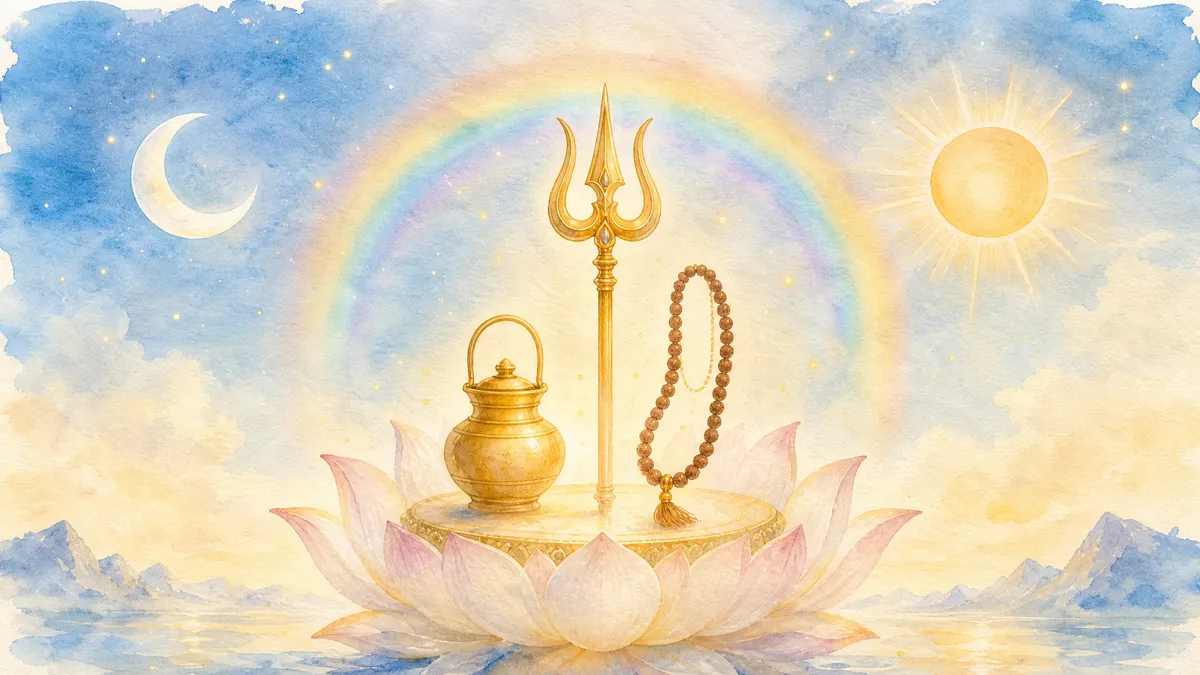
Pranava-deha is Dattatreya in the pure space of the blue sky, the sun on the right, the moon on the left, on a lotus throne, surrounded by rainbow light — a radiant, magnificent form with the purest iconographic features, saturated with light in all its majesty, splendor, and glory. We transform into such a Dattatreya, so whenever we visualize him, visualize pure blue space. Blue space personifies the element of space.
Then, in this pure space, if you gradually perform the visualization, you imagine how a rainbow radiance arises from this pure space. In principle, its iconographic depiction is similar to this; however, when we visualize, the image is far richer. From it a seed syllable manifests; this seed syllable is the germ of consciousness, the essence of Dattatreya. From the seed syllable the lotus throne, Dattatreya himself, and the rainbow radiance manifest. Then the attributes manifest, and we meditate on the key points.
In addition, we receive a blessing from Dattatreya and transform ourselves when Dattatreya, in the form of light, enters the center of our chest. What does this mean — the center of our chest? Physically, it is localized in the central anahata chakra, but here one must look deeper. By the center of the chest is meant hridayam as our own deep inner essence, manifesting within us on a very deep level of consciousness. In this way pranava-deha is recognized when the subtle body is purified.
Jnana-deha — the Body of Wisdom
Finally, when the causal body is purified and our awareness penetrates there, jnana-deha is recognized. It is recognized as one of the spaces of light — jnana-deha is the bodies of the gods. All gods have jnana-deha. Let us say we do not yet have it, but that is a fixable matter; it is temporary.
If we meditate on mahashanti, shambhavi mudra, atma-vichara, and contemplate the ten sankalpas, we gradually begin to come into contact with the jnana-deha. How do we come into contact? We come into contact with the element of space, with buddhi, with awareness diffused everywhere, and we come into contact with the absolute consciousness that transcends us. As a result of the contact between our cognitive activity and the Absolute, the jnana-deha is born — an infinite luminous space. When we introduce our consciousness into this luminous space, our own understanding arises that this is also our body, that we too can live in it.
All gods have as their jnana-deha an infinite luminous space in which they live and move. It is difficult for us to imagine what it means to have a body in the form of luminous space. We are used to the idea that a body must have arms, a head, legs — at least, even if it is subtle, astral, and divine, with three heads and six arms, it is still some kind of body, localized in space, anthropomorphic, humanized; this is understandable to us. But to have a body in the form of luminous space is very mysterious, yet these are precisely the bodies that the gods have, and it is called the jnana-deha.
It is in such bodies that Guru Brahmananda, the siddha Pambatti — and I say this not even from books, I say it from my own experience — Bhagavan Dattatreya and all the gods live. They live in them, they move in them, they occupy the infinite space of the universe with these bodies, generating vibration in different parts of this space through the seed syllable, sankalpa (intention).
They create illusory bodies at any point, and this does not mean that he can create only one body — he can create three bodies, five bodies, ten, a hundred thousand bodies. For great divine beings, creating one hundred billion emanations is natural. This body is the source of a billion emanations that have form.
Thus, Dattatreya, abiding in the form of the jnana-deha in all three worlds, can in a single instant create a manifested, illusory body here in the Trimurti Ashram, in the Odessa Ashram, in the Chitta-Amrita Ashram, in Divya Loka, on the moon, on Mars, in America, in the subtle worlds, in every loka, in countless billions of universes. This is the potential of manifestation of the jnana-deha, and this body is like an ocean, like the cosmos of luminous space.
Traditionally, five such spaces are described — this is called vyoma-panchaka: guna-rahita-akasha, chitta-kasha, maha-kasha, parama-kasha, tattva-kasha, and surya-kasha. By realizing ourselves in this space and introducing our cognitive activity and our consciousness into it, we receive the signs of realization of the body of wisdom.
Finally, there is yet another body that encompasses all three previous ones in the form of their unity — it is called by various names: sahajananda (the body of the natural state), deva-deha, sahaja-deha, vajra-deha.
Signs of Divine Blessings
Thus, by meditating on the blessing of the deities, we gradually reveal within ourselves the signs of divine bodies. When we come into contact with these dimensions through upasana (worship) and receive a blessing from these dimensions, and signs begin to arise in us, it is said that we have received signs of progress, signs of the blessing of Anugraha and shaktipat.
What can this look like? For example, you are meditating, and suddenly a light ignites in your chest, flaring like a magnesium flash brighter than one hundred billion of these lamps at once. Or you are meditating and sleeping at night, and you see the sky in the form of pieces of cast golden gold, in the form of a vast space in which you abide all night, which you recognize as your body.
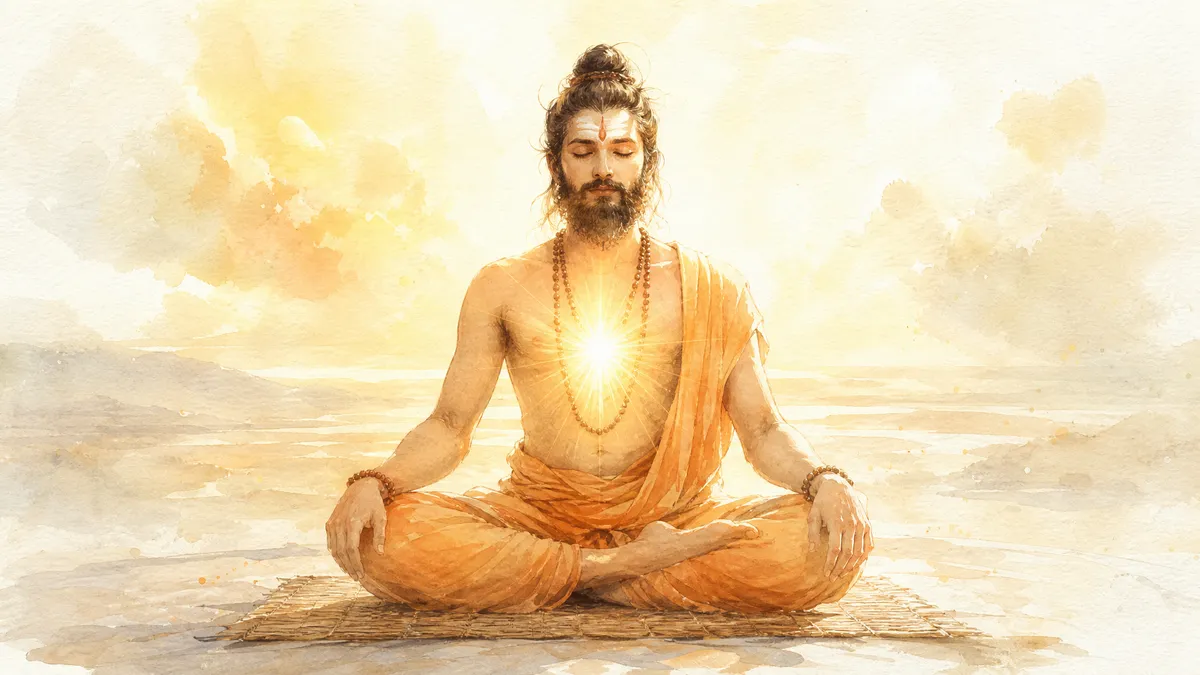
This is how the signs of the jnana-deha can manifest. And if you have little merit, and you perceive the jnana-deha through a less luminous consciousness, then you experience it as if you are entering a void in which there is neither form nor name, neither you nor anything else. Into a total space of emptiness in which all concepts, any directions, time, body, space, tattvas, and gunas are absent. Nothing from your experience remains, where your mind can only be amazed; it cannot think there, where you are, but not as a person — these are signs of how the jnana-deha can manifest.
The pranava-deha can manifest differently. For example, you see three deities and suddenly look at yourself, and your body is like that of a deity, partially or completely; or the body is not like that of a deity, but like that of a human, yet it is luminous, and for some reason you have a trident in your hand. These are signs of the birth of the pranava-deha.
Accumulating more and more such signs, when they appear in dreams, in meditations, and combine with everyday life, we become increasingly imbued with the spirit of divine blessings, the spirit of Anugraha. We divide reality less and less, divide ourselves and the deities less, ourselves and the chosen deity, ourselves and the absolute three bodies. More and more we recognize these three bodies as always inherent in us, in which we can exist fully.
The Development of the Divine Bodies
At first it is difficult for us to understand how one can exist fully in the three bodies, when of all the bodies you have seen only your own in the mirror, and you wonder where they could be. In the virtual world this is understandable: if you make yourself a photograph for an avatar, that is still understandable. But gradually you understand that the pranava-deha is the body of your imagination, the body of your dreams.
Your imagination, your thoughts have power; they can create such a body if you understand correctly and perform all the tantric visualizations, theurgies, properly perform puja, arati, engaging your visualization, Guru yoga with transformation, and become accustomed to reciting the mantra in ishta-devata yoga. Gradually your imagination creates such a body; it acquires more and more signs and attributes and becomes accessible to you for experiences of movement, a full-fledged life, and even magical operations.
There is an entire section of ishta-devata yoga called siddhi-krama, where you learn to perform various magical operations in it — a great many things can be done in it. There are different schools and directions in which you can perform them: healing, pacification, transformation, transfiguration, control of time and space.
At first all this is very, very vague; you understand only the bare method, the bare technique, but then your shakti and understanding connect to these, and you begin to develop it.
The same is true of the body of wisdom — at first it is present as the inner observer. The inner observer is not yet the body of wisdom, but it is its embryo; it is like an embryo in the mother’s womb, but it is not yet a child. When a woman goes for an ultrasound after becoming pregnant, the doctors say, “Oh, you have a girl,” and the husband says, “But I wanted a boy.” But it is not yet a child; it is its potential. It will become a child when it is born. The inner observer is the embryo of the body of wisdom.
When we maintain the sankalpa “there is a state of space,” this is also the embryo of the body of wisdom. When we combine the observer, space, and, with the help of the ten sankalpas, reveal the various powers of this space, suddenly we enter real space. It is difficult to say precisely “it should be like this” or “like that” — these are very subtle processes, and sometimes they are mystical processes.
You do the methods and nothing happens; then you leave them for a while, and suddenly it happens — this means your subtle body has performed them. But it needed a certain break in order to receive the blessing. Sometimes a person practices in retreat for a month, three months, five months, and nothing happens, and he comes to the Guru and says, “Guru, somehow I don’t have much experience.” Then he comes out of retreat, and everything begins to unfold — this means the retreat worked, but with a delay.
In the same way, the signs of realization of the jnana-deha, the causal body, gradually come in the form of expanded consciousness, in the form of the arising of brahma-aham-bhava, in the form of an ever-present observer with a tendency to open wide. In the form of skillful self-liberation not only of logical thoughts, kleshas, and emotions, but even at the level of prana. In the form of an increasing vision of the all-pervading purity of divine majesty, which does not require deliberate effort. In the form of the ability to investigate the Absolute, absolute reality, by means of brahma-vichara, as if implanting consciousness by means of brahma-kara-vritti. These are different kinds of arising of the causal body.
So, “The Questions of Milinda,” Book Six.
Venerable Nagasena, you said that one should take one quality of the termite. What is this quality?
— It is known, sire, that the termite first builds a roof to cover itself, and only then goes to search for food. In exactly the same way, sire, a yogi engaged in yoga should first build the roof of moral restraint, cover his mind with it, and only then go for alms, for if a yogi engaged in yoga has built over himself the roof of moral restraint, he is freed from every danger. This is the quality, sire, that should be taken from the termite. For there is, sire, a saying of the Thera Upasena, son of the Bengalis: “A yogi who has built the roof of moral restraint over his thoughts, not clinging to the worldly, is freed from dangers.”
Pratyahara — a Roof for a Sadhu
So, a roof is needed — nowadays this word is used in a different sense. Nagasena used it in the sense that one must restrain the mind, one must restrain the senses by the power of awareness — this is the true roof for a sadhu.
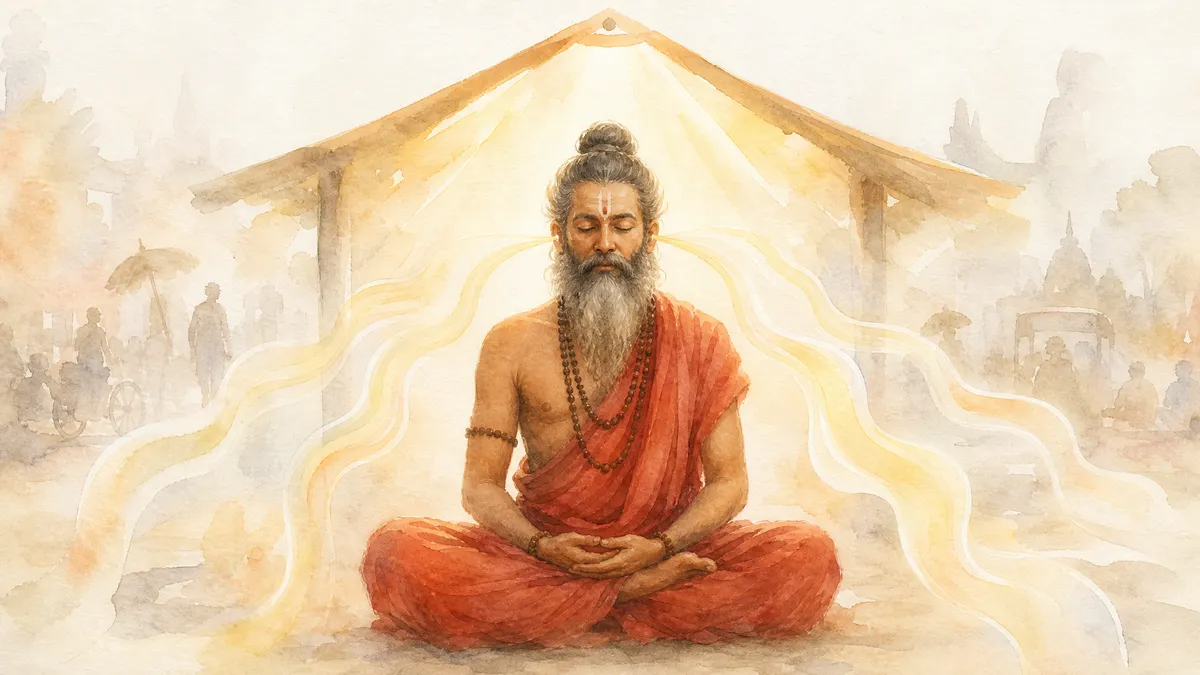
Pratyahara is the taming of the senses by drawing them inward; it is the ability not to be affected by the external world. Pratyahara precedes the ability to concentrate. One way or another, through restraining the mind, through self-discipline and vows, through contemplative sankalpas, we must cultivate good pratyahara in ourselves. This means that wherever you are, you can abstract yourself from the surrounding objects. To carry out this fivefold formula, which says: “Reduce everything to the mind, and the mind to emptiness; or dissolve the external world into the indriyas, and the indriyas into manas.”
This means that wherever you are, wherever you are sitting, whatever you hear, you can draw in the sense organs and direct them inward, and they will not affect you. You are the master of your senses — if you wish, you send them out, and if you wish, you draw them in. If you wish, you send them out; if you wish, you draw them in. You are the complete master; you do not depend on external objects. You have a button: you can switch them off or on at will — this is the perfection of pratyahara.
There was one rather funny incident at my first Kumbh Mela, when I was there in 2010. The head of the Gayatri society invited me to a conference — they like to hold various conferences against smoking, for Sanatana Dharma, and various such campaigns. There was another such conference, with many different political figures and the leader of this Gayatri society, a doctor. At the end we were supposed to light a torch symbolizing the power of knowledge, the power of consciousness, and there was a performance there — there were demons, devils around with various such things, wrathful deities, and they would supposedly run away from it, from the lit torch.
Throughout the conference I listened with one ear, while most of my consciousness was in contemplation, as if I were not here at all. Without wasting time, we lit this torch, and since I was in contemplation, there was a performance, and one had to stand with it for about ten seconds, maybe thirty or fifteen. I decided: why waste time, I should contemplate — and I plunged into contemplation. That is, I was standing there, just like a yogi’s tapasya, standing with his arm raised; I went deeply within myself, and all those wrathful deities had already dispersed, and the event had ended, while he was still holding it together with me — he felt awkward, he could not let go if I was holding it, so he kept holding it too. I was standing there, and I did not care how long to stand — one could stand for five hours, two hours; I even lost track of time, of how many minutes I had been standing. And then I kind of ended the pratyahara and looked — he was looking at me in bewilderment, wondering why I was standing there so long. I do not even know how long I stood; it turned out so awkward. That is, if I had stood there for five hours, it would have been interesting.
When you perform pratyahara deeply, withdrawing into yourself, time disappears for you, because you are not in the waking state, but in dhyana or in a semi-waking state. There is such an expression in the description of the vishuddha chakra: “For a yogi who concentrates on vishuddha even for a moment, a thousand years are like a second.”
There were stories like this: a group of monks went out in Tibet, and one of them went into a cave to sit — he liked the cave, he decided to feel its energy, to meditate — but for the rest of the group he disappeared. They searched for him for four days, fifteen days; after fifteen days he came back, and everyone looked at him in amazement — what had happened, while he asked:
“What happened? Only fifteen minutes have passed, haven’t they?”
They said:
“Where were you? You were gone for fifteen days.”
“I only sat down to meditate, and somehow time suddenly passed very quickly.”
This too is a property of pratyahara — if your pratyahara attains great power, you can at will withdraw your sense organs, abstracting yourself from this world. The basis of dharana and the basis of dhyana is a strong, good capacity for pratyahara. When you can withdraw the sense organs so deeply, you can concentrate on Dattatreya, maintain concentration on Dattatreya for three days, on the breath, on a chakra, and enter the samadhi of an element. You can do very much, because the power of your mind increases through pratyahara.
The qualities of a cat: constancy of mindfulness
Venerable Nagasena, you said that one should adopt two qualities of a cat. What are these two qualities?
“First, Your Majesty, whether a cat is in a cave, in a burrow, or in a storehouse, it is always trying to catch a rat. In exactly the same way, Your Majesty, a yogi practicing yoga, whether he is in a village, in a forest, under a tree, or in an empty room, should constantly, incessantly, and vigilantly try to catch his prey — mindfulness of the body. This is the first quality, Your Majesty, that should be adopted from a cat.
So, if for the cat this rat is prey, what is prey for a sadhu? His prey is smarana (remembrance). Yesterday we examined different kinds of smarana: rupa-smarana, nama-smarana, bhava-smarana, shakti-smarana, anugraha-smarana, and others. In the context of establishing the four foundations of mindfulness, this remembrance begins with remembrance of the body, when the inner observer is directed toward the body, remembrance of bodily sensations or remembrance of emotions and feelings, and remembrance of thoughts. In this remembrance, what matters is not the object of remembrance itself—not that the movement of the body is absolutely important, or the experience of the body or of emotions or thoughts—but the witnessing consciousness that is directed toward them; it is precisely the witnessing consciousness that carries out remembrance.
It is not so important by means of what smarana will be established, but when it appears, the habit of always remembering must be turned toward God. We must turn developed witnessing consciousness, developed smarana, toward God. The turning of smarana (remembrance) toward God, continuously maintained, is nididhyasana; it is love for God. Whatever we have used to cultivate our capacity for smarana, we must direct it toward the aspect of God that is closest to us. Everyone has their own individual abilities to perceive different aspects of God. For some, remembrance of God as the bhava of divine majesty is closer; for others, as divine love; for others, through atma-vichara; and some are not able to perceive formless aspects at once and can only remember in the mind a form, an illusory body, and a mantra.
But one way or another, our smarana unfolds toward the principle of God, toward the Absolute, and when it is continuously turned in that direction, this is nididhyasana and this is gestation. When it requires no effort and is done from non-doing, this is maintaining the natural state. There is intentional smarana with intensified support, and there is natural smarana. When smarana is natural, this is sahaja-samadhi. But until there is natural smarana, we must always maintain it intentionally.
Sometimes it happens that people, after rereading or listening again to lectures on self-liberation, on liberation from methods in the natural state, think that since the natural state requires no effort, they too require no effort. However, the natural state requires no effort; it has no relation to a person’s present state if he has not penetrated it, and therefore he must practice intentional smarana until intentional smarana grows into natural smarana; then it will become nididhyasana.
Investigation of the Five Koshas
Furthermore, Your Majesty, a cat always catches prey near its dwelling. In exactly the same way, Your Majesty, a yogi engaged in yoga should discern the arising and dissolution of those very five heaps of attachment that constitute himself: “Here is form, here is the formation of form, here is the passing away of form; here is sensation, here is the formation of sensation, here is the passing away of sensation; here is recognition, here is the formation of recognition, here is the passing away of recognition; here are the constituents, here is the formation of the constituents, here is the passing away of the constituents; here is consciousness, here is the formation of consciousness, here is the passing away of consciousness. This is the second quality, Your Majesty, that should be taken from the cat. For there is, Your Majesty, a saying of the Blessed One, the God of gods: “There is no need to depart from here; the summit of existence is of no use to you—here and now, in your very own body, you must attain victory.”
What is being spoken of here? The five heaps of consciousness—here it speaks of the five koshas. There are five skandhas, which in principle are identical to the five koshas, and pancha-kosha-viveka is the observation of the five koshas. Through cultivating fullness of attention and awareness, the ability arises to investigate and observe the appearance of the five koshas. The processes of vichara, viveka, and vairagya begin to set in motion within us the mechanism of inner, alchemical transformation. When we are able to observe the five koshas with a higher observing consciousness—their arising, movement, disappearance, and self-liberation—viveka arises.
What is viveka needed for? Viveka is not needed in order to contemplate the koshas endlessly, to analyze them endlessly—that is a rather boring activity. Viveka is needed, on the contrary, in order to make a breakthrough beyond the koshas and rise upward, because, in essence, we do not need the koshas (sheaths).
We do not need the physical plane as such; we do not need the astral plane; we do not even need the superior causal plane, although in occultism and in Theosophy great importance is attached to it. It is of interest to us for study and understanding, but it is not the goal. We need the plane called turya (the fourth state), the plane of God, the plane of the Absolute. Viveka is needed so that, by distinguishing all the lower planes, we may direct the arrow of our consciousness, hit God, hit the Absolute. When we have hit it, here the saint says: “We do not need to go somewhere upward to know God; we need to know Him here, in this life and in this body.” This means abiding in sahaja samadhi, being aware in the waking state of the dimension of turya.
Two Paths: Nirvikalpa Samadhi and Sahaja Samadhi
There is a possibility of acting differently: for example, in mahashanti meditation, having stopped the mind, to rise above the five sheaths and transfer one’s consciousness to the highest plane in samadhi.
When the body is unable to function, the subtle body exits; the subtle body ascends to the mental plane, and then to the causal plane; abiding in the light of the causal body, it dissolves into infinite space and through infinite space knows the highest level (nirvana). There is no contact with the physical world, the body is not felt, prana is not felt, the organs do not work, you cannot think, but you are aware very high above — this is the path of nirvikalpa samadhi.
Nirvikalpa samadhi is useful if you can accomplish it, and it is precisely this that you are engaged in every day, in the sense that you strive for it. Mahashanti is actually very difficult. But nirvikalpa samadhi in itself is not meant for constant abiding in it; it serves to create the potential for sahaja samadhi and for returning to this world, for abiding in the dimension of turya with the experience of turya in this physical world, in this physical body — this is the path of jivanmukti.
Someone may ask: “How is it possible to remain in wakefulness, when the sense organs are functioning, the body is moving, the mind is fluctuating, and to abide in such a magnificent, exalted state as is experienced in the state of nirvikalpa samadhi, beyond bodily senses, beyond the bodily mind — is this even possible?” At first it seems as though it is impossible, but if you become sufficiently well established in contemplation, in pratyahara and contemplation, and your awareness penetrates not in dhyana but in approaching concentration through the worlds of svapna, sushupti, and turya, and you realize jagrat-turya (turya in the waking state), then it is possible.
When turya is realized in the waking state, the time comes to perceive divine grace, because the perception of turya is the perception of God, and God is always a dimension that pours forth divine grace. You cannot perceive God and not receive divine blessing — that is impossible.
One who says, “I saw God, but for some reason I did not receive a blessing,” — that is impossible; it is the same as saying, “I ate sugar, but for some reason I did not taste sweetness.” Sugar is by default sweet; God is by default blessing and merciful. If you experience God, you simply cannot dodge His blessing, you cannot avoid it, because you enter such a dimension that by default possesses a colossal blessing power. If there is no blessing, it means there was no experience of God. It means something else was taken for God. The experience of God is always a blessing. It is like when you touch fire — there is always heat; heat cannot be separated from the concept of fire. If heat is separated from fire, then it is no longer fire; it is something resembling it, but not fire. For example, St. Elmo’s fire, Kirlian radiation, or something of that sort.
The Quality of the Rat: The Search for Genuine Attention
Venerable Nagasena, you said that one should take one quality of the rat. What is this quality?
— It is known, O king, that the rat, wherever it wanders, seeks only one thing — food. In exactly the same way, O king, the yogi practicing yoga, wherever he may wander, should seek only one thing — genuine attention. This is the quality, O king, that should be taken from the rat. For there is, O king, a saying of the Thera Upasena, son of the Bengalis: “He who discerningly considers, ‘The Teaching is the head of all,’ is not enticed, is calm, and is always devoted to mindfulness.”
Thus, here too the saint says: “You must seek, search, as a rat searches for food; you must search for this beast—the beast of smarana, the beast of nididhyasana, the beast of awareness, the beast of the inner observer.” It should be like a hunter searching for a beast in the jungle. This should be the object of your aspiration, your passion, your love. But this beast itself is the Absolute, is God; therefore smarana, nididhyasana are as yet unrevealed love for God, unrevealed devotion to God, unrevealed self-surrender.
We often compare the contemplative presence of a yogi to such a hunter, who runs through the jungle and tracks his beast all the time, whatever he may be occupied with. This tendency is called brahma-kara-vritti.
Brahma-kara-vritti: Passionate Devotion to God
Brahma-kara-vritti means vibrations of consciousness directed toward God, toward the Absolute. Another name is vichara-spanda (the vibration of inquiry), the investigative activity of the mind directed toward God. If we speak in such theological, simple terms, rather than in the philosophical terms of Advaita Vedanta and those describing contemplation, then it is passionate devotion to God, it is passionate love for God. Only this is not sensual passion, but an inner passion as devotion to the knowledge of the Absolute.
When you are walking, you can easily check yourself: if you have such a scholarly turn of mind, the disposition of a jnani, you can ask yourself: “Do I have vichara-spanda, do I have brahma-kara-vritti?” In other words, is the vibration of my consciousness directed toward God, toward the Absolute? If your disposition is more toward bhakti yoga, you can ask yourself more simply: “Do I have love for God right at this moment? Am I thinking about love for God as a person in love thinks about their beloved?”
How does a person in love think? He thinks about his beloved all the time; he thinks, goes over the last meeting, looks at a photograph, then thinks about what he said, what she said to him, how it was, how he is there, and while he is walking, he seems to notice nothing. He only thinks and thinks and thinks about the one he is in love with; he thinks about how he will look, what he will say on the phone, thousands of different shades and nuances. He is involved in an activity that is strange to others, very subtle, and therefore he appears absorbed, constantly distracted; that is why people in love are sometimes portrayed as absent-minded, beside themselves. He is absorbed in a certain vision, a certain tunnel of reality, and under this tunnel of reality he cannot think about anything else.
He is constantly in a kind of relationship, as if conversing with his beloved, mentally conveying feelings to him, his greetings, and so on; his soul is in a certain contact all the time. In the same way, the soul establishes a connection with God, with the divine Source. If you ask yourself at this moment whether my soul is directed toward love for God or whether it is directed toward thousands of different objects of doubt and selfish thoughts, there is something to compare it with. When you ask yourself this, then, if you notice that it is not directed toward love for God, you must make an effort—either a contemplative effort or an effort of devotion—to restore this loving, contemplative connection of the soul with God. This kind of effort is precisely brahma-kara-vritti, intentional remembrance (smarana).
