

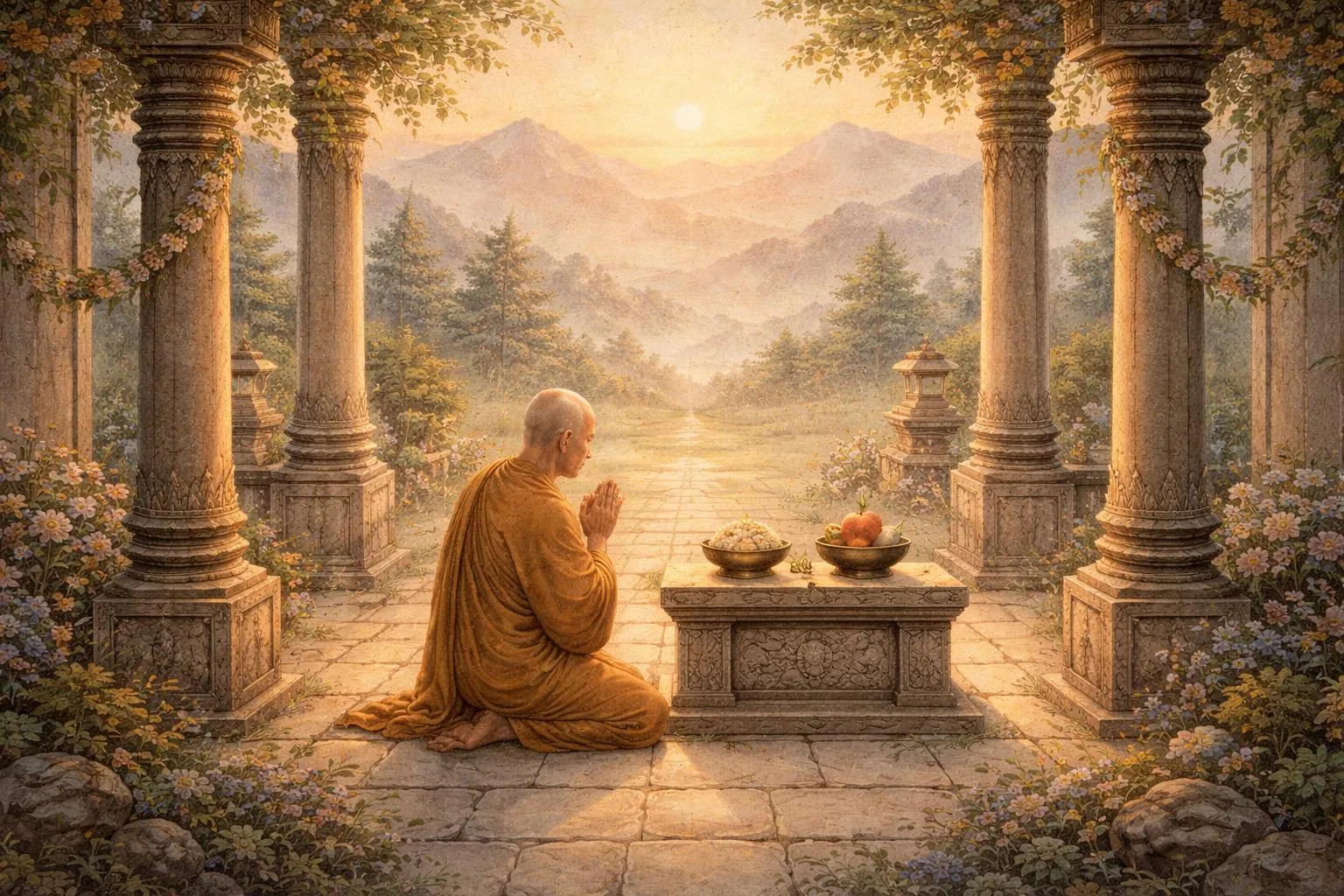
Every day we perform the practice of “Refuge in the Three Jewels.”
In the absolute sense, Guru means the transcendental Consciousness that includes all the deities, saints, siddhas, and teachers of our lineage of teaching. Dharma means the teaching that leads to enlightenment. Sangha is all living beings who follow the path of liberation; in the absolute sense, it is the world of manifested phenomena introduced into the mandala of pure awareness.
To take Refuge means to regard the Guru as a guide, the Dharma as a raft, and to strive with all one’s might toward the “other shore,” toward enlightenment and liberation from the sufferings of samsara. In the true sense, all practice comes down to taking Refuge. From the point of view of laya yoga, Refuge is the unborn Mind, and Dharma is the path of realizing and maintaining it. We simply clarify for ourselves the objects of Refuge. As sadhana progresses, they become ever more subtle and inward. We must remind ourselves again and again of taking such Refuge. At first we realize that we had taken Refuge in illusions. Renouncing illusions, we take Refuge in the Dharma, in the Three Jewels.
When you take Refuge, you must have great determination and commitment to your Refuge. This is what religions call faith. It is not when you are walking along, some sign seems to appear to you, and you think: “Does the practice of liberation suit me or not?” — this cannot even be called any kind of view of spiritual practice yet.
To take Refuge means that even if the earth and sky turn upside down, you follow the Refuge, knowing that you have no alternative. Because Refuge is the same as God, the same as Truth, the same as your true “I.” Even if you are cast down into hell, do not renounce Refuge. When we show such determination after having found Refuge, maya has not a single chance.
Unconditional Devotion
To find Refuge means Refuge not for the sake of a result, but Refuge for the sake of Refuge itself, for the sake of the Dharma, because the very finding of Refuge is the result. In other words, it means devotion to God not for the sake of some results, but devotion as such. It is already the result, it is self-sufficient, it is quite enough. There is no selfish bargain of ours here.
True faith requires nothing in return; it does not hope for results. It is hopeless, and therefore it is unshakable. It wants nothing for itself; it is satisfied solely with the fact of this faith. There is no contract for concluding a barter transaction in it, and therefore it is absolute; nothing can harm it. But if it is conditioned by hopes and the desire for a result, it can be undermined when hopes are not fulfilled or results do not come about.
Refuge should be taken in the same way, thinking: “Even if in this life I achieve nothing and I am destined to be reborn in hell, at least I have found true Refuge; I will always hold to it.” Life in hell with the Refuge of the Dharma is not bad. At least one can be liberated from hell if one has true Refuge. But life in heaven without the Refuge of the Dharma is worse than hell; when the karma of heavenly merits comes to an end, one may fall into a hell from which one cannot get out.
In the inner sense, Refuge means our essential “I,” the Truth within us, boundless non-conceptual awareness, like an ocean of sky, which contains within itself all manifesting phenomena.
The Story of the Sisters Mekhala and Kanakhala
Mekhala and Kanakhala were sisters who were betrothed to two brothers. Then the neighbors began to gossip about them, and their morality was called into question. The family of the bridegrooms broke off the arrangement, so, burning with shame, the disgraced sisters decided to leave their village. However, the elder sister (Mekhala) realized that misfortunes would pursue them wherever they went.
When Guru Kanhapa came to their village, they told him of their sorrow, and he advised them to take up practice. The sisters devoted twelve years to practice, performing the sadhana of the “decapitated Vajra Yogini.” After twelve years they found Kanhapa in his secluded cell. The Guru pretended not to recognize them. The sisters said that they were his disciples. He asked:
“Who are you? I do not know you.”
The sisters told him everything that had happened.
“Very well, now you must pay me,” said the Teacher.
“Oh, Guru! We will give you anything you demand.”
“Then give me your heads, both of them!”
The sisters replied:
“We will give everything the Teacher wants.”
From each mouth appeared a sharp sword of wisdom; the young women cut off their own heads and offered them to Kanhapa, saying:
We pay for what you have given us. We have cut off the delusion of samsara, crossing it out, in the complete union of the stage of “development” and “completion.” We have cut off the illusions of acceptance and rejection, in the complete union of view and action. We have cut off the illusions of self and other, in the complete union of knowledge and space. Here is that which is already devoid of illusion, and with this gesture we give it back.
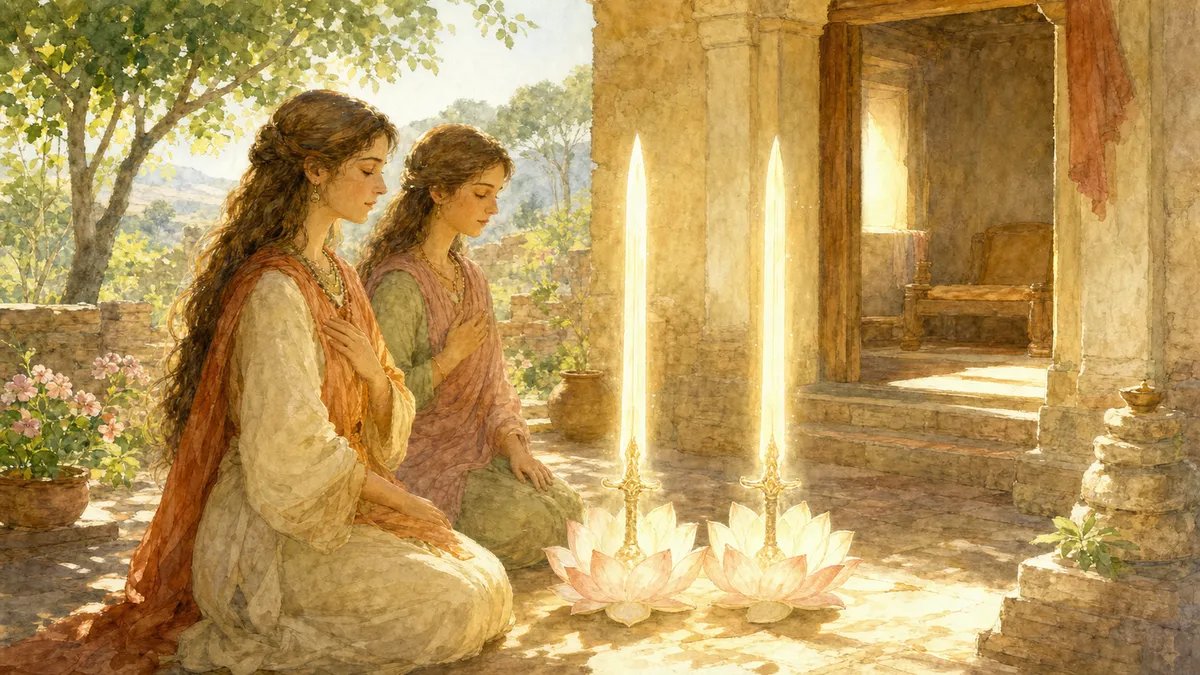
Having said this, the sisters began to dance, holding their heads in their hands.
“Look at these two yoginis!” Kanhapa exclaimed.
“You are happy, for now the rarest qualities are yours. But to remain in your serenity of nirvana is still not the best path. You should act for the benefit of living beings.”
And the Teacher restored their heads so that not even a scar remained, to the great astonishment of everyone around. The sisters, who had followed Kanhapa, became renowned. They attained mahasiddhi and, having brought great benefit to living beings, departed into the Clear Light.
By performing sadhana, they realized the siddhis called the “illusory body.” Of course, they did not cut off the head of the physical body.
Cutting Off Egoism Through Devotion
When we follow the Dharma, we must cut off the head of our egoism. This is the head that gives rise to duality. The shortest path to cutting off egoism is boundless devotion to the Dharma. If you want to realize true Refuge and the Dharma, forget yourself, all your plans, hopes, and worldly desires; remember only the Dharma. In following the teaching and the Dharma, do not even try to derive your own benefit from it, understanding that simply following the Dharma impeccably in and of itself is the highest benefit. If you have such commitment to the Dharma, it will bear fruit within you.
What does it mean to have such commitment? It means that whatever your consciousness encounters, you must make it the path, regarding everything as practice. For example, a person has read the “Bhagavad Gita” and gained commitment to Krishna. If his commitment is true, then whether suffering or, on the contrary, enjoyment falls to his lot, he must regard it as Krishna’s grace or blessing. When he suffers, he should think: “How wonderful! In this life all my ignorance is being eliminated. So quickly, by Krishna’s grace, my attachment to the pleasures of the physical body and to this world is being eliminated. This is the best of lessons that could have been given to me.” This may be called true devotion, which does not require a result.
When the grace of the Dharma touches us, it is important to receive this grace truly, gaining such devotion to it. This means: whether we are making progress in practice or not, whether we feel joy from practice or suffering from practice—all of this is united and becomes a single “taste.” Then it is impossible to suffer defeat; then everything is practice, and you truly receive genuine progress beyond results.
Overcoming the Limitations of the Small “I”
Our little “I” is limited by hopes and fears; it clings to itself. When it succeeds at something, it rejoices, congratulating itself on new achievements; when it fails at something, it falls into depression or despondency. It is like a fish that, swimming in the ocean, asks for water while dying of thirst. Or it is like a mouse on a heap of grain that dies of hunger. In the same way, we bathe in absolute Reality. However, because of being fixated on our own problems, we constantly miss it.
When we gain devotion to this absolute Reality without conditions, without a desire for guarantees, when we set no conditions, suddenly this Reality opens to us, turning toward us. We see that it has always been there, but our hopes obscured its light.
Impeccability in Daily Practice
The question is how to be impeccable in one’s practice every day. If you have received the basic practices, you must be impeccable in them. If you are engaged in service, it must be impeccable service; if you meditate, then for the entire duration of the session you must feel as though you are meditating for the last time in your life, as though everything is at stake right now—this should be your daily approach to the Dharma.
If you have come to the monastery, it means that you constantly remember where you are and the choice you have made. You do not allow yourself to be distracted by the worldly even for a second. You do not sustain a single worldly thought within yourself. You do not sustain any of this, because you know that in this place the question of life and death is being decided, that this is a place of Dharma, where everything worldly must be cast aside, where you must make a total choice and leap into that choice.
