

Commentary on Saraha’s text “Doha Kosha”
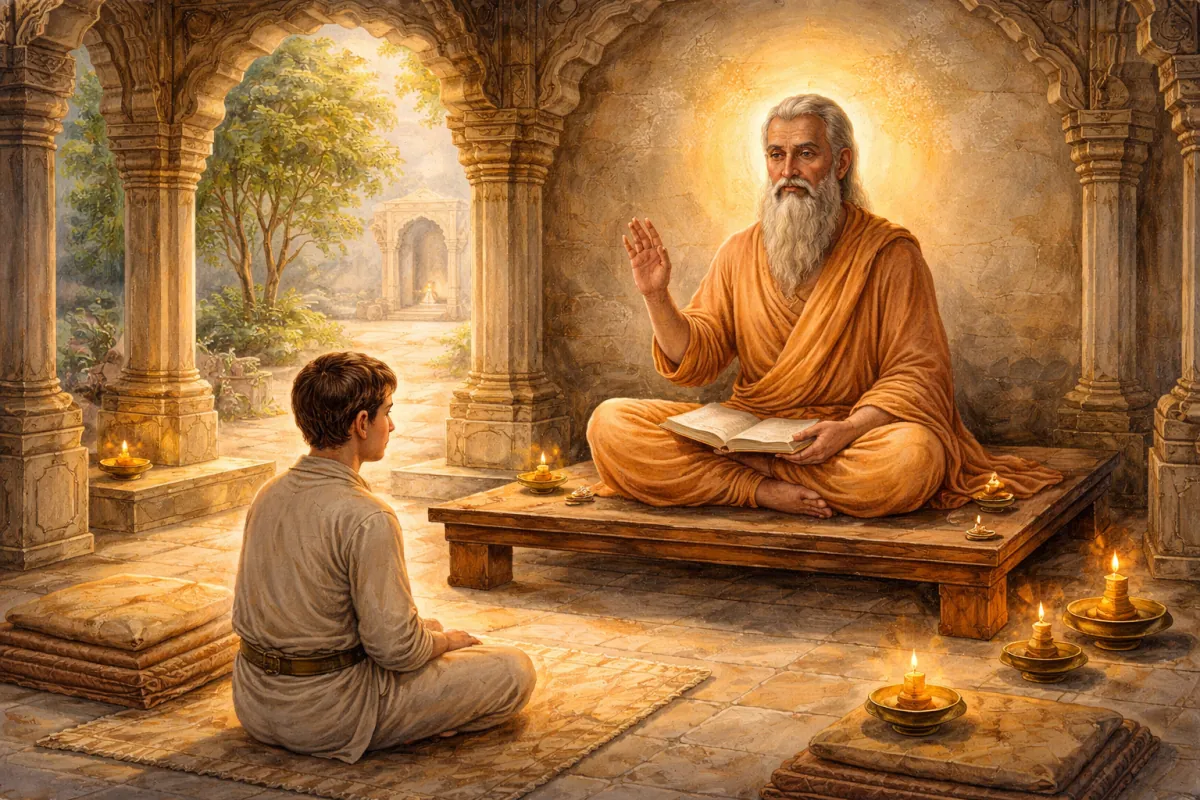
One of the most revered acharya teachers in the tradition of the anuttara-tantra teaching is considered to be the mahasiddha Saraha. Saraha is the adi-mahasiddha, that is, the primordial mahasiddha. He is regarded as the father of both Hindu and Buddhist tantra and as the author of the “Guhyasamaja Tantra,” a well-known text in the Tibetan tradition. Saraha belonged to the Hindu tradition, since he was born and raised as a Brahmin in a Brahmin family. At the same time, he is also venerated in the Buddhist tantric tradition.
In the story of Saraha, it is said that, having been born into a Brahmin family, he received a traditional Vedic education and then became a monk at Nalanda University, where he was trained in various tantras. After that, he received initiation from female deities (dakinis). His Guru was a dakini, a woman from a simple caste, an arrow-maker, which is why he received the name Saraha, meaning “the one who released the arrow of nonduality.” In fact, if you understand Saraha’s instructions, you will understand the essence of the teaching of Laya Yoga.
Laya Yoga belongs to the sahaja tradition, or the natural path of contemplation. Sahaja points to the wisdom born together (saha) with us (-ja), naturally inherent in our awareness. This means that the path of practice consists in continuously abiding in this wisdom of the natural state, born simultaneously with us. In fact, the path consists in the continuous focusing of consciousness on the natural state. However, to say that one can focus on the natural state is to express it inaccurately, because abiding in the natural state means a state beyond focusing, beyond any fixation, when the mind is not concentrated on anything but abides in openness and nakedness, like space. True abiding in presence is incomprehensible, and we cannot even imagine how profound the mahasiddhas’ abiding in the natural state is.
There are three main principles that we practice on the path of contemplation.
The first principle is receiving transmission from the Guru, when the Teacher points us to the nature of the natural Mind. Receiving instructions from the Teacher and practicing on our own, at some point we come very close to it, and it begins to shine. Before we have discovered the natural state, we are like a blind person wandering through a dark labyrinth, and even while listening to instructions, we may not understand them. Therefore, the words of the Teacher’s instruction are very important at this time. Saraha says:
Those who have not respectfully drunk the nectar of their Teacher’s instructions die of thirst in the waterless desert of an infinite multitude of texts.
That is, even if we have studied many texts but still have not discovered this state, we may have many doubts and illusions; we may remain in misunderstanding.
When this state has been pointed out, we must clarify it and eliminate all obscurities—this is the second principle, which is called manana. But to clarify does not mean to know something mentally; it means to become rooted in a deep state of awareness in which there is no longer any doubt. At this stage, the Teacher either gives confirmation to the student or does not. For example, I have given many people the task of finding the answer to the question: “What is the sound of one hand clapping?” or “How can one help a horned rabbit?” Usually these tasks are given to the student so that he meditates on the problem until he gives a satisfactory answer. When the Teacher confirms that the student has given the correct answer, this is an indication that the second stage has been passed, that the student has eliminated all obscurities and doubts, and that the natural state has been discovered by him. One should not think that this can be realized in a week. Many monks in Zen struggle with this for years. It is not simple. You must truly work on it for a long time until the right answer comes to you. In fact, satori in Zen and receiving confirmation are one and the same.
When we have discovered a minimal degree of clarity of presence, we continue to work with it, integrating it with all aspects of our life so that it deepens. Sometimes a student thinks that he has discovered the nature of the Mind and has advanced very far, but the Teacher may say to him: “No, no, you are an idiot! This is not what I think of as enlightenment.” Then the student again and again meditates on the saying and tries to give another mental answer. But the Teacher rejects his answers until the student enters a state where there are neither questions nor answers, but only living, naked presence; and then he no longer gives a mental answer, but allows the Clear Light to respond to this question, and this response itself is the authentic answer. Since in this response there is authenticity and true depth, the student receives confirmation.
Finally, the third stage comes, which is called maintenance (nididhyasana). It is not enough to receive transmission into the nature of Mind; it is not even enough to eliminate doubts and experience its deep radiance. The luminosity of this nature of Mind can be experienced if you meditate diligently and are able to realize samadhi. One who undergoes long retreats at some point touches this great state, but for the practice of laya yoga even this is not enough. It is important to maintain contemplative presence in the post-meditative period and never be distracted. In fact, the third principle means the continuous maintenance of contemplative presence, when the yogin does not lose it even for a moment. He walks in it, lives, eats, and sleeps in it. He attends to the needs of the body, rejoices, suffers, and unites all his situations with the natural state. This is the true practice of the mahasiddhas. When a yogin has realized such an ability, it is said that there are no longer any external rules for him, that he has one single rule—awareness. External practices, such as mantras or techniques, cease to be important for him. His only practice is maintaining this state. Day and night the yogin continuously abides in reverent presence, constantly bowing before, admiring, and marveling at the Clear Light. It can be said that he continuously abides in Guru Yoga, regarding the Clear Light, the Guru, and his own mind as inseparable.

“When the words of the Teacher penetrate the heart, ‘This’ begins to shine like a pearl in the palm of the hand.”
“Mind in its naturalness is the sole seed of all that exists. Both samsara and Nirvana grow from it. Revere this Jewel that fulfills all wishes and bestows everything.”
When we speak of the nature of Mind, this does not refer to the nature of the superficial mind. There is a great difference between the superficial mind and the fundamental Mind. The superficial mind is a function of the ego. Its tasks are acceptance and rejection. The fundamental Mind is the Absolute itself; it is the one God in Christianity, Brahman in the Vedantic Hindu tradition. This fundamental Mind is worthy of every kind of reverence and admiration. A true yogin establishes a connection with this fundamental intelligence, and his entire further task is to understand how to integrate completely with it, how to unite with it every drop of his soul and his energy, every deed, every action, and every word, how to live without losing this fundamental Mind for even a second. If we speak in the categories of ordinary religion, this means unceasing devotion to God, when a truly believing person thinks of God, acts for God, speaks for God, lives only by God, and his small false “I” is constantly dissolved in God.
In the terminology of laya yoga, we do not speak of God in an external sense; we say that God is our fundamental nature, that it is our own “I,” because in Advaita, God and the soul (individuality) are inseparable; they are in fact one and the same. Nevertheless, we say that a true yogin is continuously in contemplation of the Absolute, he thinks of the Absolute, unites with it, and makes every action an offering to the Absolute; nothing he has is separate from the absolute state.
Saraha goes on to say:
“Your ‘Self’ is everywhere: before you, behind you, and in all ten directions. Understand, Mind is like space. Understand, Mind has a spatial nature!”
These words, when you practice, should be engraved or written down somewhere and remembered forever, so that you can continuously remind yourself of them.
The mind of an ordinary living being is shriveled because it lives in the cage of individual perception. Because its mind is shriveled, the living being identifies itself with the body, the pranas, and so on. Liberation means that this cage is broken apart, and consciousness begins to soar in freedom. Bondage to samsara arises because of strong identification with the superficial mind and the body, and then our spatial nature is obscured; we feel compressed, having specific forms and dimensions. But this does not apply to the true “I.” To be constantly in the natural state is to feel oneself continuously expanded, like infinite space, and to become ever more imbued with this feeling. This state is like soaring.

Types of Samadhi and Their Attainment
The state of the holy mahasiddhas is the greatest spatial state. At first it is realized at the level of consciousness. After this, the energies of the body also begin to transform. Everything depends on the depth at which we abide in this spatial state. When the state of presence reaches its culmination, it is said that the yogin has entered sahaja samadhi.
Sahaja samadhi is the highest type of samadhi that can be realized in the physical body. Even if a yogin realizes nirvikalpa samadhi, this still means nothing in itself. Upon emerging from nirvikalpa samadhi, he may again enter the illusion of duality if his mind has not been completely dissolved. That is why we say that nirvikalpa samadhi is only the first step. However, even this first step may perhaps take many people an entire lifetime, since the attainment of nirvikalpa samadhi is a very great state that cannot be reached while living in an ordinary way.
But in laya yoga, what attracts us is not nirvikalpa samadhi, but sahaja samadhi. And when we practice contemplative presence, then even if we are not deeply established in it, nevertheless we are, as it were, moving toward this sahaja samadhi while abiding in gentle contemplative presence. Sahaja samadhi means that even if a yogin does not have experiences of the breath stopping, the heart stopping, the vision of light, or the loss of the sense of the body, he nevertheless continuously abides in an expanded natural state. He abides in it effortlessly, constantly remaining in naked awareness. He works with this subtle awareness, integrating all aspects of his life with it. He becomes so accustomed to it that it first becomes his second “I,” and then his first “I.” Even if this state is not very deep, nevertheless it grows year after year; the yogin becomes accustomed to it and learns to respond and act from it. While the superficial mind is active in the waking state during the day, this state is not very deep, but when the yogin falls asleep, he deepens it, and the immaculate Clear Light manifests. This is usually how contemplative presence develops without the practices of nirvikalpa samadhi.
Finally, when this contemplative presence reaches its culmination, it possesses tremendous power and begins to act upon the energies of the body. Then the energies of the body begin to be transmuted, and the yogin enters what is called the great transition (kaya-vyuha or saruba-mukti). This means that even the energies of the yogin’s physical body begin to transform; his physical body gradually begins to disappear, turning into the illusory rainbow body of Light. Great Masters usually demonstrate this either during their lifetime or at the moment of death. Thus, the goal on the path of laya yoga is the attainment of the three types of samadhi.
Daily Practice
When we practice, we should have a clear goal, an algorithm of practice. If we have understood that we are striving to free ourselves from the sleep of ignorance, we must find out what this liberation and enlightenment mean. Then we ask ourselves: “What exactly is it?” It is nirvikalpa samadhi, sahaja samadhi, and saruba samadhi, that is, the three types of samadhi. Liberation and enlightenment are preceded by the lower type of samadhi—savikalpa. Then we set ourselves the goal of freeing ourselves from suffering and attaining enlightenment and awakening through the three types of samadhi. When such a goal has been set, we must at least try to work one-pointedly to achieve it. We must think about how to attain samadhi and build some kind of strategic line of life. For example, we have learned that samadhi can be attained by practicing the teaching and studying with the Guru. Then the next stage of our path consists in understanding what, in fact, the essence of the Teaching is, what the Guru says. Therefore, we try to understand the teaching deeply and to delve into the practices given by the Guru. We strive to understand what the Guru’s method consists of, what its secret is.
Every Teacher has his own special secret, that on which his teaching is built—that is, a certain particular feature through which he can lead a disciple to liberation. And we must understand what this secret consists of. It is similar to how any artist, sculptor, musician, or martial arts master has some special vision or method of his own. In the same way, on the spiritual path there is such a secret. This secret is called the lineage of transmission (parampara), that is, the specific methodology of the teaching that should be practiced in order to obtain results. For us, this secret is a special rule about which I tell the disciples: for twelve years one must practice the basic sadhana, then the sutra, then tantra, then anuttara tantra; in the third, sixth, and ninth years one must undergo dark retreats. If you do this, everything will work out for you.
For a disciple, if he wants to receive the secret from the Guru, it is very important to understand what this secret consists of and to take it very seriously, because his spiritual realization depends on it. If he fails to receive this secret, he will simply be satisfied with certain spiritual experiences.
When we understand what the main principle and method consist of, we reflect: “How can I embody this? How can I introduce this into my life?” We try to bring it onto a practical plane, to understand where, how, and when to do it. At this stage, we already become high-level practitioners who proceed one-pointedly and directly along the spiritual path, no longer turning away from the road.
The Principle of Purification
Although the teaching is very deep and lofty, I think it is important to understand the initial principle; otherwise, the teaching will be something detached from our life, cloud-high summits that are very far from us. What is this principle that allows us to become masters of practice, like the siddhas? It is the principle of purification.

When we begin to practice, we see that it is very difficult. Not just difficult, but at times it seems incredibly difficult. This is so. One should not think that, having studied one or two techniques, we will begin to fly or experience profound transpersonal states, although this is also possible if you are near the Guru and your mind is wide open. Nevertheless, the spiritual path requires purification, and every monk or practitioner will tell you about his own life, full of drama and struggle with the lower nature on the path of purification.
What does purification mean? Purification means that, in addition to performing techniques and meditations, we gradually need to change ourselves, our attitudes, and our values. If we cannot do this, then our energetic and mystical experiences will outpace our attitudes and values, and therefore disharmony will arise between them. And in such a case, teachers say that one should wait with energetic practices, not force them, but practice mindfulness, accumulate merit, engage in service, and study the teaching. This is indeed so, which is why it is said that there are basic practices that must be performed, and there are purificatory practices that allow us to change our life.
For a true yogin, when he sets out on the spiritual path, everything becomes very simple, because his life seems to be divided in half: there is that which is favorable to samadhi, and that which hinders it; there is that which advances him along the spiritual path, and that which moves him away from it. In this sense, the life of a yogin is very simple, since he is constantly maneuvering between plus and minus. And especially for practitioners in the world, I have compiled a table that can very approximately show what is a plus and what is a minus. This table is very conditional, since it is impossible to calculate various actions, and especially to evaluate them in units, all the more so because everyone has different karma. Nevertheless, it reflects tendencies. At least, that is my vision.
The System of Spiritual Progress in Yoga
Now I will list what advances a yogin on the spiritual path and what sets him back, and you can apply this to your own life. For example, if attaining enlightenment means accumulating such potential that quantity would turn into quality, then it can be said that attaining enlightenment requires accumulating one thousand spiritual units. And this is similar to the critical mass in the creation of nuclear weapons. For example, one cannot create a nuclear bullet, only a nuclear bomb, because for a chain nuclear reaction to occur, about three kilograms of substance are needed. And if there are only three hundred grams, then a nuclear reaction will not occur, because there will be no critical mass. In the same way, for the nuclear reaction of enlightenment to occur, such a critical mass is necessary. And we accumulate it in everyday life. So, these assessments are very subjective; nevertheless, they do express something, and you can use them as a guideline.

Factors Contributing to Spiritual Progress
- Retreat on basic practices / 1 day +20
- Difficult high-level retreat (for example, a dark retreat) / 1 day +50
- Accumulation of merit, service to the Dharma / 1 day +30
- Donation to the Dharma / 1 day +10
- An ordinary day of an intermediate retreat +30
- Daily sadhana (meditations or techniques) / 1 hour +3
- Study of the teaching (reading or listening) / 1 hour +5
- Taking monastic vows +300 annually
- Observance of celibacy (brahmacharya) +200 annually
- Observance of the basic yogic precepts +200 annually
- Ascetic practice, when we endure and surpass ourselves / 1 hour +10
- Communication with those who are higher in spiritual level and help one advance / 1 hour +10
- Living far from cities +100 annually
- Observance and purification of samayas +200 annually
- Silence (mauna) / 1 hour +5
- Helping others in the Dharma / 1 time +5
- Having a spouse who shares spiritual interests +100 annually
- Having like-minded laypeople +100
- Living among like-minded monks +200 annually
- Living among those who have attained realization +500
Factors Hindering Spiritual Progress
- Watching films, television, worldly news / 1 hour –20
- Communication with non-practitioners for beginners / 1 hour –20
- Communication with non-practitioners for experienced practitioners / 1 hour –5
- Sexual relations with loss of energy during orgasm / 1 time –30
- Reading worldly literature or newspapers / 1 hour –20
- Non-observance of the basic precepts of yoga / 1 time –10
- Break in practice (complete) / 1 day –10
- Material spending on worldly pleasures / 1 day –10
- Visiting entertainment establishments that scatter concentration / 1 hour –10
- Living in a crowd, in a city, amid worldly affairs –100 annually
- Violation of vows, pledges, samayas once given to the Guru, the Dharma, and the Sangha. If it is a major violation in a year –500, a minor one –100
- Idle talk / 1 hour –10
- Sleeping during the day / 1 hour –100
- Drinking alcohol / 1 time –20
- For any reason, changing the Teacher and establishing a relationship with another Teacher, if one has practiced previously –500
- Changing the method of practice –200
- Illness / 1 day –20
- Having a spouse who does not share spiritual interests –300 annually
- Engaging in extraneous affairs not related to practice, except for the natural needs of the body, care for food, survival, and so on / 1 hour –10
Age-Related and Typological Features
These figures for the pluses apply up to thirty or forty years of age. After forty, the pluses decrease by one and a half times, and after fifty, by two times. The minuses after forty increase by one and a half times, and after fifty, by two times.
This calculation is given for the middle category of yogins — vira. Vira is a spiritual hero. But in reality, you will rarely meet spiritual heroes. Divya (divine) are those yogins who initially possess great faith, renunciation, and the capacity for practice, so for such sadhakas all the pluses can be doubled. Pashu are those who have weak will, strong attachments, low abilities, and little faith, so for them all the minuses are doubled.
Question: And do the pluses remain?
Yes.
Such is the mathematics of a yogin. It is very strict, sometimes discouraging, but it shows the real state of affairs.
Practical Application of the System
How can we work with this? We can increase the pluses (accumulations) and decrease the minuses, that is, what distracts us from practice. When we cut off distractions and leaks, our pluses rise sharply, our energy is preserved, and the natural state grows. In fact, in a short time one can close a large number of minuses and add a large number of pluses.

A true master of yoga continuously sees the world through the prism of “plus/minus, plus/minus, plus/minus.” He will not allow anything extraneous to interfere in his life so that it may not divert him from the spiritual path without authorization. As far as possible, he tries to avoid deviations and continuously move forward, like the horn of a rhinoceros. This is the way the saints recommend living. Of course, this differs very greatly from the lifestyle of an ordinary person. Nevertheless, if we want to attain genuine holiness, we have no need at all to remain ordinary people.
