

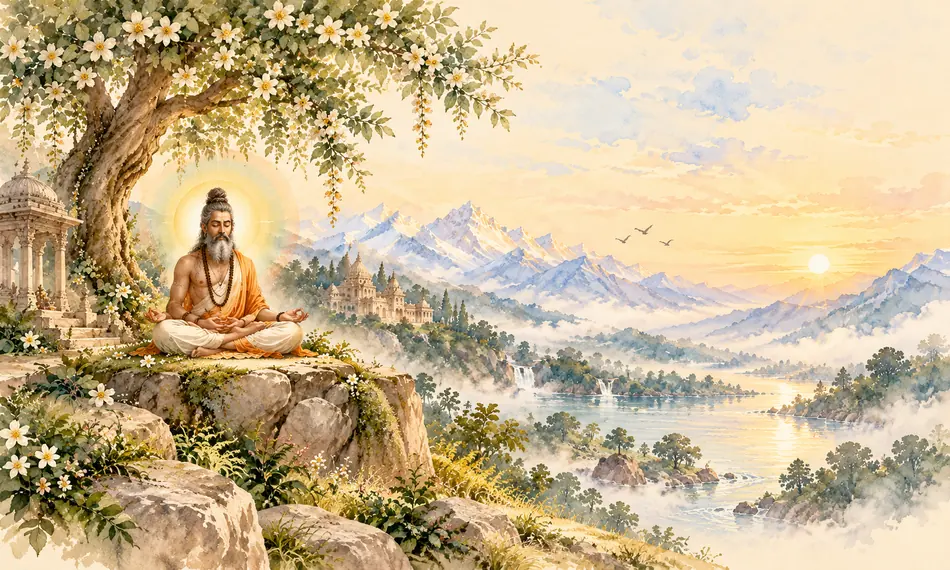
Thus, the opening of the three bodies is connected with the concept of the three enlightened bodies, which are one of the fruits of the precious Teaching of Laya Yoga. In every Teaching there are the Basis, the Path, and the Fruit. The Basis is what we rely on, what we believe in, what we take as our starting point. For example, in our tradition, the Basis is an understanding of the Absolute given in the sacred scriptures, an understanding of Brahman; the Path is our practice for realizing it; and the Fruit is what we receive as a result, at the end—it is our final destination.
So, what is the fruit of the Dharma that we practice? The highest Fruit of Laya Yoga, Advaita, and Sanatana Dharma is the attainment of complete Liberation, complete Enlightenment, and merging with the Absolute. Sayujya-mukti. But this is not only sayujya-mukti, when the Soul unites with the Absolute and dissolves; it is also the attainment of the status of Brahma, the Creator of the Universe. That is, energy develops so greatly from the state of sayujya-mukti that the yogin attains the highest jnana shakti, iccha-shakti, svatantriya-shakti, aishvarya-shakti, kriya-shakti, and ananda-shakti. And such a highest state of the energies (shaktis) is embodied by Brahma, the Creator of the Universe, as well as by all the gods who are on his level. And such an attainment is the state of the sixteen kalas, the highest state, the sixteenth stage of realization.
However, by the time we become like Brahma, the Creator of the Universe, perhaps another thousand lifetimes will have passed. That is, this is a very distant, remote goal for the future. Nevertheless, everyone can become Brahma, the Creator of universes. Confirmation of this is found in the “Yoga Vasishtha,” which describes the story of the ten brothers of Indu, and in the “Tripura Rahasya,” in the chapter “The Universe Inside the Hill,” which describes a yogin who created a Universe inside a hill, serving as its Brahma-Creator. Thus, this is the highest state—the apex of the development of our consciousness and our energy.
There are also intermediate fruits of practicing the Teaching. And one such fruit is the attainment of the three Enlightened bodies.
The Nature of Consciousness and the Creation of Bodies
What is the basis for understanding the three Enlightened bodies? The basis for this understanding is the assertion that our consciousness does not depend on the physical body. It is the nondual divine space of Light. And this consciousness, through the power of the mind, can create any body at any point in space, independent of reincarnation. Depending on karma, it can create such a body from gross tattvas, which contain tamas, rajas, and sattva. Or it can create a body solely from pure tattvas, from the state of pure sattva. And such a body, created from pure sattva, is called shuddha-sattva-rupa.

For example, our bodies are created from impure tattvas. The physical body consists of tamas. The energy body consists of rajas. The astral, mental, and causal bodies consist of sattva with various impurities. And our mind, our consciousness, is like a printer that creates a three-dimensional object and can print any body, in any dimension, and any situation. Our mind is infinitely free Consciousness, which has granted us complete freedom.
And even when we suffer—for example, when we receive some negative karmas, or even acquire a body in hellish dimensions—this is only because we have freedom. That is, our inner Lord, our nature of mind, says: “You are completely free. Whatever you want, that is what will be. I will fulfill any desire of yours. If you like the body of an animal, you can have it if you give me the command to become an animal. If you like being an asura, I will give you the body of an asura. I will fulfill any wish of yours, because you are my lord—anything. You have been given complete freedom.”
God gives our Soul complete freedom because He respects it boundlessly. He says: “I absolutely respect all your thoughts, all your intentions, and your sankalpas. I allow them all to be fulfilled. Whatever you want, that is what will be.” And when, being dissatisfied, we begin to analyze: “Why is this happening? Why has the Lord punished me?” In reality, the Lord did not punish us. In reality, our present karma is a continuation of our past thoughts. A simple Law is at work: we receive what we think about. If you want to know about your past life, look at yourselves as you are now. If you want to know who you will be in your next life, look at the course of your thoughts. This is how the Law of Karma operates.
And our mind in a state of ignorance resembles such a malfunctioning 3D printer that keeps printing and printing various things, all of it uncontrollably, and we keep receiving gross bodies in samsara. This happens only because we give it such commands. But if we change our mind, learn to control it, learn to give it the right commands and formulate the right sankalpas, then our mind can create beautiful, divine things. It can create such manifestations of the energies of our “Self” that will not be connected with tamas and rajas, but will contain pure sattva within them—the enlightened energy of realizing the Divine.
And so, the three enlightened bodies are the three pure dimensions into which our consciousness can be cast when we practice.
Jnana-deha—The Divine Body of Wisdom
Jnana-deha is the dimension of our consciousness as emptiness, as nonduality. When we practice Mahashanti meditation and Atma-vichara, we can discover within ourselves the pure, empty space of consciousness if we deeply enter into the experience of dhyana. And in this consciousness there is no name, no form, no subject, no object; there is pure luminosity that lies beyond the five sheaths. And when we deeply investigate and establish ourselves in this consciousness, ultimately we arrive at the realization of the Divine Body of Wisdom, jnana-deha.
The Body of Wisdom is simply a conventional term. In reality, it is the realization of one’s nondual nature as the Absolute, the realization of Emptiness. Shunya (Emptiness) is not only a Buddhist concept; this concept also exists in Advaita Vedanta.
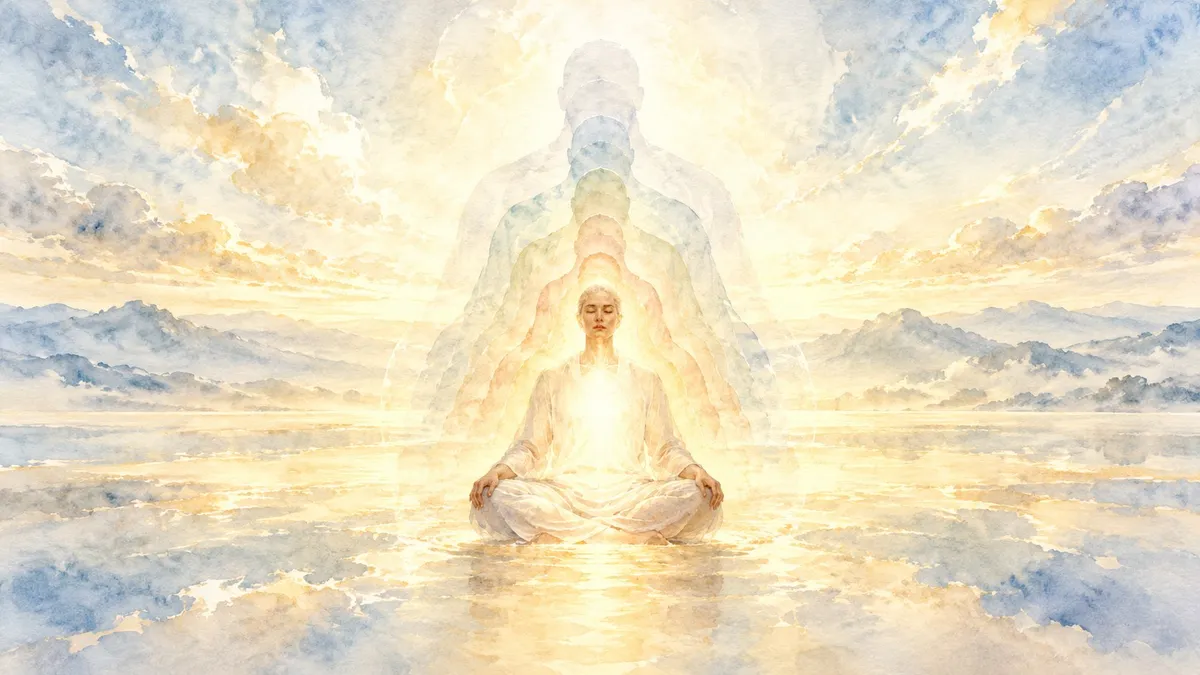
Brahman is Shunya. The nature of Brahman is emptiness of illusory objects. But Shunya is understood somewhat differently in the Vedic tradition than in the Buddhist tradition. Emptiness in the Vedic tradition is a form of fullness. It is emptiness in the sense that there are no qualities, definitions, subject, or object. It is a state beyond the mind, founded on nothing—niralambha.
And gradually, through meditation and contemplative practices, cutting off our egoism and practicing pancha kosha viveka—the discernment of the five sheaths—we open within ourselves the subtle luminous layer of nondual awareness. And when we become established in this luminous layer to the point where we can live in it, separate from the mind and body, day and night, when all our illusions disappear, it is said that a person has realized the Body of Wisdom. This is the eternal, unchanging Consciousness. He himself has become Infinity, the Supreme Meta-Mind, having transcended subject and object, past, present, and future, and gone beyond material nature.
Jnana-deha (the divine Body of Wisdom) is created when we go beyond the causal body and penetrate into the pure light of nonduality. It can be said that it consists of the understanding inherent in the causal body and the light of nonduality. When our understanding, our knowing activity, and the light of nonduality combine, the realization of the Divine Body of Wisdom takes place.
What does a person who has realized the Body of Wisdom (jnana-deha) feel? He feels himself to be the boundless space of Consciousness beyond the body: the boundless space of Divine, transcendent Consciousness that is omnipresent, omniscient, all-pervading, and omnipotent. Perhaps he has not fully realized this, but day and night he is aware of himself as the omnipresent, nondual space of Consciousness beyond subject and object. He is Infinity itself. And in Advaita Vedanta, the expression of such infinity is the mahavakya: “Aham Brahmasmi”—“I am Brahman.”
It is impossible to describe. One can give a great many lectures, but it is said that even if Brahma tried with all four of his heads for many billions of kalpas to describe this state, it would be impossible. Because it lies beyond the mind and logic. But one can at least hint at it, saying: “It is beyond name and form. It is beyond subject and object. It is beyond all five sheaths. There is no time in it: past, future, or present. There is neither inner nor outer in it. There is neither earth, water, fire, air, nor space in it. There is not a single thought in it, and the three impurities (malas) are absent: anava-mala (the feeling ‘I am a small individual’), karma-mala (the feeling ‘I am the doer, the fruits belong to me, I act’), and maya-mala—the illusion of multiplicity (the feeling ‘these are all different objects’). It is Consciousness that sees the world through the eyes of nonduality, when subject and object have completely reunited. It is the Consciousness of abiding in the Divine. And when this Consciousness is realized, Jnana-shakti awakens—the power of divine Wisdom. Jnana-shakti means not only wisdom and understanding, but also a certain power to overcome ignorance and dispel ignorance.”
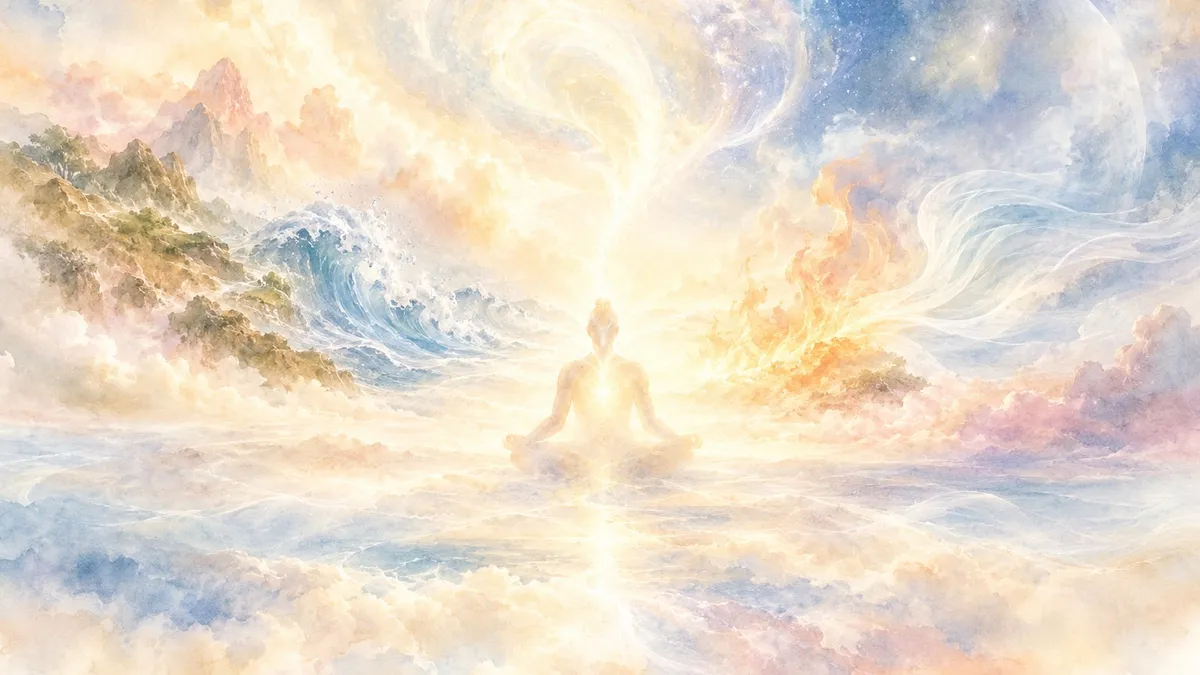
Eternal, omnipresent, eternally free, omnipotent, the one who was never born and never dies—this is Bhagavan Dattatreya. He is the Absolute itself. When we realize the Body of Wisdom, we can see these qualities within ourselves.
Pranava-deha – the Divine Illusory Body
Another of the three bodies is Maya-rupa-deha—the illusory body. The section of the Teaching called Nidra Yantra is specifically connected with attaining this illusory body. Maya-rupa-deha, or the illusory body in the form of a deity (another name for it is Pranava-deha), is created by subtle winds and consists of the subtle enlightened Mind and subtle pranas.
And if Jnana Deha operates in the causal world and beyond it, in the nondual transcendent world—that is, in dreamless sleep and beyond dreamless sleep (Turiya, Jnana-deha, which we discussed)—then Pranava-deha (the divine immortal illusory body) operates in the subtle, astral world. The astral world is also called Antar-Loka. The causal world is Shiva-Loka, and the astral world is Antar-Loka.
The illusory body consists of the subtle pranas of our subtle body, which are completely purified, and the nondual state of mind. When the nondual state of mind and the subtle pranas are joined through visualization and mantra, the invocation and transmission of the deity, an immaculate divine body is created in the form of the chosen deity, endowed with thirty-two divine marks. We will discuss the Illusory Body later as well.
Siddha-deha – the Divine Energy Body
Finally, Siddha-deha. The basis for creating Siddha-deha is our energy body—the prana-maya-kosha. When our energy is purified to the proper state, it can assume any form. For example, a person who has attained Siddha-deha can incarnate in any of the worlds. In any gross world, they can manifest as an Enlightened Being, without being obscured by entering a womb. In any gross world consisting of tamas, of dense elements, they can manifest as a Divine Being.
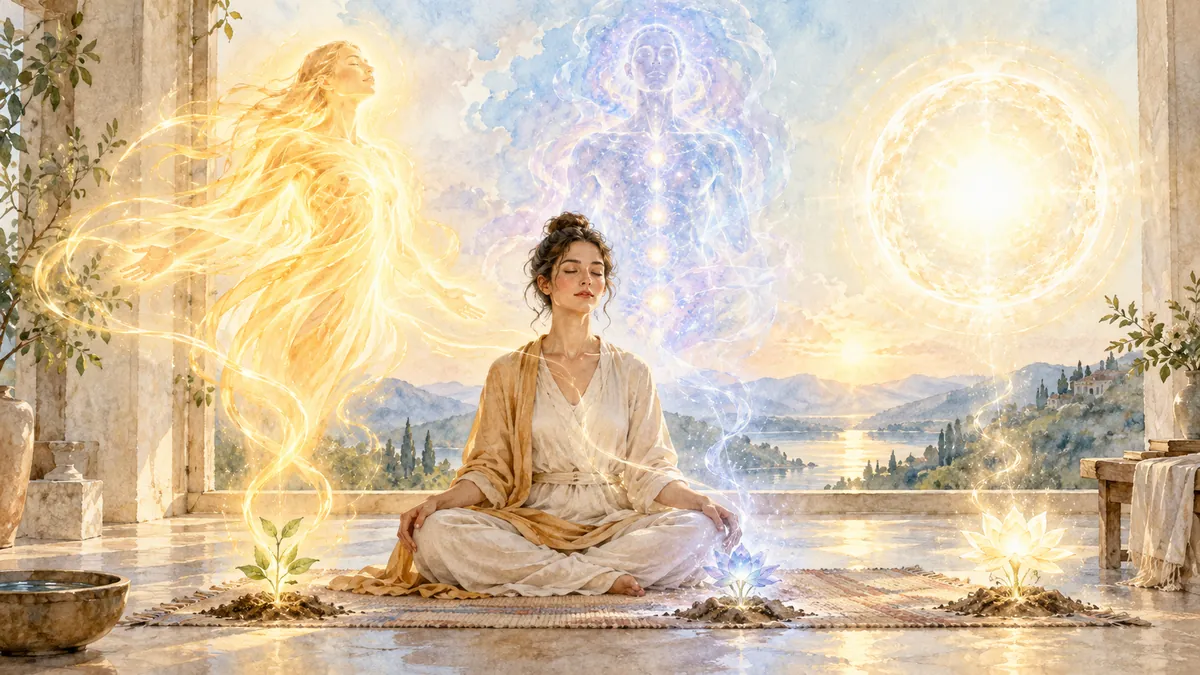
When we engage in purifying our energy and work with prana, we plant the seed and create the conditions for creating Siddha-deha—the Divine energy body. When we meditate on the subtle body, recite mantras, and engage in visualization, we plant the seed for creating Pranava-deha—the Divine Illusory Body.
The basis for the Illusory Body is our psychic body, which usually arises in dreams. Finally, when we meditate on the Nature of Mind, Emptiness, and nonduality, we plant the seed for attaining Jnana-deha—the Enlightened Body of Nonduality.
Dattatreya – the Source of the Three Enlightened Bodies
And we associate all three of these bodies with the dimension of Bhagavan Dattatreya. Because Dattatreya is the very essential nature of non-duality. Dattatreya is pure Consciousness, which is the foundation for the realization of these three bodies. It may seem that Dattatreya is a Deity with six arms and three heads, seated on a lotus. But in fact, this is merely one form of Dattatreya, of which he has very many. And he can assume the most incredible and paradoxical forms. But Dattatreya himself is infinity; he is the Divine Meta-Mind, omniscient, all-pervading, omnipotent Consciousness, infinite Consciousness, which, out of compassion, assumes the familiar form.
If we take the text “Dattatreya Sahasranama” (“The Thousand Names of Dattatreya”), it says:
“I pay homage to Dattatreya, clad in the directions of space, anointed with ashes, abiding beyond the mind, dark-bodied, placed in Brahma-samadhi.”
Dattatreya is simultaneously the Absolute itself, which contains within itself such gods as Brahma, Vishnu, and Shiva; he is Parabrahman itself. This is stated in the Shandilya Upanishad. At the same time, Dattatreya is also a Deity dwelling in the higher divine worlds, in Dattatreya-loka. One such loka is Shvetadvipa. This is a place upon which we can meditate at advanced stages of samadhi in order to enter this very sacred place—a place where all beings possess enlightened realizations of samadhi and abide in divine bodies, meditating on Dattatreya in the form of Narayana.
At the same time, Dattatreya is a great yogi, an avadhuta, and a holy siddha, the patron of all yogis, of all Nath orders, the patron of our Juna Akhara order, the primordial Guru of all gurus, who lived in the Satya Yuga, the Treta Yuga, and the Dvapara Yuga, who never died, who is immortal and still lives to this day. And he visits with his blessings those who invoke Him in a state of faith, humility, and devotion.
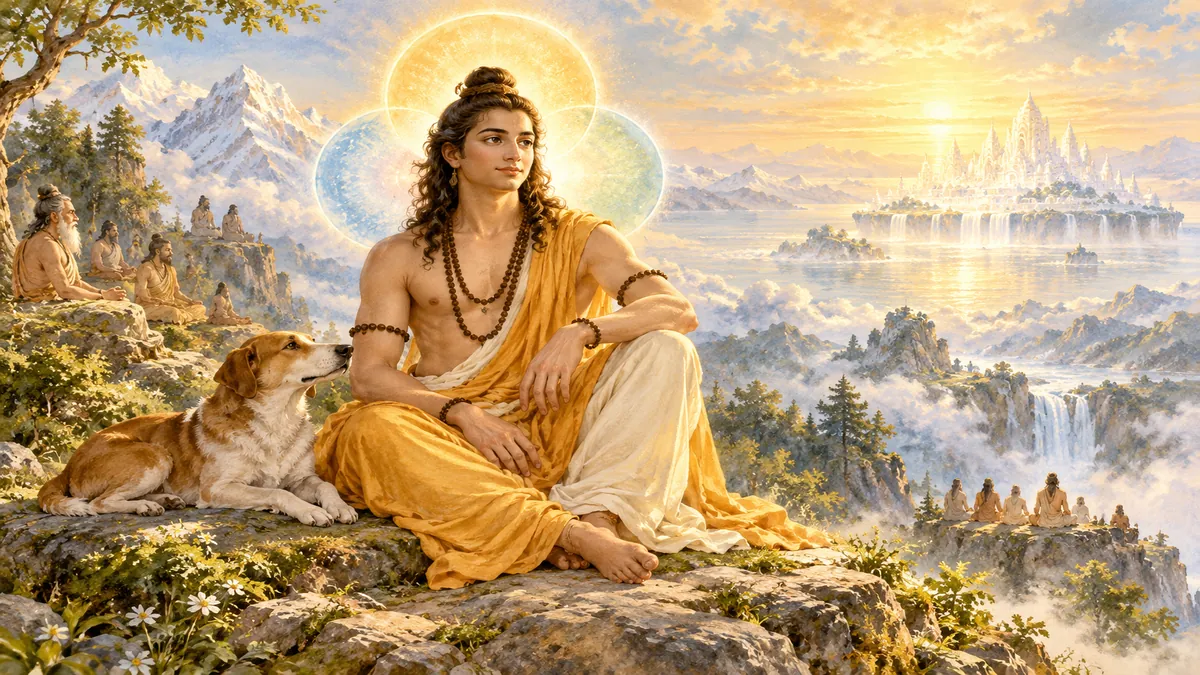
“Om Dattatreya Namaha” — homage to Dattatreya! “Om Maha Yogine Namaha!” — homage to the Great Yogi!
Dattatreya is a great yogi because he was born from the very beginning possessing the fullness of realization. Some sources claim that He was born as an incarnation of the god Vishnu after His mother Anasuya received blessings from the three gods—this is a well-known story. Some maintain that he was born as the complete incarnation of all three gods. Dattatreya did not need to undertake spiritual practice; He incarnated in the family of the rishi Atri and Mother Anasuya as an avatar, that is, as a completely enlightened divine being. Vishnu Himself descended to Earth to give people Sanatana Dharma and show them the Path of Liberation. That is why He is called the Great Yogi.
“Om Yogishaya Namaha!” — Om, homage to the Lord of yoga! Dattatreya is the source of all mantras, all Tantric methods, and all the ancient teachings of various schools, such as the Naths, Kapalikas, Aghoris, and others; he is the progenitor of all Tantric teachings in the world. They all emanate from him. In ancient times, the name Adinatha was first attributed to Dattatreya. Later, it began to be used for Shiva. But originally, Dattatreya bore the name Adinatha. That is why He is called the Lord of Yoga.
“Om Chiranjeevine Namaha!” — homage to the Lord of the immortals! There are many immortal beings. Some of them live on Earth, in secret places such as the Himalayas and Mount Kailash. Some of them have physical forms and live hidden among people. Sometimes they come to the Kumbh Mela. And you may see some strange young man and think: “Oh, what a young sannyasi!” But he may be Dattatreya; he may be five thousand years old, and you would never know. But if you see him with spiritual vision, you may realize that he is not merely a sannyasi, but the Greatest Soul that has assumed a human body.
There are immortals who live on Kailash in Siddha-puri, the city of siddhas, in a subtle body, and I managed to communicate with them when we were in Darchen before our journey to Kailash. There are immortals who live secretly among people, but they lead a very secretive, hidden life inaccessible to ordinary people, revealing themselves only when necessary. There are immortals whose bodies are in a cave, in constant samadhi. But through the power of the mind, they can create an illusory body from the five elements. In this illusory body, they can preach the Dharma and engage in various activities, and it is very difficult to guess that this is not their real body but an illusory one. It can dissolve at any moment. Meanwhile, the real body is sitting very far away, encapsulated in samadhi, perhaps for five hundred years already.
There are immortals who live in secluded groups in the Himalayas. There are immortals who communicate with people, but no one knows about it. There are immortal rishis and siddhas who live mainly in the subtle world, and when necessary, they act through people, choosing their disciples and devotees, temporarily entering their bodies to embody a particular mission. Sometimes they choose masters, saints, or even ordinary people, and transmit their sankalpas and ideas to them so that they may serve as their conduits in this world and influence humanity.
Gods and siddhas who do not have bodies cannot have bodies, and therefore they act through the bodies of other people. And Dattatreya is the lord of all these immortals. He is the Highest and Most Revered Soul—for Chinese immortals, Himalayan immortals of Sanatana Dharma, and immortals of every religious tradition alike. For He is the Most Ancient and Greatest Realized Soul in this world.
“Om Munaye Namaha!” — Worship to the One who abides in silence! Dattatreya is the Great Silent One. He constantly abides in silence. His mind is silent. Even if He ever speaks, He remains in mauna.
The Practice of Mauna and the State of Amanaska
Today, during the retreat, while you are sitting, you will observe mauna for these two days. Mauna is needed so that our mind may become silent and we may open the secret space of heart awareness. But Dattatreya’s mind is always silent because He practices—or rather, abides in—the state of amanaska. Amanaska means abiding beyond the mind, when mananasha has occurred—the complete destruction of the dualistic mind—and the Light of Atman shines without any interference from the mind.
On the Path of realization, our mind is usually our greatest enemy and rival. And we must pacify this mind, purify it, and conquer it. Sometimes this can be done as the strong defeats the weak. But it is not yet known who is strong and who is weak. The mind may say: “We shall see which of us is strong and which is weak.” Sometimes a sadhu may fail to conquer his mind. The mind may show him that it is much stronger. Sometimes we can conquer the mind through faith and devotion, directing it toward an object of faith and devotion. Therefore, shraddha (faith) is very important. Without faith, it is impossible to conquer one’s mind; it is impossible to overcome karma.
Sharanam (refuge) is very important. Always and everywhere invoke the saints of the Tree of Refuge, rely on the deities and saints of the Tree of Refuge, rely on their blessings in order to overcome karma and conquer your mind.
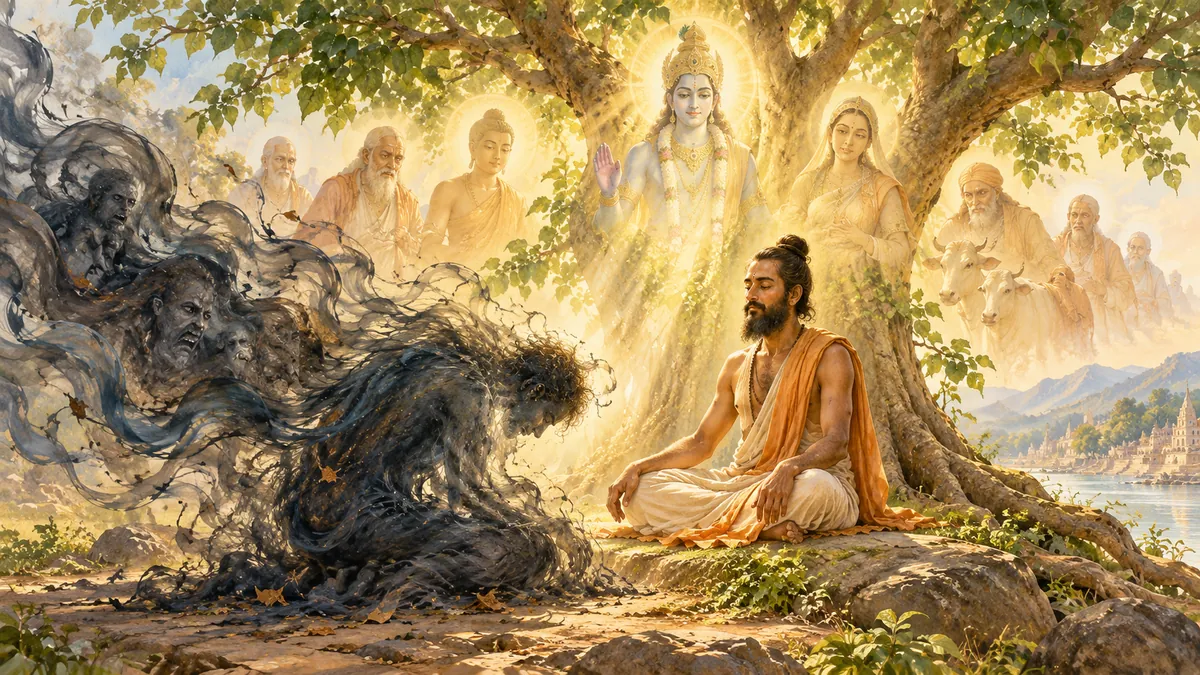
Digambara — Clad in the Directions of Space
“Digambaraya Namaha!” — Worship to the One clad in the directions of space!
Dattatreya is often depicted naked. This naked form is Dattatreya’s form as Digambara.
“Digambara” means “the one who is clothed in the directions of space.” In other words, the directions of space are space itself. And “clothed in space” means that Dattatreya has no material attachments; He is not dressed in any attributes, garments, forms, or signs. His clothing is the element of space—the subtlest and purest of the five elements. It is not contaminated by water, earth, fire, or air; He abides as the purest space of Consciousness—that is His clothing.
Our clothing may be made of cotton or wool. Dattatreya’s clothing is made of space. Surely everyone would like to have such clothing. These garments never become dirty or torn, they never wear out, and they do not need to be taken off or put on. These garments have no form, name, or color. They are the garments of immortals and gods. Each of us is destined to clothe ourselves in garments made of the element of space, but for this we must purify our mind and reveal our essential nature. We must understand: I am not earth, water, fire, or air; I am not a gross, energetic, or astral body.

The Infant State and the Causal Body
“Om Balaya Namaha!” — “Worship to the Infant!”
Dattatreya in this form personifies pure, untainted, youthful consciousness. Just as an infant has no formed experience or judging mind, Dattatreya, like an infant, dwells in the state of the immortal divine embryo of the Universe. The infant state points to the causal body. It is in the causal body that the essence of each person’s Soul is rooted. It is in the causal body that the matrix of our Soul, as it were, is contained — linga-matra. Linga-matra is the root, the foundation of our soul (jiva).
To enter the path of Liberation is to penetrate the causal body, into that state where there is no past, present, or future, no divisible time — khanda-kala, where there is akhanda-kala — indivisible time. To penetrate the causal body means to enter into one’s face before birth.
Before we were born, we spent eight or nine months in samadhi in our mother’s womb. And before we entered our mother’s womb, we may have been a spirit, perhaps a pitri, perhaps a gandharva, or even a devata. We all entered our mother’s womb with the aim of attaining human birth, possibly on the advice of our spiritual guides, Gurus in the world of the pitris, perhaps in the world of the devatas, in the subtle world. We wanted to gain experience of the material world and a material body. Perhaps we made certain promises, saying, “I will be reborn for the benefit of all living beings,” in order to know Divine Wisdom and serve the Divine Will.
But then, during rebirth, perhaps something went wrong, and we lost our memory. For twenty years we could not remember at all why we had been born, “Who am I? What is the meaning of my life?” Because during incarnation, upon entering the coarse, dense layers of matter, even saints are defiled by coarse matter. And it took us a long time to realize our Soul and remember all the promises we had made.
I have had the experience that before incarnation, various souls came to me for darshan. I would say, “There is no time left; I am going to incarnate. So if you wish, you may incarnate with me, and there on Earth I will find you, or you will find me.” And then incarnation took place. Some of my disciples found me. Precisely those to whom I had said this.
Thus, before incarnating, before acquiring an astral body, we are in the causal world, in the causal state. If our realization is high—for example, if we have attained realization of the fifth, sixth, seventh, or eighth dhyana in meditation—we may remain in the causal state for a very long time. The causal state is not yet complete Liberation; it is not full realization. But beings in the causal world can live for millions and billions of years by human standards. They live as infinite cosmic spirits. They have a sense of “I,” a sense of individuality, but their consciousness is like infinite space.
This causal state is the basis of our subtle body and physical body. Ananda-maya-kosha is the kosha, the sheath, from which vijñana-maya-kosha—the sheath of intellect—then arises, as well as mano-maya-kosha—the astral body, the sheath of the mind—prana-maya-kosha—the energy sheath—and annamaya-kosha—the physical body. And Dattatreya under this name is Consciousness as the causal body.
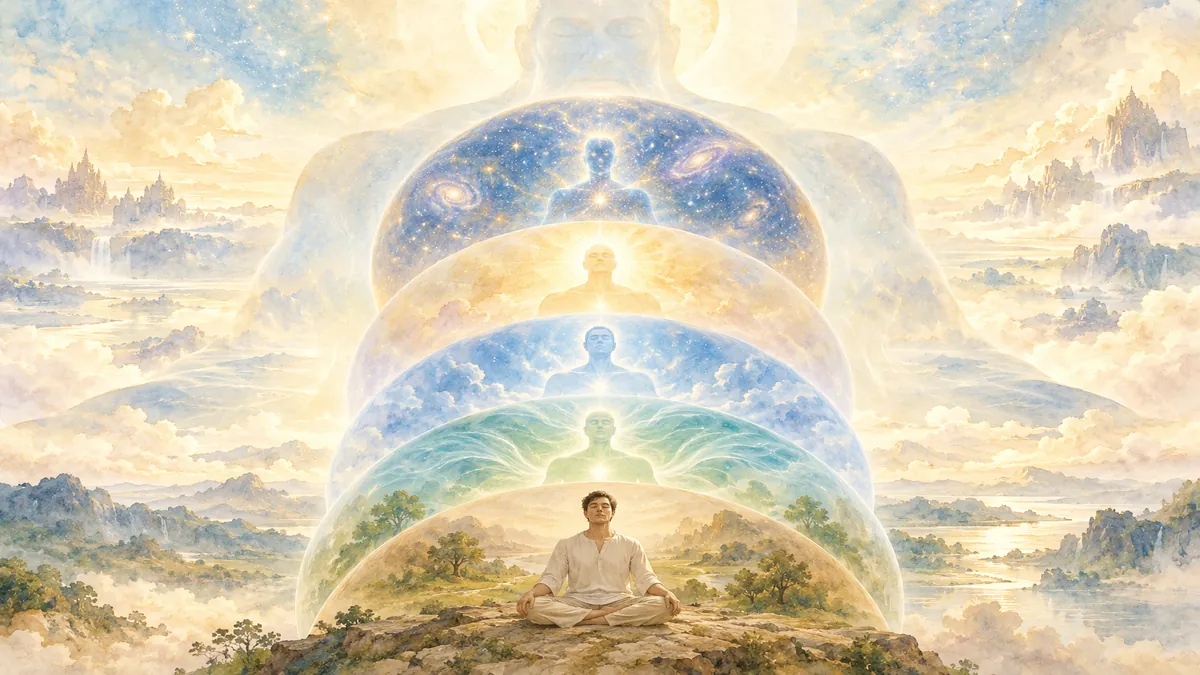
Freedom from Maya
“Om Muktaye Namaha!” — “Obeisance to the One who is free from maya!”
Dattatreya is free from maya. What is maya, illusion? Maya, or maya-shakti, is one of the universal energies. It is also embodied by the goddess Kali or the goddess Durga. Sometimes the goddess Kali is depicted dancing on Shiva. She tramples Shiva beneath her feet in her dance. Shiva personifies the principle of Brahman, nondual Consciousness, while Kali personifies the principle of prakriti. That is, energy in its dance, in its dynamism, as it were, obscures the principle of nonduality, completely tramples it underfoot, and dances upon it. This is what the state of maya is.
There are three types of energy:
External energy, called maya-shakti or bahiranga shakti — this is the entire material world
Internal energy — atma-shakti — this is the energy of God, sat-chit-ananda
Between these two lies the marginal energy — jiva-shakti — this is the energy of our subtle body
And so maya-shakti is everything external, including our physical body. And when we remain in ignorance, we develop the notion that we can be happy through maya-shakti. And we begin to establish a connection with external material energy. We believe that by satisfying the senses, we will become happy. And we strive to live in such a way as to accumulate more and more material energy, to possess more and more of it, devoting a great deal of effort and time.
But if we have intelligence, we will discover that material energy does not provide the happiness we expected. It operates on the principle that if we ask it for one ruble, it will demand a billion in return. We borrow something from it, and it will give it to us, but in return it will ask for much more. It is like borrowing from the mafia. They will say, “Yes, we can give you a small amount of money, but you will work it off later.” A person will think very carefully about whether they should get involved with the mafia at all.
Material energy (maya-shakti) is an energy that is capable of giving us something, but in return it takes us completely captive, into slavery. It says, “I will give you a little, but in return you will become entirely mine.” Therefore, yogis try to live in such a way as to be independent and self-sufficient, free from external material energy. They follow the principle: do not ask for more than you need; be content with what you have—santosha. Vairagya—be impartial, be unattached in relation to material energy.
It is impossible to attain Liberation until we cultivate vairagya and santosha within ourselves—detachment and contentment, until we redirect our mind from material energy toward the inner energy—atma-shakti. Dattatreya is free from material energy; it has no influence over him, he has no connection with it, and he lives entirely through inner power—atma-shakti. When we develop atma-shakti, we open within ourselves a non-dual space, and this non-dual space contains everything that the material world can give us. But we must master this energy so that it will give us all of this, so that we may be completely happy.
Eliminating the Soul’s Madness
“Om manamahayaya Namaha!” — “Salutations to the One who eliminates madness!”
Dattatreya eliminates the madness of the soul absorbed in the illusion of the material world; he eliminates dualistic notions and the ego. Once you open the principle of Dattatreya in your heart, you suddenly understand all your delusions.
When Ravana abducted Sita from Rama, he wanted to win her love. But he wanted to win her love with her consent, not through force or coercion. And he resorted to various tricks: he gave her different beautiful things and created a garden for her. Sita rejected him all the time. She said, “Ravana, you are not even worthy of Rama’s little finger. Do not even think that I will love you or that you will please me. You are simply foolish and heartless, because you do not know that Rama will eventually kill you.”
But Ravana was very presumptuous. He constantly wanted to enchant Sita so that she would truly fall in love with him. For this purpose, he assumed the form of Rama and other forms. And he would come in an illusory body, having assumed Rama’s form. And Sita saw that it was not Rama but Ravana, because she could feel Ravana’s energy, his bhava, and nevertheless rejected him.
Then a sage advised him: “Ravana, you assume Rama’s illusory form, but Sita sees that it is you because she feels that the bhava is different—the emotions, the perception of the world, and the mind are different. Try tuning in to Rama’s bhava. Try entering the state of mind in which he dwells.”
Then one day Ravana sat in meditation, tuning in to Rama as an embodiment of God. And he tried to enter the state of non-duality beyond the ego in which Rama always dwelled, the state of samadhi. And when he entered it, Brahma Aham bhava awakened within him—the experience “I am the Absolute.” And he saw all the foolishness of his ego, and he no longer wanted either Sita or to wage war against Rama; all his desires disappeared. Then he became frightened, emerged from that state, and said, “Then I do not need Sita, I do not need a war with Rama, I have no desires at all. What is the point of this? If I become Rama, everything will come to an end.”
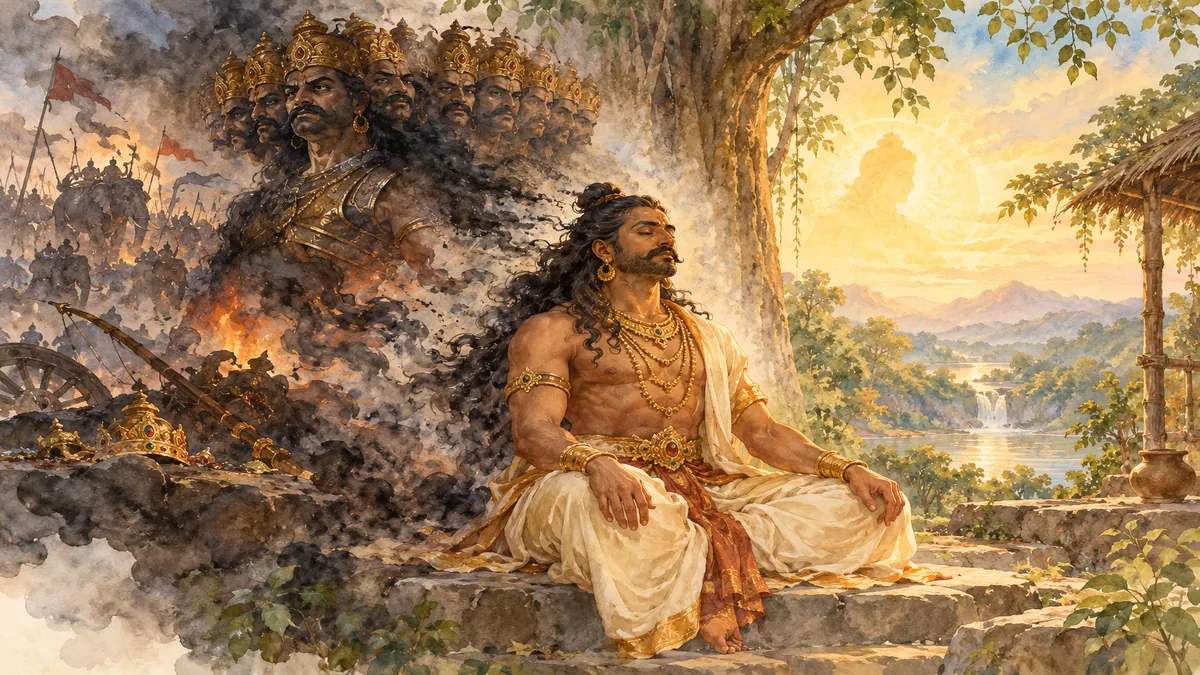
As soon as he became Rama in meditation, tuning in to his bhava, all the foolishness of his ego as Ravana became apparent. He only needed to repent and eliminate his ignorance. Therefore, he thought, “No, this method is not suitable for me,” because his ego wanted things to continue.
Dattatreya is the one who dispels the madness of the mind consumed by samsara, the madness of the ego, and the madness of the soul. Until our mind has been pacified and we have gained an understanding of the principle of non-duality, our soul remains in such madness. I once read that Bhagavan Sri Rajneesh said: “All people are a little crazy, those who live relying on the ego. Those who are too crazy are placed in a mental institution, while the rest are more or less within the bounds of the social norm.”
As long as you live through the ego, through your mind, as long as you do not know God, as long as you have not pacified the mind, you always remain in such fundamental ignorance, always in fundamental delusion. And this always brings suffering. But Dattatreya dispels it. Awakening in our hearts in the form of non-dual space, in the form of the pure light of consciousness, He flawlessly reveals all our illusions, all the attachments of our ego, all the foolishness of the ego.
And suddenly we relax and laugh. We think: “How foolish I was! How could I become so attached, how could I be so selfish, when I am not the ego—I am boundless Light, I am the pure space of non-dual Consciousness!” And then we laugh and cast off all this burden that we had carried as the ego. We become light, empty, and space-like. We feel that our kleshas, attachments, clinging, hopes, and fears have truly disappeared.
Perhaps we are not fully enlightened, but at least we have eliminated the madness carried by the ego: pride, selfishness, attachments, kleshas, and various fears based on egotism. And when we eliminate all this, the initial signs of the one taste begin to manifest. In any clothing we are happy, with any food we are happy, in any place we are happy, in any position we are happy—we are happy always. Because there is no longer an ego that becomes attached to anything or has ambitions. Because the mind has turned inward and now contemplates the Divine, and nothing can interfere with this.
Avadhuta—Beyond All Frameworks
“Om Avadhutaya Namaha!”—“Homage to Avadhuta!”
Dattatreya is an avadhuta. This means that he is neither a layperson nor a monk, neither a brahmachari nor a vanaprastha, nor a sannyasi. He is beyond all social norms, beyond all social statuses, beyond all frameworks and definitions, beyond both worldly and spiritual morality and ethics, beyond all cultures, beyond all religions. Dattatreya is a completely transcendent Being, because He is the Absolute itself.
People in the relative material world are always absorbed in some kind of frameworks, conventions, and limitations. Sometimes these are external frameworks, and sometimes they are frameworks in the mind. All of these are different cages into which our consciousness enters and in which it confines itself. Sometimes these frameworks come from society, from culture, from morality; sometimes they come from the ego, from the kleshas, from one’s own fixed ideas.
Once, when Dattatreya was present at a yajna, a brahmin was participating in it. He saw that Dattatreya was there as a young man among venerable sages and long-bearded elders, while he himself behaved rather unseriously—holding a dog in his arms (although according to Vedic notions, a dog is considered an impure animal), laughing at the most serious moment of the yajna, with some woman beside him. And this gave rise to a certain misunderstanding about Dattatreya, although all the sages always came to him with immense reverence and bowed at his feet.
He thought: “How is it that this young man has probably hypnotized all the sages with his own hypnosis and put them into some kind of state in which they respect him so much? And he himself is some strange wandering beggar, incomprehensible; there is no sign that he is a saint.” And when he came to Dattatreya, he nevertheless had enough respect to bow to him and ask a question. He said: “Many call you the Lord of all yogis and Lord Dattatreya, but I do not understand which status you belong to. The Vedas describe four principal statuses: brahmacharis (young students), grihasthas (householders), vanaprasthas (those who have withdrawn from worldly affairs), and ascetic monks (sannyasis). You resemble none of them. Who are you?”
Dattatreya said: “I am in the fifth status; it lies beyond these four, and nothing is said about it in the Vedas.” What status is this? It is the status beyond all statuses. It is the status of an avadhuta. Then he gave this brahmin instructions—teachings concerning the nondual nature. And he said approximately the following: “Today I laugh and stroke a dog or flirt with women, and tomorrow I walk upon the Sun and drink molten copper. Today I am like an ordinary person; tomorrow I abide in the worlds of the Gods. My mind is completely free; it is not limited by any boundaries, any social norms, any cultures, any concepts, or any statuses, because I am the Limitless Play of energy and Consciousness that acts for the benefit of all living beings.”
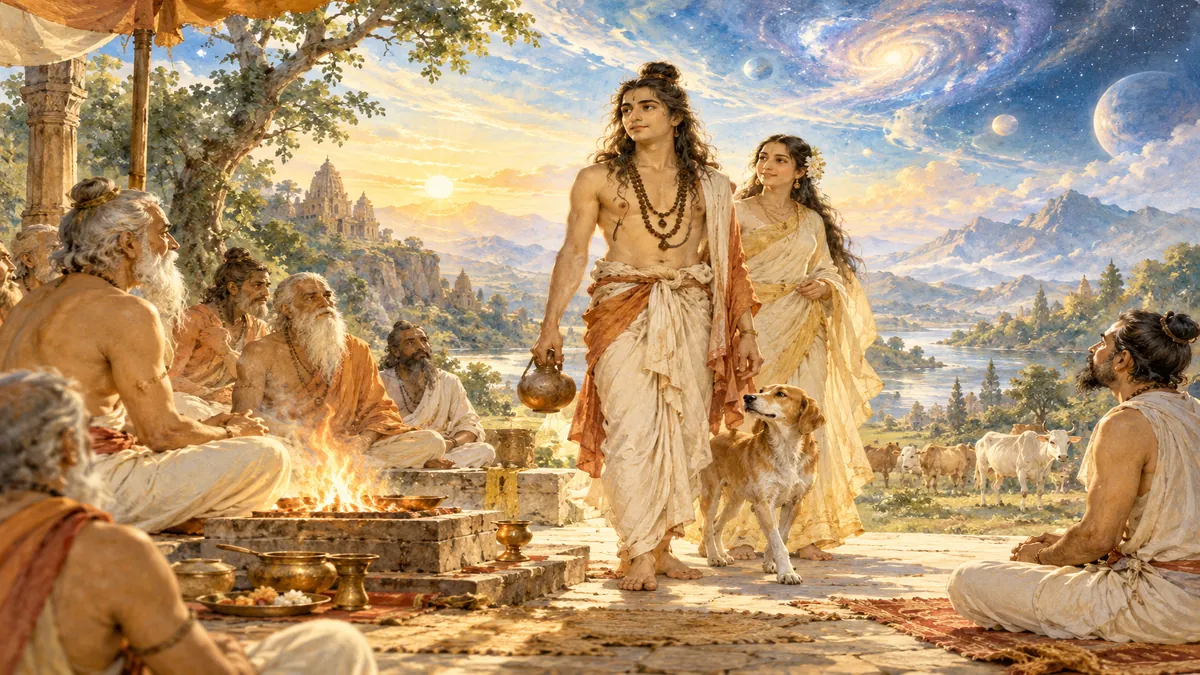
But then He truly said to him: “But do not even think of imitating me, because what is right for the gods may be wrong for human beings.” After this, the brahmin was completely satisfied with his answer and bowed to Dattatreya with deep reverence.
Dattatreya embodies the principle of infinite freedom. And it is impossible to impose any limitations on the consciousness of the Absolute—neither social, nor cultural, nor religious, nor philosophical, nor conceptual. This is Absolute Freedom. However, Absolute Freedom always presupposes a high degree of responsibility as well. One who is absolutely free voluntarily accepts limitations if necessary, for the benefit of other living beings.
Therefore, Dattatreya, being an avadhuta, fully accepted sannyasa in his time, when he incarnated. This was because sages approached him and asked: “Lord Dattatreya, in order to establish dharma and set an example for young sadhus, please accept sannyasa. By doing so, you will save and lead many living beings to Liberation.”
Dattatreya had no need to formally accept sannyasa. He could be anyone and anything. But in order to bring benefit and inspire sannyasis, He accepted sannyasa. Dattatreya Himself is beyond any limitations, because He embodies our consciousness. Consciousness cannot be limited by anything—neither by boundaries, nor concepts, nor notions.
But when consciousness manifests in the relative world through energy, different limitations naturally arise. And energy, prakriti, imposes limitations on consciousness. And we can clearly understand: “Yes, in terms of view, my consciousness may be like Dattatreya’s, but energy constantly limits me. And in order to become truly free, like Dattatreya, I must overcome this material energy.”
