Commentary on the “Brihadaranyaka Upanishad”
“Janaka, king of Videha, performed a sacrifice with many gifts for the priests. Brahmins from among the inhabitants of Kuru and Panchala gathered there. And Janaka, king of Videha, wished to know which of these Brahmins was the most learned. He confined a thousand cows in an enclosure and attached ten measures of gold to the horns of each one. He said to them:
‘Venerable Brahmins, let the wisest Brahmin among you lead these cows away.’
Those Brahmins did not dare to do so. Then Yajnavalkya said to his disciple:
‘Dear Samashravas, lead them away.’
He led the cows away. The Brahmins became angry and said:
‘How could he declare himself the wisest Brahmin among us?’
And Ashvala, the priest of Janaka, king of Videha, was there. He asked:
‘Are you truly, Yajnavalkya, the wisest Brahmin among us? We bow before the wisest Brahmin, but we also wish to have the cows.’”
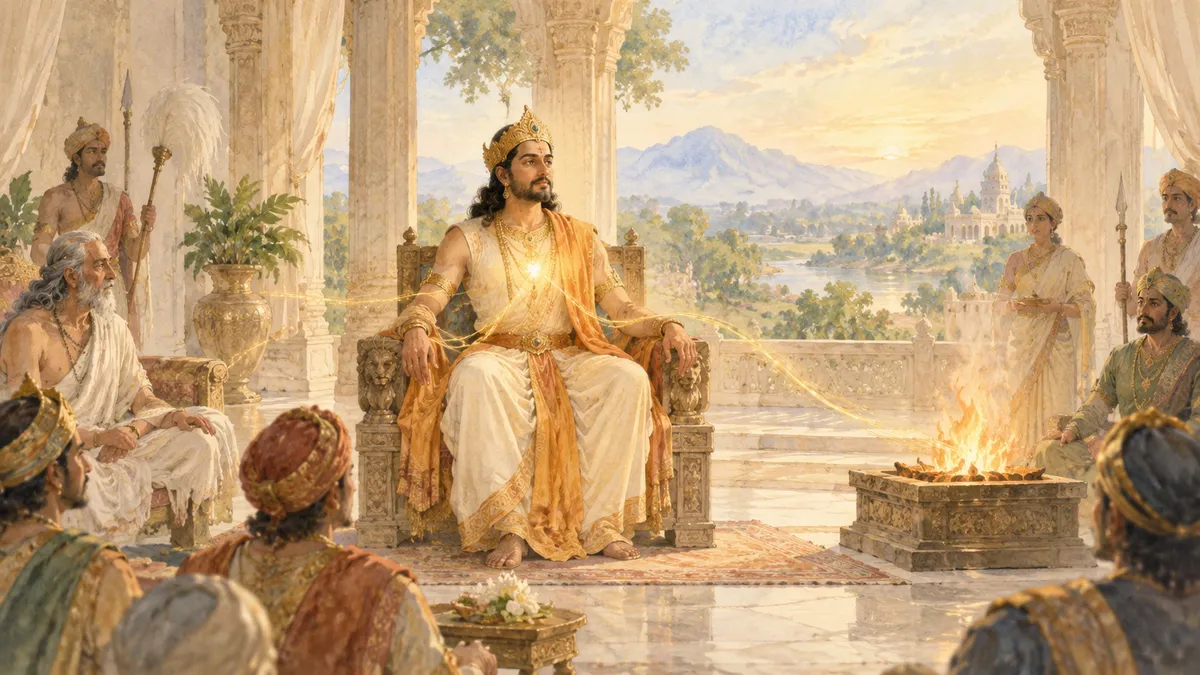
Janaka of Videha was a saintly king who attained enlightenment through Ashtavakra’s teaching. The Brahmin Ashtavakra instructed him directly in meditation on the nondual nature of the Self. It is said that when he meditated while seated on the throne, he could simultaneously attend to affairs of state and abide in presence; and when he stretched out his leg, he could lower it into a fire, yet the leg would not be burned.
“Then Ushasta Chakrayana began to question him:
‘Yajnavalkya,’ he said, ‘explain to me what Brahman is, which is directly perceived and not hidden, which is the Atman within all.’
Yajnavalkya replied:
‘It is your Atman, which is within all.’
‘Which Atman, Yajnavalkya, is within all?’
‘He who breathes through your breath in the lungs is your Atman within all. He who moves downward with the downward-moving breath is your Atman within all. He who pervades the body with the breath is your Atman within all. He who moves upward with the upward-moving breath is your Atman within all. This is your Atman within all.’
Ushasta Chakrayana said:
‘You have explained this as one might say: this is a cow, this is a horse. Explain to me what Brahman is, which is directly perceived and not hidden, which is the Atman within all.’
Yajnavalkya replied:
‘It is your Atman within all.’
‘Which Atman, Yajnavalkya, is within all?’
‘You cannot see the seer of seeing; you cannot hear the hearer of hearing; you cannot think of the thinker of thought; you cannot know the knower of knowledge. This is your Atman within all. Everything else is subject to suffering.’
Then Ushasta Chakrayana fell silent.
Then Kahola Kaushitakeya began to question him:
‘Yajnavalkya,’ he said, ‘explain to me what Brahman is, which is directly perceived and not hidden, which is the Atman within all.’
Yajnavalkya replied:
‘It is your Atman, which is within all.’
‘Which Atman, Yajnavalkya, is within all?’
‘That which transcends hunger, thirst, sorrow, delusion, old age, and death. Having realized this Atman, Brahmins rise above the desire for sons and the desire for wealth, and lead the lives of mendicant monks. For all desires—for sons, for wealth, for worlds—are merely desires. Therefore, having renounced learning, a Brahmin should become like a child. Then, having renounced both childlikeness and learning, he should become a silent sage. And then, having renounced both non-silence and silence, he should become Brahman itself.’
Then Kahola Kaushitakeya fell silent.”
Only one who has risen above all worldly desires and become a mendicant monk can say that he has some understanding of his Self. Until you have slain the thirst for desires within yourself, there is no possibility of knowing that Brahman. When we try to divide the realization of Brahman with desires, it is like trying to ride two horses at once.
What does it mean to live the life of a mendicant monk? Whether or not you actually beg for alms, at the very least your spirit must become a beggar with respect to worldly life. To be a beggar means that nothing interests you except awakening. When nothing interests you except awakening, you can devote yourself to study and practice.

The Disciple’s Path to the Master
Often, when a disciple approaches a Master and asks him a question about Reality, the Master says:
“Approach me as a disciple; do not approach me as an outsider.”
This is not because the Master is conceited; it is because he wants to teach the disciple in such a way that the teaching will be beneficial, so that he can answer the disciple’s question. This answer is not intellectual; it is an answer that transforms.
Then the disciple says:
“Very well, I will approach you as a disciple.”
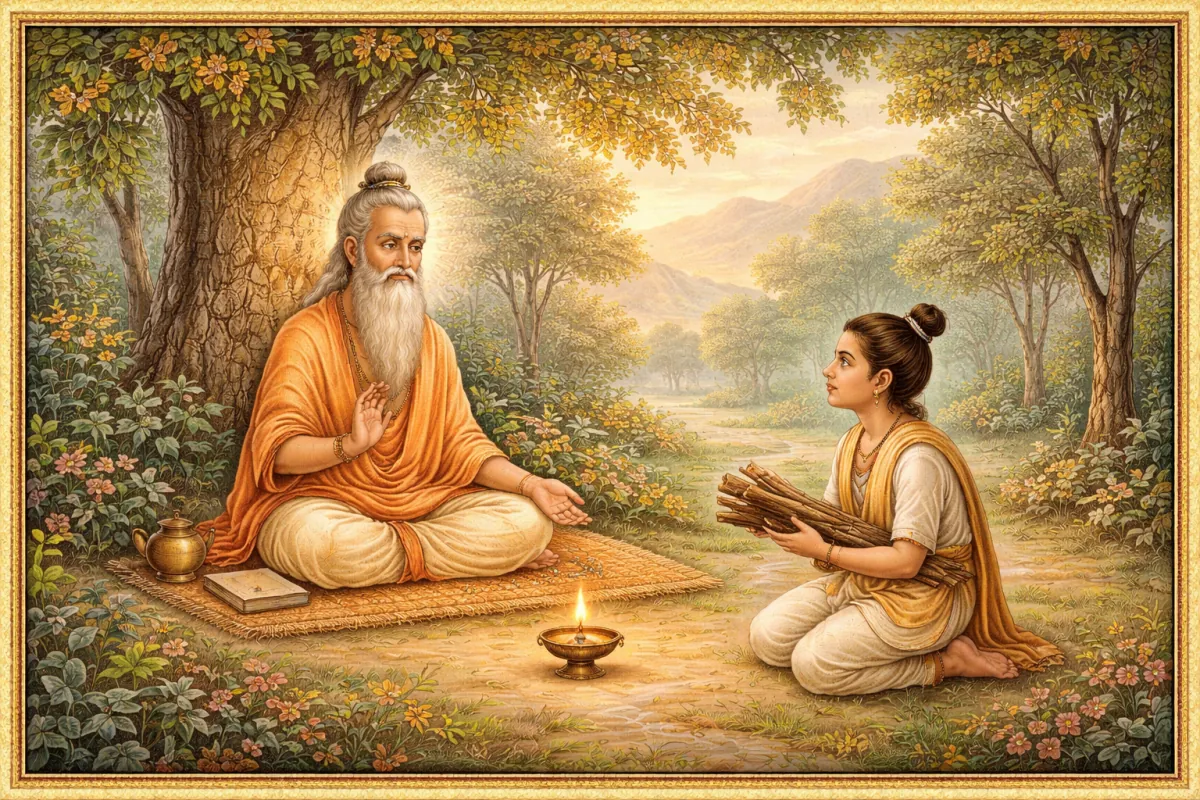
He gathers a bundle of firewood or brushwood, takes a lamp, approaches the Master, and says:
“I am your disciple. Now teach me the absolute Reality.”
The Master says:
“Now prove that you are capable of becoming a disciple.”
And once again, everything drags on. Not because the Master is proud, but because the disciple has no idea of the depth of transformation that his consciousness must undergo on the spiritual path. Then the disciple tries to prove himself. In the course of these efforts, he undergoes great trials and profound changes within himself. Finally, when he discovers that he has become a suitable “vessel,” a completely genuine disciple, at that very moment his own nature is revealed and his awakened consciousness opens up. A true Master will not allow a disciple to draw near until the disciple has abandoned all illusions. He will say:
“No, no, I am not satisfied. No, no, this is not it at all.”
The disciple will try to do one thing, then another, then a third. But until all illusions have left his mind, the Master will not allow him to draw near. Finally, having abandoned all illusions, all grasping, and all attachments, the disciple will reach such a state of awareness that it no longer matters to him whether this world exists or not, whether he has attachments or not. When he has completely lost all notions of his “I,” whether he lives or dies, whether he strives for liberation or does not strive for it, when only pure awareness remains and he attains a state in which there is no longer any difference between him and the Master, then the Master will say:
“Well, it seems you are beginning to understand something.”
This will be realized within the disciple himself, while the Master simply notices it and draws his attention to it:
“Now this is the state I consider correct. You may now become accustomed to it and practice contemplation.”
“Then Ushasta Chakrayana questioned him:
‘Yajnavalkya,’ he said, ‘explain to me what Brahman is—the Brahman that is directly perceived and not hidden, that is the Atman within all.’
Yajnavalkya replied:
‘It is your Atman, which is within all.’
‘Which Atman, Yajnavalkya, is within all?’”
Finally, when this state has been revealed, the Master points it out to the disciple directly:
“Now you have discovered it; now you have reached a point worthy of recognition. This is That—do not doubt it.”
At first, the disciple was blind and searched for it. He searched for it in the scriptures, clinging to the Master’s words and taking them for some self-sufficient truth. He searched for it in meditation, mistaking temporary experiences for true states. But when he discovered it, the Master pointed it out to him directly.
Three Stages
The first stage is called shravana, when the Master somehow helps the disciple reveal his primordial natural state. Once the disciple has come to him and revealed it, he then cuts off his doubts and uncertainty about it.
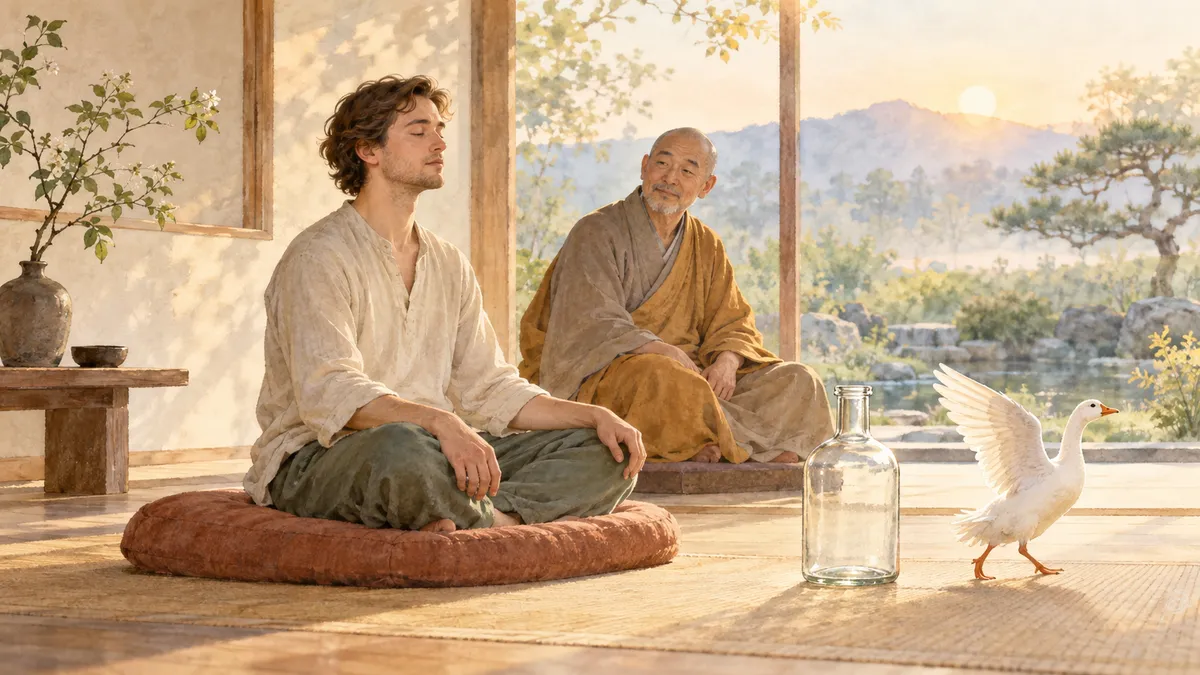
One disciple came to a Zen Master to practice under his guidance. For many days, he practiced meditation on the sense of “I” and worked on the task of how to get a goose out of a bottle. For a long time, he could not find the answer. Several years passed, yet he was unable to reveal this state. Then the Master said:
“Go and meditate continuously, day and night, for three months.”
The disciple meditated for three months but was unable to reveal it. He came to the Master. The Master said:
“Meditate continuously for another two weeks.”
Two weeks later, he returned and was unable to say anything. Then the teacher said:
“Meditate for three days and nights without sleep or rest, without becoming distracted for even a second. And if you do not discover this state, kill yourself.”
The words “kill yourself” are not a call to suicide, but point to the need to kill the false sense of “I,” to kill the meditator. When the final three days had passed, the disciple cried out:
“The goose is free!”
This state revealed itself to him.
When this state is revealed, the Teacher gives instructions on how to become accustomed to it and bring it into everyday life, how to learn to live with it. This state is still very unstable, which is why the scriptures say that at this time the yogi’s mind plunges like a waterfall. All the ideas by which we have lived fall apart. We discover emptiness within, emptiness without, emptiness in everything seen and everything heard. We discover that we ourselves are nothing but zero, emptiness. At the same time, this emptiness is a great fullness, yet it is connected to nothing. At the stage of manana, the Teacher gives instructions on how to learn to live with this emptiness and bring it into everyday life. This is not yet complete enlightenment; it is as though we have reached the home stretch.
Having reflected and dispelled all uncertainties, the disciple gains complete faith in this state and learns to live in the single state without interruption. Now, for him, there are no longer men or women, trees or stars, clouds or other monks, himself or gods or devils, above or below, space or time, mother or father, children left behind in the world, monastic or worldly—this is all behind him. There is a single, gigantic Superconsciousness, so total, so absolute, that it simply engulfs and enchants you, making you laugh and cry at the same time.
It is said that when Meher Baba discovered it, he remained continuously in a trance, in samadhi. This state is so blissful that an ordinary person who has received no instruction loses the ability to live adequately in this world. Such a person does not wish to live either in the world or in the body. After Meher Baba had been absorbed in continuous samadhi for about a year, contemplating this great Emptiness, a siddha brought him out of this state by hurling a stone at him and splitting his forehead open. He then came to his senses and began to perceive the surrounding reality. And the siddha said, “Now, it seems, you have understood what it means to be in the right state.”
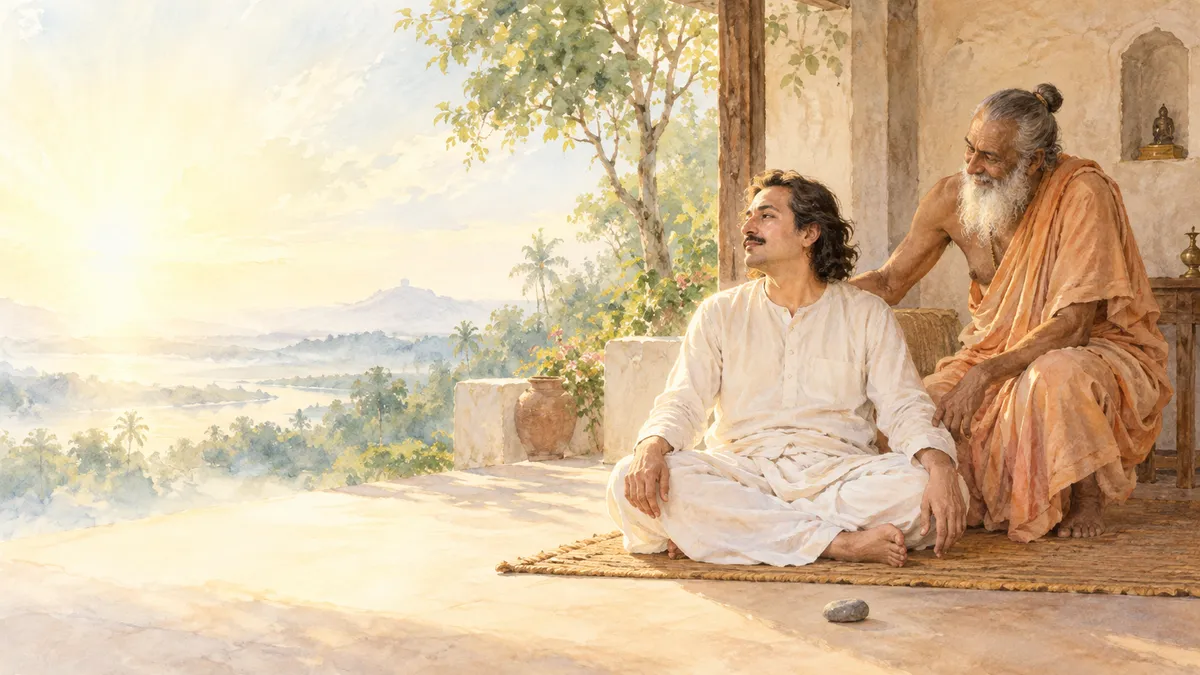
What was meant here was that his captivation by this trance-like state was incorrect. The supreme state means that we are not in a trance, but can remain aware and in ordinary contact with reality, while our contemplation nevertheless does not disappear. It is as though we see without seeing and hear without hearing. This means that we can combine ordinary perception with transcendent Reality.
One monk wrote: “At first, when I listened to the Teacher’s words, they seemed to me to be the absolute truth in themselves. Then, when I began to meditate, it seemed to me that nothing he said was true. Finally, when I deepened my meditation, I understood what truth the words pointed to and what role they played.”
At first, when we remain in a conditioned state, mountains are mountains to us, and stars are stars; rivers are ordinary rivers, and monks or laypeople are ordinary monks or ordinary laypeople. Then mountains cease to be mountains, and rivers cease to be rivers. But when we completely destroy our own illusory perception, when nothing but emptiness shines all around, rivers once again become rivers, and mountains become mountains, but now everything is different. This means that we can perceive both mountains and rivers, but they are all empty. We are no longer captivated by external stage scenery; we no longer have an “I” of our own that could make assessments and judgments.
“Then Uddalaka Aruni began to question him:
‘Yajnavalkya, tell us about the Inner Ruler.’
Yajnavalkya said:
“He who, dwelling in the earth, is different from the earth, whom the earth does not know, whose body is the earth, and who rules the earth from within—he is your Atman, the inner ruler, the immortal. He who, dwelling in water, is different from water, whom water does not know, whose body is water, and who rules water from within—he is your Atman, the inner ruler, the immortal. He who, dwelling in fire, is different from fire, whom fire does not know, whose body is fire, and who rules fire from within—he is your Atman, the inner ruler, the immortal. He who, dwelling in the atmosphere, is different from the atmosphere, whom the atmosphere does not know, whose body is the atmosphere, and who rules the atmosphere from within—he is your Atman, the inner ruler, the immortal. He who, dwelling in the sky, is different from the sky, whom the sky does not know, whose body is the sky, and who rules the sky from within—he is your Atman, the inner ruler, the immortal.”
When, thanks to the direct introduction, the disciple has discovered this state and then dispelled all uncertainties, he proceeds to the third stage—nididhyasana, that is, uninterrupted contemplation, continuous abiding in the natural state. Even when we experience brief flashes of enlightenment, this cannot yet be called realization. These flashes of enlightenment appear and disappear. They are no more than a momentary experience. Nididhyasana means that there are no longer flashes, but rather a continuously burning torch. We sustain this state of burning through non-distraction, by abiding undistractedly in the nature of Reality.
When such uninterrupted burning is sustained, the Teacher draws the disciple’s attention to the fact that he has a body composed of five elements and that there are energies within the body. He says that this continuously burning torch must be directed toward the energies of the body and, by merging with these energies, melt the five elements within the body. Therefore, at the stage of nididhyasana, a yogin who knows the Teaching applies special methods of integration. It may seem that everything has been attained and that his consciousness abides in nonduality; however, this is not enough to dissolve gross karmas. The enlightenment of consciousness differs from complete enlightenment. This is because complete enlightenment entails the dissolution of all karmas in the body and its transformation into a rainbow body.
Therefore, such a yogin begins to unite with the elements in the external forces of nature and with the elements within the body. He unites with the earth element, finding that inner consciousness which is different from the earth element and which governs it. By uniting with the elements one after another, he discovers five different kinds of the natural state. He discovers five different kinds of presence that are connected not only with consciousness but also with the elements. When he fully reveals these five kinds of presence, they become the five emptinesses or the five wisdoms.
“He who, dwelling in space, is different from space, whom space does not know, whose body is space, and who rules space from within—he is your Atman, the inner ruler, the immortal.”
By bringing his uninterrupted contemplation face to face with thousands of manifestations, the disciple acquires skill in liberating the natural state. He discovers it as the inner lord of all situations while experiencing pain or pleasure, fear or suffering. By integrating with any energies, such a yogin learns to separate and liberate his primordial awareness from any situation, discovering this awareness as the lord of all situations.
“He who, dwelling in darkness, is different from darkness, whom darkness does not know, whose body is darkness, and who rules darkness from within—he is your Atman, the inner ruler, the immortal. He who, dwelling in all beings, is different from all beings, whom all beings do not know, whose body is all beings, and who rules all beings from within—he is your Atman, the inner ruler, the immortal.”
This concerns beings.
Yajnavalkya then lists speech, the eye, the ear, the mind, the parts of the body, and the process of cognition. He says:
“Your awareness is that which rules all this from within, that inner ruler who is not connected with any of it. Unseen, he sees; unheard, he hears; unthought, he thinks; unknown, he knows. There is no other seer but him; there is no other hearer but him; there is no other thinker but him; there is no other knower but him. This is your inner lord, the immortal. Everything else is subject to suffering.
And then Uddalaka Aruni fell silent.”
What do “the invisible sees” and “the inaudible hears” mean? Although our self-born Wisdom of primordial awareness is beyond perception, beyond the sense organs, tattvas, gunas, and categories, this does not mean that ordinary perception is separate from it. As complete awakening gains strength, we see that even ordinary perception—hearing and seeing—is all part of the same awareness. True presence, contemplation, does not mean placing our mind in some infinitely remote state different from ordinary consciousness. It does not mean fixating on something within, nor does it mean experiencing something unusual created by the mind. It means completely empty, utterly transcendent awareness united with ordinary perception: the eyes see, but there is no one who sees; the ears hear, but there is no one who hears. At this stage, a yogi may engage in ordinary everyday activities, yet remain in the highest state of contemplation.

Integration of the Absolute and the Relative
Quite a long time ago, I was meditating, experiencing one very deep level of samadhi after another. I sat there feeling no less accomplished than Milarepa or the ancient rishis on whose heads birds built their nests. Meanwhile, my Teacher and another Brahmin were calmly discussing various matters related to maintaining the ashram and other things. At the time, I thought, “How can this be possible? I am experiencing such things and seeing that all of this is an utterly complete illusion. I do not even have any desire to live in this world, while they are discussing such trivial worldly matters.” I simply could not comprehend it. Then I thought, “Perhaps no one understands this but me. Perhaps even the Teacher does not understand what I have discovered. How can they discuss such things when all of this is such an absolute illusion and utterly meaningless?”
Then I went to the Teacher and asked him:
— How can you discuss all sorts of things and concern yourself with worldly matters when such absolute consciousness exists? Can it be that you do not see it? Why do worldly matters concern you? How can you seriously discuss all these things if even I, a novice disciple, can meditate in this way, remaining in a completely transcendent, utterly insane state? Can it be that you have not discovered it?! It seems that you do not even understand this transcendent state.
The Teacher said to me:
— It seems you do not yet fully understand that I am insane enough to be normal, while you are not quite there yet.
When we reveal this awareness, at first it seems ready to swallow all the universes. As we deepen it, we see that it is inseparable from every process of life, that there is nothing worldly and nothing mundane. Everything we experience is transcendental, beyond all limits, right now. When you sit, you sit in the absolute, in the transcendent. When you fall asleep in tamas, you experience absolute, transcendent tamas. When you experience confusion or worldly desires, you experience absolute confusion and absolute worldly desires. When you eat or see anything, you experience it in the same absolute state. Nothing is trivial; everything is nothing but the absolute.