Three Bodies: The Path to Discernment and Liberation in Advaita
26.11.2026
0 мин. чтения
0
Share
copy
search
add
share
The concept of the three bodies is very important for understanding, because understanding awakens our ability to awaken these three bodies within ourselves. The three bodies are connected with three dimensions, and awakening the three bodies within ourselves means awakening awareness and consciousness in three dimensions.
Usually, only the waking state, the physical world, the physical dimension, is available to us, but we gradually turn our attention to dream sleep, penetrate the subconscious, and enter subtle states of meditation — all of this is the realm of the subconscious. It is an entirely different world, closed to ordinary people, in which the physics is different, the psychology is different, everything is different — the organization of the world and the worldview are different.
But if we strive to know the truth, we need to understand that it is precisely this other world that governs everything in this world, while we have no control over it. All the control we have here is control that we do not yet possess there. And so control, impeccable discipline, sadhana, understanding — all of this is in this world, while all the power and all the governance are in that world.
Therefore, we develop control, understanding, wisdom, and self-discipline in this world and accumulate the potential for energy and clarity in order to penetrate that world, the subconscious, and unite this world with that world. But then there is also a third world — the causal world. And it turns out that the essence of the subtle world and of the subconscious, of dream sleep, is contained in the causal world altogether. It is the cause of all existence. If control over this world lies on the astral plane, then the cause of this world lies in the causal world. But it is not at all amenable either to description in ordinary language by ordinary consciousness or to perception. We must also cultivate within ourselves the instruments for knowing this world.
And in the process of penetrating these worlds, when we become conscious within them, our conscious aspect is called a body. Of course, this is not a body like the gross physical body. It is our conscious aspect and our ability to act in these worlds. And when our ability to act in these worlds gains fullness and strength, it is said that we have attained an awakened body. This is also part of the practice — cultivating and developing such awakened bodies.
Those who attain sufficiently advanced stages of realization have one awakened body or two awakened bodies. This means that they can exist as independent souls — sufficiently independent, free, and conscious — outside the physical world and outside the physical body. This is called sarupya-mukti. An experienced sadhu possesses the realization of sarupya-mukti even if they have not yet attained realization at the level of sayujya-mukti. And in order to understand how this realization comes about, we study the Advaitic concept of the three bodies.
The Structure of the Three Bodies and the Five Sheaths
The three bodies: in order to carry out this investigation, we must first learn what these three bodies are, consisting of five sheaths that must be eliminated through discrimination.
The Vedantic concept of the three bodies is as follows:
Gross body — sthula-deha, the physical body
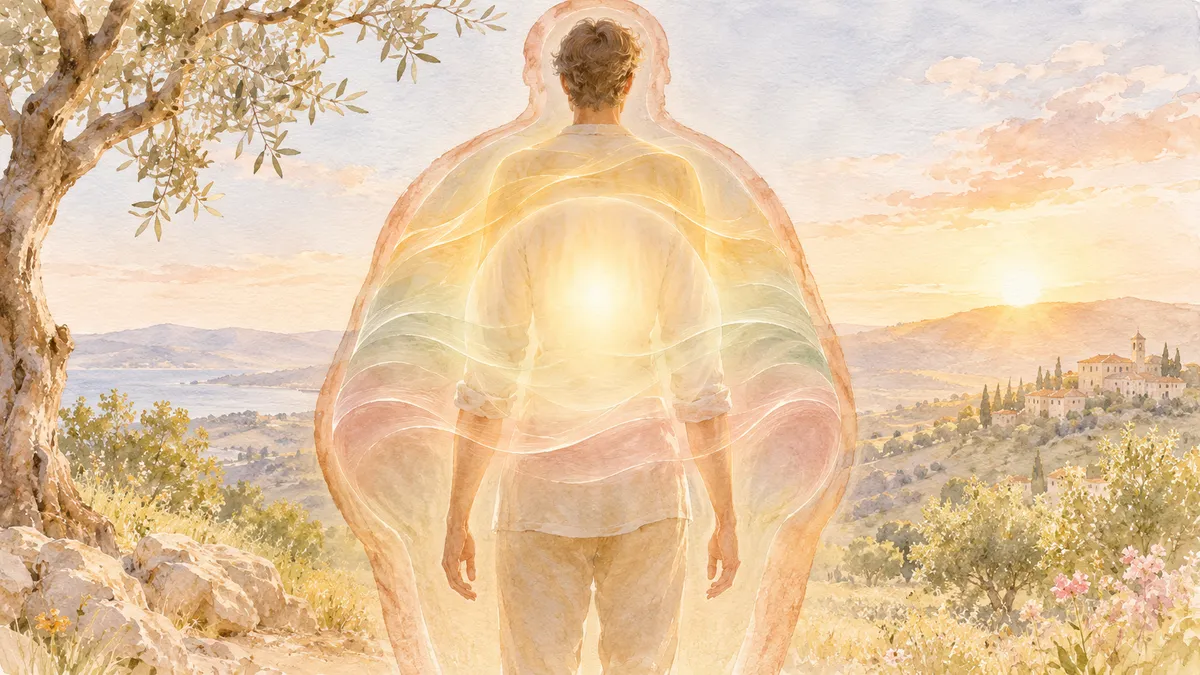
Subtle body — sukshma-sharira or linga-sharira. The subtle body includes the prana-maya-kosha, mano-maya-kosha, and vijnana-maya-kosha. That is, the energetic body (also known by another name as the etheric body), the astral body, and the mental body — all of them make up the subtle body. “Subtle” means that they act in the subtle world. And all of this is the second body.
Causal body — karana-sharira, which dwells in the causal world.
Thus, there are three bodies, but if we look more deeply and analyze the subtle body in detail, there will be five bodies, hence the five sheaths. Each body corresponds to one sheath. And so the three fundamental bodies correspond to the three worlds: the physical, astral, and causal. And within the astral world there is a division into three bodies. This is the structure.
The Path of Discrimination: Vichara, Viveka, and Vairagya
Awareness of our true nature arises as a result of developing viveka, vichara, and vairagya. All three are interconnected.
Vichara means: I investigate where my etheric body is, where the astral body is, and where the mental body is. I carry out the penetration by directing attention, through concentration and meditation — all of this is called vichara-spanda, that is, the investigative activity of my mind.
In the course of such an investigation, I begin to separate these bodies and distinguish between them. I discover them and then differentiate them. What do I distinguish? I distinguish these bodies from one another, meaning that I do not confuse the astral and the mental, the mental and the causal, the causal and the physical, or the physical and the energetic. And I do not confuse them not only intellectually, but also experientially, on the level of feeling.
Second, I distinguish my higher “Self,” my true selfhood, from these bodies. And whereas for a samsari-jiva (that is, a conditioned soul), everything is so confused that practically the physical body and the “Self” are indistinguishable, the subtle body, the mental body, and the selfhood of the “I” are never distinguished. By contrast, through vichara we develop viveka and distinguish them when we understand: this is my body, this is my instrument, but this is not the “I.” The “I” is beyond the five bodies. This is the “I” we are approaching.
In the process of developing viveka, vairagya arises—detachment, meaning: the “I” is not this body, the “I” is not the physical, the “I” is not the energetic, the “I” is not the astral, the “I” is not the mental, the “I” is not the causal, and therefore the entire experience of this body is not the “I” either. And when vairagya—detachment—arises in us, the body loses its power over us.
Gaining Power Over the Body
Why do ascetics torment the physical body, fast, sleep standing up, sleep on nails, and wear iron rings in various traditions? In order to deprive the physical body of power over them, in order to understand: “I am not the body.” The body cannot dictate to me, because the body wants to eat, sleep, and have sex, and this is power—power over the mind.
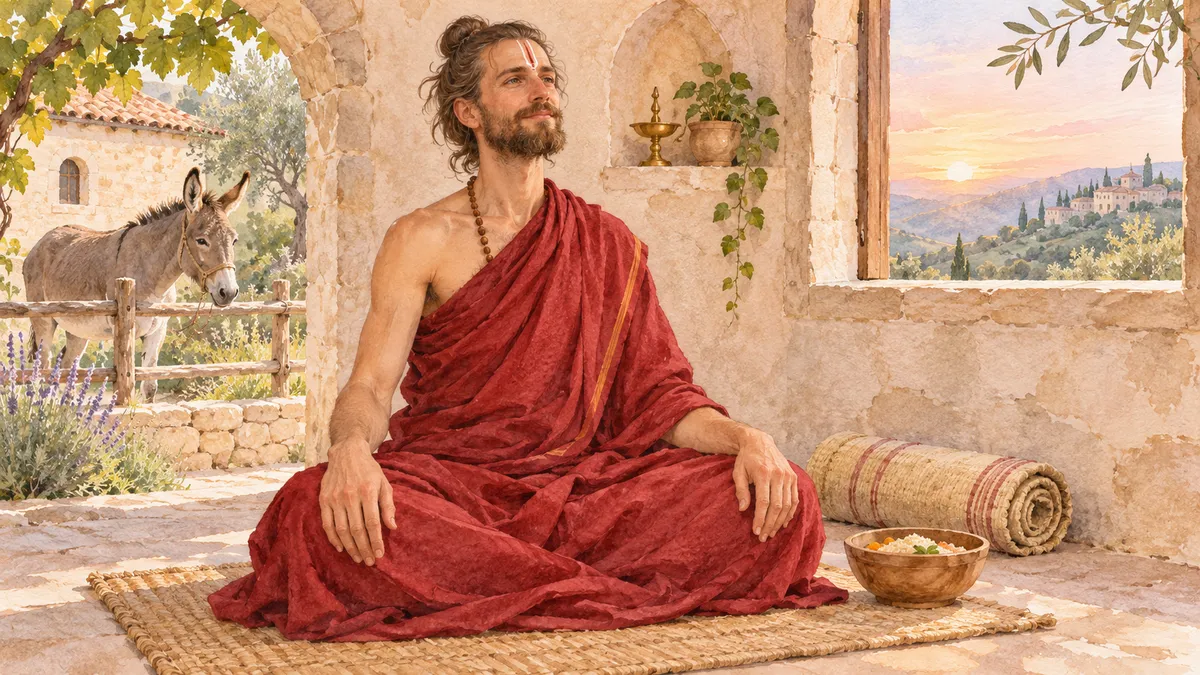
What does an ascetic do? He says: “Body, know your place! You cannot dictate to me what I should do. I am separate from you. I am your master.” Francis of Assisi even called the body “brother donkey,” something like an animal, a foolish nature. But if a person does not control the energies, the mind, desires, and passions, then this “brother donkey” controls him instead.
And so a sadhu must conquer the body and gain power over the body, because it is precisely the body that makes one reproduce. To reproduce means to have sex. To have sex means to get married. To get married means a home; it means a family. A family means loans, cars, and work—and that is already slavery. This is from the sadhu’s point of view, not the layperson’s. It is normal for a layperson, but from the sadhu’s point of view, that means you are caught—every one of you. Why? The body, the body.
But if I am the ruler, if I am the master of the body, then none of this is necessary. You can have a mat, padmasana, sukhasana, sahita-kumbhaka—and that is all you need—and it turns out you can be happy, simply because you have conquered the body. Therefore, one who is not a sannyasi is someone who has not conquered the body. We are not talking here about family obligations—one may need to look after one’s mother; that happens. But in general, essentially, on the whole, statistically speaking, one who is not a sannyasi is someone who has not conquered the body. He has not merely failed to conquer the first sheath; his body has conquered him.
Therefore, happy is the one who has conquered the body. Happy is the one whose body does not dictate how to live or what to do, whose genitals do not dictate how to live, whose stomach does not dictate how to live, and whose muladhara does not dictate how to live. A sannyasi is happy because these chakras do not dictate to him—he keeps them under control. Of course, sometimes they try to dictate, but he holds them like this. That is what makes him a sannyasi. But the weak person, the one who is not a sadhu, cannot keep all of this under control. Sometimes the stomach dictates to him, sometimes the genitals dictate, sometimes the muladhara dictates. The sadhu has conquered them.
A Wise Way to Conquer the Body
But how should one conquer the body? One should conquer it in such a way that the body becomes a friend, an ally. Do not wage war against it. If you try to fight it, it can turn into a very vengeful animal. It can take revenge. That is, it can say: “Oh, is that so! You deprived me of everything. I will not serve you. I will become ill, grow weak, stop working, and the stomach will not digest food.” In other words, if you try to conquer the body so harshly and crudely, it most likely will not be right and will not work. You can become ill and create problems.
A sadhu must conquer the body subtly, outwit and outsmart it subtly, with the help of energy, with the help of sublimation, with the help of providing higher-order joys—from anahata, vishuddha, and so on—with the help of yoga, that is, not crudely. But he must deprive the physical body of power over him.
When we deprive the body of power over itself, we somewhat pacify the mind and keep desires under control. Sometimes people simply begin the practice without having pacified the body. And when they begin to practice, muladhara gives them an impulse and starts controlling them. The genitals give an impulse, the stomach gives an impulse, and they feel that the practice is moving in one direction while the body is leading in another, and they cannot reconcile the two. They experience a kind of existential cognitive dissonance: how can all of this be reconciled? It is not easy. In every tradition, the struggle with passions and bodily desires is a stumbling block—the monastic, Buddhist, and Christian traditions. In other words, you are not the first, nor will you be the last.
But one who conquers wisely truly conquers: they deprive the body of its power and can ride this little donkey. Otherwise, the donkey rides them. All samsaric people are those whom the donkey rides well. They may not understand it immediately, but after the age of fifty or so, they do.
The Principle of the Hierarchy of Bodies
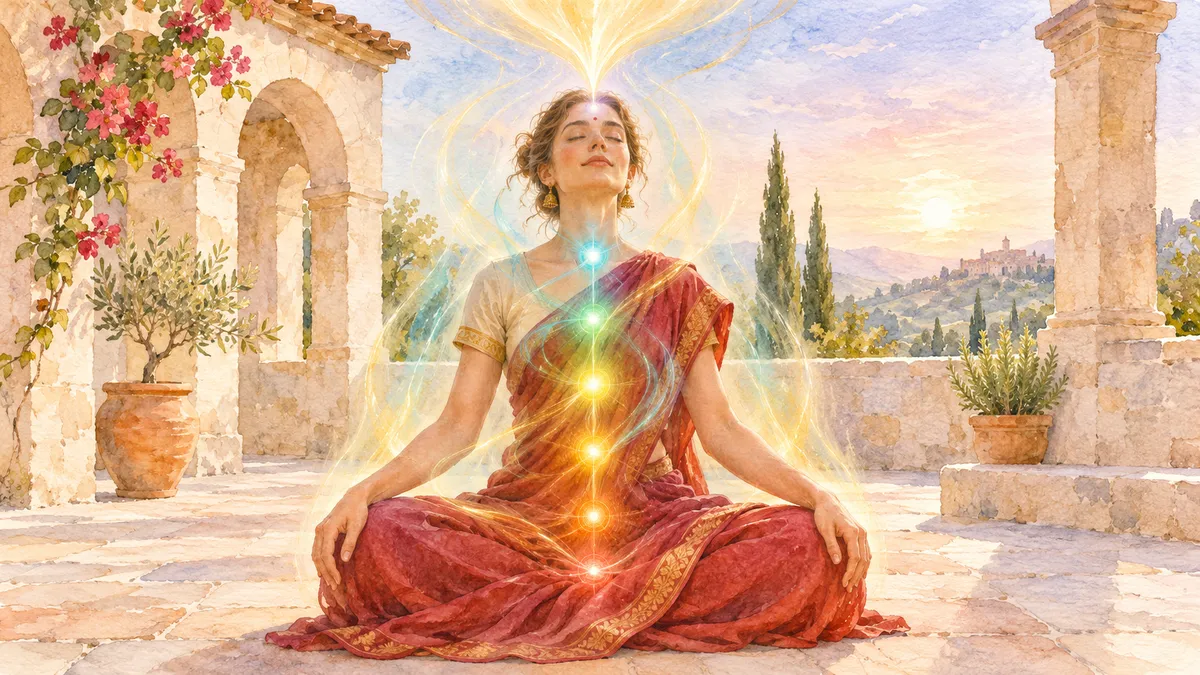
A sadhu understands that control over the physical body depends on control over the energetic body, and that, generally speaking, it is the energetic body—the second body—that controls everything in the physical body. This is the principle: each lower body is governed by the one above it. You cannot bring the physical body under control without knowing about the chakras, kundalini, winds, channels, ida, pingala, and sushumna. Control lies at a higher level; it is impossible to control the physical body at the level of the physical body itself. It can be controlled only from the energetic body.
Once you have brought the pranas under control—that is, when you practice pranayama, shat-chakra yoga, chakra purification, control of the wind, and purification of the wind—you can easily conquer the physical body. This is the wise way to conquer the physical body.
Thus, vichara gives rise to viveka, and viveka leads to vairagya—detachment from the sheath. Detachment gives power over that sheath.
The Revolution of the Inner World
Why is it important to gain power? This is a fundamental question. Therefore, in a certain sense, a sadhu is a revolutionary in the inner realm, and the fundamental question of any revolution is what? The question of seizing power. Because if we do not take power from the body, from the energetic body, and from the astral body, they will leave us no choice; they will rule over us. Yet they have no right to rule. And when the body rules—whether it is physical, astral, or energetic—it leads to suffering and problems—duhkha. It leads to impermanence and to the law of karma.
This is the fundamental question: to take power away from the gross sheaths. And only the atman—the pure consciousness—has the right to possess such power. This is the fundamental question. This is what the sadhu fights for. Kings fight for power in the external world; there, the battle for the throne is underway, while a sadhu fights for power over their bodies. Because if one does not possess power over each body, each of them has its own game and its own politics. And pacifying these bodies and controlling them is precisely the pacification of the mind. All of this is achieved through vichara, viveka, and vairagya.
The attainment of viveka and the subsequent vairagya—separation, detachment. We can control only that from which we have detached ourselves, that from which we have separated ourselves. If we have not detached ourselves, we cannot control it.
The Causal Body—Karana Sharira
The very same avidya is karana sharira, the causal body. This is karanam—the cause of both the physical and subtle bodies, as well as of their changes. Avidya is the cause not only of these two bodies, but also of identification with them, when all the characteristics of the bodies are superimposed on the atman. Essentially, prakriti is the cause of all creation. It can create everything without a doubt. Prakriti does not exist separately from Brahman. And Brahman is real, whereas prakriti and its effect, creation—the jagat—are false. But this is not a topic for discussion at present. Avidya, being a certain state of prakriti, is also considered a second-level cause.
Thus, creation—the physical creation—is, on the one hand, the energy of God, but when it is perceived by a conditioned soul, the soul sees it as impure prakriti or as maya. What is maya? Maya is sat-asat, anirvachaniya—that is, neither real nor illusory. Maya is transcendent energy, but when the soul, dwelling in obscurations, karmas, and samskaras, is dominated by tamas and rajas, it perceives maya as something gross. Then it becomes gross prakriti, causing ignorance. Then it becomes avidya.
What is wrong with avidya? In avidya, we forget God. In avidya, we forget our nature. In avidya, we forget our purpose. In avidya, our inner light is suppressed. In avidya, the light of our consciousness, our awareness, is suppressed, and therefore our powers are suppressed—the inherent powers: iccha, jnana, chit-shakti, ananda-shakti, kriya-shakti, aishvarya-shakti, svatantriya-shakti. In avidya, our potential divine qualities are suppressed; that is, avidya is clearly evil for us—it is bad. And the task of Advaita Vedanta is to destroy ignorance. First philosophical ignorance, then existential ignorance. The philosophical through study, and the existential through meditation and contemplation.
In other words, avidya is initially something not very good. It is like forgetting who you are and being suppressed because of it. It is like a person who left home and lost his memory, forgetting who he is. He has neither a passport nor money, a wallet, or the keys to his home, and he wanders around train stations and cafés. They do not even give him food. And he suffers because he does not know “Who am I?” and his shakti is also suppressed. This is what the jiva is like in samsara. And, of course, there are jivas who say: “There is nothing wrong with avidya—it is normal. Over there they give soup to poor people. Go there; you can sit on the grass somewhere.” But this will not satisfy a normal person, of course; he needs to remember himself.
And initially there are news reports about people who suddenly got lost and were found, but had forgotten themselves. A person was travelling on a train or commuter train and suddenly lost his memory. He is taken to a hospital; he cannot remember who he is, and neurosurgeons, psychologists, and psychoanalysts work with him. They try somehow to awaken his memory. Then it turns out that he knows how to play the piano, or he remembers some language, but remembers nothing else. And they put him under regressive hypnosis and conduct various tests there to engage certain neural structures, determine the cause, and awaken his memory. He himself does not know who he is, and then they write: “Who knows this man? Relatives, family members, please come forward!” At the same time, he is quite intellectual, he plays the piano, he has certain fragmentary skills, but he has completely forgotten everything else.
Avidya is something similar, only on a global scale. We have certain skills and remember some things, but in general everything is quite complicated in this world. And the Guru plays the role of someone who says, as it were: “Do you remember this about yourself? Do you have any memories at all that you are a divine soul, that you are the atman?” We need to find at least some kind of foothold. Then various skilful instruments—seva, puja—look at God; see how great they are; you too were once great, in order somehow to evoke associations. That is the process.
The study of philosophy—now we will study who we really are. This is philosophy in reality; it is the awakening of memory, because avidya has deeply infiltrated our consciousness. Not only have we forgotten ourselves, but we have also invented certain false goals and values of our own by identifying with this world. This means that a person has completely forgotten who they are and has created certain false ideas about themselves, particular illusions—and these illusions also interfere; they must be destroyed through the method of jnana yoga.
The Nature of the Dissolution of the Bodies
Sharira is called so because it is destroyed or withers. The physical body is quite obviously subject to destruction and death. But the subtle and causal bodies are destroyed only with the awakening of tattva-jnana—the knowledge of oneself.
The physical body is destroyed, while the subtle and causal bodies, on the contrary, live and thrive; but our task is to dissolve them, and they dissolve at the moment of enlightenment, at the moment of liberation. It is not so easy to dissolve them. They like to change form, take on new forms, and become conditioned, but they are something that exists for a very long time. In practice, they are what is immortal in us—but this is precisely ignorance.
Our task is to dissolve this ignorance, in particular to dissolve the astral body, the mental body, and the causal body, because experience, the memory of past incarnations, and tendencies have accumulated within them. They descended into the physical world, took form, then departed, and then sought the mechanisms of the antahkarana, seeking another physical body—this is reincarnation.
If they are dissolved, and one breaks through to the light of turiya—the pure consciousness—then, firstly, there will be no further reincarnation. Secondly, it becomes possible to create pure, divine, enlightened, illusory bodies that will be completely governed by divine pure consciousness and will no longer seek to incarnate or perform any actions in ignorance, for they will no longer contain ignorance.
The process of divinizing the three bodies, awakening and opening them, is a very important process in Advaita. In Tantra, however, it is the foundation of practice. Tantra makes the cultivation and development of these three illusory bodies into a path. If in Advaita Vedanta we need to understand these bodies in order to detach ourselves from them and understand the most important thing—Brahman—then Tantra says that it is necessary not only to understand what Brahman is and realize Ishvara-sayujya, but also to learn to manifest energies—emanations in the form of these enlightened, playful, awakened, pure bodies, consisting of the pure five elements.
This physical body is destroyed at the very moment when its genetic energy—prarabdha, which has already begun to unfold—is exhausted. But the subtle body will continue to take new incarnations again and again, drawn back by avidya—the causal body. Only knowledge of the true nature can destroy these two bodies together with the karma-phalas that cause further incarnations.
Our task is to carry out the process of dissolving the subtle body—antahkarana-laya-chintana. Why dissolve it? Because the subtle body contains the sum of our memories of past incarnations, with their sins and merits. And these tendencies from past incarnations are impure. If they were pure, everything would be fine, but they are tainted by three impurities: maya-mala (the illusion of diversity), karma-mala (the illusion of “I am the doer”), and anava-mala (the illusion of “I am separate from God, I am limited, I am small”).
Our task, having penetrated into the subtle body, is to dissolve this entire memory. This memory hinders us; that is, it is a burdened memory, weighed down by samsaric impressions.
Jiva as a Reflection of Consciousness
Jiva, which is chido-phasa abiding in avidya, acquires various statuses depending on its identification with these three bodies.
Jiva is chido-phasa. Chido-phasa is a reflection. There is a well-known example: if an iron ball is placed near a fire, after some time it becomes hot simply because it is nearby. This is the principle of chido-phasa. The fire is reflected in the ball, and the ball becomes red-hot. Thus, the soul is a reflection of the chit of the supreme consciousness.
The soul is a reflection of the divine universal consciousness, chido-phasa, but not in maya, not in the light, not in the luminous energy as Ishvara is, but lower down, in avidya—that is, in tamasic and rajasic avidya. Chit penetrated and was reflected in tamasic and rajasic prakriti. Jiva appeared. This is not Ishvara.
Here is the difference: Ishvara is reflected through the reflection of chit in maya, in sattva, in pure light, whereas jiva is a reflection in tamas and rajas, in tamasic prakriti. It is the very same Ishvara; jiva is the very same Brahman, but it was reflected elsewhere. Here it was reflected in the light and became Ishvara—fortunate indeed—whereas chit was reflected in tamas and rajas, and something different emerged: jiva came into being. But it is the same Brahman—precisely chit, the universal consciousness.
Prajna—Consciousness of the Causal Body
Identification with these statuses means either accepting them as the Self or as an inseparable part of oneself. The jiva that identifies with the causal body is called prajnah. The name speaks for itself. In Sanskrit, prajna means the principle of knowledge—jnana drishti—or that which was considered in this chapter as samvit, in contrast to particular knowledge. The principle of knowledge has already been considered as one and the same, always existing, and therefore indestructible—avinashi. It is the basis of every experience, as well as of the impressions arising from it. If prajna were absent, you would have no experiences of the waking, dream, and deep-sleep states, including the experience that you are unable to experience this. One who possesses prajna is called prajnah. Through a certain grammatical process, the word prajnah becomes praajnah. Praajnah is one who contains the principle of knowledge but is, in practice, completely ignorant, identifying with ignorance, avidya. Deep sleep is the exceptional state of praajnah, and this word may be translated as the consciousness of the sleeper.
The causal body is connected with the causal dimension of prajna. The reflection of chit in the causal world creates the causal body of the jiva. Ishvara—the one described as the omniscient Lord—sarva-jnah, as well as the omnipresent Lord—sarva-vyapi, and also the one who possesses all powers—sarva-shaktiman, that is, endowed with all powers, as sva-tantra—self-dependent.
But when chit is reflected in the causal world, these qualities are lost. The soul possesses the ability to know, but this ability to know is limited. It does not disappear, but becomes limited by the substance of the causal world, by the substance of the prakriti of the causal world.
Next in order is sukshma-sharira—the subtle body. First, the creation of the five elements of which the subtle body consists will be described. After that, up to passage 22, its components will be considered.
Question: It is not clear how does the causal world limit knowledge?
In Viveka-Chudamani, there is a description of the sheath—the ananda-mayi kosha. The causal world is a conductor of the light of atman, but the light of atman is conducted through prakriti and is not perceived directly; it is refracted through prakriti. And while residing in the causal body, the soul dwells in joy, bliss, and happiness, but this happiness is happiness in ignorance, bliss in ignorance, determined by the sheath of the “I,” connected with the limitation of the “I.”
How does the soul perceive itself in the causal world? It exists without form, without name, without qualities, as pure consciousness, in happiness and bliss, but the subtle veil of ignorance, the ananda-mayi kosha, lies in the existence of an individual “I” and identification with it. That is, prajna is precisely the one who identifies itself with the causal body. The causal body is avidya; it is already ignorance, as if glasses had been put on the soul. In principle, it is not bad, but it fails to understand something. When we experience happiness and joy in worldly life, all of this is the action of the causal body. There is joy, so to speak, but it is not deep, it is not connected with God; it is already clouded.
Three Types of Exhaustion and the Dissolution of Impurities
Question: Are antahkarana-laya-chintana, vasana-kshaya, and the three types of nishpatti one and the same?
Vasana-kshaya is the path to antahkarana-laya-chintana, that is, it is only a partial process of it. After all, antahkarana consists of manas-buddhi-chitta-ahankara, and vasana-kshaya relates more to dissolving the accumulation in chitta. The vasanas are in chitta, and they need to be dissolved there. But this is not all.
The three types of nishpatti, the three types of exhaustion, are a global process in which, when the three types of exhaustion take place, the three fundamental malas—impurities—are purified, and antahkarana dissolves because it consists of these impurities: maya-mala, anava-mala, and karma-mala.
To purify karma-mala, one must become a perfect karma yogi, a perfect servant, on the one hand—that is, learn to act without attachment to fruits and results. In general, one must feel that it is not I who acts, but that divine will acts through me. In addition to perfect service, one must cultivate within oneself the qualities of a perfect servant, an attitude toward life as a game, renunciation of action and doing, and entry into non-doing—to act from non-doing. Renunciation of fruits and results, dedicating all fruits and results to God every second.
This is the destruction and purification of karma-mala. The one who has freed themselves from karma-mala does nothing, yet everything gets done. They are a perfect conductor of divine will, and it is not important to them what to do. They receive grace from everything—they do not do anything at all; they play. So to speak, they speak without speaking and do without doing—they play. They become free from karma and enter the dimension of the divine play.
To free oneself from māyā-mala, one must learn to see the world as an illusion, as a single consciousness, and stop emphasizing distinctions such as high and low, fat and thin, red and green, pure and impure—seeing everything as a single mass of consciousness. One should not attach too much importance to differences. And if one does attach importance to them, it should only be as part of the play—that is, one must learn to contemplate without evaluations or judgments in Śāmbhavī-mudrā and Krama-mudrā. At the same time, one must not lose viveka or lapse into nihilism, and so on. This is the dissolution of māyā-mala.
To dissolve āṇava-mala, one must become firmly established in brahma-ahaṃkāra, the state of “Śivo Ham.”