

Commentary on the text “Yoga Vasistha”
Why are we here? Because we strive for happiness. None of us wants to suffer; each of us wants to be happy. But how can we be happy, what is happiness? We do not understand all this very well. How can we avoid suffering, even though we were born in the material world, where suffering and joy are present in equal measure? How can we be free in a world where there are constant limitations? That is precisely why we are here: to understand all this with the help of the teaching of Dharma, the teaching of the saints, and to attain its fruits and results.
In order to understand all this and attain the fruits and results, we need virya (great determination). We need three great things on the spiritual path:
Great faith in the Dharma, in the Refuge, in the saints, in the teaching, in the Guru. A small one is also good to begin with, but then this small faith must grow, as a little sprout grows. Small faith is better than nothing, but still it is not enough; therefore, if we water it, it will become great faith.
Faith in God, in the Dharma, in one’s spiritual path, in the lineage, in the Refuge, in the sacred texts, in everything that we follow. At first faith is always small, and it even sometimes loses out to the television, that is, we sometimes discover that we believe the television more than the Dharma; it influences us more strongly, and many call it the “one-eyed guru.” The computer, our own mind — we believe in thousands of things; of course, we do not consider them objects of our faith, but in fact we believe in them just as strongly as in the Dharma, and sometimes even more strongly.
But gradually we understand that something is not right, not correct, that it should not be this way, that there are things in which one must believe with one’s whole soul, unwaveringly, and there are things that should be accepted as part of everyday life, but no more than that. We begin to acquire viveka (discriminating wisdom) and to understand what we should give power over our soul to, and what we should under no circumstances give it to.
Faith will not develop on its own. There are processes that develop by themselves in the universe; for example, the sun rises and sets by itself, we do not need to perform tapasya for it to rise; rivers flow, the five elements (the elements of the universe) — they do this because they are directed by the gods, the guardians of creation, such as Agni, Surya, Vayu, Varuna, Chandra. Each god in Indra’s samsaric world has his own area of competence, his own sphere where his energy (shakti) is applied, and then the elements, the five elements, the universe, human civilization, other worlds — they develop.
But our own faith cannot develop by itself if we do not make a conscious effort, if we do not desire strong faith, pray to receive blessings, the bestowal of shaktipat, anugraha, the gifts of deep, strong faith; it will remain as it is. Therefore, for it to become great, one must desire this, think about it, pray for it, and then it will gradually become great. Great faith liberates.
The second great thing is great disillusionment with samsara. Since samsara is great, karma is great — disillusionment with it is also important, great: skepticism, great skepticism toward samsara.
Great disillusionment with samsara does not mean falling into depression, nor does it mean ceasing to fulfill your duties, if you have any according to your karma. It means disillusionment with ignorance itself, with the very ignorant approach to life, the ignorant vision, with the illusions of samsara, because samsara itself is ignorance, a form of ignorance.
There is material energy (prakriti), but material energy becomes samsara only when we see it incorrectly. In itself it is divine, but when we see it incorrectly, evaluate it incorrectly, define our meanings of life, values, and goals under the influence of its impact — this is called samsara. And when we live in an unmanaged, uncontrolled reality, it forces us against our will to be reborn, to reincarnate, and to suffer — this is samsara. And it is in this that we must become deeply disillusioned, realize the power of ignorance, the power of delusions, become disillusioned with unconsciousness, and desire a conscious way of life, awareness.
The third great thing is great determination (virya). When we have strong faith and we have become sufficiently deeply disillusioned with samsaric ignorance... I repeat once again: disillusionment with samsaric ignorance does not mean nihilism (denial). Very many of those who try to practice disillusionment with samsara often have their minds slip into nihilism. Nihilism is also a kind of attachment, only with a minus sign. “I was attached, and now, on the contrary, I begin to deny and hate it” — this is also wrong. It is like when you loved a person, but he also caused you much suffering; over time the sign changed, hatred appeared instead of love, but this too is attachment, only with a negative sign.
Disillusionment with samsara is something else: it is when you see it as it is, see it as an illusion, and no longer fall for its beautiful pictures; you recognize them everywhere. And when there is great faith, disillusionment with samsara, the third thing needed is great determination (virya)—the great intention to follow the path of liberation, the path of Moksha Dharma.
The Path of Moksha Dharma
When these three great qualities are present, we can follow the path of Moksha Dharma, the most majestic of all. These things do not come at once; years must pass for us to realize certain things. And a yogin deliberately cultivates them within himself: he studies texts, listens to the Guru’s instructions, listens to satsangs, conducts analysis (reflection), asking himself questions of roughly this kind: “What is God?”, “What is the universe?”, “Who am I?”, “Why am I here?” and “What is the path to happiness and freedom?”. He constantly tries to become aware of himself in this world, and while he is not yet sufficiently aware in meditation, in contemplation, he at least does this intellectually; that is, this intellectual work must always be done.
For example, we always identify ourselves with our birth, with the body, the personality, and human beings naturally; it seems to us: “This is so natural, I am a human being, I was born,” and we accept our birth by default. But a frog also accepts its birth; it thinks: “I am a frog, here is my pond, I must swim.” And how are we different from that? We like to talk, frogs also like to swim, but in principle?
A frog cannot go against its nature; it cannot stop being a frog. Likewise a bear: it is aware of itself as a bear, it thinks: “I am a bear,” and it cannot go against its bear nature; it is completely identified. In the same way, we are aware of ourselves: “I am a human being,” and we cannot go against our human nature. For example, we wake up and thoughts do not come to us such as: “All right, it is time to create a new galaxy”—these are wild thoughts for us; such thoughts cannot arise because we have the mind of a human being, not the mind of God, the creator of galaxies.
We cannot go against our human nature; our human nature operates. But to follow the path of Moksha Dharma, to be a sadhu, is to go, in a certain sense, against one’s human nature—not so much to fight it as to transcend it. For this, purposeful daily efforts are needed; one must advance by asking these questions, listening to what the saints say, studying the texts of the teaching, practicing little by little and clarifying.
Suddenly we discover that there is another possibility, the possibility of acquiring a divine nature; but for this one must change one’s thinking, one’s mentality, master many forms of wisdom and knowledge, change the level of energy and awareness—a great work must be done.
Liberation from Worldly Ambitions
When we realize the greatness of the divine nature and the limitations of human nature, disillusionment with samsaric goals, meanings, and values comes by itself, naturally; we no longer have goals in the material world as such, no ambitions. If I want the divine nature, there is no point in asserting myself in the world of people, is there? It is clear that the world of people is simply the world of people. It is like having no goals of asserting yourself among sparrows. Clearly, the world of sparrows is what it is.
You have no ambitions in the world of people; you understand that human nature is limited, limited by karma, and accordingly both praise and reputation are worth little in the world of people, a dubious thing. It is the same as reputation in the world of ants, in the world of cats—does it concern you? Now do you understand why many sadhus did not care about their reputation in the world of people? In the Vedic tradition, many (mad sages, mad avadhutas) walked around with a skull, naked. This is also a certain level, when you understand: before whom, in fact, should I assert myself, if my goals lie beyond the world of people, my goals are in the divine worlds, and it is there that I must resolve my tasks, my questions.
Before whom are my ambitions needed, what property should I have here, what should I possess that is so great? What do people possess that could truly be valued? That is, the whole world is going mad over material consumption; an entire civilization has been created, an entire culture based on material consumption. But what do people possess that would be worth spending one’s life, strength, energy, and time for? Two cars and two houses? Is that all? Some shoe factory or perfume plant, some securities—and is that all? Are these all the values and meanings?
For the gods this is laughable; it is like a little bird having a nest and in it a set of fir twigs with needles, two cones, yet it is ready to defend these cones against other thrushes, a nest in a tree. Or like a squirrel having a few leaves, a little dry grass, and a winter supply of half a kilo of nuts; if a chipmunk gets in, she will fight it, she will not allow her property... she will defend her honor, her native home. Human ambitions are exactly the same. But we do not realize this, because the identification is strong, and all these things are very important to us.
In the same way, a wolf on its territory will not allow another into its forest, where, as it were, two hundred square meters are under its control; only it has the right to mark them, but if another wolf comes, there will be a fight. And the entire human world is laughable in this sense from the point of view of a sadhu; it is laughable: people divide borders, fight over property, sometimes even take one another’s lives—the whole history of humanity. From the point of view of a sadhu, the whole history of humanity is the history of such madness over the material, delusion, ignorance. It is not a history of wisdom and the holiness of the path, because all of human history consists of this—of wars, of delusions.
Therefore, when sadhus realize this and realize their goals in the divine dimension, they lose interest—this is what is called the “great disappointment in samsara.” They can maintain an interest in material realization; the power of their consciousness is sufficient to provide for themselves, but their interest fades—interest in ambitions, interest in general in the system of values that exists. And from this arises virya—the great determination to follow the path of Moksha-dharma, to attain liberation, to reveal one’s divinity, to realize one’s divine potential, to attain samadhi, to attain one of the liberations: salokya-mukti (liberation in the same world as the deities), sarupya-mukti (having the same body as a deity), or sayujya-mukti (dissolution in the world of the Absolute, in the nondual state).
So, let us listen to the “Yoga Vasistha.”
Vasistha continued:
That which is destroyed in life by happiness or unhappiness is destroyed; but that which is not destroyed remains. This is the essence of the teachings of the scriptures. One who has desires passes through pleasant and unpleasant sensations.
The Action of Time and Change
Thus, that which is destroyed by happiness and unhappiness is parinama (change). Changes connected with both happiness and unhappiness are brought by the energy of time (kala-shakti). Kala-shakti is personified by two deities: Kalabhairava and his consort Kali. Mahakala is Shiva, his consort is Mahakali; that is, Shiva in the form of Kalabhairava and Kali are the energies of time that bring change. These are the subtlest energies, which are difficult to control and difficult for even many gods to perceive.
For example, our body ages. We look in the mirror—a year has passed; it has never happened that suddenly we became younger, and after another year even younger. Everything is the opposite. Time has a vector, and this vector moves us from the past into the future, and at the beginning of this vector you are a little child, and at the end of this vector who are we? A skeleton; we are moving very clearly toward our future in accordance with this vector of time. And this inexorable movement, or almost inexorable, is the action of Kalabhairava.
Or we leave, leave a house, some place, and come back ten years later—there it never happens that everything sparkles, everything shines, everything has been renewed. There, everything is usually in neglect, cobwebs, and so on. We left Divya Loka, did not spend two years there—and you would not recognize it; three monks live there, bears have started coming there—this had never happened before. And some people there tell me: “We are afraid to go to the Bhajan Mandala from Arya Loka in the evenings because we are afraid of bears.” Everyone knows how well-kept Divya Loka used to be. This is time, this is the factor of time (kala-shakti).
The Influence of Time on the Body and Energy
And time changes the ratio of prana, tamas, rajas, and sattva. Time governs the gunas, the proportions of the five elements in our body, in the material world. A person ages because every day, every moment, every second, subtle energy enters his subtle body; it enters the channels and chakras, and the channels and chakras become clogged. In old age, a person has roughly seventy percent fewer winds functioning, and therefore fewer channels, than in childhood—such is the difference, because the pranas increasingly clog the subtle channels.
The clogging of the subtle channels weakens the wind, the circulation of the wind, weakens the circulation of the life force in the body, unless you support the body through kundalini yoga, methods of sublimating sexual energy, shat-chakra yoga, hatha yoga, pranayamas, unless you preserve energy with all your strength, purify the channels, awaken the energy, and distribute it throughout the body; otherwise, the energy coming from the subtle world clogs it, and the body gradually takes on another form, and then it becomes generally uncomfortable to live in it. That is, at the age of eighty it simply becomes uncomfortable to live in it. But if you practice yoga well, if you practice, then at eighty you will still be comfortable living in it, perhaps at one hundred and twenty as well; therefore, a practitioner must lay down the sankalpas of the siddhi of long life, because he needs to practice a great deal in order to accomplish much in his spiritual work and overcome the force of the passage of time, to transcend time.
Overcoming Time through Nonduality
Time can be transcended only in the dimension of nonduality, in the samadhi of pure light, in deep awareness, where there are no changes, where there are no gunas. Kala-shakti moves the gunas, moves the tattvas, but in the dimension of tattvatita, gunatita, where there are no gunas, no tattvas, time also does not act.
When we become established in natural awareness beyond the gunas, we gradually discover that there is nityatva within us. Nityatva is the essence of the gods, but we, humans, also have it; we simply do not use it, it has not been discovered in us, not revealed. Nityatva is eternity, eternity in time; we are eternal beings, we are immortal beings, our immortal essence is the same as that of the gods. The gods know about it, they use it, they have made it the most important part of their lives, and therefore they are happy and free. But we cannot reveal its potential because it is unfamiliar to us, and we cannot turn our attention to it.
Nityatva is attained when we can realize nondual consciousness, when we can enter samadhi, for example, nirvikalpa samadhi or sahaja samadhi, or bhava samadhi, nada yoga samadhi, kundalini yoga samadhi; we penetrate into one or another aspect of nityatva.
Purnatva — Divine Fullness and Wholeness
The experience of nityatva grants us the second aspect of divinity — purnatva. Purnatva is wholeness, fullness, literally, “neither to add nor to subtract.” And the famous Vedic hymn in which we sing “Purna midam, purna madam” and so on — what is the meaning of this hymn? This is whole, the Absolute is whole; if something is taken from it, it remains whole, it is absolutely complete; if anything is added to it, it is still complete, it is always and everywhere complete — this is the meaning of this Vedic hymn. And this Vedic hymn speaks of our own nature.
Our own nature is purnatva (fullness, wholeness); if you take something away from it, it will remain whole, full; if you add something to it, in fact it will remain the same; if you divide it, it will still be full. The laws of mathematics and algebra do not apply to it; this is a paradox. In mathematics there is such a paradox — the paradox of the infinite hotel, a well-known paradox among mathematicians; it is a complex theory. To describe it briefly: there is a hotel with an infinite number of rooms; an infinite number of guests check in, but the next day more arrive, and it is constantly being filled, yet it never... there are never any occupied places in it; no matter how many arrive, there are always vacant rooms in it, there is always space, because this is a paradox. Purnatva is revealed in us when we discover nondual consciousness and gradually become accustomed to relying on nondual consciousness.
If there is a desire to be free from the illness of such sensations, the only way to do so is to be free from desires. In the higher consciousness there is no delusion that “I” and the “world” exist.
The Nature of Desires and Kama-kala
So, if we want to reveal divine consciousness, our divine potential, then we must also understand what we do with our desires, because as our desires are, so is our life, and so are we. It is our desires that are the spearhead or expression of our karma. If we deeply examine the nature of our desires, we arrive at the original, primordial desire called kama-kala. Kama-kala is the universal desire of Ishvara as the Supreme Being, the primary impulse that emerges at the moment of the birth of the universe in the form of energy, and all our desires are already a consequence of this primary impulse.
In other words, when we desire something, it is energy, the material force (prakriti), realizing its plans through us. Very well, let it realize them—what do we have to do with it? But we believe that these are our desires. And desires are built into every person in such a way that he cannot resist them. Imagine it like this: if there is a robot, standard programs have been embedded in it—a program to act this way, that way, and so on. In the same way, through desires, material nature (prakriti) programs our shell so that we have a standard set of desires; at the same time, there is variety in it, our individual wishes from past lives are taken into account—we, as it were, order for ourselves an individual set of desires through our thoughts from past lives, but in general it is roughly the same for everyone, and beings with the same karmic imprints desire approximately the same things. But in reality, this is material energy, material nature (prakriti).
And Vasishtha says: “There is no other way out than to become free from all desires.” And we need to understand what energy is, pure energy, and what desire is; how to become free from desires while preserving energy; how to reduce our own desires to a minimum and, on the contrary, increase our energy, never wasting it; how to attain this wholeness (purnatva).
The Divine State of Wish Fulfillment
Purnatva (the state of divine fullness and wholeness) is when there are very few desires but a great deal of energy. Why are there very few desires? Because you abide in a dimension where all desires are already fulfilled before they arise in you. It is such a paradoxical state, when a desire is fulfilled before you even want it. Can you imagine? You have only just wanted something, and you discover—it has already been fulfilled; you have only just wanted something else, and it has already been realized before you have even verbalized it and vaguely become aware of it, and all the more before you have begun to act—you discover that it has already been fulfilled.
The divine state, the state of the gods in the heavens, in the heavenly dimensions of Rupa-loka, of the gods of the causal world, is the fulfillment of desires before they are formulated. They are not even formulated in the form of clear images or actions, yet they are fulfilled. By virtue of what are they fulfilled? By virtue of abiding in the natural state, in the source; that is, the gods fulfill all their desires not as people do—they fulfill their desires through complete surrender of themselves to the Absolute, through atma-nivedana.
God (the Absolute) fulfills absolutely all the desires of the living soul, but for this the soul must come to him, must unite with him deeply enough; then he fulfills the role of a close person (mother, father, husband, lover, sister, daughter, son), the role of food, the role of information, the role of external pleasures, the role of a car, a house, conditions, conveniences, any refined intellectual requests—in general, everything that can be called a desire for a person.
Natural Detachment and the Development of Siddhis
Detachment from desires (vairagya) should come naturally as our vichara and viveka deepen, and as we recognize the absolute consciousness that fulfills all our desires. When you isolate within yourself the absolute nondual consciousness, at first it seems that it cannot fulfill a single desire. It is too distant, too empty (void-like), too elusive, and you doubt it altogether—whether it exists at all or not. You think: “I don’t even really feel it well enough to say with confidence. How can it possibly fulfill my desires?” But as your sadhana progresses, you become convinced that gradually it can become pure, clear, and deep for you, and gradually it begins to fulfill your desires.
However, it is not the case that you enter samadhi, develop a strong will, and then begin to materialize certain events by manifesting siddhis (this is called kalpita-siddhi or riddhi — worldly siddhis). Worldly siddhis can manifest, for example, if you have realized sahaja-samadhi: through the power of sankalpa or mantras, through the performance of rituals, you can achieve many desires. And many sadhus begin with the path of liberation and end with tantric magic, and they feel that they have obtained a certain instrument at their disposal and can settle quite well in this world — they can become rich, they can realize those desires; there are sankalpa-siddhis, there is an understanding of managing reality.
They are very attracted to managing reality, and managing reality becomes an end in itself. Even in worldly life, many people strive to manage reality. There is Transurfing — the books of Vadim Zeland; there is Pelevin’s story “The Fourth Dream of Vera Pavlovna”; there is a joke — the book “How to Manage the Universe Without the Orderlies Finding Out” — this is popular even among worldly people; people begin to understand something: “Yes, the world is a manifestation of consciousness, the world has a magical nature,” but, ultimately, we have parasattaka logic in Dattatreya’s own teaching, the teaching of prakamya-siddhi, the teaching of ichchha-siddhi, sankalpa-siddhi, tantric teachings, Vedic teachings on the realization of intention.
But managing reality is not an end in itself; the goal is to attain such a reality in which all desires have already disappeared, because, as a rule, people try to manage reality in order to gain something advantageous from it and to arrange themselves advantageously, to realize their intentions. Liberation is something else: it is the attainment of such a reality that no longer needs to be managed, that manages itself, when the subject of this reality, as such, merges with the object, when you yourself become this reality.
Becoming Brahma the Creator
In the teaching on the sixteen kalas, the pinnacle of realization in the siddha tradition is becoming the god Brahma, the creator of the universe. This means that you have penetrated so deeply into the reality of nonduality, into the understanding of nonduality, that your energies are sufficiently great and mature for you to create a new flow of time, a new metric of space, a new material creation, like Brahma the Creator, like Shiva. This means that you have enough chit-shakti (the energy of awareness), ananda-shakti (the energy of happiness and bliss), svatantrya-shakti (the energies of freedom), jnana-shakti (the energies of omniscience and wisdom), ichchha-shakti (the energies of divine will), and kriya-shakti (the energies of divine deeds, that is, to create, sustain, destroy, conceal, and manifest the divine). And Brahma the Creator, Ishvara, can create the universe because he himself abides in nondual consciousness.
Who invented these expressions and used them to cover the pure nothingness that is immeasurable peace? There is neither “me,” nor the “world,” nor even “Brahman.” All these are only words. The only reality is boundless peace. Since this is everything, there is no distinction in it and no one who experiences it. Definitions are invented for teaching. The only truth is in consciousness, and only this consciousness exists. But just as the dreams of two people sleeping in the same bed differ, and it is impossible to see another’s dream, each person’s understanding and inner experience are individual and unique.
There is no doubt that consciousness, as consciousness, is aware of everything in the universe. Therefore I am this consciousness; I, the world, and all the objects in it are not different from consciousness. The one consciousness appears as many, but because of ignorance and the exceptional subtlety of consciousness, it is not seen as such. This consciousness sees the universe within itself as if it had form, although in reality it has no form. All distinctions, such as conscious, unconscious, and so on, though not real, are used only for the instruction of the seeker.
The notion of “I” arises in Brahman accidentally (as in the case of a crow landing on a palm tree at the very moment when a coconut falls from it — there is no causal connection between them). In reality, I am Brahman, the world is Brahman, and there is neither end nor beginning. Therefore, is there any reason to suffer or rejoice? Since God is omnipotent, some objects appear conscious, others unconscious. But there is no such division in Brahman. This creation appears to be a part of God, and there seems to be a relationship between them, but this is not true, because in Brahman there exists nothing that could be considered its nature.
Verbal Self-Liberation and the View of the Jnani
What does what Vasistha says resemble? Today you practiced verbal self-liberation. Did you also manage it? So so. When you practice verbal self-liberation, this is called kriya-jnana, that is, the practice of training in the view of Advaita Vedanta, the view of jnana. This is a very important sadhana, since it creates your mentality as a future jnani. By exercising in this way, we begin to think; by thinking, we discover new potential within ourselves and gradually change our destiny.
Of course, mental verbal self-liberation cannot compare with contemplative self-liberation, but as long as there is no contemplative self-liberation, one must begin with something, and so we practice verbal self-liberation; this is very important. If you can remember verbal self-liberation even in a dream, you can change your dreams. If you remember even verbal self-liberation, and some situation is happening to you, you will gradually be able not to be subjected to it and to control the situation simply by changing your mind with the help of verbal self-liberation. First one must master the methodology, and then understand how it should happen intuitively.
Verbal self-liberation, mental self-liberation, expresses the worldview of a jnani, the way a jnani looks at the world. And at first this seems unusual to us, but as you become closer and closer to jnana, you will gradually see that precisely this worldview is opening within you, that everything the saints spoke of will awaken by itself within you.
When disciples approached Sri Ramana Maharshi and asked, “How can we help the suffering of the world?” he answered approximately as follows: “First find out who you are. Neither the world nor your illusions exist. First understand who you are, and then you can help the suffering of the world. But until you have understood who you yourself are, how can you help the suffering of the world? You do not know who you are, you do not know what the world is, which means you cannot eliminate the cause of suffering or understand why it arises.”
The paradox of Advaita is that when we begin to look deeply, we discover that we are not we, and the world is not the world, and suffering is not suffering, that everything looks different, everything is not as they told us in school. Mental self-liberation accustoms us to the view of Advaita Vedanta. But gradually we move away from verbal mental self-liberation toward true experience. True experience comes as a result of honing contemplation, developing vichara, practicing viveka (when we detach our consciousness from the five sheaths), and developing vairagya. It also comes as a result of developing deep faith and devotion. Many paths will lead you to this vision.
The dualistic feeling is bondage, and the renunciation of it is liberation. If duality is abandoned, the divisions between the observer (subject) and the observed (object) cease. Movement in consciousness is regarded as creation; when this movement is seen as false and nonexistent, nirvana remains. Brahman is unconditioned and unchanging. The entire universe is absolute Brahman, without any divisions.
Vasistha continued:
Infinite consciousness, O Rama, exists everywhere and therefore appears to pass from one part of the universe to another in the blink of an eye. Whatever activity you are immersed in, remain in unconditioned consciousness. Ignorance is characterized by the fact that it disappears upon inquiry; if it can be seen and observed, it becomes knowledge. Thus, ignorance does not exist, and there are undoubtedly no divisions in consciousness.
Root and Surface Illusions
The modern world, the world of our karma, is a world made up of illusions. Illusions, illusions, illusions. There are root illusions connected with identification with the body, time, and space. There are illusions as a consequence of this. And we must move from surface illusions to an understanding of the root illusions. When the root illusions are eliminated, vairagya, vichara, and viveka arise naturally.
How can this be understood? For example, when some person comes to you and asks, “Tell me, how many horns does your rabbit have? Five or six?” and tries to draw you into a dispute about the fact that your rabbit must certainly have five horns, and you say, “Wait, wait, I don’t have a rabbit at all; what are you even talking about?” And so the root illusion is that you do not have a rabbit at all, while the secondary illusions are about five horns, about six, and all the conversations.
In the same way, there is a root illusion in samsara. This root illusion consists in seeing duality, whereas the world is non-dual; in seeing the ego, whereas the ego is illusory; in identifying with the body, whereas the “I” is beyond the body; in attributing to the Atman the properties of materiality, the properties of the five sheaths — this is the root illusion. When you investigate the root illusion, all secondary illusions leave you on their own.
Investigating the Root Illusion
We must deeply investigate what this root illusion consists of. For example, the root illusion consists in my thinking that I am the body; then the secondary illusion thinks that the wind is blowing from there, I am cold, there is a snowstorm. All these are various kinds of secondary illusions. But the root illusion consists in very subtle identifications, in very subtle attitudes that our “I” absorbed in the beginningless past.
For example, there is the idea of a soul that reincarnates, is reborn, and has karma. This idea arose in its time, when a new cycle of creation began. People often ask: “And what was the cause of past karma?” They say: “Because the soul performed such actions, it accumulated such karma.” “And why did it perform those actions in the past?” “Because it had karma from even earlier births.” “And why did it perform them there?” “Because even earlier...” — and this recedes into the beginningless past, very far away, and it is impossible to trace. It is like the argument about which came first — the chicken or the egg.
But when did ignorance appear at all, if at some point all souls were pure and free? If at some point souls were not conditioned, were they always divine? This means there was some moment when the soul suddenly, for some reason, began to perform ignorant actions and accumulated this karma.
The Emergence of Karma at the Moment of Creation
What does the Vedic tradition say? It says that at the moment of the creation of the universe, when Brahma began a new cycle of creation of the universe, the three gunas (the three fundamental energies — tamas, rajas, and sattva) began to unfold, and the five great elements (the five elements) began to move. That is, topology began to form, the metric of space, the structure of the universe, the structure of time — what is probably called quantum foam in the theory of quantum physics, the theory of the universe. The first constants began to manifest from the singularity.
At that moment, souls possessing great spiritual power remained in their natural state. They are called nitya-siddhas, mahapurushas — for example, Narada. There are eternal divine souls, such as Dattatreya, Vishnu, Shiva — they are called nitya-siddhas and mahapurushas, jivanmuktas. These souls are not subject to samsara, and material creation never affects them.
There are other souls — those who, at the moment of material creation, when the gunas and tattvas began to move, for some reason lost samyoga, lost equilibrium. They began to be affected by the five elements, by the three gunas, and at the moment they began to be affected, prakriti (material energy) touched them.
Brahma, as the creator of the universe, had his own plan for creating different aspects, lokas. There were seven chains of creation, and each living being entered its own loka depending on what type of energy entered it or attached itself to it.
This beginningless karma became ours at that moment of creation because we identified with it. In other words, there was no karma initially — there was energy, the energy of Brahma the creator of the universe. But because of the weakness of our awareness at the moment of identification, this energy became part of us, part of our memory. Having become part of our memory, it was recognized by us as karma, and since it was recognized by us as karma, we are compelled to work it out.
It is similar to having memory loaded into you, impressions loaded into you — you did nothing, committed nothing of the sort, but this memory was inserted into you, and you consider it your memory and consider it your karma. Only because identification with prakriti (with material energy) occurred, and such identification occurred because of the weakness of awareness, because of the lack of atma-jyoti (inner light) — the overly dense material energies influenced the mind, the consciousness of the soul. In this we differ from jivanmuktas, nitya-siddhas, such as Vasishtha, Brahma, Shiva, Dattatreya, Krishna, Narada, Sanatkumara.
The Nature of Brahman
Only Brahman exists, as if it were the world, one and seemingly divided, pure and seemingly impure, full as empty and empty as full, moving as motionless and vice versa, unchanging as changeable, calm as restless, real as unreal, conscious as inert, the self as the object, the non-self as the self, eternal as fleeting, unknowable as knowable, obvious as hidden in darkness—and although Brahman is all existence, it is difficult to see.
The Infinite is unconditioned, and therefore does not seem to exist in any particular place. In it there is no difference between the doer, the action, the instrument, and the cause. It exists as everything always and everywhere—invisible, though right before you. In it there is no difference between consciousness and inertia. I am and am even the concept “I do not exist,” and if there is someone else, that too is I.
All these universes seem to exist in infinite consciousness, although in it itself such appearance or division is impossible. It is as if consciousness wished to see itself and became its own mirror, in which it reflected itself without such an intention. Thus pure existence becomes its own inert reflection—the universe. Infinite consciousness itself is known as the world.
In it arise all substances or material creations; they exist in it and dissolve into it. The whole world is a painting, and consciousness itself is the pure and colorless paint with which this world is painted. Objects seem to be created and destroyed, but consciousness is eternal and unconditioned. Although thousands of worlds seem to arise in consciousness, it is calm, because there is no intention in it to create, just as a mirror is not affected by the numerous reflections seen in it.
The Theory of the Mirror and Reflections
Here the famous theory of Rishi Vasishtha, called bimba-pratibimba-vada, that is, the theory of the mirror and reflections, is set forth. It is very important for us to understand the essence of this theory in order to apply it later in our contemplative practice.
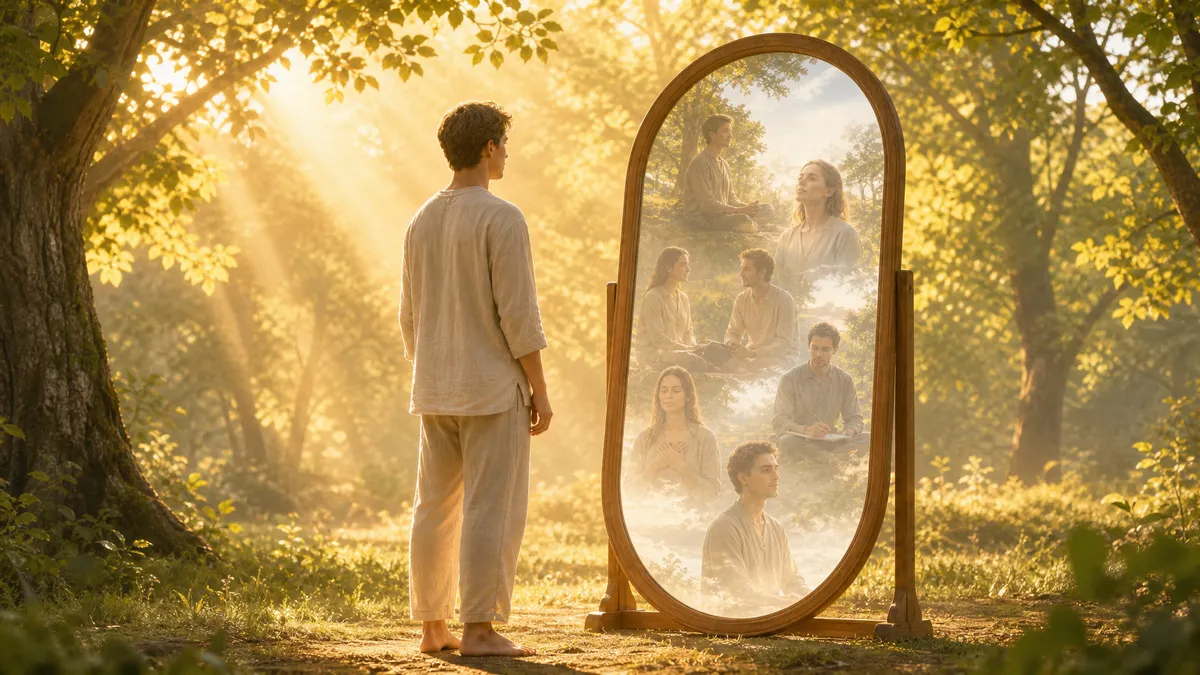
The mirror is consciousness, and consciousness is closest to space. Reflections are material objects and any objects that we perceive through the five sense organs.
The state of ignorance is a state in which we perceive only reflections but do not see the mirror, and in which we do not distinguish between the mirror and the reflections. That is, aviveka (the absence of discriminating wisdom) is when we confuse or do not see the difference between the mirror and the reflections, or do not even know about it.
Viveka-vidya (discriminating wisdom) means that we are able to distinguish between the mirror and the reflections. Life in ignorance is a life in which we are focused on reflections. Reflections in themselves are ephemeral, unreal, and they occur entirely within the mirror, but we chase after reflections and desire to possess them, appropriate them, and build our lives on the pursuit of reflections.
For example, scientists conducted an experiment in which they placed a large mirror in a forest, and various animals approached it, and they filmed the reactions of different animals—the reactions of monkeys, dogs, and other animals. Some tried to communicate with one another, some ran away, frightened. For example, if a dog sees its reflection in a mirror, if it does not know what a mirror is, it will think that it is another big dog that wants to bite it, and it will be frightened.
In the same way, when we do not recognize the mirror and are carried away by reflections, our life remains as if in a mirage. The question of contemplative practice is to learn to distinguish, to understand the difference, the clear difference between the mirror and the reflections. When we understand the difference between the mirror and the reflections, we abide in the dimension of the mirror.
Reflections can include not only material objects, but also our thoughts and feelings, emotions and images, that is, everything that constitutes the principle of energy in the three dimensions. Recognizing wisdom (viveka) is that which separates the mirror from the reflection.
Three Aspects of Primordial Consciousness
The distinctive feature of the mirror of pure consciousness is that it is always pure; it possesses innate purity and perfection — this is called “niranjana” in Sanskrit. For example, if we take a mirror, teachers often give a direct introduction with the help of a mirror, showing the mirror to students. If a Buddha (a holy person) looks into the mirror, it will reflect him as a Buddha, and then if a dog or a pig looks into the mirror, it will reflect it; but the mirror itself will not become dirty, it will become neither worse nor better. As it was a mirror with its reflective capacity, so it will remain.
That is, whatever energies or elements are reflected in it, it remains pure — this is the feature of the nature of our mind that we must deeply understand. Since it is difficult for us to believe in the primordial purity of our mind, we need to take care that only pure objects are reflected in our consciousness, because if impure ones are reflected, this may become our bad karma.
But when we attain the state of one taste, we may discover that what in our understanding was pure or impure is simply mental constructs, mental formations, while purity is not in the energies that are reflected, not in the reflections; it is in the mirror itself. The mirror possesses innate purity, and innate purity exists independently of our evaluative categories.
For example, evaluative dualistic categories often mislead us. The same person may be a spy, an enemy in one country, and a hero in another — it all depends on which country he works for. If he is a Russian intelligence officer, in America he may be a harmful spy, a harmful enemy, while for Russia he may be a hero; but has the nature of the person changed? No.
Or another example: if a man has one beloved woman and a second one, then depending on how the situation unfolds, for one he is a vile traitor, and for the other a very good person, because he loves her, he has done something absolutely right. But the person has not changed; the person is one and the same — this means that, depending on the situation, different minds evaluate this person differently.
In the same way, one person, depending on the political situation, may be an occupier or may be a liberator — all these are different points of view. We constantly live in such worlds, where our minds project reality depending on the situation, but this is not the true situation, because any dualistic situation is not true by definition.
The truth is that the mirror of our mind is always pure and is completely independent of reflections, while all reflections, material manifestations, are an illusory play of energies, empty and possessing no essence whatsoever.
The second aspect of this mirror is the ability never to be colored by any energies, to abide in its natural dimension. For example, if we place this glass on red, it will seem to be colored red; if we place it on brown, it will seem to be brown; if we place it on black, it will seem to be black. But in fact, as we see, the glass remains as it was, and no matter how many such backgrounds there may be, the glass, the pure water, is always transparent.
In the same way, our primordial consciousness is not stained, not colored by any energies, by any manifestations. Our Atman is not colored by our nationality, our body, male or female, our intellect, our material position, our reputation in the material world, our deeds and actions.
The third aspect of this primordial consciousness is its innate perfection, its spontaneity. What does this mean? No one created it deliberately; it does not need to be created again. For example, if we take a peacock feather, no one painted the peacock feather in an art studio. The peacock feather is colored by itself, simply because it is a peacock’s. The peacock is so perfect and beautiful; there is nothing artificial in it, it possesses spontaneous beauty and perfection.
In the same way, our essential consciousness beyond reflections possesses primordial perfection before our birth; therefore it is said: “God is perfect.” Even if we accumulate some karma, some sinful reactions (karma-phala), if we remember perfection, purity, and unstainedness, these three aspects of the primordial mirror of consciousness, and the unreality of reflections, we can purify all our karmas, and this is called “self-liberation.”
The Involuntary Nature of Creation
Infinite consciousness is the involuntary and unintended cause of the appearance of the world now and of future worlds. When it opens its eyes, worlds arise; when it closes them, worlds disappear.
Vasistha continued:
Just as children’s fantasies are unreal to me but real to the child, so too there is no creation in my consciousness. Since forms, vision, and the intellect that perceives them are pure consciousness, only it exists, and not the universe. I do not perceive the sense of ego, etc., but I am aware of the existence of pure consciousness or perfect peace.
Three Theories of the Creation of the Universe
There are three main theories of the creation of the universe: drishti-srishti-vada, srishti-drishti-vada, and yugapat-srishti. These are the theory of gradual creation, similar in many ways to the theory of classical physics, the theory of the instantaneous creation of the universe, and the theory of no creation at all.
The theory of gradual creation is described in many Puranas and Itihasas, and they describe how time, space, the five elements, and the three gunas gradually unfold.
The theory of instantaneous creation says otherwise: that these elements do not unfold gradually, but already exist originally in the source of the universe, and each act of consciousness creates a new universe instantly, recreating its structure through the simplest act of consciousness.
The first theory is closer to Einstein’s physics; the second theory is closer to quantum physics, where the observer influences the observed, where variable universes exist parallel to one another, and each act of observation creates a new cascade of variable multiverses. It is usually difficult to understand, but if you want to understand it from a scientific point of view, you can study Hugh Everett’s theory.
In the twentieth century, Everett produced the effect of an exploding bomb in physics, but in fact this had long been known in the Vedic tradition five thousand years ago. The essence of Everett’s theory is similar to the theory of instantaneous creation. It says that since the external object depends on the subject, each act of observation creates the universe, each fluctuation, each change in consciousness creates a new universe, and therefore there is no single permanent universe. The universe changes every time we look at it; we change it every time we change our state of mind.
This is a magical picture of the world, one that magicians and shamans also intuit. The world exists because there is our consciousness, and it vibrates at a certain frequency, and it creates the world in this way. For example, this hall exists only because we collectively recreate it through the power of our consciousness. It does not exist objectively; it exists only until we leave this hall, it exists in our consciousness, but in our consciousness our realities intersect, and we see this world.
When we leave this hall, when the last person leaves, the consciousness creating this hall will fade, and the hall will disappear. Someone may say: “How can that be, where can the hall disappear to, surely the walls might not hold?” But in fact, if our consciousness creates other rooms of this hotel and does not create the hall, then they exist in our vision. To maintain walls in the mind, no load-bearing structure is needed; it is simply a creation of the mind. For anything to appear, a directed act of our perception is needed.
In other words, an object exists when we actively perceive it and create vibrations in consciousness; then it is recreated, singled out from the space of the universe. A collective act of perception creates stable things; certain small things are created by our individual consciousness.
Sometimes people say: “But if we leave and set up a recording video camera, then we will all leave, and the camera will show that the hall has not disappeared anywhere.” To this one can answer as follows: the camera will not show anything until you approach it with your memory or with your samskaras, and until it reproduces this. Until there is a subject who could see it, it will show nothing, because it will not exist either.
For the camera to show that the hall exists, you as the subject are needed; you must necessarily enter into a relationship with it and activate certain imprints. If the imprints are not activated, then the hall will not exist either; this means that the hall does indeed arise in consciousness, and it arises subjectively.
The Theory of No Creation
This is a complex theory, but it can be understood. The theory of no creation, described by Gaudapada in the “Mandukya Karika” and by Dattatreya, says paradoxical things. It asserts that nothing was ever created, nothing was ever born, nothing ever arose, and therefore nothing will ever be destroyed. Originally, the universe never existed; originally, it was never created.
The theory of non-creation is an expression of the most absolute, the most complete realization, akin to the realization of Dattatreya or Shiva. When our consciousness is free from karma and does not vibrate, the universe is not created either, since only the vibrations of consciousness cause the universe to be created.
One can give the following example: when you meditate and your mind is stopped, if your mind is stopped and you perceive emptiness, and as long as you have no thoughts and no images in consciousness, you do not have the desire to see anything, to speak — you abide in awareness beyond thoughts and without images, and no situations come into contact with you or are attracted. But as soon as a thought or desire appears, various situations develop: people are drawn to you, conversations begin, chains of connections arise, and suddenly everything starts to unfold. This example shows that while you were in a deeper consciousness, nothing developed, no connections were activated, because your consciousness was not vibrating.
Know that even these words of mine are pure consciousness; this dialogue exists only in the space of your own consciousness.
In the highest state, desires do not arise. The wise one, free from desires, acts as if he were made of wood. He feels pure nothingness within and without; for him the world is like a hollow reed. The one who is not enchanted by this world, whose heart delights in cosmic existence, abides in boundless peace and has crossed the ocean of samsara. Having overcome desire and abandoned hidden tendencies or mental conditioning, say what must be said, touch what must be touched, taste different flavors, look at different scenes, and smell different scents.
Only by understanding that the objects of sensation are empty can one be freed from the disease of desires. The arising of desire is suffering; its cessation is supreme bliss. There are no sufferings or pleasures comparable to them, even in heaven or in hell.
Studying the Philosophy of Advaita Vedanta
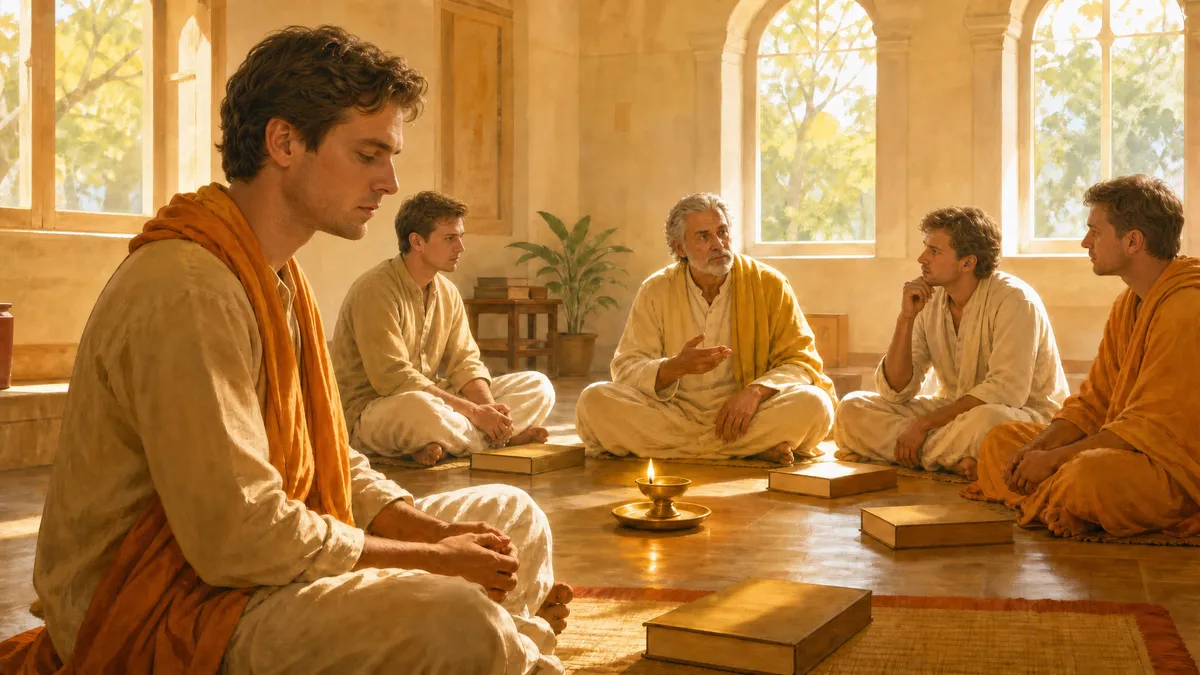
Such theories are good to contemplate for about six hours — by the fifth hour, a deep immersion occurs. In ancient times, many sages gathered in order to think deeply about the theories of Advaita Vedanta, to discuss them deeply, to immerse themselves deeply in their understanding. A certain amount of time and great work are needed for such a vision to truly penetrate, which is why it is very important to study the philosophy and theory of Advaita Vedanta. All of this is the practice of view.
When we are stable in the view, in Vedantic yukti (the course of thought and reasoning), our contemplation is also filled with great power; we have something to say to our mind. It is not necessary to say this to the world — if you come and tell someone else, “The universe was never created at all,” he will say, “What?” This should not be discussed with other people who do not understand you. But you can say it to your mind, because your mind is your main interlocutor and your main competitor, and your main tempting serpent. You must have powerful knowledge, a powerful instrument, a powerful philosophy in order to train your mind.
Working with the Mind
The mind must be trained; one must work with it. You must learn to stand up to your mind. The mind is like a small disobedient child or teenager who constantly challenges you, who constantly tests his boundaries:
- “How much will you give in to me here? Let’s check.”
- “How far can I lead you into illusion here?”
- “How much can I provoke you, make you angry here?”
- “How much can I attach you here?”
It is such a disobedient teenager who challenges parental authority, feels out his boundaries, and wants to understand himself. Your awareness, as the parent, must understand how to tame this mind, because taming the mind is a very important task on the spiritual path. How to set the right boundaries for it, how to raise it to be restrained, sattvic, obedient, and, most importantly, so that it serves divine awareness, divine will, so that it carries out the commands of your inner observer, so that it is under the power of buddhi (awareness).
There can be no democracy in consciousness—democracy in consciousness is a bad thing. In consciousness there should be a monarchical theocracy, that is, the rule of the divine. Democracy in society is a good thing, but in the mind it is when your mind says, “Let’s sleep in today, let’s not do sadhana,” or “Let’s satisfy this desire,” and voices arise within you: the body votes, “Let’s sleep,” the mind says, “Let’s sleep, let’s not practice,” and by majority vote you decide—the decision is made to keep sleeping. And your conscience, your soul within, says: “What are you doing? It’s the ninth hour! You are a sadhu!”—this is the rule of the majority.
In fact, for a sadhu it is the rule of the divine source—a monarchical theocracy. We must have a whole instrument in order to educate our mind, tame it, make it a pure, flexible, transparent, obedient instrument, because the mind itself has no right to rule, no right to make decisions and govern. It is an instrument, and it must be subordinated to awareness.
