

Commentary on the text “Tripura Rahasya.” Chapter 7. On Pure Mind and Absolute Consciousness
“Be that as it may, it must be acknowledged that He is pure mind, and His consciousness is absolute and transcendent. Such is consciousness-mind in all its purity. This absolute Being, the one Queen-Goddess, Parameshvari (the transcendent goddess), surpassing the three states and therefore called Tripura. Although She is one indivisible whole, the universe manifests within Her in all its diversity, reflected as it appears to us in the self-luminous mirror. A reflection cannot exist separately from the mirror, and therefore it is one with it.”
Three Types of Vision
The tantras mention that there are three types of vision.
The first type is impure, or obscured, vision, that is, the vision characteristic of the ordinary mind. It is also called samsaric vision (avidya). In the state of obscured vision, we see the world through the prism of our own ideas and perceptions.
The second type is the practitioner’s vision, which is connected with experience. For example, during meditation, you may experience heightened awareness and clarity. Or, while working with a sankalpa, you may suddenly feel an expansion of consciousness and inner greatness. Or you may experience an unprecedented sense of emptiness, a feeling that everything is unreal. All of this belongs to the realm of experience.
Finally, the third type is the vision of the siddhas. It is connected with a single “taste,” with fully realized pure vision and nonduality.

Thus, our practice consists in moving from impure, or obscured, karmic vision in samsara, through experiences and the inner alchemy of contemplation, toward a single “taste” and the completely pure vision characteristic of the siddhas.
Obscured Karmic Vision
At first, of course, we have only ordinary karmic vision, which is called obscured. We begin with it because we have nothing else. For example, in a state of obscured vision, we divide the world into subject and object, or we perceive the past and the future, the inner and the outer, the bad and the good, the kind and the evil as existing for us. All of this seems to us to be an axiom, something naturally inherent, something that is an integral part of reality. It seems just as natural to us as the ground beneath our feet and the sky above our heads. However, from the point of view of the siddhas, it is precisely this vision that is impure or obscured.
The siddhas say that there is no reality outside vision, that all our thoughts, ideas, and evaluative judgments are merely vision. Siddhas may also express certain evaluations or opinions, but they are not bound by them. When a person who is in obscured karmic vision expresses judgments, it can be said that they become bound by them. This is the difference between the vision of the siddhas and the state of ignorance (avidya).
The Story of the King and the Yogi
Once, a certain yogi was meditating in the jungle. A king was hunting and, having lost his way in the jungle, was looking for a path to his army and his palace. In the jungle, he came upon a hut in which this yogi was meditating. The yogi was in samadhi. The king expected the yogi to show him the proper respect. The king was accustomed to everyone knowing who he was, so he could not even imagine that the yogi did not know what the king looked like, since the yogi was in his own reality, having spent decades in samadhi. When the king entered the hut, he saw that the yogi had not even opened his eyes but continued meditating. The king realized that no respect was going to be shown to him, and this greatly outraged him. Then, deciding to mock the holy man, he took a dead snake that was lying nearby and draped it around the yogi’s neck, saying: “Here, this is a garland for you! This is my way of paying you respect as a sadhu.” In other words, thinking that the yogi did not respect him and becoming angry because of it, the king hung a dead snake around his neck and left.
This yogi did not even see the king enter, because he was in samadhi. But the king projected his obscured vision onto him. Later, he had to pay for it with his life. When the son of this sadhu arrived and saw that a snake was hanging around the neck of his father, a brahmin and ascetic, he found out that the king had insulted his father in this way. The yogi himself was such a great and dispassionate sadhu that he was not offended in the least, but thought: “One never knows what kings may be like.”

But his son was not free from attachment, so he said among his friends: “These kshatriyas think far too highly of themselves. They do not know the true power of the brahmins and think that they are the rulers here. It is time to teach them a lesson!” Then this boy performed a magical ritual, sending a curse upon the king. Having received the curse, the king realized his mistake. He decided to accept death with dignity, as befits a kshatriya, and not reject the curse. He spent the final days of his life on the bank of the river, surrounded by eminent yogins, listening to the teachings given to him by Shuka Deva Goswami. This story is described in the Puranas. And the cause of everything that happened was the king’s obscured, impure karmic vision. He took offense where he should not have, instead of perceiving the situation in an entirely different way.
Transition from Obscured to Pure Vision
When we practice, we try in every possible way to displace obscured vision within ourselves and cultivate pure vision. Gradually, we acquire the vision of practitioners, and a genuine contemplative experience begins, changing our vision. When the experience gains strength, we begin to penetrate somewhat into the state of a single “taste.”
Speaking about contemplation, one Zen master wrote: “It is just like ordinary life, except that you are always hovering a foot above the ground.”
“Hovering a foot above the ground” means that you hover without regard to the fact that you continue to perceive the world as before and that you are accompanied by all perceptions. Any perceptions self-liberate within your experience.
On Worship and Integration
“And since this is so, there can be no distinctions in levels or ranks (for example, that Shiva is higher or lower than Vishnu). Bodies are merely concepts for beings of a lower order, and they have no place in relation to God. Therefore, be wise and worship the one, pure, and immaculate transcendence.”
Here, from the perspective of the teachings of laya yoga, we could comment on “worship” as “integrate.” In Advaita, there is no worship, because the practice of worship is characteristic of Dvaita or Vishishtadvaita, where there is a subject identifying with a personality and an object of worship, such as a chosen deity (ishta-devata). In Advaita, it is incorrect to speak of worship in the sense that the very principle of Advaita is incompatible with the worship inherent in bhakti yoga within Dvaita or Vishishtadvaita. Nevertheless, we speak of contemplation and the principle of integration.
For a yogin practicing Advaita, the object toward which he directs his consciousness is always the world without form, without sound, without smell, without color—the principle of pure consciousness as such, existing beyond concepts, which he perceives through intuitive consciousness (buddhi). Nevertheless, it would be incorrect to say that this world alone is the object of contemplation, because pure consciousness always has manifestation, an expression of energy. Therefore, we also speak of integration. To integrate means to unite in contemplative presence with any object, to interact with its prana, with its relative dimension. Such integration would be the equivalent of the word “worship,” which is characteristic of bhakti yoga. Through integration, we significantly strengthen the principle of contemplation; it becomes saturated with energy. For example, by integrating with the moon, you can saturate your body and your karmic vision with lunar energy and thoroughly understand the principles of the left channel.
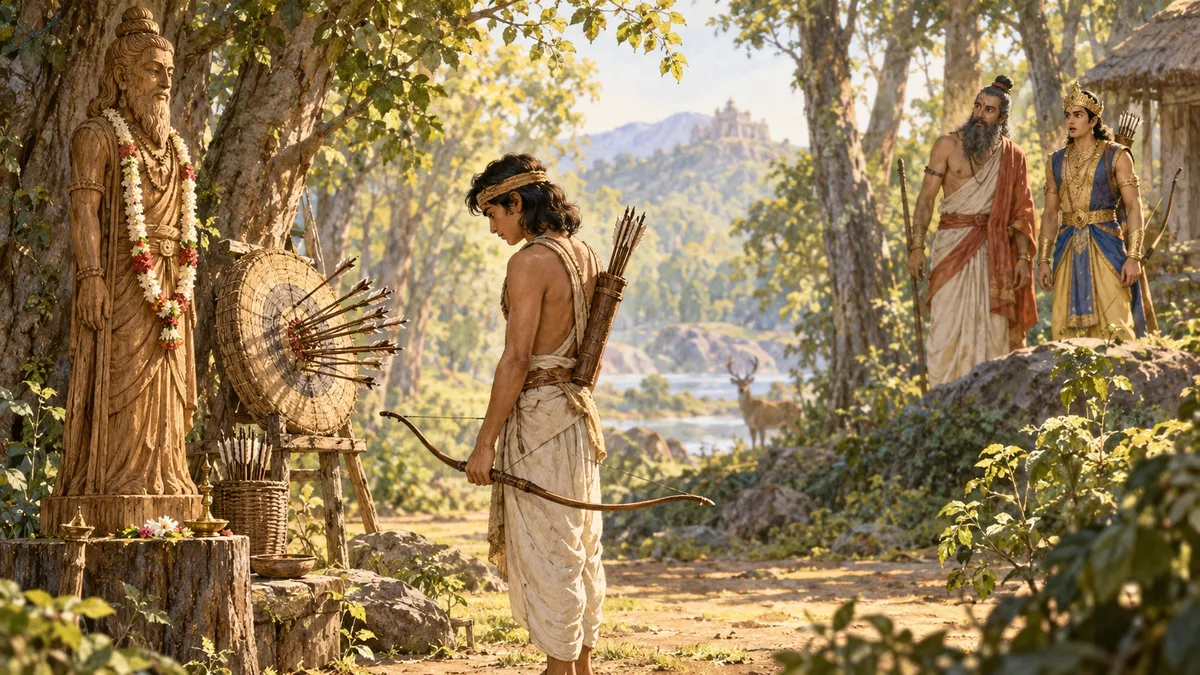
There is a story about Drona and Ekalavya. Ekalavya wanted to study archery under Drona—a great archer and brahmin. He came to him from far away and asked to be accepted as a disciple. But Drona was training Arjuna and wanted Arjuna to be his finest student. Noticing that Ekalavya possessed exceptional qualities and could surpass Arjuna himself, he refused to train him, explaining that he belonged to a lower caste and therefore Drona could not teach him. Ekalavya then went to live in the jungle, where he carved an image of Drona from wood and meditated on it as his guru. It was solely through this that he mastered unrivaled skill in archery. When he came to Drona to demonstrate his skill, Drona saw that he shot a bow better than Arjuna.
Practice for Different Levels of Understanding
“If a person is unable to comprehend this pure state, then he should worship God in the particular form that is most acceptable to him.”
This means that a person should choose a lower form of practice if they are unable to comprehend this pure state. In other words, they should integrate with something that has form, something more comprehensible to their mind.
It is commonly said that the teachings of laya yoga and contemplation are suitable for those who possess sufficient intellectual abilities. By intellectual abilities, however, what is meant is not so much erudition as intuitive clarity—the ability to grasp the essence of the practice intuitively. This is connected with the ability to go beyond concepts and be aware of oneself in this non-conceptual state.
Many believe that mindfulness and contemplation are the beginning and the end of practice. However, contemplation is the beginning of practice. It is said that where the practices of various teachings end, the practice of laya yoga only begins. It begins with contemplation, or the ability to remain in this non-conceptual awareness, but of course it does not end there.
Continuous Absorption in Contemplation
The development of contemplation is continuous absorption in contemplation of the supreme Source. One could say that a monk is someone who constantly thinks about the Absolute. He thinks about the Absolute until awareness of the Absolute becomes a greater reality for him than the world of the material universe, until his consciousness fully acquires the qualities of the Absolute, and he begins to feel that the Absolute is him, and he is the Absolute.
In this context, thinking about the Absolute means not thinking about it, because if you think about the Absolute, you are actually only distancing yourself from it. It means being in a state of attunement effortlessly, without engaging in thought processes or artificial constructions. Nevertheless, put in simpler terms, it does mean precisely thinking about the Absolute.
Often, when I see a person who is experiencing mental difficulties, I simply ask them: “What are you thinking about, anyway? If you are thinking about the Absolute, then this very act of thinking eliminates your mental problems. Perhaps you simply need to remember that it is time to engage in contemplation after all? This very recollection instantly dispels many problems.”

Shaktipata—the Descent of Inspiring Power
When you contemplate continuously in this way, a connection is established that begins to give you strength. It begins to permeate your thoughts, your walk, your actions, your life, your dreams, your relationships, your desires, and even your obscured kleshas and states—in other words, what you considered sinful. You receive a powerful reverse impulse as the result of genuine practice. This is shaktipata—the descent of inspiring power. Thanks to this impulse, you begin to experience tremendous inspiration, or a transformation of bhava, a transformation of your perception of the world. It is as if you were continuously reflecting on the sun, concentrating on it, gathering information about it, and talking about it. After some time, the sun would become a subjective psychic reality for you. You would feel its warmth in your channels and its light in your mind. It would fill your entire world and change your destiny. There would be constant signs connected with the sun all around you.
It is something similar. In this case, the sun represents the unified sphere of reality. Therefore, a person who receives this inspiring impulse always remains in a state of tremendous inspiration. They have neither doubts, nor disappointments, nor desires, nor confusion, nor clinging, nor hopes, nor fears, because their existence is so complete that all of this seems utterly unimportant and inappropriate. Just as a person’s infatuation can be seen in the sparkle of their eyes and their joyful mood, so a person’s receipt of the inspiring impulse can be seen in the depth of their consciousness.

Once, a disciple came to me with some questions. Instead of answering his questions, I diagnosed him: “The whole point is that you lack the breathtaking ecstasy of Being—you are not dancing with joy! Everything else is merely a consequence, so there is no point in answering these questions. If the most important thing is absent, how can we talk about other things? Let us first figure out why you do not have this inspiring ecstasy.”
And when we began to look into it, it turned out that there simply was no one-pointedness, no mind that was directed toward this sun. There was not even an understanding that one needed to direct the mind toward this sun or how to do it. If you direct your mind toward this sun, it is inconceivable that the sun would not illuminate you. In principle, this is impossible, because the descending force continuously extends equally throughout all 24 hours of the day.
