

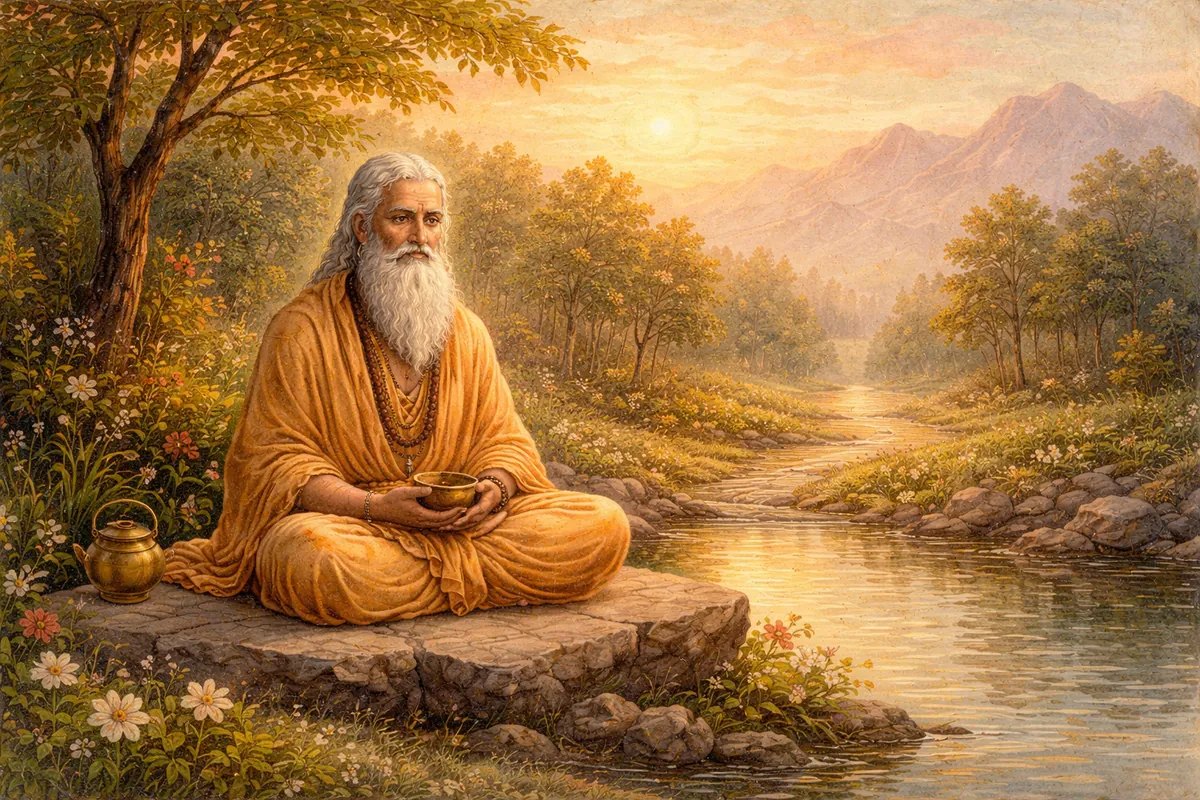
Lecture at Swami Vishwananda’s ashram
I am glad to be here, to meet many souls who are walking the path of Sanatana Dharma. I really liked this place, created by the holy soul Swami Vishwananda. Of course, there should be more such places on Earth. I believe that the future of humanity will always be connected with spiritual people and with spiritual practice, with those who are called sadhus.
Humanity is now in a deep dead end. A dead end in economics, in politics, in culture — a crisis in many things. Even in such developed countries as Europe, they speak about this. In my view, this crisis is connected with the fact that humanity has lost itself, its meanings, values, and goals. It has played too much with the culture of material consumption and has lost the meaning of its existence. This cannot continue endlessly.
But ahead of us there must be a much brighter future. And this bright future will be connected with spiritual people, with those who follow the spiritual path. I believe that this future is being laid right now, during our lifetime. This beautiful spiritual future will not be connected with religious divisions, because religions sometimes become too closed within their religious ego, begin to divide, and many problems arise.
True sages and saints are beyond divisions. And the teaching of Advaita Vedanta, the teaching of Sanatana Dharma, to which we consider ourselves to belong, is also beyond any divisions. Advaita Vedanta says that all divisions are illusory; we are all one. Russian, American, Englishman, Hindu, German — all this is a certain duality, an illusory concept. Buddhist, Hindu, Catholic, Taoist — these are also certain concepts, human notions, but in essence we are all one.
Advaita is translated as not-two, non-dualism. The moment we begin to understand Advaita, we begin to understand where the keys to this universe are, where the keys to our life are, to understanding our Self. Usually we are all accustomed to living in duality. We always divide everything: inner — outer, subject — object, Shiva — Shakti, and so on. But Advaita says that this division exists only as long as we remain in ignorance regarding our own nature.
The teaching of Advaita says this:
Aham Brahmasmi
I am the Lord, I am the supreme absolute being
When, even to a small degree, we begin to realize this truth of Advaita, then our ignorance, our illusion, gradually disappears.
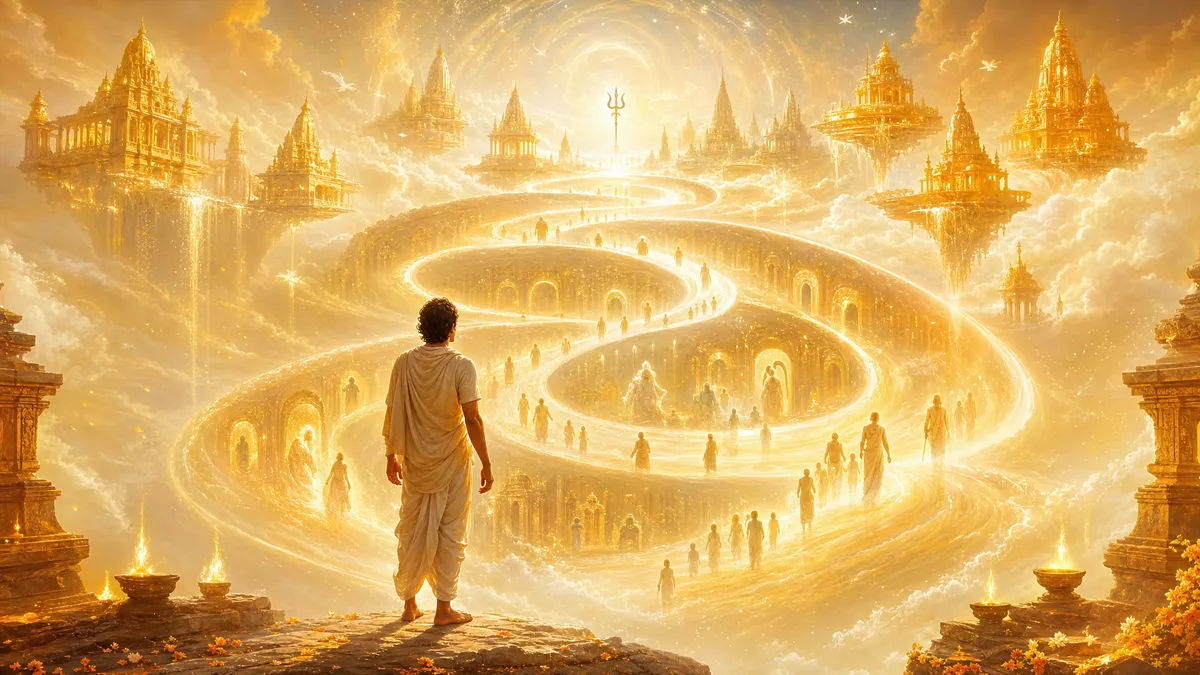
This world in which we were born cannot be called a happy, joyful, or heavenly abode, because suffering, old age, illness, and death exist; there is reincarnation. But we do not necessarily have to be born in this limited world of samsara, in this energetic trap. Samsara is not the entire universe; in the universe there are many worlds far higher than samsara.
There are many souls who are called nitya-siddha, eternally perfect. These souls live beyond samsara, in liberated divine worlds. They have bodies that are not born and do not die; they are bodies of light. By the power of reason they can create very many bodies; they are beyond the limitations of time and space. One could say that all decent people left samsara long ago. They are not subject to the law of karma; for them there is no karma of causes and effects, karana vikara; for them there is lila, the divine play. They are inseparable from the Supreme Source; each of them abides in the state of “Brahma-aham-bhava.”
But something went wrong with us; for some reason we decided to come precisely here. We wanted to obtain a gross, limited body, limited by the laws of karma, by causes and effects; we did not want to be divine, for some reason we wanted to be in karma. Obviously, there was some meaning in this; obviously, our soul lacked some experience or perhaps it wanted a certain kind of extreme experience.
There are fans of extreme sports: some like to jump on motorcycles over three hundred goats, and some tie themselves by the leg and jump into an abyss on a rubber rope, or they jump from a skyscraper with a small parachute. There are many ways to get adrenaline.
Our soul may have wanted a certain experience, but did not calculate its strength. It plunged deeply into matter, which means its memory of its divinity was switched off. It lost almost all its divine qualities; it began to think that it was this body, and it lost its divine wisdom, jnana-shakti, and its divine will, iccha-shakti, and its personal capacity for action, kriya-shakti—the ability to create, sustain, destroy, manifest the divine, and conceal without hindrance. It lost a great deal, many of its various qualities, simply because it did not calculate its strength, the light of its wisdom. Then it began to wander through this world in search of the meaning of life; it began to look for a spiritual teacher, to practice something. In order to free itself from the limitations of the material world, the material body, time, space, and causality, it now needs sadhana, tapasya.
What does it mean to follow the spiritual path of Sanatana Dharma? Sanatana Dharma begins with three processes: shravana, manana, nididhyasana.
Shravana — listening to instructions
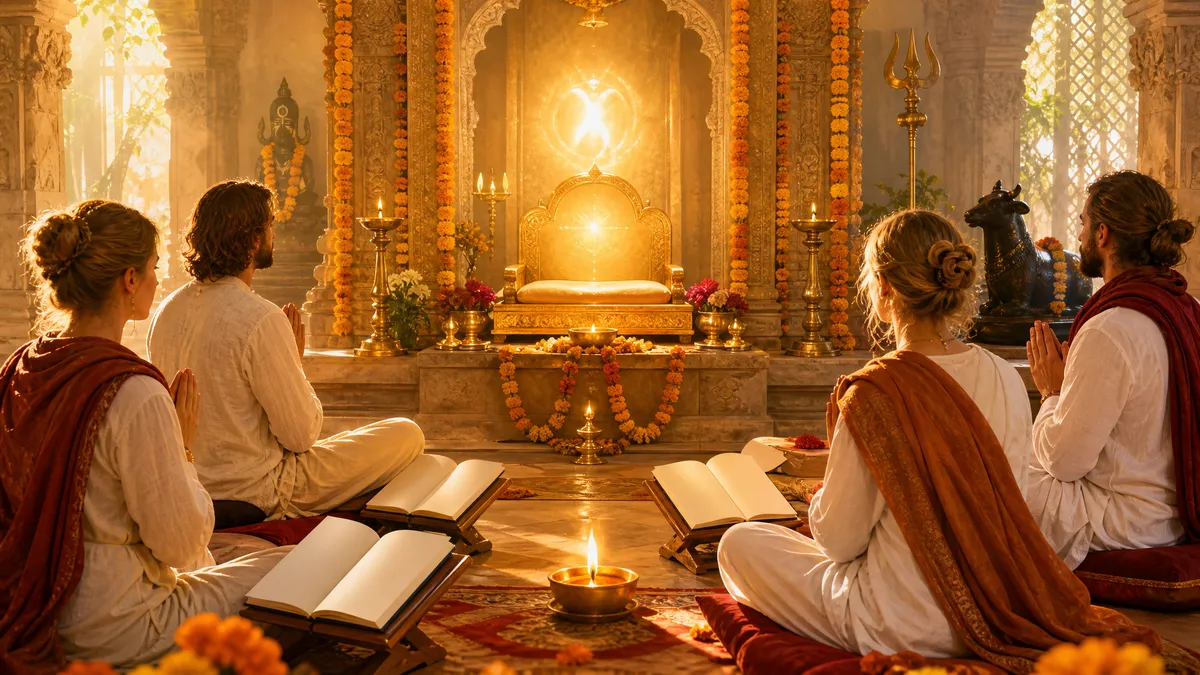
Shravana is when you listen to the instructions of the sacred scriptures from the mouth of the Master, from the mouth of the Guru, from your Guru, Swami Vishnananda. If you are disciples of Swami Vishnananda, you listen to the teaching of your Guru—this must be done many times. No matter whose disciples you are, you must listen many times to the instructions of your Master. You must understand the course of his thoughts, how he evaluates and looks at the world, his worldview, his meaning, his vision—grasp it and adopt it.
The same can be read in books, when a book becomes your Guru and gives you shastra-kripa, if it is a sacred book such as the “Yoga Vasishtha,” the “Tripura Rahasya,” the “Viveka Chudamani,” the “Atma Bodha,” and others. We must absorb a great deal—this is called shravana.
Manana — reflection and inquiry
Then a moment comes, and we think: “But what does this have to do with my personal life; how does it relate to my life?” We discover that the spiritual Master and the sacred books speak of some incredible things, while we live our ordinary lives. We begin to think about how to apply this to our life, how to make it part of our world.
This process is called manana.
We must reflect a great deal, carry out analytical meditation, in order to apply all these instructions of the teaching to our own life. Because we ourselves must understand and try, gain personal experience of what the sacred scriptures speak about; otherwise it will be like a pilgrim who carries different kinds of food but has never tasted it himself. When we comprehend this, a certain understanding is born in us, perhaps some kind of glimpse. The more we meditate on the meanings, the texts, the Guru’s instructions, the greater this glimpse becomes. Manana is not only reflection, but also vichara, inquiry.
Ultimately this should lead us to rasa, to the experience of a certain taste of the nature of consciousness. In the “Tripura Rahasya,” Dattatreya calls this fleeting samadhi. It is not yet true samadhi; it is only a certain flash, one instant and that is all. This can sometimes last when something amazes or frightens you, or when you have left one place but have not yet arrived at another, when you hear something paradoxical and your mind becomes paralyzed.
Then suddenly you touch your deepest part and the mind opens wide. Your heart opens wide, and you suddenly realize: “I am not the body, I am not a small point, I am boundless consciousness, I am infinity in a human body, I have neither a specific center nor limitations, and my mind is emptiness. There is no subject and object, there are no divisions in it, no concepts; I can experience this, but I cannot express it.” And even the slightest flash is enough to dispel a great many of our illusions. If you experience this flash, you will no longer be able to forget it.
Nididhyasana — continuous contemplation
Then the next process begins; it is called nididhyasana. Nididhyasana means continuous contemplation of the nature of consciousness; I would put it more simply: “Continuous abiding in God, when the face of God is before you as if in the palm of your hand 24 hours a day.” But this is not possible immediately, and the yogin must practice nididhyasana, engage in contemplation, meditation, and any practices that move his mind toward this state.
On the path of Sanatana Dharma, these three golden principles—shravana, manana, nididhyasana—are the entire essence of spiritual life.
Self-inquiry and viveka
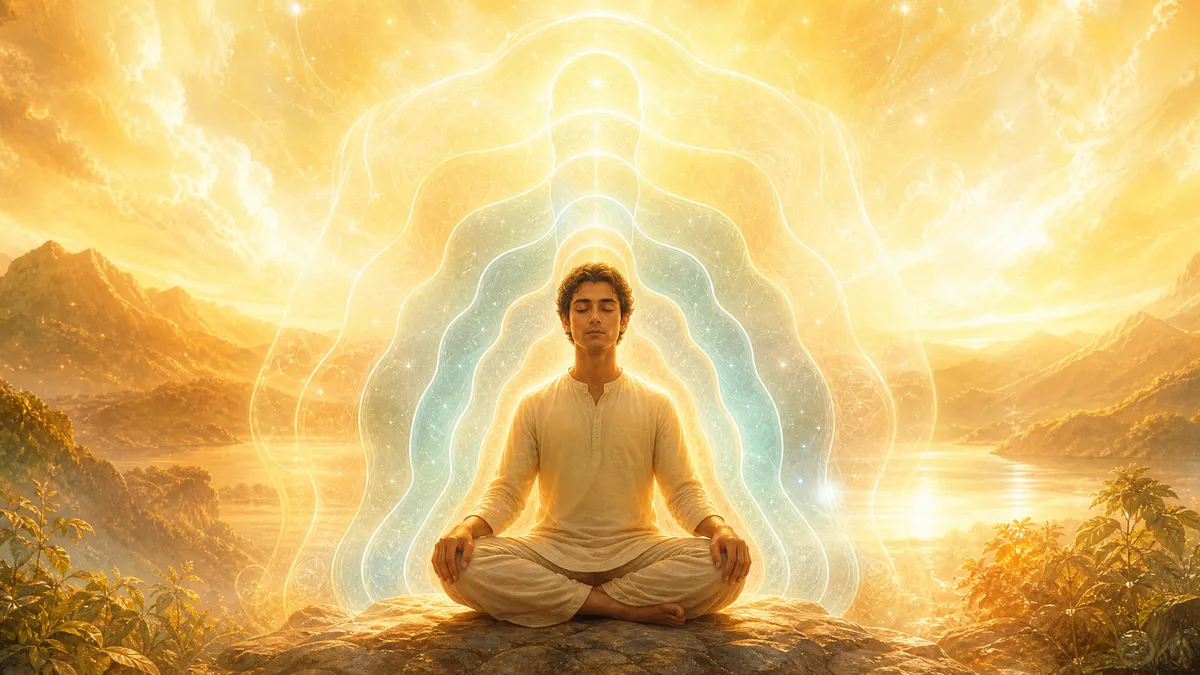
Thus, we walk this path, we engage in self-inquiry, vichara, asking the question: “Who am I?”, trying to investigate the nature of our consciousness, to look deep within, inward, deeper. And when we do this for a long time, when we are guided by the instructions of our Guru, understanding, viveka, arises in us: “I am not the physical body, I am not the energy body, I am not the subtle body, I am not the mental body, I am not even the causal body. I am the Atman, I am the infinite radiant space of pure consciousness.” And we call such understanding viveka. And the point is to continuously hold on to such understanding, not to forget it. Such understanding can be attained as a result of meditation.
But what about after meditation? We get up, begin to think, speak, and it disappears. While we meditate, we are like the Buddha. But when we get up, we become ordinary people. The whole point is to bring meditative experience into the post-meditative state. Even if we have reached great heights in meditation, when we get up, we need to start all over again in order to bring meditative consciousness into our everyday life, so that we can remain in this state while standing, sitting, lying down, while walking, working, eating, talking. We will see that our mind constantly strives to forget this state, to become distracted, to run away toward an external object.
Constant Awareness
We have a great deal of work ahead of us to develop such a habit of being aware, because the mind is like a little dog that is always trying to run away from its owner. If you have seen a person walking a dog, then when he holds it on a leash, it wants with all its might to run off somewhere. The owner either shouts at the dog or pulls the leash back. The very same situation exists with our mind. Therefore the instruction of the saints is this: “Always, wherever you may be, watch your mind. Even if seven enraged dogs are chasing you.”
Recently we were at Kailash, and at Lake Manasarovar there was a small camp where we stopped to perform a small yajna. Five Tibetan dogs chased after one of the practitioners. Then he remembered these words of the Guru, and he tried not to forget himself in that situation: “I thought, it is only five, not seven.”
But the meaning is that always and everywhere we must remember our divine nature, engage in contemplation, if we want to realize the truths of Advaita. This principle of nididhyasana consists in meditating on God all the time, remaining before the face of God all the time, being in contemplation of God all the time. Then for us there remains nothing but God. We discover that our problems, hopes, grasping, fears, and ego gradually go away. Vairagya, detachment, arises in us. Vairagya means that we have ceased to identify with human limitations, with society, with the ego, with attachments. We no longer rely on anything except our divine nature.
The Three Principles of a Sadhu: Vichara, Viveka, Vairagya
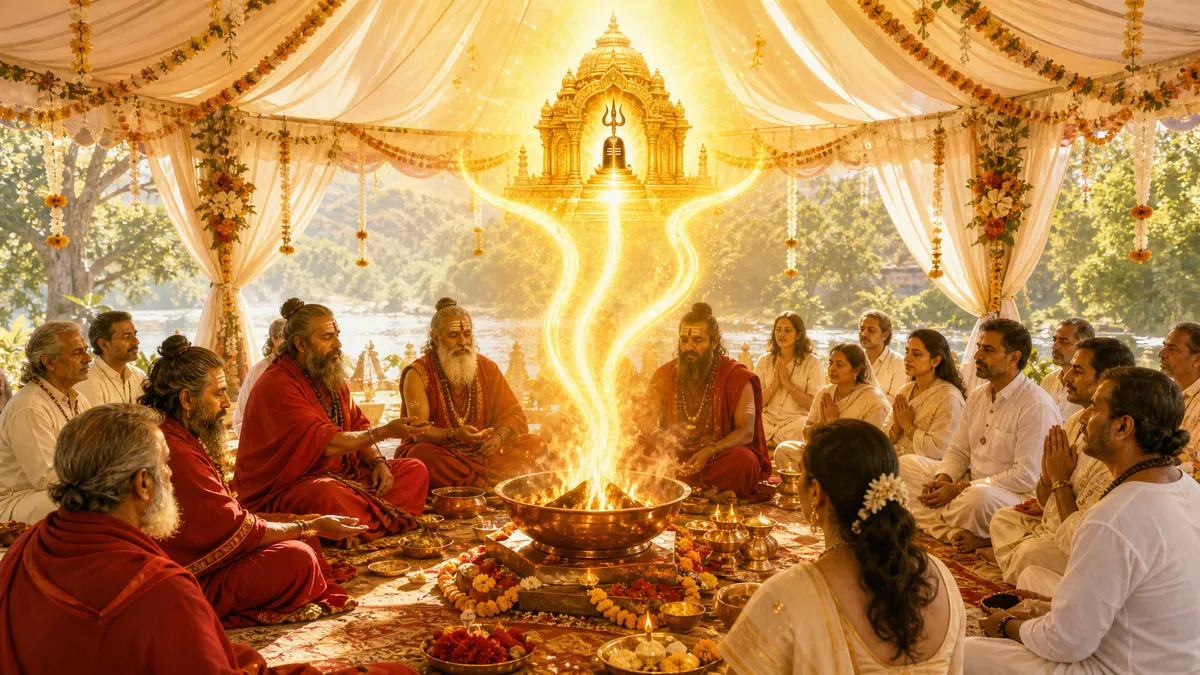
The three principles: vichara, viveka, vairagya — this is what sadhus, sadhus of the Vedic tradition, practice. For all of this, of course, the blessing of the Guru is needed, and great faith, great devotion to the Refuge are needed. All of this we call sharanam, Refuge. Because if we have no faith, no devotion, if we have not taken Refuge, then we will always be outside observers of the dharma, but we will never be involved in the dharma. Faith, devotion, Refuge mean that we truly open our heart to the dharma, to our Master, to our chosen deity, and then miracles begin to happen. These are not some external miracles, but they are necessarily the miracle of inner transformation.
This is possible only if we also have shila. Shila is aspiration. On the one hand, our faith, devotion, and openness are a necessary condition, but on the other hand, aspiration is needed. Your great aspiration is your readiness to carry out sadhana, perform service, meditate, and walk the path to God. When faith and aspiration unite, you become a very strong, true sadhu. No karma, no illusions, attachment, or ignorance will be able to stop you; you move forward on the path of awakening like an elephant going to a watering place. There is such a saying: “When an elephant goes to a watering place, all the insects scatter.” What are these insects? They are our illusions, various doubts, attachments. We cut some off, and new ones appear. But when we have aspiration, all of this is unimportant.
My blessings that you may have such aspiration and such faith.
