

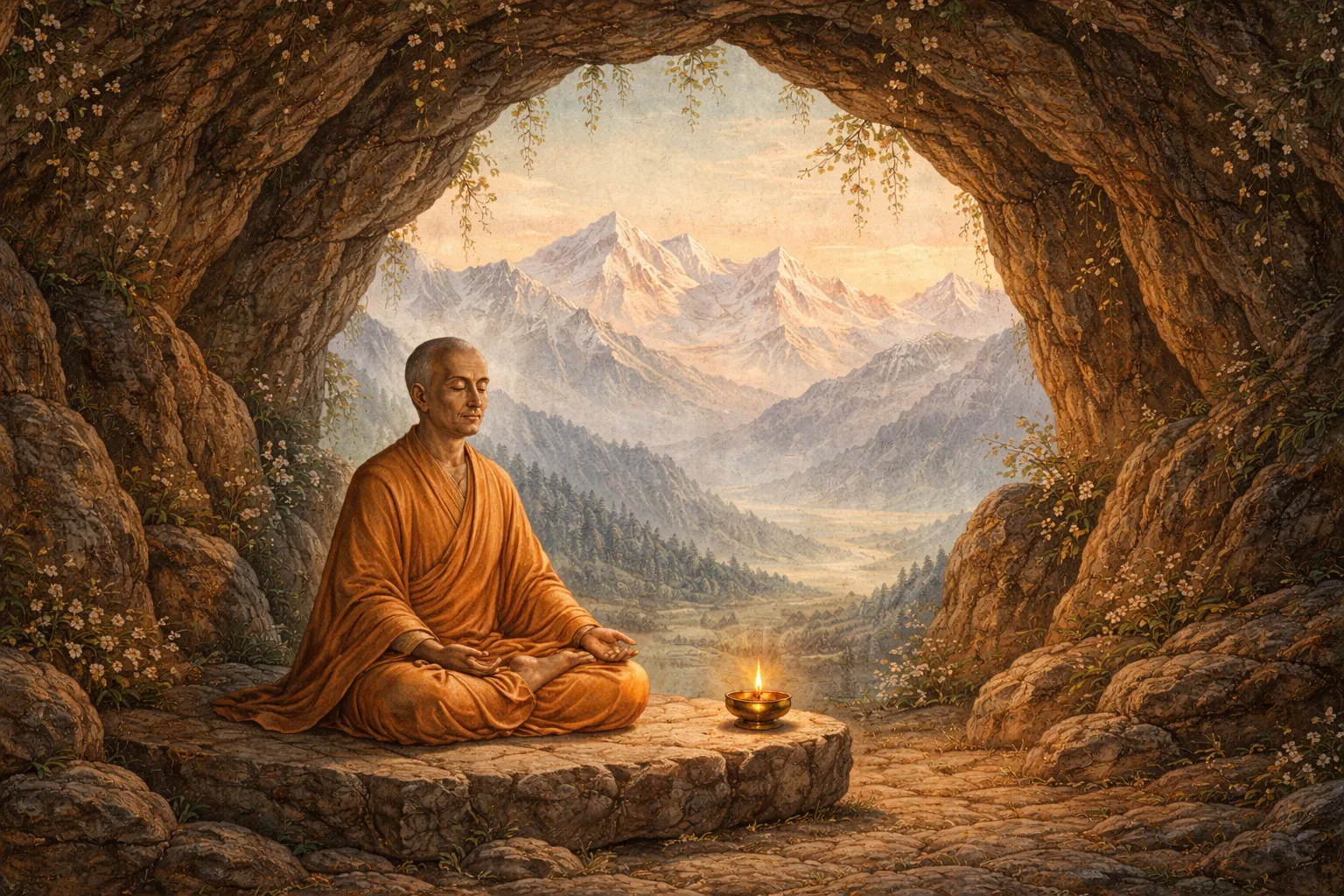
Matsyendranath and Gorakshanath, who are the founders of the teachings of laya yoga, were the founders not only of laya yoga, but also of other religions. For example, it is known that Gorakshanath initiated Kabir, one of the main teachers of the Sikh teachings, and thus the Kabir Panth movement arose. Today the Sikhs are not a very large, but a powerful and influential force in India. They occupy an entire separate state in India.
The teachings of the Sikhs are based on the teachings of the ten Gurus, Nanak and Kabir. The teaching of nada yoga is one of the main teachings of the Sikhs, transmitted by the mahasiddha Gorakshanath. There is a spiritual movement, Sant Thakar Singh. This is a teaching about the inner sound and light. In fact, it is a teaching of nada and jyoti yoga, only transmitted through the tradition of Kabir, but also originating from our Guru Gorakshanath.
Gorakshanath and Matsyendranath stand at the origins of Buddhist Tantrism and are among the principal mahasiddhas in the canon of the eighty-four mahasiddhas, who are also revered in Tibet; that is, they stood at the origins of the Vajrayana tradition. For example, Matsyendranath is revered as Buddha Avalokiteshvara, and in India there is a statue of him in precisely this form.
In addition, they gave rise to numerous branches of Indian Tantrism. There is also a separate school called Kashmir Shaivism, which is very close in philosophy to our teaching. One of the founders of Kashmir Shaivism is considered to be Abhinavagupta, who also received transmission from Gorakshanath and was his disciple. The second founder of Kashmir Shaivism is Vasugupta. Kashmir Shaivism is a brilliant school of instantaneous enlightenment, the advaita of self-recognition, the Pratyabhijna school. In fact, it is a very close school, almost identical to ours. The difference is that our style is somewhat different—the Sahajayana of the mahasiddhas—whereas Kashmir Shaivism places greater emphasis on philosophy. For example, the “Vijnana Bhairava Tantra” is practiced both in our tradition and in theirs as well.
I am making this digression not so that we become scholars of religion, but so that we have some understanding of the overall picture of spiritual traditions and know our place within it. Therefore, if you are asked which tradition you follow, you can say that your religion is Tantrism. In essence, Tantrism is not a religion; it is the practical essence, or quintessence, of all religions. Tantra is like a single thread that exists in every tradition. But it is usually said that there is Buddhist Tantra, Hindu Tantra, and Jain Tantra. Some also regard Taoism as one of the varieties of Tantrism. It is also said that Taoism was transmitted by Shiva to China (China in Sanskrit was called Mahachina). When he cut off Brahma’s fifth head, that head, associated with Tantrism, fell in China. Therefore it is said that the fifth Veda of Tantra appeared in China because Shiva cut off this head of Brahma. Thus Taoism arose, or the teaching of the Taoists, which is closely connected with the rishis, with the mahasiddhas, for example with the rishi Boganathar from among the Tamil siddhas. That is, Tantrism first took root in China, and then appeared in India.
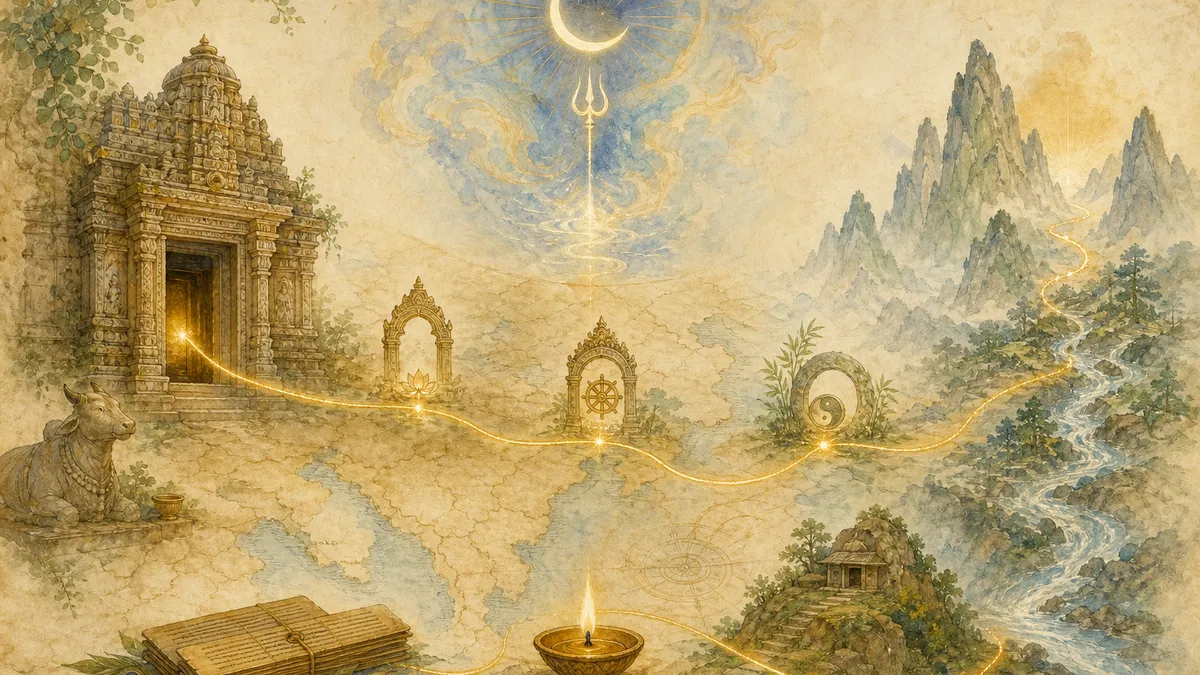
We adhere to Tantrism that originates in India. The direction of this Tantrism is Anuttara Tantra, which means “the highest.” There are also lower levels, for example Kriya Tantra, Charya Tantra, and Yoga Tantra.
How does the highest Tantra differ from the lower ones? Anuttara Tantra considers the very heart of spiritual practice, namely the nature of the Mind as such, the unrestricted free space of primordial awareness. Yoga Tantra pays more attention to channels, winds, energies, chakras, and kundalini. In our case, Yoga Tantra is subordinate to Anuttara Tantra. Charya Tantra pays attention to pure vision, deities, mantra recitation, and visualization. Kriya Tantra emphasizes ritual practice. The lower Tantras are considered the initial forms of spiritual practice. In the direction of Anuttara Tantra, we study the teaching of laya yoga in the tradition of the avadhutas.
What exact style do we practice? The Sahajya style of the mahasiddhas. Our lineage of teaching is the Dattatreya Sampradaya, that is, the parampara coming directly from Anama Prabhu.
Thus, once you have determined what exactly you identify yourself with, you then clarify what the essence of the teaching consists of. The essence of our teaching consists of the five yantras of laya yoga, which must be meticulously mastered and fully applied to oneself. When you apply the five yantras of laya yoga, they work.
The Thirty-Six Tattvas of Kashmir Shaivism
Now briefly about the universal manifestations of Parasamvit and the structure of the universe.
Parasamvit is a term used to denote the primordial nature of the Mind.
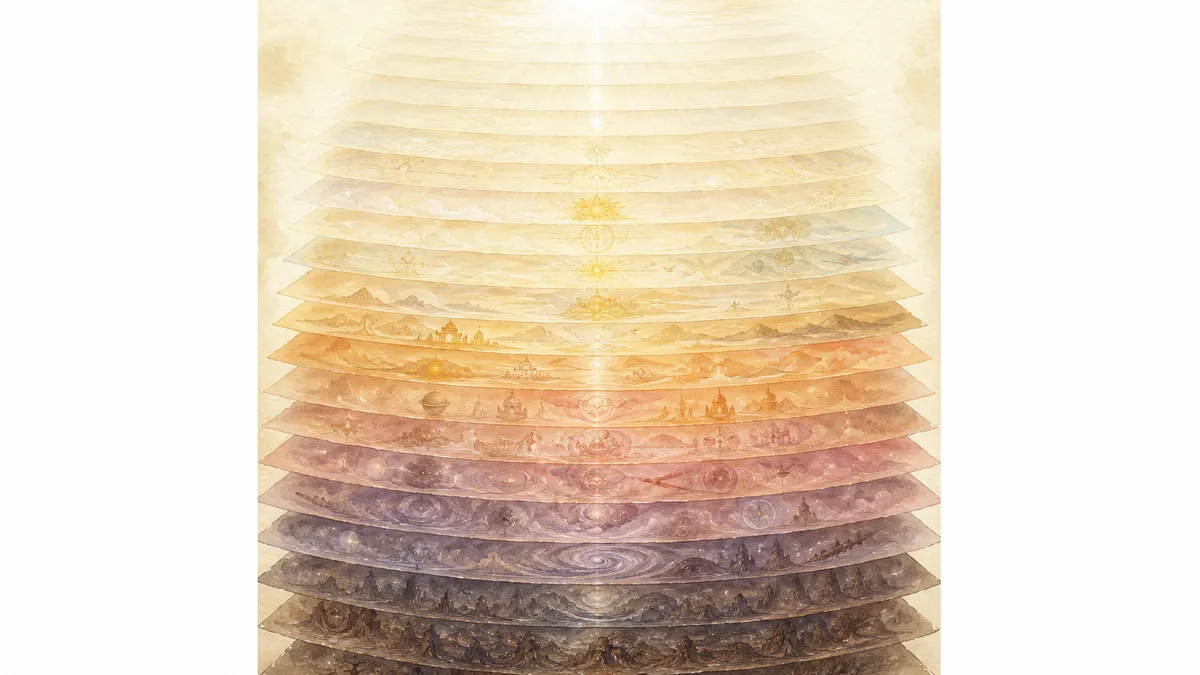
We can conditionally divide reality into thirty-six tattvas...
The thirty-six tattvas are the thirty-six elements of the universe. They describe the position of our “I” in this world and the process of creation of this world.
...into thirty-six levels of existence. Thirty-six principles, or thirty-six elements: from the most divine and transcendental to the gross material. Let us consider these tattvas: Shiva-tattva is the very principle of the divine supreme subject, the divine “I,” the first creative movement of the inexpressible and indescribable.
It can be described as the principle of unmanifest Being, the principle of the Universe in an unmanifest state, or nirguna Brahman.
Shakti-tattva, the bliss of Shiva, expressed through the experience of the “I” in the dynamics of existence, which is bliss.
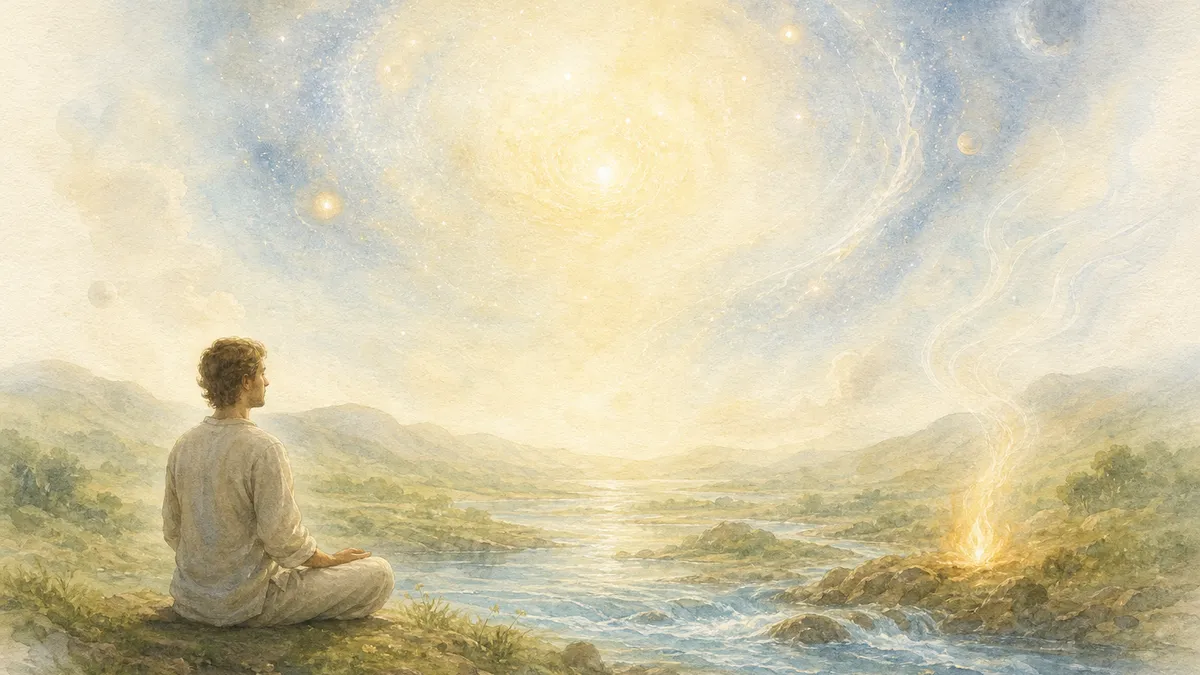
From this unmanifest state arises the first vibration. One could say that when the pure primordial Clear Light exists, movement, or a wave, appears within it. This is the seed of creative energy, which begins to manifest like ripples on water.
Shiva and Shakti are tattvas that constitute a single whole. Sadashiva-tattva is the experience “I am this entire world, I myself am this entire universe.”
When creation unfolds, a subtle vibration arises from the state of Clear Light, which is also called the “creative tattva”; that is, it is the seed from which the entire Universe is born. Then this seed begins to generate awareness, and the first germ of awareness appears: “I am this entire world,” “I myself am this entire universe.” One could say that this is God beginning to become aware of Himself. There are as yet no people, no planets, no suns—there is only pure awareness.
The next tattva is called Ishvara-tattva. “The Universe is My own manifestation.” At this level, energy is already manifesting in such a way that awareness has not only a sense of “I,” but also a sense of an external Universe. This awareness begins to feel itself as the creator of the external Universe.
The fifth tattva continues further; that is, manifestation begins from the unmanifest, the process of the unfolding of the tattvas, the elements of Being, takes place. The experiences “I am I, and this Universe is this Universe,” “I am Shiva, and this Universe is the fruit of duality; it is not something real for me.” Here a subtle division into duality already occurs: into the external world and the sense of one’s own absolute “I,” into Brahman and maya.
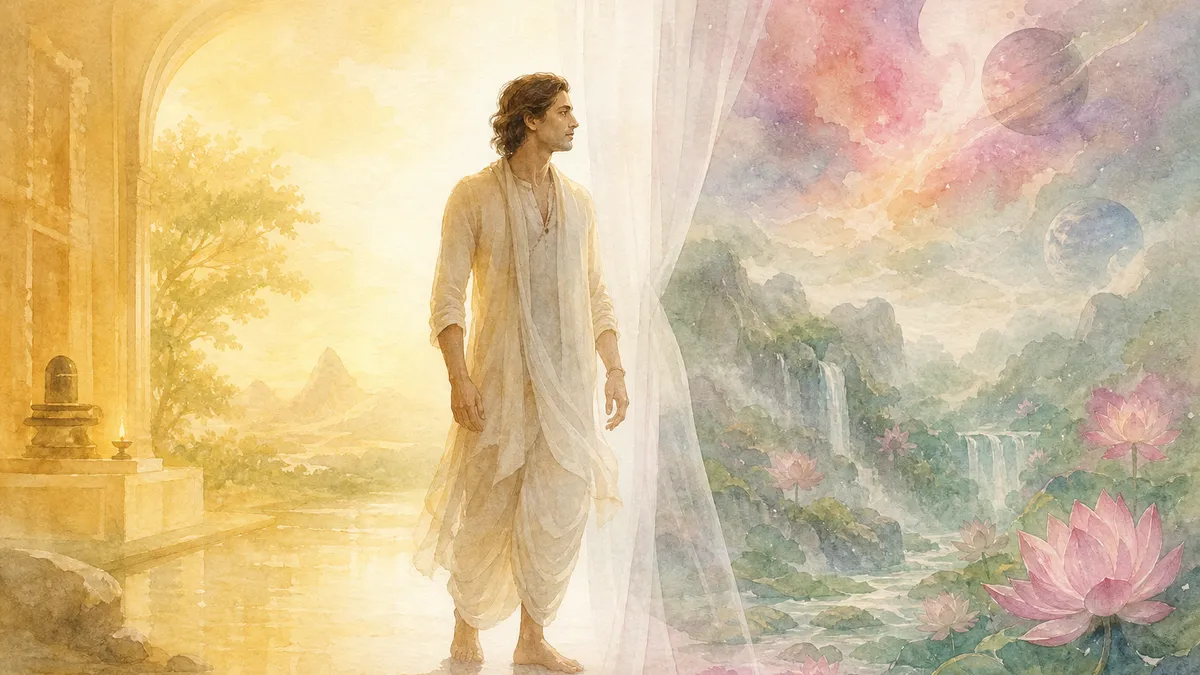
The five tattvas described are called tattvas of the highest order. In each of them, the supreme and deepest divine nature is experienced. It is considered that these tattvas can be experienced only in the state of samadhi.
From the level of the subsequent tattvas, the true divine nature is already concealed. The first five tattvas show our true nature in its pure form, when the Clear Light, the space of primordial consciousness, shines in its fullness. One could say that God is aware of Himself, and that nothing exists apart from this. But as the tattvas unfold, a part of the gross consciousness that separates off begins to forget itself. This forgetting part gradually moves away from the deepest part itself, and then maya-tattva sets in. From this level, the true divine nature is hidden. On this plane, “I” and “this” are perceived not as one, but as something concrete and separate from each other.
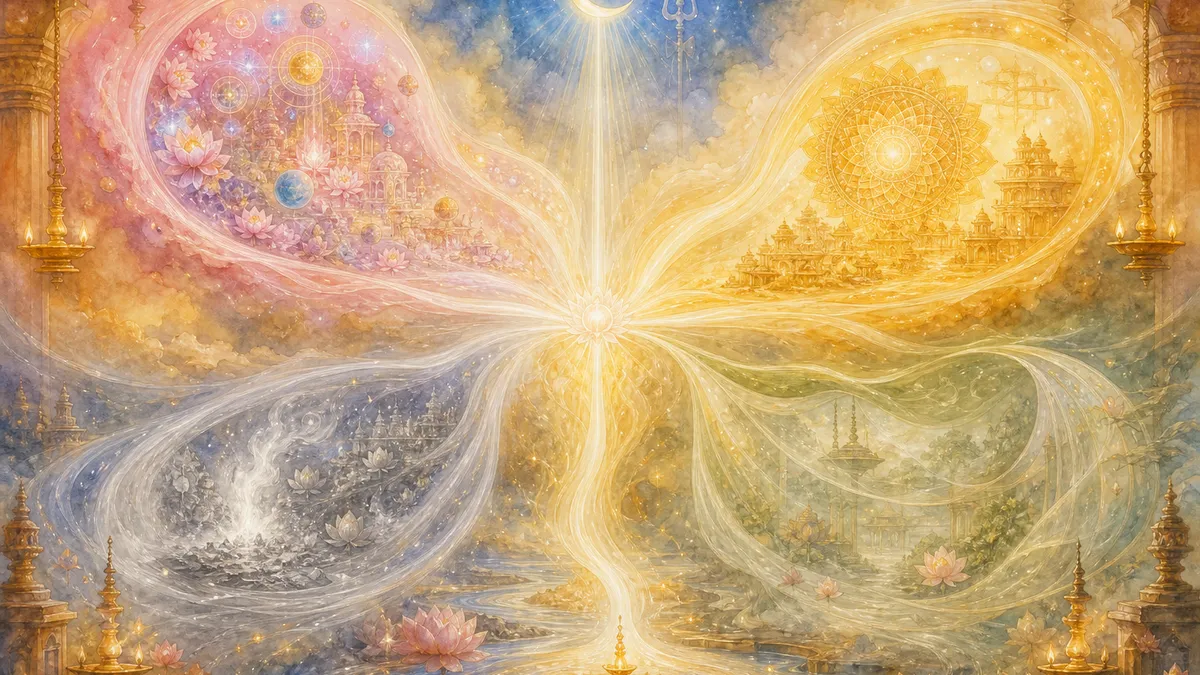
Maya-tattva and the Five Veils
Maya is that which gives rise to duality. It allows the next five tattvas, or five veils, to exist, which envelop the experiencer. As the tattvas unfold, a subtle veil is cast over our primordial awareness, and in this way we forget ourselves.
It is said that once the god Vishnu was cursed and, because of this, was born on earth as a pig. When other gods, such as Brahma and Shiva, came to remind him of his divine nature, they could not awaken his consciousness. He completely identified himself with the body of a pig and thought that he now had to live according to a pig’s way of life. The gods told him: “In reality, you are the great God, the preserver of the universe!” They called him to come with them, but Vishnu’s consciousness was so clouded that he said to them: “I have very important matters here! I have piglets, I have a wife—a sow. Every day I am given feed here, which I must eat. I have many responsibilities here. You do not even understand how important these responsibilities are! I am very busy; I have absolutely no time for divine matters.” And then force had to be used to awaken his consciousness. When Vishnu’s consciousness cleared, he suddenly realized how clouded his mind had been.
In the same way, our consciousness is clouded, and so we begin to consider ourselves to be the body and think that we have certain responsibilities. But, in essence, these are roughly the same kinds of responsibilities that Vishnu had in the form of a pig. Our true responsibility is only one—to realize our divine nature. But because consciousness is clouded, we identify ourselves with the body and with the other tattvas, and therefore we remain in such a pig-like state.
Kala-tattva
Kala-tattva—under the influence of this covering, the experiencer feels that he is not capable of everything, that he cannot do everything in the world.
When the mind contracts and becomes shriveled, it identifies with the body. And then the feeling originally inherent in our “I” disappears. Our “I” is boundless, but when the mind enters the body and contracts, we feel that we are localized in space. Initially, all the stars and galaxies exist in our mind, and we can reach them in the blink of an eye. However, by identifying with the body, we do not feel this; we believe that we are very far from the Source, that we are not free.
Originally, the mind possesses very great magical powers. Three bodies are originally inherent in it: the dharmic body, like emptiness, the illusory body of enjoyment (pranava-deham), and the manifested body. Various magical powers are also inherent in it, but when the mind is confined in the body, the feeling of these magical powers disappears because we identify ourselves too strongly. For example, a person in the bardo can hear and see at a distance; he remembers past lives, even if he did not practice. In the astral body, this is inherent in every living being. That is, even a low-level spirit can know the future, see the past, possess clairvoyance and clairaudience, know how to fly and move freely. Such is the nature of the astral world, so there is no merit of his in this; no one calls him a mahasiddha or prostrates before him. In the astral world, this is something natural, so even low-level spirits can teleport themselves and do other amazing things. For example, in India there is a sect called Karna Pishachini, whose representatives predict the future or recount the past. They can do this because some spirit is present in their sheath, whispering the necessary information to them.
That is, our mind originally has very great capabilities, and limitation appears because the idea arises: “I am this body.” And then we think that we are limited, and therefore lose our creative intuition and our sense of higher purpose, thus falling under the power of material energy.
Vidya-tattva
Vidya—the limitation of knowledge. Thanks to this covering, the sensations are experienced: “I do not know everything in the world, but only something specific.”
Originally, the nature of the Mind possesses the fullness of omniscience and all-knowingness, and therefore, by attuning ourselves to the Source, we can intuitively receive all information about the universe. But when consciousness has become coarse, it needs training; that is, it needs intellectual information. There is a separation from the subtlest layer of consciousness, and therefore the state arises: “I do not know everything.”
When, on the contrary, we enter contemplation and practice the natural state, various kinds of knowledge come to us intuitively; this is a fact, and any experienced practitioner of Laya Yoga will confirm it. When you practice contemplation and unite with the Source, after some time creative powers come to you and talents awaken. No one has taught them to you, yet these talents or creative abilities manifest at a professional level or even higher. Why does this happen? Because the original Source, the natural state, is the king of all knowledge, a unique repository of any information.
Thus, if you practice the path of contemplation and develop a connection with the Source, you may intuitively possess various kinds of knowledge, which will inevitably manifest in you as creative abilities.
Raga-tattva
Raga is the tattva that evokes a sense of incompleteness: “I am not complete, and because of this I experience dissatisfaction. In order to achieve completeness and satisfaction, I must have this and do that.”
The feeling of incompleteness means the mind’s being captured by something external. A lack of wholeness, of self-sufficiency, when we are not here and not now. If we are not here, then we need to be somewhere else, and so we are constantly divided. If we are not now, then we are constantly dreaming of the future, constantly making plans. And then, in the present moment, we are not whole, but dual and divided; we cannot act with the fullness of awareness and cannot be relaxed in the natural state. We constantly feel this lack, this deficiency, and therefore we cannot say that we are kings of the natural state. At best, we feel like slaves or servants of Being. We are governed by karma, by various situations and events. But when we train in contemplation and learn to be in the present moment without plans for the future, everything changes completely, and we attain the wholeness we have been seeking for so long. Attachment to external objects disappears.
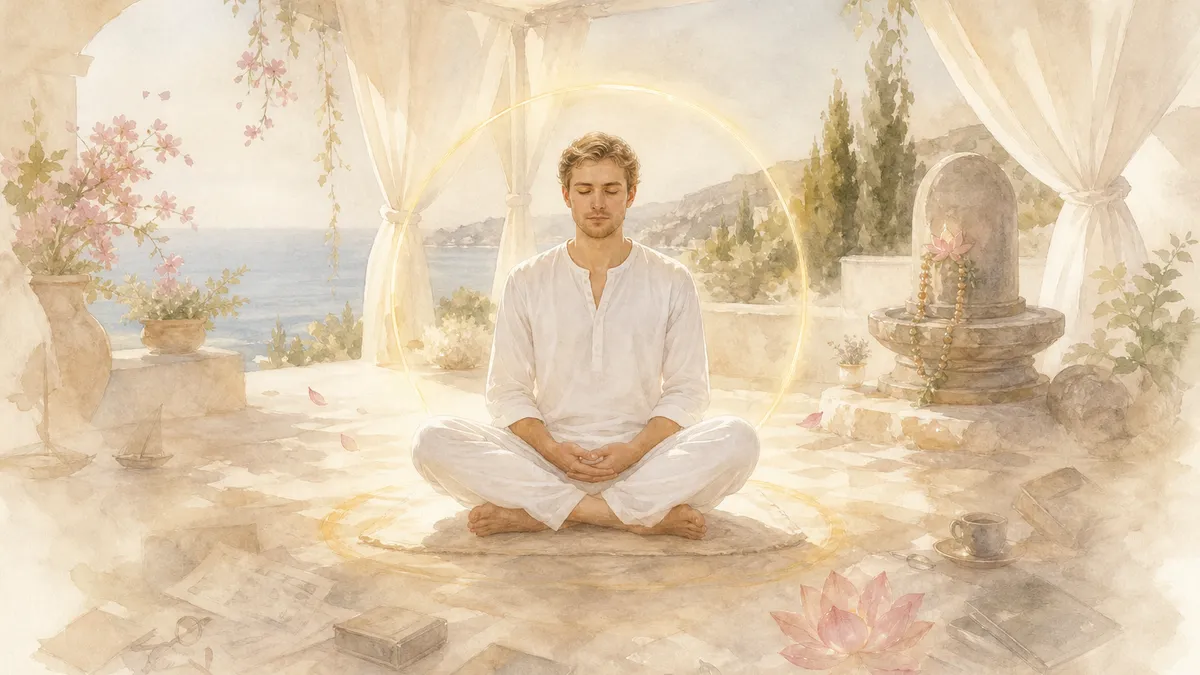
It is useless to seek this wholeness in a friend, a beloved person, in material things, or in anything else. A person can attain this wholeness while owning nothing but a meditation mat and prayer beads around the neck. Yet at the same time he can be a god, the king of everything. However, people strive for security and wholeness by insuring themselves through the constant accumulation of material possessions, as well as by acquiring male and female friends. Nevertheless, we will never attain wholeness in this way. Wholeness is achieved when a person comes into contact with the Source and continuously holds it in his consciousness. Such a person is absolutely self-sufficient; in principle, he needs nothing at all.
Kala-tattva (temporal limitation)
Kala is the tattva that imposes temporal limitation on existence. Through this covering, the sense of past, present, and future arises, and the feeling of the impermanence of existence manifests.
Originally, time is a factor of duality. In the state of nonduality there is no time. Tantra is translated as “continuity.” The natural state is not interrupted. It is constantly changing, playing, yet like a single thread it permeates all Being. But when we are in duality, time arises; that is, past, present, and future exist. But time is a factor only of the worlds of form, that is, the worlds in which there is a subject. When we ascend to the samadhi of the formless world, or enter deeply into the natural state, we discover timelessness, because there is no time there. One could say that there is only the ultimate present there, while there is no past or future. In the same way, when we contemplate, practicing the natural state, over time we also see that we live only in the present. Of course, in a relative sense there are certain future events, there is the past, but this ceases to have any real importance. What has the greatest importance is what is happening now, in the present moment. We see that this contemplation does not operate in terms of the future or the past.
When we become distracted from the natural state, the future and the past appear, and so we again find ourselves in plans, hopes, and daydreams that never come true. It is said: “The past has already gone; it will never be again; it is decay, a myth, it no longer exists. The future has not yet arrived, which means it is something unreal. And what is the present? As soon as we try to grasp it, it slips away from us. It turns out that the past, the future, and the present are all unreal things constructed by our dualistic mind.”
Time changes as one rises upward. For example, in the world of the gods it flows differently. In the time it takes for a drop to fall, an entire epoch may pass in the world of the gods. And the ancient scriptures describe how a king could enter samadhi and, during that time, live an entire life in the world of the gods. He could even marry there, live for a while, and then return again, but in the human world, during that time, the drop would not yet even have fallen.
When we rise still higher, time as such does not exist at all. Time is simply a factor of our consciousness. To become established in the natural state means to go beyond time. How can immortality be attained? Only when we become established in that state of mind in which there is no present and no future, when within us there exists a single continuous thread that is beyond time.
Niyati-tattva
Niyati — this tattva gives rise to the feeling of being localized in space. “I am here, and not in some other place, much less at every point of infinite space.”
The next tattva points to localization, when the mind, identifying with the body, begins to consider itself as residing in a specific place. Originally, our consciousness has no localization; it abides everywhere: in every blade of grass, stone, dog, tree, cloud, and star. If we contemplate deeply and discard our grasping and attachments, we begin to feel this. But if we hold on to material attachments, we do not feel it; we have a sense of being bound to a specific place of habitation.
But as practice progresses, our attachment to a specific body or place of habitation disappears. The higher the yogin’s spiritual level, the greater the degree of freedom he has: in samadhi he can travel to the worlds of the gods and have bodies there; in a subtle body he can travel through the human world or to other places; that is, for him the concept of space as such becomes blurred. He feels that he is not so strongly localized in this physical body.
Purusha-tattva
Purusha-tattva is the very principle of the existence of a limited being, a separate subject.
Purusha-tattva means the sense of “I,” the sense of ego, when we begin to feel ourselves as something separate, when we feel “I am me, others are others, and there is no third option here.” When we strongly separate ourselves from others, we also distance ourselves from the primordial Source of Being. Therefore teachers often say: “You must stop distinguishing between yourself and others. You must learn to live for others just as you live for yourself. This is difficult. However, if you want to attain enlightenment, you must learn to care for others just as you care for yourself. You need to deal with identification and attachment to this ‘I’ in order to overcome purusha-tattva.”
Purusha-tattva is very difficult to overcome. It is precisely what impels you to go and do something or to preserve something for yourself, for your own. If you can completely sacrifice all of this to others, without attachment, you will be freed from purusha-tattva.
Earlier, I taught laypeople in quite a radical way. For example, when they came to lectures, I would say to them: “Since you are not this body, exchange clothes in order to understand this. And since the world is an illusion, let some go and live in the apartment of these people, and let these people go and live in the apartment of those. You are not this body, you believe in this, so why not try it on your own skin?” I literally recommend trying this. You will discover a great deal for yourself and see what dharma truly means, that is, not in words, but in life. If you say that one should live for all people, care for someone else’s child just as you would for your own. Do this for at least a week, and then you will see what it means to live for others.
Thus, we must overcome purusha-tattva in order to free ourselves from clinging to the ego and to the self, in order to free ourselves from the principle of being captured by a separate subject.
Prakriti-tattva
The next principle is prakriti-tattva. This is the existence of the objective world, of separate things, that is, the external world. Usually, as we practice, we discover that the external world is a creation of our consciousness; it depends on our karmic vision. The saints say that the external world is a magical show, a skillful hologram, a virtual reality into which we have become very firmly caught. The external world is a dream, like a reverie. It is something entirely projected by our consciousness.
However, if we lack clarity, the external world binds us and forces us to believe in its reality. On the contrary, when there is much awareness, we understand how flexible and plastic this world is, that it can change under the influence of our consciousness, that by changing inwardly we can change our environment, destiny, and so on. If our consciousness is plastic, then the external world is also plastic. The external world adjusts itself to our consciousness if we have concentration and flexibility. This is a matter of changing karmic vision.
There is such a concept as the point of focus of consciousness, loka-bindu, that is, what holds us in this world. To see the world in this way and not otherwise is a certain attunement of consciousness. If we change this attunement, then the world around us also changes. A high-level yogin can play with this world, arranging it according to his wish. He can shape it as he wants, because, being inwardly plastic, he can change and restructure himself.
For example, among laypeople there are those who are poor, and there are those who are rich. But if you need it, you can change the world around you by changing your consciousness in the direction of wealth. If your consciousness is sufficiently plastic, then the world around you will also restructure itself. There is one who practices diligently and even lives like a yogin, and there is one who practices with long interruptions. You too can change the situation around you if your mind is plastic, if inwardly you sincerely want this. This is how the principle of prakriti-tattva manifests.
There are siddhis called prakriti-siddhis, which allow a yogin to control the external world. It is merely a question of your flexibility and plasticity. For example, a practitioner who considers himself a failure in spiritual life thinks: “I have no samadhi, kundalini has not awakened, and I have no dhyana either. I am completely different from the mahasiddhas. I have great attachments and kleshas. I am probably a failure.” He thinks this way for years and gradually becomes rooted in the thought that he is an incorrigible yogin who has no chance even for real practice.
However, if the mind is plastic, it can think of itself as a saint, as a mahasiddha, and will gradually become imbued with this mood. But if the mind is not plastic, it will not have enough spirit to think of itself in this way and attune itself accordingly. Yet if a yogin thinks of himself as a saint, suddenly his karmic vision will change, and he will become what he has thought of. Guru yoga is precisely such a practice of plasticity, in which the disciple identifies himself with the mind of the saints and in this way changes the perception of himself.
Conclusion on the System of the Thirty-Six Tattvas
Next are described the tattvas that already exist within us, that is, in the mental apparatus of every living being. These are ahamkara, buddhi, and manas. Then come the tattvas of sensory perception, such as hearing, touch, sight, and so on, and the five gross elements. All of this together constitutes the principle of the thirty-six tattvas. We have examined the most important of them.
This system of classification of Being was proposed by the Kashmir Shaivism saint Abhinavagupta, who was a disciple of Gorakshanath. It is a very well-known system of classification of the tattvas. We have examined it in the style of the teachings of Laya Yoga, as applied to contemplative practice.
