


Commentary on the treatise “Xiao Zhi Guan” (“Brief Instructions on Shamatha and Vipashyana”), Zhiyi
There are five kinds of screens that must be removed
The Screen of Desire
Monastic practice is a constant examination of oneself: daily analysis, looking into one’s consciousness, eliminating what should not be there, and cultivating what should. If we want to realize God, then instead of many small desires, we should have only one great desire. The saints say that this desire should be as strong as that of a drowning person who wants to get out of the water. However, it is not easy to acquire such strength of desire, nor is it easy to understand what desiring God means. By and large, this is right contemplation, which is why a monk is always a warrior of the spirit who overcomes his desires.
For example, there is sexual desire, the desire for food, comfort, attachment, the expression of one’s will, one’s “self,” pride, and other things—all these desires must be cast beneath the feet of our path to awakening. As long as desires remain within us, we will not be able to know God. As long as even a particle of such desires remains in our consciousness, we will not be able to attain liberation. This includes the desire for worldly things, pride, self-satisfaction from Dharma practices such as siddhis, and so on.
For example, a novice’s practice should be viewed not so much as training as obedience. Of course, you learn kriya yoga, yoga nidra, and everything else, but I would like you to learn something deeper during your novitiate—the rejection of yourself and your own will. This is a deeper practice. Then the kriyas and secret techniques will truly work. Therefore, a monk always analyzes his consciousness, and if a desire manifests within it, he does not make peace with it but applies an antidote, either cuts it off at the root or remains in a state of awareness in order to disperse the desire through the principle of presence.
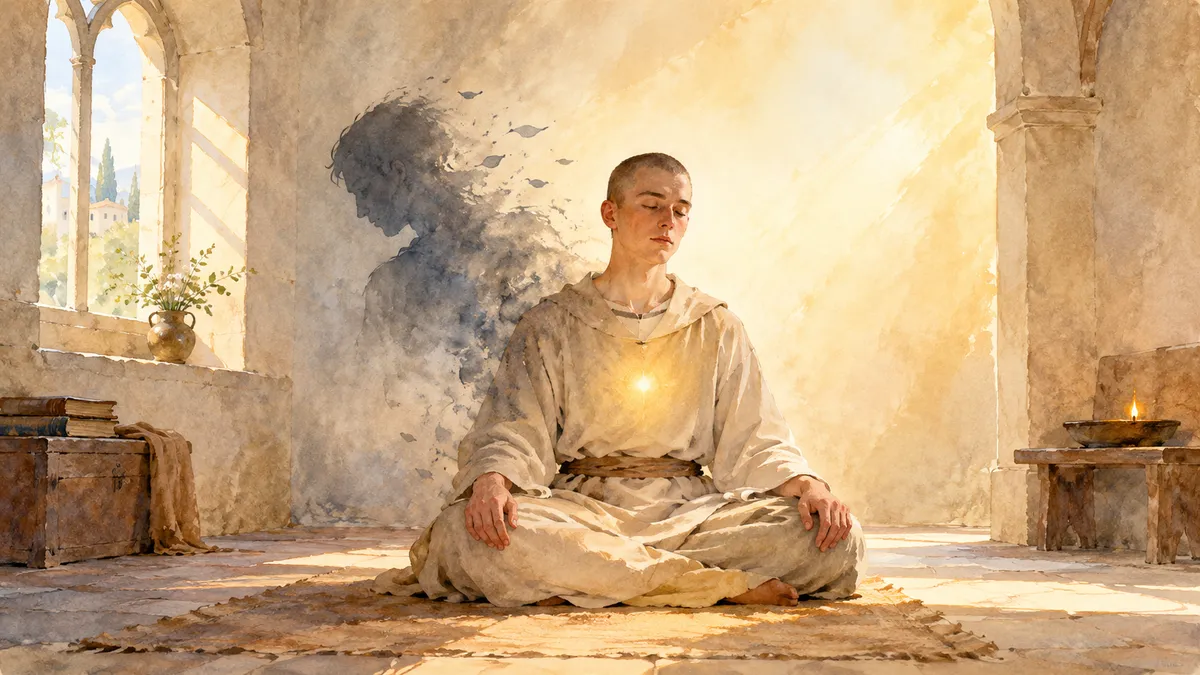
A person who humbly enters the path carries an alms bowl in order to help all beings. How can he pursue the senses through which he falls into the five passions? He has already cast away the five desires and turned his back on them, so why should he revive them like one who eats his own vomit? None of them can bring any happiness. They are an affliction that seeks to become permanent. The task is to drive them all out so that true bliss in dhyana and samadhi may be experienced, while delusion disappears forever.
The Difficulties of the Spiritual Path and the Need for Vigilance
Know that you have entered a path with no end. It is not only a path on which you enjoy yourself; it is a path on which you fight, a path on which many suffer defeat. This does not mean that you can think about this path once and say, “Yes, of course.” It means that you must remember it in the morning, during the day, and in the evening. And it is not only young novices who suffer defeat on this path; some practitioners do so even after twenty years of monastic life.
We read about siddhas: he meditated for twelve years and attained siddhi. That is wonderful, but we should understand that there were eighty-four siddhas, while over the course of several thousand years there were millions of yogis. Therefore, in order to join the number of those fortunate ones who attained the highest perfection (siddhi), one must avoid becoming one of those who are captivated, tempted, seduced, led astray, and so on. As a rule, the number of those who are tempted, captivated, and led astray is astronomical compared with the number of those who attain, because such is the nature of human karma. Therefore, a true yogi always maintains a very vigilant, awakened spirit.
The standard of practice in our sangha is very high. It is precisely the standard that makes it possible to realize the state of the highest perfection. It is a very high standard, and even some monks have not yet fully met it. That is, as you practice, you move from a modest standard to a greater one, from a greater one to a high one, and from a high one to the highest—such is the practice; it becomes more demanding. In order to be capable of realizing such the highest standard, you should gradually prepare yourself for it, and therefore, at first, you should think not so much about liberation as about how to become a good monk.
A good monk is one who has already completely purified himself, has developed as a yogi, and is boundlessly ready to practice; he has neither obstacles, desires, nor problems, his meditation is stable, his channels are pure, the bridges to worldly life have been burned, and plans have been cast aside; he is self-sufficient, does not wish to follow the path of illusions, seek friends for himself, and so on; he is one-pointed, a fierce warrior of the spirit who can no longer be defeated.
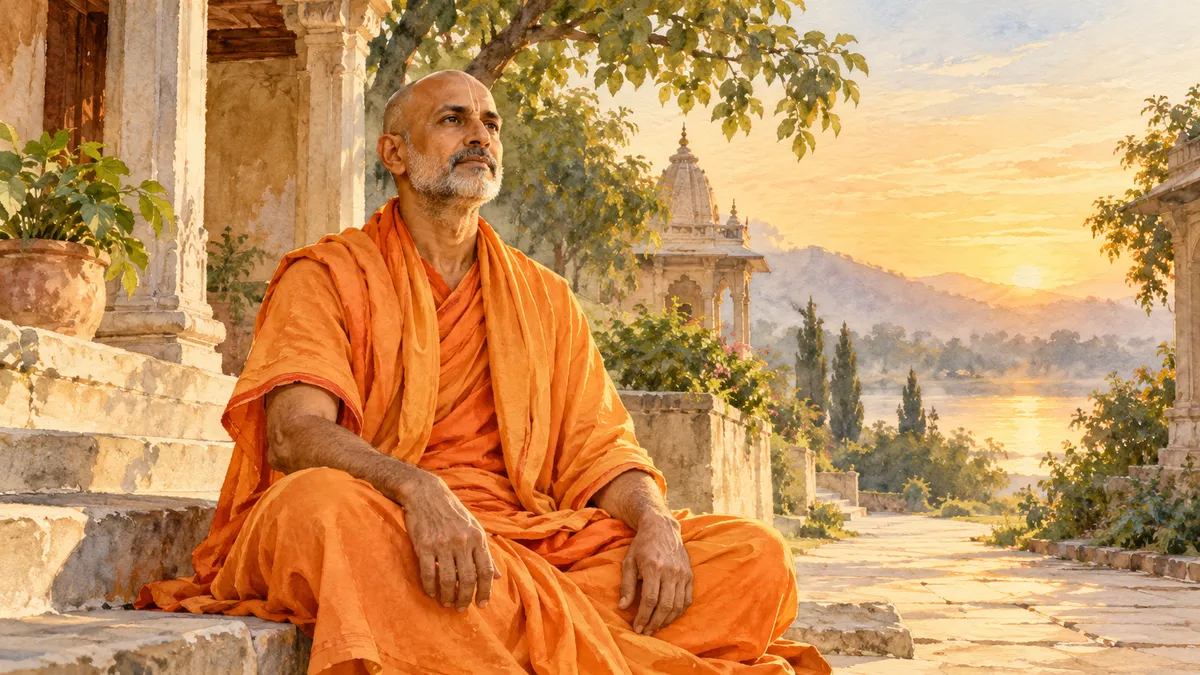
A monk grows into such a warrior of the spirit through daily spiritual practice, when he is awake to his own state, when, analyzing his soul, he encourages what is right within it and eradicates what is wrong. And the first thing to do is to bring all worldly desires completely under control.
The Nature of Desires and Methods of Working with Them
Desires in themselves are not something separate from the nature of awareness. In sutra and tantra, they should be negated. In Christianity, desires are considered a sin and a demon; in tantra, they are viewed as coarse energy that has not been sublimated, yet it is part of the nature of awakening. In the absolute sense, desires are inseparable from the nature of awareness and are its manifestation. However, they should be brought completely under control, because when they are beyond our control, they will lead us into a new birth.
Therefore, we attain complete control over desires when our mind is completely free from any desires. It is impossible to fulfill all desires, because each desire, once it is merely unfolded, is a universe; they are like a dog's tail—no matter how much you straighten it, it bends again. Liberation is what lies beyond the sphere of desires.
When you meditate a great deal, images and visions arise. If you are not accustomed to seeing everything as an illusion in ordinary life, you will forget this in meditation as well. You will converse with these images and visions until you begin to awaken periodically.
Sometimes I give a person a dark retreat. If he is poorly prepared, then when a vision arises—and everyone has visions in retreat—he falls into a kind of sleep; that is, these visions subtly carry him away. They are subtle, difficult to recognize, and become confused with reality, like hallucinations. Then he forgets that he is sitting in a retreat room and begins conversing with the visions—his own illusions—and there are many such visions. Imagine if the retreat lasts at least forty-nine days, while visions arise every day from morning until evening. They draw him in, and what happens to the person then? In such cases, people say that he has “lost his mind.”
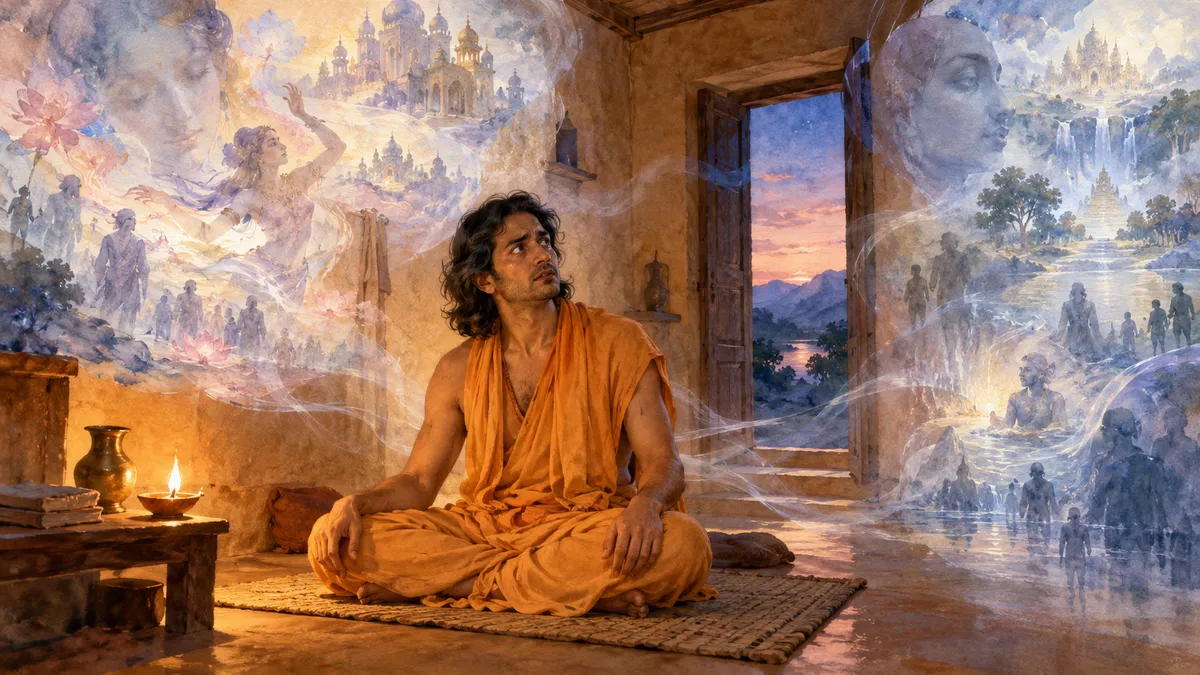
Therefore I say: “Learn to regard the world as an illusion. Regard this world as a vision, have no desires, and then visions will neither enchant nor draw you in.” This is because in dark retreats a person experiences the authentic experience of bardo, the state after death. One who is experienced maintains contemplation; whatever visions arise for him, he remains in presence, and therefore the visions dissipate while he gains the deepest experiences of clarity. The visions develop into deities until they are exhausted. The practice of working with visions, deities, mandalas, and spheres of light is a special method of jyoti yoga that leads to the complete realization of the rainbow body within a single lifetime. However, this method is given only to prepared practitioners; that is, one must prepare for it for six or nine years. If it is applied earlier, problems may arise.
The Screen of Hatred
In meditation, a yogin should allow the following thought to arise: “My opponent now irritates me and those dear to me; he takes pleasure in causing me harm; he acted this way in the past and will continue to act this way in the future.”
When hatred for something arises, it is a sign of strong duality, of attachment to oneself and one’s ideas. Son Chol Tulku said: “The one who curses, scolds, and insults you is your greatest benefactor; regard him as your very best friend, who eradicates your ignorance.”
By practicing contemplation, we must become very flexible, accepting, and free from dividing things in duality. To attain such flexibility means learning to include any aspects of the Universe in our consciousness. Usually, we like to include in our consciousness what we like, while excluding what we do not like—this is normal for ordinary beings. To be present means learning to include both what we like and what we do not like, that is, to attain flexibility without becoming despondent or losing ourselves in the process.
The Screen of Sleep and Drowsiness
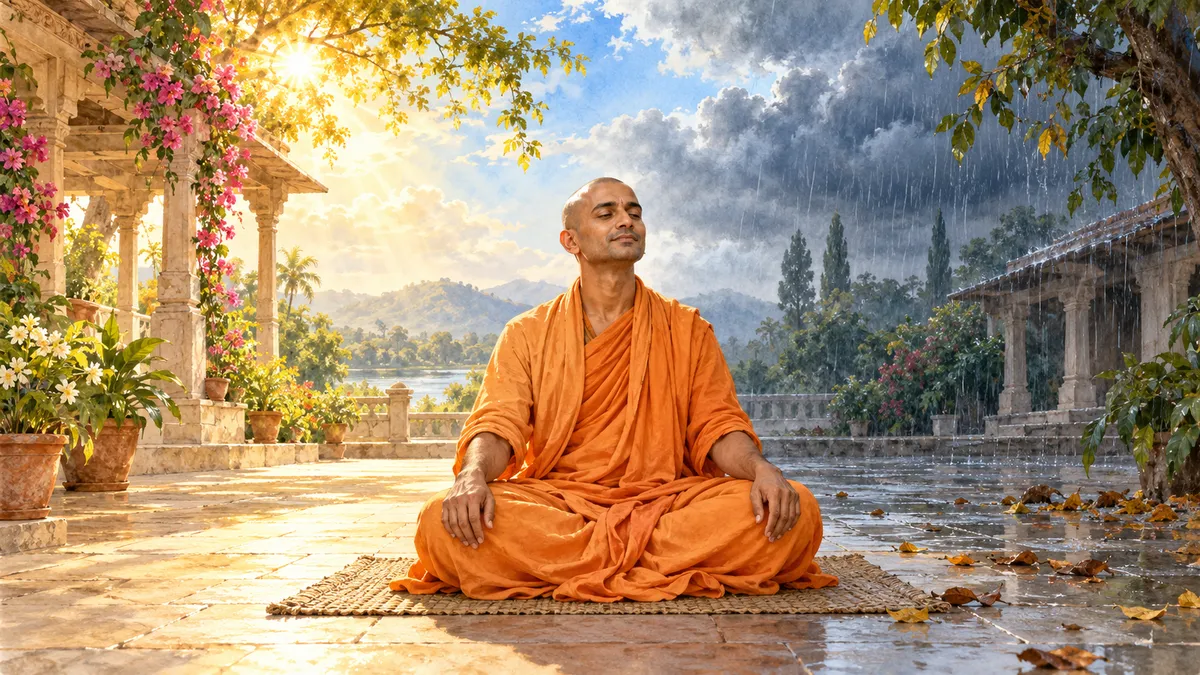
When the mind is passive and dull, and the five passions are unclear and confused, one feels inclined to doze. Sleep, drowsiness, and such dullness obstruct our true joy, which we find in the Dharma, as well as our happiness in a future birth in the spiritual heavens or our bliss in nirvana.
Do not embrace a foul-smelling corpse in sleep, for it contains impurities and is mistakenly called the human body. Like a gravely ill person wounded by an arrow, how can you sleep peacefully with such an aim? Like one who has been bound to be killed, how can you sleep when disaster has arrived? When you lie between crossed swords, how can you sleep peacefully? Drowsiness is like a great darkness that conceals everything, constantly deceiving you and taking away your perception.
This does not mean that one should not sleep at all; it means overcoming the tamasic, dull state in meditation, when sleep comes during meditation.
The Screen of Anxiety and Sorrow
All anxiety and sorrow are eliminated through the principle of faith, which is the same as contemplation. If you are trained in contemplation, you can change your consciousness yourself. This happens instantly. What distinguishes the awakened from the unawakened? The awakened experiences the same feelings and the same effects on the body and mind, yet differs from the unawakened through a special quality: they can instantly change their consciousness. It is not that they change it deliberately; this happens instantly: perception flashes, a reaction arises, yet this perception falls into the abyss of presence and disappears—this is called self-liberation.
A practitioner of a lower level requires some effort; when a perception arises, they make an effort to liberate themselves from it. Suppose a feeling of attachment to another person arises, and they come to their senses and think: “A monk should not act this way.” They consciously concentrate and disperse this feeling of attachment, returning to correct awareness. Desires arise, and they remember and eliminate them through the power of awareness.
In the absolute sense, if you have faith, anxiety and sorrow are overcome through the simple power of faith. Faith is the same as surrender, reliance on the Source. Surrender presupposes that your contemplation has already gained strength, that, in principle, you understand what self-transcendence means. However, even if you do not understand the principle of contemplation and cannot follow self-transcendence, but you have strong faith, then any anxiety, sorrow, and so on are overcome by the power of such faith. Faith is irrational; it lies beyond all experiences. Therefore, 99% of various difficulties can be addressed by saying: “You simply have weak faith. If you had strong faith, you would not have such questions, and you would not commit such acts. It is solely a matter of your faith.”
Faith works miracles. If you have faith, you can do anything; you will be happy and dispassionate in any situation. If you have faith, you will be able to endure everything and liberate anything at all.
The Screen of Doubt
When this screen clouds the mind, no Dharma practice is possible, and no benefits can arise from the Dharma.
The following doubts are obstacles to dhyana: doubt concerning oneself, when the practitioner thinks: “Am I not a person with bad roots and great sins?” If they persist in this doubt, they will never attain dhyana. One must not treat oneself contemptuously, for you do not know what roots you planted in previous lives.
If anyone is beset by doubts: “Am I ready for liberation and for the practice of awakening, or am I not ready?”, then I can tell you for certain—you are not ready. If you were ready, you would not need spiritual practice at all. Why do people become monks? In order to prepare themselves. Monasticism is precisely a way of preparing oneself. But if you do not prepare yourself, you will never be ready in principle, because it is never the case that you are ready. Preparation is already a matter of your own personal effort; that is, it is a certain stage of evolution when we ourselves participate in our evolution and consciously prepare ourselves. Therefore, everything depends on us. How ready we are depends on our own effort. Even a person with poor abilities and little merit, if they train diligently, will prepare themselves and attain realization. And even a person with great merit, if they do not prepare themselves, will remain at the level of their previous merit.
When you read descriptions of the mahasiddhas, you see that many of them were illiterate, belonged to a low caste, and possessed great defilements and desires; nevertheless, they managed to purify themselves and attain realization.
Our nature is always awakened in the absolute sense, and each of us possesses it. This indicates that our readiness is confirmed by Being, by the Absolute.
The disciple’s doubt regarding the teacher: “If his appearance and manners are such and such, and it seems to me that he himself has not attained the Tao or realization, how can he teach others? This is an obstacle in the practice of dhyana.”
Here, the relationship is described at the level of sutra. At the level of tantra, the principle of samaya operates for us. If you keep samaya pure, such things never arise in principle, because the Guru is the source of realization.
Doubts regarding the Dharma.
If you have doubts regarding the Dharma, then, like a deer caught by a lion, you will not be able to hope for your salvation.
Among the multitude of good Dharmas and their opposites, as between nirvana and samsara, there is truly only one genuine Dharma in which you must never doubt. But if you nevertheless regard it with suspicion, you will be bound to Yama—the god of the dead and guardian of evil. Therefore, you should rejoice in the perfect Dharma, just as at crossroads one chooses the path that proves most suitable.
Doubts about the Dharma arise among neophytes because they have inadequate preparation and no education. The Dharma is boundless; it provides a comprehensive answer to any question. However, when you have a weak education, you are not yet fully oriented in the Dharma, and doubts may arise. Therefore, such doubts should be eliminated through preparation: studying texts, listening to lectures, or consulting a Teacher. The Dharma of yoga tantra is boundless; the number of texts exceeds anything imaginable—several million texts are available to people, in which answers to any questions can be found. However, when we are not very well versed in the texts and also have little personal experience, until we comprehend our meditative experience, various doubts about the Dharma may arise.
From the tantric point of view, such doubts should be overcome at the very beginning. This is called the principle of samaya: if you follow something, you must believe in it completely for it to benefit you.
The principle of samaya means that you uphold the samaya of the teaching and follow the teaching precisely within the dimension that the teaching provides. If you do not understand something, think: “One day I will clarify everything; it will definitely become clear to me when I eliminate my ignorance.” However, if you follow some practice while having doubts about it and no faith in what you are doing, this is a deviation from the practice. In that case, you need to clarify all your misunderstandings completely.
In the absolute sense, the practice of the Dharma represents one thing that unites all paths. However, in accordance with people’s inclinations and karmas, there are innumerable methods, and at the relative level it seems that there are many Dharmas; nevertheless, the Dharma is always one. Therefore, there are these words: “For a siddha drinking from the One Source, all these differences are insignificant.”
As long as our mind is not integrated, our vision of the Dharma is also fragmented; when our mind becomes integrated, our vision of the Dharma also becomes whole and unified. This means that doubts about the Dharma are dispelled through the practice of the Dharma itself.
Thus, once these veils have been removed, you can practise without encountering any problems.
