

The text “Tiruvarupa. The Divine Song of Saint Ramalinga.” Selected shlokas.
“What did you experience when the Lord deigned to bless you?
Ramalinga answered: It is the happiness of the holy dance of our Father, which I experience while I am conscious as well as unaware.”
What did you experience when God blessed you? Ramalinga says: “It is the happiness of the holy dance of our Father.”
The first sign of your correct practice is your happiness.
We can truly immerse ourselves in the natural state when we are completely satisfied. When this satisfaction so overflows and overwhelms us that there is no longer any need to dream of anything else, no need to passionately desire anything, no need to remember all the grievances and wounds we have endured. All of this is so petty compared with this immense happiness that we simply laugh at it all. This is the happiness of the holy play of the Supreme Source.
As soon as the Absolute touches us, all our illusions depart, and then continuous happiness begins. Happiness is a quality of the Absolute. It exists right now, but many people manage to be unhappy. In fact, they have attained great mastery in how to make themselves unhappy. Everything they do resembles attempts to dodge that all-consuming happiness which pours down upon them each time. And many succeed in this. With great success they dodge this happiness, moving away from themselves. Some go into their dreams, into self-absorption. Some go into their past, into memories of their old attachments or grievances. Some go into external objects, into another person with whom, as they hope, they will feel good. Some go into doctrines and concepts which, as they believe, will give them some true knowledge. All of these are various forms of fleeing from this great happiness that is present right now.
Santosha as the Basis of Contemplation
However, when we become truly satisfied, contemplation begins. When we become established in the state of “here,” abide “now,” when we accept ourselves from the tips of our fingers to the roots of our hair, when we accept the world as it is and cease projecting our own thoughts onto it, when we decide to see everything that exists, beginning with ourselves, as absolute, pure, and sacred, then our spiritual search does not end; it only begins. This means that the beginning of the practice of true contemplation begins with santosha (contentment).
If we do not have contentment, then no matter how many asanas, mudras, mantras, or pranayamas we do, all of it will be merely a variety of projections of new suffering.
Often, when we are not satisfied in our spiritual paths, we remain under the illusion that the causes of this dissatisfaction of ours lie in something external, for example, in another person. We may seriously think that others are the source of our problems. It is hard even to find a greater foolishness, because in reality dissatisfaction is an inner quality; it is a heavy piece of past karma hanging upon the soul. But, not understanding this, we may project it onto someone. And then we think: “Oh, this is such a bad person! How could he even act like that? After all, it is so wrong!” Or we may project our dissatisfaction onto certain actions. But in reality dissatisfaction is simply a state of the soul.
If a person is dissatisfied, then he is simply in the state of a hungry ghost. Whatever you give him, he will spoil it all; in any case, he will find a way to be dissatisfied.
One man came to study with a Guru, and the Guru accepted him at once. The man said, “What kind of Guru is this? They do not even test me. He is probably undiscriminating in his disciples and accepts just anyone.” Being very dissatisfied, he became disappointed and left the ashram. He came to another Guru, who was the complete opposite of the previous one; moreover, he was very fierce. To gain access to him, one had to undergo severe ascetic practice, live in the mountains, practice fasting and tapas. And the man thought, “This is not a Guru at all, but simply some kind of bandit! How can one study with him?” And again he left dissatisfied. When he came to the third Guru, he saw that he was very courteous, intelligent, and knew the sacred scriptures. He tested his disciples in moderation, and was gentle and compassionate with them in moderation. And then this man thought, “So he is simply a pandit who knows the texts well.” That is, he again found a way to be dissatisfied. When he came to the fourth Guru, that Guru was constantly in samadhi. It was clear that he was a great saint. He was so holy that he had no concern for this world: neither for scriptures, nor even for disciples. He was always in samadhi. But this man came and said, “What kind of saint is this?! This man has no compassion at all for others. He is immersed in his own personal happiness!” He was dissatisfied again and went off to seek the path in yet another ashram.
One day he met a saint who said, “You will never find your path. You will never find your Guru, because dissatisfaction lives in your heart, but you connect it with the external world. You are deeply mistaken. This dissatisfaction is not someone else’s. No one is to blame for your problems. It is the result of what you did in the past, and therefore only you are responsible for it. Everything around you is already perfect. Everything around you has long been holy. Accept your fate and try to rejoice in what you have. Try to be satisfied in any situation in which you may find yourself. Know that this is the shortest way to come to liberation. And only then does contemplation begin.”
Experiencing a state of contentment does not mean falling into some kind of tamasicness, into some kind of satiated pleasure, and ceasing to practice. Not at all. On the contrary, our practice advances by leaps and bounds. Our practice flows from our fullness, our wholeness. It is precisely from a state of contentment that true contemplation becomes possible, because now we truly accept ourselves, accept the world. Now we can, at last, open ourselves to God and hear Him. But a dissatisfied being does not hear God.
What does a dissatisfied person do? He pities himself. He asks, “Give me something, somebody give me something! Take pity on me! Encourage me!” A dissatisfied person is fixated on himself and on his little problems. He has no time to think about God. But a content person is always overflowing with gratitude to being. He is filled with admiration and weeps tears of joy every second, because he is in such a state of fullness and depth that it can only grow and grow. He always thinks of the Absolute. He is always overflowing with rapture, reverence, and gratitude. He lives every moment so wholly and fully that he cannot even conceive that there exists even a tiny crumb of any dissatisfaction. Only from this great santosha does the further deepening of the natural state grow. All other kinds of sensations are samsara, ordinary karmic obscuration. Run from these obscurations as far as possible.
This does not mean that there are no difficulties, obstacles, and sufferings on the path. There are many of them. If they did not exist, you would not be living on earth. However, unlike the former, one who abides in contentment perceives all obstacles as blessings, all difficulties as a gift and grace.
Realization of the Body of Grace
The text “The Divine Song of Grace”:
“I was asked: ‘What did you experience when you realized the Body of Grace?’
I answered: ‘It is the form and substance, the grace of our God, which I experience while I am in samadhi, and which I will experience when all concepts disappear.’
My heart is overflowing with ecstasy. It cries out in joy: “Glory to God and His Grace, which He has poured out in compassion upon my body, mind, heart, and even my clothes!” My whole body is filled with the light of love and joy. Even great sages who know the Vedas could not have dreamed of such a thing in their sweetest dreams. He has arrived to dwell in my heart. Any self-control and practice are nothing compared to this. And this is amazing. I have partaken of the food of pure amrita and attained a form of existence that is indestructible. Behold! This is so excellent! I have been provided with the medicine of Divine wisdom, which cures disease and death. And I am a precious stone among precious stones. Such a vision destroys ignorance. And thus self-knowledge occurs. And then the heart, in perfect prayer, cries out with joy: “This is all the grace of God—my beloved!”
Ramalinga’s verses are such a sacred thing that simply by reading them, you can dispel the clouds of obscurations. He says: “My heart is overflowing with ecstasy. It cries out in joy. Glory to God and His Grace, which He has poured out in compassion upon my body, mind, and heart... Even great sages who know the Vedas could not have dreamed of such a thing in their sweetest dreams.”
A yogi experiences something like this when he opens this total, all-encompassing state. “To behold is so excellent!” Even the slightest touch of the Supreme Source radically changes everything. Such a yogi is simply breathless with delight and ecstasy. He has no time even to think about any petty things. It is like when a poor man suddenly comes into a huge fortune and becomes a multibillionaire.
“O my Lord! I have understood that all living beings are a sacred temple where You abide and dance Your eternal dance. I have rid myself of evil and hatred. I have attained prosperity and known the One who is unmanifest. I have become lost in joy, dancing with the hairs on my body rising from ecstasy. All that is living and nonliving is worthy of this joy and happiness. Therefore, seek refuge in my Father, who alone can give you the inexhaustible stream of eternal bliss.
Behold what God has done for His poor servant! The highest good glory shines from this depth. The mighty veils of obscuration have fallen away around me piece by piece and disappeared. The massive dark growths in my being have all been removed. Great miracles of purity and compassion have appeared and abide in me.”
What does it mean to “seek refuge in the Father”? Who is the Father? The Father is pure consciousness, which is above the personal “I.” When we seek refuge in this Father, we enter the inexhaustible stream of supreme bliss. When we seek refuge in something else, we are always confused and find ourselves enchanted by illusions. Whether we seek refuge in words, theories, our own self-reflection, communication with another person, or anything external, we are always enchanted and cannot attain this bliss.
Ramalinga says: “The massive dark layers of karma in my being were all dissolved thanks to the radiance of the stream of eternal bliss.”
No matter how many blockages or karmic reactions we have, they all begin to dissolve one after another when we approach this bliss.
If someone recalls his past and thinks, “I had such a difficult childhood; I went through such-and-such experiences,” then I tell him: “Forget about it! As soon as you come into contact with this, you will see that all of it was a dream. You will forget that you were ever any other person.”
Someone says: “I thought a lot and finally decided that I need this, that I need to do such-and-such!” I tell him: “Leave these games of thought and self-reflection. As soon as the Source touches you, you will forget all of this. Your consciousness will change ten more times. All of this will pass. Why do you give it importance? All of this is completely unreal. Do not give it importance. These are all lilas of the surface mind. Seek refuge in this Father. Stop playing all of this so seriously.”
King Yudhishthira once came to Krishna and asked him for guidance in case Krishna would not be nearby and he found himself in a critical situation. Krishna gave him a copper tablet and said: “Open it only when a critical situation arises and I am not nearby.”
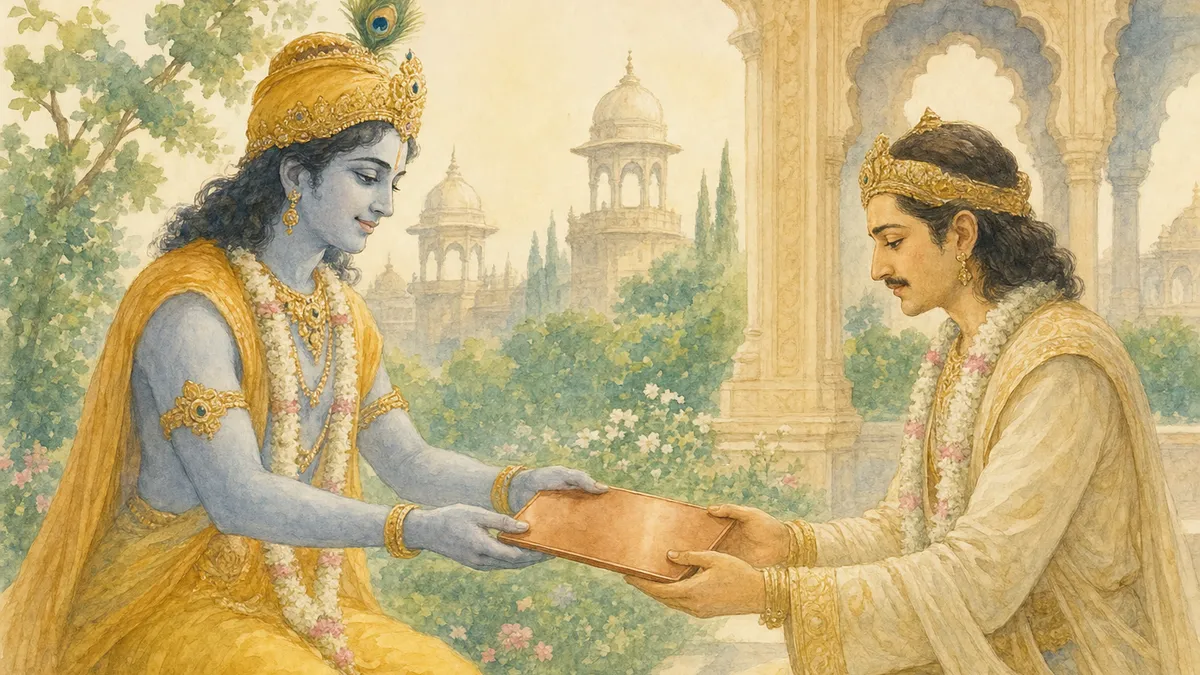
Once Yudhishthira was defeated in battle; the situation was going terribly badly. Then he remembered this tablet and opened it. Inside was engraved: “This too shall pass.”
In the same way, any state of ours will soon pass. None of this is real even for a second. Therefore, the true yogin seeks refuge in the Father, who alone is real. Everything else will pass. Your attachments and aversions, your sufferings or visions in experiences, your thoughts—all of this is transient. A saint does not base his life on this. A saint looks upon it as illusions.
Different Paths in the Search for God
“O Lord! Some read prayers to You, desiring money and fame; some spend the whole day memorizing the texts of the sacred scriptures, dreaming of gaining the glory of a connoisseur. Others seek You in temples and pujas; some go to the mountains and deserted places, hoping to meet You. And some have grown weary of reading prayers to You, amazed by Your superiority and inner qualities. Only I, Your poor servant, think of You when I eat, when I sleep, in hard labor—I am always with You, for You are my Teacher, the one who lovingly placed a divine gift in my hands.
O Lord! When I had lost all hope of Your blessing, You appeared before me and encouraged me. Since that day I have been overwhelmed with joy. My Father! My Teacher! My God! On that day You freed me from all sorrows, obstacles, and fears.”
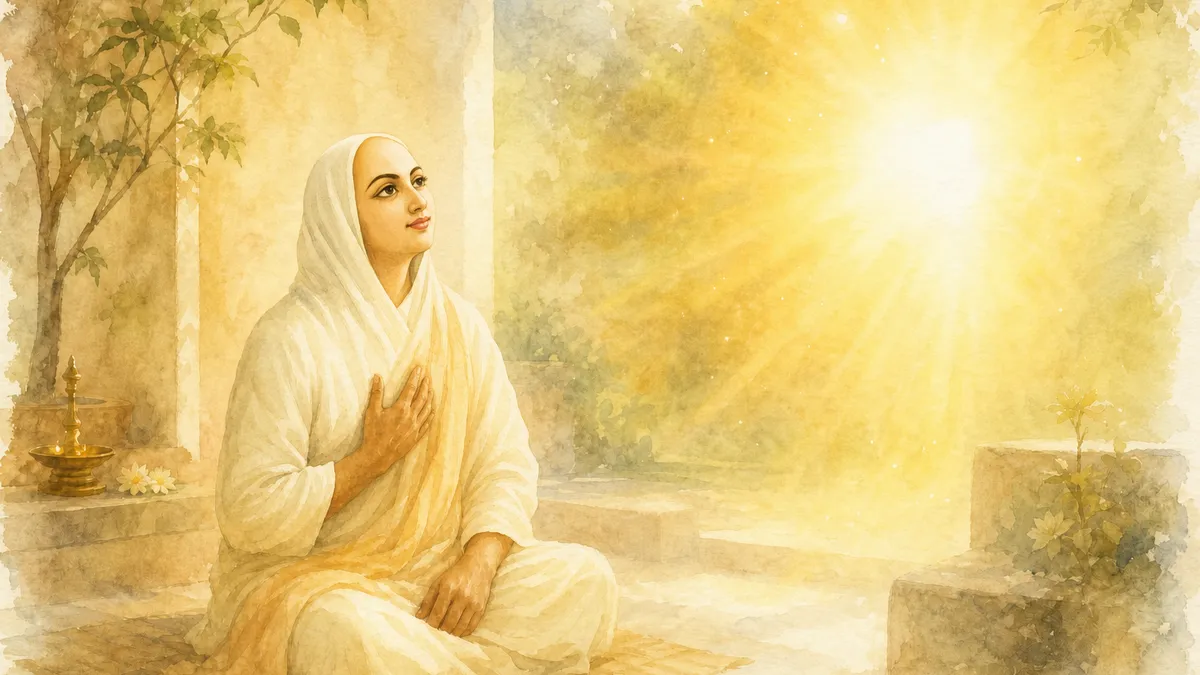
Ramalinga says: “Only I, Your poor servant, think of You when I eat, when I sleep, in hard labor—I am always with You, for You are my Teacher.” This is the principle of natural contemplation. What do we contemplate? Toward what do we direct our mind at the moment of contemplation? Of course, only toward this one essence and nothing else. All the diverse techniques—atma-vichara, traya-sankalpa, space meditation, observation of the body—are merely master keys for turning and refining our mind and directing it toward the Supreme Source. One should not think that the techniques are self-sufficient, separate from the Absolute.
Therefore, when a yogin eats, sleeps, and labors hard, he always directs his mind one-pointedly toward the Supreme Source.
Ramalinga says: “When I had lost all hope of Your blessing, You appeared before me and encouraged me. Since that day I have been overwhelmed with joy.”
All your hopes arise from illusions. Only when you lose them, renounce them, and cease to identify with them will the Absolute appear before you. Until that moment, it could not appear before you, because you were obstructing it with your hopes. Only when you abandon all hopes and fully accept your fate, learn to be content, and in this contentment attain contemplation, will you suddenly turn your consciousness toward the Source.
This does not mean that you will have no thoughts at all about tomorrow. You will, but now they will not be essential for you; they will be like a game, because every second you will live in the absolute today, in the now.
Divine Grace and Transformation
“O Lord! I was constantly occupied with conversations and frivolity. I wasted a great deal of time here and there. I was like a neglected dog that, day after day, hunted for food amid the filth. But by the light of Your grace You seated this dog upon a precious throne and crowned it with a crown made of precious stones.
O, glory to You, Lord, and to Your eternal patience! O divine radiance! I can liken Your love to the love of a mother. But even a mother’s love is only a faint reflection of Your infinite love.
O my Lord! You showed me Your Grace, purifying all that was impure, destroying all the refuse within me. You lovingly took me as Your own servant and devotee. You poured upon me the nectar of Your Grace, which carried me to the shore of infinite radiance. And I can call You an ingot of gold that shines in a casket of grace. You are the eternal dancer, dancing in the Heart of Love.
O my Lord! You are the One who spontaneously creates worlds in the Heart of Love. And I swear by Your Holy Feet that I will forever be Your devotee, honoring Your creations with great care. But I cannot remove all the straw from the field by my own strength and consent alone. Therefore, from this moment on, You must help me by any means to manifest this love toward all Your creations. You Yourself must protect me. This is the obligation You gave when I surrendered to You my body, mind, feelings, and thoughts. May all living beings feel and experience this infinite Divine Love.”
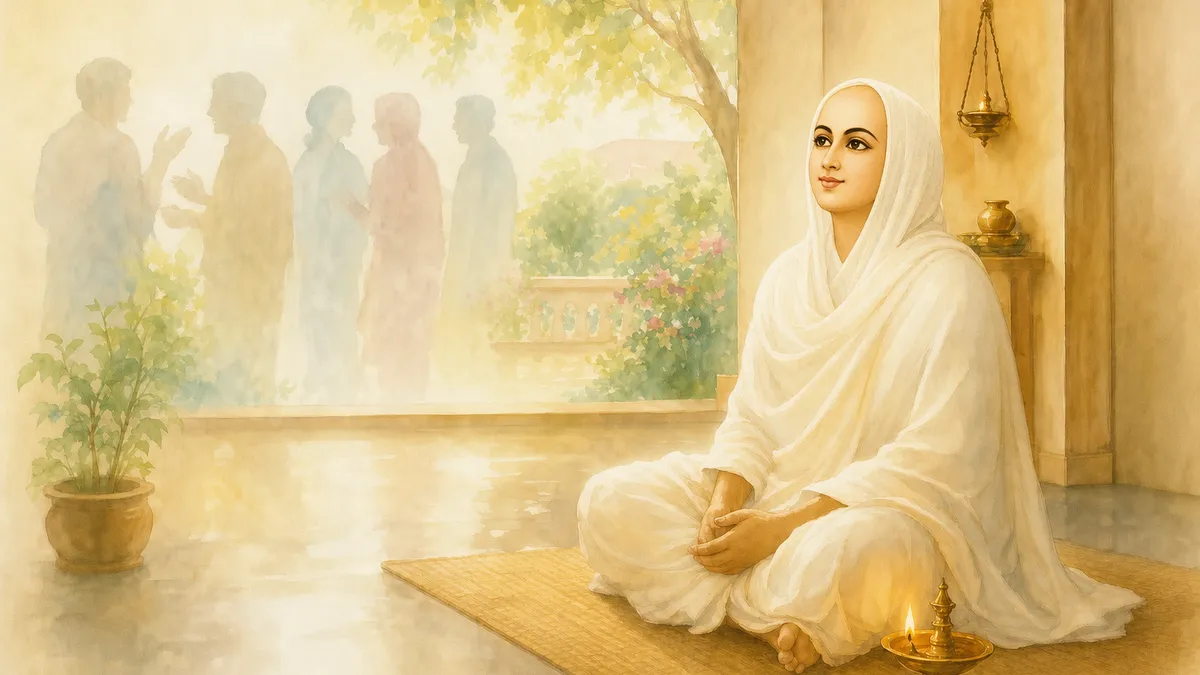
Ramalinga says: “I was occupied all the time with conversations and frivolity. I wasted a great deal of time here and there.” We are so busy with our conversations and thoughts, on which we spend a great deal of time, that we have no time to listen to God. If we listened to God very attentively, we would need only a very short time—enough time for the snap of a finger.
The Voice of the Absolute and the Nature of the Ego
Why do we not hear the voice of the Absolute? Because we listen to our superficial self. Only when the ego falls silent does the voice of the Absolute begin to sound. Ramalinga likens the ego to a neglected dog that hunts for food amid the dirt.
The food of the ego is the illusions on which it feeds. But when light descends upon the ego, this dog sits upon a throne. This light crowns it with a crown made of precious stones. The ego does not know that its greatness and glory are contained in the Absolute, and so it tries to live on its own. It tries to plan its life without taking the Absolute into account. But only when it touches this intuitive mind and begins to receive light from it does the ego finally receive its crown.
