Lessons of the 24 Gurus: The Path to Liberation Through Wisdom and Overcoming Maya
05.07.2026
0 мин. чтения
0
Share
copy
search
add
share
The Teaching of the Twenty-Four Gurus of Dattatreya
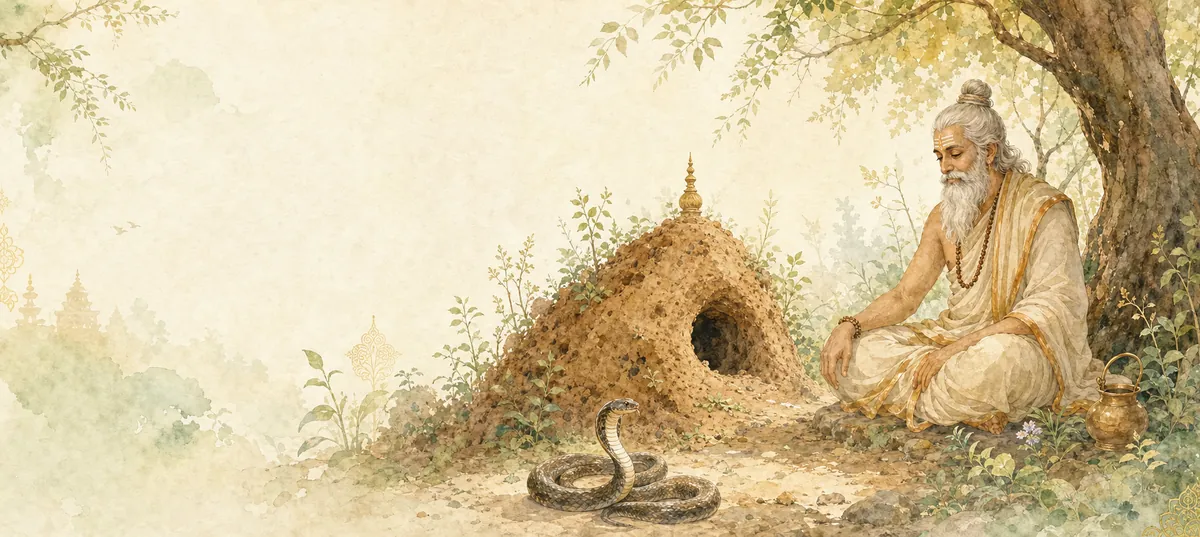
22. The Snake. O King, you may notice that a snake moves solely by writhing, not absent-mindedly lost in thought, but always vigilant. Although it has two tongues, it does not make foolish noise. If this body is a transient dwelling place, why should a house be built for it? Moreover, householders know from experience that when a house is built, many cares and anxieties arise. Instead of wasting its time building shelter, the snake lives happily in a hole built and abandoned by white ants. Reflecting on this, I understood that a sage too should follow this example.
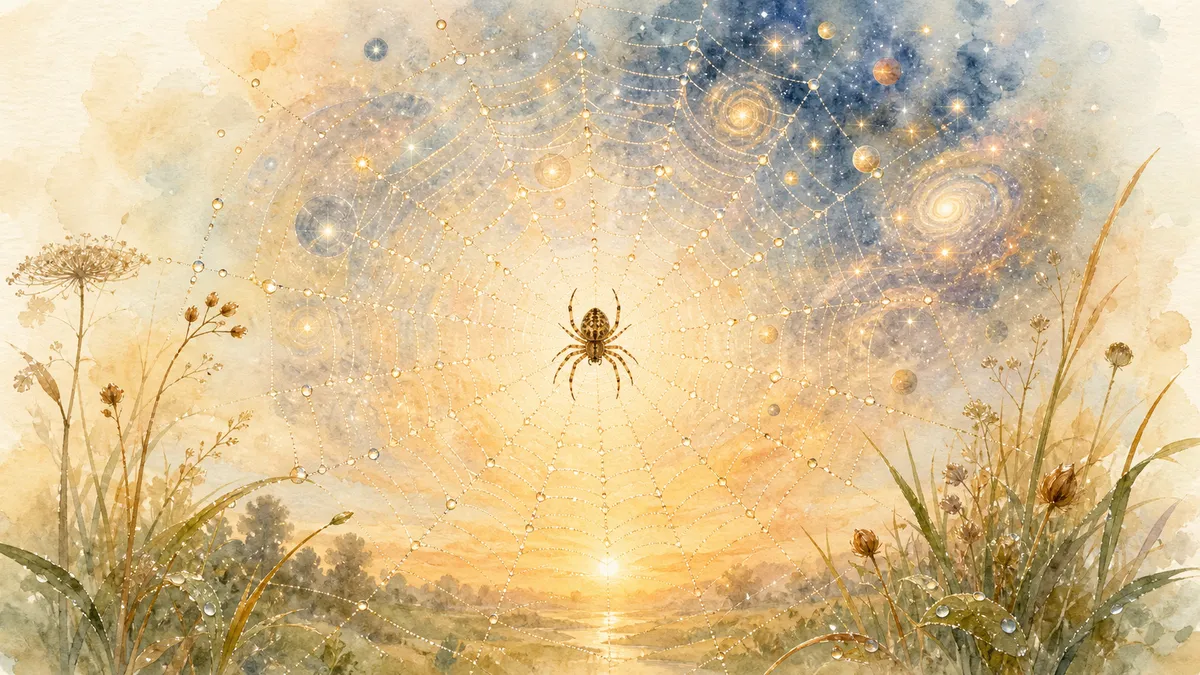
23. The Spider. O King, the spider taught me about Parabrahman, the primordial Reality that transcends Pradhana and Purusha. It also taught me that the processes of creation and dissolution are caused by this Reality. The spider spins threads in its belly, causing them to emerge from its body. From this material it weaves its web. As I reflected on this, it occurred to me that the process of creation is similar to this. Narayana, who is the Absolute, creates the universe beginning with maya, but at the time of dissolution destroys it again. Then all the gunas—sattva, rajas, and tamas—come into equilibrium. This equilibrium is Pradhana. This Pradhana is an attribute of Purusha. Then the one Narayana remains—the lord of Pradhana and Purusha, beyond all distinctions, who is the blissful form of the “I.” When the desire to create comes to Him, Narayana shakes maya, consisting of the three gunas, in order to create a thread possessing creative power. This thread creates the ego and the world of diversity. This creative thread is the primordial cause responsible for the universe, distinguished by multiplicity and diversity. And when Narayana wishes, He absorbs it and again remains unchanged. I learned all this from the spider.
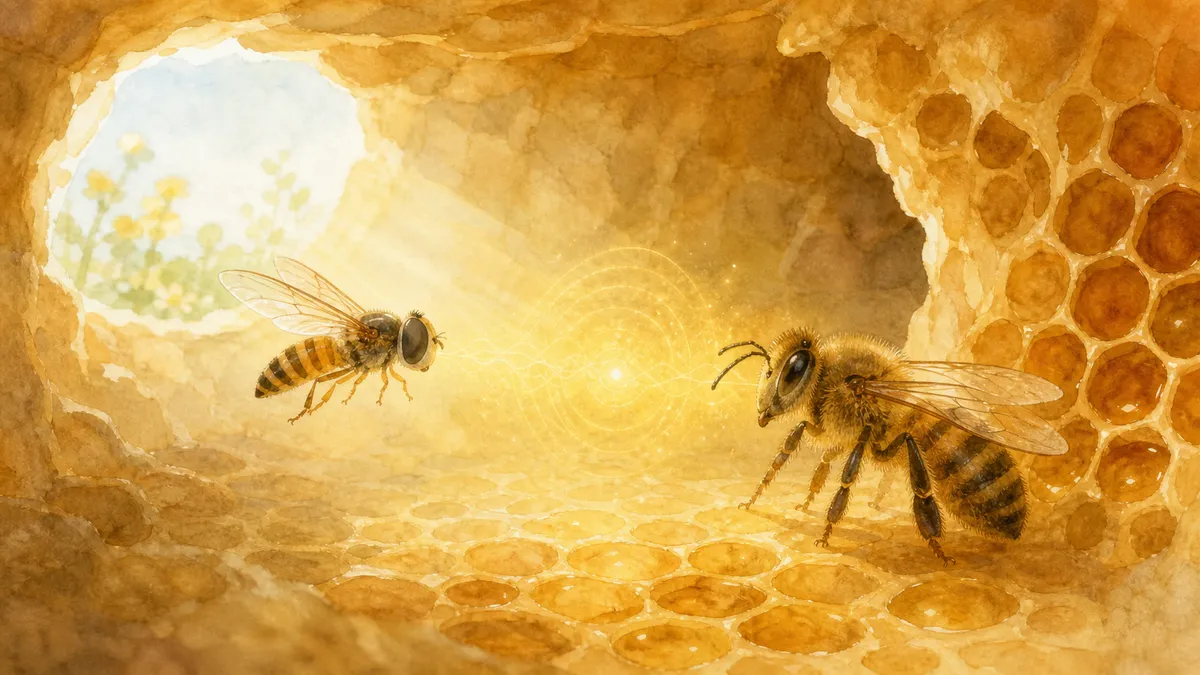
24. The Insect. One type of bee catches an insect and keeps it in the hive, where it circles round and round, buzzing loudly. Out of fear, the insect stares intently at the bee, concentrating its mind entirely on it. As a result, the insect’s appearance gradually undergoes changes, and it becomes like the bee. In the same way, a person takes on the form of the one on whom he concentrates his mind completely.
This is a common example: bhramara and kita. Bhramara is a bee; kita is a certain insect that embodies the principle of our mind. The point is that when this insect looks at someone, it is so hypnotized by their form that, over time, it itself takes on that form.
In the same way, we become what we contemplate. Often even worldly psychologists observe that spouses, having lived with each other for a long time (twenty or thirty years), take on each other’s appearance. They become each other’s illusory bodies; that is, the husband begins to resemble the wife, and the wife begins to resemble the husband. They exchange subtle data at the level of bodily form. Another thing has also been observed: when a person keeps some animal, for example a dog, he begins to resemble his dog. A connection undoubtedly exists.
In the same way, in yoga, in the Upanishads, it is said: “A yogin who meditates on the radiant Brahman himself, after some time, becomes the radiant Brahman. A yogin who meditates on the infinite Brahman himself becomes like the infinite Brahman. A yogin who meditates on the all-pervading Brahman himself becomes the all-pervading Brahman.”
When we understand this mechanism—that by directing our mind toward the necessary states we can identify ourselves with them and become anyone—we obtain the secret of liberation.
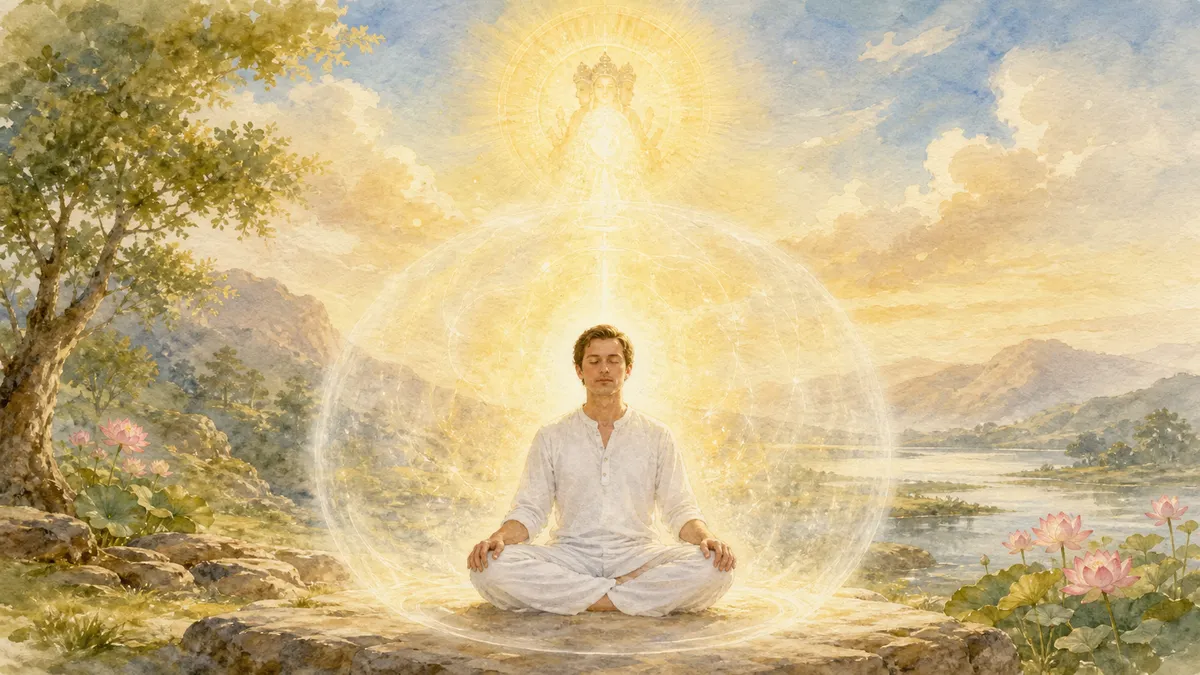
For example, if we direct our mind in shambhavi mudra toward space, we create the seeds for attaining the jnana-deha body, similar to space. If we direct our mind toward the principle of divine pride, we create the seeds for transforming into a deity. If we perform the practice of the yoga of the illusory body, meditating on ourselves in the form of Dattatreya, we create the seeds for attaining the body of Dattatreya. The sadhana of the natural state consists in continuously becoming similar to the Absolute in various qualities.
If a small insect can change its body, can there be any doubt that a person endowed with intelligence and the abilities for meditation will attain liberation after the body has been transcended, and will attain the same form as the deity on whom he is focused. This I learned from the insect.
The True Teacher Is One’s Own Mind
King Yadu, since you have performed extraordinary austerity, I have told all this out of love. Such are my twenty-four gurus. O king, now I shall reveal to you the main secret. I have mentioned twenty-four teachers, but in reality every atom in the world is my teacher—each and every one. All those who know the truth have realized it with their own mind, endowed with discernment. Ultimately, it is the mind that teaches good and bad throughout life. Therefore, the true teacher for everyone is the mind itself. There is no doubt about this. A person who wants to understand the nature of virtue, through analysis and examination of direct perception and inference, will discover that the mind is the only teacher.
The Preciousness of Human Birth
In this world, God created many diverse beings, such as one-legged, two-legged, three-legged, four-legged, many-legged creatures, and beings without legs. However, He loves the human being because he is the only intelligent creature who, through examination and discernment, can understand the divine principle present in all beings as the inner “Self.” A knower of yoga can easily recognize the divine principle in this very birth. A human being possesses the capacity for inquiry. The body, the senses, and the intellect are all inert and dull. Therefore, they cannot shine. However, the body, the senses, and the intellect are instruments for us. The human body is very dear to God because it is the basis for the search for the recognition of Truth. Therefore, we must take good care of it.
The Body as the First Deceiver
But, O king, this body itself is the first deceiver. I have learned much from it. From any point of view, the body always produces suffering. It cannot escape birth and death. That is why I am not attached to it. How much suffering people endure because of their attachment to the body! They acquire a wife, children, servants, friends, wealth, and so on. They love, cherish, feed them, and endure all kinds of misfortunes and illnesses for their sake. But what is there in the end? Life must come to an end. The body must die. Can the wife and children who surround it prevent this? Then where does such excessive attachment to them come from? This body does not simply die. It dies only after acquiring a sufficient amount of sins and merits to create another body. The suffering caused by the body does not end with the body; it creates another body. This is like a seed that has fallen from a tree and, sprouting, becomes another tree. There are millions of desires. The sense organs and the organs of action tease a person and trouble him, and yet dispassion does not grow. O king, for this reason attachment to the body is foolish. Moreover, since this body is the means to attain the highest goal of human life, one must, without wasting time, set out on the path of liberation before death comes.
Why is it said here, “without wasting time, set out on the path of liberation before death comes”? Because while we have a physical body, we can control the mind, we are in the waking state, and in this waking state we are aware of ourselves. We have been trained enough to distinguish reality and control the waking state. But what about the subconscious? When there is no body, there is no waking state either. The waking state is entirely a product of the work of the brain, the physical body, upbringing, and this reality. But when there is no body, this entire layer is cut away, and a deeper state remains—the subconscious. This is called taijasa, something like sleep with dreams.
Everyone can check how well they can subconsciously recite mantras and strive for liberation, how often in dreams they meditate, study sacred texts, and reflect on atma-vichara. In other words, if we analyze the world of taijasa (the world of the subtle body), we will see that it is far less under our control. It is a world of great probabilities, where one careless thought can lead into a completely unpredictable reality.
Life in the Astral Body
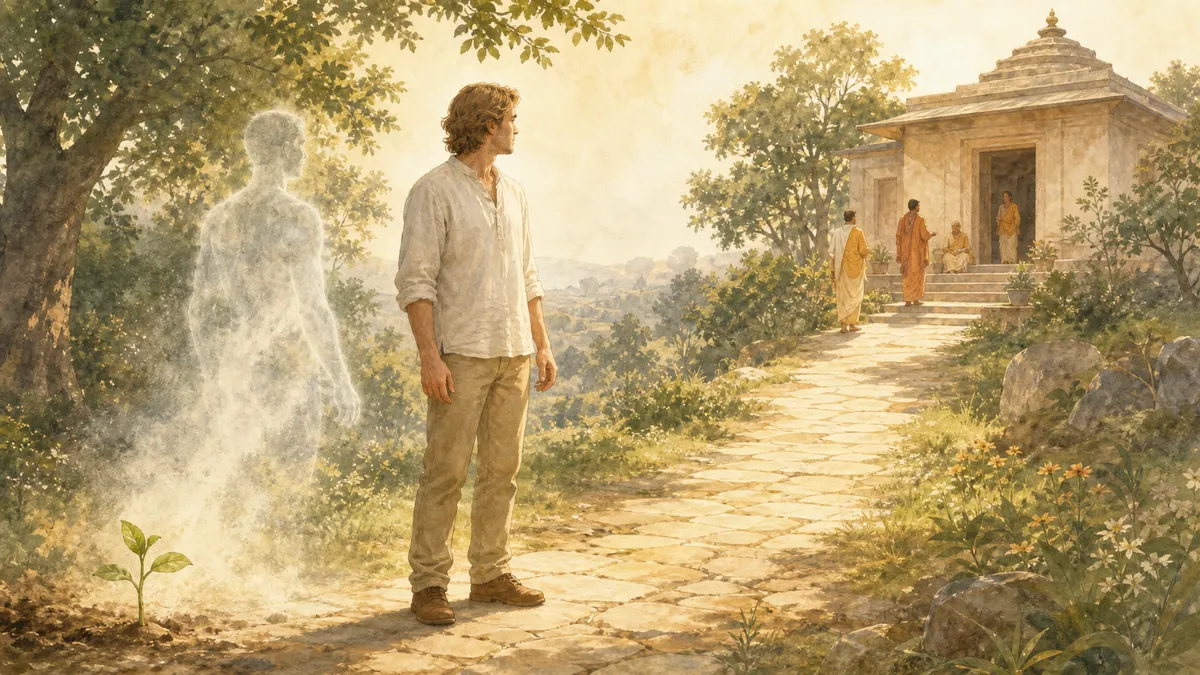
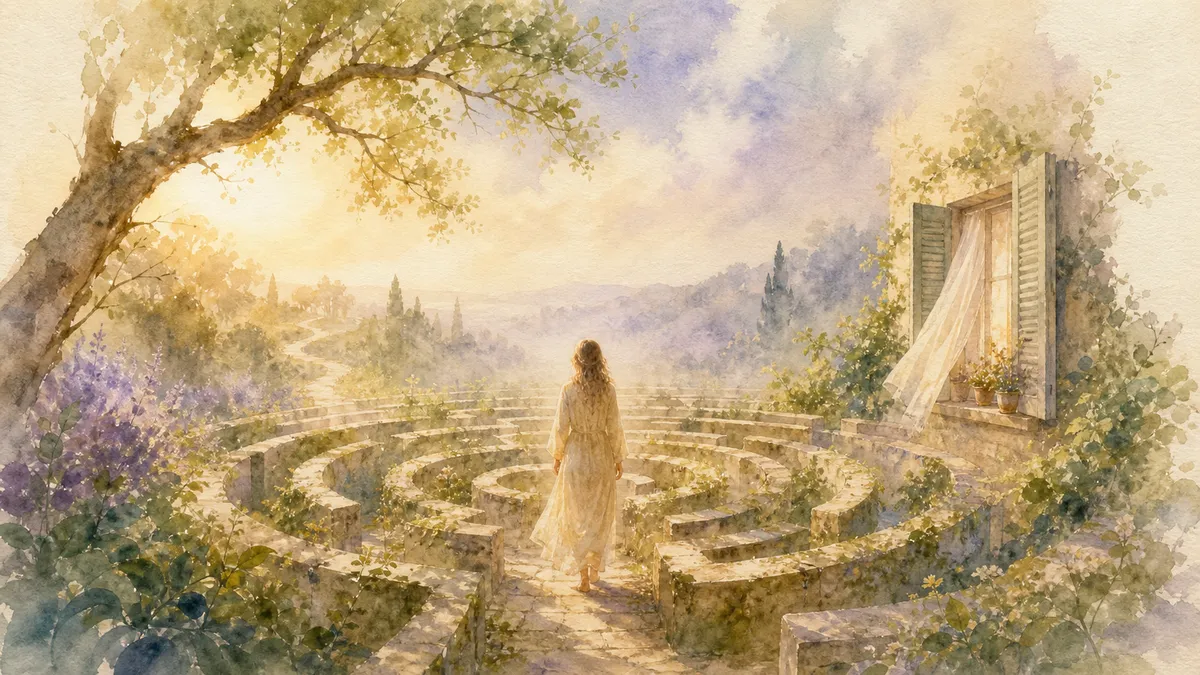
When a person is deprived of the body, he constantly lives in such a world, through which he can move by a simple effort of will: he has only to think of something and he immediately finds himself there; and since he thinks constantly, for the mind continues to generate thoughts, he continuously moves through the labyrinths of his memories. If these memories impress him, his consciousness changes: sometimes for the better, and sometimes for the worse. If he does not know how to release them, he falls under their influence.
Sometimes he moves even in this real, material world, but his body itself is subtle. His impressions are a continuous kaleidoscope. Sometimes he sits for a while in a tree, sometimes he walks through worlds of illusions created solely by the power of the mind, and sometimes he visits the homes of the living and watches what they are doing there. Sometimes he is overcome by despair because he wants to speak with his relatives, but they neither see nor hear him. Sometimes his consciousness is clear, and sometimes it is completely clouded; he is as if in a half-sleep. Sometimes the spirits of his lineage, connected with him, or acquaintances who are also spirits without bodies and have already settled in the astral world, come to him and try to help him, to explain his current situation.
The Process of Rebirth
For such a being, tormented and torn in the bardo by various contradictory states, if it does not possess skills in spiritual practice, the practice of liberation is out of reach, because its control of consciousness is too weak; all its skills manifest very faintly. As a rule, such a being ends up in one of the astral worlds governed by the spirits living there. There it remains for some time, awaiting its future fate.
A being may spend, perhaps, half a year or a year in such an astral city. Gradually its impure notions and karmas are purified, and then a time comes when the question of its incarnation arises. Either, having purified itself sufficiently, it may ascend to higher worlds and enter pure lands, or, according to the state of its soul, it is better for it to enter a physical body again, because the subconscious is strongly filled with various desires. It craves impressions and sensations, and in the astral body they cannot be satisfied.
Since the vasanas, impulses, and desires have not been burned by the fire of discriminating wisdom, the aspiration to obtain a body arises. Such a being gradually begins to choose parents. It sees several options closest to it and begins to establish a connection with them. By concentrating, it can see moments of its future life and aspects of its rebirth. At a time favorable for conception, such a being is drawn into the mother’s womb and once again receives a physical body, in order to try once more to enter the path of practice and awareness.
Many people misjudge reality. They believe that they will remain in this physical world all the time. However, this is, of course, not so. They are very identified with their physical bodies, not even realizing that the physical body is like a kind of spacesuit animated by their consciousness, and that the subtle body can leave the physical body as if leaving a spacesuit. Therefore they have false values and set themselves false goals. They think: “I will live so that this spacesuit is provided with everything.”
In reality, there is nothing worse than having such values and goals, because in the end one has to part with this spacesuit anyway, and only accumulated merit, the level of awareness, mastery in practice, and the degree of purity from worldly desires count.
The rishis have given many descriptions of the supreme Brahman. Therefore, the ability to discern must be received from one’s own teachers before it is too late. Having thus attained wisdom and cast aside egoism and self-conceit, I plunged into my own “I” and wander almost unattached. Such is the religion I follow.
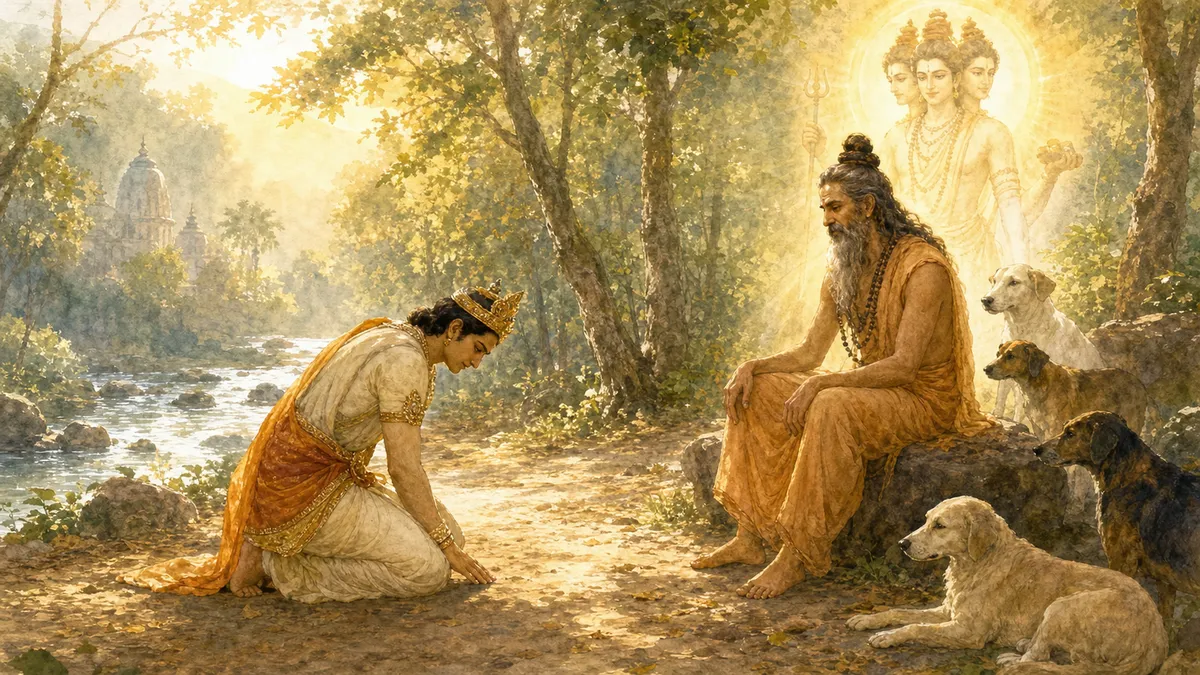
When Yadu listened to these instructions of the avadhuta, all his efforts made in previous births bore fruit, and the light of the inner Self was kindled in the depths of his heart. Filled with happiness and devotion, he prostrated before the avadhuta, and at once Lord Dattatreya appeared before him. Thus King Yadu received the darshan of Datta. He contemplated the teaching of Brahman transmitted by Lord Dattatreya and attained Brahman.
Constant Remembrance of the Preciousness of Human Birth
The preciousness of human birth means that we always remember the meaning of our practice, where we are, and what path we have chosen. And we do not forget this even for a second.
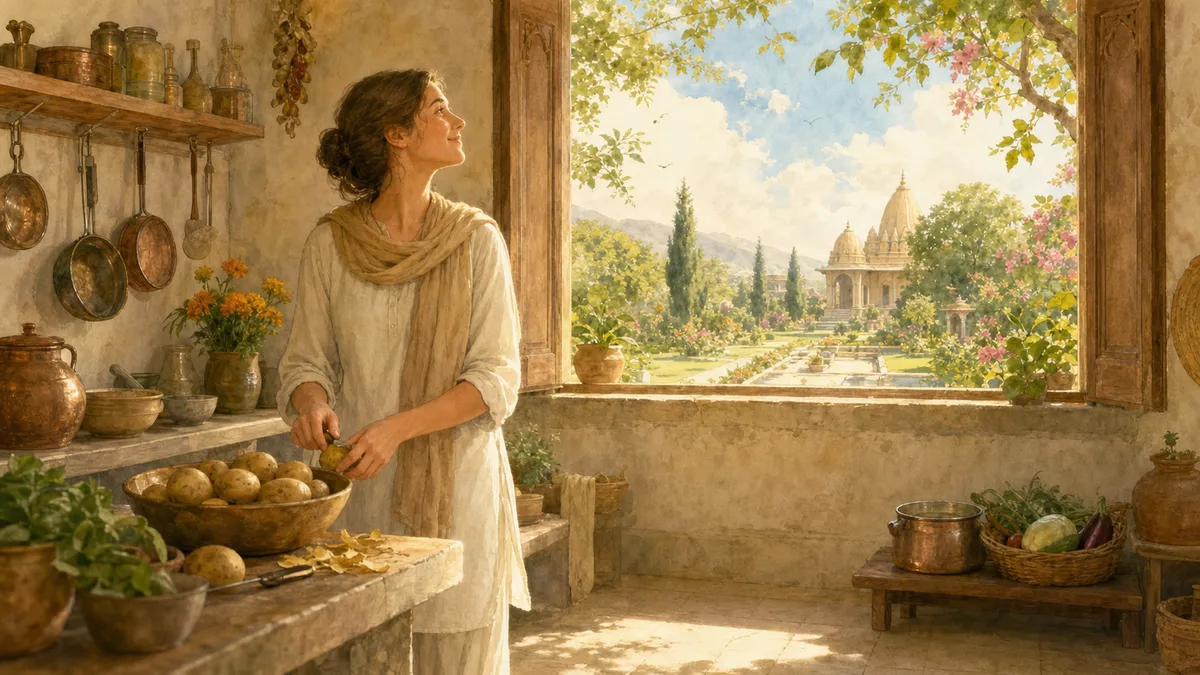
Sometimes it becomes almost absurd: even in a monastery, a person falls under the influence of maya. He allows his mind to be colored by some utterly insignificant things. For example, one mataji admitted in a letter that she had had some disagreements with the cook about how to fry potatoes. Her opinion was one thing, and the cook’s opinion was another, and this affected her so much that she felt as if her consciousness and the whole universe had shrunk down to this small problem. She herself was amazed that it could happen that she had come to the monastery for a month to receive the Dharma, yet her mind had become so strongly conditioned by this completely insignificant episode.
This is exactly how we receive lessons in our own conditionedness. We are often surprised ourselves that our mind can so easily fall into various kinds of illusions. Only a mature practitioner knows this and understands how strong and manifold illusion is.
A disciple once asked a teacher: “Guru, are you afraid of maya?”
The teacher replied: “Yes.”
The disciple said somewhat proudly: “But I am not afraid! I will certainly be saved by God, because I believe in Him.”
The teacher smiled wryly: “Well, well, live and practice as long as I have, and then you too will begin to fear maya.”
Maya is not just some small illusion; it is the whole world, the entire vast universe. Maya is capable of deceiving even Vishnu. When Vishnu was reborn with a certain purpose and assumed the body of a boar, he became attached to his pig family: his spouse and piglets. Even the gods appeared to him and tried to convince him that he was in fact the deity Vishnu, and that it was unworthy of him, in the body of a boar, to amuse himself by eating excrement. But he refused to acknowledge it. It came to the point that Indra himself had to descend and strike the boar’s body with his magical staff, cleaving it, in order to free Vishnu. When Vishnu emerged from that body, he regained his memory and simply laughed, saying, “How great is the power of maya!”
Only continuous remembrance of the preciousness of human birth can be set against such a power of maya.
Read 15 times
Articles
Vidya AI
Search
Lectures
November 3, 2026
Mantra of the day
ОМ САДРЩАЙА НАМАХ ОМ Видящему равно – поклонение!
Auspicious Times(Rome)
Brahma Muhurta:
04:54 - 05:49
Abhijit Muhurta:
11:33 - 12:14
Sayam Sandhya:
16:43 - 17:24
Mokshada Ekadashi (6 November)
Ekadashi of liberation. Helps to achieve spiritual enlightenment.