The Teachings of Dattatreya: The Path to Liberation Through Renunciation and Self-Knowledge
05.09.2026
0 мин. чтения
0
Share
copy
search
add
share
Commentary on the text “Srimad Bhagavatam 11.7.32–34.Dattatreya’s Teachers, Beginning with the Moon”
This is a text that should be meditated upon in order to free ourselves from our own limitations and obstacles. It is a kind of universal matrix associated with our limitations, kleshas, desires, and attachments; by meditating on it, we can discover within ourselves the very same limitations that Dattatreya speaks of and uproot them from within.
Viveka: Discerning the Eternal Light from the Glitter of Samsara
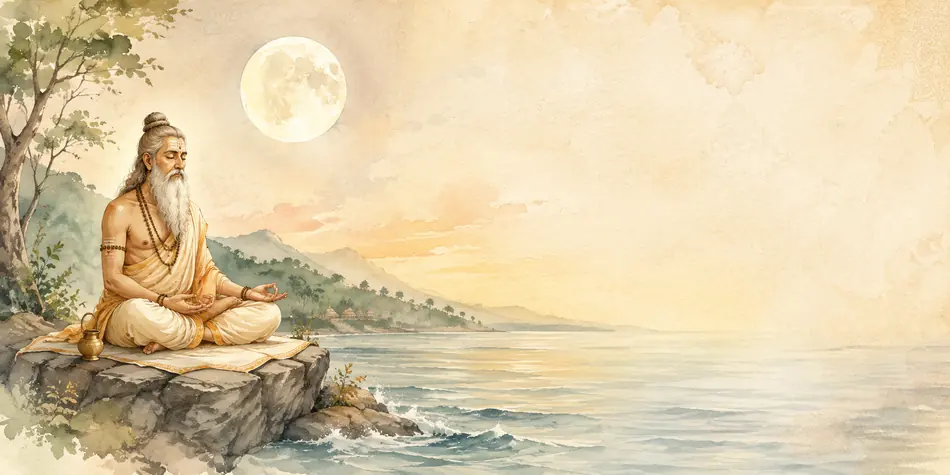
The Moon.
“The waxing and waning of the moon occur due to the movement of time. Furthermore, if we reflect on this, we will see that it is not the moon itself that waxes and wanes, but its radiance. From the moon I learned that the six objects of the senses arise from the body, not from the Atman.”
“It is not the moon itself that waxes and wanes, but its radiance”: by radiance, prakriti is meant. The moon is a symbol of pure nondual Consciousness. Impermanence is inherent in prakriti. Nityatva, eternity, is inherent in the Atman. Viveka consists in separating the radiance of prakriti from the nityatva of the Atman. When such viveka reaches its full strength, we become what is called a Paramahamsa. A Paramahamsa is a swan that flawlessly separates milk from water. It is believed that such a swan—not just any swan, but an exceptionally rare one—can freely drink the milk while leaving the water behind, straining it out of the water. Viveka means the subtlest discernment, born of our inner ascetic practice, that allows us to release the light of the Atman in any situation without mixing it with anything else.
Here, the radiance of the moon represents the tinsel of samsara, prakriti, the material world, the sense organs, and the five koshas. But its essence, whose radiance does not change, is always eternal and constant. This is the Atman. How can we distinguish the Atman from prakriti? Viveka is needed. Viveka is a quality of a strong chit, Consciousness. A strong chit is needed. How can such viveka be developed and cultivated?
Two things are constantly necessary: atma-vichara and brahma-vichara, inquiry into the Absolute and inquiry into one’s “I” as part of the Absolute. Ishta-devata yoga is also necessary. Through developed viveka, we can unmistakably recognize the Light of the Absolute amid perceptions of objects, sensory experiences, and concepts, just as a child unmistakably recognizes their mother in a bustling marketplace. Wherever the child may be, they will unmistakably recognize their mother and will not confuse her with anyone else. Self-liberation in contemplative presence, which destroys vasanas, is the unmistakable recognition of the Light of the Atman’s pure Consciousness amid any experiences whatsoever. You must simply recognize it unmistakably. You should not be concerned with honors, fame, wealth, sensory pleasures, clinging and attachments, or how others treat you. Close your eyes to all of this for at least twenty-five years; simply close your eyes to everything. Prestige, whether or not you are respected in this society, even food—whether you are fed well or not so well—your conditions and daily life: simply close your eyes to all of it and say, “Endure it for twenty-five years.” Devote yourself to the flawless cultivation of viveka. This alone should concern you. If you manage to do this, you will be grateful to fate for having been so fortunate. If you do not, then twenty-five years later you will still be troubled by the same problems as at the beginning. Viveka allows you to release the power of chit, separate yourself from the glittering tinsel of samsara, and become established in constancy and eternity. The true humility of a sadhu consists in separating oneself from this world, from all its games and ambitions, from one’s own world of ego, from all phenomena, and simply seeking viveka. This is true humility.
Sometimes I liked to joke in the 1990s, in 1999. I told the monks that when they attained liberation, I would make them great people. When you attain enlightenment, I will make all of you important, respected, great people. Some would ask, “Who exactly, and how?” But I would say nothing and only laugh. Finally, one of the monks questioned me very persistently about who I would make them after liberation, so that he would be more motivated to practice. I said, “After liberation and enlightenment, some of you will happily wash dishes, while others will carry water and chop wood as enlightened beings.” Some did not understand, while others did. It does not matter who you will be in the material world; it is utterly unimportant. What matters is what you realize within yourself. Who you are in the material world is simply determined by fate, niyati, as well as by your will, sankalpa, or Shiva’s blessing; but what you realize depends on your aspiration for liberation and divine grace. Therefore, a sadhu never seeks to become someone.
A sadhu considers that, having been born and received the precious human body, he has already found his place in the material world. He has taken monastic vows, tantric samayas, and the single samaya—this is his place. Everything else is either seva, and seva is not something one can choose; it should be performed with this attitude: “I will become whatever I need to be, and wherever I need to be, there I will serve God, the Dharma, and the Guru. It is not a question of who I will be; it is a question of what role divine grace will entrust to me in this play.” That is all.
The Art of Self-Education and Taming the Mind
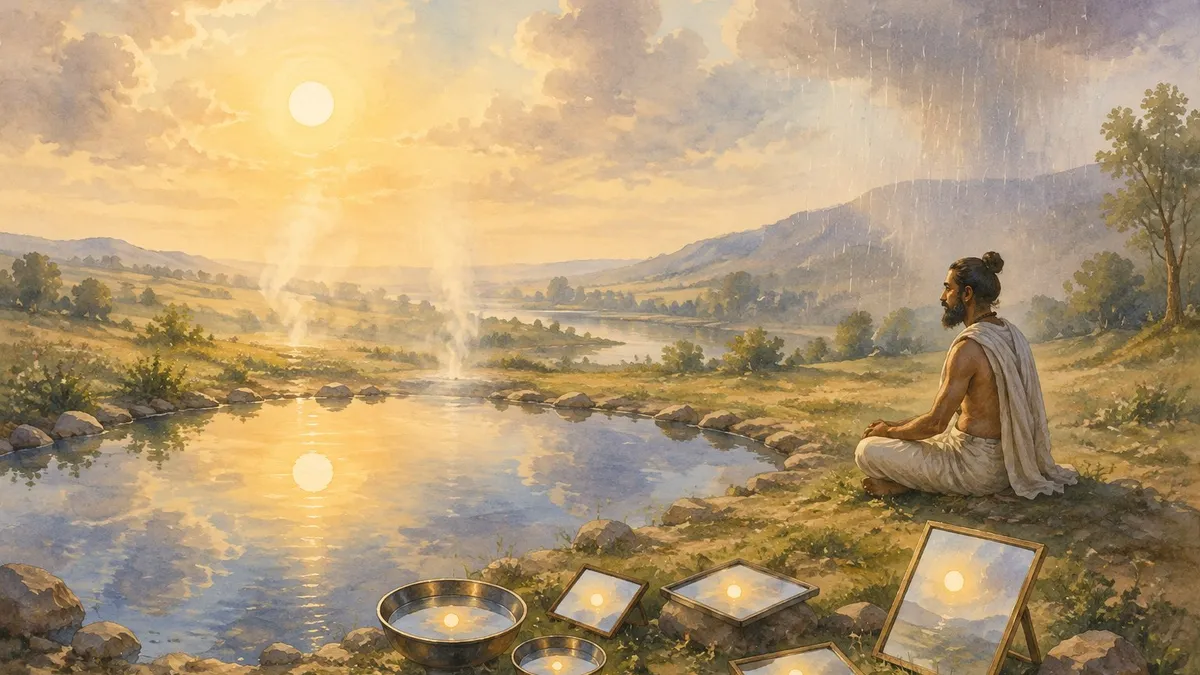
The Sun.
“With its rays, the sun evaporates water from the earth. At the appropriate time, it returns the water to the earth again. In the same way, a yogi should accept the objects of the senses without any eagerness or greed. When deluded people see the sun reflected in water or mirrors, they think that there are many suns, but in reality there is only one sun appearing in such a multitude of reflections. From this I learned that although the Atman is one, the deluded intellect perceives it as many because of the deceptive nature of the mind.”
“.
Why does the desire arise to talk to someone, to see something, to read something? Why not wake up in the morning and realize, “All news is within me, all conversations are within me, all images are within me, I alone exist,” and be happy with this fact? It is very difficult, because the mind will not believe it; it will say, “No, there is nothing within me; I want to obtain something there, to talk there,” because the mind is aware of its deficiency, the mind is aware of its wretchedness, and it needs somehow to nourish itself in order to feel comfortable; it needs to take something from outside. But viveka makes it possible to live not at the level of the mind, but to find the source of that mind. Viveka is a quality of buddhi, not of the mind. When viveka is developed, it says: “Mind, come here. Here is your happiness; here is the source of your wisdom and strength. Look to buddhi, submit to buddhi, and surrender yourself to buddhi, because buddhi draws upon divine grace; this is the source of your happiness, your ananda.” A sadhu must educate his mind until it finds the source of its happiness and its ananda. The mind must be handled carefully, which is why the saints say, “Strike the pig’s snout with a club, but do not strike its nose.” The mind must be guided and strictly disciplined, but it must not be broken by force, completely suppressed, killed, or subjected to an irreconcilable war, because it is part of you. Rather, it should be educated gently, like a child, through attraction, so that the mind feels drawn to mantra, contemplation, sadhana, and the divine name, and so that it turns away just as gently from worldly desires and from all of samsara.
The art of self-education consists in constantly working with the mind, constantly striving to change. Sometimes, at first, we understand that we need to change, but then some time passes and we forget it; we begin to think that someone around us is wrong and that they need to change, and that they may be the cause of our problems. Or we begin to think that the world must change. But the one who must change is ourselves. Such change is possible if we constantly watch the mind and guide it correctly, if every day we vigilantly tame the mind, if we direct it toward faith, devotion, pure vision, self-surrender, self-discipline, and control of the senses.
From Attachment to Unity with Brahman
The Pigeon.
"I learned from the pigeon that excessive attachment or friendship with anyone inevitably leads to misfortune. Here is a story that illustrates this. A very beautiful and strong pigeon lived in a forest. He formed a bond with a female pigeon who suited him perfectly. Their love for each other was incomparable. It seemed that they had two bodies but one soul. In due course, the female pigeon became pregnant for the first time and laid eggs. This served to strengthen their mutual attachment. In time, the chicks began to hatch from the eggs. Is not Hari's maya incomprehensible even to great pandits, and how much less comprehensible must it be to these pigeons? For that winged pair, those chicks alone constituted the entire world. Whenever they looked at the chicks and their antics and heard their affectionate chirping, the winged pair felt pride and happiness. One day, both parent birds flew into the forest to bring food for their chicks. A hunter came and spread his net, and many birds were caught in it. The poor, little, innocent birds trapped in the net began to cry out helplessly. When the parent birds returned and saw the empty nest, they lost consciousness. Soon, however, they came to their senses, and each flew in a different direction in search of the chicks. The mother pigeon saw the chicks caught in the net and, overwhelmed with pity and love for them, without weighing the pros and cons, rushed into the net to save them. But she too was caught in it and began to lament. Such is the result of reckless passion. A little later, the father pigeon arrived and saw the situation. Although he did not rush forward as the mother had, he was overwhelmed with grief at the sight of his own wife and children dying before his eyes. He could not control his sobbing and began to wail loudly in sorrow: "What happiness can there be for me after losing my wife and children? For whom should I live? Oh, if only my wife or at least one of the children had survived—what is the point of living?" he lamented. Under the weight of grief, his intellect became blind. As a result, he concluded that it would be better to die, and so he too flew into the net and met his end at the hands of the hunter.
O Yadu, what is the lesson of this story? When one lives in duality, instead of discovering one's own Self, one merely becomes a victim of recklessness and passions. A person who delights in dualities has no peace of mind, and when he regards the preservation of his family as the sole purpose of his life, one day he perishes together with his acquaintances and relatives. O King, this mortal world is an open door to final liberation—there is no doubt about it—but we must not lose this opportunity by allowing ourselves to be bound by attachments."
The truth was that the female pigeon was not a pigeon; she was Brahman. The male pigeon was not a pigeon; he was Brahman. Their chicks were not chicks; they were Brahman. Brahman was playing through various energies, but illusion and ignorance arose in their minds. All living beings in samsara are subject to this ignorance. We must conquer this ignorance and discover how things truly are, how reality is actually arranged. When we comprehend this, illusions, suffering, and anxiety can no longer take root in our hearts. We advance confidently toward the truth every day. We draw closer to the great happiness that has neither beginning nor end. Such is Dattatreya's lesson.
Life Without Personal Ambitions
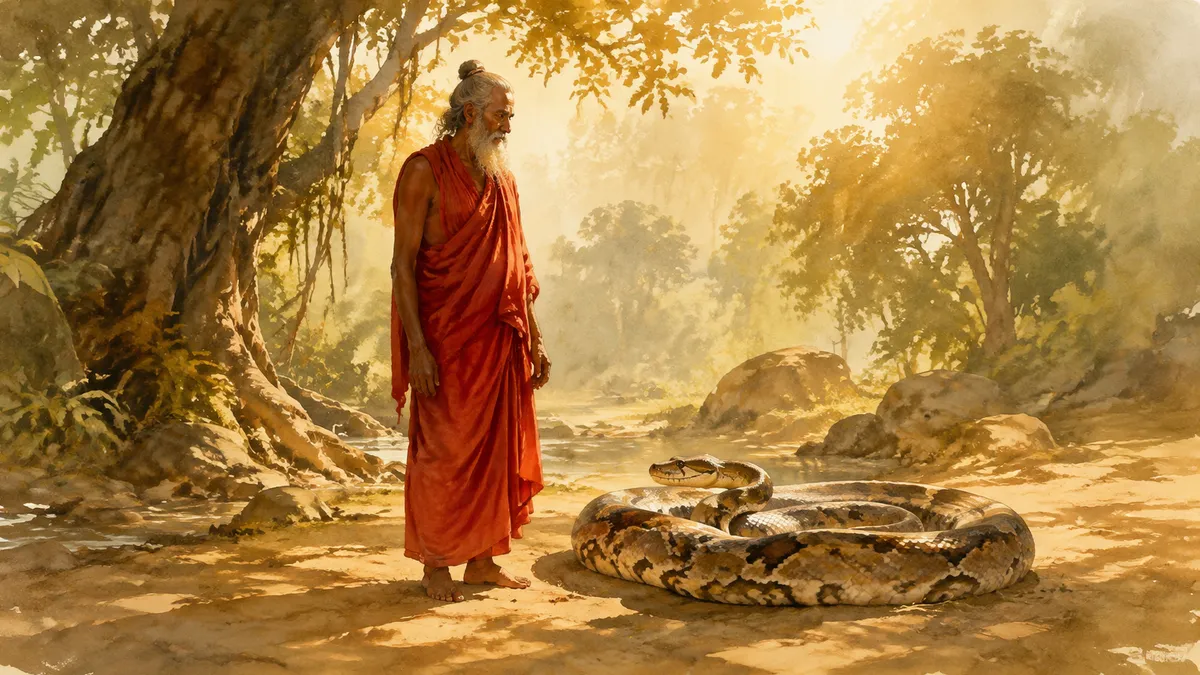
The python.
"O King Yadu, a person will undoubtedly experience pleasure and suffering according to his past actions. They cannot be prevented even when he wishes to prevent them. Nor can he make them come when he wants them to. This is also true of other worlds. Therefore, it is useless to strive for this or that. Food, whether tasty or dry, whether abundant or scarce, comes to everyone as ordained, and one should be content with it. If it is unavailable, one should simply fast. Not only that: what has been said above applies equally to sleep. One must always remain firmly devoted to one's own Self. I learned this from the python."
The principle of the boa constrictor, or python, is also called ajagara sadhana: to pursue no goals in this life other than contemplation of Brahman and service to the divine will; to pursue no personal ambitions or goals, but to surrender all personal ambitions and goals to God, the Absolute, and become a completely empty conduit of divine will and divine wisdom. This does not mean doing nothing; on the contrary, you may do a great deal, but your motivation for acting will be entirely different: you will act as God's illusory body, as a conduit of the divine will.
This is an entirely different motivation. People usually act or refrain from acting based on their motivations. Your motivation, however, will be divine wisdom and divine will. None of the fruits or results of your actions belong to you; they belong to God. Through this attitude, you yourself come to belong to God. This is the meaning of the example of the python. Do not pursue personal ambitions in monastic life, do not pursue personal goals, have no personal ambitions or goals other than liberation in God, knowledge of God, and service to God; free yourself from selfish personal aims, learn to surrender everything to God and give everything to God, and become a completely empty vessel of God. This does not mean being weak-willed or utterly incapable of action; on the contrary, actions may be manifold, as may the exercise of will. But it means an entirely different vector of motivation: motivation based on surrender to God, renunciation of the fruits and results, and delight only in divine blessings.
The Art of Inner Discipline and Non-Involvement
The sea.
"I learned two or three things from the sea. Even though the sea is vast, it cannot allow even a small dry leaf lying on its surface to remain there. Instead, the sea carries it away toward the middle. If the sea did not always do this, by now it would have dried up like a tank. Likewise, no matter how great a tapasvin or yogi may be, he must not allow even the slightest desire or agitation to enter his mind.
"Nowadays, propaganda is also highly developed. One must not allow propaganda to enter one’s mind: the enticements of the material world, the promotion of a consumerist lifestyle, advertising.
"If he is careless, he will not be able to avoid being destroyed by it. Therefore, I learned from the sea that one must not let in even the slightest deviation that has no point of support."
Not even the slightest deviation should be allowed. This is a very important principle. It is difficult to permit absolutely no deviations whatsoever in contemplation, samaya, and adherence to the principles and vows one has taken, but one must strive for this. Otherwise, you will not become a sadhu. To strive for this, we must always watch our minds, always remain vigilant, purify our hearts, and the first thing we must observe is the purity of samaya. We must place the purity of samaya upon a pedestal and make it our inner deity. We must hold the sacred, holy spirit of samaya in the highest reverence within our hearts. The fourteen root vows must become golden rules inscribed in our hearts. Cultivating such a pure spirit of Refuge and faith will open up the possibility of the single samaya of contemplation for us. Then direct introduction, direct transmissions, and the methods of Anuttara Tantra will blossom in our hearts, take root there, and also begin to work. Then we must also place the single samaya of contemplation upon a pedestal. In addition, we must honor the commitments and vows we undertake. We must clearly understand our status, which vows we observe and which we do not, what the rules are, what the exceptions are, how they should be followed at each stage, and, if anything is unclear, clarify it. Everything in the teaching is clear; everything has been explained down to the smallest detail, but sometimes we do not understand everything. Therefore, our task is also to clarify precisely how to apply Vinaya, samaya, and the single samaya in our lives.
How can we act scrupulously? Over the years of spiritual practice, the stronger the chitta and the deeper our viveka, the more skillful we become in observing all the principles, and the more we begin to rely on the single samaya of awareness. The single samaya of awareness encompasses everything and permits no deviations.
Why is this so important? Observing Vinaya, samaya, and the single samaya is nothing other than never falling away from nonduality and pure sattva, and the never-ending process of transmutation—the alchemical transmutation that transforms rajas and tamas. When we act in this way, we truly become impeccable masters. That is, masters are not those who become increasingly careless—no. They are those who become increasingly free through their skill in observing the many subtle nuances of the teaching.
Sometimes we can see saints, masters, and avadhutas who have attained liberation behaving beyond the bounds of human conventions, but this is not carelessness on their part; it is their great art of mastery in understanding the subtleties of the laws of nature, dharma, prakriti, and the universe.
For example, if a dog is considered impure and Dattatreya picked up a dog, this does not mean that he disregarded accepted rules. It means that the power of his contemplation was such that he could draw deities out of the dog's energy. In other words, this does not mean that he breaks the rules; it means that he observes them on a higher level than ordinary people.
We must also learn to observe the principles and samayas of contemplation so scrupulously that no deviation occurs under any circumstances. When there are no deviations, our “Self,” our higher Self, knows it; our soul rejoices in it, and we feel our inner light and inner purity growing. Conversely, when our soul is obscured, our kleshas intensify; our soul grieves over it, and our higher Self also knows it.
We cannot deceive our soul and our higher Self; they see everything flawlessly, they know perfectly when tamas and rajas increase, and when sattva and nonduality increase. If we listen to our soul, our Atman guides us from within, and then we no longer need external observance—we know how to observe everything properly within. Therefore, we must listen to our soul every time in order to be certain that our soul does not become obscured. This is the meaning of these precepts: to protect our soul from obscurations.
“The sea is very deep. Even so, the entire multitude of organisms contained in its bosom, or the precious pearl hidden within it, is neither revealed nor exposed. Many rivers flow into it, yet none flow out. In summer, the flow of water in the rivers decreases, yet the sea does not dry up. It is not conditioned by time and space. Likewise, a muni should not display his power or express his feelings. He should not allow others to fathom his beginning and end. He should not become joyful when his desires are fulfilled, nor should he fall into depression when they are not realized. From the sea I learned to practice tranquility and remain steadfast in my devotion to the inner ‘Self.’”
Muni means sage. Here Dattatreya says that he should not put his power and feelings on display. Sometimes it seems that if we express our feelings, others will understand us or pay attention to us, or we will achieve mutual understanding, or accomplish our goals. Sometimes it is useful to tell others about our feelings and reveal our thoughts—for example, to the Guru—or, in a friendly conversation with a brother or sister in the dharma, to clarify something concerning relationships, approaches, and vision; but this should not become a permanent rule, it should not become a drug, it should not become an area of psychology into which we have climbed, in which we keep stewing, and from which we cannot find a way out.
It is more like a temporary psychotherapeutic pill, but it is not a drug that we constantly take and feed upon. A sadhu should restrain his feelings, practice awareness, and dissolve them in the mind. A sadhu does not need outside psychologists; he is his own psychologist, and within him there is a wonderful psychotherapist who heals all his emotional wounds and brings harmony and tranquility. What is it? It is his Atman! Contemplation of the Atman resolves all psychological problems in the best possible way.
Western psychology is now popular throughout the world, and it has a great many branches: body-oriented therapy, Gestalt therapy, hypnotherapy, and any number of others, all of which belong to the realm of psychology. But the realm of psychology does not allow one to rise higher, to the Divine Source. For a sadhu, psychology must be subordinated to inner theology. Our goal is not psychology, but theology.
Theology means that it does not matter what is in our soul—weeds or roses—we offer everything to God; it does not matter what has grown there, for both belong to God. It means that we shift our focus completely to the transcendent; it does not matter what time, nature, and destiny have bestowed upon us today—gold coins or slaps in the face—we offer both to God.
Samyoga: Maintaining Balance and Distance
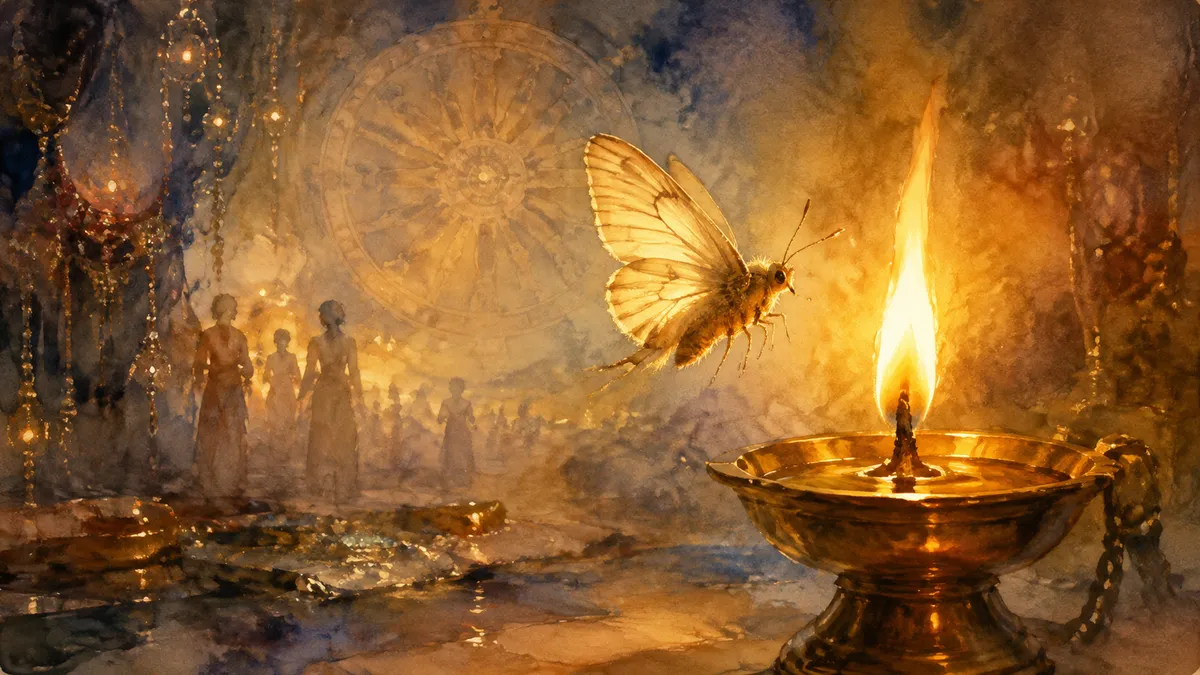
The moth.
“Deceived by the bright glow of the fire, the moth rushes toward the light and burns up. Likewise, a person attached to a beautiful woman adorned with jewelry and walking coquettishly is consumed by a reckless passion for her, without realizing that this illusory flirtation is a means of drawing him into the turning wheel of samsara and hidden prakriti. Instead, he believes that he is enveloped in happiness. As a result, he loses both this world and the next and sinks into ignorance. In the same way, a woman who sees an attractive man becomes deluded and falls into the wheel of samsara. I learned from the moth that I must not become a victim of the illusion created by the senses.”
While living as a monastic, one should always maintain a distance between the external world, oneself, and the senses. One should maintain distance in relationships with one another and between oneself and one’s desires. If you do not learn to maintain such distance, you will be vulnerable to samsara.
Until you attain the vision of everything as the play of the Great Mother and, in your relationship with prakriti within the universe, rise from the stage of relating as worldly spouses to relating as sister and brother, and then to relating to her as the Great Mother who nourishes her son, you will constantly become entangled in certain ties and relationships. These relationships will always attempt to control you—or rather, they will not merely attempt to do so; they will control you completely through the senses and the mind.
Only at the stage of relating to prakriti as the Great Mother will material nature, the universe known as Devi Dhama, nourish you rather than bind you, and you will not be absorbed by material nature. Therefore, maintaining distance—between the senses and their objects, between one another, between the mind and concepts, and between emotions and feelings and consciousness—is very important for a sadhu.
For example:
Maintain distance between men and women
Maintain distance between social statuses
Maintain distance between the mind and worldly information
For your future birth and your liberation, this is as important as can be imagined: never allow this distance to be broken.
Through the senses, through emotions, and even through the world and other people, samsara will try to invade your space of awareness. It will always try to break this distance, violate the established rules, disturb your clarity, and cast you back once again. But if you are an intelligent, wise sadhu, then by relying on the vows of vinaya and samaya that you have taken, as well as on self-discipline, you will continually restore this distance. You will constantly remind yourself: “I am a sadhu, I am a sannyasin, and I must maintain this particular distance.” You will respectfully keep prakriti at a distance.
Sometimes prakriti breaks this distance through relatives, by touching the most painful spot. It may say: “Help us, we need you, we love you; come home, stay, give all this up. We need grandchildren; we are already old—who will take care of us?” This is a difficult choice because attachments still remain, and we must understand how to maintain distance while showing compassion so as not to hurt anyone.
Sometimes samsara will intrude through society, news, information, and devices. It will constantly say: “You are part of this world; you must know everything, you must watch and hear everything—television, news, devices—and keep up with all the latest developments.” This, too, is maya. You must say: “I am part of a world, but a different one, not yours. I am part of the divine world, so keep away from me and remain at a distance.”
Sometimes it will intrude through a man or a woman, when attachments may arise, and you must say: “This is not why I entered the path of sannyasa. I am not looking for male or female friends. All my male and female friends are within me; they are deities. My wife is Kundalini, and my husband is Shiva.” If you establish such distance, your spirit will always remain free.
In tantra, there are practices involving interaction between a man and a woman, such as the worship of a woman, stri puja, kumari puja, the worship of a little girl, worship on the path of vamachara, and worship on the path of dakshinachara. However, at this stage you should not fantasize too much about this subject, because you may lose your way as a sadhu, a sannyasi.
These paths become possible after samadhi, when you have mastered samadhi, when your illusions have vanished and you have realized turiya; then you will disappear, and all your attachments will disappear along with you. If, however, you try to make use of them before that, your ego will most likely creep in and seek to use tantric texts to indulge its worldly desires, and you will become deeply entangled again. This is an important subtle point that must also be understood.
A sadhu must keep his distance in everything. The sense organs, all kinds of experiences, and the ego—all of these will try to break down the distance between themselves and you. Many times you may see samsara challenge you and break down your distance from the world, narrowing it and seeking closer contact with you. It wants to test you: “Well, here I am. Do you see me? What are you going to do?” If you are too weak to accept this challenge and transform it through the power of presence, you must leave.
It is like fighting a strong boxer: you should not come close to him—you could be knocked out for life. Instead, you should adopt a strategy of retreating, ducking, dodging, and keeping your distance. If the boxer is tall and has long arms, you must keep your distance, run away from him, not come near him, and not let him get close to you. Smaller boxers who are of a lower class know this; their coach instructs them: “Keep your distance. Under no circumstances should you close in. If you come close, that is it, the end—at close range he will put you down.” Therefore, the smaller boxer uses his advantage—he runs fast.
You must become the kind of sadhu who runs swiftly away from samsara. Later, when you yourself become a strong spiritual warrior, you will no longer run; you will stand still while samsara dances around you, submitting to your presence. When you become like a mountain and your nondual contemplation becomes like Mount Meru, samsara will manifest around you in a divine way as deities, dakinis, and siddhas who will make offerings to you, perform offering dances, bow in praise, and sing songs, while you remain motionless, because you have conquered your mind and your mind has become like Shiva, and Shakti is always obedient to Shiva.
But until your mind has become like Shiva, always keep a respectful distance from the universal Shakti and say: “Great Mother, I bow to You from afar”—and run away. “Great Mother, namaste to You; I bow to You, but from a distance.” This means that we take care of ourselves, protect our sense organs, and maintain a respectful distance from any energies that might disrupt our samyoga. Our task is to maintain samyoga, equilibrium; that is what matters most to us until we have become firmly established in contemplative non-action.
The Art of Non-Possession and Inner Freedom
The Bee.
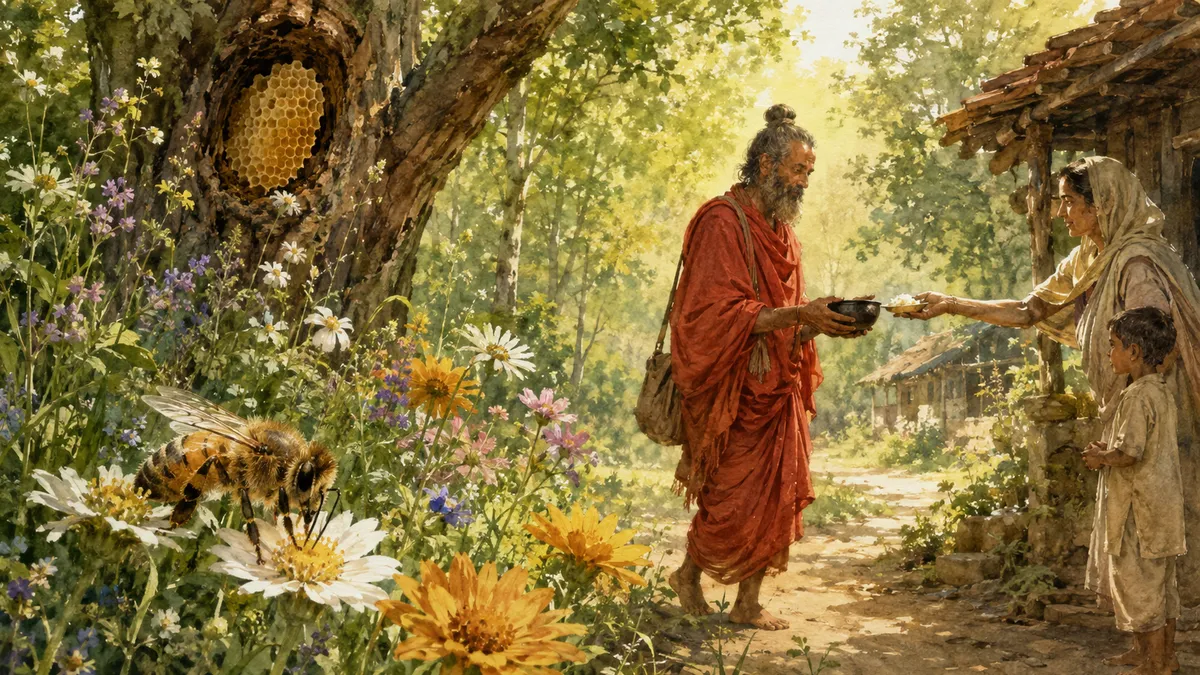
“From the honeybee I learned three things. The honeybee buzzes from flower to flower and nourishes its body. It continually draws a little nectar from each flower but does not cause the flowers to wither. In the same way, a muni should go to the homes of householders and accept everything without being importunate, content with whatever he is given. The bee gathers nectar from almost every flower. Like the bee, a muni should study all the sacred scriptures, skillfully and quickly grasping their essence and adapting them to his quest for the inner ‘Self.’ In addition to these two good qualities, bees possess a ruinous folly. They make honey and store it for future use, but a man plunders the entire stock after smoking them out and kills them. Instead of enjoying the wealth they have accumulated, they meet with ruin and death. Likewise, a muni should not store food for the next day; he should eat whatever food is available in the house and then continue on his way.”
This describes the behavior of a bee when studying teachings and the state of non-attachment for a sadhu. As monks, we do not accumulate anything; even if some possessions gather around us, we should not regard them as our own—they are considered the property of the sangha. In some monasteries, there is a tradition once a year whereby the monks bring and offer all the possessions they have accumulated, after which they determine who needs what. In this way, they fulfill their vow of non-possession, remaining without property. Then some things accumulate again, and a year later they offer everything once more.
We must not become attached to anything material if we wish to keep our vow of not possessing material property. We should accept gifts, but we should regard these gifts not as our own, but as the property of the sangha. Establish this attitude in yourself once and for all: even the sankhati and kurta belong to the sangha, so that you do not become attached and your mind may be at peace forever.
In fact, it is a great blessing not to be bound by material desires and not to own material property. Material property is a stumbling block in the material world and is considered something valuable. But we become monks in order to do the opposite, to rid ourselves of it, because our wealth is prana, pure contemplation and blessings, connections with deities and siddhas, as well as spiritual powers.
Once I met a well-known wealthy man, an oligarch. He said, “We oligarchs are crazy about the material world, while you monks are the opposite. It is very interesting.” I tried to explain to him the essence of the Dharma and the issues of non-possession, but he was unable to hear me. After a while, someone called him, and he said, “Excuse me, I have to run; I need to make millions.” I thought: all the millions are before you, billions are here, yet you cannot understand. What is the reason for this? A passionate craving for possession and great concerns connected with the material world.
By contrast, when we become monks, we have very few things—or at least we should have very few—and even the things we do have are common property that we use temporarily. We must possess this monastic spirit from the first day of our novitiate and throughout our lives. This is the assurance that our soul is free from material attachments.
Beyond Desire and Possession
The elephant.
“By studying the life of the elephant, I learned one thing. The elephant is a very strong and intelligent animal, and therefore it is very difficult to catch. Yet it is often caught by humans because of its lust. To capture an elephant in the forest, a pit is dug and covered with bamboo, mud, and grass so that it looks like ordinary ground. Then a decoy shaped like a female elephant is placed there, and the male is deceived by the decoy, mistaking it for a real elephant, and lustfully rushes toward it. When he reaches the figure, the bamboo gives way and the elephant falls into the pit. Seeing this, I concluded that one should stay away from women in order to avoid such a trap. Likewise, when an elephant follows a female and another strong elephant in a state of sexual arousal sees them, he tries to drive the other elephant away and fights him until one of them perishes. Seeing this, I concluded that even thinking about a woman is dangerous. This is as true for women as it is for men.”
The honey thief.
“Listen to the lesson I learned from the honey thief. Bees build their hive with great diligence. The honey thief plans to smoke out the bees and steal the honey. Thus the strong rob the weak of their wealth. Such is the world—just or unjust. Therefore, I learned from the honey thief that if a person is miserly and hides his wealth, neither enjoying it himself nor sharing it with others, he risks being robbed.”
Sometimes, when foreigners come to India, they experience a number of stresses and shocks. One of them concerns money, because Indians perceive foreigners as wealthy white sahibs. Since they are white, have come from rich countries, and had enough money to fly here, they must certainly be wealthy—so people ask them for money. Many people ask for money, and this can be surprising. They may be spiritual people, monks, sadhus, non-monastics, beggars—there are all sorts of possibilities. At first, this was surprising and even upsetting. Sometimes people came to India seeking spirituality but left with troubled minds, thinking, “They just want to make money off me; everyone here is a beggar or a panhandler—how can they be people of dharma?”
But in such cases I would say, “Understand that the culture here is different, and the attitude toward money is different. Money is not a sacred cow here; it is not something that people worship, as they do in the West. Yes, money is a divine power, but it should work for God and for the dharma, so asking for a little of this power so that it can work for someone is not considered shameful. Besides, making donations and participating in various dharma projects is a matter of prestige. That is why the attitude toward money there is more relaxed and free—you may donate if you wish, or not donate if you do not.”
But for many who come to India, this becomes a source of tension. For example, you agree with a taxi company that a driver will take you somewhere for a certain amount, you pay at the counter, and he drives you there, but afterward the driver asks whether you would also like to give him some money because he has a wife, children, and so on. A monk who was traveling with me became indignant and said, “Guru, do not give him anything. They all beg for money, they want to deceive you. This is wrong, it violates the agreement, it is unfair.” I said, “Yes, I know it is unfair and violates the agreement, but that is how our European minds see it; to them, it is normal. Besides, our task is to make people happy. Why do you not want to make this man happy for 200 rupees? Give him the money, and that is all.” If we simply shift our mindset toward the idea that we can make people happy, it ceases to be a problem.
There are other kinds of shock as well. For example, cultural shock, when you encounter an entirely different attitude toward the way business is conducted, the perception of time, and promises. How can this be? It is incomprehensible—but it is simply a different culture. You may also experience food-related stress when Indian food consists of the same dishes—sabji, dal, palak paneer, masala chai—three times a day, every day, and everything is so spicy that it is impossible to eat. You may also experience a shock related to everyday living conditions. The living conditions are not exactly bad; they simply do not exist. People encounter many different difficulties when traveling in India, and at first their minds refuse to accept them.
But when we see this as a way to deepen our faith, cut off hopes and attachments, and, behind it all, still recognize divine grace, we truly feel that we are becoming sadhus. For divine grace does not depend on such things. They may be present or absent, but this does not affect divine grace in any way, nor does it affect pure vision. Then we understand that we did not go to India for pseudo-spiritual pleasures, but to strengthen our faith and practice tapasya—that is why we went to India.
When Enjoyment Becomes an Offering
The deer.
“The deer brings purity and gentleness to the mind; its swiftness in running is astonishing, yet because of its powerful love of music, it falls into the hands of the butcher. The hunter’s music causes it to stand motionless and listen with closed eyes. From this I learned that if a hermit living in the forest were to succumb to music or dance, his downfall would be certain. Was it not because he was captivated by music and dance that the muni Rishyashringa fell into the trap set by a dancing girl? Thus I learned from the deer that one should not be deceived by music or dance.”
Except for music dedicated to God—bhajans—and dance offered to God. India is a land of song and dance because many gandharvas have been reborn there. For gandharvas, this is very natural; they are deities in the channels that, for example, are unknown to Europeans. When Swami Kailasanathananda came to the Advaita Vedanta Congress in 2010, I believe he gave a sermon, and then, during a break at the congress, a group of people or disciples gathered to listen to him. He said something and then added, “Well, now let us dance.” People had come in such a serious frame of mind to listen to Advaita Vedanta and the Dharma, and then they received such a proposal. But for gandharvas, this is normal, because for them dance is either a form of kama, enjoyment, or a form of offering to God, devotion to God.
Here, dance and singing are spoken of as kama: when gandharvas become absorbed in kama, their consciousness slips into such sensual pleasures. But if singing becomes a bhajan, a form of upasana, bhakti, or worship, and is accompanied by proper contemplation and meditation, then it is a path to liberation, a Tantric path to liberation that allows us to direct our energy toward the Divine Source.
There is a story. A Ukrainian delegation came to Cuba, and the Cubans asked, “Why can’t we create anything—no industry, nor build anything?” They were told, “Well, because you don’t work; all you do is dance, sing samba, and hold rallies for Castro and the revolution.” They asked, “So what should we do?”—“You need to start working somehow.” They thought about it and said, “All right, then we’ll start right now; we’ll hold a rally for work right now.”—“And you need to stop dancing samba.”—“Then we’ll call a rally against samba and for work.” They gathered, the rally began, Fidel Castro gave a speech and urged them to work; then they started rallying and dancing “for work” even more, and once again began dancing samba.
A mind attached to sensual pleasures turns everything to its own ends, but the art of Tantra consists in placing those very same attachments in the service of God. When we sing in the name of God, enjoy music in the name of God, and unite with the presence, this awakens the inner deities and becomes a genuine practice of liberation.
Curbing the Tongue and Inner Silence
The fish.
“O Yadu, know that of all the sense organs, the tongue is like an invisible thief. A muni practices severe austerities, abstaining from food and attaining control over all the sense organs. Yet they cannot control the tongue. It seems as though it could be controlled easily, but herein lies its trickery. Until the tongue is brought under control, the conquest of the senses is incomplete. If the tongue is neglected, ruin is difficult to avoid. Look at the fish: it has no flaw except the fickleness of its tongue. It is that uncontrolled tongue that makes it prey to the fisherman’s hook. Thus, by observing the fish, I learned the importance of controlling and subduing the tongue.”
Control of the tongue has two aspects. The first is control over eating. We must control the tongue by regulating our consumption of food and eating without greed. The second area is control of speech. We must control our speech, knowing what to say and when to say it, neither engaging in idle talk nor speaking without need. If we do speak, it should be to the point, about God and the Dharma; that is, our speech should not lead us into ignorance. We should be able to observe mauna vrata, the restriction of speech during a retreat, with ease. The most important mauna is in the mind. If our mind is calm and recognizes its source, then control of the tongue is also easy to achieve.
From Desire to Dispassion and Inner Happiness
A prostitute named Pingala.
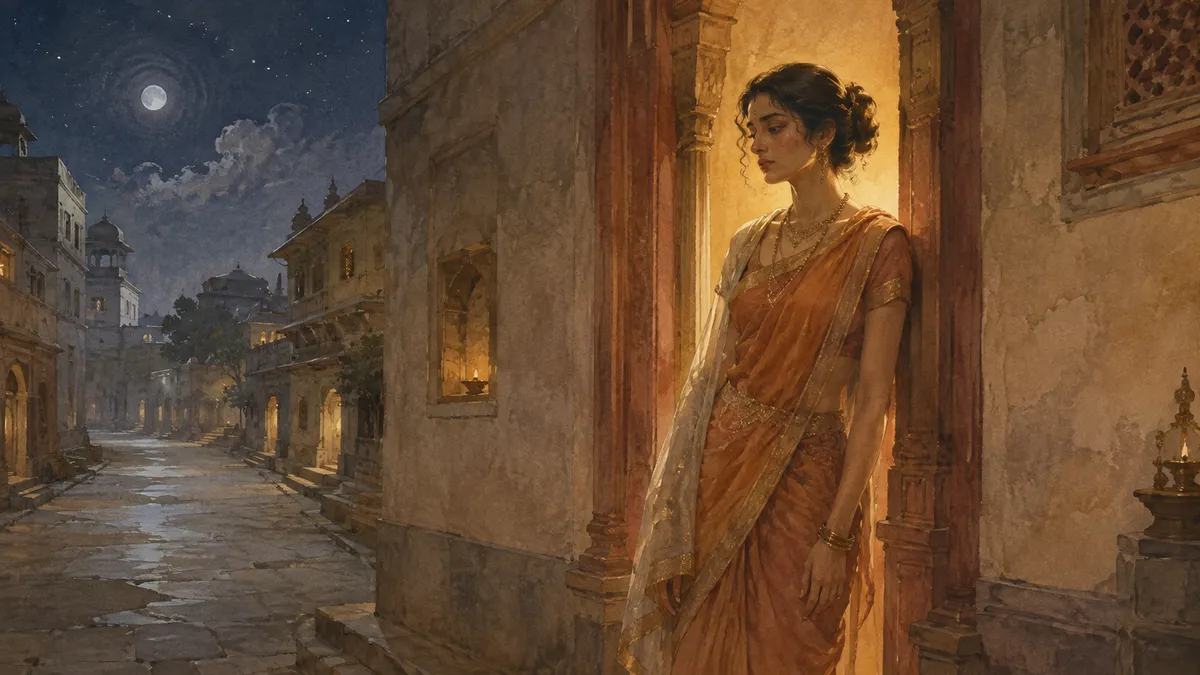
“Pingala was a prostitute. I learned from her as well. I will now tell you her story. In the glorious city of Videha, the capital of King Janaka, there lived a prostitute named Pingala. One day, she was overwhelmed by a desire for wealth and sensual pleasures. As usual, she stood in the doorway of her house looking for a lover, but without success. Not a single one appeared that day. She stood waiting for a very long time, her eyes intent and her desire strong. Night fell, her feet began to drag, and her weariness increased. Disappointed, she went inside, but her desire arose again. Therefore, she could not remain indoors and returned to the doorway. Thus, going in and out again and again, she became physically exhausted. Although midnight had passed, still no lover appeared. Truly, strange are the ways of the divine. As a result of her exhaustion, her passionate desire for wealth, as well as for sensual pleasures, gradually left her. She even repented of having sunk so low, and her lust vanished. Revulsion took hold of her. Without this restraint, attachment to the body cannot be lost, and the state of dispassion cannot be attained. By God’s grace, freedom from passion was kindled within her, and she began to look within herself.”
She reflected: “Shame on me! What madness! Fie, fie! Unable to control my senses, I was utterly miserable while waiting for some wretched man who lusts after women. Shame on this pitiful desire for someone to come and make me happy, while forgetting that God, who is Truth, who is eternal and unchanging, and who bestows happiness upon everyone, is close at hand. I imagined that if some base and unrighteous man embraced this body, I would find happiness—how wild my mind is! Oh, how deluded I was in contemplating this body and its beauty. What is its true nature? At the bottom are two legs like pillars; at the top are two arms; and there is a spine like a great beam connecting them, with ribs on either side resembling rafters, all of it covered with skin. There are nine doors, and what comes out of them every day is nothing but waste. How persistently I labored to beautify this thing called the body—what a fool I was.
How can I regard another person as my lover in this glorious Videhapuri, forgetting Achyuta, who is the form of my own Self, the embodiment of bliss, and inner peace? This beauty, these desires, and the gods who grant them—will they not all be destroyed by time and ultimately lose their qualities? What happiness can we obtain through love for these perishable things? For this reason, I will no longer allow myself to be deceived. Regarding Shri Hari, the benefactor of all and the essence of all things, as the one dearest to me, I surrender myself completely to him. Perhaps some meritorious deed performed by me in a previous birth has now borne fruit, and the company of some Mahatma helped it ripen and caused Shri Hari’s grace to descend upon me; otherwise, how could such a noble feeling have prevailed in a sinful person like me?
Moreover, did not all kinds of hardships beset me until this moment, after which detachment arose and brought about such tranquility? Therefore, since this discernment that has awakened within me is undoubtedly the grace of Shri Hari, I shall regard it as Shri Hari’s command, cast out every desire for sense objects, and surrender myself to him alone. Shri Hari alone can save people like me, who are ensnared by desires for sense objects, who blindly perish in the mire of samsara, and who have succumbed to the deception of the venomous serpent called desire. Shri Hari himself guides those in whom discernment has taken root and who, remaining vigilant, have attained dispassion. He alone is my teacher.”
Thus, when her dispassion became firmly established, Pingala attained extraordinary tranquility and peace of mind. Therefore, O Yadu, I learned from Pingala’s story that desires are sorrow, while freedom from desire is the highest happiness.”
Liberation
Dattatreya
Samaya
Atman
Samsara
Viveka
Brahman
Attachment
Sadhu
Prakriti
Author Гуру
Read 12 times
Articles
Vidya AI
Search
Lectures
November 1, 2026
Mantra of the day
ОМ НИТИМАТАМВАРАЙА НАМАХ ОМ Лучшему из нравственных – поклонение!
Auspicious Times(Rome)
Brahma Muhurta:
04:52 - 05:47
Abhijit Muhurta:
11:33 - 12:14
Sayam Sandhya:
16:45 - 17:27
Mokshada Ekadashi (6 November)
Ekadashi of liberation. Helps to achieve spiritual enlightenment.