Calming the Mind Through Contentment Based on the Yoga Vasistha
04.09.2026
0 мин. чтения
0
Share
copy
search
add
share
First, let us cultivate the right motivation, and then we will move on to the topic of “taming the mind” based on the text of the “Yoga Vasistha.”
When we listen to the Teaching, it is important to cultivate the following right motivation: we listen to the Teaching in order to learn how to tame our mind (the mind and the ego are one and the same), not in order to acquire certain mystical powers or material benefits—all this is secondary, because the root of all problems in samsara is the mind, the ego.
What does Advaita teach, and what do the saints teach? They teach us to tame the mind, the ego, through the discovery of our own nature. The goal of yoga is to tame the mind and free ourselves from ignorance and suffering. Therefore, when we listen to the Teaching, we try to cultivate the motivation that the Teaching will help us tame our mind in life. This is a very important topic—one might say the most important one.
Vasistha continued:
“The bliss that comes from the company of saints is incomparable to any other kind of bliss. The nature of a holy person is pleasant and peaceful, and his conduct and actions are pure; therefore, his company fosters peace and positive qualities in all who seek him out. In his presence, fear passes away, sins come to an end, and purity increases.”
Signs of a Tamed Mind
The sure sign of a jnani is a tamed mind. Taming the mind begins with the simplest things, but at a certain stage, a jnani—that is, a yogi—acquires the ability to keep his mind tamed.
What are the signs that allow one to say, “Yes, this jnani’s mind is tamed; his ego is tamed”? These signs are well described by Rishi Vasistha in the “Yoga Vasistha.” They are as follows: whatever clothes you wear, you are happy; whatever food you eat, you are happy. Wherever you may be—in America, Australia, Russia, or Europe—you are always happy in any place, even in Antarctica or the African jungle. Whatever situation you may be in, whatever your status may be, you are always happy. When you experience happiness in all these various circumstances, it can be said that your mind is tamed.
For example, whether you wear rich, beautiful clothes or rags and a loincloth, you are happy. Today you eat exquisite food, and tomorrow you eat meager, very modest fare—instant noodles straight from the can or something even simpler—and you are perfectly happy, perfectly fine. Whether you are in one place or another, in a metropolis or somewhere in the forest, in a village, or in the mountains, you are happy there as well. You are always happy.
For example, I am a country dweller, and when I come to Moscow, I feel a little like Crocodile Dundee in the big city. But in fact, I am fine in either place; there are no problems. Whatever situation unfolds, whether you are a boss or a subordinate, poor or rich, you are happy in any situation. When you are always happy, you have attained mastery over the mind. This is a truly important achievement.
You can practice different kinds of yoga and study different texts, but whether you are happy or not is the main and most important criterion in these situations. Yoga is not for yoga’s sake, and philosophy is not for philosophy’s sake, is it? If it does not become your life, then it is useless—it is merely abstraction, physical exercise. True yoga is beneficial when it becomes our life. Your yoga practice becomes successful if you are truly, genuinely happy in all circumstances of life.
The Principles of Yama and Niyama
There are the yogic principles of yama and niyama (yama is what must be followed, and niyama is what must be abandoned). The principle of santosha means contentment; the principle of shaucha means spiritual purity; svadhyaya means the study of sacred scriptures; tapas means austerity, ascetic practice, sadhana, or intensive external or internal sadhana; and Ishvara-pranidhana means trusting in God and relying on God throughout every day, year, second, and hour of one’s life. These are the principles of niyama: shaucha, santosha, svadhyaya, tapas, and Ishvara-pranidhana.
The principle of santosha (contentment) is a very important principle. Shankara also speaks of it, although he calls it vairagya (dispassion). Contentment means that we are content with the world, content with ourselves, content with life; we are happy. This is not dull complacency arising from the ego. It is true inner contentment, because you are in harmony with yourself, with the world, and with God. You are always content with everything; you simply radiate happiness at all times and sometimes are even forced to conceal it deliberately so as not to stand out too much. If you are always smiling among gloomy people, they may think that something is wrong with you. But you know that everything is “okay” with you.
The principle of contentment means that we have no grievances against the world, ourselves, or God. A discontented person always has a grievance against someone or something. They will find something to complain about; that is how consciousness works.
It is like a person who has stepped on their own foot: they are in pain and suffering, but they do not understand that they themselves are the cause of their suffering. Instead, they want to find an external reason for their pain and project their pain onto something. But because they lack understanding and remain in ignorance, they find various pretexts for their projections so that they can project this pain and suffering. Yet if you look closely, they are standing on their own foot, causing themselves pain and suffering.
The Nature of Discontent
Discontent arises because there is a rejection of the situation, and rejection of the situation arises from pronounced duality and weak awareness. When there is no clarity and awareness is weak, the situation constrains us and we fall under its influence. In reality, nothing can constrain us—no situation—but because of weak awareness, we become so caught up in the situation that it seems to us as though the situation constrains us. Then we have no choice and no responsibility—if there is no choice, we are not responsible, as it were. In reality, there is always a choice, and the responsibility is always ours. But in a state of ignorance, it seems as though there is no choice, and if there is no choice, there is no responsibility. Then we begin looking: “Who is responsible for this? Who is responsible for our discontent, for our suffering?” Alla Pugacheva, the president of the United States, oligarchs—anyone at all. We seek someone out; the mind simply runs through the nearest possibilities: “No, that is too far away, that is too far away. Ah! The neighbor is closer. My wife and children are even closer.” Then there is simply projection and an outpouring: the mind takes over, finds a specific target, and identification follows: “There it is, the source of my discontent.” But all of this is illusion, delusion, a dream.
The source of all contentment lies within and nowhere else. We ourselves are responsible for everything we experience, and we always have a choice—this is important to understand. One who is content understands this well. Above all, they rely on themselves in the sense that whether they are happy or discontented depends on them alone.
The Practice of Santosha
So what does santosha mean? Patience. To practice yoga means to practice patience; this must be understood from the very beginning. You must cultivate patience, exercise it, and endure when you dislike something or find it unpleasant; when others exasperate you; when you hear unpleasant sounds or words. Yoga is patience (titiksha), dispassion (vairagya).
Another principle that fosters contentment is being satisfied with little. This does not mean that you should narrow your consciousness and think, “I need so little; may there always be little.” No. Being satisfied with little means accepting everything that happens in its fullness, as though it were abundant.
A saint or yogi may live in a palace today if such conditions are provided, and tomorrow may live in a dugout, a hut, or even spend the night in the forest. But each time they encounter these circumstances, they receive so much from them that they are completely content. They are satisfied with what they have. Whether it is a palace or a hut, it is so much to them because they are filled with gratitude for life. To be content means always being filled with the greatest gratitude for life. Then a joy arises that does not depend on circumstances. This joy is unconditional; it simply comes from within because it is our very nature. But if we lack contentment, then even while living in a magnificent palace under wonderful conditions, we will find a way to be discontented. We will always find a way.
A man in the West sued God. He said, “Since God promised happiness and eternal life to those who turn to Him, and I have repeatedly attended church, taken part in services and prayers, but have so far received neither eternal life nor happiness, I have a grievance. As a consumer of the service provided by the church, I am dissatisfied.” The court refused to accept the lawsuit because the defendant’s address was unknown.
Another man, a lawyer from America, sued his parents. He argued that life contains suffering, old age, illness, and death, but when he was conceived, he was not warned about this, and he had a major grievance against his parents. Why is that? He does not want any of it.
These are examples of the most absurd forms of dissatisfaction, but we see dissatisfaction everywhere. So many conflicts, quarrels, crimes, and wars occur simply because people lack contentment. If they had it, perhaps there would be no world history filled with suffering and wars.
Dissatisfaction arises because a person cannot control the mind. If the mind is controlled, if the mind is subdued, then contentment (santosha) arises naturally, always and by itself.
Signs of Contentment
The signs of contentment are humility, an effort to be humble, and pleasant, harmonious speech. You have no malicious words, attacks, criticism, abuse, or slander directed at others. There is a light sense of humor, especially toward your own ego, when you see all its games but do not give in to them in any way. You think, “Go on, then, ego, keep playing.”
When there is contentment, you rely on yourself because you know that you yourself are the source of everything; you do not rely on others. When there is no contentment, the feeling is, “Everyone owes me,” but when there is contentment, you think, “I am the one who owes everyone.”
You feel responsible for the fact that others suffer; that something is wrong in their lives; that they are ill; that they lack material resources; that they lack understanding. You feel compassion, even a sense of helplessness because you cannot help others understand this. But when there is dissatisfaction and the mind is not subdued, such a person always has grievances against the world; their position is, “Everyone owes me. I am the most important one.” These are fundamentally two different positions.
Contentment is the position of a jnani, a yogi, whose mind is gradually being subdued. Dissatisfaction is the position of a samsarin, an ordinary person, a karmically bound person; one who is strongly influenced by maya; whose mind is heavily conditioned.
Self-Sufficiency and Dependence
One who abides in santosha, who is content, relies on themselves because they have learned to rely on themselves; they have discovered within themselves an unlimited potential for contentment. They know, “I am responsible for all my choices, for all my actions. This is my world, my life; I depend entirely on myself. I do not depend on anyone.” A dissatisfied person is dependent; they are always dependent on external things, on their own desires and selfishness. This is precisely why they project their expectations onto the external world and other people and adopt the position that “everyone owes me.” In fact, this is the attitude of a loser in life.
A contented person, by contrast, is completely self-sufficient, inwardly free, and their position is: “No one owes me anything; I am the one trying to give something to others because I feel morally responsible for doing so.”
One who abides in contentment and relies on themselves understands that the entire world is a manifestation of consciousness. The world is a projection of consciousness. Everything depends on you, not on others, not on others at all. And even if another person causes you suffering, you must understand that it is evidently your consciousness that paints such pictures in the subtle world, and these pictures materialize again and again. Clearly, the problem lies first and foremost in your consciousness. When your consciousness changes, that person will disappear.
Our consciousness itself chooses different versions of reality, different reality tunnels, and glides through them. It is like a worm inside an apple, crawling through different tunnels and revealing different versions of reality (if we imagine the universe as such an apple). Consciousness crawls like a worm inside this apple, and every turn reveals a certain version of reality.
Acceptance and Rejection
The state of contentment arises through accepting everything; any situation is accepted with gratitude as a particular lesson in the maturity of spiritual life, or even as darshan, as divine Shaktipat. In a state of discontent, there is always a very sharp, rigid rejection of the situation. The more strongly we reject a situation, the greater our discontent becomes, while the situation still refuses to obey us: it continues to unfold, and our discontent keeps growing. Then anger and aggression arise, along with the desire to change the situation by force at any cost—this too is a powerful manifestation of discontent. Once again, the world has failed to become the way we want it to be.
People often do not understand that the world will move according to its own laws; it will not be the way we want it to be. Never. It is beyond our control; it was created by higher energies. One who understands this abides in contentment and accepts this world in all its manifestations. Such a person has willpower and can change certain things in this world, but no matter how the world manifests, they respect it; they respect any turn of events. But if the mind has not been subdued, a person always wants the world to be the way they wish, and when the world is not that way, strong rejection arises. One who abides in contentment is truly a person who has subdued their mind; they move through life carefully, harmoniously, and with ease, without taking harsh actions.
The Example of the Prisoners
There is a secular film called “The New Land.” This film is about prisoners and a UN experiment. When prisons became overcrowded, it was decided, as an experiment, to take all the prisoners from the prisons—several thousand, perhaps, or several hundred—send them to an island, to a new land, and release them. There was nowhere to escape anyway—the ocean was all around, and the island was monitored by helicopters.
The prisoners were brought there and told that this was an experiment and that their imprisonment would proceed in this manner. They were told, “Now you will be released.” When they began freeing themselves, a fight broke out. They immediately began competing and feuding with one another, and after a while, half of them had killed each other.
It would seem that you are free and can at least live your own life. They were given freedom, but they were unable to make use of it because there was so much aggression and hatred within them. This hatred and aggression obscured the new possibility that they could live independently and make a wonderful life for themselves on the island. This is an example of how discontented people with unsubdued minds behave.
If you were to take a thousand saints and place them somewhere, then whether a day, a week, or a month passed, those thousand saints would remain equally content, joyful, and harmonious. They would have no problems; no one would quarrel with anyone else, no one would be offended, and no one would confront others to settle disputes. There would be peace and grace. Even if the place were not particularly beautiful, when you entered it, you would sense a special fragrance, a scent as though it were paradise. This paradise would be created by the minds of the saints because they have excellent control over their minds; their minds are completely subdued. They would serve one another, meditate, simply abide in silence, and communicate, but most importantly, within them there would be santosha, joy, tranquility, and peace. You would feel it immediately.
But what if a thousand people whose minds have not been subdued were placed together for a month? Within just a week, mortal enemies, aggression, rejection, and confrontations would emerge because when the mind has not been subdued, there is always a tendency to project one’s inner difficulties and problems onto the outside world.
Living beings live in the cage of their narrow ideas, and these narrow ideas dominate them. Because such ideas prevail, they are unable to be flexible and appropriate or to accept any situation. When there is no acceptance, clinging, fear, or hatred arises. All of this can be overcome through the practice of subduing the mind.
The State of a Liberated Sage
Vasishtha said:
“The liberated sage is not concerned with the events of the past, present, or future; he observes the state of the world with wonder. Constantly engaged in actions appropriate to the occasion, established in the blissful middle ground between extreme and opposing points of view, he lives free from every kind of conditioning.
He is established in the supreme state of all-acceptance and therefore is neither troubled nor agitated by events in the world. In any situation, he remains neutral, yet he is endowed with compassion and respect for all, while remaining untouched by the apparent world.
If someone starts a conversation with him, he responds simply and appropriately to the situation; if no one speaks to him, he remains silent. He seeks nothing and hates nothing; the world does not disturb him. He says what is true for everyone and, when asked, convincingly explains his point of view.
Remaining calm and dispassionate at heart, he looks upon the world with wonder. Such is the state of the wise who have attained Liberation in this very life.”
The Necessity of Taming the Mind Before Studying Advaita
Before we embark on the philosophy of Advaita, we need to cultivate certain qualities, learn contentment, and learn to tame the mind. Because a person who has not learned to control and tame the mind is, as we have said, a failure spiritually and in life in general. It is difficult for such a person to make their way through life; they have constant problems. In fact, problems do not exist anywhere; there are no problems anywhere at all—only in the mind, only in consciousness, within us. But such a person believes that these problems are objective in nature. If they changed themselves and opened up a space of contentment within, their life would also be wonderful, and they would never have any problems.
If a person abides in contentment (santosha), then at their center are God, awareness, and contemplative presence, and they serve others. A contented person controls their mind and tames all its impulses; they do not allow their mind and ego to tyrannize them.
Our ego’s favorite trick is to convince us that the ego and we are one and the same. The mind says, “I am you”; the ego says, “You and I are one, which means that whatever I want, you must want too.” This, of course, is the ego’s deception. In reality, we are not the mind, nor are we the ego. This favorite trick results in our mind remaining untamed and our experiencing discontent.
The path to attaining contentment is discriminating wisdom and self-inquiry (vichara). When discriminating wisdom arises within us, we can distinguish the ego and the mind from pure Consciousness and understand that the key to contentment is to abide in pure Consciousness and contemplative awareness, constantly feeling our way toward and recognizing this pure Consciousness. But abiding in the ego and the mind is the key and the path to discontent.
The World as a Projection of Consciousness
One who abides in a state of contentment (santosha) understands that the world is a manifestation of their consciousness; that everything depends on them; that everything around them is their own self. Through projection, you yourself create various situations and then find yourself in them. Accordingly, everything depends solely on you. Therefore, one who is content always relies on their inner awareness and has little or no dependence on external things. Because they rely on what is within, they never experience discontent arising from desires or dependencies. They know that their consciousness is the source of everything, a magical, mystical stone, a precious elixir from which anything can be obtained. Even if something unsatisfactory occurs, such a person simply regards it as a consequence of their own shortcomings. They always look for shortcomings within themselves rather than in the situation.
There is a saying: when a stick is thrown and flies through the air, a dog looks at the stick, whereas a lion looks not at the stick but at the person who threw it. One who abides in contentment is like such a lion. They do not look at the effect; they look at the cause and see that there is no external cause. There is not a single cause outside; there are only internal causes.
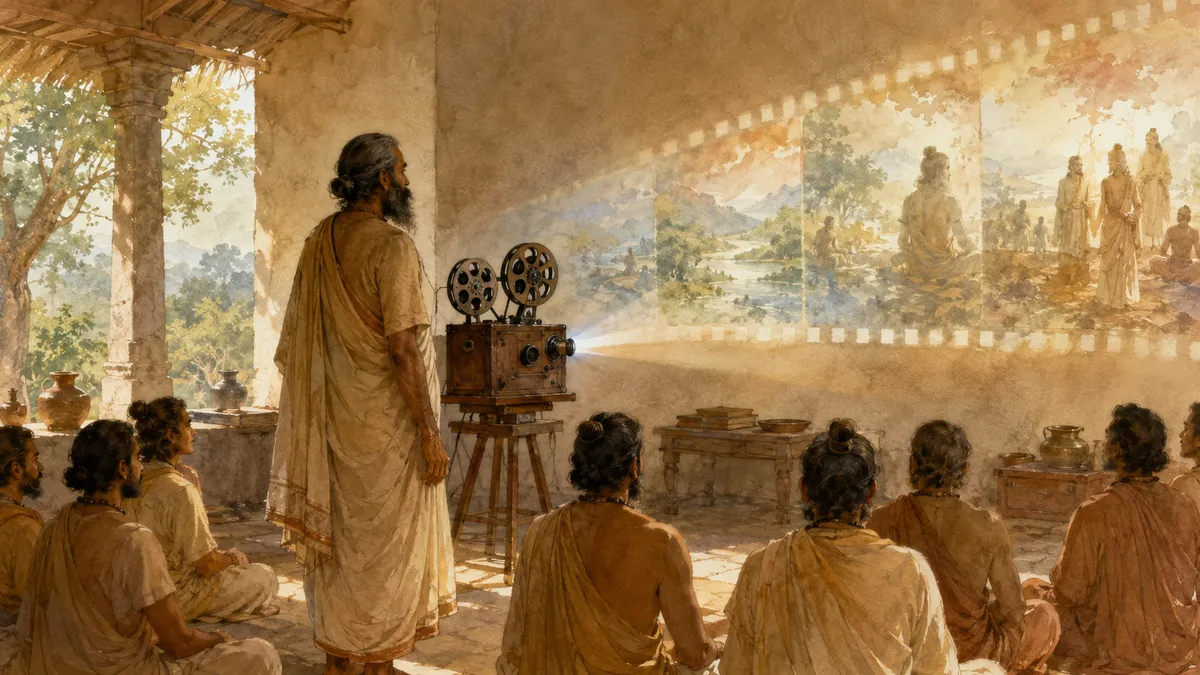
What is the world? The world is the successive unfolding of subtle karmic imprints from the stream of consciousness. The world is created by consciousness, just as a film is created by a projector in a movie theater. The frames on the film reel can be likened to vasanas and samskaras—karmic imprints. These karmic imprints simply unfold; they constantly project the world around us, frame by frame. That is what the surrounding world is. This is what the rishi Vasishtha says, what Saint Dattatreya says, what Shankara says, and what all the saints of Advaita Vedanta say. It is very important to understand this truth.
What is happening around us is not an external, objective reality; it is a subjective reality that only appears to be external. It is as though there were a movie projector inside us, in the center of our head, with the eyes serving as lenses. The inner Light, together with vasanas and samskaras—that is, images of the subconscious—is simply projected outward and creates this world. That is what reality is.
What is projected depends on our attitude and our awareness. The world depends on our consciousness. By changing ourselves from within, we change the world—that is the law. One who has pacified the mind knows this secret, while one who has not pacified the mind does not. First, they project reality, and then they become angry with it, become attached to it, shake their fist at it, without realizing that this reality has been projected from within, from their own self.
Positivity as a Natural State
One who abides in contentment (santosha) is always positive. Positive thinking courses are very popular today. In fact, I believe this is very important. It is a direct teaching of the principle called “santosha.” You must learn always to be positive, always to think positively—absolutely always—because not thinking positively is like an anomaly, like something wrong and distorted, like a violation of cosmic law. We are inherently positive; our Source—God—is inherently positive: Life, Being, and Existence are inherently perfect, pure, beautiful, and positive. If we are not positive, it means there is something wrong with our perception. Perhaps it is connected with our past lives, but something is wrong, and it must be corrected.
A person who abides in contentment is always positive; a saint is always positive. Angels, siddhas, and devas in the heavens are always completely positive. Even if something negative happens near them due to the karma of other people, they respond to it positively as well. This is because they have pacified their minds, and the mind within them is under control; it projects only a pure, positive, wonderful, beautiful reality.
When you are completely positive, you are filled with respect and gratitude toward this world. You see that the world is divine in essence, but there are many other souls who do not understand this, and they can be helped. Then a tendency to serve others or to serve this world arises—not because you are obligated to do so, but because it is natural. It is natural for the sun to shine and for the wind to blow. For one who is firmly established in contentment (santosha), who has pacified the mind and become established in the Higher Self, it is natural to serve the world, to serve the Universe, and to serve others.
The State of Dissatisfaction and Its Consequences
If a person is dissatisfied, they have a major inner problem that stems from past lives, from accumulated imprints, samskaras, vasanas, and impulses. They lack the power of discernment needed to understand this; they do not see it and are half-blind. They then become heavily dependent on the external world and adopt this attitude: “Everyone owes me something: my wife owes me this, the government owes me that, my boss at work owes me this, the world owes me that, God owes me this,” and so on. They are in terrible opposition to the world and to the Universe, and their consciousness constantly functions in this way.
So what happens then? He attracts the corresponding universal energies. In other words, it is like the consciousness of a hungry ghost (preta), and the universal energies respond; they react, they are bound to respond, and he constantly finds himself in those tunnels of reality where he is always dissatisfied. Then he thinks, “See! I told you, that is how it is.” He shifts himself into such universes, such tunnels of reality, and then experiences them, without understanding the secret that everything depends on him, on his own consciousness. He then becomes a sufferer, a failure, experiencing limitations and delusions. He is deeply confused; he believes that God has wronged him, that life has wronged him, that other people are limiting him, or that such is his fate; or he looks for some hidden catch everywhere, believing that no one values or respects him. A contented person seeks neither external respect nor appreciation; he does not strive for self-affirmation. It is enough for him that he respects himself, and when he respects himself inwardly, it is also visible outwardly; it is projected outward. To respect yourself means to understand that you yourself are God within, and that you infinitely respect God within yourself, and you respect God in others.
A dissatisfied person is constantly inclined to blame others and often lapses into negativity; he has no positive, pure vision. The one who is content, on the contrary, becomes established in an ever deeper and deeper pure vision.
The one who abides in contentment places inner awareness, God, at the center, while the one who is dissatisfied places himself at the center. He ignores others, he ignores the universe and the world, while his ego is very large; he attaches enormous importance to the ego, and then a great dissonance arises. He constantly tries to make others appreciate and love him; he tries to assert himself. He constantly flaunts this, saying, “Look how important I am. Love me, give me at least something.” This is also called the “poor little me” state.
When practicing yoga, you cannot be like that. You cannot be “poor little me,” especially when studying Advaita. You must respect yourself and rely on yourself, and then the Universe will also begin to respect you.
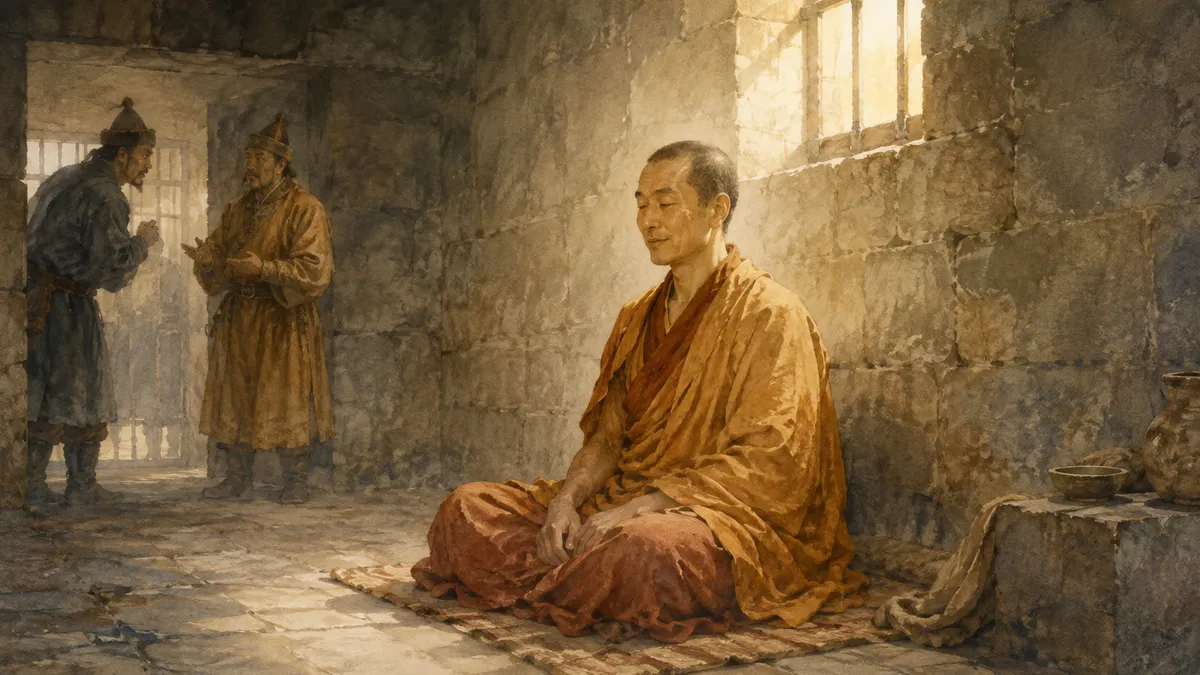
There was an incident in Tibet when Tibet was occupied by the Chinese. After some unrest, the Chinese police imprisoned a Tibetan Teacher. The guards would come and say, “You are such a scoundrel, such a bad person,” insulting him in every possible way and trying to provoke him and get on his nerves, but he merely smiled. Several days passed; they saw that this tactic was not working and began to say, “You are such a saint, such a great person, you are so wise,” and again he smiled. They said, “Nothing seems to affect you. We insult you, then we praise you, but you keep smiling. Why is that?” He replied, “Well, I know who I am.” What problems could there be?
When you are content, when your mind is pacified, you know who you are, and you do not need to listen to others to find out who you are. You know it yourself; you are self-sufficient.
The Ocean of Awareness as the Source of Contentment
When a person abides in contentment, he is like the ocean. The ocean is within you; it is always there. The source of contentment is this ocean of awareness. You must always seek it and rely on it. The one who has pacified his mind comes from God; he is born anew from God and lives by God. The one who has not pacified his mind lives by the ego.
There was once an incident during the Soviet era when a Christian priest was discussing the origin of man with Khrushchev, the General Secretary of the Communist Party. The priest said that man came from God, while Khrushchev said that according to Darwin’s theory, the theory of evolution, natural selection, and mutation, man descended from the ape. They argued and could not reach an agreement. Finally, seeing Khrushchev’s position, the priest decided to end the argument. He said, “Very well, then let us not debate. Let each of us retain his own view. Let each of us keep believing what he believes. I came from God, and you, evidently, came from the ape.”
The monkey is an example of the ego. The ego is always like a monkey, and when our mind is not subdued, we belong to the monkey lineage. But when we are positive, have subdued the mind, and have trained ourselves to be content and filled with gratitude toward the world, then we are born and trace our lineage to the divine, to the Supreme Source within us, to the ocean within us.
One who is in a state of discontent, who belongs to the monkey lineage, is always full of grievances. It does not matter toward whom or what, but this grievance is an expression of dissatisfaction. By contrast, one who has attained contentment (santosha) is always grateful. Love, gratitude, and unmotivated joy are the blossoming, the fragrance of their inner contentment, because within them this source, this ocean, is always open. They are so overflowing with this source that there is nothing more to desire.
Advaita teaches the subduing of the mind and ego through the discovery of one’s own Nature. The mind and ego will submit only when we discover our own Nature; there is no other way to subdue or bring them under control.
Pure Vision and Divine Play
When things happen that you dislike or consider wrong, do not rush to suffer, take offense, or become ambitious; it is better to smile, inwardly or outwardly offer namaste, and if there is an irritated person nearby, you can simply say, “Bless me.”
If you manage to see God in everything, you will experience a breakthrough into pure vision. Pure vision is the next stage after we have attained some contentment and subdued the mind. Pure vision means that we see the world as divine. We see that everything is divine play (lila); through situations, lessons and darshans come to us, or perhaps the severing of illusions or hopes; through people, gods and deities (devatas) act. This divine perfection, these lessons and darshans, manifest through everything that happens. If we have sufficient wisdom, we will recognize these darshans and always be grateful for them, because through all of this we mature and grow spiritually.
One should never lose contentment when something manifests. Why? Because even logically, it makes no sense. When something happens, it is karma; it is our prarabdha karma being realized. What we accumulated in the past is now returning. It had already been planned within us and remained there for years and hundreds of years, and now a suitable situation has arisen, and it has unfolded. There is no point in being upset about it; the causes were created earlier, long ago.
Second, from the perspective of Advaita, the world is a manifestation of our “Self,” our consciousness. Since everything is a manifestation of our consciousness, there is no point in suffering or being upset. One may, of course, consider how to change one’s consciousness so that the world manifests differently.
Third, the world around us is divine play (lila); we only need to recognize it. If we are discontented, we will not recognize this lila, but if we are content, we will.
Fourth, “Everything that manifests is an illusion,” Advaita tells us; the rishi Vasishtha and Sri Shankara say the same. It is a dream, it is an illusion—we must never forget this. Brahman is transcendent, the entire world is only Brahman, and everything that happens is an illusion. “Brahman Sat, Jagat Mithya,” say the Vedic scriptures.
Everything that happens to us is as if you were asleep, dreaming of a city in which something was happening, while your body remained lying on the bed the entire time. Nothing is happening. If there is a sleeping person and someone who is awake, and the sleeping person dreams that dogs are biting them, the one who is awake will not feel too sorry for or worry about them, because dogs in a dream cannot truly bite. Pain in a dream cannot cause real suffering, because the city in the dream, the dogs in the dream, and the pain have the same nature as thoughts and consciousness. It turns out that they are biting themselves with their own thoughts. Their thoughts, in the form of dogs within a city made of their thoughts, bite a body made of their thoughts. They are biting themselves, and there is no point in worrying about such a person—they are amusing themselves in a dream and can only be awakened. But this material world is the same; it is simply denser.
This world is also like such a dream; it too consists of consciousness, and everything that happens to us is a projection of our inner reality. If a dog bites you in the street, know that this dog was generated by your consciousness. It is your own consciousness that has bitten you. Why was it generated by your consciousness? Perhaps there was aggression within you, and you attracted these forces, which manifested in the form of a dog.
Whatever happens, a yogi practicing sadhana regards it as spiritual practice, according to the principle that “everything can be used for spiritual practice.” If something good happens, it is practice; and if something unpleasant happens, that too is practice—for example, the practice of cutting off attachments or hopes. It is all practice given to you by the Supreme, and it depends solely on you whether you go through this practice with dignity or forget that it is practice and fall into a state of dissatisfaction.
True Spirituality and Taming the Mind
In fact, it is not so important which Teaching a person practices, which religion they follow, or what they profess. What matters is how well they have managed to tame their mind and how spiritually pure they are. This is because all religious paths lead to taming the mind. When the mind is tamed, divine reality gradually reveals itself and gains the upper hand. But it often happens that people outwardly profess a religion, while everything remains superficial and formal. They regard it as scriptures or rituals, but do not search deeply within and do not strive for contentment. Then religious beliefs, philosophy, and ways of thinking also become ways of dwelling in dissatisfaction, ways of suffering.
We often see numerous national and religious conflicts and wars—all of this is a consequence of accumulated aggression and dissatisfaction. But where did this aggression and dissatisfaction come from, and why did they accumulate? They accumulated because one people holds grievances against another. One people—an entire nation, for example—sincerely believes that someone else is to blame for its troubles: another people, another country. This is how it sees things. When an entire people sincerely believes this, what is there to prevent it from launching large-scale military action? But in reality, this is not the case at all. Who prevents these people from loving, creating, inventing, being enterprising, and astonishing the world with their creativity, harmony, art, and scientific achievements? No one prevents them—only the mind, only limitations.
The Search for External Enemies as an Obstacle to Prosperity
When there is no clarity, no discriminating wisdom or understanding, even large masses of people become possessed by the thought that we suffer and are constrained because the Americans are to blame, or the Arab world is to blame, or the Jews are to blame—so that, apparently, is the source. It does not matter who; these are merely examples. But what prevents you from becoming a flourishing, inventive, creative nation and doing everything yourself? What prevents you?
A people and a nation become successful, flourishing, inventive, and creative when they understand that there is no need to look for any external enemies—it is all a futile pursuit. One must turn inward and seek the source of contentment (santosha). One must tame the mind, tame selfishness, and then unlock the potential of one’s various creative powers, manifesting it from this ocean. For as soon as we attain contentment, as soon as we discover the inner source within ourselves, it is as though we have found a beautiful, extremely precious diamond from which various powers emanate—creative powers. They can be directed toward anything: new technologies, science, culture, art, or solving economic and social problems, and then everything will be wonderful. A people that succeeds in doing this becomes a leader, a passionate driving force. It becomes a creative people of passionate pioneers, geniuses, talents, creative individuals, and godlike human beings.
Those who fail to do so take the position that “everyone owes me; all nations owe me; the UN owes me; I must be given credit; I must be given a loan.” This is the state of a dissatisfied hungry ghost. Such a people will never rise from its knees; it will always remain in the position of a dependent. It will always be dependent, always seeking the causes of its own failures in the machinations of a world government or anyone else, but never within itself, because it has even forgotten that it possesses an inner potential that simply needs to be awakened. Nothing is required for this except to turn inward and learn to distinguish the mind and the ego from the inner ocean of awareness.
Santosha as the Foundation of Spiritual Practice
Advaita is Yoga, Jnana Yoga. This means that only a yogi can practice it. The qualities of a yogi begin with our attempt to cultivate contentment (santosha) within ourselves as a principle of niyama—a very important principle.
If you feel that you do not have such contentment, you should not immediately begin practicing yoga, Enlightenment and Liberation practices, techniques, pranayamas, or asanas. Why? Because if you begin practicing in a state of discontent, that discontent will open up your subconscious, and the flow of vasanas and samskaras—that is, karmic imprints from past lives—will intensify. The speed of this flow will also increase, and your discontent will become even stronger; it will continue to grow, and your spiritual practice will make you even more dependent, even more dissatisfied and distressed. Inner stress and aggression will accumulate within you. Ultimately, you will conclude that yoga does not help but, on the contrary, only makes things worse. First, you need to try to cultivate the quality of contentment (santosha) within yourself.
In ancient times, holy Teachers placed great emphasis on ensuring that disciples first spent several years cultivating the quality of contentment within themselves. You do not necessarily have to practice pranayamas and asanas or meditate; you can simply saw wood or mow grass, but do so with gratitude, with wholeness, without any problems, remaining present in the current moment without limitations, grievances, or ambitions. When a disciple attained this inner wholeness and contentment, the Teaching, secret techniques, meditations, asanas, pranayamas, visualizations, and so forth were transmitted to him, because he had matured and fulfilled this principle of santosha.
If you want to understand what this is, simply try to pay attention to those who have succeeded in it, who are truly content, who radiate joy in life and gratitude toward the world; who are humble and depend on nothing; who try to help others more than themselves; whose attitude is not “everyone owes me,” but “I owe everyone.” If you find such people, you should pay attention to them and learn from them, try to understand their train of thought, their way of thinking, and their worldview; then try to discover the same thing within yourself.
Signs of a Pacified Mind
Contentment will give you great humility. This humility will arise from your inner wholeness and your respect for all the divine energies in this world. When this happens, it is called “pacification of the mind.” One day, you will discover that your mind has been pacified. Whatever clothes you wear, you are happy. Whatever food you eat, you are happy. Wherever you live, you are also happy. Whatever situation or status you find yourself in, you also feel wonderful, and you are happy. Such happiness will come from within; it will not be conditioned by anything.
This state means that you are very close to sahaja samadhi, to Enlightenment. You become a channel of God; your ego has stopped tyrannizing you, it has been pacified, and you have discovered this Source within yourself.
There are very few examples of such contentment in the world. As a rule, it is demonstrated by saints, not ordinary people. An ordinary person will always find a reason to be dissatisfied, but if we want to practice the path of Advaita Vedanta, we must follow the path of holiness.
If we meet some “star” or a person with many whims, such a person can easily become dissatisfied over a trifle. He booked a six-star hotel and a “luxury” suite, but he was given five stars—what an insult! He feels offended, but that is merely a pretext. In reality, there is great insecurity and discontent within. You can place a saint in a hut, and he can live and sleep in that hut, or he can live in a palace, yet there is no discontent whatsoever. Everything he does is, rather, a game for others. He himself is content with very little, and when more comes, he accepts that as well, rejecting nothing and showing no preferences.
Question: You say that one should always be positive. Why does the path to Enlightenment, to nonduality, lie through the positive rather than the negative, since from the standpoint of nonduality they are one and the same?
In the Absolute, of course, there are no such concepts as “positive” and “negative.” When this is said, consider it simply a manner of speaking. In the Absolute, all of this is merged into one. Yes and no, good and evil, past and future—all of this is merged in the Absolute. This oneness is total positivity; it is a kind of positivity that includes even the negative. And when we say that one should be positive, this does not mean superficial positivity, such as putting on a cheerful face. No, it is deeper than that. It is a kind of positivity that encompasses duality: the negative, the bad, and the good—it includes everything.
This is not a positivity that divides things into good, evil, bad, and favorable: “I accept the good and reject the bad.” No, it is a kind of positivity that flows from natural awareness. When I am aware, I act from the Source. This Source is the source of the superpositive, the source of self-perfection, the source of all that is best. But this awareness can unite with both the bad and the good. When things are good, that is good; when they are bad, that is good too. The positive is good, and the negative is excellent as well. That is what was meant.
But it is still better to begin with a positive state, because if you try to apply nondual awareness right away while remaining in a negative state, you may awaken forces within yourself and in the Universe, and they will come if you have summoned them. You may be unable to cope with them.
It is important to understand that the world becomes what you conceive it to be in your thoughts. Indeed, in the tantra of the siddhas and the yoga of the avadhutas, there are practices in which contemplation is united with negative things: pain, fear, horror, and obscured states. These are the so-called “dog-and-pig” and “crazy wisdom” practices, but they are suitable for great saints, not ordinary people. Ordinary people should not do this, because they will be unable to unite with and contemplate such situations. It is like a world record holder who can lift a three-hundred-kilogram barbell and can lift it every day during training. But if you are a beginner, you should lift eighty kilograms at most.
Question: You said that one should not practice yoga until one has attained santosha. Is it possible to attain santosha and practice yoga simultaneously, since, as you said, it is difficult to attain santosha completely?
Yes, I think these should be done in parallel. You have to start with what you have and try to attain at least a little santosha. Of course, it is simply unrealistic to attain the santosha of a saint or siddha right away. You have to start with something small, but at least strive for it and direct your mind toward it. If we express our intention (sankalpa), it will lead to santosha beginning to unfold within us. When we practice yoga, we should not overemphasize technical practices until we have attained at least a minimal degree of santosha and awareness.
The Principle of Samyoga in Spiritual Practice
Every object and situation has its own specific magical weight. Suppose this object is eight hundred units, while my consciousness is one thousand—that is, my santosha, my positivity, and my awareness amount to one thousand. Then I can take this object of eight hundred units and dissolve and integrate it without any difficulty, with another two hundred units remaining in reserve. This is, of course, a conventional illustration, not a literal one.
When my consciousness is sufficient to unite with a particular situation, and the power of my santosha is higher and stronger, this is called samyoga—equilibrium. In other words, I have effortlessly accepted a particular situation, and as a result of uniting with it, everything is harmonious, the cosmic law is observed, and deities appear.
Our task is to live so that there is always and everywhere samyoga, harmony, and equilibrium. Every yogi must know their own boundary and measure. There are energies they can accept, and samyoga will be attained through the power of their awareness and positivity. But there are also situations they may accept without attaining samyoga, and they must stay away from those situations.
Working with Karma
Question: How should I deal with karma that was formed before I was born? I cannot understand whether I am projecting this situation from my own consciousness or whether all I can do is leave this situation because the karma was formed earlier.
Whenever there is karma, it is always a projection from one’s own consciousness. This karma was formed earlier through actions and thoughts, especially thoughts, since thinking is more important than actions. If you do something with good thoughts and motivation, the imprint will also be good.
What can be done about this karma? You cannot do anything about karma—that is precisely the point. It exists; it is a given, so what can you do with it? It will manifest, and this cannot be stopped. But you can develop awareness, qualities, and clarity, and when it manifests, you can simply distance yourself from it—for example, by observing it. Karma manifests, while you observe, and what would have affected you before will no longer affect you; you simply smile. Or you can change your attitude and accept this karma with pure vision. Karma manifests, but for you it is like a blessing, like darshan: “Let it manifest; I will accept it with ease.”
Suppose that, according to the law of karma, your wallet was destined to be stolen on the subway. When that karma manifests, you can observe the moment when the wallet is gone and remain aware, can you not? You may think: “This is darshan, this is a blessing. My attachments, my clinging, my material attachments are being cut away so that I do not hold on to them so tightly.” This is how you can work with karma, and then the impulse, the imprint, the samskara has played itself out and disappeared.
When a high state of “one taste” has been attained, such a yogi can use the spiritual practice of samskara-shuddhi to go deep into the subconscious and purify karma. Karma can, of course, be changed and purified, but to do so, one must be able to look into one’s subconscious.
Mental imprints (samskaras) reside in the space of consciousness, in chitta, which is also called karma-vishaya—the repository. Chitta is the repository of mental tendencies. If you can penetrate deep into your subconscious and purify these mental imprints, then you can purify and change your karma, provided you can meditate well. There is a practice for this called samskara-shuddhi, and anyone who wants to learn how to change their karma to some extent can study this practice. I often teach it, and the monks perform it collectively once every three months. It is like taking a film cassette containing a movie, erasing some of the frames, and drawing the ones you need.
The Role of Philosophy and Skillful Knowledge
Question: You said that developing the intellect does not lead to Enlightenment. Why, then, are philosophy and other secular disciplines taught in your monastery?
These are preliminary practices, a means of developing the necessary qualities.
Nothing at all leads directly to Enlightenment—not even yoga. No method leads to Enlightenment. No logical knowledge, no philosophy, not even Advaita philosophy, leads to Enlightenment. Nothing expressed at the level of the mind, nothing done with effort, leads to Enlightenment.
Enlightenment is a state beyond qualities and definitions, beyond above and below, beyond subject and object, beyond categories and time, beyond anything whatsoever. However, we need a certain method; we need certain conditions. Preliminary practices are all about conditions—creating favorable conditions and developing the necessary qualities. This is also called “skillful knowledge.”
For example, in Buddhist practice there is an entire perfection, or paramita, a section of the Teaching called the “Paramita of Skillful Knowledge.” And a saint or buddha who leads other living beings to Awakening is described as “skilled in skillful knowledge.” In other words, this is auxiliary knowledge that helps one move toward Enlightenment. Studying philosophy and other such things are all different forms of skillful knowledge intended to prepare us for Enlightenment. For if we try to enter the state of Enlightenment immediately, without preliminary practices, we will not succeed.
The Nature of Reality and Faith
Question: You write that the tradition of Laya Yoga originated with seven great rishis. In one book, they are depicted, purely symbolically, in different colors. One might conclude that God is the color white, and that at the first manifestation, the seven colors of the rainbow emerged, and the seven rishis appeared. In this regard, can these rishis be symbolically correlated with the seven chakras of the human being? Which rishi corresponds to which chakra, and how does this help when working with that chakra?
Perhaps there are Teachings somewhere in which this connection is established, but we do not emphasize it. Each rishi has his own distinctive quality, that is certain. Each rishi may preside over certain energies, arts, and a particular vision. Each rishi has his own area of responsibility in the Universe. For example, Kashyapa is associated with populating, reproduction, and the human race. But the task is to understand that all rishis are manifestations of our consciousness, and that consciousness operates according to laws different from those of objective, so-called eternalist reality. Whatever you believe is what will be. Many people do not fully understand this.
Reality consists of consciousness, and consciousness is governed by faith. No knowledge has an essence of its own; all knowledge is merely a description of the world. It is not the real world, not a real, objective picture of the world, but merely a vision. One saint believes and sees in a certain way; he describes the world and its philosophy, and this knowledge is real. Another saint believes and sees in a different way and describes a different philosophy, and that too is real. Sometimes their views may be paradoxical and contradictory, yet both are real. It is often said that every muni has his own view of the Universe, and if you do not have a view of your own, then you are not a muni. This is so because the Universe becomes what you believe it to be. If you believe that each rishi is connected with a particular chakra, rest assured: that is indeed the case. Sooner or later you will become aware of it in some way; perhaps they will give you a sign in your dreams.
Question: Please tell us, are Surya-akasha and Sat-Chit-Ananda one and the same?
This is a complex metaphysical question, and several answers can be given. According to one perspective, Sat-Chit-Ananda is experienced when the final type of akasha is revealed. That is, Sat-Chit-Ananda is experienced at all levels, but at the peak, when Surya-akasha is experienced, one may say that Sat-Chit-Ananda is experienced in its fullness. Therefore, yes, it is perfectly valid to say that they are one and the same.
The Method of Self-Liberation
Question: During spiritual practice, a person encounters negative inner influences and becomes dissatisfied. Are there any tactical techniques for overcoming them in order to accelerate the transition to a positive state?
There are many tactical techniques. For example, the principal tactical technique in the Laya Yoga Teaching is self-liberation through contemplative presence (sahaja-sthiti). When any negative experience arises, a bhavana (a way of experiencing the world) emerges in your consciousness. You should not allow this bhavana to take root in the stream of the mind. Instead, you should look directly into it with awareness (also called naked awareness), without making assessments or judgments, placing the mind at a point beyond concepts.
If you place the mind at a point beyond concepts, your mind naturally begins to expand. It becomes like space, free of all these limitations. With this expanded, non-conceptual consciousness, you should look at the negative emotions that arise, at the manifestation of karmas. As soon as you look and unite your expanded, non-conceptual mind with this negativity coming from within, you will see that you are greater than the negativity and stronger than it. This negativity will begin to dissolve. It may not disappear immediately, but you will see that your awareness is stronger than this negativity and that your soul possesses immense positive potential. The expanded, non-conceptual mind is positive consciousness itself; it is an immense source of positive consciousness. And whenever anything negative appears, you simply need to direct this source toward the negativity that arises.
This is the most subtle and principal method. However, until we have mastered it, there are other, simpler methods. For example, meditation on the infinite states of joy, love, equanimity, and compassion—the so-called “four Brahma-viharas.” If you are firmly established in this meditation, even when something negative happens, you can easily redirect your mind.
It is important to understand that the mind can be controlled. It is like flipping a switch on a video: you can direct it in any direction with the help of sankalpa, a volitional intention. The habit of directing your mind toward a positive state is very helpful. It does not matter how you do it; what matters is the habit itself. When a negative state arises, you must remember: you must not believe these states, give in to them, or regard them as something real. At any moment, you can flip the switch and shift your mind. You do not need to do anything for this; it is enough simply to express the intention, “I want to do this,” and imagine that you are already in that state. The very act of imagining begins to change reality.
Uniting your mind with the minds of saints and invoking the grace of the Ishta-devata—the chosen deity—all this helps clear away obstacles. For example, there is the practice of Dattatreya Kavacha—the Armor of Dattatreya. If you recite it, you invoke Dattatreya, and little by little the mind becomes protected.
Differences Between the Spiritual Paths of Men and Women
Question: Do the paths by which men and women attain Liberation differ?
Yes, because the constitutions of their inner energies differ, their channels differ, their swaras differ, and the proportions of the red and white drops differ. As they say, a woman is yin on the outside and yang on the inside, while a man is the opposite.
What does this mean? It is easier for a man to practice Jnana Yoga, philosophy, and meditation, and more difficult to practice humility, self-abandonment, devotion, and bhakti. It is easier for women to practice energy practices, enter the subtle body, cultivate devotion, and abandon the self. These differences can be taken into account, but in fact, the true “Self” is neither man nor woman.
A man is often less dependent and inclined toward self-assertion, and sometimes this can be used as a driving force for practice. If you are very proud and self-assertive, then you must go all the way; you must assert yourself like Vishvamitra, assert yourself for real. You must prove that you are formidable, not some ordinary samsaric being. Become a siddha, a saint; practice tapas, move forward, and show everyone that you are a man like the saints of old.
This is called “Vira Yoga”—the approach of the vira. And although you begin with the ego, with selfishness, and all of this is the ego’s game, as it was with Vishvamitra, sooner or later the absurdity of the situation will dawn on you, and you will see how the ego led you by the nose. But this can be used as a motivating force, a very powerful force capable of tearing you out of samsara. Feel like a lone wolf, a wanderer, a special forces soldier, or anyone you like, but go toward Nirvana if that helps you. Feel like a great practitioner, but tear yourself free from conditioning. This path may suit many men. Later, all of this will fall away, humility and non-doing will arise, and the ego will capitulate anyway, because it cannot attain.
For women, it is different. Since they often have a tendency toward devotion, they may likewise have this tendency toward attachment; this tendency can be used—you simply need to purify it and change the object of attachment. If you are to love and be devoted, then let it be to Dattatreya, to God; relying on this tendency and strengthening it more and more, go to the very depths.
On the Nature of the Absolute and Consciousness
...in your concept that the world is a manifestation of consciousness...
It is not a concept; that is truly how it is.
Question: All right, can it be said that you do not acknowledge a single transcendent divine Reality that manifests itself as multiplicity? In other words, you do not allow divine reality the right to manifest itself in multiplicity.
We do; let it manifest, by all means.
Question: Does the divine transcendent Reality exist in itself, or is it also consciousness?
You see, of such things one can only say, so to speak: both. There is no contradiction here; it depends on which point of view you take. If you abide in non-conceptual awareness, you can take both points of view. The first one you mentioned is called “monism,” and the second one you mentioned is called “pluralism.”
Monism is unity, “mono,” one Absolute and everything, and if we are speaking of God, then it is monotheism. But we are more monists, ekantins. Pluralism is diversity, a multiplicity of energies. Both points of view have their place and are valid; it all depends on where you place your consciousness. Place your consciousness in monism, and everything will be mono, one. Place your consciousness in pluralism, and that is how it will be. And the two do not contradict each other.
Question: Must there necessarily be consciousness as an observer?
No, not necessarily. It is simply a way of speaking. Consciousness is identical to the Absolute; consciousness is the Absolute. “Prajnanam Brahma,” says Vedanta. In pure consciousness there is no observer, nothing to be observed, and no one to observe.
Misunderstanding often arises because of language, since language cannot express or adequately describe transcendent Reality. Our task is to understand the limitations of language, logic, and the mind.
Debates in philosophy are often based on logic, and if one takes logic seriously, one can strongly identify with it and become dependent on it. But we say from the outset: logic is inadequate—neither Aristotelian logic nor any logic whatsoever is adequate, because it belongs to the realm of thoughts and concepts. All concepts and thoughts are like a dream; our task is to break through logic and enter a non-conceptual state of awareness. When you enter it, you will see that whatever you call the Absolute, whether monism or pluralism, does not matter.
Question: Thus, are the Absolute and consciousness identical?
You could say so, yes.
On Aging and Illness
Question: Why do most people pass away because of illness rather than naturally upon reaching old age?
As the body ages, the five elements weaken. The five elements are represented in the body by five currents of energy: apana, samana, prana, udana, and vyana. As one ages, these five currents of vital force cease to permeate the network of channels in the body; they weaken, and then an imbalance of the doshas, the body’s constitutions, and an imbalance of the elements arise. The pranas can no longer maintain balance as they did in youth. Even minor environmental influences—wind, poor food, bad karma in a dream (this is also an environment, only a subtle one)—can easily disrupt this balance, and the disruption of balance leads to illness. When prana is weak, illnesses are difficult to treat; immunity then declines, and a person becomes vulnerable to any illness, even a minor one. That is how the process works.
On Spiritual Temperaments and Past Lives
Question: For some people, would even thirty or fifty years not be enough?
In past lives, some of you engaged in spiritual practice but did not bring it to completion. Some made offerings to saints, built temples and monasteries, or translated sacred texts; in this life, they encountered the Dharma according to the law of karma in order to continue their spiritual practice. Some meditated a great deal in past lives, investigated their minds, and purified themselves, and perhaps in this life they have very little left to do. There is still some duality, conditioning, certain karmas and attachments, but they only need to practice a little, and these will disappear.
These are the different temperaments of yoga students: vira, pashu, and divya. A divya needs very little: they need transmission and a little practice. Click—and they enter that state and never leave it again. Sri Ramana Maharshi was like this. A vira needs a great deal of effort, renunciation, struggle, self-transcendence, and self-denial, and finally attains Realization. A pashu simply needs to accumulate merit, purify themselves again and again, change themselves, and so on. All these are yogic temperaments, and they depend on what we did in a past life.
Sometimes I tell people: “You say you have no place for a retreat. That is because you did not create the circumstances for it in a past life, so now you do not have one. And if you do not create them in this life, you will not have one in the next life either. Are you satisfied with that? Think about it and draw your conclusions.”
On Saints and Enlightenment
Question: Can all saints and enlightened people be considered fully enlightened if they call the absolute absolute...
You know, passing judgment on saints is a thankless task. To pass judgment on saints, you must be a saint yourself—that is the whole point. It is impossible to assess someone’s consciousness if you have not attained that state yourself and do not understand it; it is very difficult. You can only speculate and guess. Who can determine who is a saint and whether they have fully realized the Absolute or not? Only when you rise to that level will you be able to see it. And when you have not risen to it, naturally, you cannot see it.
“Realization of the Absolute” is also a logical term, merely a conceptual label. When we go beyond concepts, we will understand that the process of realization is infinite. There is no point at which you realize the Absolute once and for all. That’s it, I have realized the Absolute. But is the Absolute limited? Where are its boundaries, where is the prohibition on going further, on energies blossoming?
In the Absolute, there is no time, no kalpas. And when you say “kalpas,” I will tell you: “Kalpas, yugas, eons, years, cycles—all of this is simply the mind.” When you meditate, there are no vikalpas, no changes or modifications of the mind, no vrittis, no concepts. Can you say which kalpa it is? To say that, you would have to come out of meditation. You would have to say “I,” “kalpa”; you would have to use verbal speech, engage logic and the conceptual apparatus. All of this would then create a description of the world, that reality tunnel in which there would be a kalpa. But while you are in meditation and your mind has stopped, you cannot say anything, you cannot think anything. What kalpa? What Absolute? What saints? None of this exists.
Question: But surely everything can be explained?
But I cannot explain everything. It is impossible to explain because any explanation is logic, concepts, mind. Go beyond it. When you have broken through logic, concepts, and words, what remains beyond thoughts? Is there something beyond thoughts right now? When one thought has ended and the next has not yet begun. What is between them? There is a gap between them; you simply need to try to enter that gap. Do not believe thoughts and concepts; they are merely a description of the world, a working model. In reality, everything is not like that. Accordingly, any such serious discussions are mistaken; they are mistaken from the outset. And the sooner we understand this error, the sooner we will advance toward Enlightenment.
Do not waste time on discussions. It is simply a waste of time. It is important to understand the principle of non-conceptual awareness and enter directly into it. When you enter it, you will understand everything yourself, but then you will not want to tell anyone about it. You will not want to talk about it at all.
You simply need to abide. Truth cannot be expressed through logic or words. Any frameworks are rainbows in the sky, horns on a hare. When our mind becomes too engrossed in them, we need to go to the Master, seek out the Zen stick, or do it ourselves. This is very useful. I sometimes do it to myself. When my mind begins to invent something logically, I look for that stick and say, “Enough.”
On Enlightened Women and Their Disciples
Question: Does it ever happen that a woman attains Enlightenment and leads her husband to Enlightenment?
Yes, it does. There are several unique examples in history of a woman who was enlightened and led her husband to Enlightenment.
The “Tripura Rahasya,” as told by Dattatreya, contains an account of the life of a woman named Hemalekha, who led her husband Hemachuda to Enlightenment by giving him teachings.
The “Yoga Vasistha” contains a wonderful story, the chapter about Cudala and Sikhidhvaja, or Shikhidhvaja—the king and queen. The queen attained Enlightenment and then led her husband to Liberation in various ways.
There is another story about the siddha yogini Madalasa, who, being enlightened, taught her husband.
These are wonderful stories. And if it so happens that your wife is enlightened, you can venerate her, serve her, listen to her teachings, and practice under her guidance. This means that such is your wonderful destiny.
On Memories of Past Lives
Question: Why does a person, a soul, remember nothing and know absolutely nothing about themselves in a past life?
All records of past lives exist; they are contained in the muladhara chakra, in the physical body. But the energies in which emotions, samskaras, and impressions of past lives are recorded are blocked by three knots (granthis). One knot is in the navel (brahma granthi), the second is in the chest (vishnu granthi), and the third is between the eyebrows.
Energy cannot convey these impressions to the brain, and because of this our consciousness is coarse and cannot perceive these memories. When the three knots are untied and the flow of Kundalini energy moves unobstructed through the central channel, the brain will begin to perceive these vibrations from the muladhara chakra. One after another, memories of past lives will begin to appear during meditation or in dreams.
On Prana and Kundalini
Question: What is the difference between prana and Kundalini?
Kundalini is the central concept. It is the Universal Mother Herself (Mahashakti); it is mahaprana. In the human body, it is localized in the muladhara chakra as energy coiled three and a half times, in the form of a sleeping serpent. We have Kundalini, but it operates at only five or ten percent; it has not been awakened. It still needs to be awakened so that it can circulate through the channels.
Prana is the energy of the energy body (pranamaya kosha). We have an energy body, which is nested within the physical body like a Russian nesting doll. When viewed with “subtle” vision, the sheath of the pranic body extends three to five centimeters beyond the boundaries of the physical body. It has the appearance of glowing violet-white threads. This pranic body consists of five currents of prana—apana, samana, prana, udana, and vyana—which permeate the entire body. This is prana.
The more we awaken Kundalini and the purer our channels become, the stronger our prana is. Kundalini nourishes and strengthens our pranas when we work with it.
Question: How can the channels be purified?
There is a technique described in the “Hatha Yoga Pradipika,” the “Shiva Samhita,” and the “Gheranda Samhita”—the classical texts of yoga. This technique is called “sahita kumbhaka pranayama.” It is believed that if you can sit at least in sukhasana and practice this pranayama for three months, you will completely purify your channels. In addition, Hatha Yoga asanas are an excellent practice for purifying the channels.
Sahita kumbhaka pranayama means that you perform the sadhana—inhalation, retention, and exhalation—alternately through each nostril. The ratio is 1:4:2. You begin with a small ratio, for example, 6:24:12 seconds, and gradually increase it to 8:32:16, 10:40:20, and 12:48:24. When you reach the 10:40:20 ratio, you will feel your body becoming light, energy circulating throughout your body, your need for sleep decreasing, and your desire for food and sexual desire disappearing. You will truly feel tremendous lightness in your body. This is the result of sahita kumbhaka pranayama.
If you wish to continue purifying the nadis, you can practice tribandha mudra—thirty cycles daily, with breath retention lasting two to three minutes. This is an easy and wonderful method. The only thing is that if your mind is dissatisfied, you should not force it; you need to cultivate santosha.
On Influencing Reality
Question: If life is what happens, what occurs by itself, then how can a person, even an enlightened one, as part of the unified consciousness, influence reality? Can they do so at all? And what about reality transurfing, black magic, and so on?
In fact, life is both what happens and, at the same time, what we ourselves create. A person can, of course, influence reality. If one could not influence it, there would be no magic, nor would there be any path to Enlightenment at all. It would be like this: whether you practice or not, life is simply what happens. Enlightenment will occur, will happen, and no effort is needed whatsoever. In reality, much depends on our will (sankalpa). Our will is the very will of the Absolute; it is iccha shakti. When we activate our will, we activate the very energy of the Absolute; therefore, transurfing is entirely real.
Vasishtha’s Teaching contains a teaching on transforming the world, as does Dattatreya’s Teaching. This is called Sankalpa Vidya—the art of intention. If we can focus our intention powerfully, we can easily shift reality and change it. In doing so, we do not so much create a new reality as glide through different possible universes.
Brahma has already created the Universe, and we truly cannot add anything to it; it is Brahma’s creation. We are not yet Brahma, we are not yet Creators, but Brahma’s Universe is multivariate, and we can change reality simply by moving through different alternative universes.
Question: Where does Kundalini come from in the Universe?
Kundalini in the Universe is a manifestation of Adi Shakti (the Great Mother). It is the feminine, active, manifested aspect of the Absolute.
Purusha and Prakriti
There is Purusha, and there is Prakriti. Kundalini is the principle of Prakriti, while Purusha is the principle of awareness. The Absolute is beyond Purusha and Prakriti. When division first begins within the Absolute, as a subtle movement, a separation into Purusha and Prakriti occurs. From Prakriti arise the three gunas, the five elements, the twenty-four tattvas, and all the substances described in the Sankhya philosophical system. All of these are modifications of the Kundalini principle.
Question: If there is a severe imbalance of fire and the body feels as though it is burning, should one continue practicing? If so, which practices should be done, and how can the fire be balanced?
You should not continue practicing until you have balanced the fire. The best way to balance fire is to change your diet and eat foods associated with the Kapha dosha according to the Ayurvedic classification. You should also practice Sitali Pranayama. In Sitali Pranayama, you inhale through the tongue curled into a tube, then hold the breath. This cools the fire quickly. In general, you should integrate with the elements of earth and water and balance your energy.
Unfortunately, our time is limited, and we must give other people an opportunity to present their programs.
May your spiritual practice be successful.
Advaita
Consciousness
Pure vision
Karma
Enlightenment
Contentment
Ego
Pacification of the mind
Santosha
Yoga Vasistha
Author Гуру
Read 12 times
Articles
Vidya AI
Search
Lectures
November 2, 2026
Mantra of the day
ОМ САХАДЖАЙА НАМАХ ОМ Естественному – поклонение!
Auspicious Times(Rome)
Brahma Muhurta:
04:53 - 05:48
Abhijit Muhurta:
11:33 - 12:14
Sayam Sandhya:
16:44 - 17:25
Mokshada Ekadashi (6 November)
Ekadashi of liberation. Helps to achieve spiritual enlightenment.