

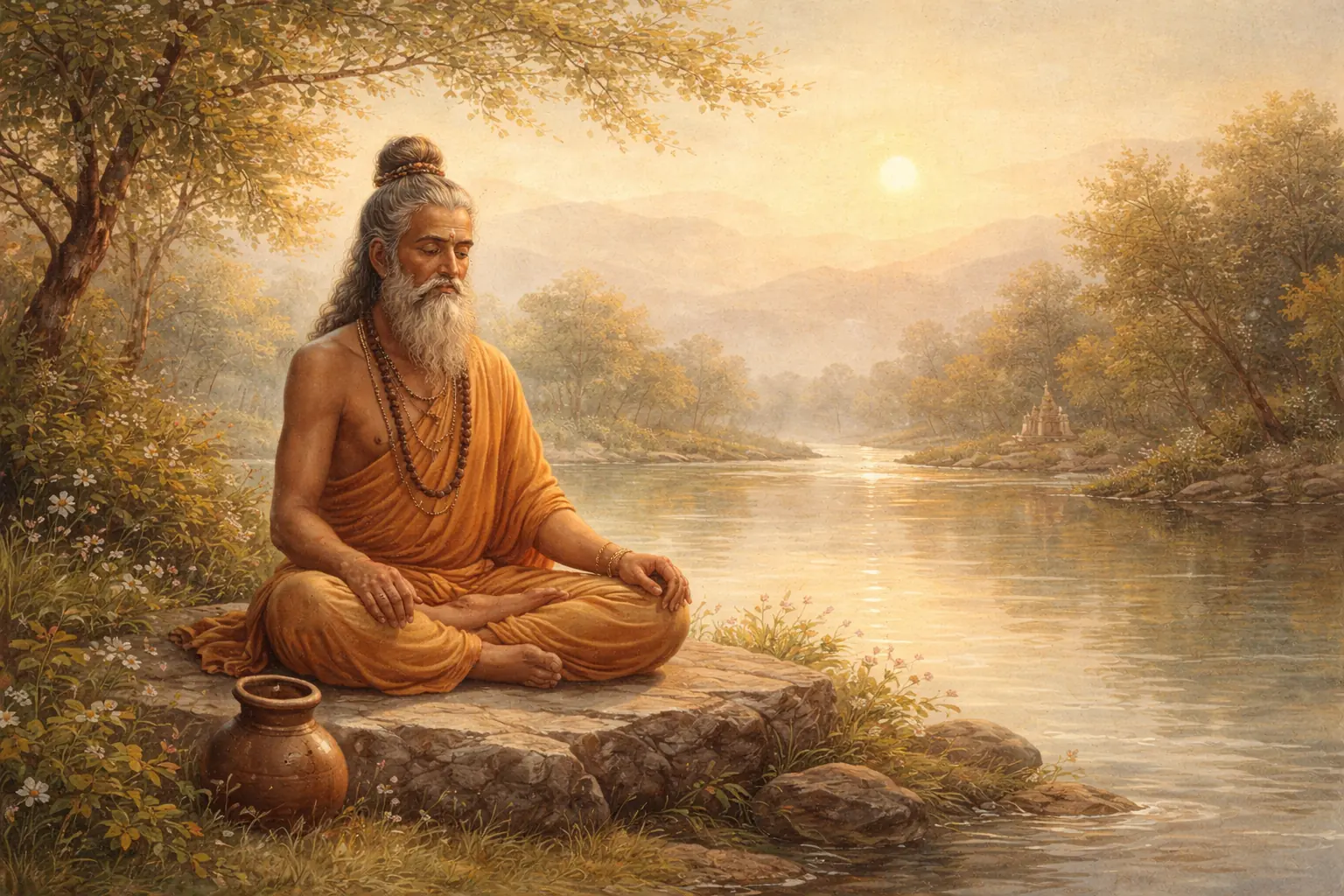
“I neither praise nor condemn myself, others, or anything at any time. My mind does not rejoice upon attaining something considered good, nor does it fall into depression if it receives something considered bad.”
One of the criteria of your practice is that you are always happy. This indicates that you have subdued your mind to some extent. It means that you are doing everything correctly: you are working with your mind and handling it skillfully.
“Hence my state of happiness and health.”
If your mind is happy, your pranas are also in harmony. And if your pranas are in harmony, your physical body is strong as well. This is the logic of the subtle bodies. If the mind is unhappy, it is torn apart by inner demons: one says, “Let’s sleep,” another says, “Let’s think about women,” and a third suggests something else. Another part of it says, “What are you doing!? This is the law of karma. Have you forgotten why you came here? You need to attain God. So what is the point of all this?” The mind is torn apart; a war between angels and demons is raging within. And the etheric body does not feel very well: it does not know whose side to take or to whom it should give its energy. It will give energy to whoever wins—it does not care, because the etheric body has no mind of its own. It is simply prana, and prana goes wherever the mind goes. And the physical body does not feel very well either when this happens.
But if the mind is subdued, everything is wonderful: consciousness is happy, all the demons are bound by vows to serve the Dharma and kept on a short leash, while the inner angels prevail. Then prana accumulates, life force increases, the etheric body grows stronger, and the physical body is always very powerful, stable, and resilient. Life expectancy then increases—all of this is also the result of skillful handling of the mind.
A State of Peace and Wholeness
“I reject even the desire to live; therefore, my mind desires nothing and abides in a state of peace and harmony.”
Peace and harmony mean that all your inner entities have “come to an agreement”; they have merged into something single and whole. The angels have subdued the demons—that is, wisdom has subdued the kleshas. The demons have vowed to serve the Dharma and the Dharma alone, and not to take a single step without the angels’ command. The angels themselves have become established in the empty space of awareness. All the different parts of your “self” have merged into one and become something single and whole. You are no longer torn apart by contradictions. You no longer make strong dualistic distinctions: this is unequivocally bad, while that is unequivocally good; this is unequivocally a good person, while that is unequivocally a bad person; this is unequivocally good, while that is unequivocally evil; this is unequivocally right, while that is unequivocally wrong. You no longer abide in such a childish perception of the world. Everything has merged into a single, integral whole, and all of it is one great good. But this good is based not on the mind’s conceptual judgments, but on the essence of bhava and awareness.

Everything that was diverse and fragmented in your soul has become harmonious and whole, acquired its structure, and turned into a beautiful “snowflake”—a yantra, a mandala, something beautiful. All parts of such a yantra are equidistant from the center, that is, from the natural state. All concepts, thoughts, and energies are now connected to this center and do not act on their own. It is as if a multitude of foolish servants have found their master and arranged themselves around him in a beautiful formation. These servants themselves have now also become auspicious and peaceful masters. All this is a sign of skillful training of the mind.
I want to say that when many people come to the monastery, they imagine it as a magical place where they will be induced into a trance or nirvikalpa samadhi, where some sort of magic will project their subtle body into the astral plane, and so on. But such childish notions of spiritual practice do not correspond to reality. This is not that kind of place. It is a school where, first and foremost, you are taught to work with the mind and subdue it. All subtle magical and mystical things do not even come close to the art of subduing the mind, because all of that comes by itself at the right time if your mind is subdued.
I have seen many different half-crazed psychics who had many experiences and traveled in the subtle body, but their minds were not subdued. There is no benefit in this, because even hungry spirits have astral bodies and travel in them; they see the future, but this has not helped them attain liberation in any way. They experience greed, attachment, self-cherishing, and so on, despite having experiences that some people consider mystical. But when we begin to subdue the mind, that is true magic, a genuine miracle, because subduing the mind leads to liberation from self-cherishing and the ego. It is precisely self-cherishing and the ego that are the root of bondage (bandha) and all problems.

Seeing the One Essence in Everything
“I see the one underlying essence in everything: in a piece of wood, a beautiful woman, a mountain, a blade of grass, ice, fire, and space. And I am not troubled by thoughts such as ‘What should I do now?’ or ‘What will happen tomorrow morning?’ I am not concerned with thoughts of old age and death, the pursuit of happiness, and I regard nothing as ‘mine’ or ‘not mine.’
When the mind is subdued, contemplation and the natural state arise as if spontaneously, by themselves. This is because as soon as the mind is subdued, contemplative presence arises. If you try to practice contemplation with an unsubdued mind, even if you are a talented person and understand something about the threefold sankalpa, bhava, or space, that unsubdued mind will constantly pull you out. You have barely immersed yourself and begun performing the complex sadhana of unification with the chakras when some situation suddenly arises, and your mind immediately jumps out and says: “How can that be?! What about me?!” You immediately forget both contemplation and sankalpas; all complex practices cease to work because the unsubdued mind spoils everything. Conversely, if the mind is subdued, you always remain in this kind of floating presence and do not stray far from it.
Prapatti Yoga and the Eradication of Self-Cherishing
Prapatti Yoga is considered one of the minor yogas belonging to the prajna yantra. Anava Yoga, Vishvarupa Yoga, and Drashta Yoga are all minor yogas of the prajna yantra, intended to strengthen our practice. I would say that Prapatti Yoga is very important from the perspective of the prajna yantra. Its other name is hridachara, meaning that it is one of the ten acharas, or principles of the Laya Yoga teachings. There are Advaitachara, Sahajachara, Samayachara, Upayachara, Sadachara, Tapachara, Siddha-Svecchachara, Divyachara, and Darshanachara. There is also Bhrityachara, another name for Prapatti Yoga—the yoga of relinquishing oneself, the yoga of compassion, love, and self-surrender. If you comprehend Bhrityachara, it will be very easy for you to practice sadhana, engage in prolonged practices, and observe monastic commitments. In fact, there will be no difficulty in this at all, because self-cherishing will have been eradicated. And when self-cherishing is eradicated, the root of suffering is eradicated as well.
To give an example from modern life, if consciousness is a complex virtual informational reality, then the ego and self-cherishing are like a virus or even a faulty program. This faulty program severely slows down the operation of the entire system. Moreover, it simply blocks many functions. And unless this program is removed, nothing can be done with the system. The system will constantly operate sluggishly, and many functions will not work at all; that is, it is severely limited. But when we remove it, everything appears completely different.
What does self-cherishing lead to? It leads to suffering both in this life and in future lives. The first step toward eradicating self-cherishing is to understand that we ourselves are the creators of our suffering. It is precisely selfishness and self-cherishing that give rise to suffering. If we do not thoroughly analyze the situation, it seems to us that suffering comes from outside. But this is a delusion; it seems that way only because we have not conducted a thorough analysis. In reality, suffering does not come from outside; it comes from within—from self-cherishing and selfishness. But when we are inattentive and do not analyze situations, it seems as though suffering comes from outside, and then we develop the notion that someone is to blame, that there is some external enemy. We look for a cause: bad weather, another person, or certain circumstances. But this is a delusion, because the root of suffering lies in a selfish outlook, in self-cherishing.
The following example is given: a man named Devadatta makes a wooden statue and leaves it near his house in the dark. When he passes by in the evening, it appears to him to be a living person; he becomes very frightened and suffers because of it.

In the same way, our self-centered thoughts create causes that produce effects in the form of suffering. Or it is like giving birth to a child who then grows up and begins to beat you or cause you other suffering. Or you take an arrow and carelessly shoot it in such a way that it wounds your leg. In other words, you yourself bring it all about.
All the suffering that exists in this world is generated by us ourselves because of a false view based on self-centeredness. And we take the first step toward freeing ourselves from such a false view when we understand this.
The Secrets of Bhusunda’s Immortality
“I know that everything around me, always and everywhere, is one cosmic awareness. These are the secrets of my happiness and health.”
Vasishtha asked Bhusunda questions about his immortality. He was greatly astonished: “How is it possible that so many kalpas have passed, yet you do not die even during pralaya? You lived in the previous kalpa, and now you live in this one. Even time has no power over you.” Bhusunda replied that it was all due to such a selfless view. He says:
“Hopes and expectations do not affect me. Even when something is old and worn out, I look at it with fresh eyes, as though it were new. I am happy with those who are happy, and with those who grieve, I share their sorrow and feel compassion for them, yet I myself remain uncolored by anything. Whatever I do is not tainted by desire or a sense of ego. Therefore, I do not lose my head either when I am powerful or when I am poor and beg for alms. Neither wealth nor misfortune troubles me; when they befall me, I regard them as equal.”
Such are the secrets. This is Bhusunda’s greatest upadesha on prapatti yoga—the yoga of relinquishing the self.
The Mechanism Behind the Creation of Karmic Vision
We constantly create obstacles for ourselves in spiritual practice when we act selfishly. Our thoughts embody our selfish intentions, and these selfish intentions create tunnels of reality into which we unconsciously shift ourselves. This is a particular kind of vision. And because our consciousness has the ability to generate and sustain reality, this happens continuously.
Consciousness can be likened to an ocean or a lake, and thoughts to bubbles rising to the surface. The mirror of our consciousness constantly generates certain thoughts. This occurs at a very subtle level of visualization. For example, as soon as you think of something, a subtle image instantly arises. The mind may not even have become aware of it, but this image has already begun its work. And when we generate selfish thoughts, we create many such images that, layering upon one another, establish complex associative links among themselves. Over time, they grow into an entire tunnel of reality that forms a particular karmic vision, and this karmic vision begins to influence us.

This is the paradox: we created it ourselves, and now it influences us. This is the “child who beats the parent.” We conceived something, we created it, these thoughts became powerful, and then they themselves began to influence us, changing our mood and outlook. All of this is a consequence of such self-centered thinking.
When we have attachment and self-centeredness, neither truth nor dharma sits upon the throne, but rather our false “self,” our ego. And when our ego sits upon the throne, we commit wrong actions and create various kinds of undesirable karmic imprints that will inevitably bear fruit in the future, whether we want them to or not. This is as natural as roses blooming in spring on the rose seedlings you planted; it would be naive to expect lilacs to bloom there, because the law of cause and effect is at work.
The purpose of practice is to transform the state of mind into a positive and selfless one. When we transform a state of selfishness into compassion, into a selfless state, the entire functioning of the negative aspects of our mind is reversed and becomes positive.
The Sevenfold Method of Taming the Mind
One method of taming the mind is called the sevenfold method—it is a method of logical analysis. If you are an accomplished practitioner, you can easily tame your mind through simple self-liberation; however, accomplished practitioners are few and far between. As a rule, we are beginners. Therefore, logical methods of taming the mind are also important and can be applied when necessary.
The sevenfold method consists of the following formulas and principles:
observe (sakshi);
analyze and apply discriminating wisdom (viveka);
generalize (ekavidya), gather data, and look from a distance at everything that is happening;
draw conclusions (pramana);
make a decision (sankalpa);
carry it out;
move to a new level (parinama).
If any selfish states of mind arise and you feel that your contemplation is unable to cope with them, you should apply this method.
For example, anger arises in you. At the very least, you should observe it—that is, not identify with the anger, but step aside and simply watch it. Yet merely observing anger will not help; it will continue. Even if you observe your anger, it may still successfully ruin your life and create negative imprints for future lives. You should analyze it and think: “Undoubtedly, this anger is arising because I created various negative imprints in the past. Perhaps I insulted someone or behaved badly toward others, and now my karma is manifesting in such a way that this situation has arisen. So why should I be angry?”

After analyzing it, you should proceed to generalization and think: “What will happen if I continue to be angry? What will my next life be like? Obviously, with my consciousness functioning this way, I will end up in hell. And if everyone behaves like this, relationships among people will become truly hellish.”
By analyzing and generalizing, you arrive at the conclusion that you do not need this at all. First and foremost, it harms you. Whether the other person is right or wrong, whether the situation is good or bad—all of that is irrelevant, because in any case you are harming yourself. You think: “What difference does it make who said what? I will not ruin either this life or my future lives because of it. Many have suffered because of anger and incurred terrible rebirths. I do not want such a fate, such a future for myself.”
Once you have looked at anger from the outside and generalized, the next step is to draw conclusions: “Being angry is dangerous. It is foolish because it is the functioning of an immature mind.”
Having drawn your conclusions, you must decide to put an end to the mind’s angry activity. You counter anger with your sankalpa (intention). You express this sankalpa and try to stop the mind from functioning in this way. You practice observation or pratipaksha-bhavana—something opposite to anger, such as meditation on love—but by any means necessary, you no longer tolerate anger and instead try to extinguish it. If previously you did not see it as a problem at all and thought you had the right to be angry when someone provoked you because it seemed like righteous anger, now you understand how utterly futile it is; you no longer tolerate it and work on yourself instead of being angry at something external. And if you succeed in doing this, you move to a new level. Your state changes, and anger simply disappears.
You can apply this sevenfold analysis to any emotion. If other states arise (envy, attachment, and so on), you can likewise work with them from the perspective of sevenfold analysis.
Applying Sevenfold Analysis to Various States of Mind
By analyzing all states of mind in this way, you use logic as a means of taming it. For example, you may experience a state in which you feel like being lazy and sleeping instead of meditating and practicing. You should observe these states and then analyze them: “If I keep doing this, where will it lead? What will it give me?”
You will conclude that this is entirely unfavorable and that your spiritual progress will be in question if this becomes a tendency of your consciousness. If distraction, laziness, compromise, and dullness become tendencies of consciousness, you yourself will gain nothing from it. We must reflect, generalize all of this, and think: “What, then, will my future lives be like? Have the thousands of people who lived this way achieved anything? Obviously, they have achieved nothing at all. They were unable to tame their minds and free themselves from suffering. For them, both the next life and suffering were a reality.”
Then you need to conclude that such a state of consciousness is of no benefit, and make a decision: “I will perform sadhana; I will control and tame my mind.”
Having made the decision, you then methodically ensure that it is carried out. How exactly? For example, you take a sheet of paper and record the number of rounds in Chandali Yoga or the number of kumbhakas in pranayama. It does not matter what you do; the point is that you become methodical and tame your mind through strict discipline in sadhana. Every day you perform a certain sadhana, monitor and record everything, and strive to remain vigilant over your mind. As a result, you advance to a new level.

A Universal Formula for Working with the Mind
This formula—observe, analyze, generalize, draw conclusions, make a decision, ensure that it is carried out, and advance to a new level—can be applied to all situations and aspects of life in which you need logic, when you feel that awareness alone is not yet sufficient and therefore need to use logic to understand a state of mind, an emotion, or a situation.
For example, if you envy someone, you need to observe that envy. You should not think that you and envy are one and the same. If you feel envy (or become attached to someone) and think that you and the envy (or attachment) are one and the same, you are lost. Through observation, you must always separate yourself from the emotion and observe what is happening to it.
Once you have observed it, you need to separate it out, analyze it, break it down into parts, and examine it carefully. “Obviously, this envy is the result of certain unfavorable imprints in my mind. Obviously, if I simply leave it as it is, it will create further imprints in the stream of my consciousness, which will manifest in the next life. Do I need such imprints?”
For the law of karma is like an echo in the mountains: when you shout some abusive word, you hear the same word in reply. It does not happen that you shout an abusive word and the answer comes back: “Om Namah Shivaya.” Such mountains exist only in the Pure Lands, where there is nothing wrong or impure. But if the mind is not tamed, even pure lands may seem boring, incomprehensible, and too gentle. A sinful soul, even upon entering a heavenly abode, will not feel joyful because there will be nothing exciting there. It will not understand the subtleties of how the consciousness of its inhabitants works. It is like a commoner entering the refined environment of scholars or musicians and being unable to fit in there, because everything there is alien and far too boring to his coarse consciousness. A coarse mind feels the same way in a pure land.

Thus, if you analyze envy and realize that you have no need for it, you then generalize. Having generalized, you can view the situation on a larger scale, from the perspective of many lifetimes, and think: “My rebirth may have occurred because of envy; perhaps it was envy that propelled me into incarnation in this world. How can I continue playing these games? How can I put up with this?”
After that, you make a decision: “I must consciously renounce this kind of activity of the mind.” Then you ensure that this decision is carried out: you constantly observe the mind closely and put a stop to such tendencies. As a result, you reach a new level at which this quality no longer arises and no longer troubles you. Thus, little by little, the mind is tamed and becomes a devoted minister serving the Higher Self.
The Result of Taming the Mind
When the mind is tamed, you truly attain happiness and a serene state of consciousness. External circumstances can no longer cause you suffering, because different situations and suffering are merely interpretations of the mind. In reality, this is a factor of one’s inner state, but due to our lack of awareness, we may often identify with these situations and suffer as a result.
If a person does not have such a proper, tamed mind, then sooner or later suffering is guaranteed—they cannot escape it. Even if their circumstances are favorable, if their mind is untamed, then as soon as they find themselves in an unfavorable situation, this suffering will inevitably come to them, because the untamed mind itself becomes a source of suffering.
The Projection Mechanism of the Untamed Mind
Sometimes, because of an untamed mind, a person experiences dissatisfaction. Moreover, it is not a specific feeling but an all-encompassing, general one. If a person does not work with the mind and believes this feeling, it begins to take hold of them. The mind projects and looks for someone to blame for its dissatisfaction—and inevitably finds someone.

This is how the mind works: it goes through the options and chooses the most suitable target onto which to project, because it needs this kind of external projection. The inner demon wants to acquire some murti, a tangible vessel. And if you allow it, it will actually happen—it will materialize. But the art of analysis lies in preventing such a projection from occurring, in stopping it at the deepest inner level.
