


Commentary on the text “Sri Siddhanta Shikhamani. Sthala: Aspiration”
If we assess the emotional state of a sadhu, then ten is the maximum, and a normal sadhu should be somewhere between seven and eight. Ten is ecstasy, nine is rapture, eight is bliss, seven is simply happiness, six is joy, five is contentment (santosha), four is calmness (neutrality). But then difficulties begin. Three is dissatisfaction, two is suffering from dissatisfaction, one is life in some gloomy, dissatisfied, suffering dimension between fear and anger. We no longer count zero.
And a sadhu lives somewhere between seven and eight, between bliss, happiness, and joy. If, of course, he cultivates his faith and purifies his mind. If he is a proper sadhu and lives in the spirit of dharma, then everything is as it should be. But sometimes he may not have such joy and bliss, yet he has contentment. Contentment is also a good state, as a foundation from which one can go further. That is, “you may not be enlightened, but you are obliged to be content.”
Enlightenment is granted by divine grace, while contentment is earned through one’s own effort. Through his own effort, a sadhu becomes content. If he is not content, it means he did not educate himself, did not study the Teaching, did not apply it, did not understand it, did not deepen it; he left something unfinished, trained poorly, hit the punching bag too little at the gym, drew the bow across the violin too little, practiced scales too little. Because contentment is a matter of mastery, a psychological thing. Even without being enlightened or believers, you can be quite content simply by learning how. Even a psychologist can teach you this. He will tell you something about letting go and accepting yourself, about positive thinking. And such banal truths will work if you apply them.
Contentment is not difficult. Contentment does not require tapas; one only needs to work a little in this direction. But for high bhavas, the higher tattvas, serious sadhana is needed: the opening of faith, of the higher circuits of consciousness, the awakening of the higher tattvas, purification, surrender to God, because all of these are divine categories: divine rapture, ecstasy, reverence, happiness, joy, love (divine, not worldly). All of this already requires greater work on oneself, greater letting go, greater self-surrender, greater depth of faith. Contentment, however, is simple: to learn to accept one’s life, to accept one’s path, to respect one’s choice, to cut off what is unnecessary.
At the same time, by contentment we do not mean the contentment of a domestic animal, for example, a dog or a cat (I am fed, I feel good, I am warm and full). Contentment as a basic state is the calmness of a sadhu’s mind, contentment with the path of dharma and with God, in which there is spiritual work. Within this contentment burns a fire, the flame of faith, aspiration (shila), the fire of inner tapasya, the fire of contemplation, the fire of vichara-spanda, Brahma-vichara. This is contentment. It is not the tamas of a domestic cat that is content with milk or sausage. It is the contentment of a sadhu with the path he is walking. In this contentment there is dynamism; there is no sleep-like, inert, dull, blunted state in it. This is very important.
And it is about such aspiration that we will speak with the help of the text “Sri Siddhanta Shikhamani” by Sri Shivayogin Shivacharya.
Section “Aspiration.” Chapter 13
“As knowledgeable people say, aspiration (shila) is a sincere, strong striving to know the essence of Shiva. One who possesses this desire thanks to the instructions of noble Teachers is called one who possesses aspiration.”
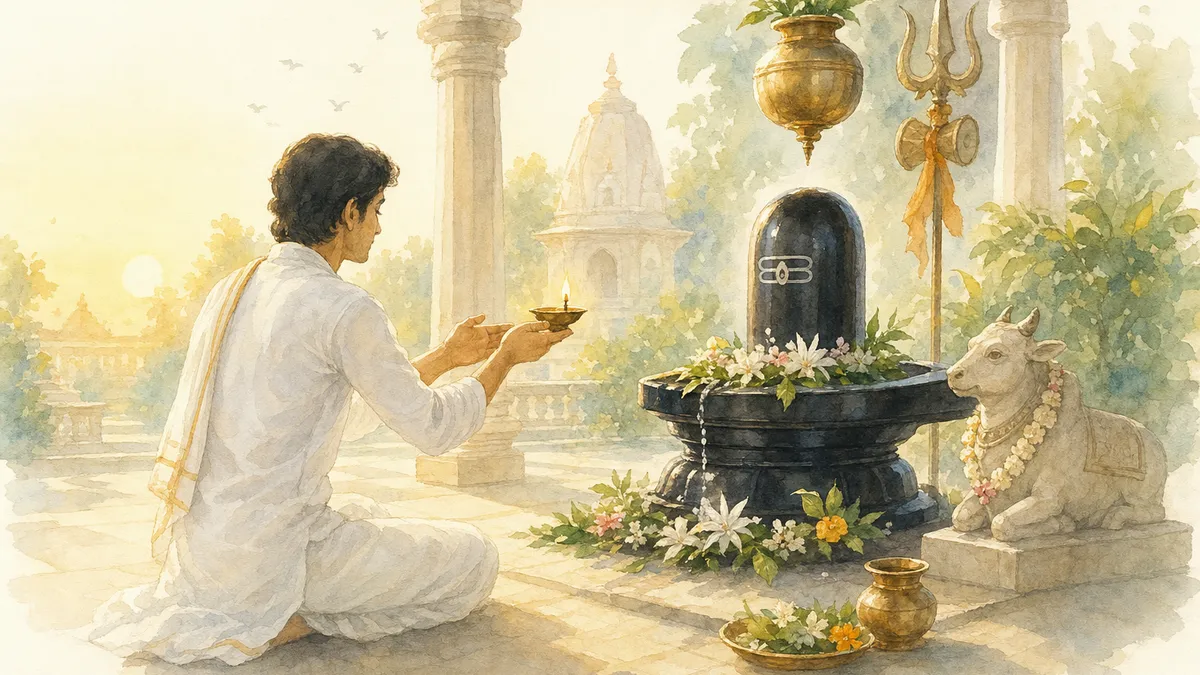
Shila in Shaivism is the aspiration to know the essence of God. It is the same as mumukshutva (the aspiration to attain Liberation) in Vedanta, the aspiration to know Brahman. Mumukshutva is the aspiration to become free, the aspiration for freedom. But in Shaivism, shila is not even an aspiration for some personal freedom. It is simply aspiration toward Shiva, the aspiration to know Shiva. The question of one’s personal freedom is not raised, because there is also some admixture of self-interest here. “And I want to know Shiva without conditions.”
Of course, the knowledge of Shiva and Liberation are one and the same. With the knowledge of Shiva, with the knowledge of Shivatva (the nature of Shiva), Liberation comes. But here I do not set any goals or any conditions at all; I simply strive to know Shiva, to merge, to unite, to reunite with him as with my own primordial nature, as with my own home, as with something so dear and close that no conditions are set: whether I attain liberation or do not attain it. Those are already other questions. I simply strive to return to God, because I feel that I cannot help but strive toward God, because God is my nature. And here there are no questions, and even liberation is not a condition of this striving.
Because if we make liberation a condition, it looks like this: “If Shiva guarantees me liberation, then I will strive toward him, but if he does not guarantee it, then I will not.” No! I will strive toward him regardless of whether he guarantees me liberation or does not guarantee it. I will strive toward him because I cannot help but strive toward him, because Shiva is my nature, and I cannot help but strive toward myself. Shiva is my primordial good, and I cannot help but strive toward the primordial good. And how this will manifest, and what guarantees I will receive, does not matter. I set no conditions.
“The wise say that aspiration (shila) is steadfastness in devotion to Shankara (Paramatman) — the Lord who removes the suffering of the devotee.”
Steadfastness in devotion is faith that does not depend on anything. Steadfastness in devotion means that I am devoted to God under any circumstances: I was devoted to Him yesterday, I am devoted today, I will be devoted tomorrow, and in another billion years I will also be devoted. Perhaps I will change many bodies, perhaps the Universe will collapse and dissolve, becoming a black hole, perhaps I will even receive the body of a star or merge with a deity that creates galaxies, but my devotion to Shiva will remain as devotion to the Supreme Absolute, devotion to God.
Steadfastness of devotion means that regardless of the weather, mood, or latitude of the place, I am directed toward God. Regardless of anything! That is, my devotion does not depend on anything: whether I am praised or reviled, whether those around me love me or not, whether they extol me or hate me. Regardless of anything, I strive toward Shiva.
“Aspiration (shila) is the knowledge that Shiva and the Atman of a person are one. It is immersion in the contemplation of Shiva and an ardent striving to attain him in order to become one with him. A yogin who possesses these qualities possesses aspiration (shila). The one deserves aspiration in whom indifference to any knowledge except the knowledge of Shiva is steadfast, whose thoughts and impulses are attached only to Shiva.”
Extreme Views: Eternalism and Nihilism
Steadfast indifference to any knowledge except God, except Shiva. We suffer precisely because we do not have such steadfast dispassion toward all other kinds of knowledge and perception. And when there is no such steadfast dispassion, this absence of steadfast dispassion has a cause and has its own name.
The absence of such steadfast detachment is called eternalism. Eternalism is the perpetuation of anything except God, and even of God Himself, by means of the concepts of the mind. It means attributing some material, absolute character to that which is an illusion, and clinging to it. That is, clinging to concepts, clinging to matter, clinging to perception, and many other things — all this is eternalism.
When the number of nihilists increases, everything falls apart, service is performed haphazardly, the material world slips out of control, everything simply becomes emptied out. A person encounters the material world as energy, as the universe, and receives challenges, but does not know how to respond to them. His nihilistic view does not help him; the vector of his spiritual life becomes disrupted, relationships are destroyed, and the spiritual path itself is destroyed. That is, nihilism is a destructive attitude toward life and the spiritual path. The method is destroyed and the nihilistic view is absolutized.
With eternalism it is different. When eternalism increases, on the contrary, the density of material relationships is strengthened, the materialistic vision of the world is strengthened, the materialistic vision of God is strengthened, and subtle spiritual materialism flourishes with regard to the spiritual path, one’s mind, connections, relationships, and the world.
If in nihilism you find yourself in airless outer space at –273°C (absolute zero, absolute vacuum), unable to breathe or turn around. You feel that you have neither support nor reference point, you are simply suspended, there is nothing around you, but nevertheless suffering has not gone away, ignorance has not gone away, and you are in a kind of dark, very cold vacuum, then eternalism is something different. Eternalism means that you find yourself in a jungle among predatory plants that have entangled you with their shoots, simply bound your arms and legs with their tendrils. Everything around holds you so tightly, so seriously, so powerfully that you do not even have a chance to extricate yourself from all of this. On the contrary, there is so much samsara, it is everywhere, and you have no chance whatsoever of freeing yourself from it.
Eternalism means that you take everything as truly existing; you do not see certain things. What are these things? They are five things:
- First, you do not see the purity of the energies that are occurring. You do not see and do not believe in their purity, and therefore they bring various problems. For example, the purity of perception, relationships, the external world, and so on; that is, you lack pure vision.
- You do not see the emptiness of the surrounding phenomena: the emptiness of thoughts, the emptiness of words, the emptiness of the external, the emptiness of action. You do not notice this; you believe in their inherent existence, their self-sufficiency.
- You do not recognize the illusory nature of the surrounding phenomena. That is, they are not only empty, they are also illusory. You do not recognize maya; you are fundamentally mistaken. For example, you see a mannequin, but it seems to you that it is a person, and you become attached to the mannequin, sort things out with it, shake your finger at it, imagine something, but it is just a mannequin. That is, you have understood nothing at all.
- In the state of eternalism, you do not recognize the playful nature of all phenomena. Playful means that it acts according to the law of transcendence; it contains an element of spontaneity, probability, unpredictability, freedom, and is limited by nothing. But you see based on the patterns of your mind, based on rigid rules, based on your duties, powers, and responsibility in relation to yourself. You demand something, rely on something, have expectations of something, have ambitions, and are dissatisfied when they are not fulfilled. It is the same as coming to the ocean and making claims against it because it rolls its waves not in the order you would like, not in the sequence you want. And you may even threaten the ocean, become indignant, write petitions, but the ocean does not even hear you at all; it simply rolls its waves. Five thousand years will pass, none of those living on this earth will remain, and the ocean will still be rolling its waves; nothing will change for it.
- Finally, the fifth thing that is not recognized in eternalism is perfection, the perfect essence of all phenomena (paripurna, siddha). All phenomena are pure and perfect in their foundation, no matter how they manifest. But our ignorance does not allow us to recognize this.
Failure to recognize the playful nature of maya is a failure to understand that illusion plays by its own unique rules and principles, and it does not take your desires and ambitions into account; therefore you must not expect anything from it. One must recognize this play. This play is incomprehensible, transcendent, flows from the Supreme Source, and, most importantly, it is not controlled by you; it cannot belong to you, yet you want to control it, you have ambitions and expectations.
Recognizing the playful nature of phenomena allows one to accept this play. For example, to accept the ocean as it is. After all, one can learn to swim in this ocean according to the ocean’s rules, without wishing somehow to correct the ocean. But at first, those who abide in eternalism all wish to change the ocean. Someone wants to change the world, and when the world cannot be changed, someone wants to change the people around them, their loved ones. And they do not succeed in this either. Then someone wants to change at least themselves, and they see how difficult it is even to change oneself. Then they declare war on themselves; their ego is offended that they cannot even change themselves. They begin to fight with themselves and lose to themselves. Having lost, they surrender, capitulate. They understand that they cannot even change themselves. They understand that they can only accept this fact, become completely disillusioned with all of this, and simply surrender to God, learn to rely on God without the desire for any external changes. Thus the eternalist evolves spiritually, freeing themselves from eternalism. And all of this happens because of the failure to recognize the playful nature of all phenomena.
For example, you are walking, you get on public transport, and someone steps on your foot. An unpleasant situation. Mentally, anger arises in you toward him. You have so many concerns, and then someone steps on your foot too. As if that were not enough! Pain. But it does not occur to you at that moment to reflect that this situation was pure, empty in its essence, illusory—that is, in reality no one stepped on your foot, and the one who stepped on it does not exist; he is empty and pure at the foundation, like the Absolute. And that this situation is of a playful nature, completely spontaneous, that it is God’s darshan to you, and that in its essence it is perfect. The Spirit touched you in this way, played with you. Perhaps your right channel had become stagnant, and a point on your toe needed to be massaged, some reflexology needed to be done. Perhaps your mind had stagnated on some false idea, and it was necessary to knock the direction of the flow of pranas off course and free it. Shiva spontaneously played his lila, and you received darshan. And this is a perfect situation, in the state of mind in which you are.
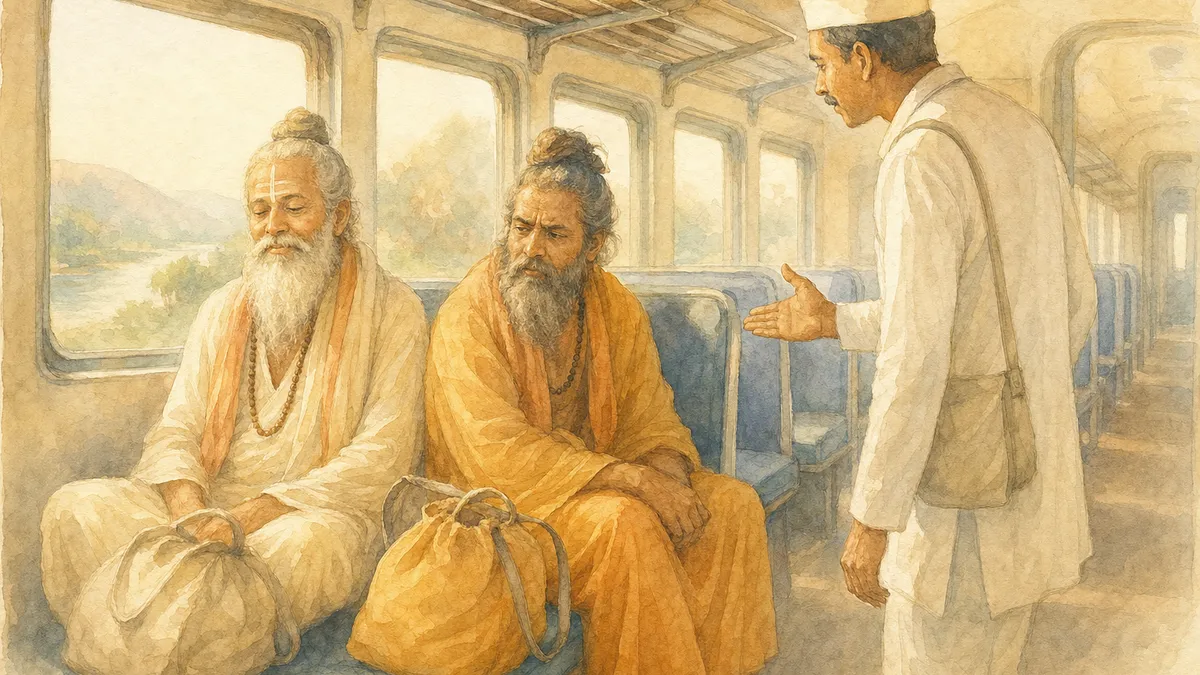
Once Swami Rama was traveling by train with his friend, and this friend liked to be constantly indignant. The conductor came and demanded their tickets; he spoke to them very harshly. They had no tickets, and the conductor said, “Get up, go and sit over there.” They said that they were sadhus, and that sadhus should be respected. The conductor was a Muslim and was not going to follow the customs of Hinduism, of Sanatana Dharma. Some sadhus. He said, “I don’t care. And what does religion have to do with it? Pay or leave! I don’t know any sadhus; I am a Muslim, and I have no concern at all with who you are.” Although, of course, he knew who they were. He moved them to the end, then asked them to move somewhere else, then again. Then he put them off the train altogether, and Swami Rama’s friend was very indignant. In the end, they boarded another train and continued on their way.
Swami Rama said, “You do not understand—Shiva took care of us! Our legs were tired and numb; we had been sitting for a long time. He decided to play with us, to bless us by having us stretch our legs and walk around; it is good for our health. Why did you not see the blessing in this?” Swami Rama was enlightened, and his friend was not—that was the whole problem. They saw one and the same situation differently. Swami Rama saw it as pure, illusory, empty, playful, and perfect in its essence. But his friend was conditioned by concepts of unfair and fair treatment of himself, by the division into Muslims and Hindus, by the division into sadhus, sannyasis, and householders, by concepts of respect, egoistic concepts, and many others. He thought about anything at all: he thought about himself, he thought about those Muslims who do not honor Vedic traditions yet live in India, he thought about injustice, about mistreatment. He thought about anything at all—anything but God. This is what eternalism is: an overestimation of relative illusory reality. Of course, he himself, as the one evaluating, was present at that moment, and therefore he suffered. Swami Rama at that moment abided in God, and he had no such evaluations. All of this is eternalism.
Eternalism creates the feeling that you are fundamentally entangled in spiritual life, as if you are so firmly attached to various thoughts, concepts, fixed ideas, the external world, and all limitations that there is not even a chance to disentangle yourself from it.
There is eternalism of thoughts, when your thoughts go on and you are attached to them; you keep inventing and inventing something, and then you believe in it. And the mind is such that it can make a mountain out of a molehill, and you will believe in it. It can inflate such a reality, and you will believe in it, and then this reality will gain power over you, instead of your taking a pin and sticking it into it like a balloon so that it dissolves. But eternalism does not allow this. Such is the eternalism of thoughts.
Types of Eternalism
There is the eternalism of the ego, when you believe in your ego, you encourage it, and when it is offended, you defend it like a fortress; you strive to obtain some rewards, preferences, gratitude, and signs of attention for it, you clearly outline its boundaries, standing with a machine gun in a watchtower so that no one crosses those boundaries, God forbid. All of this is for the sake of the ego! This is eternalism; it is the perpetuation of the ego instead of recognizing its emptiness, its illusory nature, and saying: “Oh, just go away, this ego...,” and casting it aside. “I give everything to God. I am a tuft of grass, a dry leaf on the road, a bundle of straw. No problems! Only an instrument for service. I develop the ego only as an instrument, but I do not try to enjoy it.” But the eternalist tries to squeeze drops of enjoyment out of his ego, and these drops of enjoyment come together with tears. He is like a camel in the desert chewing a thorn. There is no water, but he finds a thorn growing in the sand and thinks he can squeeze at least a little water out of it. The thorn has long been dry, but he chews it, his tongue is wounded and bleeds. This blood has a salty taste, and the camel thinks it is water, that he is receiving a little life-giving moisture from this thorn. The attempt to enjoy the ego is exactly the same.
There is the eternalism of fixed ideas, when the patterns of our mind become so deeply rooted that we become attached to them and believe in them as something unequivocal. We absolutize certain concepts, including religious, ideological, political, and social concepts. That is, we unequivocally believe in these concepts, and behind these concepts a tremendous force builds up. Why do religious wars happen? Eternalism. Not a single war in the world has occurred because of nihilism. What would nihilists say? They might even gather with weapons, but then they would say: “But this does not exist at all. There is no one who would fight. All of this is illusory, empty, and there is no point in fighting anyway. What are the goals? The goals are selfish, they are illusory, they are empty, and in the Absolute there is nothing of the kind.” They would drop their swords and disperse. They would ask: “And who is supposed to fight at all? Me? But I am not the body. The mind? But the mind does not fight.” That is, there has not been a single religious war of nihilists in the world. There is no reason to fight for emptiness (shunya). No one will fight for emptiness, for the absence of qualities, for Nirguna Brahman. That would be the most absurd battle. There has not been a single serious dispute among nihilists, because they are not attached to anything. Perhaps they are mistaken in terms of denying the material world, but at least they do not have eternalism. But all religious wars, all political wars, all conflicts were unleashed by eternalists. Why? Because they believe that all of this is genuine, that all of this is real, that one must fight for it “to the death,” “we will not forget, we will not forgive,” “we will not give up a single inch of our land,” “we all...,” “we will all of them...”. This is eternalism, when people believe that all of this is real, because there is no one to say: “Wait, wait! All of this is from the mind, this is your mind! Whom have you gathered here to tear to pieces?” But eternalism is exactly like that. In the Middle Ages, witches were burned. Ideological concepts, fascism, Nazism, racism—all of this is also very strong eternalism, the belief that “we are the chosen race,” or the belief that whites are better than blacks, that whites really exist and they really are better than blacks. Various types of gender behavior, feminism—the same thing. Semitism, anti-Semitism, a heap of various -isms—all of these are forms of eternalism, when certain fixed ideas are perpetuated.
The Eternalism of Emotions and Relationships

There is internal eternalism in terms of emotions and feelings, when we believe in emotions and feelings. We do not recognize the emptiness of emotions and feelings. For example, panic has seized us, and we give in to it. We cannot recognize that panic is empty; it came and went. If it is observed, then it is the energy of uncertainty, and there is nothing so terrible about it. That in its essence it is empty, illusory, and perfect by nature, because it is a form of vibrations, spanda, shunya, yet we give in to it. Or anger has seized us, or attachment has seized us, or envy has seized us. And we become involved in all these emotions; we do not recognize their playful, empty, illusory character, perfect and pure by nature. These are pure energies playing, but we become attached to them. This is the eternalism of emotions and feelings. That is, an eternalist believes in his emotions and feelings, and he also declares them to others: “Look, I have such-and-such feelings, such-and-such emotions. Why do you not take them into account, why do you not respect them?” And very many people speak this way. A wife says to her husband in the family: “Do you not take my feelings into account?” And if the husband is a nihilist karma-sannyasi, then he will say: “They are empty and illusory. So why take them into account?” He will not understand at all. “Feelings are feelings. They came and went. What are you even talking about?” Husband and wife do not understand each other if the wife is an eternalist and the husband is a nihilist. This happens in karma-sannyasi families. Monks do not have husbands and wives, but among monks too there are eternalists and nihilists. Eternalists are those who attach importance to emotions and feelings, who fuss over their feelings. Instead of offering them to God, they appropriate them, pay attention to them, and even draw the attention of others to them: “How can this be? How could they say that? They do not respect me, they do not take into account that I have been a nun for twelve years, they did not give me that, they did not remind them about it, they treat me improperly, they forgot to show signs of respect...” These feelings and these emotions overflow. This too is eternalism. But what should a sadhu do? “Feelings and emotions are empty, they are illusory, they are perfect. Thus this is the perfect play of Shiva, thus Shiva has manifested darshan to me, my higher ‘I’ is giving me a lesson, ecstasy, everything is pure and perfect. There are no problems.”
There is the eternalism of relationships, when we become too carried away by relationships and consider them real. We are unable to recognize their emptiness, illusoriness, and playful, blessing, essentially perfect character. Then we will become entangled in relationships with a neighbor, with dharma brothers, husband and wife in a Vedic family will become entangled in their relationships with each other, the elder with the younger, the manager with brahmacharis or a novice; one can also become entangled in service relationships (who should carry out whose sankalpa), and a mahant and a manager can also become entangled. That is, eternalism is great entanglement in relationships. And only in the relationship with the Guru can the disciple not become entangled. More precisely, the disciple can become entangled, but the Guru cannot, and the Guru will remind the disciple of this in time. Because the Guru is not one who becomes entangled; the Guru is not an eternalist. To be a Guru means to be neither a nihilist nor an eternalist. A disciple may very well become entangled by projecting an eternalistic vision onto the Guru, but the Guru simply will not allow him to do this and will show the essence of guru-tattva in time.
Cultural and Religious Eternalism
There is cultural eternalism, when the soul becomes entangled in the dominant culture. Culture and the social environment become very important, and the soul falls completely under their influence. There are people who follow their faith because they were born in a particular culture, and this culture prescribes that they do certain things: go to church, perform rituals, observe fasts. It is simply the surrounding culture; this person has seen no other and believes that it is the only existing culture, that it has always existed and will always exist, that it is something eternal. And when he becomes acquainted with other cultures, he cannot accept them; he says that they are something unreal, demonic, devilish. If he had been born in Tibetan culture, he would behave differently; if he had been born in Islamic culture, he would behave in a third way. But he falls under the influence of the surrounding environment and the surrounding culture. Culture determines his worldview, and he believes in it as self-existence, not as a manifestation of his own “I.”
There is religious eternalism, when one’s own dharma is perceived egoistically, dualistically, conceptually. We have spoken about this. And there is also philosophical eternalism. This is also called mara-teachings (the eternalism of Teachings), when teachings are perceived in duality, as a self-existing concept externally separate from consciousness. There is the eternalism of the shastras (shastra-vasana), when we study the shastras with a stereotyped mind, perceiving the shastras as something separate from the state of nonduality, from the nature of the Mind. Eternalism connected with the perception of the body (deha-vasana) is considering oneself to be the body and attachment to the body, not recognizing the empty, illusory, and pure nature of the body, the perfect and playful nature of manifestation in the form of the body. The eternalism of kleshas means that we do not recognize the empty, pure, and illusory nature of the kleshas, and the kleshas obscure our consciousness. All these are different kinds of eternalism. But all these kinds of eternalism can be briefly reduced to three kinds of eternalism: the eternalism of view, the eternalism of contemplation, and the eternalism of behavior.
The Three Main Kinds of Eternalism
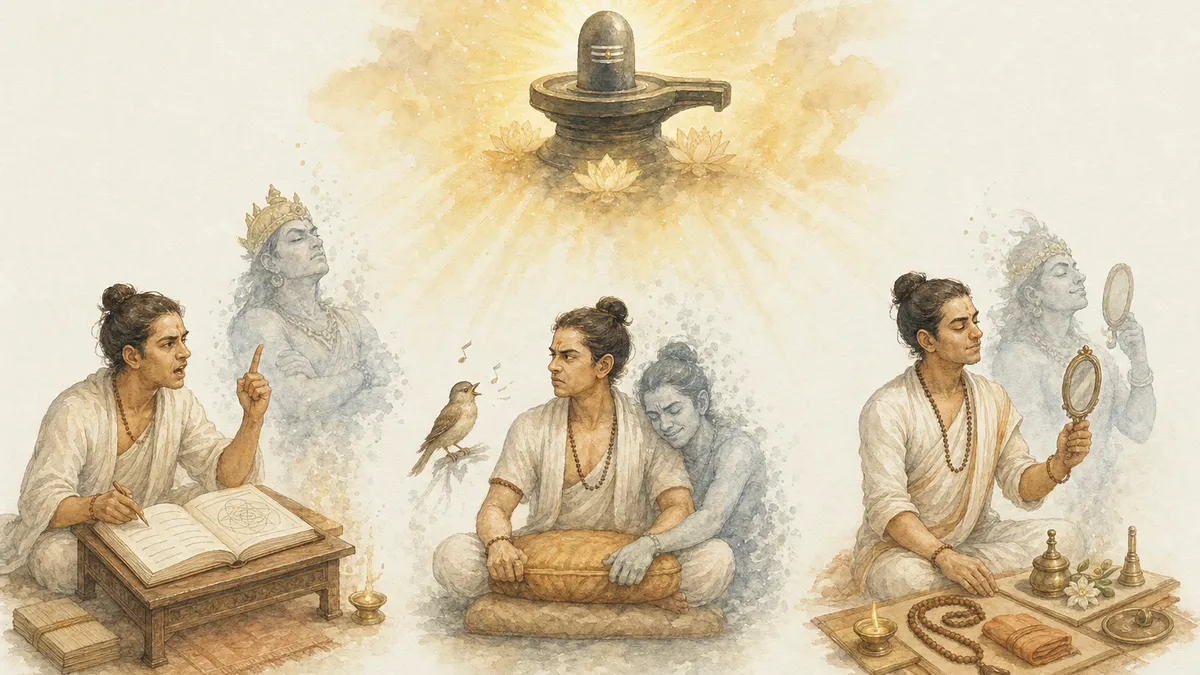
So, what does the eternalism of view mean? There exists one who has a nondual view. This is the eternalism of view. Beginning practitioners of Advaita are often subject to this. They believe in Advaita so strongly that they are ready to defend it foaming at the mouth. The eternalism of view. At the same time, they do not understand that the one defending it is himself illusory, according to Shankara.
The eternalism of contemplation is characteristic of beginning sadhus. This means that there exists one who contemplates. He contemplates so intensely and clings so much to contemplation that he is ready to speak angrily to everyone who prevents him from contemplating. Because the one who contemplates is very eager to contemplate, and he very much believes in himself as the contemplator.
Finally, there is the eternalism of behavior, which means that there is one who acts. He observes the commandments, principles, and routine so diligently that pride appears in him; his self-existence as someone successful and behaving correctly is only strengthened. The one who behaves exists, and faith in this is strengthened. This is the eternalism of behavior.
Overcoming Eternalism and Understanding the Nature of God
So, when we overcome all these various kinds of eternalism with the help of the five recognitions, we can recognize the pure character of the divine play through the recognition of purity (shuddhi), emptiness (shunya), illusoriness (maya), the playful character (lila), and the perfect essence of all phenomena (paripurna). When we are not subject to eternalism and can accomplish the five recognitions, we can understand the nature of God.
“All the virtues of a devoted wife, praised by everyone, are caused by her love for her husband; likewise, the virtues of a devotee are caused by his love for Shiva. Just as it is a disgrace for a woman to serve someone other than her husband, so for the blessed devotee of Shiva, service to another God besides Shiva is dishonor.”
By “service to another God besides Shiva,” service to Vishnu, Dattatreya, or Lakshmi is not meant. What is meant is service to something lower than the Absolute. For example, service to ahamkara, service to maya, that is, service to some lower tattva.
“What need is there for many words? The saints say that aspiration (shila) is concentration on knowing Shiva as one’s own ‘I’. And such a person is called one who possesses aspiration.”
Conclusion on the Obstacles to Aspiration
So, there are two major problems that prevent one from having strong aspiration. These are nihilism and eternalism. Nihilism destroys faith and devotion, while eternalism makes them dense, materialistic, and deprives the soul of inspiration. A sadhu must avoid both the one and the other; then his aspiration is strong, pure, and unmixed. And every time we must analyze whether we are free in our contemplation, in our view, in our behavior from eternalism and nihilism.
“He who is concentrated on the awareness of the unity of his Atman and Shiva, whose will is firm, who has surrendered to the mercy of Shiva (the Lord of the worlds), and who is adorned with aspiration to Shiva alone, is called one with Shiva.
Thus ends the sthala ‘Aspiration’.
