

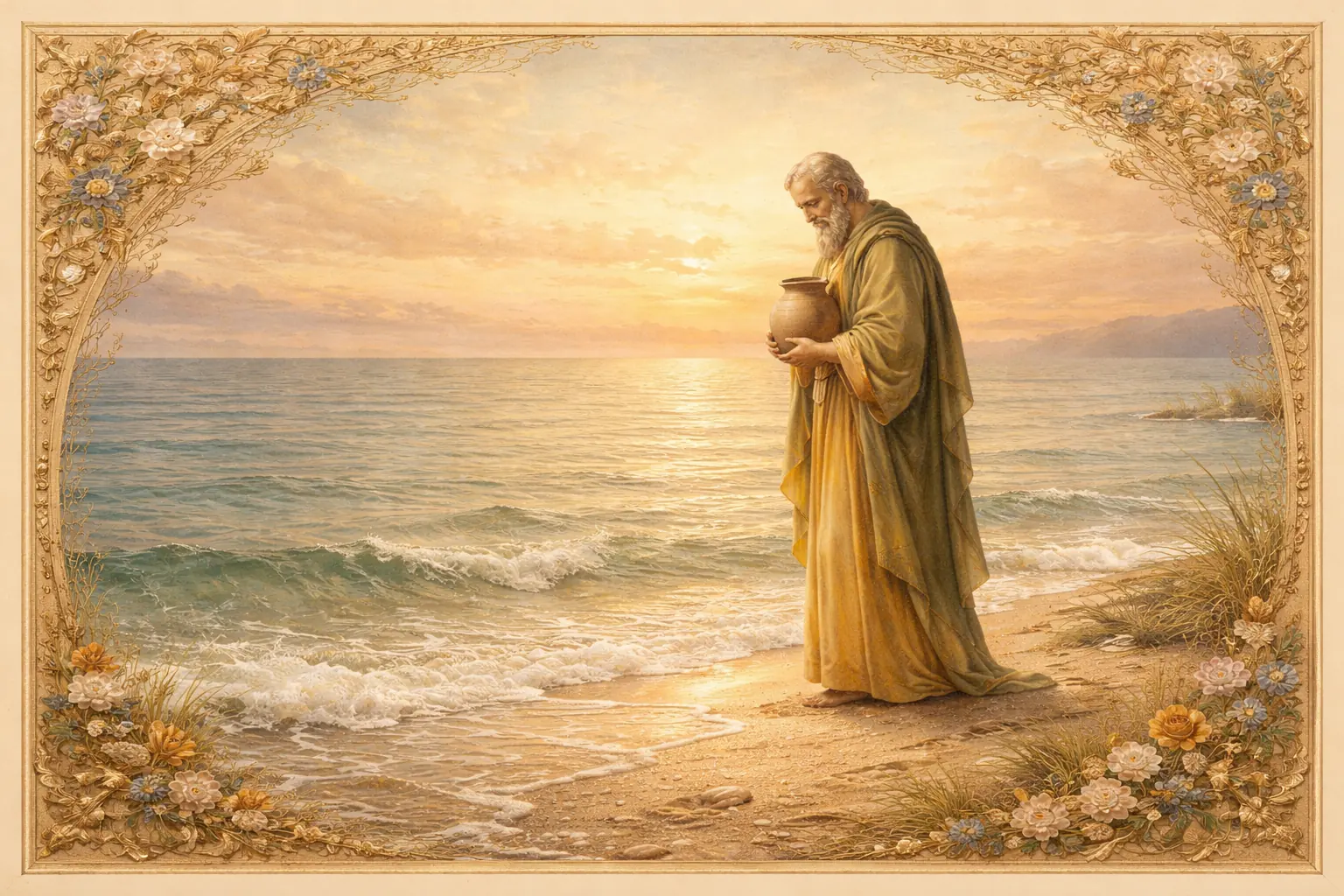
We have established that Agni represents the principle of will, Indra the principle of mental power, and the Maruts the energy of thoughts over which Indra presides. Who, then, is Varuna?
When we hear about the Vedic deities, we should understand them as universal forces endowed with their own intelligence, will, and individuality, and at the same time as aspects of our consciousness. That is, they all have their own share within us, their own psychic component, and it is difficult to separate one from the other. For example, when you exercise your will, Agni acts within you; when you exercise mental power, Indra's energy acts through you; when karmic winds rush about within you, the Maruts are at work through you. Little by little, you begin to discover your entire body and pranas as inner deities.
Why does this happen? Because all the deities originally reside within our subtle bodies and channels. And when situations are described in which an ascetic, having performed severe austerities by standing on one leg for a thousand years and subsisting on leaves alone, earned Brahma's darshan, this means that his inner deity was revealed, an inseparable part of the great Brahma—his localized aspect placed within our consciousness.
To purify one's subtle bodies means gradually revealing one's inner deities and discovering their identity with the primordial deities—that is, discovering one's participation in the deities—while at the same time discovering that the background of both the inner and outer deities is the primordial, fundamental nature of Mind. If we merely discover the deities within ourselves or worship external deities, this will be Dharma, but it will be a dualistic, eternalist Dharma. The greatness of nondual Dharma lies in our discovery of the fundamental basis of both inner and outer deities.

“The name ‘Varuna’ comes from a root meaning ‘to surround,’ ‘to cover,’ or ‘to penetrate.’ The ancient mystics saw God as the highest all-encompassing sky, felt the divine existence as an all-embracing ocean, and lived in His boundless presence as in a pure, all-pervading ether. Varuna is this highest sky, this ocean washing over the soul, this ethereal domain and infinite penetration. But the same root gave them a name for the dark concealer, the enemy, Vritra, for the meanings ‘to hinder’ and ‘to oppose,’ ‘to shelter’ and ‘to enclose,’ ‘to besiege’ and ‘to encircle’ are also among the many shades of meaning of this root.”
There are also various dark forces in the universe that are called demons, rakshasas. These dark forces are also Brahman's lila. In the absolute sense, they are aspects of wrathful deities, and just as there are peaceful deities (deities of sattva) and joyful deities (deities of rajas), there are also wrathful deities, goddesses of destruction belonging to the family of samhara-shakti, and they have many devoted servants—spirits, pishachas, pretas, and various classes of demons. Until we are purified and pacified, they also have representatives in our subtle bodies. And as long as the kleshas—avarice, anger, envy, greed, lust, and so on—act through us, as long as these kleshas remain unpacified, demons also have a claim on us in the sense that their energy manifests through our bodies. In other words, it is not all that simple; it is not enough to say that everything is primordially pure and perfect. Of course, this is an axiom in the View, but before it becomes a genuine reality, we must truly master such a level of presence as to unite with it.
“But dark Vritra is the dense cloud and enveloping shadow. His knowledge—for he, too, possesses knowledge, maya—is the sense of limited Being and the concealment, in the night of the subconscious, of those riches of abundant and boundless existence that should belong to us. Because of this denial of and resistance to the all-creating knowledge, Vritra fiercely opposes the gods. His undivine order opposes the divine order of God and man.
Through his boundless essence and vast vision, Varuna pushes back these boundaries; surrounding us with the light of his domain, he reveals to us what Vritra's dark delusion had hidden from us and obscured.”
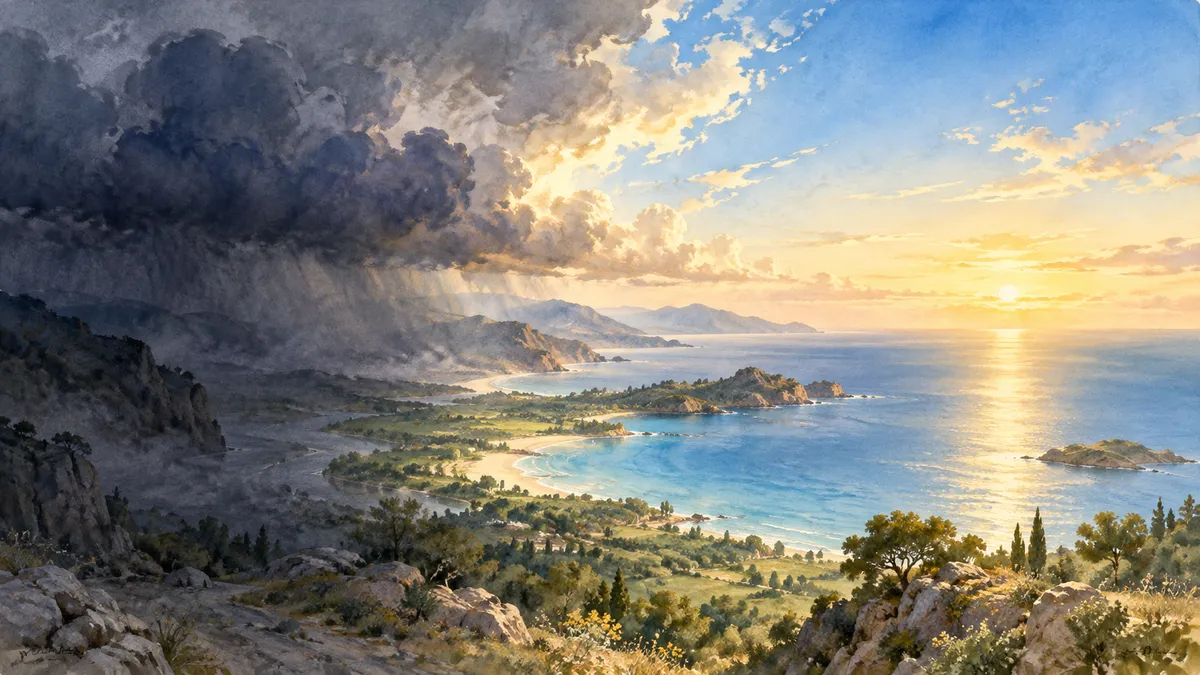
Thus, Varuna is both the deity of space and the deity of the ocean. He embodies the power and might of expanded consciousness.
Varuna as the Deity of the Waters and the Principle of Samyoga
“The divinity of Varuna is the form or spiritual image of all-encompassing and illuminating infinity. In the Puranas, he is the deity of the waters, and his net was transformed into the merciless noose of the god of the ocean.”
The deity of the waters, the water element, embodies the principle of fluidity and harmony that arises during contemplation. But this is possible only when there is samyoga, when the principle of Anuttara Tantra is truly realized—the balance of bliss and emptiness, the inner and the outer, the mother’s energy and the son’s clear awareness. When such samyoga is maintained, Varuna appears before us as infinite space for integration with the objects of the external world, symbolized by the water element. But as soon as our samyoga is disrupted, we fall into distraction and lose our proper connection with objects; then Varuna appears as a merciless being capable of dragging us into the deep ocean with his nets.
When objects appear to us as a “mother” or a “sister,” that is, when samyoga is maintained, Varuna is present within us as all-encompassing infinite space. But when objects become like a “worldly wife,” Varuna’s net drags us into the ocean of unconsciousness.
“In the Veda, Varuna is a king, but not of the Heavens as such, for that is Indra, but of the highest, all-encompassing ether and all the oceans.”
Varuna is the natural state itself in its glory, omnipotence, and power.
The texts say, “Whether you walk, stand, sleep, or eat, contemplate the nondual king.” It is precisely the natural state that is called the king, since it occupies the supreme position. This sovereignty of the natural state is embodied by Varuna. Power, the ability to withstand demons such as Vritra, the demon of limitation, and the ability to self-liberate and purify everything—these are all functions of Varuna.
“All spaces belong to Varuna; all boundlessness is his property and dominion.
In the mystical vision, ether and ocean merge, becoming one. Varuna, with his boundless law and truth, is called upon to guide our limited will and judgments so that we may avoid these dangers.”

Whenever your consciousness expands, when you gaze at the horizon or the ocean, this is Varuna’s darshan: a part of him within you is revealed, for he also has his presence within you. At the same time, it is said that Varuna acts as a mentor to the limited will and the limited mind. That is, Varuna teaches us: look at everything from the perspective of infinity, look at everything from the perspective of boundlessness; do not be confined by your narrow view, petty thoughts, limited will, or the feeling “I am a small body” (something to which living beings are deeply attached).
The Divine Ship and the Human Boat
“We must not set out in a human boat, but must ‘board the divine ship, a vessel flawless and well-oared, one that does not sink, on which we may safely make the journey beyond sin and evil.’”
Living beings often try to set out on the path of liberation in a human boat, but this boat is unfit for the path of liberation: it may soon spring a leak and fail to reach its destination altogether. The human boat is the mind and the ego arising from it, with its kleshas and attachments.
Sometimes a person thoughtlessly embarks on the spiritual path, perceiving it as just another spiritual adventure during which their illusions and desires will be supported, as something frivolous. There is nothing surprising about this; that is simply human nature. But sooner or later, they see that the boat in which they are trying to cross to the other shore is unsuitable, because it moves too slowly, has many holes, and its very design is wholly unsuited to flying across the boundless ocean of the universe. Little by little, they realize that they need to build a new self, a new ship in which they can fly, and cultivate new qualities—and this is not a quick process.

Once I spoke with a man who wanted to become a monk. He said, “I thought I would practice for two years, quickly attain realization, and then teach others.” I thought, “Well, what a prabhu—good for him. If only your words could be fulfilled, but the price for that is high.” He asked, “And what is the price? I earn a decent living.” I said, “The price is you—the person you are now.”
Varuna teaches us that we cannot approach the spiritual path with our limitations. We must learn a great many things before calling ourselves people who have embarked upon the path: humility, patience, control of the senses, the ability to set our ego aside, and service as the principle of the transpersonal ego. When we feel that the darshan of Infinity has touched us, it means that Varuna’s teachings are gradually touching us, and once again we must make a choice.
Varuna as the Lord of the Celestial Rivers
“Beyond the farthest heavens, in the highest ocean of light and the vastness of the supreme supraconscious ether, our heaven awaits us, abiding in the truth concealed by a lesser truth, just as in the night of nescience darkness is immersed in and enveloped by an even greater darkness. This is the truth of King Varuna. Varuna contains all of this within himself, within his boundless being; he sees all and directs all through his infinite knowledge. All these oceans belong to him, down to nescience with its nights, which seem the very opposite of Varuna’s nature, endowed with the boundless radiance of the one, eternal, infinite sun that brings the light of joy and truth. Day and night, light and darkness, are merely symbols of his infinity. Radiant Varuna has encompassed the nights; through his creative knowledge he establishes the dawns within himself. Visible, he embraces all things.
From this conception of the oceans arises the concept of the Vedic rivers. These rivers are present everywhere; they are the waters that flow down from the mountain and rise into the realm of the mind, spreading out and illuminating with their current the dark subconscious recesses of Vritra.”
It is believed that the Vedic rivers, such as the Ganga, Yamuna, and Saraswati, originate in the celestial worlds, flowing from Mount Meru, while their source begins with Vishnu himself, who pierced a hole in the Brahmanda (the cosmic egg) with his toe. Some rivers flow through Brahma, then through Dhruva-loka, and then through the rishis, who receive them upon the crowns of their heads, thereby performing such service. They then pass through the celestial worlds of Svarga-loka, bringing various pleasures to the celestial beings as they descend upon the mystical kalpavriksha trees. When these rivers flow through the celestial worlds, the bodies of the celestial beings who drink their water become filled with fragrance and life force; from these rivers they obtain whatever they desire—clothing, gold, food, and so forth—simply by contemplating them. These rivers then manifest on the earthly plane as sacred rivers in which people perform ablutions, make pilgrimages, and so forth, and which are also projected onto the channels of the human body.
And Varuna, the lord of these rivers, stands at their source, for all waters are also subject to him.
“They are those mighty ones from heaven whom Indra brings down to earth. They are the streams of truth. They are the rain from its radiant heavens. They are the seven eternal sisters and companions. They are the divine waters that bear knowledge. They pour down upon the earth, they rise from the ocean, they flow into the ocean, they ascend to the highest seas.”
The Seven Rivers of Consciousness and Pratyahara
What, then, are these relative rivers on the relative plane? They are the five sense organs and their faculties—sight, taste, hearing, touch, and smell—the mind with its memory, and ahamkara. All seven must return to Varuna, to the ocean of the boundless. Until we learn to return these seven rivers, these seven streams, to primordial awareness, Varuna will continually ensnare us in his nets and plunge us into dark, unconscious waters.
Often, when we perceive the world, we find ourselves stretching out intensely through one or another of the sense organs. Through sight, hearing, and taste, we become fascinated by and captivated by this world, losing prana and awareness, losing the inner center of awareness.
To understand Varuna’s darshan means to unite all these seven streams in the boundless space of “I am” awareness, when the mind, the ego, and the five consciousnesses inherent in the sense organs are all, as it were, directed toward a single point, all gathering together.
One of the meditation instructions of one school contains these words: “Before meditating, one must reprimand all the sense organs, because, like thieves, they steal inner energy.” This is true. Until you reprimand your sense organs so that they perceive the world correctly and do not become captivated by it, it is difficult to maintain this inner center. This reprimand is pratyahara—the ability to withdraw the focus of one’s attention from objects and their sense organs toward awareness itself. When all these seven rivers converge at the estuary where Varuna dwells, you gain an indestructible fundamental presence uniting all experiences, and Varuna’s net will no longer be able to capture you.
“Varuna-ocean—the king of all these waters.
One of the hymns says: ‘In the ascending rivers he is the brother of the seven sisters; he is among them.’
Another rishi proclaims: ‘In the rivers Varuna sits, upholding the law of his deeds, perfected in the will, for supreme dominion.’
The rishi Vasishtha speaks more precisely of the divine, pure, and purifying waters flowing with honey, among which King Varuna walks, gazing upon truth and falsehood in created beings.
Varuna, like Indra, with whom he is often associated, also releases the waters. Pouring forth from his mighty hands, they, like him, become all-pervading and flow toward an immeasurable goal.
‘The Son of Infinity, widely established, released them everywhere. The rivers rushed toward Varuna’s truth.’
‘With power and thousandfold vision, Varuna sees the goal of these rivers. He is the lord of kingdoms; he is the form of the rivers, for in him is the highest and universal power.’ His oceanic movement washes over all the kingdoms of Being and rises toward the paradisal heights of heaven.
‘He is the hidden ocean, and he rises beyond the limits of heaven. When he placed the sacrificial word in these dawns, then with his foot, like a ray, he tramples down the evil spells and rises to paradise.’
We see that Varuna is the oceanic wave of the hidden divinity; as he rises, he manifests more and more his own immeasurable vastness and delight in the soul of the God-liberated seer. The evil spells that he shatters with his step are false formations created by the lords of darkness.”
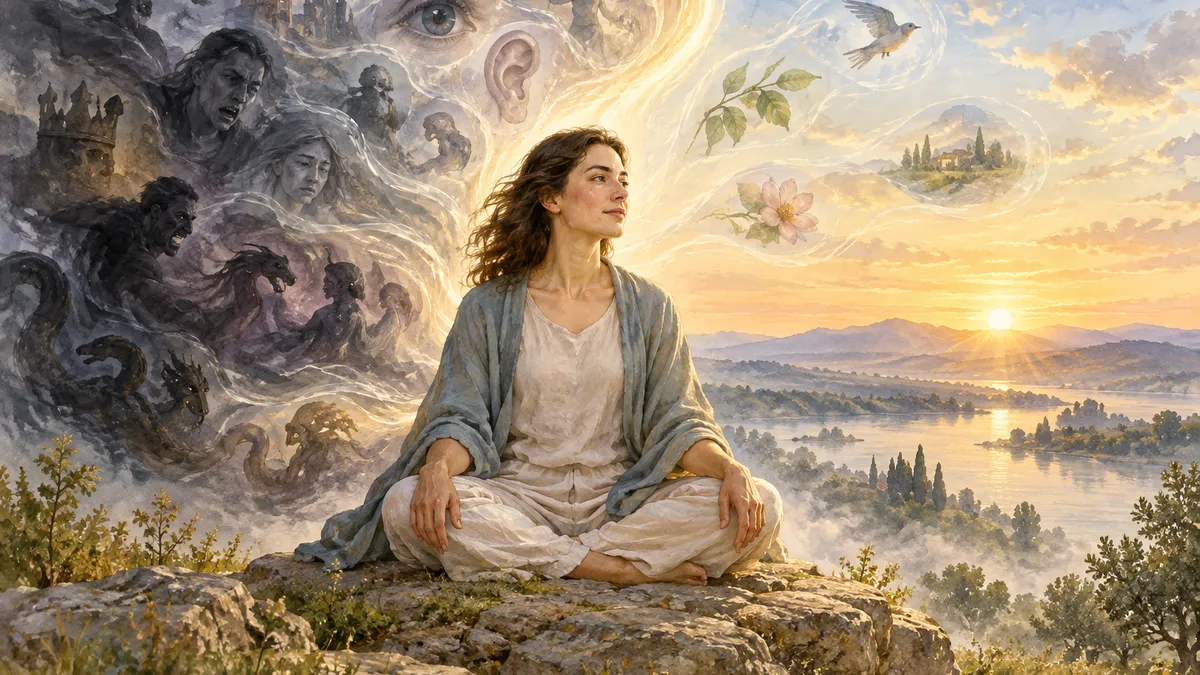
Overcoming Maya’s Evil Spells
Every living being, regardless of what it may think of itself, is subject to evil spells. Otherwise, it would not be an ordinary living being in maya but a liberated deity. These evil spells are a layer of darkness consisting of tamas and rajas. Before a person attains liberation, they must become firmly established in sattva, while the part within them consisting of rajas and tamas must be pacified and subdued.
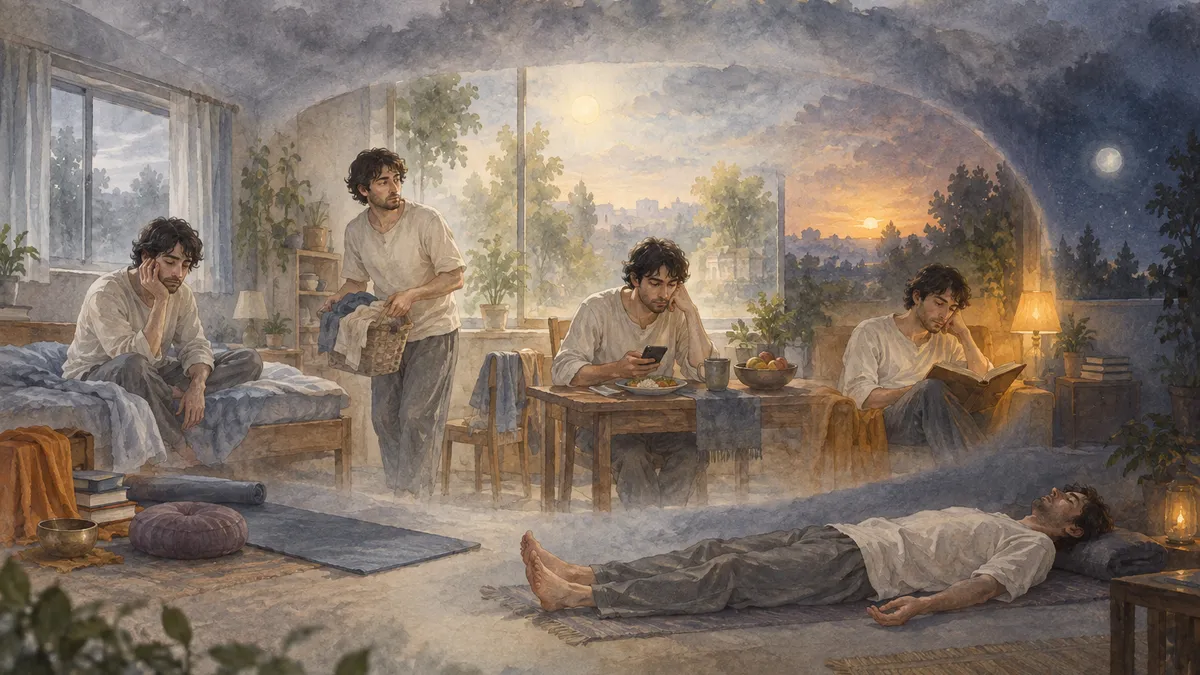
For example, a person gets up in the morning and is in such a tamasic state that they do not meditate, practice asanas, or recite a mantra; they somehow make it to prasad, then perform seva and think: “When will the next prasad finally come?” While performing seva, they talk; when they eat the second prasad, they again enter a not particularly sattvic state, so in the evening, during Mahashanti, it is difficult for them to meditate; their mind becomes blurred again, and when they read the text, they understand nothing. When it is time for the lecture, it is difficult for them to understand what is being discussed; once again, they are in a vague state. Then they lie down in shavasana, thinking: “At last.” That is how their day passed. And how many glimpses of sattva, glimpses of the original state, did they have? What do you think? One day, a second, the twenty-fifth, the seventy-second, the hundredth, the three hundred and fifty-sixth, one year, a second year, a third year. Where is their vector directed? What are their chances of liberation, of rebirth in higher worlds, of attaining a pure birth, of being born in pure lands? We must be realistic.
It is not easy for living beings to break the spell of maya. To do this, I can tell you, one must make superhuman efforts. This does not mean performing some great heroic deeds. A monk’s heroism manifests itself every day in ordinary life; it consists of small things. Every day you overcome yourself, every day you set yourself a challenge, every day you try to be impeccable. Little by little, you conquer tamas and rajas, compel yourself to practice, to be attentive and remember your obligations, catch yourself in moments of unconsciousness, in compromises, in various distractions, observe every movement of your mind and stop it. And this must not be done for just one day; for years, you must perform such an uninterrupted feat.
Practicing in this way, you discover, to your surprise, that you are a “poor hunter,” that the mind and ego manifest themselves much faster than you notice, and that rajas and tamas get ahead of you. And you understand that you need to develop and perfect your hunting skills; you need to be a good hunter: to hunt your mind, hunt the ego, hunt desires, hunt rajas, hunt tamas. You simply need to become a master possessing various skillful means, traps, and so on. But there is no other way, since the spell of maya, consisting of rajas and tamas, is not easy to dispel.
The Christian Tradition and Yogic Sleep
Many people, for example, act this way in the Christian tradition. One elder said: “If you want the devil not to slip into your soul, it is better not to sleep at all; stay awake.” Some people do just that because they know that you become unconscious when you fall asleep, and that rajas and tamas creep into you.
I am not urging you to stay awake; you may sleep according to a schedule. However, you can sleep a yogic sleep, performing sadhana; that is, you can work with the practice, create a sankalpa, and perform sadhana. The most important thing is to remain awake while awake. It happens that a person is not awake while awake: they seem to be awake, but in reality they are as if asleep. Becoming absorbed in concepts, becoming absorbed in the fantasies of your mind, becoming absorbed in the ego—it is the same as falling asleep while awake.
Only those who have become deeply rooted in their natural presence, who have separated themselves from the sense organs, found the point of awareness and established themselves in it, and then returned outward again, to the sense organs, from that point of awareness, are truly awake. But now they have returned not as slaves, but as masters; not as guests, but as owners of the sense organs. Only such people can be called awake. The others are asleep, immersed at times in thoughts, at times in the sense organs, at times in their own projections, and at times in the fantasies of the ego.
This process of awakening from the state of being asleep while awake to continuous wakefulness twenty-four hours a day is a battle with the spell of maya, with rajas and tamas, for sattva and for the light that emanates from the primordial state.
It is impossible to describe all the joy and all the merit that arise from victory in such a battle.
Varuna as the Guardian of the Universal Law

“Varuna, embodying the heavens of divine truth and the ocean of divine being, cannot be merely the personification of the physical sea or sky. He is the purest and most majestic king, who crushes evil and delivers from sin. Sin is a violation of the purity of divine law and truth. The response to it is the wrath of the pure and mighty one. The king of divine law turns his weapon against those who, like the sons of darkness, serve self-will and ignorance; the noose descends upon them, and they fall into Varuna’s snare.”
Varuna also watches over adherence to the universal principle (rita) and the laws of ethics. When someone violates any ethical principles, vows, obligations, or their dharma, it is believed that Varuna’s wrath descends upon them. Our infinity within, our conscience, understands when we act under the influence of obscurations or unconsciously; it becomes angry and resists following the wrong paths.
The mind and ego may sometimes follow their own dark paths, seized by rajas and tamas and unable to resist them; they may follow desire, pride, and self-expression when there is no self-liberation. But Varuna, in the aspect of infinity within us, becomes angry at this; that is, the true “I,” the soul, always understands and resists these wrong paths. Thus, Varuna embodies within us the ethical and moral law and the law of the universal primordial principles (rita).

Liberation from Sin through Sacrifice
“Those who seek the truth through sacrifice are freed from the bonds of sin, just as a calf is freed from a rope or a sacrificial victim is untied from the sacrificial post. In many hymns, the Rishis strive to turn away Varuna’s punishing wrath and plead with him for liberation from sin and the payment for it—death. They exclaim: ‘Keep destruction far from us! Free us even from the sin we have already committed. Cut sin away from me like a rope.’
Vasishtha offers a passionate plea to mighty Varuna: ‘It was through weakness of will that we acted against you, O most pure and mighty one; be merciful to us, have mercy. Thirst struck one who worships you, although he was standing in the midst of the waters. Be merciful, O mighty Lord, have mercy! Whatever it may be, O Varuna, whatever we humans may have done, having betrayed the divine birth, whenever through ignorance we rejected your laws, do not punish us for this sin, O god!’
Here it says, “It was through weakness of will that we acted against you.” Often, because a person’s will is weak and undeveloped, they act contrary to awareness, contrary to inner infinity, unable to resist worldly desires, selfishness, and mental temptations. All this is because their will, as an agent of this infinity in the relative dimension, is weak.

Training the Will
The will must be trained. It is trained in the same way an athlete can train their muscles. If your will is strong, the most difficult practices become possible.
Often, one must do what one does not want to do and not follow what one wants to do. Often, one must act contrary to one’s selfish preferences, yet embody something higher—what lies behind those preferences. Often, one must show patience and persistence. When you act in this way, your will develops and becomes tempered. And this will is capable of resisting thoughts, desires, the pressure of the kleshas—anything at all.
The Danger of Prakrita-Sahajiyaism
Practitioners who follow the dharma of nonduality, and especially anuttara-tantra, face a great temptation, and this temptation lies in prakrita-sahajiyaism. Without developing the necessary qualities, without developing the will, one may superficially adopt the siddhas’ concept of natural purity, perfection, the unification of everything with the nature of Mind, and effortlessness. To adopt such a prakrita-sahajiya concept and introduce it into one’s life without tempering one’s personality is a great mistake, for which one may later have to pay for decades or even dozens of lifetimes, since it is impossible to pass from pashu-bhava to divya-bhava. Pashu must overcome its pashupatic nature and first become vira. If it becomes vira, then someday the vira within it may be able to reach divya. Sahaja-dharma, anuttara-tantra, and laya-yoga are fundamentally divya-dharma; they are not pashu-dharma, nor even vira-dharma. This must be understood.
Three Types of Practitioners: Pashu, Vira, and Divya
Pashu relies on superficial adherence to the dharma. Its shortcomings are timidity, weak will, indulgence in sensual desires, orientation toward external public opinion, lack of personal will, and weak responsibility for one’s choices—all these are qualities of pashu. Complexes and fears—that is what pashu is. In Vedic society, too, the shastric pashu follows a path of limitations: from birth to death, one remains under the supervision of the brahmins in ritual and service, reads the Vedas, participates in temple worship, gradually develops, and controls one’s senses—this is what the shastric pashu was in Vedic India. For the shastric pashu in Vedic India to attain a higher rebirth, one had to guard oneself from morning until evening, observe the rituals, remain within one’s caste, gotra, and varna, and take not a single step to the right or left, because as soon as one deviated, one would descend to the non-shastric pashu, to mahapashu—that is, to an animal state. Therefore, one had to constantly guard oneself, continuously observe ritual purity, and live at all times according to certain Vedic samskaras, even as a householder.
Vira is a different type. Vira lacks all the limitations inherent in pashu. Vira is a very strong-willed and self-confident person. It is someone who hears the voice from within and follows it. It is someone capable of austere sadhana, who has a sense of responsibility and is ready to move mountains for the sake of his word if he has given it. Vira has other problems, for example: overestimating his own strength, pride, excessive self-importance, and the desire for fame. Vira is capable of austerity, tapas, and controlling the senses, because he is a hero and a winner at heart. But at the same time, Vira’s limitation is his reliance on himself, on the ego, on his own efforts. This is both his advantage and his limitation, since he cannot let go of himself and reveal something subtler. He fights until Vira’s ego is exhausted in this battle.
And finally, divya is one who truly and subtly abides in the divine, who instantly understands the principle of the primordial state of effortlessness and openness, and is himself an embodiment of the divine. He only needs to remove certain veils in the mind. Divya possesses sattva; he has a great deal of sattva, which sometimes manifests as creative abilities and sometimes as clarity. Thanks to this sattva, he is able to let the light of Anugraha pass through him, and all he needs to do is surrender to this Light. Vira cannot do this because he is fixated on personal effort and personal seeking. He takes dharma too personally. He has not yet understood that dharma is impersonal in nature. Pashu is incapable of this because he has many inner limitations. Only divya, who possesses a great amount of sattva, can make Anugraha a path; the effortless path truly works for him.

Varuna as the Guide of Will and Thought
“Through that eye with which Varuna sees all things, the radiant symbol of the sun, he possesses the power to purify. And until he directs our will and teaches us discernment, until we comprehend the divine thought, we will not be able to board the ship of the gods and, with its help, cross the ocean of life, beyond all these obstacles and evils.”
Thus, “until he directs our will and teaches us discernment.” Varuna, as the lord of infinity, must act as a mentor, as a guide. While an ordinary person is governed entirely unconsciously by samskaras and vasanas, and his whole life is nothing other than the experience of vasanas and samskaras, in the yogin, Varuna, as the lord of infinity, directs both will and thought. This means that thought is at least self-liberated and guided by inner infinity. The will serves not the whims of the ego, the mind, or other external things; it also serves the infinity of natural awareness.
A true yogin listens very attentively to this inner infinity; he will not take a single step without it. He may do something else, he may sacrifice something, but he will not sacrifice this infinity, and he constantly cultivates obedience within himself. Thanks to this, his mind is not uncontrolled, and his will is not uncontrolled.
Varuna’s Royal Authority and Purification from Sin
“Dwelling within us as a thinker endowed with knowledge, Varuna removes the sin we have committed. By his royal authority, he forgives us our transgressions committed in ignorance.”

What, then, is this royal authority of Varuna? The royal authority of infinite space, when we become aware of it, is such that it can liberate everything; it can disperse all obscurations and mental constructs. No matter how obscured the mind may be or how tightly it may be gripped by sinful thoughts, the moment we recognize Varuna’s infinite essence within ourselves and enter a state of mind resembling space, all of this, like ripples on water, is as if nonexistent; it self-liberates.
It often happens that when a person is limited by his mind or sense organs, he has too many doubts. His mind can easily become obscured; he can easily fall into impurity and suffer because of it, wondering whether he has committed a sinful act, how long he will have to carry it, and how to purify himself.
But here it is said that Varuna has the royal power to cleanse sinfulness and impurity. This happens when we open ourselves to Varuna’s darshan through natural contemplation, when, instead of remaining at the level of the mental or astral body, we begin to perceive the light emanating from the causal body (anandamaya-kosha), and then from the Atman. Then all the mind’s hooks, the knots of the mind, and obscured states are effortlessly dispersed by this light, because it is no more difficult for the light to dispel them than it is for an elephant to frighten an insect, such as a grasshopper.
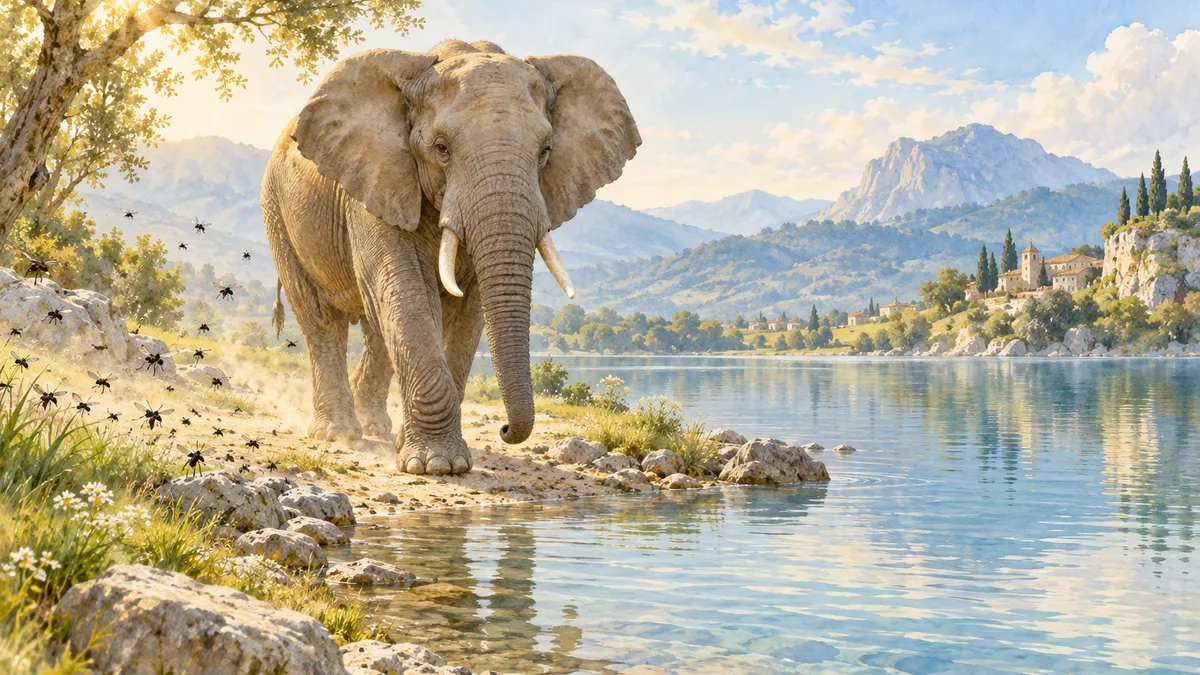
It is said that when an elephant goes to drink, all the insects scatter in terror. The elephant does not even intend to frighten the insects; it does not think, “Well, I’ll teach them a lesson now!” It is simply going to drink water; it does not even see them or suspect that they exist.
In the same way, Varuna’s royal position and power consist in the fact that as soon as we turn our attention to infinity, all the obscured states and kleshas that tormented us or prevented the mind from being at peace are instantly pacified.
Varuna’s Thousands of Healers
“Using another image, the Veda tells us that this king has a thousand healers in his service, and because they heal our mental and moral ailments, we gain a firm foundation in Varuna’s righteous and boundless being.”

What are these thousands of healers in Varuna’s service? They can be listed.
They are:
discriminating wisdom;
clarity bestowed by natural contemplation;
the inspiration of divine pride that arises as a result of shambhavi mudra;
the self-liberation of thoughts, emotions, and kleshas;
the experience of various creative powers that arise in our stream solely because we turn our attention to this boundless state;
flawless awareness that enables us to understand any phenomena.
All of these are Varuna’s healers—that is, the antidote that naturally ignites in the mind as soon as we turn our attention to the essence of the infinite and beginningless within us. Even if you are in an angry state and turn your attention to the infinity within yourself, you will find your anger amusing; the anger will become nothing more than a game.
Think about it: one person in a small body becomes angry with another person in a small body, while somewhere right now our entire solar system is no more than a speck of dust in the galaxy, and the entire galaxy is no more than a speck of dust in the universe. And the period of time during which we live is no more than a momentary flash during Brahma’s day or during our manvantara, in terms of time. Everything will turn to dust in a billion years; no one will even guess that this lecture may once have existed, that there were people who engaged in this, or that they had feelings. And a billion years for Brahma is an entirely imperceptible span; he does not even see such periods of time as intervals, they are so very small. And if you think from the perspective of infinity, your attachments and emotions disappear at once.
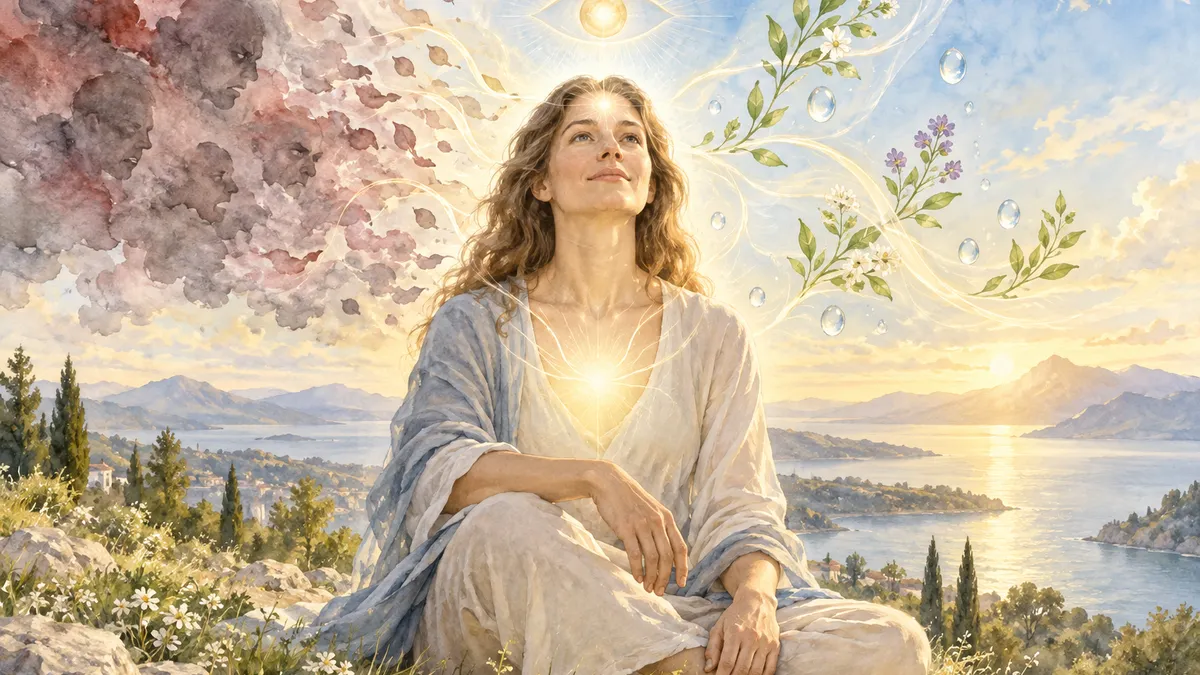
Varuna’s Royal Status and Universal Power
“The royal status of the great Varuna signifies his unlimited supreme power over all that exists. He is the mighty lord of the world, an autocrat. Varuna possesses vastness and the entire diversity of forms and manifestations; among his customary epithets are: boundless, abundant, he whose dwelling is vastness, he who has many births. But his mighty being encompasses not only universal immensity, but also universal strength and power.
“Neither these birds in their flights, nor these waters rushing sleeplessly, nor those who take shelter in the vastness of the wind can attain your strength, and power, and passion.”
This is the power of universal existence, which moves all-encompassingly and acts in everything that lives. And behind this vast universal force and boundless being, observing everything, acts the infinite universal knowledge.”
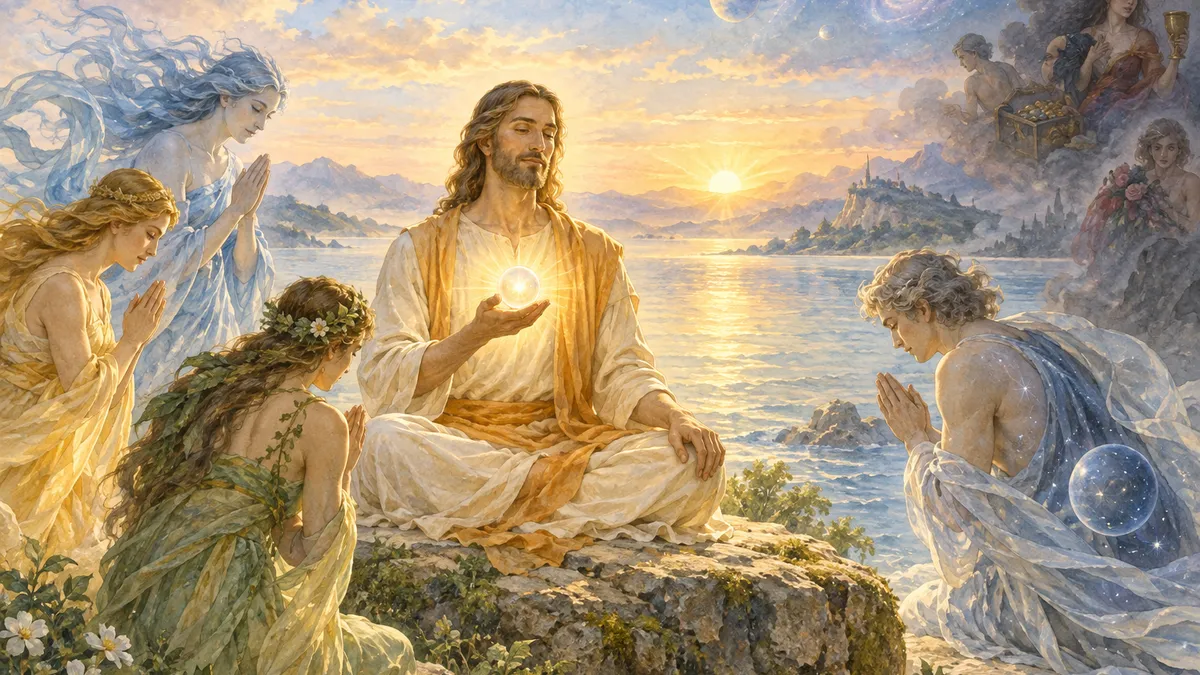
Thus, Varuna is also strength and power. The practice of the natural state only appears subtle; in reality, it makes you a shaktiman—the master of shakti. Little by little, the principle of awareness reveals itself as boundless bhava, calling forth, pacifying, and subjugating any forces of the universe. When this boundless bhava is discovered, the universal forces themselves begin to come to the yogin with their hands folded in namaste, asking: “How can we serve you?”
Why do they come to the yogin? Because the yogin has earned the right to this; he has received a divine artifact—the pearl of awareness. But if the pearl of awareness has not been revealed and the yogin does not possess it, then, of course, the divine forces will not come to him with their hands folded in namaste and ask: “How can we serve you?” On the contrary, they will send their beguiling aspects and say: “How can you serve us?” (through worldly desires).
A yogin becomes a shaktiman when he establishes himself in shambhavi mudra and in bhava as the center of his being, and never leaves it.
The Trials of Divine Beings
Divine beings often view people with skepticism when they see how humans practice. On the one hand, they know that human existence is precious, and many of them would have preferred it in order to attain liberation. Life in a human body, unlike the life of gods in the heavens of passion, makes it possible to attain liberation in a short time. On the other hand, being proud, they look at people with skepticism, thinking: “What can these mortals do? What kind of power of consciousness do they have, what creative powers, what will? Why, they are merely inferior beings.”
And when a yogin begins to practice, they do not immediately accept him as a shaktiman; instead, they test him. First, they give him the opportunity to prove himself by tempting him with various experiences, abilities, or even worldly blessings, thinking: “Let us give him a worldly blessing and see how he responds to it.”
And when a person strives either to become a monk or moves toward liberation, he is given the opportunity to receive this worldly blessing: wealth, fame, or honor come to him, and he becomes very famous. All of this is, in fact, a test from the worldly devas.
Someone with fewer merits receives some difficulties instead of worldly blessings, in order to test his will and strength of character.
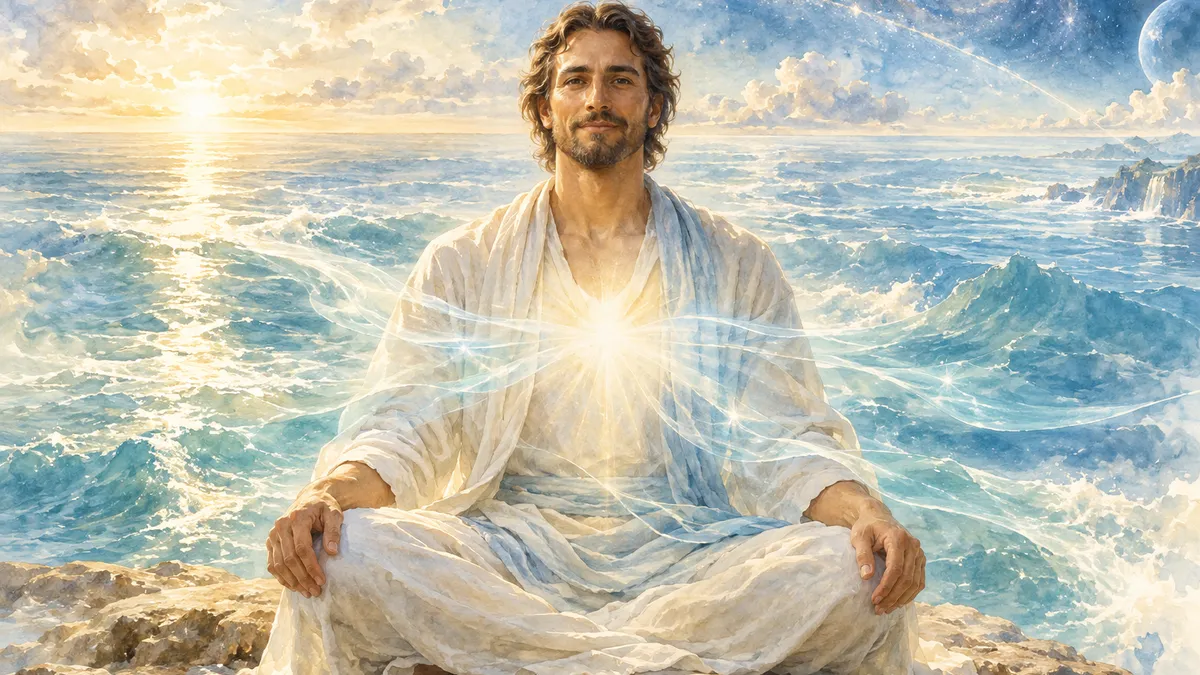
“Varuna possesses many energies embodying heroic power, as well as the capacity for broad expression inherent in a thinker. He comes to us as a deity of grandeur and strength, but at the same time we recognize in him a spirit of broad vision. Varuna rules both himself and the entire world. In a human being, he manifests as the sovereignty of thought and action, the fullness of wisdom and will.
Gained through the deity, through Varuna, ‘the almighty, the omniscient, whose vision is thousandfold, whose form is truth,’ these qualities raise us to the level of the highest and universal principles of existence. Divine and eternal grandeur unfolds before us, the boundlessness of consciousness and the immeasurability of power, omnipotent wisdom, omniscient force, an established law, and truth fulfilled.”
