The Importance of Serving the Guru: Lessons from the Shri Guru Charitra
22.06.2026
0 мин. чтения
0
Share
copy
search
add
share
Commentary on the text “Sri Guru Charitra”
Continuation of the text “Sri Guru Charitra.” The story of Dattatreya’s incarnation in the form of Narasimha Saraswati.
The Story of the Brahmin Muni and the Importance of Serving the Guru
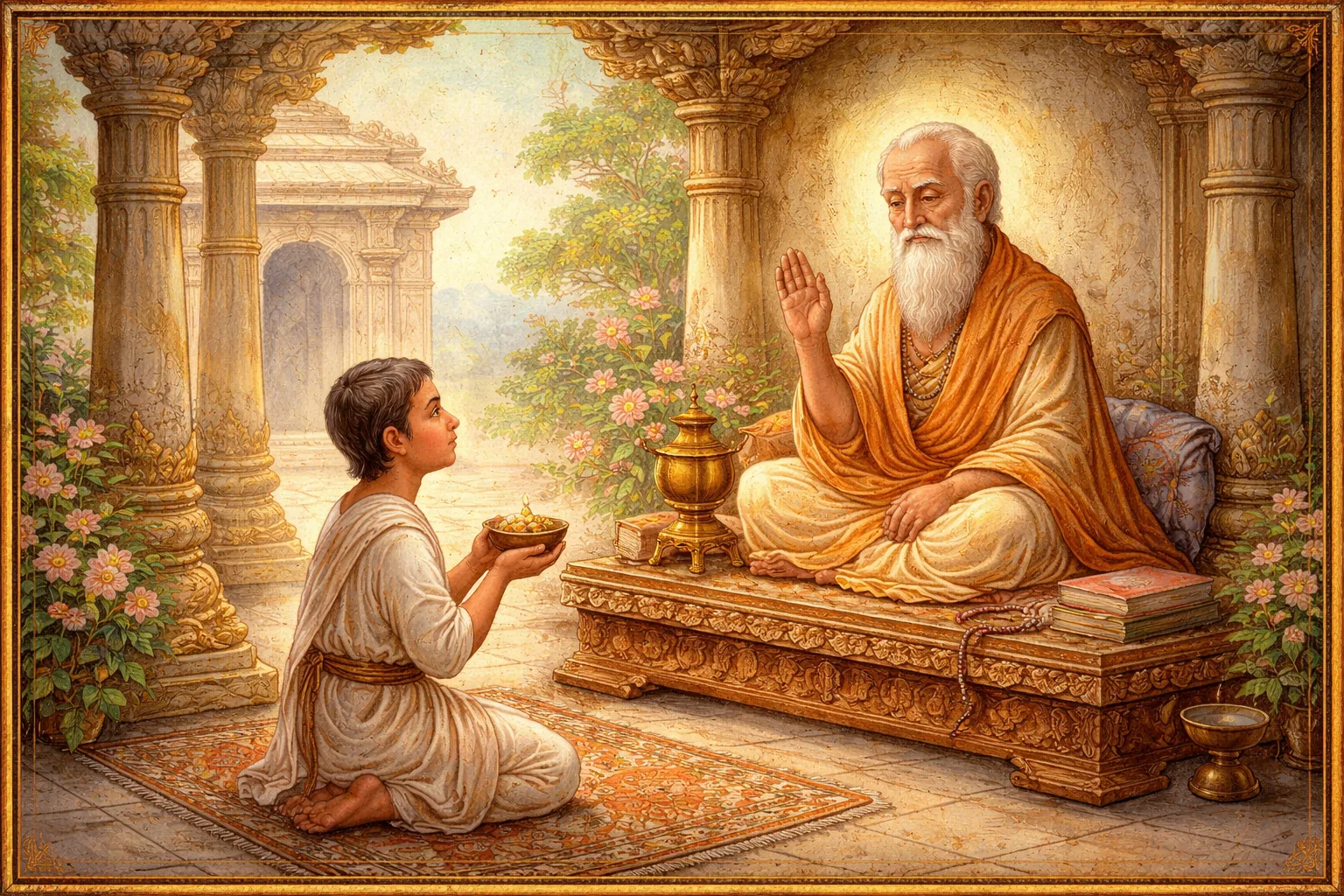
Once a Brahmin Muni came to Vaijanath. He prostrated before the guru with devotion and said, “Liberate me. I have not attained enlightenment, although I have practiced austerity. My mind has been purified by your darshan.”
The guru said, “How can you become a muni without a guru?” Muni said sadly, “I had a guru, but he was very harsh with me. I stayed with him for a very long time, but it was useless. He spoke very harshly, and I left him and came here.” Hearing such words, Sri Guru became angry and said, “You are harming yourself. You do not take into account your own mistakes and your bad behavior. One who deceives the guru will not receive knowledge. You will receive neither happiness now nor liberation in the future, because you have left the paramguru.”
Muni said, “O Jagad Guru, how can I, an ordinary person, know about the guru? How can I serve him? Be so kind to me, tell me.” Then Sri Guru told him the following story.
The Story of Rishi Daumya and the Three Disciples
Aruni’s Test
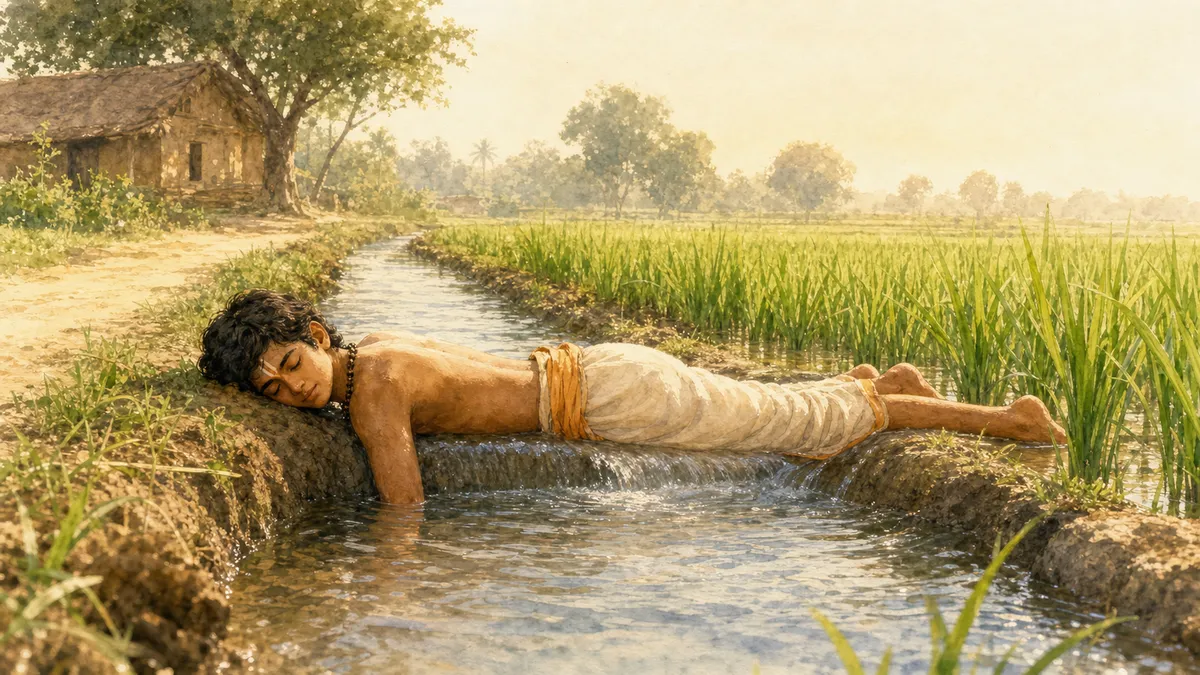
Long ago there lived a rishi named Daumya, and he had three disciples named Aruni, Baida, and Upamanyu. The rishi taught them the Vedas. He gave them as much knowledge as they could receive. One day the rishi wanted to test the disciples. He called Aruni and told him to water the rice fields. When Aruni came to the fields, he saw that there was little water in the canal and that it could not reach the plants. Aruni began to think about what he could do. He tried to place large stones in the stream to raise the water level. But the current was so strong that the stones were carried away. He tried other methods, but the water did not reach the fields. Finding no other solution, he performed smarana of the guru and God, and threw himself into the stream to block the current and raise its level. Immediately the water flowed over him and reached the rice fields. The fields turned green.
Since Aruni had not returned by evening, Daumya Muni himself went to the fields. He was pleased to see the well-watered fields. But he did not see Aruni anywhere and became worried. He called, “Aruni, where are you? Come here quickly.” As soon as he heard the guru calling him, Aruni climbed out of the water and prostrated before the guru. When the guru learned everything that had happened, he was very pleased with Aruni and said to him, “You have fulfilled your mission. Today you have surpassed all the Vedas.” With these words he blessed him, brought him to the ashram, and said, “You have received all knowledge. Now return to your home, enjoy family life, and be happy.
What is meant here is training as a brahmachari in preparation for the life of a grihastha. Why did he say, “Enjoy family life”? Because he was not a monk; this was not a monastic ashram.
The Tradition of Varna-Ashrama Dharma
According to the tradition of varna-ashrama dharma, in ancient India a child at about the age of seven was sent to the guru’s house for training, becoming a brahmachari. There, until reaching adulthood, he studied the Vedas, grammar, the basics of yoga, the Puranas, certain specialized disciplines, and engaged in service. That is, it was a kind of primary and secondary school.
After reaching adulthood, according to the principles of varna-ashrama dharma, he was to become a grihastha and fulfill family duties while continuing practice, ritual purifications, the reading of the Vedas, and so on.
Finally, when he reached mature age (over fifty), he was to become a vanaprastha, that is, one retired from affairs. By this time he had married off his children, he had a stable position, and he could leave his wife, knowing that the children would provide for her, and so he simply retired from affairs, becoming a hermit, but still in the world. He settled nearby or in a room adjacent to the house and began to practice japa, meditation, and reading texts, while his wife brought him prasada (like a retreat). Such vanaprastha hermits had different categories—kutichaka, bahudaka, parivrajakacharya.
Finally, when he had passed through the stage of purification in the vanaprastha ashram and prepared himself for the life of sannyasa (closer to the age of seventy), according to varna-ashrama dharma he was to withdraw completely from the world, accept the status of a sannyasi, and thus, as it were, die to this world. Forgetting home, wife, and children, he was to become a mendicant wandering ascetic and travel, having received initiation in accordance with the rules of the sannyasa order of that time. And when his life was nearing its end, he was to wander continuously, heading north. In such wandering he would leave the body.
This was usually the traditional path of a sannyasi, although there were different schools of sannyasa. Some chose hima-samadhi, that is, they went to the mountains, to the Himalayas, in order to leave the body there in samadhi. Some chose ganga-samadhi, that is, they entered samadhi in the Ganges, immersing themselves under water. But in any case, the principle of sannyasa meant the complete abandonment of all attachments of this world.
Other sannyasis lived at mathas, ashrams, that is, at monasteries. Beginners were like ordinary novice monks, similar to our novice monks. And those who had already attained a certain realization were called sannyasi-avadhutas, living in monasteries and ashrams. They were either servants at temples or lived as hermits in nearby caves at the monasteries.
Baida's Trial
Then the rishi called his second disciple Baida and said to him: “Go to my fields, guard them day and night, then bring the harvest to the ashram.” Baida went to the fields and guarded them day and night. After some time, the harvest was ready. He returned to the ashram and asked the Guru how to deliver the harvest. The Guru said: “Take a cart and a buffalo.” Then Baida took the cart, loaded the entire harvest onto it, and harnessed the buffalo to it. But the load was so heavy that the buffalo could not pull it. Then Baida tied a rope around his own neck and began to pull the cart. The rope was like a noose around his neck, and he began to experience severe pain. When Daumya saw through his inner vision that Baida was suffering, he went to him, removed the rope from his neck, and said: “You will receive all Vedic knowledge.” He praised him and bestowed gifts upon him. Baida went home with the Guru’s permission.
Upamanyu's Trial
Daumya then called the third disciple, Upamanyu, who knew how to serve the guru but was a glutton and therefore could not acquire knowledge. The Guru said to him: “Take the cows to graze every day.” The disciple began taking the cows to graze, but he returned home early because he was hungry. Therefore Daumya said to him: “Do not return until evening.” Upamanyu, feeling hungry at noon, went to the ashrams of the brahmins, asked for food, and ate it. Then he returned home. After some time, the rishi asked him: “How is it that you look so strong, although you fast every day?” Then the disciple told him everything. Daumya said: “How can you eat without me? From now on, bring bhiksha (alms) to the ashram, then take the cows into the forest and come home in the evening.”
As the guru commanded, Upamanyu began bringing alms to the ashram. But he felt hungry, so he went for alms to several houses and ate that food. He became even stronger than before. Finally, the guru asked him: “How is it that you are becoming stronger and stronger day by day?” Upamanyu replied: “I bring the first bhiksha home, then I receive a second bhiksha and eat it myself.
Apparently, it was thicker there.
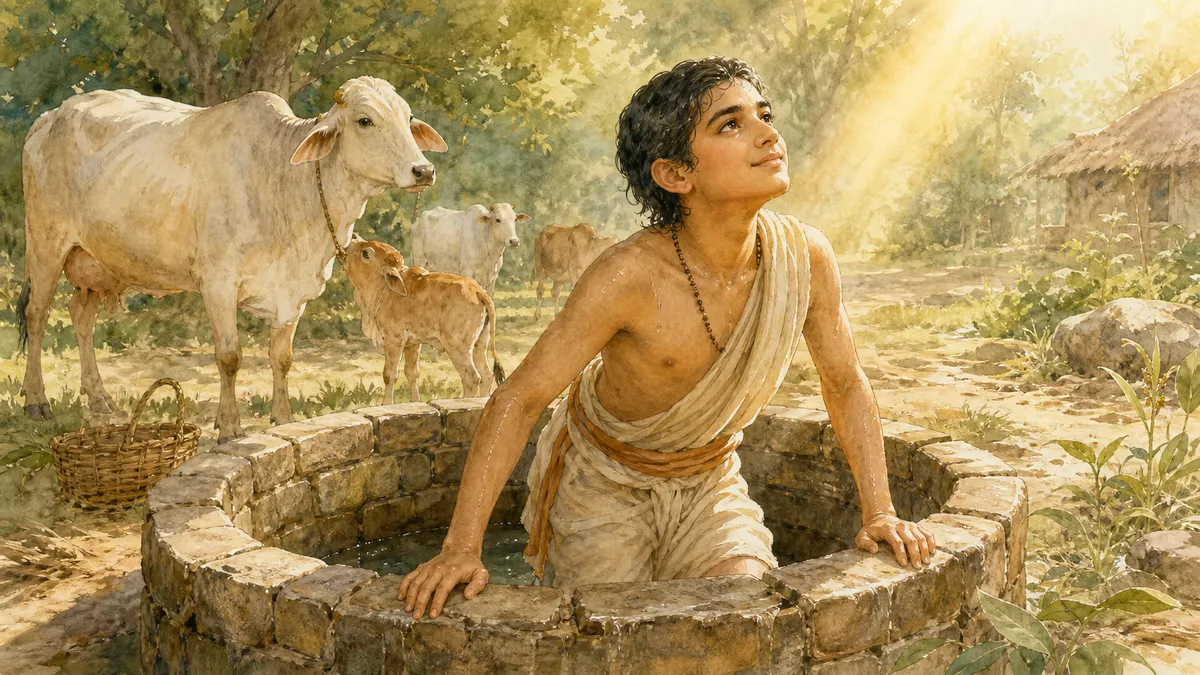
Daumya became angry and ordered him to bring that bhiksha to the ashram as well. Upamanyu began bringing two bhikshas to the guru’s house, but he was not at all saddened by not eating the food from the bhiksha. When the cows fed their calves, some of the milk spilled past the calves’ mouths, and Upamanyu drank it and satisfied his hunger. The Guru learned of this and said to him: “If you drink such leftover milk, your mind will become dull.” Therefore, the next day, when he became hungry, he drank the milky sap of a certain kind of cactus. As he drank it, the sap got into his eyes, and he went blind. He could not see the cows and fell into a well. Since Upamanyu did not come home for a long time, Daumya Muni went into the forest to look for him. When he saw the disciple’s distress, he told him to chant the Ashvini mantra. Upamanyu chanted the mantra and regained his sight. He climbed out of the well, bowed to the guru, and the guru blessed him.
Thus, the guru’s grace works. With the guru’s blessing, anyone can receive all knowledge.
Repentance and Forgiveness
Narasimha Saraswati said to the muni: “Go to your guru and serve him.” The brahmin felt remorse and said: “I have hurt my guru. How can peace be restored in his mind? I am guilty. I will end my life.” The Guru was pleased with such words of repentance and said: “Your repentance has washed away your sins. Fix your mind on the guru, concentrate on him.” He placed his hand on his head as a sign of protection and blessed him. Thus the brahmin received all knowledge, freedom, and enlightenment.
Read 18 times
Articles
Vidya AI
Search
Lectures
November 5, 2026
Mantra of the day
ОМ ЭКАЙА НАМАХ ОМ Единому – поклонение!
Auspicious Times(Rome)
Brahma Muhurta:
04:56 - 05:51
Abhijit Muhurta:
11:33 - 12:14
Sayam Sandhya:
16:40 - 17:21
Mokshada Ekadashi (6 November)
Ekadashi of liberation. Helps to achieve spiritual enlightenment.